Quick AnswerGrocery store license Dubai 2026: open a baqala for AED 18,000–40,000+. DET licence, Dubai Municipality food approvals, Ejari, visas and full steps.
Your setup cost, in 10 seconds
Package prices. Health insurance is required by law and not included.
Thank you.
Your written quote follows on WhatsApp.
How much does a grocery store license in Dubai cost in 2026?
Opening a grocery store (baqala) in Dubai in 2026 typically costs between AED 18,000 and AED 40,000 or more in the first year for the licence and government approvals, with the exact figure driven by location, shop size, the trade activities you choose and the number of staff visas you need. That budget covers the Department of Economy and Tourism (DET) commercial licence, trade name and initial approval, Dubai Municipality food-trade approval for the premises, Ejari tenancy registration and immigration establishment cards. Shop rent is separate and is usually the single largest line item. A small convenience baqala can launch on a modest budget, while a full supermarket with fresh produce, butchery and bakery sections runs considerably higher.
At Noble Core Ventures we help founders open grocery stores across Dubai every month, and the single biggest lesson is that the licence is the easy part. The real work is choosing the right retail unit, passing the Dubai Municipality food-safety inspection, and building a layout that lets you legally sell everything from packaged staples to fresh meat. This guide walks through the cost, the steps, the authorities involved and the mistakes that cost first-time grocers the most time and money. Whether you are planning a corner-shop baqala in a residential cluster, a minimart near an office tower, or a neighbourhood supermarket, the path is the same in structure and differs only in scale.
What exactly is a baqala, and why grocery retail is a smart Dubai play
The word "baqala" is everywhere in Dubai's residential life. It is the Arabic term for the small grocery or convenience store that sits at the base of an apartment block or on the corner of a villa community, stocking bread, milk, eggs, water, snacks, household basics and the everyday items people run out of. Across Dubai's densely populated communities, the baqala is a daily-need business: customers come back several times a week, the demand is recession-resistant, and a well-located shop can build a loyal base quickly because convenience and proximity beat price for a lot of small purchases.
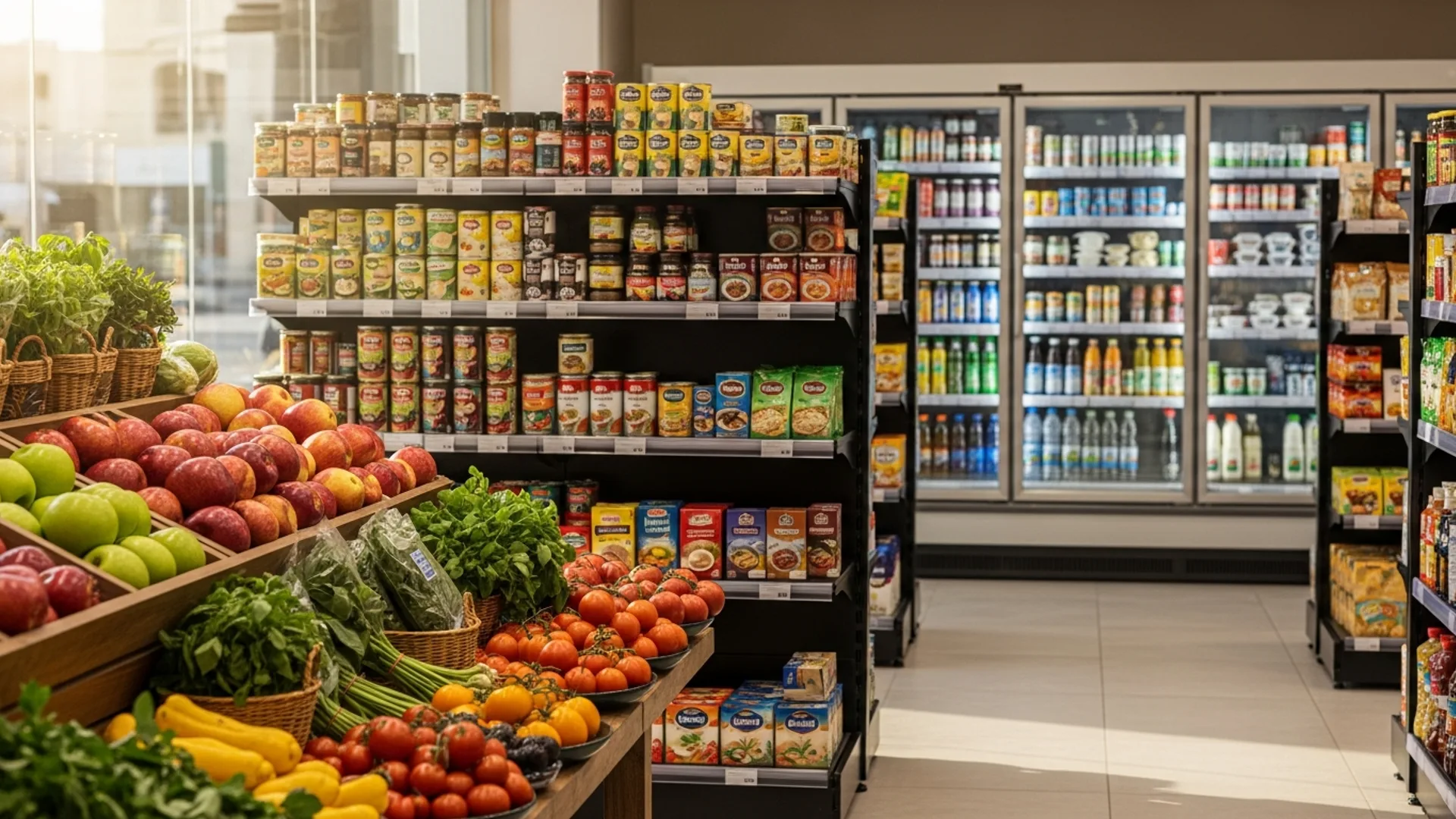
It helps to understand the spectrum of grocery formats before you decide what to build, because the licence, the rent and the operational complexity all scale with format. At the smallest end is the baqala, a compact convenience store of perhaps thirty to eighty square metres focused on fast-moving everyday goods. A step up is the minimart, slightly larger, carrying a broader assortment including some chilled and frozen items, basic fresh produce and a wider range of household goods. At the top end is the supermarket, a full grocery operation with fresh fruit and vegetables, a butchery or meat counter, a bakery, dairy, frozen aisles and a deep packaged-goods range. All three are licensed the same way at their core; what changes is the number of trade activities on the licence, the floor area you lease, the staff you hire, and the stringency of the food-safety requirements you must satisfy.
The reason grocery retail remains attractive in Dubai is structural. The emirate's population keeps growing, new residential towers and communities keep opening, and every cluster of homes generates demand for daily provisions within walking distance. Unlike trend-driven retail, food and household basics never go out of fashion. The flip side is that grocery is an operations business with thin per-item margins, so your profitability is decided by footfall, supplier terms, stock management and the discipline of your fit-out and staffing. Getting the setup right from day one — the location, the licence activities and the municipality approvals — is what separates a baqala that thrives from one that struggles to cover its rent.
The two pillars: your DET commercial licence and Dubai Municipality food approval
Every legal grocery store in Dubai rests on two pillars, and understanding both early saves you weeks of rework. The first pillar is your trade licence, issued by the Department of Economy and Tourism, which is the modern name for the body many people still call the DET. The licence you need is a commercial licence carrying retail trade activities — typically grocery store, sale of foodstuff, or foodstuff trading, with related activities added depending on your product range. This licence is what legally establishes your company and authorises it to trade in Dubai. The DET licence is renewed annually, and it is the document banks, suppliers and landlords will ask to see.
The second pillar is food-safety approval from Dubai Municipality. Because a grocery store sells and stores food, the premises themselves must be approved as fit to handle food, separately from the company licence. Dubai Municipality is the authority responsible for food safety across the emirate, and it regulates everything from storage temperatures and refrigeration to pest control, ventilation, surface finishes, waste handling and staff hygiene. Before your shop can open to the public, the municipality reviews your layout, checks that your fit-out meets its food-safety code, and inspects the premises. Only once it is satisfied does the food-trade approval issue. This is why the order of operations matters so much: you cannot finish your licence and then discover your shop fails inspection. The layout and the approvals have to be designed together.
These two pillars interact through a third element, your tenancy. To get a mainland licence for a physical shop, you need a registered lease, and in Dubai that means an Ejari tenancy contract registration. Ejari is the official system that records and authenticates rental agreements, and the DET will require your Ejari before finalising the licence on a physical address. The municipality, in turn, ties its food approval to that specific premises. So your shop unit sits at the centre of everything: the lease feeds Ejari, Ejari feeds the licence, and the premises feed the municipality approval. Choose the wrong unit — too small for your visa quota, in a building that does not permit food retail, or in a layout that cannot meet food-safety standards — and every downstream step inherits the problem.
Step-by-step: how to open a grocery store in Dubai
The path to opening a baqala follows a logical sequence, and while a good consultant can run several stages in parallel, it helps to understand each one so you know what you are paying for and what can go wrong. The first stage is defining your business activity and legal structure. You decide whether you are opening a small baqala, a minimart or a supermarket, and you select the precise DET activities that match — grocery, foodstuff trading, and any specialised activities such as fresh meat or bakery if your format includes them. Most single-owner grocery stores are set up as a limited liability company, which, as of 2026, generally allows full foreign ownership for retail activities on the mainland without an Emirati partner, though you should confirm your specific activity's ownership rule before you proceed.
The second stage is reserving your trade name and securing initial approval from the DET. The trade name is the legal name of your company; it must follow Dubai's naming rules, avoid restricted words, and not duplicate an existing name. Initial approval is the government's preliminary no-objection to your business activity and structure, and it lets you proceed to the next steps with confidence that your concept is acceptable. At this point your company exists on paper but does not yet have premises.
The third and arguably most important stage is finding and leasing your shop. This is where founders should spend the most time. You are looking for a retail unit in a building or community zoned for food retail, with the right footfall, accessibility, parking or pedestrian flow, and enough floor area to support both your product range and your visa quota. Once you agree terms with the landlord and sign the tenancy, you register it through Ejari. The registered Ejari contract is then submitted to the DET, which can finalise your licence against that physical address. Simultaneously, you begin the Dubai Municipality process, submitting your shop layout for food-safety review so the fit-out is built to standard rather than corrected afterward.
The fourth stage is the fit-out and food-safety approval. You build out the shop — shelving, refrigeration, cold rooms if you stock chilled and frozen goods, hygienic flooring and wall finishes, proper ventilation, a back-of-house storage area, and any specialised sections such as a meat counter or bakery. Dubai Municipality inspects the completed premises against its food-safety requirements, and once it is satisfied, it issues the food-trade approval that legally permits you to sell food from that location. The fifth stage is opening your corporate bank account, registering with the immigration authorities for your establishment card, and processing staff visas. Visas are applied for through the General Directorate of Residency and Foreigners Affairs and the ICP, and employment relationships are registered with MOHRE, the Ministry of Human Resources and Emiratisation, which governs labour contracts and worker protections.
The final stage is tax and compliance registration and then opening for business. Depending on your projected turnover, you assess your obligations with the Federal Tax Authority for VAT, since registration becomes mandatory above the prescribed turnover threshold and is voluntary above a lower threshold. As of 2026, you should verify the current thresholds before relying on them, because they can be updated. With the licence in hand, the food approval secured, the premises fitted out, the staff visas issued and your tax position settled, you can stock the shelves, set your pricing, and open your doors. For an official starting point on company formation procedures, founders can consult the Dubai Department of Economy and Tourism, the authority that issues commercial licences, which explains the local framework behind Dubai's grocery licensing process.
What a grocery store license actually costs in 2026
Cost is the question every founder asks first, and the honest answer is that it varies more for a grocery store than for almost any other small business, because the licence is a relatively small and predictable part of a much larger setup. The licence and government fees — the DET commercial licence, trade name, initial approval, market fees, Ejari registration and immigration establishment cards — are reasonably stable. The variable that swings your total is the shop itself: rent, fit-out and refrigeration. A modest baqala in an outer residential cluster will cost a fraction of a full supermarket in a high-footfall community, and the difference is almost entirely premises-driven rather than licence-driven.
The table below sets out indicative 2026 ranges to help you build a realistic budget. Treat these as planning figures only. Government fees change, free zones and the mainland price differently, and your final number depends on your activities, your shop size and your visa count.
| Cost component | Indicative 2026 range (AED) | Notes |
|---|---|---|
| DET commercial licence + trade name + initial approval | 12,000 – 20,000 | Core mainland licence with grocery/foodstuff activities |
| Dubai Municipality food-trade approval | 1,000 – 5,000 | Premises food-safety approval; varies by format |
| Ejari tenancy registration | 200 – 1,000 | Official rental contract registration |
| Immigration establishment card + setup | 1,500 – 4,000 | Needed before sponsoring staff visas |
| Staff visa (per visa, all-in) | 4,000 – 8,000 | Quota tied to shop size; multiply by headcount |
| Shop rent (annual) | 30,000 – 250,000+ | Largest variable; depends on size and location |
| Fit-out, shelving and refrigeration | 30,000 – 300,000+ | Scales sharply with fresh and frozen sections |
Indicative — confirm current fees with the authority. The pattern to notice is that the licence and approvals are the smaller, more predictable end of your budget, while rent and fit-out dominate the total and scale dramatically with format. A bare-bones baqala selling packaged and ambient goods needs little refrigeration and modest fit-out, so a founder can launch on a comparatively tight budget. The moment you add chilled dairy, frozen aisles, a fresh produce section, a meat counter or an in-store bakery, your refrigeration, cold-room and equipment costs climb steeply and your municipality requirements get stricter. This is why we always advise founders to decide their final product range before signing a lease or starting a fit-out, so the premises are built once, correctly, for the format they actually intend to run.
Choosing the right location: the decision that makes or breaks a baqala
If the licence is the easy part, the location is the hard part, and it is also the part that determines whether your grocery store earns money. A baqala lives or dies on convenience, which means proximity to homes, ease of access and visibility. The ideal unit sits where residents pass it naturally on their daily routine — at the base of a tower, on a community high street, near a school run, or on a corner that catches foot traffic from several buildings. Footfall is everything: a slightly more expensive unit on a busy corner usually outperforms a cheaper unit tucked away where nobody walks past.
Beyond footfall, you have to confirm that the building and community actually permit food retail. Not every commercial unit is zoned or fitted for a grocery, and some residential developments restrict the types of business that can operate on the ground floor. Before you fall in love with a unit, verify that food retail is allowed there, that the landlord can provide a tenancy that supports an Ejari registration, and that the utilities — particularly the power supply for refrigeration — are adequate. A grocery with significant chilled and frozen sections draws meaningful electricity, so a DEWA connection sized for your refrigeration load is something to confirm rather than assume. Underestimating your power requirement is a classic cause of post-opening problems.
Floor area deserves special attention because it does double duty. It sets how much product you can display and store, and it also caps how many staff visas you can sponsor, since immigration ties your visa quota to the square metres on your Ejari. If you intend to run a shop that needs four or five staff across opening hours, you need a unit large enough to justify that quota. Lease too small a space to save on rent and you may find you cannot sponsor the team you need to keep the shop staffed. Conversely, leasing far more space than your format requires burns cash on rent you cannot monetise. The right answer is a unit sized for both your product range and your realistic staffing plan, in a location where the footfall justifies the rent. Spend your time here; it is the highest-leverage decision in the whole project.
Staffing, visas and the people side of a grocery store
A grocery store is a labour business. It needs to be staffed across long opening hours, often from early morning until late at night, and the team handles everything from stocking shelves and operating the till to receiving deliveries and maintaining hygiene standards. Your visa planning therefore has to match your operating reality. Once your tenancy is registered and your establishment card is issued through the immigration system, you can begin sponsoring staff visas. These are processed via the General Directorate of Residency and Foreigners Affairs and the ICP, and each employee's contract is registered with MOHRE, which administers the UAE's labour framework, wage protection and worker entitlements.
The practical constraint is the link between visa quota and shop size. Because the number of visas you can sponsor is tied to the floor area on your Ejari, you cannot simply hire as many people as you like; you size the team to the quota the premises support, and you size the premises to the team you need. For a small baqala running with a lean rotation, two to four staff may be sufficient. A larger minimart or supermarket with multiple departments and longer shifts needs more, and the floor space has to support that quota. Plan this before you sign the lease, not after, because changing premises to fix a quota shortfall is expensive and disruptive.
Beyond the mechanics of visas, there is the compliance side. Food-handling staff in a grocery environment are expected to meet Dubai Municipality hygiene standards, and depending on your sections — particularly fresh meat or bakery — some roles need food-handler training and health checks. Building a culture of cleanliness and proper food handling is not just regulatory box-ticking; it is what keeps your municipality approval in good standing through routine inspections and what protects your customers and your reputation. The grocers who last treat hygiene and staff training as core operations, not afterthoughts, and they keep their documentation — contracts, health cards, training records — organised so an inspection is never a scramble.
Tax, banking and ongoing compliance
Once you are licensed and trading, a grocery store carries the same ongoing obligations as any UAE retail business, and staying on top of them is what keeps your licence renewable and your operation clean. The first is your corporate bank account. Banks will want to see your trade licence, your Ejari, your shareholder documents and a clear description of your business, and grocery is a well-understood, low-risk retail activity that banks are generally comfortable with. Opening the account early lets you receive supplier credit terms, accept card payments and manage cash properly from day one.
On tax, two regimes are relevant. The first is Value Added Tax, administered by the Federal Tax Authority. VAT registration is mandatory once your taxable turnover exceeds the prescribed threshold and voluntary above a lower threshold, and a grocery store with steady turnover will commonly cross into mandatory registration. As of 2026, you should verify the current VAT thresholds with the Federal Tax Authority before relying on them, because they can be revised. Many grocery products attract VAT, and your point-of-sale and accounting systems need to handle it correctly, charging the right rate and keeping records that support your periodic returns. The second regime is corporate tax, the federal business-profits tax that applies across the UAE. As of 2026, businesses assess their corporate tax position against the prevailing rules and thresholds, and again you should confirm the current treatment and any small-business relief with the authority or your advisor rather than assuming, since the framework continues to mature.
Beyond tax, your ongoing compliance includes renewing the DET licence annually, maintaining your Dubai Municipality food approval through routine inspections, keeping your Ejari current, renewing staff visas on time, and keeping your trade activities aligned with what you actually sell. If you decide to add a category — say you started as a packaged-goods baqala and now want to add a fresh meat counter — you must add the relevant activity to your licence and meet the additional municipality requirements before you start selling it. Compliance in a grocery store is continuous rather than a one-time event, but it is entirely manageable with a simple calendar of renewals and a tidy document file, and it is the foundation that lets you focus on the part that actually grows the business: serving your neighbourhood well.
Common Mistakes to Avoid
The most common and expensive mistake first-time grocers make is signing a shop lease before confirming that the building permits food retail and before designing the fit-out to Dubai Municipality standards. Founders fall in love with a unit because the rent is attractive or the corner looks busy, sign the tenancy, and only then discover the layout cannot meet food-safety requirements, the power supply is inadequate for refrigeration, or the community restricts grocery use. By then they are committed to rent and a deposit. The fix is simple discipline: verify food-retail permission, utility capacity and layout feasibility before you sign anything, and have your municipality requirements mapped before the fit-out begins.
A second frequent error is under-sizing the shop relative to the staff you need. Because visa quota is tied to floor area on your Ejari, leasing too small a unit to save on rent can leave you unable to sponsor enough staff to run the shop across its long hours. Founders then face the painful choice of operating understaffed or breaking a lease to move. Size the premises to both your product range and your realistic staffing plan from the outset.
A third mistake is choosing the wrong trade activities, or too few of them, on the DET licence. Grocers sometimes register only a basic foodstuff activity and then find they cannot legally sell fresh meat, run a bakery or handle certain product categories. Each of those needs the correct activity on the licence and the corresponding municipality approval. Map your full intended product range before licensing, add the right activities up front, and you avoid the cost and delay of amending the licence and re-inspecting the premises later.
A fourth error is treating Dubai Municipality food-safety approval as a formality rather than a design input. The fit-out — refrigeration, cold storage, finishes, ventilation, separation of raw and ready-to-eat goods — has to be built to the food-safety code from the start. Building first and seeking approval afterward almost always means tearing out and redoing work, which is slow and costly. Engage with the municipality's requirements while you design, not after you build.
A fifth and underrated mistake is neglecting tax and accounting setup in the rush to open. Grocery is a high-volume, many-small-transactions business, and without a point-of-sale and accounting system that handles VAT correctly from day one, founders end up with messy records that make Federal Tax Authority returns painful and obscure whether the shop is actually profitable. Set up clean systems before you open, register for VAT when you cross the threshold, and confirm your corporate tax position early. The grocers who avoid these five mistakes are the ones who open on time, on budget, and on the right side of every authority.
Bringing it together
Opening a grocery store or baqala in Dubai in 2026 is a well-trodden path, and the structure is the same whether you are building a small corner shop or a full supermarket: secure a DET commercial licence with the right grocery activities, lease and register a suitable shop through Ejari, win Dubai Municipality food-safety approval for the premises, sponsor your staff through the immigration authorities and MOHRE, and settle your tax position with the Federal Tax Authority. The licence and approvals are predictable; the rent, the fit-out and the location are where the real money and the real decisions sit. Get the location right, build the premises to food-safety standard the first time, choose the correct trade activities up front, and size the shop to your staffing needs, and you give your grocery the best possible foundation to serve its community and turn a profit.
At Noble Core Ventures, we guide founders through every stage of this process — from selecting activities and reserving the trade name, to navigating Dubai Municipality approvals, registering Ejari, processing visas and getting tax-ready — so you can focus on the part that matters: stocking the shelves and opening your doors. If you are planning a baqala, minimart or supermarket in Dubai, the difference between a smooth launch and a costly stumble is almost always the quality of the planning before the lease is signed. Plan well, and a Dubai grocery store can be one of the most resilient, daily-need businesses you can own.
Talk to Our Experts
opening a grocery store or baqala in Dubai
Frequently Asked Questions
How much does a grocery store license in Dubai cost in 2026?
As of 2026, a grocery store (baqala) licence in Dubai typically costs between AED 18,000 and AED 40,000 or more in the first year, depending on the location, the size of the shop, the trade activities you add, and the number of visas you need. The figure covers the DET commercial licence, trade name and initial approval, Dubai Municipality food-trade approvals, Ejari tenancy registration and immigration establishment cards. Rent for a suitable retail unit is a separate and often larger cost. Always verify current fees with the authority before budgeting.
What is a baqala and do I need a special license for one?
A baqala is the Arabic word for a small neighbourhood grocery or convenience store, the corner shops found across Dubai’s residential communities. There is no separate licence category literally called baqala; you open one under a standard DET commercial licence with retail trade activities such as grocery, foodstuff trading or sale of foodstuff. Because you sell and store food, you also need Dubai Municipality food-safety approval for the premises. The combination of a commercial licence plus municipality food approval is what legally lets you operate a baqala.
Can I open a grocery store in Dubai as a foreigner with 100% ownership?
Yes. Grocery retail is a commercial activity that, as of 2026, generally allows full foreign ownership on the Dubai mainland under the amended Commercial Companies Law, so you no longer need a 51% Emirati partner for most retail activities. You can also open a grocery operation inside certain free zones, though free zones suit warehousing and distribution more than a walk-in neighbourhood shop. Ownership rules can change by activity, so confirm your specific activity code with the DET or your consultant before you commit.
What approvals does Dubai Municipality require for a grocery store?
Dubai Municipality regulates the sale and storage of food, so any grocery store needs food-trade approval. This usually means submitting your shop layout for review, ensuring proper storage temperatures, pest control, ventilation and hygienic finishes, and registering the premises through the municipality’s food-safety system. Depending on the products you stock, you may also need a food import or food-handling permit. The municipality inspects the premises before issuing approval, so the fit-out has to meet its standards before you open to the public.
How long does it take to set up a grocery store in Dubai?
The licensing paperwork itself can be completed within a few days to two weeks once your documents and trade name are ready. The longer part is securing a suitable retail unit, signing the tenancy, registering Ejari, and completing the shop fit-out to Dubai Municipality food-safety standards, plus the pre-opening inspection. Realistically, most founders should plan for four to ten weeks from decision to grand opening, with the fit-out and approvals being the variable that determines how fast you reach the shelf-stocking stage.
Do I need a physical shop to get a grocery license in Dubai?
Yes. A grocery store is an inherently physical, walk-in business, so you must lease a real retail unit and register the tenancy through Ejari before the DET finalises your licence. Unlike some service businesses that qualify for flexi-desk or virtual-office arrangements, a baqala cannot operate from a shared desk because it sells and stores food on-site. The location, footfall, parking and proximity to residential blocks directly shape your revenue, so choosing the right unit is one of the most important early decisions.
How many visas can a grocery store license sponsor?
The number of visas a grocery licence can sponsor is tied mainly to the size of your leased shop, because immigration links visa quota to the square metres on your Ejari tenancy. A small baqala might support two to four staff visas, while a larger supermarket with more floor space can sponsor more. You apply for visas through the General Directorate of Residency and Foreigners Affairs and the ICP, and employment relationships are registered with MOHRE. Confirm your exact quota when your tenancy is finalised.
What is the difference between a baqala, a minimart and a supermarket licence?
The difference is mainly scale and product range, not licence type. A baqala is a small convenience store; a minimart is slightly larger with a broader range; and a supermarket is a full grocery operation with fresh produce, butchery, bakery and a wide assortment. All three sit under a DET commercial licence with grocery or foodstuff trading activities and require Dubai Municipality food approval. Larger formats simply add more activities, more floor space, more staff visas and stricter municipality requirements for sections such as fresh meat or in-store baking.
Can I sell fresh meat, vegetables and bakery items in my grocery store?
Yes, but each adds specific requirements. Fresh produce, fresh meat and in-store bakery are higher-risk food categories, so Dubai Municipality applies stricter storage, temperature, separation and hygiene rules, and you may need to add the relevant trade activities to your DET licence. A butchery section, for instance, needs dedicated cold storage and trained handlers. Many baqalas start with packaged and ambient goods, then expand into fresh categories once the premises and approvals support it. Plan the layout for these sections from the start to avoid a costly second fit-out.
Is a free zone or mainland better for a grocery store in Dubai?
For a walk-in neighbourhood grocery that sells directly to residents, the Dubai mainland is almost always the right choice, because a DET mainland licence lets you trade anywhere in the local market and lease a shop in a residential community. Free zones are better suited to import, wholesale and distribution of foodstuff rather than retail to the public. If your plan is a physical baqala or supermarket serving walk-in customers, choose mainland; if you are building a foodstuff import and supply business, a free zone may fit.
Related: buying a business in Dubai.
Related Guides
Related guides
- Baqala (Grocery Store) Licence Dubai: Cost 2026: costs, steps and requirements for 2026
Contact Us For Free Consultation
Licensed UAE consultancy. One reply, no spam.
Thank you.
A consultant will reply on WhatsApp shortly.