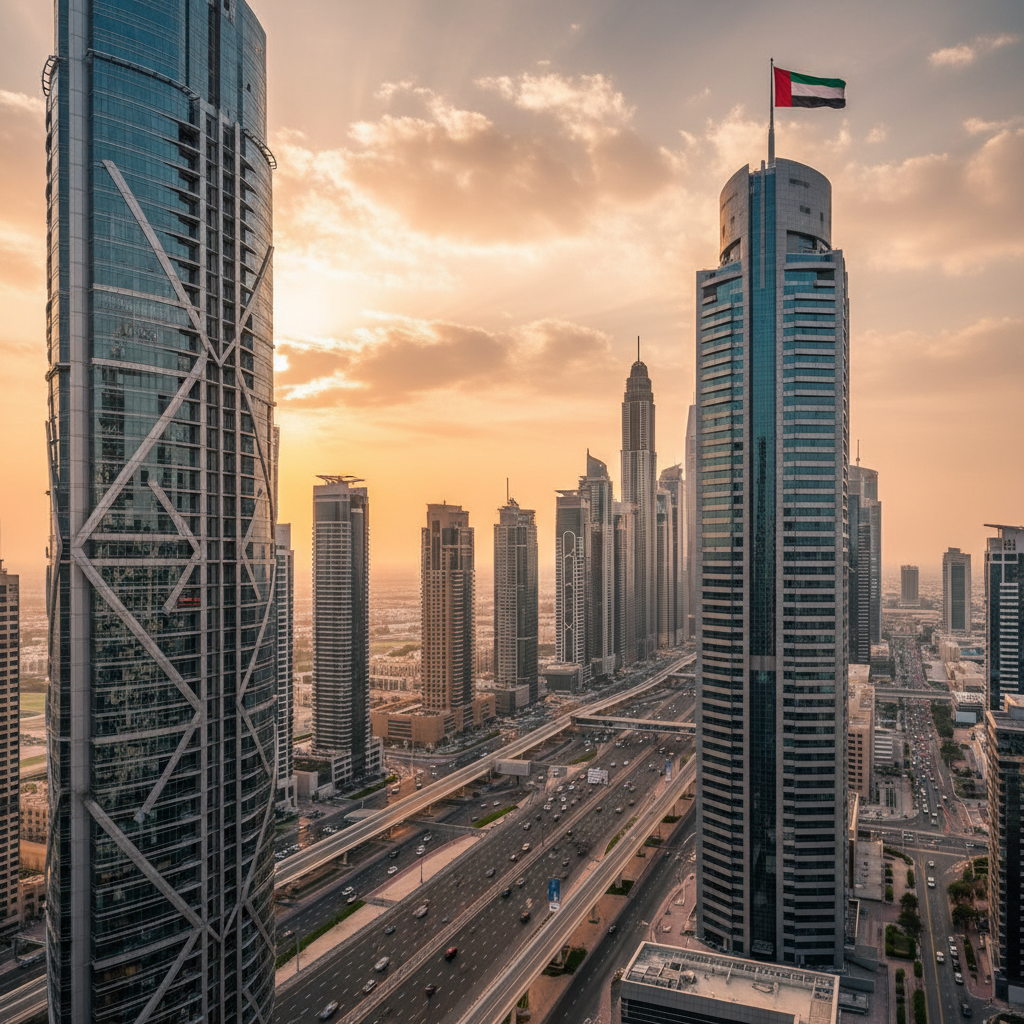
DMCC, IFZA, Meydan, DIFC, JAFZA, SHAMS, RAKEZ — pick the right zone for your activity. Licence, visas, Flexi-desk, and bank account. From AED 5,555.
50+ UAE Free Zones · DMCC · DIFC · JAFZA · IFZA · RAKEZ
A Dubai free zone company offers 100% foreign ownership, 0% import/export duties within the zone, fast setup (3–5 days), and industry-specific ecosystems. With over 50 free zones in the UAE — each with its own regulator, cost structure, and activity list — picking the right one is the single biggest cost-and-speed decision you'll make.
Different zones suit different businesses: DMCC for commodities and trading, DIFC for finance, Meydan for tech and e-commerce, IFZA for affordable SME setup, JAFZA for logistics, SHAMS for media, RAKEZ for manufacturing. We've set up companies in all of them.
Unlike mainland companies, free zone entities cannot trade directly with UAE mainland customers without a distributor — but they're unbeatable for international-facing businesses, holding structures, and industry-specific clusters.
Zone selection, licence, visas, office, banking, and compliance — fully managed.
We match your activity, budget, and visa needs to the right free zone.
Commercial, professional, industrial, service, or e-commerce licence from your chosen zone.
Zone-approved office address — flexi-desk to full warehouse depending on your needs.
Investor, employee, and family visas. Emirates ID issuance coordinated end-to-end.
Intros to Emirates NBD, Mashreq, Wio, HSBC, and international banks.
Licence renewal, UBO filings, economic substance, accounting, Corporate Tax.
Five clean steps. Mostly remote. No surprises.
30-minute call. We shortlist 2–3 optimal zones based on your activity and budget.
Trade name reserved. KYC collected. MoA prepared. Activity list finalised.
Licence application filed with the zone. Initial approval in 24–48 hours.
Digital trade licence issued. Establishment card + immigration file set up.
We introduce you to banks and manage KYC submission. Account opened in 5–14 days.
Zero local sponsor required. You own, control, and repatriate 100% of profits.
Goods moving in/out of the free zone or re-exported are duty-free — huge for trading businesses.
Fastest company formation in the UAE. IFZA can issue licences in 24 hours.
DMCC commodities, DIFC finance, SHAMS media, Dubai Internet City tech — built-in ecosystems.
Qualifying Free Zone Person status can give 0% Corporate Tax on qualifying income (vs 9% mainland).
Most free zones don't publish shareholder details. Privacy on par with offshore jurisdictions.
"Noble Core analysed 4 zones, recommended DMCC, issued the licence in 4 days, opened our Mashreq account in 11. Zero friction."
"Shams Free Zone setup in 2 days. The most cost-effective path for our startup."
Naveed SheikhFounder, Media Co Shams"RAK Free Zone with no hidden costs. Perfect for our international e-commerce."
Layla Al ZarooniEntrepreneur, RAKEZ"Ajman Free Zone — budget-friendly, zero hassles, docs ready in record time."
Pooja SharmaAjman FZ ClientAll-inclusive. Licence + visa + Flexi-desk bundled. No surprise fees.
Need something custom? Talk to us.
Choosing the wrong free zone costs you time, money, and headaches at renewal. Here is the definitive side-by-side comparison of the top 12 UAE free zones — updated for 2026. Each zone has its own regulator, cost structure, approved activity list, and visa quota rules.
| Free Zone | Emirate | From (AED/yr) | Visa Quota | Best For | Setup Time |
|---|---|---|---|---|---|
| IFZA | Dubai | 12,900 | 1–6 | SMEs, consultants, e-commerce | 24 hours |
| Meydan FZ | Dubai | 12,500 | 1–6 | Tech, media, general trading | 3–5 days |
| SHAMS | Sharjah | 5,750 | 1–3 | Freelancers, media, solopreneurs | 2–3 days |
| Ajman Free Zone | Ajman | 5,555 | 1–3 | Budget SMEs, general trading | 3–5 days |
| RAKEZ | Ras Al Khaimah | 13,131 | 1–6+ | Manufacturing, trading, academic | 3–5 days |
| DMCC | Dubai | 34,500 | 1–6+ | Commodities, gold, crypto | 4–6 days |
| JAFZA | Dubai | 29,000 | 1–5+ | Logistics, re-export, warehousing | 5–7 days |
| DIFC | Dubai | 48,000+ | 1–8+ | Finance, VC, asset management | 1–3 weeks |
| ADGM | Abu Dhabi | 15,000+ | 1–4+ | Finance, tech startups, family offices | 1–2 weeks |
| SAIF Zone | Sharjah | 10,000 | 1–5 | Industrial, warehousing, manufacturing | 3–5 days |
| SPC Free Zone | Sharjah | 5,499 | 1–3 | Ultra-budget freelancers, startups | 2–3 days |
| Dubai Internet City | Dubai | 25,000+ | 1–5+ | IT companies, tech firms | 5–7 days |
Year 1 all-in costs (licence + flexi-desk + visa). Exact costs depend on activity type and office package. Get a tailored quote
With 50+ free zones in the UAE, picking the right one is not obvious. The wrong choice means paying for a zone that does not fit your activity list, missing out on tax benefits, or facing banking difficulties that another zone would have avoided. Here are the five decision criteria we use with every client before recommending a zone.
Every free zone publishes an approved activity list. Your intended business activity — for example IT consulting, general trading, crypto exchange, or food manufacturing — must be on that list. Some zones are broad (IFZA accepts 1,500+ activities); others are highly specialised (DIFC accepts only financial services). Step one is always to confirm your activity is approved. If your activity spans multiple categories, check whether the zone allows activity bundling — IFZA and Meydan do, while some zones charge a separate fee per additional activity.
Each free zone licence grants a visa allocation based on your office type. A basic flexi-desk licence typically grants 1–3 visas. If you need to sponsor 10 employees, you need a zone that scales — DMCC, JAFZA, and RAKEZ warehouse packages all support larger visa quotas. Meydan and IFZA offer scalable visa packages without requiring a full physical office, which makes them ideal for remote-first businesses and solo founders who still want multiple investor visas for family sponsorship.
Some zones have significantly better corporate bank account opening success rates than others. DMCC and Meydan are well-regarded by UAE banks — accounts typically open in 5–14 days. Offshore-leaning zones or newer free zones can trigger additional bank due diligence, extending timelines to 30–60 days. If speed of banking is critical, choose a zone with a strong local banking track record. Read: How to Open a Corporate Bank Account in UAE 2026.
Year 1 costs get all the attention, but Year 2 renewal is often the surprise. IFZA licence renewal is approximately AED 5,000 per year — genuinely budget-friendly. DMCC renewal runs approximately AED 25,000 per year. Always model the 3-year total cost before committing. The cheapest zone in Year 1 is not always the cheapest zone over 3 years, especially once you factor in mandatory annual audits, visa renewals, flexi-desk renewal, and any accounting or bookkeeping fees.
If your clients are UAE-based businesses or consumers, a pure free zone licence creates a legal barrier — you need a mainland distributor or a Dual Licence to sell directly to UAE mainland customers. If your revenue is 100% international, a free zone is the clean, low-cost, low-tax choice. Be honest about your customer base before choosing the structure.
Here is exactly what happens from decision to trading, based on 5,000+ setups across all major UAE free zones. The full process typically takes 3–7 working days. Banking adds a further 5–14 days.
Shortlist 2–3 zones that match your activity, visa needs, and budget. Confirm your specific activity is on the approved list before paying any fees. If your activity spans multiple categories, ask whether the zone supports bundled activities at no extra charge — this can save AED 1,000–3,000 per year.
Submit 2–3 name options to the zone authority. Names must not include restricted words such as Dubai, UAE, International, or Global without special approval. Approval takes 24–48 hours. The fee is typically AED 100–500 depending on the zone.
Standard documents for a sole-founder free zone company include: passport copy (attested if required), Emirates ID copy if you are a UAE resident, proof of address (utility bill or bank statement, 3 months old), a basic business plan (required by DMCC and DIFC), a passport-size photograph, and an NOC letter from your current employer if you are on an employment visa.
Submit the application with documents and the initial approval fee. Most zones have an online portal. Initial approval is typically granted within 24 hours for IFZA, Meydan, and Ajman Free Zone, and within 3–5 days for DMCC and DIFC. You receive a Letter of Intent or initial approval letter at this stage, which you can use to begin banking pre-work.
Choose your workspace option: a flexi-desk (shared hot-desk, the cheapest option at AED 3,000–8,000 per year), a serviced private office (AED 15,000–40,000 per year), or a warehouse for manufacturing and logistics businesses. Your office type directly determines your visa allocation. A flexi-desk typically supports 1–3 visas; a warehouse can support 10 or more.
Pay the licence issuance fee and receive your digital trade licence. Most zones issue digitally first, with a physical card following by post. Your Establishment Card is issued simultaneously — this is the document you will need for all immigration and visa processing steps. Keep a certified copy of both documents.
With your trade licence and establishment card in hand, apply for a UAE corporate bank account. Recommended banks for free zone companies in 2026: Emirates NBD, Mashreq, Wio (digital banking), and RAKBANK. Typical timeline: 5–14 days for established businesses; 3–6 weeks for brand new companies. See: How Long to Open a Business Bank Account in UAE 2026.
The headline "from AED 5,555" is the licence fee only. Below is the complete cost breakdown for a typical single-investor free zone setup across three budget tiers. These are real numbers, not marketing estimates.
| Cost Component | Budget (SHAMS / Ajman) | Mid-Range (IFZA / Meydan) | Premium (DMCC) |
|---|---|---|---|
| Trade Name Reservation | AED 300 | AED 500 | AED 500 |
| Trade Licence Fee | AED 5,555–5,750 | AED 10,500–11,500 | AED 20,285 |
| Flexi-Desk / Office | AED 0–1,500 | AED 3,000–5,000 | AED 15,000–20,000 |
| Investor Visa | AED 3,500–4,000 | AED 4,000–5,000 | AED 4,000–6,000 |
| Emirates ID | AED 300–370 | AED 300–370 | AED 300–370 |
| Medical + Health Insurance | AED 1,500–2,000 | AED 2,000–3,000 | AED 3,000–4,500 |
| Establishment Card | AED 1,200–1,500 | AED 1,200–1,500 | AED 1,825 |
| Year 1 Total (all-in) | AED 12,000–15,000 | AED 21,000–27,000 | AED 45,000–55,000 |
| Year 2 Annual Renewal | AED 7,000–9,000 | AED 14,000–17,000 | AED 25,000–32,000 |
Does not include professional fees. Compare cheapest UAE free zones
The three main business structures in the UAE serve different purposes. Choosing the wrong one at formation costs time and money to restructure later.
| Feature | Free Zone | Mainland | Offshore |
|---|---|---|---|
| Foreign Ownership | 100% allowed | 100% allowed (post-2021) | 100% allowed |
| UAE Mainland Trading | Needs distributor or dual licence | Direct — no restriction | Not permitted |
| UAE Visa Eligibility | Yes | Yes | No |
| Corporate Tax | 0% if QFZP qualifying | 9% on profits above AED 375,000 | 0% (no UAE income) |
| UAE Corporate Bank Account | Easy — 5–14 days | Easy — 5–14 days | Difficult — 30–90 days |
| Office Requirement | Flexi-desk minimum | Physical Ejari lease required | No UAE office |
| Annual Audit | Required by most major zones | Not mandatory (recommended) | Varies |
| Starting Cost | From AED 12,000 | From AED 18,000 | From AED 8,500 |
| Best For | International business, export, tax efficiency | UAE market sales, retail, F&B | Holding structures, IP, asset protection |
Full comparison guide: Free Zone vs Mainland vs Offshore UAE 2026
Need zone-specific cost breakdowns, step-by-step processes, and insider tips? We have published dedicated expert guides for every major UAE free zone — with real AED figures, competitor comparisons, and honest assessments of banking difficulty.
The honest, numbers-first framework we use with every founder. No vendor spin. Costs, tax, ownership, visas, activity restrictions — decoded in 40 minutes.
Each free zone publishes its own activity list, but most allow these high-demand categories. Want a specific activity checked? Our advisors verify it across all 50+ zones for free during your cost calculation.
Free zone licence types vary slightly between authorities, but most boil down to these five categories. Not every zone offers every type — IFZA, Meydan, SHAMS and RAKEZ cover most cases. Industrial requires specific zones like JAFZA, KIZAD or Hamriyah.
Trading any physical goods — most flexible licence type.
Pure-service businesses — consulting, IT, marketing, design.
Online-only retail — Shopify, Amazon, marketplace storefronts.
Light manufacturing, packaging, assembly. Needs warehouse.
Asset / SPV / shareholding structure — no operating activity.
Free zones are faster than mainland because the document list is leaner — no MOA notarisation at courts, no NOC from current sponsor in most cases. Below is the typical checklist (zone-specific exceptions apply).
Industrial / regulated activities (crypto, financial, healthcare) need additional approvals — we coordinate them as part of our PRO service.
Free zone licence is day one. Below is the rest of the operational stack we set up alongside or right after.
Wio (digital, 5–7 days) is fastest for free zone companies. Mashreq Neo Biz, Emirates NBD also accept. We have desks at all three.
Bank account opening9% above AED 375k. Free zone QFZP status = 0% on qualifying income. Mandatory FTA registration in 3 months.
Corporate tax filing5% VAT mandatory at AED 375k revenue. Voluntary from 187.5k. We handle filing every quarter.
VAT complianceFree zones (DMCC, JAFZA, DIFC) require audited accounts. We handle monthly books + year-end audit prep.
Accounting & booksMandatory for DMCC, JAFZA, ADGM, DIFC, KIZAD. Filed annually with the zone authority. Approved auditor list provided.
Audit servicesFree zones can also operate on mainland via a service-agent or dual-licence structure. Talk to us about hybrid setups.
Mainland setupThe cheapest entry-level free zones in 2026 are Ajman Free Zone (from AED 5,555), SHAMS (Sharjah, from AED 5,750), and SPC Free Zone (Sharjah, from AED 5,499). IFZA is our most popular choice for SMEs and solo founders due to speed (24-hour setup) and flexible visa options.
Not directly. Free zone companies need a mainland distributor or a dual-licence structure to sell to UAE mainland customers. For international trade, re-export, or zone-to-zone business, no distributor is needed. If UAE domestic sales are your main revenue, a mainland licence is better.
3–5 working days is standard. IFZA can issue licences in 24 hours. DMCC, DIFC, and Meydan typically take 4–5 days. Banking adds 5–14 days depending on the bank and your activity.
Under UAE Corporate Tax rules, a free zone company can pay 0% CT on qualifying income (instead of 9%) if it: (1) is a QFZP, (2) maintains adequate substance, (3) derives 'qualifying income' per FTA rules, and (4) complies with transfer pricing. We structure every free zone setup with QFZP in mind. Learn more.
Yes — every free zone licence includes at least 1 visa eligibility (investor visa). Visa count scales by package: basic packages typically support 1–3 visas; larger offices/warehouses support 6+.
DMCC (Dubai) is the global gold standard for commodities, gold, diamonds, and general trading — it's the most awarded free zone in the world. JAFZA is best for logistics and re-export (port access). RAKEZ and SAIF Zone are cost-effective for trading with warehousing.
Meydan FZ and IFZA are optimal for tech and consulting — fast, low-cost, digital-first. Dubai Internet City (DIC) offers tech-specific infrastructure but higher fees. DIFC is for fintech, asset management, and fund structures.
Most do: DMCC, DIFC, ADGM, JAFZA, RAKEZ, Meydan, and most major zones require annual statutory audits at licence renewal. Smaller zones (IFZA, SHAMS) may waive this for certain entity types — but all benefit from clean books. See audit services.
Only JAFZA Offshore is approved to hold Dubai freehold property directly. Most free zone companies cannot hold UAE real estate. If property holding is your goal, structure your setup around JAFZA Offshore or a mainland LLC.
Annual renewal is typically 70–85% of Year 1 cost — licence renewal, Flexi-desk, visa renewals, and any accounting / audit fees. Specific zones vary: IFZA ~AED 5K/year renewal, DMCC ~AED 25K/year.
Free 30-minute consultation. We compare 3 zones for your specific activity, visa needs, and budget — then issue your licence in 3–5 days.