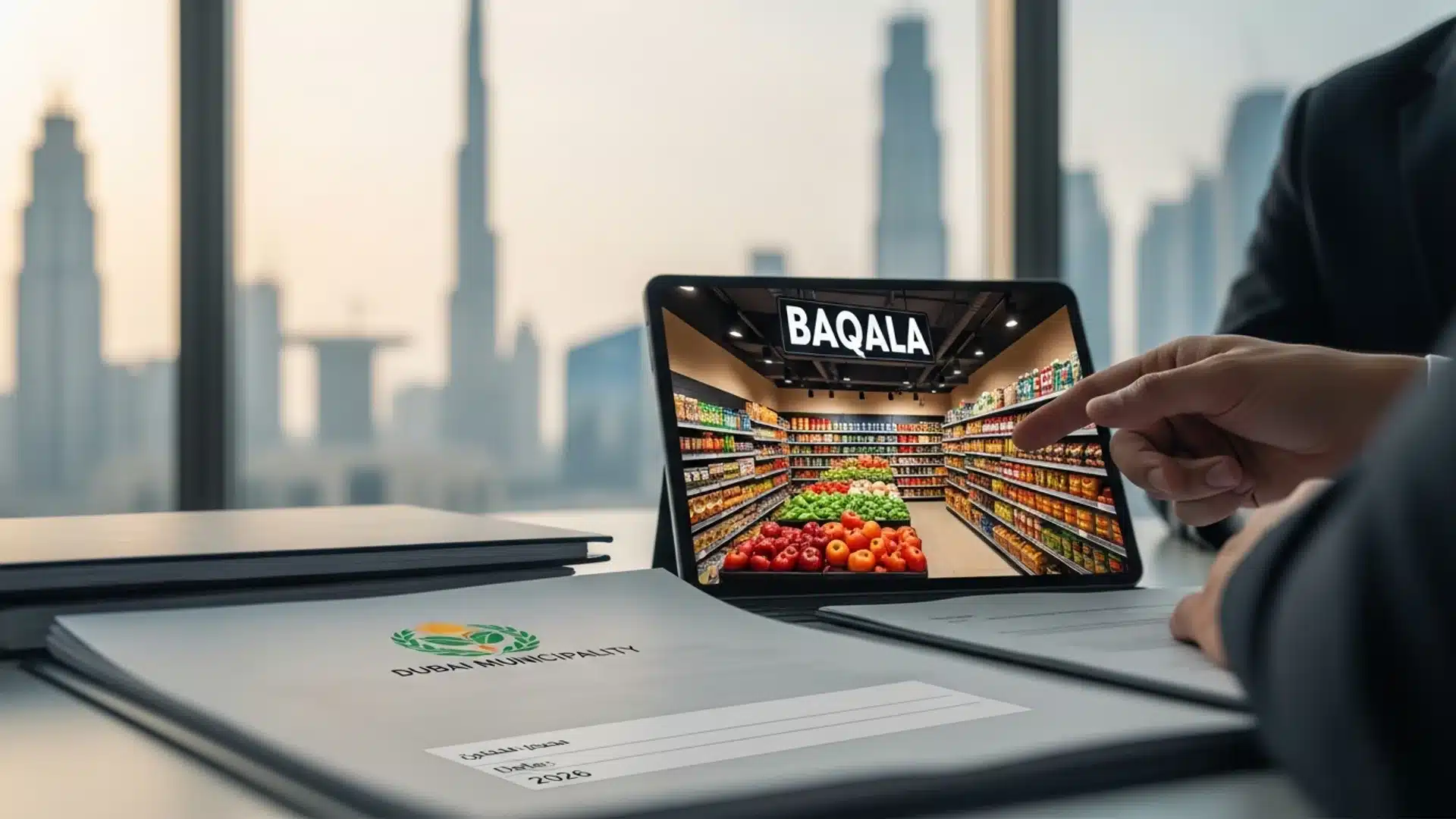
Quick AnswerBaqala grocery store licence Dubai 2026: indicative cost from around AED 15,000, Dubai Municipality food approvals, steps and visas explained simply.
Your setup cost, in 10 seconds
Package prices. Health insurance is required by law and not included.
Thank you.
Your written quote follows on WhatsApp.
How much does a baqala (grocery store) licence in Dubai cost in 2026?
A baqala license in Dubai costs from around AED 15,000 for a straightforward setup, and in practice most small grocery stores land somewhere between roughly AED 15,000 and AED 30,000 across the first year once you add up the DET trade licence, the Dubai Municipality food and shop approvals, your tenancy and Ejari registration, and the initial visas. That headline number is deliberately a range rather than a single figure, because a baqala is one of those businesses where the size and location you build to changes the economics noticeably. A tidy corner shop in a residential building serving one neighbourhood sits at the lower end; a larger mini-mart on a busy street with a broad product range, chilled and frozen sections and several staff sits well above it. Treat the AED 15,000 starting point as a planning anchor, not a quote, and always confirm current fees with the authority before you commit, because UAE government charges are reviewed periodically and the right figure for your plan depends on your exact activity and premises.
To make the number meaningful, it helps to break it into the pieces that actually make it up. The first piece is the trade licence itself, issued by the Department of Economy and Tourism (DET), which is the core permission that lets you legally operate a grocery business in Dubai. On top of that sits the approval a food shop specifically needs: Dubai Municipality food-trade and shop sign-off, which treats your unit as an approved food-retail outlet and expects a clean, well-organised, compliant fit-out. Then there is the cost of the shop itself — the annual rent for your unit, the Ejari registration that formalises the tenancy, and the fit-out with shelving, refrigeration and signage — which for a baqala is usually where the real money goes. Finally there is food-handler training for your staff and your visa budget. When people quote a single very low number for a baqala licence, they are almost always referring only to the bare trade licence and leaving out the food approvals, the shop and the visas that make the business actually function. This guide walks through every layer so your budget reflects reality rather than a marketing headline.
What exactly is a baqala, and how is it classified for licensing?
"Baqala" is one of those words that everyone in the UAE understands instantly, even though it never appears on a licence in those exact terms. It is the everyday name for the small neighbourhood grocery you find tucked into the ground floor of residential buildings across Dubai — the shop you pop into for bread, milk, eggs, a cold drink, laundry powder, a phone top-up or a last-minute ingredient. Some people call it a mini-mart, a corner shop, a convenience store or a foodstuff shop, and larger versions shade into what most of us would simply call a supermarket. Culturally the baqala is a fixture of daily life, the friendly outlet within walking distance that keeps a community stocked with the essentials. On paper, though, it is simply a small retail grocery business, and Dubai licenses it through a clear, well-trodden path rather than anything exotic.
For licensing purposes, a baqala is registered as a grocery or foodstuff trading and retail activity through the Department of Economy and Tourism. The activity you select on your trade licence defines what you are legally permitted to sell, so it matters that it accurately reflects a grocery operation rather than, say, a restaurant or a general trading company. The practical effect is that your licence covers the retail sale of packaged foods, beverages, household consumables and everyday convenience goods from a fixed shop. Because you are selling food and drink to the public, the activity automatically brings a second layer of oversight from Dubai Municipality, which is responsible for food safety and the standards of food-retail premises. Understanding this dual nature early — a commercial trade licence from DET plus food and shop approvals from Dubai Municipality — is the single most useful thing you can do before you start, because it shapes both your budget and your choice of premises.
It is worth drawing a clear line between a baqala and its close cousins in the food world, because the requirements differ. A baqala sells packaged and pre-prepared goods; it does not, in its basic form, cook food to order the way a cafeteria or restaurant does. That distinction keeps a straightforward grocery on the simpler end of the food-licensing spectrum, because you are storing and selling sealed products rather than running a hot kitchen with the more demanding food-preparation controls that come with cooking. If your ambitions include preparing fresh food, making sandwiches to order, or running a hot counter, you are edging toward a different or additional activity — and it is worth reading our guide to the cafeteria licence in Dubai to understand where that line sits. Getting the classification right from the outset saves you from having to unwind and re-file later, and it ensures your Dubai Municipality approvals match what you actually do behind the counter.
The trade licence: your foundation from the Department of Economy and Tourism
Every legitimate baqala in Dubai stands on a trade licence issued by the Department of Economy and Tourism, and this is the document that turns an idea into a lawful business. The DET trade licence establishes your company, names the grocery activity you are permitted to carry out, and is the anchor to which every other approval, visa and bank account attaches. Without it you cannot sign a commercial tenancy in the company's name, apply for staff visas, open a corporate bank account or pass a Municipality inspection. It is, in the most literal sense, the foundation stone, and getting it in place cleanly and correctly makes everything downstream smoother. For a small grocery, the licence is a commercial trade licence covering foodstuff retail, and it is renewed annually.
The process of obtaining the licence follows a logical sequence that has become well established over the years. You begin by settling the shape of your business — the activity, the legal form of the company and the trade name you want to register. The trade name is reserved and approved so that it is unique and appropriate, and initial approval is granted to confirm there is no objection in principle to you carrying out the grocery activity. Somewhere in this early phase you also fix your premises, because a grocery licence is tied to a physical shop and the tenancy feeds directly into the licence. Once the paperwork, the tenancy contract and the Ejari registration are aligned, the licence can be issued. The core administrative steps are not the bottleneck for most people; the shop and its approvals usually are, which is why experienced owners run the premises search in parallel with the name and initial-approval steps rather than one after the other.
One of the genuinely encouraging developments of recent years is how much more accessible mainland ownership has become. For many commercial activities, full foreign ownership is now available, which means a great number of grocery investors can own their baqala outright without a local partner holding equity in the company. This is a meaningful shift that has widened the door for entrepreneurs from every background who want to run a shop in Dubai. That said, some activities still carry specific conditions, and the framework is periodically refined, so the wise move is to confirm the current ownership position for your exact grocery activity at the time you apply rather than relying on older advice. A reputable setup advisor, or DET directly, can verify the live position quickly. If you would like a fuller picture of how mainland licensing works across activities, our overview of mainland business setup walks through the structure, the ownership rules and what to expect.
Dubai Municipality food-trade and shop approvals: the second essential layer
If the DET trade licence is the foundation, Dubai Municipality approval is the layer that makes a baqala fit to trade in food. Because your shop stores and sells items that people eat and drink, the Municipality has a direct and legitimate interest in how those goods are kept, displayed and handled. This is not bureaucracy for its own sake; it is the framework that keeps Dubai's food supply safe and its shops trustworthy, and it is one of the reasons customers can walk into any neighbourhood grocery with confidence. For a grocery, the Municipality's involvement centres on your premises being an approved, hygienic food-retail outlet and on your staff being properly trained to handle food. You can read more about the department and its remit on the official Dubai Municipality website, which is the authoritative source for current food-safety requirements.
In practice, the approval looks at the design and condition of your shop. Inspectors are interested in your storage and refrigeration — that chilled and frozen goods are held at safe temperatures, that dry goods are kept off the floor and away from damp, and that stock is organised so nothing spoils unnoticed. They look at cleanliness and pest control, at the finishes and layout of the shop, at how food is displayed to the public, and at whether the general environment protects the products from contamination. The exact conditions scale with the size of your shop and the range of products you carry: a compact grocery selling mostly packaged goods faces a lighter set of expectations than a larger mini-mart with a fresh-produce section, a cold room and a broad chilled range. Because the specifics vary, the smartest approach is to engage with the Municipality's requirements before you design your fit-out, so your shelving, cold storage and layout are built to pass inspection the first time rather than being reworked afterward at extra cost.
Alongside the premises approval sit two people-focused requirements that are easy to overlook in the excitement of finding a shop. The first is food-handler cards: anyone who stores, handles, displays or sells food and drink in your baqala generally needs to have completed approved food-safety and hygiene training. The training covers safe storage temperatures, cleanliness, avoiding cross-contamination, personal hygiene and sensible stock handling, and the cards are renewed periodically. The second, often linked, requirement is that your shop has someone accountable for food safety — a person responsible for making sure hygiene practices are actually followed day to day. Neither of these is onerous, but both need to be planned and budgeted from the start, because a shop cannot open properly until its people are correctly certified. Treat food-handler training as part of your launch checklist, book it early, and keep a simple record of who is certified and when their cards fall due for renewal.
Choosing the right shop: tenancy, Ejari and location rules
For a baqala, the shop is not just where the business happens — it is a defining part of whether the business is approved at all. A grocery licence is bound to a specific physical unit, so the premises you choose feeds directly into your Municipality approval, your visa allocation and your day-to-day trade. This is why experienced owners treat the property search as one of the earliest and most important tasks, not an afterthought once the paperwork is underway. The right unit is one that sits in a good residential catchment with steady footfall, has the space and services to be fitted out as a compliant food shop, and is in a building and location where the activity is permitted. Getting this decision right sets the ceiling on how well the business can perform, because a grocery ultimately depends on being conveniently placed for the people it serves.
Two pieces of paperwork formalise the premises. The first is the tenancy contract itself, signed in the name of your company once the licence process is underway, which establishes your right to occupy and trade from the unit. The second is Ejari, the official system that registers and formalises tenancy contracts in Dubai, giving the lease legal standing and linking it to your licence. Ejari registration is a routine but essential step: your trade licence and your Municipality approvals expect a properly registered tenancy behind them. Budget both the annual rent and the smaller Ejari and related administrative fees into your first-year plan. Because rent is typically the largest recurring cost a baqala carries, it pays to negotiate the lease carefully and to be realistic about the rent a given location can support against the trade it is likely to generate.
Location for a grocery also carries a planning dimension that newcomers do not always anticipate. Dubai applies zoning and planning guidelines that can influence where a new grocery is permitted, and in some areas this includes maintaining a sensible minimum distance between grocery shops so that neighbourhoods are served in a balanced, healthy way. The practical effect is that the specific unit you like may or may not be approvable depending on how close existing groceries already are and on the zoning of the building. This is a constructive framework — it exists to keep local retail well distributed and to give each shop a viable catchment rather than clustering groceries on top of one another. Because these guidelines are applied case by case and are reviewed over time, the essential move is to check the current position for your chosen unit with the relevant authority, or through a setup advisor, before you sign the tenancy contract. Confirming approvability first protects you from committing to a lease on a unit that cannot ultimately host the shop you want.
Contact Us For Free Consultation
or
Ask on WhatsApp insteadLicensed UAE consultancy. One reply, no spam.
Thank you.
A consultant will reply on WhatsApp shortly.
Step-by-step: how to open a baqala in Dubai
It helps to see the whole journey laid out as a sequence, because while every setup has its own quirks, the path a baqala follows is consistent and logical. The first step is to define your business clearly — the grocery activity, the legal form of the company and the trade name you want. This is where you decide whether you are opening a compact corner baqala or a larger mini-mart, because that decision shapes the premises and budget that follow. With the concept settled, you reserve and register your trade name and secure initial approval, which confirms there is no objection in principle to you running the grocery activity. Running alongside this, you begin the search for your shop, because the premises and the licence are tied together and the property is usually the longest lead item.
The second phase is about locking in the premises and its paperwork. Once you have identified a suitable unit in a good catchment, and confirmed that the location is approvable given any zoning and minimum-distance considerations, you sign the tenancy contract in the company's name and register it through Ejari. This gives your lease legal standing and provides the address the licence attaches to. With the tenancy in place, you can finalise and collect the DET trade licence itself, which is the milestone that formally brings your company into existence. Around the same time you arrange your DEWA connection so the unit has water and electricity, and you begin designing the fit-out — shelving, refrigeration, storage and signage — to meet food-retail standards. Sequencing the fit-out to match Municipality expectations at this stage, rather than building first and adjusting later, saves both time and money.
The final phase turns a licensed company into an open, trading shop. You complete the fit-out and prepare the premises for Dubai Municipality food-trade and shop inspection, making sure refrigeration, storage, cleanliness and layout all meet the required standards. You arrange food-handler cards for your staff and ensure someone is designated as responsible for food safety. Once the Municipality approval is granted, you can process your staff visas and your own investor visa, each of which runs through its own sequence of entry permit, medical, Emirates ID and stamping. You stock the shelves, set up your point-of-sale and payment systems, and register with the Federal Tax Authority if your turnover reaches the VAT threshold. With approvals granted, staff certified and stock in place, you are ready to open the doors. The whole journey, from first decision to opening day, is very achievable, and the parts that take longest — the premises and its approvals — reward early, parallel effort more than anything else.
Budgeting realistically: where the money actually goes
The most useful thing a first-time owner can do is build a budget that reflects the whole business rather than a single licence fee, because a baqala's real cost is the sum of several moving parts. The DET trade licence is the headline item people fixate on, but for a grocery it is often not the largest. The shop is. Annual rent for your unit, the Ejari registration and the fit-out — shelving, refrigeration, a cold or chill section, signage and a point-of-sale system — typically absorb a significant share of your first-year spend, and they vary enormously with the size and location of the shop. A compact grocery in a modest residential building carries a very different cost base from a larger mini-mart on a prime street, which is exactly why any honest cost answer for a baqala has to be a range rather than a precise figure.
Around those two big blocks sit the approvals and people costs. Dubai Municipality food-trade and shop approvals, food-handler training for your staff, and the DEWA connection are all part of getting the shop live. Then there are the visas: your own investor visa and the shop-assistant visas you need to run the hours a grocery keeps. Each visa is its own small project with costs for the entry permit, medical, Emirates ID and stamping, and those costs sit on top of the licence rather than inside it. On the operational side, you also need working capital to buy your opening stock and to carry the business through its early weeks before the neighbourhood trade builds. Owners who plan only for the licence and the rent, and forget the stock and the visas, are the ones who feel squeezed at launch — so it is far better to map every layer up front.
A sensible way to frame the whole picture is to treat the AED 15,000 starting point as the floor for a lean, straightforward setup, and to plan toward the AED 15,000 to AED 30,000 band as a realistic first-year envelope for many small groceries once the shop, approvals and initial visas are included. Larger or more ambitious mini-marts naturally sit above that. Because every one of these figures is indicative and government charges are reviewed periodically, the numbers here are for planning rather than quotation, and you should confirm the live fees with DET, Dubai Municipality and the visa authorities for your exact plan. If you would like a structured walk-through of how the pieces fit together for a Dubai company in general, our guide to business setup in Dubai sets out the moving parts clearly and helps you sanity-check your own budget.
Staffing, food-handler cards and visas for your grocery
A baqala is a people business as much as a product business, because shops tend to run long, dependable hours and customers value familiar, helpful faces behind the counter. That reality shapes both your staffing plan and your visa budget. Most small groceries run with a compact team of shop assistants covering the trading day, and the owner often holds an investor visa alongside. The number of staff visas you can sponsor is generally linked to your shop size and licence type rather than a fixed number, so a larger unit typically supports a larger headcount. Planning your team early — how many people you need, across what hours, in what roles — lets you size both your visa allocation and your monthly wage bill before you commit to a premises, which keeps the whole plan grounded.
Every staff member who works with food in your shop needs to be properly certified, which is where food-handler cards come in. Because a baqala stores, displays and sells food and drink, the people doing that work generally need to have completed approved food-safety and hygiene training, and your shop is usually expected to have someone accountable for hygiene practices day to day. This training is a positive part of running a trustworthy grocery: it ensures your team understands safe storage temperatures, cleanliness, stock rotation and personal hygiene, all of which protect your customers and your reputation. The cards are renewed periodically, so it is worth keeping a simple record of who is certified and when renewals fall due. Fold food-handler training into your onboarding for every new hire so that no one ends up working the counter without the right certification in place.
The visa process itself follows a clear, repeatable sequence for each person, and it is helpful to think of it as a mini-project you run once per employee. Broadly, it moves through an entry permit, a medical examination, biometrics and the Emirates ID, and finally the visa stamping that completes the status. Your own investor visa follows a comparable path. Each step carries its own fee, and because visas sit on top of the licence cost, they are an important line in your budget rather than a rounding error. Employing staff also brings you into contact with MOHRE, the labour authority, for the employment side of things. None of this is difficult when approached methodically, and many owners choose to have a setup partner run the visa applications in parallel so the shop can open on schedule with a fully certified, properly documented team.
Tax, compliance and keeping your baqala in good standing
Opening the shop is the beginning; keeping it compliant is what lets it trade smoothly year after year. The good news is that a well-set-up baqala is straightforward to run compliantly, provided you stay on top of a short list of recurring obligations. The most fundamental is your trade licence renewal: the DET licence is an annual document, and keeping it current — along with the tenancy and Ejari behind it — is what keeps the business lawful. Alongside it, your Dubai Municipality food-trade approval and your staff's food-handler cards need to be maintained and renewed on their own cycles, because the Municipality expects an operating grocery to remain a compliant, hygienic food outlet throughout its life, not just on opening day. Building a simple calendar of these renewal dates is one of the most effective habits a small-shop owner can adopt.
On the tax side, the UAE's framework is clear and manageable for a small grocery. Value Added Tax applies once your taxable turnover reaches the registration threshold, at which point you register with the Federal Tax Authority (FTA) and account for VAT on your sales in the normal way. Many everyday food staples are treated favourably under the VAT rules, but the treatment varies by product, so it is worth understanding how VAT applies to your particular mix of goods rather than assuming a single rate across the shop. Corporate tax is a separate consideration under the UAE's business-tax framework, and whether and how it affects you depends on your profits and structure. Because tax rules and thresholds are set and periodically updated by the authorities, the sensible approach is to confirm your current obligations with the FTA or a qualified adviser and to keep clean, orderly records from day one so that registration and filing, if and when they apply, are painless.
Good record-keeping underpins all of this and is genuinely worth the small effort it takes. A tidy set of records — sales, purchases, staff documents, licence and approval renewals, and food-handler cards — makes inspections straightforward, makes any VAT filing simple, and gives you a clear read on how the shop is actually performing. Modern point-of-sale systems make much of this almost automatic, capturing sales and stock movements as you trade. The owners who find compliance stressful are usually the ones who left records to chance; the ones who find it effortless built simple systems early. Treat compliance not as a burden but as the quiet infrastructure that lets you focus on serving your neighbourhood, and your baqala will stay comfortably in good standing.
Common Mistakes to Avoid When Opening a Baqala in Dubai
The most common and most costly mistake is signing a shop lease before confirming that the location is actually approvable for a grocery. Because Dubai applies zoning and planning guidelines — including, in some areas, a sensible minimum distance between grocery shops — the perfect-looking unit may not be permitted for a baqala if another grocery is already close by or the building's zoning does not allow it. Owners who fall in love with a unit and commit to the tenancy first sometimes discover afterward that the activity cannot be approved there, leaving them tied to rent they cannot use. The fix is simple and disciplined: verify approvability for the specific unit with the relevant authority or a setup advisor before you sign anything. A little patience at the property stage prevents an expensive misstep that is very hard to unwind.
A second frequent mistake is budgeting only for the trade licence and underestimating everything else. The DET licence is the headline figure, but for a baqala the shop rent, the Ejari registration, the fit-out with refrigeration and shelving, the Municipality approvals, the food-handler training and the visas together make up the real cost of getting open — and the opening stock has to be bought on top of all of that. Owners who plan around the licence fee alone often feel squeezed at launch, precisely when they need working capital most. The remedy is to build a full first-year budget that maps every layer, then add a sensible buffer for the early weeks before neighbourhood trade builds. Planning for the whole business rather than one line item turns launch from a scramble into a smooth, well-funded opening.
A third mistake is designing and building the shop fit-out before understanding what Dubai Municipality expects of a food-retail outlet. Some owners rush to install shelving and refrigeration to save time, only to find at inspection that the layout, cold storage or finishes need reworking to meet food-safety standards — which means doing the work twice and paying for it twice. Because the Municipality's requirements scale with your shop size and product range, the smart sequence is to engage with those expectations first and design the fit-out to satisfy them from the outset. Getting refrigeration, storage, cleanliness and layout right the first time is far cheaper than retrofitting, and it means your inspection becomes a confirmation of good work rather than a list of corrections. Build to the standard, not merely to a deadline.
A fourth mistake is treating food-handler cards and food-safety responsibilities as an afterthought. Because the shop cannot open properly until its people are correctly certified, owners who leave staff training to the last minute can find their opening delayed while cards are processed. The same applies to designating someone responsible for hygiene practices day to day. The fix is to fold food-handler training into your launch checklist from the beginning and into your onboarding for every future hire, so certification is always in place before anyone works the counter. Keeping a simple record of who is certified and when renewals fall due turns this from a recurring worry into a routine you barely notice. Certified staff are not just a compliance requirement; they are part of running a grocery your customers can trust.
A fifth mistake is choosing the wrong activity classification for the shop you actually intend to run. A basic baqala sells packaged and pre-prepared goods, but the moment you start preparing fresh food — making sandwiches to order, running a hot counter — you are edging into cafeteria or food-preparation territory, which carries additional or different requirements. Owners who pick a plain grocery activity and then quietly start cooking can find their licence and their Municipality approvals no longer match what they do, which creates avoidable friction. The remedy is to be honest at the outset about your menu and to select an activity, and secure approvals, that match your real plans — including any future ambitions. If you think you may prepare food, factor it in from the start rather than retrofitting the licence later.
A sixth mistake is neglecting the renewal calendar once the shop is open. The trade licence, the tenancy and Ejari, the Dubai Municipality approval and the staff food-handler cards all run on their own cycles, and letting any of them lapse creates unnecessary complications for a business that is otherwise trading happily. Owners who treat opening day as the finish line, rather than the start of a simple maintenance routine, are the ones who get caught out by an expired document at an awkward moment. The fix is easy: build a single calendar of every renewal date at the moment you open, and set reminders well ahead of each deadline. A few minutes of organisation converts compliance from a source of stress into quiet background housekeeping, leaving you free to focus on serving your neighbourhood.
Bringing it all together: your path to opening a Dubai grocery
Step back from the detail and the shape of the journey is reassuringly clear. A baqala in Dubai rests on two pillars — a trade licence from the Department of Economy and Tourism that establishes your grocery business, and food-trade and shop approvals from Dubai Municipality that make your shop fit to sell food to the public. Around those pillars sit the practical pieces that turn a licence into a living business: a well-chosen, approvable shop with a registered Ejari tenancy, a compliant fit-out with proper refrigeration and storage, food-handler cards for your team, your visas, and sensible tax and record-keeping habits. None of these pieces is exotic, and the path connecting them is well established and travelled by thousands of shop owners before you. The businesses that open smoothly are simply the ones that respect the sequence and plan for every layer rather than fixating on the licence fee alone.
If there is a single theme worth carrying away, it is that the premises and its approvals deserve your earliest and most careful attention. The trade-licence steps rarely hold anyone up; the shop — finding an approvable unit, confirming any zoning and minimum-distance considerations, signing and registering the tenancy, and fitting out to Municipality standards — is where the real timeline and the real cost live. Run the property search in parallel with the paperwork, verify approvability before you sign, design the fit-out to pass inspection the first time, and get your staff certified early, and you will have removed almost every avoidable source of delay. Treat the AED 15,000 starting point as a planning floor, build toward a realistic first-year envelope, and confirm the live figures with the authorities for your exact plan.
Opening a neighbourhood grocery is one of the most grounded, community-minded businesses you can start in Dubai, and the framework around it is designed to help good operators succeed while keeping food safe and shops trustworthy. With a clear plan, an honest budget and the right premises, the journey from idea to a stocked shop with the lights on and customers coming through the door is very achievable. Whether you are opening a compact corner baqala or laying the groundwork for a larger mini-mart, the principles are the same: get the classification right, secure both layers of approval, choose your shop wisely, look after your people, and keep your records tidy. Do those things well, and you will have built not just a licensed business but a genuine fixture of its neighbourhood — the kind of shop a community relies on every single day.
Talk to Our Experts
Open your Dubai baqala or grocery store end to end with Noble Core — DET trade licence, Dubai Municipality food and shop approvals, Ejari, food-handler cards and your visas handled in one place.
Frequently Asked Questions
How much does a baqala licence in Dubai cost in 2026?
A baqala license in Dubai typically costs from around AED 15,000 for a straightforward setup, and in practice most small grocery stores land somewhere between roughly AED 15,000 and AED 30,000 across the first year once you add the DET trade licence, Dubai Municipality food and shop approvals, your Ejari tenancy and initial visas. The figure moves depending on your shop size, location and how many staff you sponsor. These are indicative planning numbers rather than a quote, so confirm current fees with the Department of Economy and Tourism and Dubai Municipality before you commit, since government charges are reviewed periodically and the right figure depends on your exact activity and premises.
What is a baqala and how is it licensed in Dubai?
A baqala is the everyday term across the UAE for a small neighbourhood grocery or mini-mart that sells packaged foods, drinks, household basics and daily convenience items. In Dubai it is licensed as a grocery or foodstuff trading activity through the Department of Economy and Tourism, which issues the trade licence that lets you legally operate. Because a baqala handles food for the public, it also needs Dubai Municipality food-trade and shop approvals, and your staff need food-handler cards. The name baqala is cultural shorthand, but on paper it is simply a small retail grocery business, and it follows the same clear, well-established licensing path as other food-retail shops in Dubai.
Do I need Dubai Municipality approval for a baqala in Dubai?
Yes. Because a baqala sells food and drink to the public, Dubai Municipality food-trade and shop approvals are a core part of the process alongside your DET trade licence, not an optional extra. The Municipality reviews your shop layout, refrigeration, storage, cleanliness and the way you store and display food, and it expects your premises to be a properly fitted, hygienic food-retail outlet. Your staff need valid food-handler cards, and a person responsible for food safety is often expected. The exact conditions vary with your shop size and the products you carry, so confirm the current requirements with Dubai Municipality early in your planning so your fit-out is designed to pass inspection first time.
Is a baqala a mainland or free zone business in Dubai?
Almost every baqala in Dubai is set up on the mainland, because a grocery store is a premises-bound retail business that serves walk-in customers in a specific neighbourhood and depends on a Dubai Municipality-approved shop tied to that location. A mainland licence lets you operate the shop, sell directly to the public and trade with local suppliers. Free zones are generally better suited to trading, e-commerce and office-based businesses rather than a public-facing corner grocery. Because a baqala lives or dies on its street-level location and local footfall, the mainland route through the Department of Economy and Tourism is the natural and practical choice. A short conversation with a setup advisor confirms the right structure for your plan.
How long does it take to open a baqala in Dubai?
Once your documents and shop are in order, the core DET trade licence step can move relatively quickly, often within a handful of working days. The realistic timeline for the whole journey depends on finding a suitable unit, signing a tenancy contract and registering Ejari, completing the shop fit-out and passing Dubai Municipality inspection, which can extend the process to several weeks. Taking over an existing grocery unit that already meets shop standards can be faster because much of the groundwork is done. The single biggest factor is usually the premises, so identifying and preparing your shop early, and checking any minimum-distance rule between groceries, is the best way to keep the overall timeline tight and predictable.
What approvals does a baqala need besides the trade licence?
Beyond the Department of Economy and Tourism trade licence, a baqala needs Dubai Municipality food-trade and shop approvals covering your premises as an approved food-retail outlet, food-handler cards for staff, and a hygienic, compliant shop fit-out. You will also need a registered Ejari tenancy contract for your unit and a DEWA connection for water and electricity. Depending on the products you carry, specific items may need extra approvals. If your turnover reaches the VAT threshold you will register with the Federal Tax Authority, and when you hire staff you will deal with MOHRE for labour matters. The exact list depends on your shop and stock, so confirm your specific requirements with each authority before you open.
Do I need a local Emirati partner for a baqala in Dubai?
For many mainland commercial activities, full foreign ownership is now possible, which means a great number of grocery investors can own their baqala without a local partner holding equity. Some activities still carry specific conditions, and the rules are reviewed over time, so the safest approach is to confirm the current ownership position for your exact grocery activity at the time you apply. A reputable setup advisor or the Department of Economy and Tourism can verify this quickly. Always rely on the live position rather than older guidance, because ownership rules in the UAE have evolved positively in recent years and the path to owning a mainland grocery store is more open than many newcomers expect.
What are food-handler cards and who needs them in a baqala?
A food-handler card confirms that a staff member has completed approved food-safety and hygiene training and is fit to work with food in Dubai. In a baqala, anyone who stores, handles, displays or sells food and drink generally needs valid food-safety credentials, and your shop is usually expected to have someone accountable for hygiene practices. The training covers safe storage temperatures, cleanliness, avoiding cross-contamination, personal hygiene and stock handling. Cards are renewed periodically and form part of what Dubai Municipality checks during inspection. Budget for training and renewal across your team, and confirm the current requirements and approved providers with the Municipality so your staff are correctly certified before opening day.
How many visas can I get with a baqala licence?
The number of visas you can sponsor is generally linked to your shop size and licence type rather than a fixed cap, so a larger grocery usually supports more staff visas than a small corner baqala. Grocery retail is staff-oriented because shops often run long hours, so many owners plan for a few shop-assistant visas plus their own investor visa. Each visa carries its own costs for entry permit, medical, Emirates ID and stamping, which sit on top of the licence fee, and your staff will also need food-handler cards. Plan your headcount and the associated visa budget early, and confirm your specific quota with the authorities once your premises is fixed.
Can I turn a baqala into a bigger supermarket or mini-mart later?
Yes, many owners start with a small baqala and grow into a larger mini-mart or supermarket as the neighbourhood trade builds, and the licensing framework supports that progression. Scaling up usually means moving to a bigger unit, expanding your Dubai Municipality-approved shop area, adding refrigeration and storage, broadening your product range and increasing staff and visas accordingly. Your trade licence activity may need to be updated to reflect the larger operation, and a bigger premises can unlock a higher visa allocation. The clean approach is to begin compliant and modest, prove the location, then expand deliberately. When you are ready to grow, confirm the updated fit-out and licence conditions with the Department of Economy and Tourism and Dubai Municipality.