What Noble Core charges
Quoted after scoping
This activity needs approval from a sector regulator, so we price it after a short review of your plan. The quote is in writing and free of obligation.
Quote this licence on WhatsAppQuick answer
Coffee shop license in Dubai costs AED 18,000–25,000 for the DET trade license. — Realistic year-1 total is AED 230,000–560,000 including fit-out, equipment, and permits.
- Mainland (DET) license structurally required as free zones don’t permit retail F&B serving the general public
- Setup timeline: 10–12 weeks if approvals run in parallel
- Fit-out for 50–80 sq m specialty café: AED 120,000–300,000; equipment AED 60,000–200,000
Best for: entrepreneurs opening street-front, mall, or hotel coffee shops in Dubai 2026
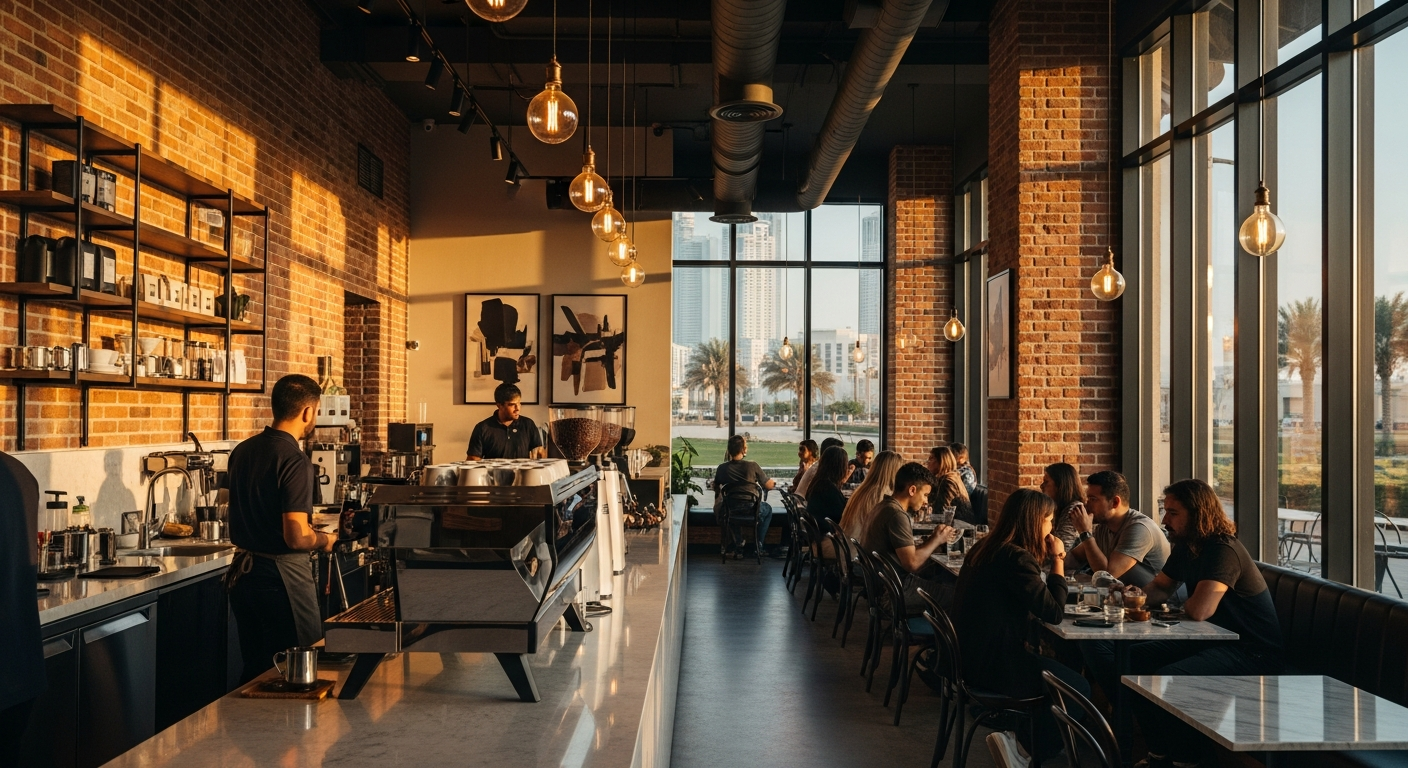
Opening a coffee shop in Dubai in 2026 requires three regulatory approvals running in parallel: DET commercial trade license, Dubai Municipality food safety permit, and venue-specific approvals (mall, hotel, or street-front). Realistic setup cost from license to grand opening: AED 180,000-450,000 for a 50-80 sq m specialty café — with the license itself being only AED 18,000 of that.
This guide covers Dubai coffee shop license for 2026: real costs broken down, food permit requirements, location decisions (mall vs street-front), fit-out approvals, and the 10-week realistic timeline from idea to first cappuccino sold.
Your setup cost, in 10 seconds
Package prices. Health insurance is required by law and not included.
Thank you.
Your written quote follows on WhatsApp.
Dubai Coffee Shop License Cost Breakdown 2026
| Item | Cost (AED) | Notes |
|---|---|---|
| DET trade license (initial) | AED 18,000-25,000 | Coffee shop activity code; mainland-only (FZs limited for F&B retail) |
| Tenancy + Ejari | AED 5,000-15,000 admin + lease | Mainland mandatory; lease ranges AED 80,000-500,000/year |
| Dubai Municipality food permit | AED 5,000-10,000 | Mandatory; renewable annually |
| Civil Defense fire approval | AED 8,000-15,000 | Sprinkler, exhaust, fire panel |
| Health card + food handler training | AED 1,500-3,000 per employee | Mandatory for all kitchen + serving staff |
| Fit-out (50-80 sq m specialty café) | AED 120,000-300,000 | Espresso machine, grinders, counter, plumbing, exhaust hood |
| Equipment (espresso, grinders, fridge) | AED 60,000-200,000 | Specialty (La Marzocco, Mahlkönig) vs entry tier |
| Year-1 total realistic estimate | AED 230,000-560,000 | Excluding inventory and 6-month operating runway |
Related: Sharjah free zones compared
Our cost research checks what each authority actually publishes, so you can compare like with like:
- Sharjah free zone licence cost — four zones, only two of which publish any price at all
Why Mainland (DET), Not Free Zone
F&B retail (coffee shop, restaurant, bakery) in Dubai is structurally a mainland-only setup in 2026. Free zones either don’t permit retail F&B or restrict it to within their own zone (which limits foot traffic dramatically). Specifically:
- DMCC, JAFZA, IFZA: Allow F&B as a service activity but only for FZ-internal customers, not the public.
- SHAMS, SPC: Similar — internal-only F&B.
- Sharjah Free Zones: Limited retail F&B exceptions for Sharjah-resident expats.
For street-front, mall, or hotel-located coffee shops serving the general public: DET mainland is the only viable path.
Location Decision: Mall, Hotel, or Street-Front?
| Location type | Lease/year (50-80 sq m) | Pros | Cons |
|---|---|---|---|
| Premium mall (Mall of Emirates, Dubai Mall) | AED 800,000-2,000,000+ | Massive foot traffic, brand prestige | Brutal margin pressure, mall fees, brand restrictions |
| Mid-tier mall (City Walk, JBR) | AED 350,000-700,000 | Foot traffic + lower fees | Mall approval often slower than landlord |
| Hotel concession (5-star) | AED 200,000-500,000 + revenue share | Captive guest market, no marketing | Revenue share 8-15% kills margin |
| Street-front (JLT, Dubai Marina) | AED 150,000-450,000 | Margin freedom, branding flexibility | Foot traffic must be built; longer ramp |
| Boutique neighbourhood (Al Quoz, Karama) | AED 80,000-200,000 | Cheapest path; specialty café gold | Niche audience; longer revenue ramp |
Step-by-Step: From Idea to First Cup (10-12 Weeks)
- Concept + location signing (Week 1-2). Lease term, mall/hotel approvals if applicable.
- DET trade license application (Week 2-3). Activity code “Coffee Shop” or “Café” filed; initial approval.
- Tenancy contract + Ejari (Week 3-4). Required for license issuance.
- Dubai Municipality food permit application (Week 4-6). Submit kitchen layout, equipment list, exhaust plans.
- Fit-out commencement (Week 4-9). Plumbing, electrical, exhaust hood (mandatory for any espresso/cooking equipment), counter build-out.
- Civil Defense fire approval (Week 6-9). Inspection, sprinkler test, fire panel commissioning.
- Equipment installation (Week 8-10). Espresso machine, grinders, fridges, ice machine.
- Staff hiring + health cards + food handler training (Week 8-10).
- Final municipality inspection + permit issuance (Week 10-11).
- Soft launch + grand opening (Week 11-12).
Talk to Our Experts
Open your Dubai coffee shop end-to-end — license, food permit, fit-out approvals, visas. Free 20-minute consultation.
Common Mistakes (2026)
1. Underestimating total cost beyond the license fee
The license itself is only 15-30% of true year-1 cost. Founders consistently miss: workspace fit-out, equipment, customs registration, visa processing per applicant, banking setup time, regulatory pre-approvals, and operating runway. Always model 24-month total cost-of-ownership, not just license fee.
2. Sequencing approvals instead of parallelizing
Trade license, regulatory approvals (food safety, civil defense, environmental), and workspace allocation must run in parallel. Sequencing extends 8-week setups to 6+ months. Submit all approval tracks in week 1-2, not after license issuance.
3. Choosing tier on price, not on 24-month projection
Promotional tiers look attractive but rarely fit beyond solo founders without growth. Run a 24-month team-size and revenue projection BEFORE selecting the package. The savings disappear fast when you upgrade mid-year.
4. Banking blindness
License doesn’t auto-confer banking. UAE banks apply different KYC tiers based on jurisdiction, activity, and ownership structure. Pre-engage your banking partner before license submission to avoid 2-3 month account-opening delays.
5. UAE-mainland customer 5% customs reality
Free zone licenses can’t directly invoice UAE-mainland B2C customers without 5% customs duty on goods. Plan distributor relationships, sister mainland entity, or pricing strategy from Day 1, not after first lost margin.
Strategic Use-Case Deep Dives (2026)
Use Case A: Solo Founder Bootstrap
Pre-revenue solo founder testing market fit. Year-1 priorities: cheapest viable license, flexi-desk workspace, fast banking (Mashreq Neo / RAKBANK direct partnerships), 1 visa quota, no premature hiring. Total Year-1 fixed: AED 12,000-20,000. Goal: validate product-market fit before scaling structure.
Use Case B: Mid-Market Operator (3-8 person team)
Established business with revenue and team. Year-1 priorities: Standard or Premium tier, dedicated office or workspace, 3-6 visa quota, multi-bank relationships, possible mainland sister entity for UAE-domestic sales. Total Year-1 fixed: AED 60,000-150,000. Goal: optimize unit economics + tax structure.
Use Case C: Series-A+ Funded Startup
VC-backed scaleup. Year-1 priorities: premium jurisdiction (DIFC/ADGM/DMCC) for VC-friendly Common Law contracts, formal office presence, 8-15 visa quota, premium banking (HSBC Private, Emirates NBD Private). Total Year-1 fixed: AED 200,000-500,000. Goal: investor-grade structure + Series-B readiness.
Dubai vs Regional Alternatives (2026)
| Jurisdiction | Setup cost | Setup time | Tax framework | Best for |
|---|---|---|---|---|
| Dubai (this guide) | AED 6,275–100,000+ | 5 days–6 wks | 0% FZ qualifying / 9% above AED 375K | UAE/MENA-focused operations |
| Abu Dhabi | AED 19,000+ | 10-15 days | Same as Dubai | AD government access |
| Sharjah | AED 5,555+ | 5-7 days | Same as Dubai | Cheapest UAE |
| Saudi Arabia | SAR 25,000+ | 4-8 weeks | 20% Corporate Tax | KSA-domestic operations |
| Bahrain | BHD 1,500+ | 1-3 weeks | 0% Corporate Tax | GCC light operations |
| Qatar | USD 7,500+ | 3-6 weeks | 10% Corporate Tax | Qatar-domestic |
2026 Setup Checklist
- ☐ 24-month team-size + revenue projection (week 0)
- ☐ Jurisdiction selection based on customer mix + tax + prestige needs (week 1)
- ☐ Pre-engage banking partner (week 1)
- ☐ Trade name reservation with appropriate suffix (week 1)
- ☐ Activity code mapping — confirm all intended activities covered (week 1)
- ☐ Submit license application + parallel regulatory approvals (week 2)
- ☐ Document attestation: passport, NOC if applicable, address proof (week 2)
- ☐ License issuance + share certificate + establishment card (week 2-4)
- ☐ Workspace allocation or office tenancy + Ejari (week 3-6)
- ☐ Bank account opening + payment gateway integration (week 4-8)
- ☐ Visa processing for founders + first hires (week 4-8)
- ☐ Operational systems: accounting, CRM, payment processing (week 5-9)
- ☐ First customer onboarding + revenue capture (week 6-12)
- ☐ 90-day post-launch audit: structure efficiency, tax optimization, growth bottlenecks identified
Contact Us For Free Consultation
or
Ask on WhatsApp insteadLicensed UAE consultancy. One reply, no spam.
Thank you.
A consultant will reply on WhatsApp shortly.
Frequently Missed 2026 Considerations
The UAE Corporate Tax framework introduced in 2024 has 2026-specific enforcement updates that many founders overlook:
- QFZP substance requirements: Free zone companies claiming 0% Corporate Tax on qualifying income must demonstrate adequate substance (qualified directors, board meetings in UAE, decision-making in jurisdiction). 2026 audits are stricter than 2024-2025.
- Transfer pricing documentation: Companies with related-party transactions exceeding AED 200,000 must maintain transfer pricing files. Most SME founders are unaware until first audit.
- Pillar Two (Global Minimum Tax): UAE companies that are part of multinational groups with EUR 750M+ revenue face 15% global minimum tax. Standalone UAE businesses unaffected, but subsidiaries of larger groups must restructure.
- VAT registration thresholds: Mandatory at AED 375K, voluntary at AED 187,500. Late registration penalty AED 10K + retroactive VAT obligations.
- Economic Substance Regulations: Banking, fund management, IP, holding, and certain other activities have annual ESR notifications. Penalties for non-filing AED 20K+.
What Most Other Guides Don’t Tell You
The Dubai/UAE business setup industry has built decades of received wisdom that’s now outdated for 2026. Three things most other guides still miss:
- Banking is the real bottleneck. Trade licenses issue in days. Bank accounts take weeks to months. Most setup delays in 2026 are banking-side, not licensing-side. Plan accordingly.
- Substance requirements are real. “Set up a UAE company and pay zero tax” worked in 2018. In 2026, you need genuine UAE substance (directors, decisions, premises) to claim free zone tax benefits. Shell structures get caught.
- The mainland-vs-FZ choice is no longer binary. Sophisticated operators run hybrid structures: free zone entity for tax-efficient international trade + mainland LLC for UAE-domestic sales. The dual-license model is now standard practice for any business with both export and UAE-domestic streams.
2026 Regulatory Context You Should Know Before Setting Up
UAE business setup in 2026 operates under a substantially evolved regulatory framework compared to even 2024. Understanding the changes that affect your specific setup option saves both money and compliance risk:
Corporate Tax Framework (introduced 2024, refined through 2026)
The UAE Corporate Tax regime imposes 9% federal corporate income tax on taxable income exceeding AED 375,000 annually. Three carve-outs matter for setup decisions:
- Qualifying Free Zone Person (QFZP): Companies registered in qualifying UAE free zones meeting specific substance requirements pay 0% on Qualifying Income (e.g., re-export, B2B-FZ-to-FZ trade, certain headquarters activities). UAE-mainland sales remain at 9% above the AED 375K threshold. The 2026 enforcement is significantly stricter than 2024 — directors must hold board meetings in UAE, decisions must be documented as taking place in UAE, and the entity must demonstrate adequate operating substance.
- Small Business Relief: Companies with revenue under AED 3M annually can elect for 0% Corporate Tax through the AED 3M Small Business Relief programme. This applies through tax year 2026, with potential extension. For solo founders and early-stage operators, this is a meaningful saving.
- Pillar Two Global Minimum Tax: Multinational groups with consolidated revenue exceeding EUR 750M face a 15% global minimum tax under OECD Pillar Two rules — but standalone UAE businesses below this threshold are unaffected.
VAT Registration and Compliance
UAE VAT operates at a standard 5% rate with mandatory registration at AED 375,000 annual taxable supplies and voluntary registration available from AED 187,500. Critical 2026 dates: registration must occur within 30 days of crossing the threshold; failure to register attracts AED 10,000 penalty plus retroactive VAT obligations. For e-commerce and trading businesses approaching the threshold rapidly, voluntary registration at AED 187,500 is often the safer play to avoid penalty risk.
Economic Substance Regulations (ESR)
Banking, fund management, intellectual property holding, distribution-and-service-centre, headquarter, holding company, lease-finance, insurance, and shipping activities all attract ESR. Annual ESR notifications and substance reports must be filed with the regulator. Non-filing penalties begin at AED 20,000 and escalate. Many setup providers don’t mention ESR; founders are routinely surprised in Year 2 audits.
Beneficial Ownership Disclosure
UAE companies must maintain a Beneficial Ownership Register identifying all individuals owning 25%+ of shares (directly or indirectly). The register must be filed with the regulator and updated within 15 days of any change. 2026 enforcement is active: missing or outdated disclosures attract penalties from AED 50,000.
Realistic 24-Month Total Cost of Ownership Model
License fees are the visible cost. Below is the 24-month total cost-of-ownership for a typical mid-market operator using this setup option, including everything most “starting from” guides hide:
| Cost item | Year 1 (AED) | Year 2 (AED) | Notes |
|---|---|---|---|
| License fees (initial + renewal) | 15,000 – 60,000 | 12,000 – 50,000 | Range based on tier + jurisdiction |
| Workspace (office or warehouse) | 20,000 – 200,000 | 22,000 – 220,000 | Includes Ejari + utilities |
| Visa processing (per founder + 2 hires) | 14,000 – 21,000 | 0 – 5,000 | Year 1 includes initial issuance |
| Bank account opening + fees | 1,000 – 5,000 | 500 – 3,000 | Setup + monthly maintenance |
| Accounting + bookkeeping | 6,000 – 24,000 | 6,000 – 24,000 | Outsourced; mandatory for VAT-registered |
| VAT registration + filing | 2,500 – 8,000 | 3,000 – 8,000 | Once threshold crossed |
| Corporate Tax filing | 3,000 – 10,000 | 3,000 – 10,000 | Annual TR filing + audit if applicable |
| Insurance (PI, employer’s liability) | 4,000 – 15,000 | 4,000 – 15,000 | Activity-dependent |
| Software, telecoms, basic operations | 10,000 – 30,000 | 10,000 – 30,000 | Communication, tools, hosting |
| 24-month total | — | — | AED 150,000 – 750,000+ |
The ranges reflect the difference between solo founder bootstrap and 5-8 person mid-market team. Add 30-50% on top if your activity requires Civil Defense (industrial/F&B), MOCCAE (chemicals/food/plastics), Dubai Municipality food permits, or Ministry of Health pre-approvals.
Worked Examples: Three Real Setup Scenarios in 2026
Scenario A: Solo founder, pre-revenue (Year-1 budget AED 25,000)
A solo founder with AED 50,000 capital testing market fit. Optimal play: cheapest viable license tier with flexi-desk, Mashreq Neo direct-partner banking (48-hour opening), 1 visa quota, manual bookkeeping for first 6 months, voluntary VAT registration deferred until revenue projections crystallize. Total Year-1 fixed: AED 18,000-25,000. Goal: validate product-market fit cheaply, upgrade structure once monthly revenue exceeds AED 30,000.
Scenario B: Mid-market team, AED 200K-500K revenue (Year-1 budget AED 100,000)
3-5 person team with established revenue. Optimal play: Standard or Premium tier in chosen jurisdiction, dedicated office or substantial flexi-desk, 3-5 visa quota, multi-bank relationships (Emirates NBD + FAB), outsourced accounting from month 1, voluntary VAT registration. Total Year-1 fixed: AED 80,000-130,000. Goal: optimize unit economics, set up tax-efficient structure (consider mainland sister entity if UAE-domestic > 40% revenue).
Scenario C: Series-A funded scaleup, AED 5M+ raised (Year-1 budget AED 400,000+)
VC-backed team scaling fast. Optimal play: premium jurisdiction (DIFC for tech/AI, ADGM for fintech, DMCC for trade), formal office presence (200+ sq m), 8-15 visa quota, premium banking (HSBC Private, Emirates NBD Private), full-time CFO or fractional CFO, audit-ready financials from month 1, dedicated tax advisor for QFZP substance compliance. Total Year-1 fixed: AED 350,000-650,000. Goal: investor-grade structure ready for Series-B + due diligence.
What to Expect From a Noble Core Setup Engagement
Most setup providers offer the same core service: license issuance + visa + workspace + banking introduction. The differences that compound into a meaningfully better outcome:
- Pre-decision strategic consult. Before you pay anything, we model your 24-month customer mix, tax exposure, and growth trajectory — then recommend the structure that minimizes 24-month total cost-of-ownership, not just the cheapest license.
- Parallel-track approval management. Trade license, regulatory approvals, workspace, banking — all run simultaneously, not sequentially. Saves 4-12 weeks vs the typical sequential approach.
- Banking pre-engagement. We pre-introduce your structure to 2-3 banks before license submission, so account opening starts in week 1, not week 6.
- Substance compliance from Day 1. QFZP eligibility, ESR notification, beneficial ownership filings — built into onboarding, not retrofitted in Year 2 audits.
- Post-setup operating support. Most providers disappear after license issuance. We stay engaged through your first VAT filing, first Corporate Tax return, first ESR notification — so the setup actually translates to compliant operations.
The 5 Questions Every Founder Should Answer Before Choosing a Setup
- What % of your 24-month revenue will come from UAE-mainland customers? If > 40%, mainland or hybrid structure is structurally cheaper after 5% customs is factored in.
- Do you need investor-grade contracts (English Common Law)? If yes, DIFC or ADGM. UAE Civil Law works for everyone else.
- How many visas in 24 months — realistic projection? Pick the package that fits, not the cheapest one. Mid-year upgrades are expensive.
- What’s your annual revenue trajectory hitting AED 3M? If yes within Year 2, plan VAT + Corporate Tax compliance from Day 1.
- Are you part of a multinational group with EUR 750M+ consolidated revenue? If yes, Pillar Two minimum tax applies — restructure consideration.
Most founders haven’t thought through these explicitly before they choose a jurisdiction. The setup providers who don’t ask are setting you up to overpay or to face surprise compliance issues in Year 2.
The Bottom Line for 2026
UAE business setup in 2026 is meaningfully different from even 18 months ago. The Corporate Tax framework, Pillar Two minimum-tax rules for multinational subsidiaries, stricter QFZP substance enforcement, the AED 3 million Small Business Relief programme, beneficial ownership disclosure penalties, and the Economic Substance Regulations all combine to mean that the right setup decision today is not just about the cheapest license — it is about the structure that minimises 24-month total cost-of-ownership while keeping your operations audit-ready and investor-grade.
The founders who succeed in 2026 are the ones who treat setup as a strategic decision rather than a paperwork exercise. They model their customer mix carefully, choose jurisdictions based on substance and taxation rather than vanity address, run all approval tracks in parallel rather than sequentially, pre-engage their banking partner before license submission, and build compliance routines into onboarding rather than retrofitting in Year 2 audits. They understand that a free zone license alone does not deliver 0% tax — only a free zone licence combined with genuine UAE operating substance does. They understand that mainland and free zone are not binary choices for any business with both UAE-domestic and export revenue streams. They understand that banking is the actual bottleneck, not licensing. And they understand that the cheapest setup option is rarely the most cost-efficient over a realistic 24-month operating horizon.
If you are weighing this setup option against alternatives, the right next step is a 20-minute strategic consultation that maps your specific customer base, revenue trajectory, growth plans, and risk profile against the available structures. Get this right at Day 1 and the 24-month operating costs and compliance posture take care of themselves. Get it wrong and you spend Year 2 paying restructuring fees and unwinding bad early decisions that locked you into the wrong jurisdiction or the wrong tier or the wrong structure.
Frequently Asked Questions
How much does it cost to open a coffee shop in Dubai 2026?
License only: AED 18,000-25,000 (DET). Realistic year-1 total including 50-80 sq m fit-out, equipment (espresso machine, grinders, fridges), Civil Defense, food permit, and 6-month operating runway: AED 230,000-560,000. Premium mall locations push this to AED 800,000+.
Can I open a coffee shop in a Dubai free zone?
Mostly no. F&B retail serving the general public in Dubai requires a mainland (DET) license — free zones either don’t permit it or restrict to FZ-internal customers only. Specialty coffee shops, cafés, and quick-service restaurants are structurally mainland-only in 2026.
Do I need Dubai Municipality approval for a coffee shop?
Yes — Dubai Municipality food permit is mandatory and runs parallel to the trade license. Includes kitchen layout review, equipment compliance, exhaust hood inspection, water/grease trap requirements, and final inspection before opening. Cost AED 5,000-10,000 plus annual renewal.
How long does it take to open a coffee shop in Dubai?
10-12 weeks from lease signing to first sale, IF approvals run in parallel. Sequential approval mistakes can extend to 18-20 weeks. Premium mall locations add 4-6 weeks for landlord-side approvals beyond DET/Municipality timelines.
What’s a typical lease for a Dubai coffee shop?
Premium mall: AED 800K-2M+/year. Mid-tier mall: AED 350K-700K. Hotel concession: AED 200K-500K + 8-15% revenue share. Street-front (Marina, JLT, JBR): AED 150K-450K. Boutique neighbourhood (Al Quoz, Karama, City Walk fringe): AED 80K-200K.
Do I need health cards for staff?
Yes — every kitchen and serving employee must hold a Dubai Municipality Food Handler’s health card (AED 1,500-3,000 per employee, includes medical and food safety training). Mandatory before employment can start; lapsed cards trigger inspection violations.
Can I sell food at a Dubai coffee shop?
Yes, with Dubai Municipality approval for the specific food categories. Pre-packaged baked goods are easiest. On-premise food preparation requires kitchen-grade exhaust, refrigeration, and additional inspection. Hot food adds further requirements (fire suppression, dedicated cooking area).
Are there alcohol restrictions for coffee shops?
Coffee shops cannot serve alcohol under standard DET licensing. Alcohol service requires a separate license restricted to hotel premises or specifically-zoned tourist locations. Most specialty coffee shops in Dubai are fully alcohol-free, with specialty drinks and pastries as the upsell category.
Related guides: Security Company License Dubai 2026: SIRA + DET Cost, Steps … · Freelance License UAE 2026: Types, Costs How to Get One