Quick AnswerDubai South free zone 2026, what it is, setup cost, licence types, logistics & aviation focus, visas, and how to set up a company, step by step.
Dubai's free zones each have a character, and Dubai South's is unmistakable: it is the emirate's logistics and aviation powerhouse, a vast master-planned economic city built around Al Maktoum International Airport in the south of Dubai. For businesses whose operations involve moving goods, warehousing, distribution, aviation, or e-commerce fulfilment, few locations in the region offer the same combination of infrastructure, scale, and connectivity, all wrapped in the free-zone benefits of 100% foreign ownership. But Dubai South is not the right home for every business, and understanding what it is, who it suits, and what it costs is essential before choosing it. This guide explains Dubai South free zone in full for 2026: its focus, setup, cost, licence types, visas, and how to decide whether it fits your venture.
Your setup cost, in 10 seconds
Package prices. Health insurance is required by law and not included.
Thank you.
Your written quote follows on WhatsApp.
Dubai South Free Zone: Setup Cost 2026
Dubai South free zone setup costs AED 12,500 for a zero-visa licence and AED 20,560 all-in with one visa, identical pricing to Meydan across every tier: AED 26,620 with two visas, AED 32,680 with three, AED 38,740 with four, in a typical 12–15 working days including licence, establishment card, e-channel, visa, medical and Emirates ID.
The choice between the two is therefore not price, it is geography and quota mechanics. Dubai South sits beside Al Maktoum International Airport and the Expo District, and its visa quota is tied to physical space at one visa per 8 sqm of office, where Meydan allocates up to six visas with no office lease. If you need warehousing, logistics adjacency or a future EXPO-corridor address, Dubai South wins; if you want maximum visas per dirham with no premises, it doesn’t.
Renewal runs AED 12,500 to 19,900 depending on visa count, and change of status for applicants already in the UAE is a government fee of AED 1,500 per visa, paid at actual. Health insurance is required by law with every visa and is not part of any package. Our Dubai free zone comparison puts these numbers alongside every alternative.
Dubai South Free Zone: Costs, Visa Quota and Property Rates (2026)
Dubai South Free Zone does not publish licence package prices on its authority site, but it does publish real property rates: a business centre office from AED 25,000 + VAT per year (9 sqm and above), and business park space from AED 1,200 / 900 / 550 per sqm per year by grade. Its visa quota is 1 visa per 8 sqm of leased space, so headcount is a direct function of the office you take.
Verified against the Dubai South authority site in August 2026. One caution: the widely quoted “Dubai South from AED 12,500” figure originates from a third-party registration site linked from the official domain, which does not disclose its operator, treat it as an agent offer, not an authority rate.
| Dubai South (published) | Cost / rule |
|---|---|
| Licence packages | Not published by the authority |
| Business centre office (9 sqm+) | From AED 25,000 + VAT/year |
| Business park space | AED 1,200 / 900 / 550 per sqm/yr |
| Visa quota | 1 visa per 8 sqm |
If you need visas without leasing square metres, zones like Meydan (6 allocations, no lease), SHAMS (up to 50 per licence) and SPC (uncapped) work differently, see our visa quota comparison and verified cost index. Have us model it against your headcount.
What Dubai South actually is
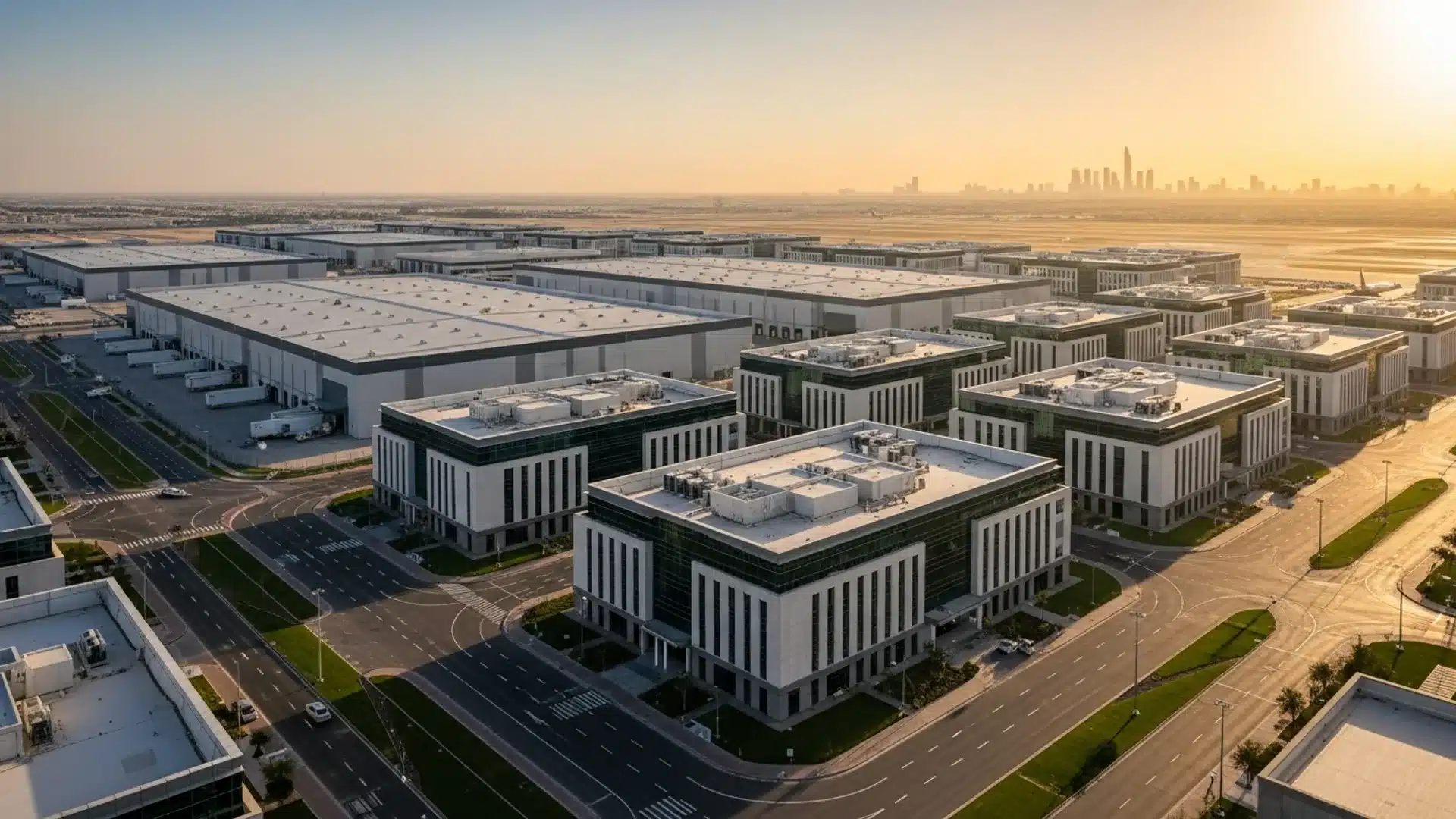
Dubai South is a large, master-planned economic zone and free zone located in the southern part of Dubai, developed around Al Maktoum International Airport. It is one of Dubai's most ambitious urban-economic projects, conceived not merely as a free zone for company registration but as an integrated city combining business districts, residential communities, aviation infrastructure, and large-scale logistics facilities. It is also associated with the legacy district of Expo, which has added to its infrastructure and profile.
As a free zone, Dubai South offers the structural benefits that define the model: 100% foreign ownership of companies, a streamlined formation framework, and an operating environment built for international business. But its defining feature is its orientation toward logistics, aviation, trading, e-commerce, and light industry, sectors that benefit from proximity to a major airport and access to ports and supply-chain infrastructure. Where a media-focused zone clusters creative businesses and a technology zone clusters tech firms, Dubai South clusters the businesses of movement: freight, logistics, distribution, aviation, and the trading and e-commerce operations that depend on them.
The scale and integration are part of the proposition. Dubai South spans a range of facility types, from offices through to warehouses and even land for larger operations, meaning it can accommodate everything from a lean service business to a substantial logistics or industrial operation. Its position around Al Maktoum International Airport, envisioned as one of the world's major aviation hubs, gives airport-adjacent businesses a genuine operational edge. And its master-planned, integrated-city design means the supporting infrastructure, connectivity, facilities, and the broader community, is built in rather than improvised.
For a founder, the essential takeaway is that Dubai South is a free zone with a clear, infrastructure-led identity. It offers the universal free-zone benefits, but its real value is concentrated for businesses that can use its logistics and aviation infrastructure. Understanding that focus is the key to deciding whether it is the right base, because for the right business it is exceptional, and for the wrong one it is simply a free zone whose main advantages go unused.
Who Dubai South suits, and who it doesn't
Choosing a free zone well begins with an honest assessment of fit, and Dubai South's strong sector identity makes this especially important. It fits some businesses superbly and others poorly, and being clear about which avoids paying for infrastructure relevance you won't use.
Dubai South is a natural home for logistics, freight, and supply-chain businesses, companies whose core operation is moving and storing goods, for whom airport proximity and large-scale warehousing are direct operational advantages. It suits aviation and aerospace businesses given its airport-centred design and aviation ecosystem. It is excellent for e-commerce and distribution operations that need fulfilment and warehousing close to transport infrastructure, an online retailer running its own logistics, for instance, gains real efficiency from a Dubai South base. It works well for trading businesses that benefit from airport and ports access for import-export, and for light-industrial ventures needing facilities at scale.
The common thread is infrastructure dependence: businesses whose operations genuinely benefit from proximity to the airport, access to warehousing and logistics, and the scale Dubai South offers are exactly who it was built for. For them, the location is not a cost but a competitive advantage that can lower operating friction and improve service.
Dubai South is a weaker fit for businesses with no logistics, aviation, or physical-goods dimension, a pure consultancy, a small online service business, or a media venture gains little from Dubai South's airport-and-warehouse infrastructure and might be better served by a zone matched to its sector, or by a cheaper, more conveniently located general zone. Such a business would essentially be paying for relevance it won't use. It is also, like every free zone, a consideration for businesses whose customers are predominantly mainland UAE entities, since free-zone companies face restrictions on direct mainland trade.
Location is a practical factor too. Dubai South sits in the south of Dubai, around Al Maktoum airport, excellent for logistics and airport-adjacent operations, but further from central Dubai than some zones. A business whose team or clients are centred in central Dubai should weigh the commute and location against the infrastructure benefits. For logistics and aviation businesses, the southern location is exactly where they want to be; for others, it may be less convenient than a more central zone.
The honest framing is that Dubai South is an outstanding choice for logistics, aviation, e-commerce-with-fulfilment, trading, and light-industrial businesses, for whom its infrastructure is a real asset, and a less natural fit for businesses outside those sectors, who may find better value in a zone matched to their needs. Matching the zone to your actual operation is what leads to a good decision.
Licence types and choosing the right one
Like other free zones, Dubai South offers licences across the main activity categories, and selecting the correct licence is a foundational step that defines what your business can legally do.
Dubai South's licences span the standard categories aligned to its focus, commercial/trading licences for buying and selling goods, service/professional licences for providing services, logistics licences for freight and supply-chain activities, and industrial licences for manufacturing or assembly, reflecting the zone's logistics, aviation, trading, and light-industrial orientation, alongside general business activities. Your specific business activity determines which category and which listed activities you need, and those activities define the scope of what you are authorised to do.
Getting this right matters. A licence that does not properly cover your intended activities can leave you unable to do part of what you planned, or require amendments later; conversely, listing activities precisely, covering what you actually do without over-broadening, keeps your setup clean and cost-effective. Logistics and trading businesses in particular should ensure their licence covers the specific activities (freight, warehousing, distribution, the goods they trade) they intend to undertake.
Because Dubai South serves a defined set of sectors well, businesses in logistics, aviation, e-commerce, trading, and industry typically find a strong licensing fit there. It is worth confirming that your specific activities are available and well-matched before committing, as part of the broader question of whether Dubai South is the right home for your particular business. A good setup adviser maps your real activities to the available categories at the outset, so the licence genuinely fits the business you intend to run.
Costs and what drives them
Cost is naturally a key consideration, and while exact figures must be confirmed live because packages and fees change, understanding what drives the cost lets you evaluate any quote and budget realistically.
A Dubai South setup cost is built from several components. The licence itself is the core, often bundled into a package. Facility is a major variable, Dubai South spans flexi-desk and office options through to warehouses and land, and what you take dramatically affects cost (a flexi-desk is a fraction of a warehouse). Visas add per-person government costs (entry permit, medical, Emirates ID, stamping) for each residence visa. Deposits may apply depending on the package and visas. And there may be registration and administrative fees.
The single biggest driver of cost variation at Dubai South is the facility, because the zone accommodates such a wide range, from lean office packages suitable for a small service or trading business, up to substantial warehousing and logistics facilities for major operations. A small office-based company sits at one end of the cost spectrum; a large warehousing operation at the other. This range is part of Dubai South's strength (it can house businesses of very different scales) but it means there is no single "Dubai South price", your cost depends heavily on the physical footprint your operation needs.
Because of this, the meaningful comparison, both against other zones and across Dubai South's own options, is the all-in cost for your actual requirements: licence, the facility your operation genuinely needs, and the visas you will use. A logistics business needing warehousing should compare Dubai South's facility-plus-licence cost against other logistics-capable zones; a small trading business taking just an office should compare on that lean basis. As with all UAE setups, get a current, itemised quote for your specific configuration rather than relying on a headline figure, and budget for ongoing annual renewal costs (licence, facility, visas), not just the first-year setup.
It is worth noting that for the businesses Dubai South suits, logistics, aviation, e-commerce-with-fulfilment, the facility cost is not merely an expense but an investment in the infrastructure that makes the operation work. A warehouse near the airport is a cost, but it is also the operational backbone of a logistics business. Judged that way, Dubai South's value for the right business is in the capability its facilities and location provide, not just the licence price.
Contact Us For Free Consultation
or
Ask on WhatsApp insteadLicensed UAE consultancy. One reply, no spam.
Thank you.
A consultant will reply on WhatsApp shortly.
Visas and the practical setup process
The free-zone structure connects directly to how many people you can sponsor, and the setup follows the familiar free-zone logic.
The number of residence visas a Dubai South company can obtain is generally linked to the licence and the facility taken, a small office package supports a few visas, while larger offices, warehouses, and facilities support more. This linkage matters because your visa allocation must match your hiring plans. A logistics or distribution operation building a team needs a setup (and facility) that supports the required visas. Confirming the allocation tied to your chosen configuration before committing avoids discovering, after setup, that your structure cannot sponsor the team you need.
The setup process itself follows the standard free-zone sequence: select your activities and licence type, choose your facility option, prepare and submit the required documentation (company and shareholder details, passports, supporting documents), complete registration and pay the fees, and obtain your licence. Once the company exists and has its establishment registration, you can process residence visas for owners and employees, entry permits, medicals, Emirates ID, and stamping, to bring your team onto the company's sponsorship.
All of this sits within the UAE's broader compliance framework. Every business, free-zone or mainland, must attend to obligations such as corporate tax registration with the Federal Tax Authority (tax.gov.ae), and companies hiring staff engage with the ICP (Federal Authority for Identity, Citizenship, Customs and Port Security) for visas and, where relevant, the Ministry of Human Resources and Emiratisation (MOHRE) for employment matters. A Dubai South company is not exempt from these wider obligations; the free-zone structure governs ownership and the operating base, while the national compliance framework still applies. Planning for these from the start is part of setting up properly.
Dubai South in the wider free-zone landscape
To choose well, it helps to see Dubai South as one option within Dubai's rich free-zone landscape, because the right decision is always a comparison rather than a verdict on a single zone.
Dubai has many free zones, each with a character: generalist zones, sector-specific zones (media, technology, finance, healthcare), and infrastructure-led zones like Dubai South (logistics/aviation) and others focused on trade or industry. Dubai South occupies the logistics-and-aviation niche, and its closest comparisons for a founder deciding are other logistics-capable zones, JAFZA (the major Jebel Ali ports-and-logistics free zone), and other zones with warehousing and trade infrastructure, as well as, for businesses that don't actually need the heavy infrastructure, cheaper or more central general zones.
The comparison should turn on what your business genuinely needs. For a logistics or aviation business, the decision is often between Dubai South (airport-centred) and JAFZA (ports-centred) or similar, a question of which infrastructure matches your supply chain. For an e-commerce business needing fulfilment, Dubai South's warehousing-plus-airport combination is compelling, but so might be other logistics zones. For a business that doesn't move physical goods at all, Dubai South's infrastructure is irrelevant, and a cheaper or more convenient general zone, or a sector-matched zone, is likely better value.
The mainland also enters the comparison for businesses serving the local UAE market directly, since a mainland licence allows unrestricted local trade where a free-zone company faces some restrictions. The expansion of mainland foreign-ownership rules has made this a more open question.
What this means in practice is that the question is never simply "is Dubai South good?", it is, for the right business, but "is Dubai South the best fit for this specific business, compared with the realistic alternatives?" Founders who compare honestly on the dimensions that matter (infrastructure needs, location, all-in cost, activity fit, market) end up with setups that fit; those who choose on name or assumption can over-pay for infrastructure they don't use or pick a less suitable base. A good, advice-first setup partner lays out the genuine candidates and helps you choose, which for logistics, aviation, and fulfilment businesses may well be Dubai South, and for others may be somewhere better matched.
Why Dubai is a logistics and aviation hub, and what that means for you
Understanding the bigger context behind Dubai South helps explain why it can be such a powerful base for the right business. Dubai has deliberately positioned itself as one of the world's major logistics, trade, and aviation hubs, and Dubai South is a central pillar of that strategy. The emirate sits at a crossroads between East and West, within a few hours' flight of a huge share of the world's population, and has invested enormously in the airports, ports, roads, and free-zone infrastructure that make it a natural point for goods to flow through. For a business in logistics, distribution, or trade, basing yourself in this hub means plugging into world-class connectivity rather than fighting against poor infrastructure.
Dubai South specifically is built around Al Maktoum International Airport, envisioned as a future centerpiece of Dubai's aviation capacity, and is designed to integrate air logistics with warehousing, distribution, and business facilities in one master-planned zone. The idea is that a shipment can move through air cargo, into warehousing, and out to distribution with minimal friction, all within an integrated environment. For e-commerce fulfilment, freight forwarding, aviation services, and trading businesses, this integration is the entire point, it compresses the supply chain and reduces the cost and time of moving goods.
The practical implication for a founder is that choosing Dubai South is, at its best, a strategic decision about positioning your business inside this hub. If your business lives or dies by how efficiently you can move and store goods, being inside the infrastructure rather than adjacent to it is a genuine operational advantage that compounds over time, faster fulfilment, lower logistics cost, better service to customers, and proximity to the partners and carriers that cluster around major logistics nodes. This is value that a cheaper, generic free zone simply cannot provide to a logistics-dependent business, because it isn't about the licence, it's about the physical and logistical ecosystem.
Conversely, this same logic explains why Dubai South is wasted on businesses that don't move goods: a consultancy or online service business gains nothing from air-cargo proximity and integrated warehousing, so paying for a base inside a logistics hub makes no sense for them. The hub's value is specific to those who use the hub. This is why the fit question matters so much with Dubai South more than with a generic zone, its advantages are real and substantial, but concentrated in particular kinds of business. Get the match right, and Dubai South is not just a place to register a company but a strategic asset; get it wrong, and it's an expensive way to do what a simpler zone would do for less. That clarity about whether you genuinely belong in the hub is the single most important thing to establish before choosing Dubai South.
Common mistakes to avoid
Several recurring mistakes trip up founders considering Dubai South or any free zone, and each is avoidable with foresight.
Choosing Dubai South without needing its infrastructure. Its main advantages are logistics and aviation infrastructure; a business that doesn't use them pays for relevance it won't benefit from. Match the zone to your operation, choose Dubai South for its infrastructure, not its name.
Underestimating the location factor. Dubai South is in the south of Dubai, around Al Maktoum airport, ideal for logistics, less central for others. Weigh location against the infrastructure benefit for your team and clients.
Taking the wrong facility size. Because cost and visa allocation are tied to facility, choosing too small constrains growth and too large wastes money. Match the facility to your real operational and hiring needs.
Overlooking the mainland-access question. Free-zone companies face restrictions on direct mainland trade. If your customers are largely mainland UAE, weigh this before deciding.
Listing activities imprecisely. A licence that doesn't cover your logistics/trading/service activities, or is over-broadened, causes problems or cost. Map your real activities carefully.
Budgeting from outdated or headline figures. Costs vary enormously with facility; an office-based figure won't reflect a warehouse operation. Get an itemised quote for your specific configuration and budget for renewals.
Forgetting wider compliance. A free-zone company still has national obligations like corporate tax registration. Treating the licence as the end of compliance creates problems later.
What to do next
Dubai South is a powerful, infrastructure-led free zone, outstanding for logistics, aviation, e-commerce-with-fulfilment, trading, and light-industrial businesses that benefit from proximity to Al Maktoum International Airport and large-scale logistics facilities, all with 100% foreign ownership. For the right business, its infrastructure is a genuine competitive advantage; for businesses outside its core sectors, a zone matched to their needs may offer better value. The key is matching it honestly to your operation, location needs, and budget.
At Noble Core Ventures, we help founders make exactly this kind of decision with clear eyes: we assess whether Dubai South's logistics-and-aviation infrastructure genuinely fits your business or whether another free zone or the mainland would serve you better, we map your activities to the right licence, we plan your facility and visa allocation around your real operational and hiring needs, and we give you a current, itemised cost so you can compare options fairly. If you are considering a Dubai South free zone setup, especially for a logistics, aviation, e-commerce, or trading venture, and want honest, jurisdiction-neutral advice on whether it's the right home, get in touch and we'll help you decide and execute with confidence.
Talk to Our Experts
Dubai South and free zone company setup
Frequently Asked Questions
What is Dubai South free zone?
Dubai South is a large master-planned economic zone and free zone in Dubai, built around Al Maktoum International Airport and the logistics, aviation, and Expo legacy district in southern Dubai. As a free zone it offers 100% foreign ownership and a business environment oriented toward logistics, aviation, e-commerce, trading, light industrial, and related sectors. It is designed as an integrated city, combining business, residential, and aviation/logistics infrastructure, and suits businesses that benefit from proximity to the airport, ports access, and large-scale logistics facilities.
How much does it cost to set up in Dubai South free zone in 2026?
The cost of a Dubai South free zone setup in 2026 depends on the licence type, activities, the facility you take (office, warehouse, or land), and the number of visas. Free-zone packages bundle the licence with a workspace option, plus per-visa government costs and any deposits. Dubai South spans lean office packages through to large warehousing and logistics facilities, so costs vary widely by configuration. Get a current, itemised quote for your specific plan rather than relying on a single figure.
Can I get 100% foreign ownership in Dubai South?
Yes. As a free zone, Dubai South allows 100% foreign ownership of companies established within it, no local partner is required. This is a core attraction of the free-zone model and applies to Dubai South like other UAE free zones, making it appealing to international founders, particularly in logistics, aviation, trading, and e-commerce, who want full control of their business close to Dubai’s major airport and logistics infrastructure.
What is Dubai South best for?
Dubai South is best for logistics, freight, and supply-chain businesses, aviation and aerospace companies, e-commerce and distribution operations needing warehousing, trading businesses that benefit from airport and ports access, and light-industrial ventures. Its defining advantage is proximity to Al Maktoum International Airport and large-scale logistics infrastructure, plus its master-planned, integrated-city design. Businesses whose operations involve moving goods, aviation, or warehousing gain the most from a Dubai South base.
How many visas can a Dubai South company get?
The number of residence visas a Dubai South company can sponsor depends on the licence and the facility taken, a small office package supports a few visas, while larger offices, warehouses, and facilities support more. As with other free zones, visa allocation scales with physical space. If your hiring plans require a specific number of visas, confirm the allocation tied to your chosen facility before committing so the setup matches your team size.
What licence types does Dubai South offer?
Dubai South offers free-zone licences across the main categories relevant to its focus, commercial/trading, service, logistics, and industrial licences, suited to logistics, aviation, e-commerce, trading, and light-industrial activities, as well as general business and service activities. The right licence depends on exactly what your business does, so confirm your intended activities map to an available licence category before committing, as the licensed activities define what you are legally permitted to do.
Is Dubai South good for e-commerce and logistics businesses?
Yes, Dubai South is particularly well suited to e-commerce, logistics, and distribution businesses because of its proximity to Al Maktoum International Airport, access to large-scale warehousing and logistics facilities, and its position within Dubai’s supply-chain infrastructure. For an e-commerce business needing fulfilment and warehousing, or a logistics company needing airport access, Dubai South’s infrastructure is a genuine operational advantage, combined with 100% foreign ownership and the free-zone benefits.
Can a Dubai South company do business in mainland UAE?
A Dubai South company is a free-zone company, designed primarily to operate within the free zone and internationally. Doing business directly in the mainland UAE market can require additional arrangements, such as working through a distributor or establishing a mainland presence, depending on the activity. Many Dubai South businesses serve international and supply-chain markets where this is not a constraint, but if a large share of your customers are mainland UAE entities, weigh this before deciding.