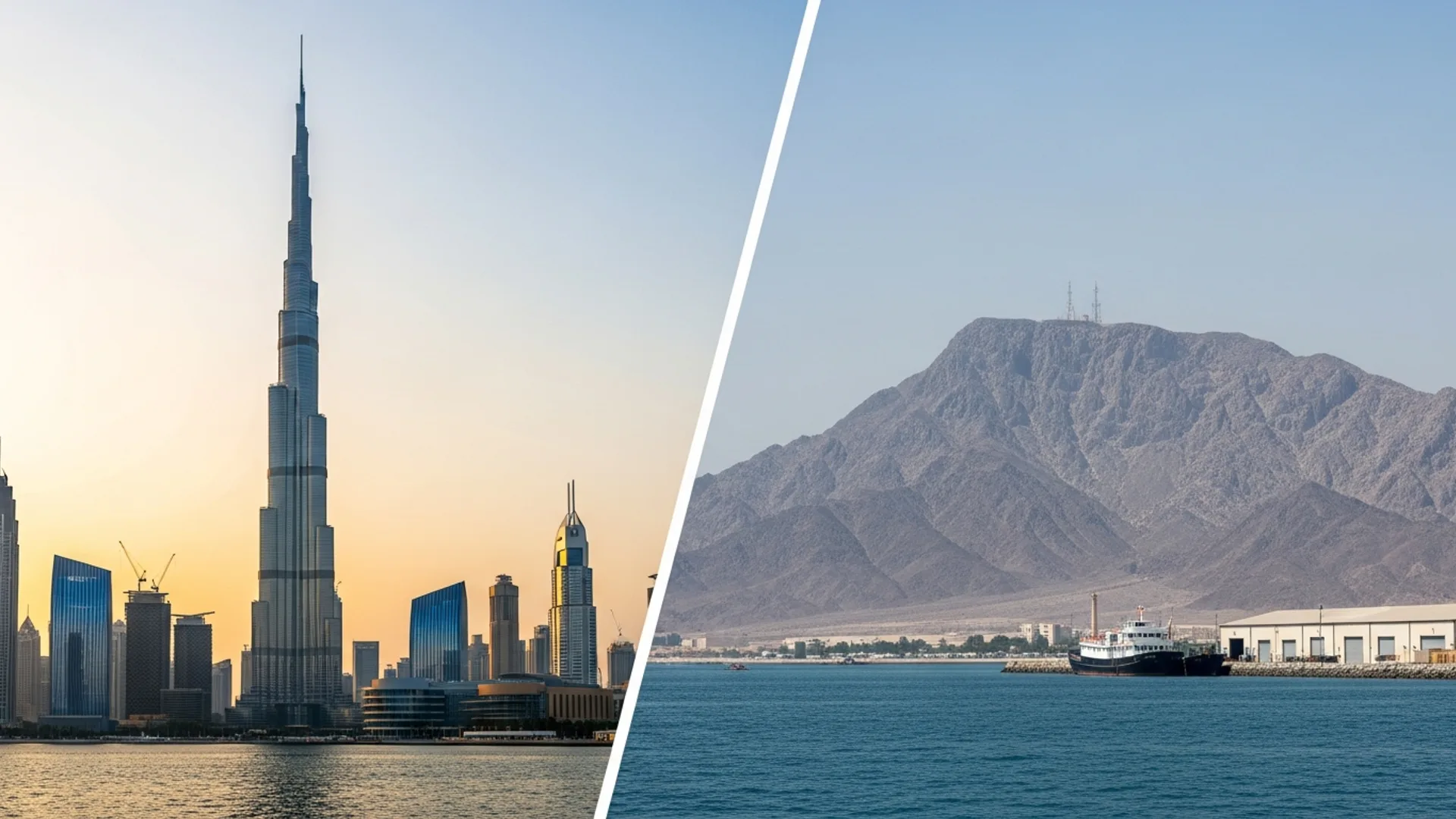
Quick AnswerDubai vs Ras Al Khaimah business setup compared for 2026: cost, RAKEZ vs Dubai free zones, prestige and which emirate fits your business.
Your setup cost, in 10 seconds
Package prices. Health insurance is required by law and not included.
Thank you.
Your written quote follows on WhatsApp.
Dubai vs Ras Al Khaimah business setup in 2026 — which should you choose?
For most founders weighing Dubai vs Ras Al Khaimah business setup in 2026, Ras Al Khaimah is the cheaper, leaner choice for cost-conscious SMEs, manufacturers and industrial or B2B companies, while Dubai is the stronger choice for trading, e-commerce, media, consumer brands and globally facing businesses that need prestige, talent and connectivity. Entry-level RAKEZ free zone packages frequently start in the AED 6,000 to 15,000 range, while comparable Dubai free zone packages often run from around AED 12,500 upward, so Ras Al Khaimah typically wins on raw cost, though the gap is narrower than many expect. Both emirates sit inside the same federal UAE framework, share the identical corporate tax regime administered by the Federal Tax Authority, both offer 100% foreign ownership in their free zones, and both issue nationwide UAE residence visas. The decision is therefore driven less by tax and law and more by budget, sector, where your customers are, and how much brand prestige your model needs. Always confirm current figures with the relevant authority before you commit.
This guide is a decision framework, not a price sheet. It is built to sit alongside our deeper jurisdiction guides rather than repeat them, so you can choose an emirate first and then dive into the mechanics. If Ras Al Khaimah is on your shortlist, our Ras Al Khaimah business setup guide walks through the free zone and mainland mechanics in detail, and our RAK mainland company formation guide covers the onshore route specifically. This article is the sibling to our Dubai vs Abu Dhabi business setup comparison, and the two read well together if you are still mapping the whole emirate landscape. What follows is the layer above all of those: how to decide which emirate fits the business you are actually building.
Why "cheaper" is the wrong place to start the comparison
Almost every founder who arrives at the Dubai-versus-Ras-Al-Khaimah question opens with cost, and that is understandable, because Ras Al Khaimah has built its reputation as the value emirate. But starting with price alone is how people make expensive mistakes. The UAE is a federation, and at the federal level the two emirates share far more than they differ. The currency is the same dirham, pegged to the dollar. Corporate tax is a federal regime under the Ministry of Finance and collected by the Federal Tax Authority, so the headline rate does not change when you cross from Dubai into Ras Al Khaimah. VAT at the standard 5% rate applies nationwide. Labour rules for mainland staff flow through MOHRE on a federal basis, and residence visas are processed through federal immigration via ICP and GDRFA regardless of which emirate licensed your company. Even the customs union means goods moving between the two emirates are not treated as imports.
So a cheaper licence in Ras Al Khaimah does not buy you a different tax bill or a different immigration system. What it buys you is a lower cost of entry and operation, and what a Dubai licence buys you is access to a denser, more globally visible ecosystem. The honest framing is that you are not choosing between a good emirate and a bad one. You are choosing between two genuinely strong jurisdictions that optimise for different things. Ras Al Khaimah optimises for affordability, industrial capacity and lean operations. Dubai optimises for connectivity, prestige, talent depth and consumer reach. The right answer is whichever set of trade-offs shortens your path to paying customers without burning cash you do not need to spend.
That said, the cost difference is real and it compounds. Over a five-year horizon, the gap between a lean Ras Al Khaimah base and a prime Dubai setup can run into tens of thousands of dirhams once you factor in renewals, office rent and operating overhead. For a bootstrapped founder, that difference can be the runway that keeps the business alive. For a venture-backed consumer brand chasing a Dubai market, the same difference is rounding error against the revenue Dubai unlocks. The rest of this guide breaks the decision into the dimensions that actually move the needle.
The regulatory landscape: Dubai's DET and free zones versus RAKEZ
Understanding who regulates what is the foundation of this comparison, because the authority you deal with shapes everything from your licence activities to your renewals and your legal recourse. In Dubai, mainland companies are licensed and regulated by DET, the Department of Economy and Tourism, which carries forward the function historically associated with the DET. When you set up a mainland trading or services company in Dubai, your trade licence, activity codes and renewals run through DET, and you can read about the authority's official mandate directly at DET. Dubai also hosts dozens of free zones, each with its own authority. DMCC serves commodities and general trade, DAFZA sits at the airport for logistics-heavy businesses, JAFZA anchors heavy industry and re-export at Jebel Ali, and IFZA has become a popular cost-efficient option for SMEs. Each free zone issues its own licences and sets its own packages while still operating inside the federal system for tax and immigration.
Ras Al Khaimah's structure is simpler and that simplicity is part of its appeal. The emirate's flagship free zone authority is RAKEZ, the Ras Al Khaimah Economic Zone, which was formed by consolidating earlier RAK free zones into a single body. RAKEZ issues commercial, industrial, educational, professional and service licences, and it is built around offering cost-efficient packages, flexible facilities and, crucially, large tracts of competitively priced industrial land. There is also RAK ICC for international business companies aimed at holding structures and asset protection, which serves a different purpose from the operational free zone licences. For onshore mainland activity in Ras Al Khaimah, the emirate's own economic department handles commercial licensing, the counterpart to Dubai's DET, and that route is covered in detail in our RAK mainland guide.
The practical takeaway is that Dubai gives you a very wide menu of specialised free zones plus a large, mature mainland regulated by a single recognisable authority, while Ras Al Khaimah gives you a streamlined, value-focused free zone in RAKEZ that is especially strong on industrial space and price. Neither structure is better in the abstract. If your business needs a specific Dubai free zone for sector reasons, such as DMCC membership for commodities credibility, that may decide the question. If your business is industrial, warehousing-heavy or simply needs the lowest viable cost of entry, RAKEZ is purpose-built for exactly that.
Cost: where Ras Al Khaimah genuinely wins, and by how much
The reputation that Ras Al Khaimah is cheaper than Dubai is, for once, broadly accurate, though the size of the gap depends entirely on what you are comparing. For a straightforward single-shareholder free zone company with one or two visas, entry-level RAKEZ packages tend to land lower than comparable Dubai free zone options once you account for the licence fee, the establishment card, basic visa allocation and a flexi-desk or shared facility. Ras Al Khaimah's advantage comes from lower underlying real estate and operating costs across the emirate, which flow through into cheaper office space, warehousing and facility fees. Dubai counters with breadth rather than absolute floor: because Dubai hosts so many competing free zones, there is almost always a low-cost option such as IFZA fighting for SME business, which narrows the gap and means a budget Dubai setup is not the impossibility it once was.
Where the cost difference becomes decisive is at scale and in physical footprint. If your business needs warehousing, light or heavy industrial space, or land for manufacturing, Ras Al Khaimah's pricing can be dramatically lower than Dubai's, because the emirate has abundant industrial land and a deliberate strategy of attracting producers. A factory, a building-materials business, a food-processing operation or a bulk-storage logistics player can find that the all-in occupancy cost in RAKEZ is a fraction of what an equivalent footprint costs in a Dubai industrial zone. Conversely, the cost gap narrows to near-irrelevance for a tiny services consultancy that needs only a flexi-desk and one visa, because at that scale both emirates are already cheap and the difference is a few thousand dirhams a year.
Below is an indicative comparison to anchor expectations. Treat every figure as a starting range, not a quote, because packages change frequently and depend on your activity, visa count and facility.
| Item | Dubai (indicative 2026 AED) | Ras Al Khaimah / RAKEZ (indicative 2026 AED) | Notes (indicative — confirm current fees with the authority) |
|---|---|---|---|
| Entry free zone licence, 0 visa | 11,000 – 16,000 | 6,000 – 11,000 | RAK typically lower; Dubai's cheapest zones narrow the gap |
| Free zone licence + 1–2 visas | 18,000 – 30,000 | 13,000 – 22,000 | All-in including establishment card and flexi-desk |
| Mainland trade licence (services) | 18,000 – 35,000 | 12,000 – 25,000 | Varies widely by activity and approvals |
| Flexi-desk / shared office, annual | 8,000 – 20,000 | 5,000 – 14,000 | Dubai prime districts sit at the higher end |
| Warehouse / industrial space | Higher, premium land | Notably lower, abundant land | RAK's clearest cost advantage |
| Corporate tax (federal) | 9% above threshold | 9% above threshold | Identical; set by the Federal Tax Authority |
The pattern is consistent: Ras Al Khaimah is the value play, especially for anything involving physical space, while Dubai is competitive at the very small end and worth its premium when the ecosystem pays for itself. Do not choose on the licence fee alone. The all-in three-year cost, including renewals, office and visa pipeline, is what actually matters, and it is the number we model for clients before recommending an emirate.
Market access and connectivity: Dubai's clearest advantage
If cost is Ras Al Khaimah's home turf, market access and connectivity are Dubai's. Dubai is the most globally connected city in the UAE and one of the most connected in the world. Its airports, the depth of its ports through Jebel Ali, its dense concentration of multinational headquarters, and its sheer visibility mean that a Dubai-based company sits at the centre of regional and global trade flows. For a business whose growth depends on meeting international clients, attracting overseas talent, raising capital from regional investors, or building a consumer brand that people recognise, Dubai's gravity is a genuine competitive asset rather than a vanity purchase. The ecosystem effect is real: events, networking, service providers, banks, accelerators and buyers are concentrated there in a density Ras Al Khaimah cannot match.
Ras Al Khaimah is not isolated, and this is where founders sometimes overcorrect. It is roughly an hour's drive from Dubai, fully integrated into the federal road, customs and logistics network, and home to its own seaport and growing tourism sector around Jebel Jais and the coastline. A RAKEZ company can serve Dubai clients, import and export through UAE ports, and operate across all seven emirates without friction. What Ras Al Khaimah lacks is not access but concentration. The deals, the talent pool and the daily business density are thinner than in Dubai, which matters enormously for some models and barely at all for others. A B2B manufacturer shipping pallets to distributors does not need to be in the room where the networking happens. A founder selling premium services to walk-in enterprise clients probably does.
The practical rule we give clients is to map where their first ten to twenty customers actually are and how they will be reached. If those customers are global enterprises, premium consumers, or anyone who will judge you partly by your address, Dubai's connectivity and visibility justify the higher cost. If those customers are regional distributors, industrial buyers, or anyone who cares about price and product over postcode, Ras Al Khaimah delivers the same federal market access at a lower burn rate. Connectivity is a spectrum, not a switch, and you only need as much of it as your revenue model actually consumes.
Prestige and brand perception: how much does the address matter?
Prestige is the dimension founders are most reluctant to admit matters, and the one that quietly shapes a lot of decisions. A Dubai address carries strong global brand recognition. When an overseas client, a potential partner or a premium consumer sees a Dubai location, it signals a certain level of ambition and credibility, fairly or not. For consumer brands, professional services selling to international buyers, and any business where perception is part of the product, that signal has commercial value. It is not irrational to pay a premium for a Dubai address if your customers attach weight to it, because in those cases the address is part of your marketing.
Ras Al Khaimah's brand is different but far from weak. Within the UAE, across the GCC, and throughout industrial and manufacturing circles, Ras Al Khaimah is well respected and well known, particularly for its heritage in ceramics, building materials and industrial production. For B2B, industrial, regional and trade-focused businesses, a RAK address signals seriousness and cost-discipline rather than any kind of deficiency. The honest assessment is that the prestige gap exists almost entirely at the level of global consumer and enterprise perception. The further your customers are from the UAE, and the more consumer-facing your brand, the more a Dubai address tends to matter. The closer and more industrial your customers are, the less it registers at all.
There is also a pragmatic middle path that many founders overlook. You can base your operations and your cost centre in Ras Al Khaimah while presenting a Dubai face to the market through a branch, a Dubai meeting address, or a later expansion once revenue justifies it. Prestige does not have to be an all-or-nothing decision made on day one. Plenty of successful UAE businesses run a lean RAK core and a thin Dubai presence layered on top, capturing the cost advantage and the brand signal at the same time. The mistake is paying full Dubai prices on day one for prestige you do not yet need, or denying yourself a Dubai presence forever when your market clearly rewards it.
Which business fits which emirate
The cleanest way to use this comparison is to match your model to the emirate that was effectively designed for it. Ras Al Khaimah is the natural home for manufacturing and industrial businesses, because RAKEZ offers large, competitively priced industrial land, warehousing and utilities, and the emirate has decades of credibility in production. It suits cost-conscious founders and bootstrapped startups who need to conserve runway, since the all-in cost of formation and operation is genuinely lower. It works well for B2B, trading and warehousing operations that serve the wider UAE without needing a city-centre address, and for holding or asset-protection structures through RAK ICC where a lean, low-profile entity is the goal. If your priority is keeping costs down while building real operational capacity, Ras Al Khaimah is built for you.
Dubai is the natural home for trading and re-export businesses that benefit from Jebel Ali and the airport free zones, for e-commerce and consumer brands that need market reach and recognition, and for media, marketing, technology and professional services that draw on the deepest talent pool in the country. It suits businesses that need to raise capital, meet international clients regularly, or build a brand whose address is part of its positioning. It also suits companies that need a specific Dubai free zone for sector credibility, such as DMCC for commodities. If your growth depends on connectivity, talent, capital and prestige, Dubai's premium pays for itself, and the higher cost is an investment rather than an expense.
Many founders, of course, do not fit neatly into one box, and that is fine. A common and sensible pattern is to start lean in Ras Al Khaimah to prove the model and conserve cash, then add a Dubai branch or entity once revenue justifies the higher operating cost and the market clearly rewards a Dubai presence. The reverse also happens: a Dubai company sets up a RAKEZ industrial or warehousing arm to move its physical operations to a cheaper base while keeping its commercial face in Dubai. The federal structure makes both moves workable. The point is to choose deliberately based on your sector, budget and customers rather than defaulting to Dubai out of habit or to Ras Al Khaimah purely to save money.
Banking, visas and the practical mechanics
Beyond the headline comparison, founders need to know whether the day-to-day mechanics differ meaningfully between the two emirates, and mostly they do not, with a few nuances worth flagging. On visas, both Dubai and Ras Al Khaimah issue investor, partner and employee residence visas through their licensing authorities and the federal immigration channels via ICP and GDRFA. A residence visa obtained through a RAKEZ company is valid for living and working anywhere in the UAE, exactly the same as a Dubai-issued visa, because residence status is federal. Visa quotas depend on your licence type and the size of your office or facility rather than on the emirate itself, so a larger RAK facility can support more visas than a tiny Dubai flexi-desk and vice versa. Dubai's larger service-provider ecosystem can mean faster turnaround on standard cases, but Ras Al Khaimah's processes are streamlined and entirely workable.
Banking is the area where founders most often worry, and the reality is that UAE corporate account opening is rigorous everywhere, driven by federal compliance standards rather than by which emirate licensed you. A RAKEZ company and a Dubai free zone company go through broadly the same know-your-customer and compliance scrutiny when opening a corporate account. Some founders perceive that a Dubai address makes banking marginally smoother, but in practice the bigger drivers are your business activity, your shareholders' profiles, your expected transaction patterns and the quality of your documentation. A well-prepared RAK company opens accounts successfully every day. The key is to go in with a clean, coherent business case and complete paperwork, which is something we prepare with clients regardless of emirate.
On the regulatory and operational side, both emirates plug into the same federal systems for tax registration with the Federal Tax Authority, for any VAT obligations, and for labour matters through MOHRE where mainland staff are involved. Renewals, licence amendments and activity additions follow each authority's own process, with RAKEZ generally praised for streamlined, predictable procedures. The practical message is reassuring: choosing Ras Al Khaimah over Dubai does not hand you a harder operational life. It hands you a lower-cost base inside the same federal machinery, and the mechanics that matter most, namely tax, visas and compliance, are federal and therefore largely emirate-neutral.
Common Mistakes to Avoid
The most common mistake we see is choosing purely on the headline licence fee. A founder reads that a RAKEZ package is cheaper than a Dubai one and books it without modelling the all-in, multi-year cost or asking whether the cheaper base actually fits the business. Sometimes it does, and the saving is real. But a consumer brand that needs Dubai's market and ends up isolated in a low-cost zone can lose far more in missed revenue than it ever saved on the licence. The fee is the smallest number in the equation. Compare the three-year all-in cost including renewals, office and visas, then weigh it against the revenue each emirate actually unlocks for your specific model. The cheapest setup is only cheap if it does not cost you the business.
The second mistake is the opposite error: paying full Dubai prices on day one for prestige the business does not yet need. Bootstrapped founders routinely overspend on a prime Dubai address because it feels like the serious choice, then run short on runway before the brand has any revenue to justify the burn. If your first customers are regional, industrial or price-sensitive, a Ras Al Khaimah base buys you the same federal market access and the same nationwide visas at a meaningfully lower cost, and you can always add a Dubai face later. Prestige is worth paying for when your customers reward it; it is dead weight when they do not. Match the spend to the stage and the customer, not to the ego.
A third mistake is assuming a Ras Al Khaimah company cannot serve Dubai clients or operate across the emirates. It can. The UAE is a single federal market, and a RAKEZ licence lets you trade nationwide. The genuine limits are narrow and specific: a physical shopfront in Dubai, certain Dubai government contracts, or particular regulated activities may require a Dubai branch or mainland licence. Founders who do not understand this either over-restrict themselves by assuming RAK is local-only, or under-prepare by assuming RAK gives them everything a Dubai mainland licence does. Get clear, sector-specific advice on exactly what your activity requires before you choose, because the answer depends on whether you need physical Dubai presence or simply Dubai customers.
The fourth mistake is ignoring the physical-footprint dimension. Founders who will eventually need warehousing or industrial space sometimes set up a cheap Dubai services licence first, only to discover that scaling into physical operations in Dubai is far more expensive than it would have been in Ras Al Khaimah, where industrial land is abundant and cheap. If there is any chance your model grows into manufacturing, processing, bulk storage or significant warehousing, factor that into the day-one decision rather than the day-one licence. Restructuring across emirates later is doable but costs time and money. Finally, never treat indicative prices, including the ranges in this guide, as fixed quotes. Packages, fees and rules change, so confirm current figures directly with the authority or a qualified consultant before you commit a single dirham.
How Noble Core Ventures helps you decide
Choosing between Dubai and Ras Al Khaimah is not really a question about two emirates. It is a question about your business: your budget, your sector, your customers, your hiring plans and how much prestige your model genuinely needs. Both emirates are strong, both sit inside the same federal framework with identical corporate tax and nationwide visas, and both can be the right answer depending on the founder asking. Ras Al Khaimah wins on cost, industrial capacity and lean operations. Dubai wins on connectivity, talent, capital access and global brand recognition. The mistake is choosing on reputation or reflex rather than on the trade-offs that actually shape your first two years of revenue.
At Noble Core Ventures, we model the all-in cost of both routes against your specific activity, visa needs and growth plan, then recommend the emirate, the free zone or mainland structure, and the facility that shortens your path to paying customers without burning cash you do not need to spend. If you want to dig deeper into either jurisdiction, start with our Ras Al Khaimah business setup guide and our RAK mainland company formation guide, and read them alongside our Dubai vs Abu Dhabi business setup comparison if you are still weighing the wider emirate landscape. When you are ready to turn the comparison into a decision, talk to our team and we will map the right setup to the business you are actually building.
Talk to Our Experts
Choosing between Dubai and Ras Al Khaimah for your company setup, matched to your budget, sector, client base and visa needs
Frequently Asked Questions
Is it cheaper to set up a business in Dubai or Ras Al Khaimah in 2026?
Ras Al Khaimah is usually the cheaper emirate for entry-level company formation, with RAKEZ packages frequently landing below comparable Dubai free zone options. The gap is real but narrower than many founders expect, because Dubai’s intense free zone competition has pushed several Dubai packages down too. Cost should be compared on the all-in figure including visas, establishment card and office, not the headline licence fee. Always confirm current numbers with the authority before budgeting.
What is RAKEZ and how does it compare to Dubai free zones?
RAKEZ, the Ras Al Khaimah Economic Zone, is the emirate’s flagship free zone authority, formed by merging earlier RAK zones into one body offering commercial, industrial, educational and service licences. It is known for cost-efficient packages, flexible facilities and strong industrial land options. Compared to Dubai zones like DMCC, DAFZA or IFZA, RAKEZ generally competes on price and industrial space rather than central-city prestige and global connectivity, making it attractive to budget-conscious SMEs and manufacturers.
Can a Ras Al Khaimah company do business in Dubai?
Yes. A company licensed in Ras Al Khaimah can trade with clients across all seven emirates, since the UAE is a single federal market for most commercial purposes. The nuance is physical presence and onshore mainland work: to open a physical shop or office in Dubai or to take certain Dubai government contracts, you may need a Dubai branch or mainland licence. Many founders run a RAK free zone company while serving Dubai clients remotely. Confirm sector rules first.
Is a Dubai address more prestigious than a Ras Al Khaimah address for clients?
For many international and consumer-facing clients, a Dubai address still carries stronger brand recognition because Dubai is the UAE’s best-known global business hub. Ras Al Khaimah is well respected within the UAE and across industrial, manufacturing and regional B2B circles, but it has less global name recognition. If your customers are overseas enterprises or premium consumers, Dubai prestige can matter; if they are regional, industrial or price-sensitive, the difference rarely affects deals.
Which emirate is better for manufacturing, Dubai or Ras Al Khaimah?
Ras Al Khaimah is widely favoured for manufacturing, industrial and heavy-trade activity because RAKEZ offers large, competitively priced industrial land, warehousing and utility access, and the emirate has a long history in ceramics, building materials and industrial production. Dubai has excellent logistics and free zones like JAFZA, but prime industrial space tends to cost more. For factories, processing and bulk warehousing on a budget, Ras Al Khaimah is often the stronger and more cost-effective choice.
Is corporate tax different in Dubai versus Ras Al Khaimah?
No. Corporate tax in the UAE is a federal regime administered by the Federal Tax Authority, so the headline rate is identical whether you set up in Dubai or Ras Al Khaimah. The standard rate is generally 9% on taxable profit above the threshold, with qualifying free zone income potentially at 0% under Ministry of Finance rules. Tax treatment depends on your activity and how you operate, not on which emirate licensed your company, so seek professional advice on your specific structure.
How do visas work for a Ras Al Khaimah company versus a Dubai company?
Both emirates issue investor, partner and employee visas through their licensing authorities and federal immigration channels via ICP and GDRFA. Dubai’s larger ecosystem means more service providers and often faster turnaround for standard cases, while Ras Al Khaimah processes are streamlined and competitive. Visa quotas depend on your licence type and office or facility, not just the emirate. A RAK free zone visa is valid for UAE residence nationwide, the same as a Dubai-issued one.
Can I move my company from Ras Al Khaimah to Dubai later, or vice versa?
Yes, though it is not a single click. Common routes include opening a branch in the other emirate, registering a new entity, or in some free zones migrating the company where re-domiciliation is supported. The practical path depends on your current jurisdiction, licence type and contracts. Many founders simply add a Dubai branch to a RAK base, or vice versa, rather than fully relocating. Plan your structure early with proper advice so you keep options open as you scale.
Which is better for a startup, Dubai or Ras Al Khaimah?
It depends on your sector, budget and customers. Dubai suits trading, e-commerce, media, consumer brands and globally facing startups that want a deep talent pool, investor access and strong connectivity. Ras Al Khaimah suits cost-conscious founders, manufacturers, industrial and B2B businesses, and anyone wanting a lean base while serving the wider UAE. Many founders start lean in RAK to conserve cash, then add a Dubai presence once revenue justifies the higher operating cost.
Contact Us For Free Consultation
Licensed UAE consultancy. One reply, no spam.
Thank you.
A consultant will reply on WhatsApp shortly.