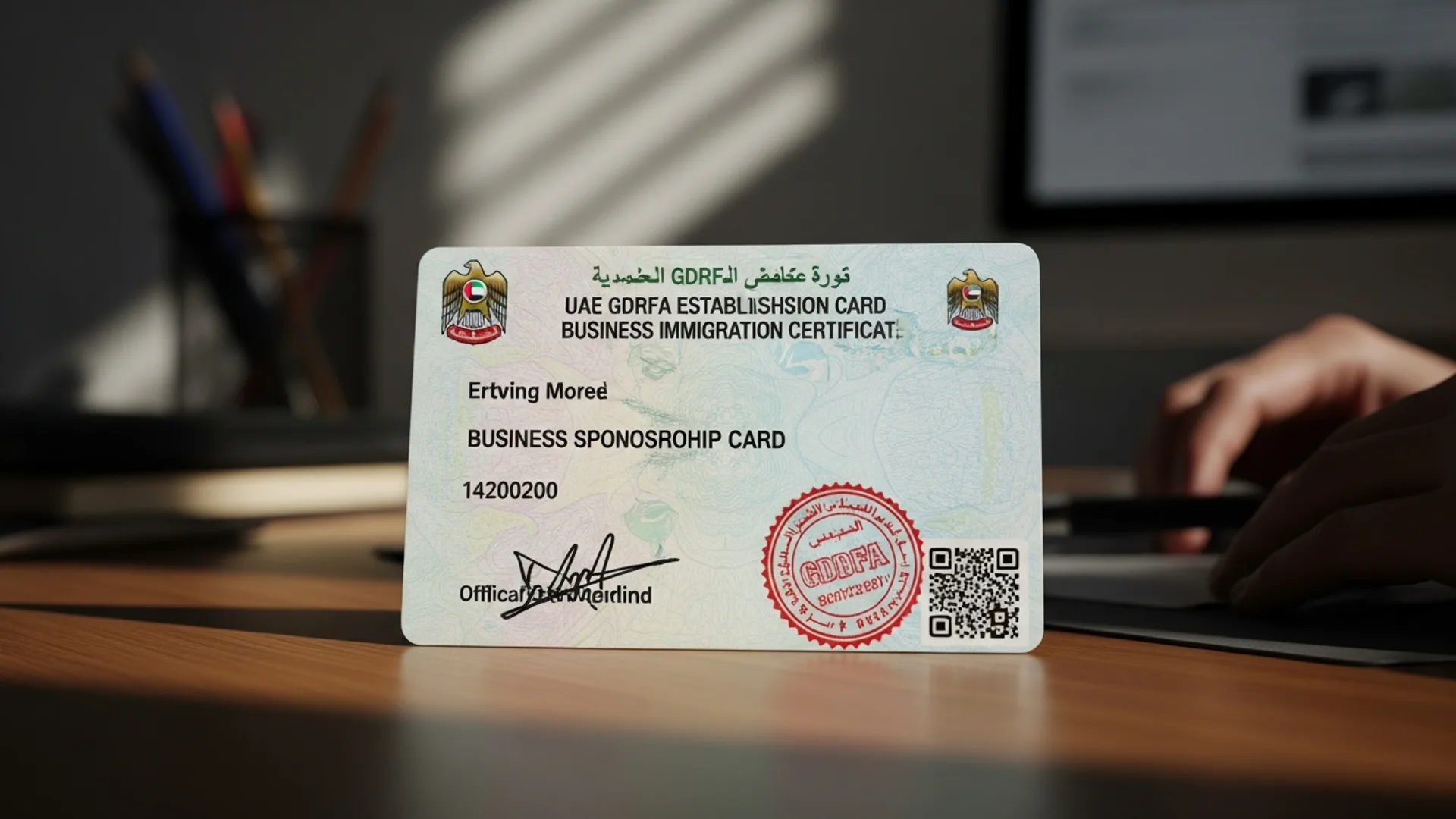
What is an establishment card and why you need one
An establishment card (also called an immigration card or establishment immigration card) is the document that registers a company with the UAE immigration authorities, enabling it to sponsor residence visas for owners and employees. Without a valid establishment card, a company cannot process work or residence visas. It must be renewed periodically; an expired card blocks all visa transactions, so keeping it current is essential.
Quick AnswerUAE Establishment Card 2026 — AED 600 issuance, 1–3 year validity, mandatory for company visa sponsorship. Full process, GDRFA portal and renewal.
Establishment card UAE 2026 — cost, process, renewal
A UAE Establishment Card costs AED 600 for initial issuance plus AED 300-1,000 in service fees in 2026. The card is mandatory for any UAE company that wants to sponsor employee visas, hire staff, or operate within the residency system. It links your trade license to the GDRFA residency framework and to the Ministry of Human Resources and Emiratisation (MOHRE) labour file. Without it, your license exists on paper but cannot support real operations.
This guide is built from real establishment card applications and renewals across Dubai mainland and major free zones (IFZA, DMCC, Meydan, JAFZA) under the General Directorate of Residency and Foreign Affairs (GDRFA), the Federal Authority for Identity, Citizenship, Customs and Port Security (ICP), and the Ministry of Human Resources and Emiratisation (MOHRE). It covers application steps, GDRFA portal access, the relationship between the card and visa quotas, and the renewal process.
What the establishment card actually does
The establishment card is the bridge document between your business license and the UAE residency system. It enables:
- Sponsoring employee visas — without an active card, GDRFA cannot process work visas under your company name
- Sponsoring investor and partner visas — the founder's own residency visa typically requires the card to be active
- Issuing entry permits — for new hires and family members of staff
- Accessing the GDRFA digital portal — for visa applications, renewals, cancellations, status checks
- Linking to MOHRE labour file — required for employment contracts and end-of-service settlements
- Customs code application — Dubai Customs requires an active establishment card alongside the trade license
Without an active establishment card, your trade license is essentially decorative — you cannot hire staff, sponsor visas, or run real operations.
The real cost in 2026
Line items for establishment card setup in Dubai 2026:
| Line item | AED (2026) | Who collects it |
|---|---|---|
| GDRFA establishment card fee | 600 | GDRFA |
| Service centre processing | 300–800 | GDRFA-approved service centre |
| Typing centre fees (Arabic translation if needed) | 100–300 | Typing centre |
| Priority/fast-track (optional) | 200–500 | GDRFA |
| Total initial issuance | AED 1,000–2,200 | |
| Annual renewal | AED 1,000–2,000 | GDRFA |
| 3-year renewal (eligible established companies) | AED 1,800–3,500 | GDRFA |
Most free zone packages (IFZA, Meydan, RAKEZ, Sharjah Media City) include the establishment card in their base license fee — you don't pay it separately. Mainland DET licenses always require separate GDRFA application.
For the latest GDRFA fees see the General Directorate of Residency and Foreign Affairs at https://www.gdrfad.gov.ae/. ICP federal rules at https://www.icp.gov.ae/. MOHRE labour rules at https://www.mohre.gov.ae/.
Contact Us For Free Consultation
or
Ask on WhatsApp insteadLicensed UAE consultancy. One reply, no spam.
Thank you.
A consultant will reply on WhatsApp shortly.
Application process — step by step
Step 1: Confirm prerequisites (Day 1)
You need:
- Valid trade license (DET or free zone)
- MOA / company formation documents
- Manager passport copy with valid UAE residence visa (or entry permit for new founders)
- Manager Emirates ID
- Company contact details (phone, email, registered address)
- Office tenancy contract (Ejari for mainland, free zone lease for FZ companies)
Missing any of these stops the application. Service centres won't begin processing without complete documents.
Step 2: Submit via GDRFA service centre or online portal (Day 1–3)
Two paths:
- GDRFA service centre (in-person): Visit any GDRFA-approved Amer or Tasheel service centre with documents. The centre handles application submission, Arabic translation if needed, and document attestation. Typical visit time 1-3 hours.
- GDRFA digital portal (online): Submit via the GDRFA app or web portal at gdrfad.gov.ae. Required if you have UAE Pass and existing GDRFA file. Faster but only available for already-active companies seeking renewal.
For first-time issuance, in-person service centre is more common because of attestation requirements.
Step 3: Pay fees and await issuance (Day 2–5)
GDRFA reviews documents, validates trade license linkage, and confirms address. Issuance typically 3-5 working days. Service centre staff coordinate via SMS/email.
Step 4: Receive establishment card (Day 5–7)
The card is issued digitally (PDF) and can be downloaded from the GDRFA portal once approved. Physical cards are no longer issued in 2026 — the digital version is the legal document.
Step 5: Link to MOHRE labour file (Day 7–14)
Once the card is active, you typically apply for the MOHRE labour file (Tasheel labour establishment file) within 2 weeks. The labour file uses the establishment card details to register your company as an employer. Without the labour file, you cannot issue work permits even if the establishment card is active.
The relationship between card, visa quota and labour file
These three are linked but distinct:
| Document | Issued by | Purpose | Tied to |
|---|---|---|---|
| Establishment card | GDRFA | Authorise company to sponsor visas | Trade license |
| Labour file | MOHRE | Authorise company as employer | Trade license + establishment card |
| Visa quota | GDRFA + MOHRE | Maximum number of work permits company can hold | Office size + establishment card |
A new company gets all three set up in sequence: license → establishment card → labour file → visa quota allocation. Quota is typically calculated at 9 sqm per employee for mainland offices, with adjustments for industrial spaces and ground-floor retail.
Common mistakes that cost founders money
- Mistake 1: Forgetting to renew before expiry. Renewal must complete BEFORE expiry. A 30-day grace period exists with light penalties (AED 100/day), but beyond 30 days fines escalate to AED 25,000+ for prolonged lapses. Calendar reminders 60 days before expiry are essential.
- Mistake 2: Missing the trade license renewal link. Your establishment card cannot be renewed unless your trade license is also active. Many founders renew their trade license late and discover their establishment card has also lapsed. Renew the trade license first, then the establishment card.
- Mistake 3: Wrong manager name on the card. The card shows the appointed manager (per MOA). If you change managers without updating GDRFA, signed documents and visa applications get rejected. Update the card whenever management changes — cost AED 200-500.
- Mistake 4: Trying to hire before card is issued. Visa applications for new hires only process after the establishment card is active. Founders who try to hire before card issuance face 2-4 week delays for the new employee.
- Mistake 5: Not linking to MOHRE labour file. Establishment card alone is insufficient — you also need the MOHRE labour file. Some founders complete the GDRFA step and skip MOHRE, then can't issue work permits. Always complete both within the first 30 days.
GDRFA portal access — operational reality
Once your establishment card is active, you (and authorized PRO services) can access the GDRFA portal for:
- New visa applications (employees, family members)
- Visa renewals
- Visa cancellations
- Status changes (e.g., from visit visa to work visa)
- Emirates ID applications
- Card renewal and replacement
- Salary certificate generation
- Quota management
Portal access requires UAE Pass linked to the manager's Emirates ID. Most companies delegate routine operations to a PRO (Public Relations Officer) — an employee or external service that handles GDRFA, MOHRE, and DET interactions.
PRO services in Dubai 2026 cost AED 1,500-3,500/month for a part-time external PRO handling a small company (1-10 employees), AED 6,000-15,000/month for in-house PRO covering medium operations (20+ employees), or per-transaction fees (AED 200-800 per visa application) for smaller operations.
Renewal timeline and process
Annual or triennial renewal follows a similar process to initial issuance:
Step 1: Confirm trade license is active
Renewal requires an active trade license. If the license expires within 30 days of card expiry, renew the license first.
Step 2: Submit renewal application (60-30 days before expiry)
Start renewal 60 days before expiry. Submit via GDRFA portal or service centre. Documents required:
- Current establishment card (expiring)
- Renewed trade license
- Manager Emirates ID (current)
- Updated MOA if any changes
- Updated tenancy contract (Ejari)
Step 3: Pay renewal fees (Day 1–7)
AED 600 renewal fee + service centre fees. 3-year renewal AED 1,800–3,500.
Step 4: New card issued (Day 7–14)
Renewed card replaces previous one. Operations continue without interruption if renewed before expiry.
What changes between free zone and mainland establishment cards
The establishment card itself is identical document — same GDRFA-issued format. Differences are in:
- Application path: Mainland through DET-DM-GDRFA flow; free zones through their internal services + GDRFA branch
- Cost structure: Mainland separate fee; free zones often include in package
- Service centre access: Mainland via Amer/Tasheel; free zones via internal GDRFA desk
- Renewal coordination: Free zones often coordinate renewal proactively; mainland founders manage independently
For mainland companies see Dubai mainland license breakdown. For free zone setup paths see DED activity list.
Card status check and verification
Establishment card status can be checked in three ways:
- GDRFA portal: Login with UAE Pass, view card details, expiry, and any flags
- GDRFA app: Mobile app with same features
- MOHRE portal: Cross-reference between card status and labour file status
For third-party verification (banks, customs, vendors checking your company), the GDRFA validation tool at gdrfad.gov.ae allows public verification of company existence and card validity using the trade license number.
When you need card amendments (not renewal)
Distinct from renewal, sometimes you need to AMEND the existing card:
- Manager change — different person becomes appointed manager. Amendment fee AED 200-500, takes 3-5 days.
- Company name change — full re-issuance. Treated as new card with new validity period.
- Address change — amendment to update registered address. AED 200-300.
- Trade license amendment that affects activities — sometimes triggers card re-issuance.
- Conversion (mainland to free zone or vice versa) — full new card application required.
Most amendments are simple. Don't let outdated card information persist — banks and government services flag mismatches between current operations and card details.
Establishment card and customs code
If your business imports or exports physical goods, you also need a Dubai Customs code (or other emirate's customs registration). The customs code application requires an active establishment card. Specifically:
- Customs registration through Mirsal 2 system
- Authorized signatory list (whoever can sign customs declarations)
- Bank account details (for duty deposits)
Customs code annual fee AED 1,500-4,500. Without it, physical imports cannot be cleared. See related discussion in import-export license guide.
Special considerations by company structure
Single-shareholder LLC
Straightforward. Manager and shareholder typically the same person. Establishment card issued in the company name with manager's details.
Multi-shareholder LLC
Manager designated in MOA must be specified on the card. If managers change, card amendment required.
Branch of foreign company
Establishment card issued in branch name. Linked to parent company registration. Different documentation flow but similar fees.
Holding company with subsidiaries
Each subsidiary needs its own establishment card. Cards cannot be shared across entities. Holding company structures typically have 2-5 separate cards.
Free zone branches
Free zone branches typically use the free zone's GDRFA channel rather than mainland service centres. Faster processing but coordinated through the zone.
What changes if you are foreign-owned vs UAE-resident
Process is identical. Foreign founders need to be in UAE on a valid entry permit or visa when applying for the card. UAE residents on existing visas can transition to investor visa under the new company once the card is active.
100% foreign ownership applies to most activities under the 2021 amendment to Federal Law on Commercial Companies. The establishment card does not depend on Emirati partnership — it's issued to whatever ownership structure your trade license reflects.
Maintaining card health over time
Annual best practices to keep your establishment card healthy:
- Q1: Verify trade license renewal completed
- Q2: Check establishment card expiry date — renewal in next 6 months?
- Q3: Verify Ejari/lease renewal — required for card renewal
- Q4: Update manager info if any changes; sync with bank and customs records
Late renewal is the single most common cause of card-related operational disruption. A simple calendar with 60-day-before-expiry alerts prevents 95% of issues.
What your first 90 days look like
Typical timeline for a Dubai mainland LLC's establishment card setup:
- Days 1-7: Trade license issued. Establishment card application submitted via Amer service centre.
- Days 8-14: Establishment card issued. MOHRE labour file opened.
- Days 15-21: Visa quota allocated. Investor visa application begins.
- Days 22-35: Investor visa stamped. Emirates ID issued.
- Days 36-60: First employee visas applied. Bank account opening underway.
- Days 61-90: Bank active. Customs code (if applicable). First employees onboarded.
For free zone companies, the timeline compresses slightly because the establishment card is often issued with the license itself.
PRO services vs in-house management
Most small Dubai companies in 2026 outsource establishment card management (along with all GDRFA, MOHRE, DET interactions) to a PRO service rather than handling internally. Typical PRO service contracts:
- Basic monthly retainer — AED 1,500-3,500/month covers establishment card renewals, basic visa applications, license renewal coordination. Good for 1-10 employee companies.
- Standard retainer — AED 4,500-8,500/month covers above plus medical insurance coordination, Emirates ID renewals, customs code work, labour disputes. Mid-size operations.
- Premium retainer — AED 9,000-25,000/month covers all of above plus corporate restructuring, sector approvals, GCC subsidiaries. Group companies and larger operations.
- Per-transaction PAYG — AED 200-1,500 per transaction (specific application). Best for very small companies or one-off needs.
Decision factors: company size, GDRFA interaction frequency, founder time availability. Most founders we work with engage a PRO service from day 1 because the administrative burden grows quickly with multiple employees.
Family visa sponsorship via your establishment card
Active establishment card enables the company manager (or investor visa holder) to sponsor immediate family:
- Spouse — income requirement AED 4,000/month + valid Ejari/tenancy showing minimum 2-bedroom or equivalent
- Children under 18 — automatic eligibility under parent's visa
- Children 18-25 (university age) — possible with documented student status
- Parents — income requirement AED 20,000/month, harder to qualify
- Domestic helpers — separate sponsorship under maid visa rules
Each family visa application is processed under your establishment card's quota. Cost AED 3,000-5,500 per family member visa (3-year validity). The application uses the same GDRFA portal as employee visas — same workflow but different document set.
Maintaining compliance across multi-entity structures
For founders running multiple UAE entities (Holding Company + 2-3 subsidiaries), establishment card management gets more complex:
- Each entity needs its own card
- Renewal dates can stagger (different license issuance dates)
- Managers can be the same person (you, the founder) but the card is per-entity
- Salary certificates and visa quotas are per-card, not aggregated
- Banking sometimes requires evidence of all active cards across the group
Group treasury and HR teams use spreadsheets or specialised software (Bitrix, custom CRM) to track card statuses across entities. Late renewal on one subsidiary doesn't affect others, but compounds the operational disruption if multiple cards lapse simultaneously.
Documents and digital signatures
Modern GDRFA processing in 2026 increasingly uses UAE Pass digital signatures for establishment card applications and amendments. UAE Pass is the federal digital identity that links Emirates ID, residency, banking, and government services. Once your manager's UAE Pass is verified, document signing becomes paperless:
- Sign establishment card applications digitally
- Sign visa applications digitally
- Sign tenancy contract attestations digitally
- Sign government service agreements digitally
This reduces processing time by 30-50% versus paper-based workflows. UAE Pass setup is free via the UAE Pass app linked to Emirates ID. Highly recommended for all company managers.
Establishment card and free zone migration
If you decide to move from one free zone to another (e.g., RAKEZ → DMCC), or from free zone to mainland, the establishment card does not transfer. A new card is issued for the new entity. Typical migration steps:
- Cancel existing visas under old establishment card
- Cancel old establishment card (final compliance)
- Set up new entity in new jurisdiction
- Apply for new establishment card
- Reapply for visas under new card
Migration takes 6-12 weeks total and triggers tax/banking reviews. Plan migration during quieter operating periods to minimise disruption.
Establishment card vs trade license vs Emirates ID — clarifying the documents
First-time founders often confuse these three documents:
- Trade license — issued by DET or free zone. Authorises the business to operate. Annual renewal AED 8,000-35,000 depending on activity.
- Establishment card — issued by GDRFA. Authorises the business to sponsor visas and access immigration system. Annual renewal AED 600 + service fees.
- Emirates ID — issued by ICP to individuals. Personal identity document. Linked to residency visa, not directly to the company.
All three are typically active simultaneously for an operational UAE business. They renew on different cycles. Calendar these separately to avoid coincidental expiry.
A common pitfall — out-of-date card on bank file
Banks regularly check that your establishment card details match your current operations. Mismatches trigger account reviews. Common scenarios:
- Manager changed but card not updated → bank sees outdated authorised signatory
- Address changed but card not updated → bank flags address mismatch with Ejari
- Card expired and renewed but new card not uploaded to bank → bank treats account as on hold
Update your bank within 7 days of any establishment card change to prevent account holds.
Final operational notes for first-time card holders
Keep digital copies of your establishment card accessible to your PRO, accountant, banker, and customs broker. The card is requested for nearly every government interaction.
What to do next
If you have an active trade license but no establishment card yet, the next step is service centre application via Amer (mainland) or your free zone's GDRFA desk. The application takes 3-5 days and AED 1,000-2,200 total. Time it to coincide with your investor visa application to avoid sequencing delays. We help founders coordinate the establishment card + investor visa + labour file + bank account sequence to minimise time-to-operational. A 20-minute call clarifies the sequence for your specific setup.
Related Noble Core deep-dives
Companion guides for founders working on establishment card setup or adjacent topics:
- MOA UAE 2026 — memorandum of association — formed before establishment card
- WPS payroll UAE — card prerequisite for WPS setup
- DED activity list — activity selection before card application
Talk to Our Experts
Get your UAE establishment card issued and renewed without GDRFA delays. Card application, immigration portal access, visa quota allocation and labour file linking handled end-to-end. Free 20-minute consultation.
Frequently Asked Questions
What is a UAE establishment card?
An establishment card (also called an immigration card or company card) is the GDRFA-issued document that allows a UAE-licensed company to sponsor employee visas and operate within the UAE residency system. Every Dubai mainland or free zone company that wants to hire employees or sponsor investor visas needs an establishment card. It links the trade license to the residency and labour systems.
How much does an establishment card cost in UAE 2026?
An establishment card costs AED 600 for initial issuance + AED 300-1,000 in service centre fees in 2026. Renewal is AED 600 + service fees, paid every 1-3 years depending on validity period. Some free zones include the establishment card in their package fee (e.g., IFZA, Meydan). Mainland DET requires separate application via GDRFA.
How long does it take to get an establishment card?
An establishment card is typically issued within 3-7 working days of application. The card application requires a valid trade license, MOA, manager passport, photo, and signed application. Fast-track issuance (1-2 days) is available at GDRFA service centres for an additional AED 200-500 priority fee.
What is the difference between an establishment card and an immigration card?
They are the same thing — the document was historically called Immigration Card but is now officially titled Establishment Card under the new GDRFA system. Both terms appear in older documentation. New cards issued after 2023 use Establishment Card as the official name; older companies with Immigration Cards continue to use that nomenclature until renewal.
Do free zone companies need a separate establishment card?
Yes. Each company needs its own establishment card regardless of whether it operates on mainland or in a free zone. Some free zones bundle the card with the license package (IFZA, Meydan, RAKEZ) while others require separate GDRFA application. Free zone cards are issued through the GDRFA branch handling that zone — typically faster than mainland processing.
How long is an establishment card valid?
Standard validity is 1 year for new companies. Established companies (3+ years operating, clean compliance history) can apply for 3-year cards. Some sectors (medical, education, regulated financial) are restricted to 1-year cards regardless of company age. Renewal must be completed before expiry to maintain employee visa sponsorship continuity.
What happens if my establishment card expires?
Expired establishment cards trigger immediate freeze on all visa-related activities — no new visas can be issued, no existing visas can be renewed, no employees can be added. Penalties for late renewal are AED 100-500 per day plus AED 5,000-25,000 reinstatement fees for prolonged lapses. Some employee visas may face cancellation if the card is expired for 90+ days.
Can I link multiple licenses to one establishment card?
No. Each trade license requires its own establishment card. Companies with multiple licenses (e.g., a Holding Company structure) maintain one establishment card per registered entity. The cards are linked to the specific license number and cannot be transferred between entities. Group companies typically have 2-5 separate establishment cards for their various subsidiaries.