Quick answer
Hamriyah Free Zone industrial license starts at AED 5,500 for Standard FZE and AED 35,000+ for Light Industrial Unit. — Setup takes 6-8 weeks with 30-40% lower costs than JAFZA.
- Located adjacent to Khalid Port (UAE’s third-largest container terminal) with 4-12 hours typical port-to-warehouse transfer
- Hosts 6,500+ companies across petrochemicals, construction materials, food production, and metal fabrication clusters
- Industrial land plots from 5,000 sq m available, with lease costs AED 100-175K/year versus AED 250-450K/year at JAFZA
Best for: mid-market manufacturers and heavy-industry operators requiring port adjacency at lower cost than Dubai alternatives
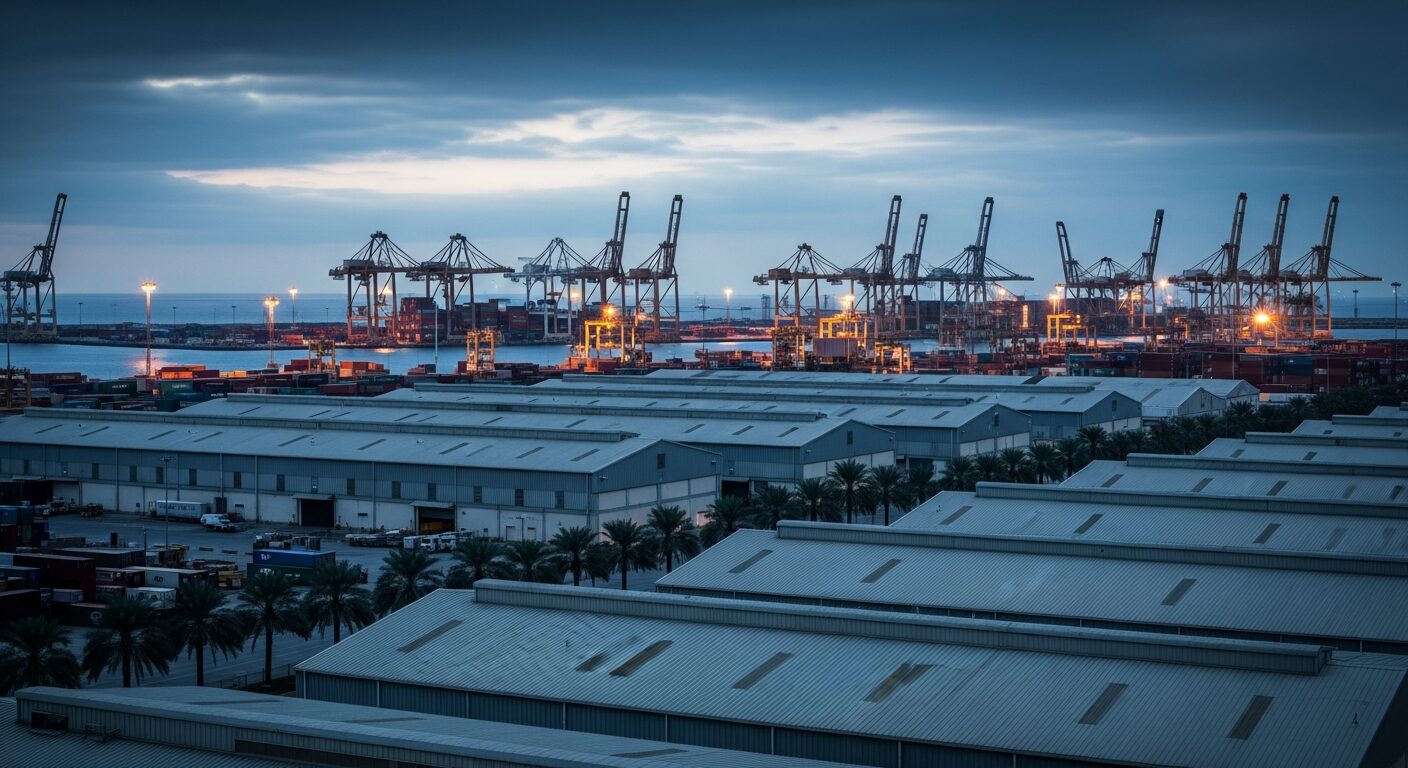
Hamriyah Free Zone Authority (HFZA) is Sharjah’s largest industrial free zone, established in 1995 adjacent to Khalid Port. With 6,500+ companies and dedicated industrial clusters for petrochemicals, oil services, construction materials, food production, and heavy industry, Hamriyah delivers JAFZA-level industrial infrastructure at 30-40% lower cost. For mid-market manufacturers, distributors, and heavy-industry operators where Jebel Ali Port’s premium isn’t required, Hamriyah is structurally the best-value heavy-industry setup in the UAE.
This guide covers Hamriyah Free Zone setup for 2026: real fees from AED 5,500 (FZE) to AED 35,000+ (industrial), allowed activities, the 6-8 week process, Khalid Port integration, visa quotas, and where Hamriyah beats RAKEZ, JAFZA, and SAIF Zone for industrial operations.
What Is Hamriyah Free Zone?
Sharjah-government-owned free zone occupying 30+ sq km of industrial land adjacent to Khalid Port (Sharjah’s primary container terminal). Its USP for 2026: dedicated industrial clusters, large land plots from 5,000 sq m, deep-water port adjacency, and significantly lower setup + operating costs than Dubai’s JAFZA. Hosts include Crescent Petroleum, Air Liquide, Lafarge cement, dozens of construction-materials manufacturers, and Sharjah’s oil-and-gas services ecosystem.
Hamriyah Cost Breakdown 2026
| Setup tier | Setup fee (AED) | Workspace | Year-1 estimate |
|---|---|---|---|
| Standard FZE | AED 5,500-9,500 | Smart desk / shared | AED 12,000-18,000 |
| Standard FZ-LLC | AED 14,500 | Office 30+ sq m | AED 35,000-55,000 |
| Light Industrial Unit (LIU) | AED 35,000+ | Pre-built warehouse 250-1,000 sq m | AED 100,000-200,000 |
| Industrial Land Plot | AED 50,000+ | 5,000+ sq m allocated land | AED 175,000+ (excl. construction) |
Industrial Activities at Hamriyah
- Petrochemicals + oil services: Dedicated cluster, equipment, supply-chain operators
- Construction materials: Cement, concrete, ceramics, glass, gypsum (large cluster)
- Food production: Processing, packaging, cold-chain (Sharjah halal infrastructure)
- Metal fabrication: Steel, aluminium, machining, welding
- Plastics + polymers: Injection moulding, recycling, packaging
- Heavy machinery: Industrial equipment, parts, distribution
- General trading: Standard FZE/FZ-LLC for non-industrial operations
Khalid Port Integration
Khalid Port (Sharjah’s container terminal) is the UAE’s third-largest port by container volume after Jebel Ali and Khalifa. For Hamriyah licensees:
- Direct port-to-warehouse: 4-12 hours typical from container landing to warehouse
- Bonded warehousing: Goods cleared into FZ without customs duties until re-export
- Lower port handling fees than Jebel Ali (typically 20-30% cheaper per container)
- Customs efficiency via Sharjah Customs digital portal
- Strategic for GCC + East Africa trade: Sharjah Sea Container terminal positioned for Iran, Saudi East Coast, Qatar, East Africa routes
Hamriyah vs JAFZA vs RAKEZ for Heavy Industry
| Criterion | Hamriyah | JAFZA | RAKEZ |
|---|---|---|---|
| Setup cost (LIU) | AED 35,000+ | AED 75,000+ | AED 17,500+ |
| Land lease (5,000 sq m) | AED 100-175K/yr | AED 250-450K/yr | AED 125-225K/yr |
| Port | Khalid Port (medium) | Jebel Ali (world #11) | RAK Port (smaller) |
| Setup time | 6-8 weeks | 16-24 weeks | 6-8 weeks |
| Industrial clusters | Petrochemicals, construction, F&B | Multinational supply chain | Mixed mid-market |
| Best for | Heavy industry, port-adjacent operations, value-conscious | Global trade, premium positioning | Cost-conscious manufacturing |
Common Mistakes Founders Make in 2026
1. Choosing structure on price alone, not 24-month TCO
The cheapest Year-1 license is rarely the cheapest 24-month total cost-of-ownership. Founders consistently miss the compounding effect of mid-year package upgrades, additional visa fees, banking complications, and Year-2 renewal cost differences. The right framework: model 24-month TCO before signing anything, including realistic team-size projection, expected revenue trajectory, customer mix (UAE-domestic vs international), and likelihood of needing additional licenses or restructuring.
2. Sequencing approvals instead of parallelizing
Trade license, regulatory approvals (Civil Defense, MOCCAE, food safety, Ministry of Health), workspace allocation, banking — these all run in parallel for efficient setup. Founders who submit them sequentially turn 4-week setups into 4-month nightmares. Submit all approval tracks in week 1-2, not week 6 after license is issued.
3. Treating banking as a week-6 problem
UAE bank accounts now take 2-12 weeks depending on jurisdiction, structure, and beneficial-owner profile. Pre-engage your banking partner in week 1, not after license issuance. Most setup delays in 2026 are banking-side, not licensing-side. Mashreq Neo and RAKBANK Liv direct partnerships with specific free zones offer 48-hour to 2-week onboarding when correctly pre-engaged.
4. Mismatched visa quota assumptions
Picking Promotional package and assuming you’ll add visas later costs significantly more than starting with Standard or Premium when you need 3+ visas. Add-on visa fees of AED 4,200+ each erase package savings within 2-3 visa additions. Always run team-size projection BEFORE selecting package tier.
5. UAE-mainland customer 5% customs blindness
Free zone licenses cannot directly invoice UAE-mainland customers without 5% customs duty on physical goods. Founders who plan UAE-domestic distribution from a free zone face surprise margin compression in Year 1. The right structure: hybrid mainland LLC + free zone entity, or mainland-only license if 50%+ of customers are UAE-domestic. Plan this from Day 1, not Year 2.
Strategic Use-Case Deep Dives (2026)
Use Case A: Solo Founder Bootstrap
Pre-revenue solo founder testing market fit. Year-1 priorities: cheapest viable license, flexi-desk workspace, fast banking (Mashreq Neo / RAKBANK direct partnerships), 1 visa quota, no premature hiring. Total Year-1 fixed: AED 12,000-20,000. Goal: validate product-market fit before scaling structure. Common mistake: over-investing in premium structure before revenue justifies the spend. Right approach: start lean, upgrade once monthly revenue exceeds AED 30,000 sustained.
Use Case B: Mid-Market Operator (3-8 person team)
Established business with revenue and team. Year-1 priorities: Standard or Premium tier, dedicated office or workspace, 3-6 visa quota, multi-bank relationships, possible mainland sister entity for UAE-domestic sales. Total Year-1 fixed: AED 60,000-150,000. Goal: optimize unit economics + tax structure (consider QFZP eligibility maintenance, mainland sister LLC for direct UAE-domestic invoicing). At this stage, 5-7% structural inefficiency compounds into AED 50,000-150,000 of unrecoverable cost over 24 months — get the structure right.
Use Case C: Series-A+ Funded Startup
VC-backed scaleup. Year-1 priorities: premium jurisdiction (DIFC/ADGM/DMCC) for VC-friendly Common Law contracts, formal office presence, 8-15 visa quota, premium banking (HSBC Private, Emirates NBD Private). Total Year-1 fixed: AED 200,000-500,000. Goal: investor-grade structure + Series-B readiness. Top-tier investors require Common Law jurisdiction, audit-ready financials from month 1, and dedicated tax advisor for QFZP substance compliance. Getting this right at Series-A round closes the door on expensive restructuring before Series-B.
Your 2026 Action Checklist
- Run 24-month team-size + revenue + customer-mix projection (week 0)
- Jurisdiction decision based on customer mix + tax + visa quota + prestige requirements (week 1)
- Pre-engage banking partner — pre-introduce structure to 2-3 banks before license submission (week 1)
- Trade name reservation with appropriate suffix (FZ-LLC for FZ, LLC for mainland) (week 1)
- Activity code mapping — confirm all intended activities covered without surprise restrictions (week 1)
- Submit license + parallel regulatory approvals + workspace pre-allocation (week 2)
- Document attestation: passport, NOC if applicable, address proof, MOA (week 2)
- License issuance + share certificate + establishment card (week 2-4)
- Workspace allocation or office tenancy + Ejari (mainland only) (week 3-6)
- Bank account opening + payment gateway integration (week 3-8)
- Visa processing for founders + first hires (week 4-8)
- VAT pre-registration if revenue projection above AED 187,500 (week 4)
- Operational systems setup: accounting, CRM, payment processing (week 5-9)
- First customer onboarding + revenue capture (week 6-12)
- 90-day post-launch audit: structure efficiency confirmed, tax optimization in place, growth bottlenecks identified
- 12-month substance audit: QFZP eligibility maintained, ESR notifications filed, beneficial ownership current
2026 Regulatory Reality You Should Know
The UAE regulatory landscape in 2026 has evolved meaningfully from even 18 months ago. Understanding the layers that affect your specific structure saves both money and compliance risk:
Corporate Tax + Small Business Relief
UAE Corporate Tax operates at 9% on profits above AED 375,000. Companies under AED 3 million revenue can elect Small Business Relief (0% rate) through 2026. Free Zone companies meeting Qualifying Free Zone Person criteria get 0% on qualifying income — but 2026 substance enforcement is significantly stricter than 2024-2025: directors must hold board meetings in UAE, decisions must be documented as taking place in UAE, and the entity must demonstrate adequate operating substance.
VAT Compliance
UAE VAT operates at 5% with mandatory registration at AED 375,000 annual taxable supplies (within 30 days of crossing). Voluntary registration available from AED 187,500 — useful when your customers are VAT-registered B2B and can recover. Late registration penalty is AED 10,000 plus retroactive VAT obligations.
Beneficial Ownership and ESR
All UAE companies must maintain Beneficial Ownership Register filings — penalties for non-disclosure start AED 50,000. Banking, fund management, IP holding, distribution-and-service-centre, headquarters, holding company, lease-finance, and certain other activities trigger Economic Substance Regulations (ESR) annual notifications. Most setup providers don’t mention ESR; founders are routinely surprised in Year 2 audits.
Pillar Two Global Minimum Tax
Multinational groups with consolidated revenue above EUR 750M face the 15% global minimum tax. Standalone businesses below this threshold are unaffected. Subsidiaries of larger groups must restructure for compliance.
The Bottom Line
UAE setup decisions in 2026 are meaningfully more strategic than even 18 months ago. The Corporate Tax framework, stricter QFZP substance enforcement, beneficial ownership disclosure penalties, and the Economic Substance Regulations all combine to mean that the right structure today is not just about the cheapest license — it is about minimising 24-month total cost-of-ownership while keeping your operations audit-ready and growth-ready. Founders who succeed in 2026 model their customer mix carefully, choose jurisdictions based on substance and taxation rather than vanity address, run all approval tracks in parallel rather than sequentially, pre-engage their banking partner before license submission, and build compliance routines into onboarding rather than retrofitting in Year 2 audits.
If you are weighing this option against alternatives, the right next step is a 20-minute strategic consultation that maps your specific situation against the available structures. Most founders haven’t thought through these considerations explicitly before they choose a path. The advisors who don’t ask are setting you up to overpay, to face surprise compliance issues in Year 2, or to lock into the wrong structure by Year 3.
2026 Regulatory Reality You Should Know
The UAE regulatory landscape in 2026 has evolved meaningfully from even 18 months ago. Understanding the layers that affect your specific structure saves both money and compliance risk:
Corporate Tax + Small Business Relief
UAE Corporate Tax operates at 9% on profits above AED 375,000. Companies under AED 3 million revenue can elect Small Business Relief (0% rate) through 2026. Free Zone companies meeting Qualifying Free Zone Person criteria get 0% on qualifying income — but 2026 substance enforcement is significantly stricter than 2024-2025: directors must hold board meetings in UAE, decisions must be documented as taking place in UAE, and the entity must demonstrate adequate operating substance.
VAT Compliance
UAE VAT operates at 5% with mandatory registration at AED 375,000 annual taxable supplies (within 30 days of crossing). Voluntary registration available from AED 187,500 — useful when your customers are VAT-registered B2B and can recover. Late registration penalty is AED 10,000 plus retroactive VAT obligations.
Beneficial Ownership and ESR
All UAE companies must maintain Beneficial Ownership Register filings — penalties for non-disclosure start AED 50,000. Banking, fund management, IP holding, distribution-and-service-centre, headquarters, holding company, lease-finance, and certain other activities trigger Economic Substance Regulations (ESR) annual notifications. Most setup providers don’t mention ESR; founders are routinely surprised in Year 2 audits.
Pillar Two Global Minimum Tax
Multinational groups with consolidated revenue above EUR 750M face the 15% global minimum tax. Standalone businesses below this threshold are unaffected. Subsidiaries of larger groups must restructure for compliance.
The Bottom Line
UAE setup decisions in 2026 are meaningfully more strategic than even 18 months ago. The Corporate Tax framework, stricter QFZP substance enforcement, beneficial ownership disclosure penalties, and the Economic Substance Regulations all combine to mean that the right structure today is not just about the cheapest license — it is about minimising 24-month total cost-of-ownership while keeping your operations audit-ready and growth-ready. Founders who succeed in 2026 model their customer mix carefully, choose jurisdictions based on substance and taxation rather than vanity address, run all approval tracks in parallel rather than sequentially, pre-engage their banking partner before license submission, and build compliance routines into onboarding rather than retrofitting in Year 2 audits.
If you are weighing this option against alternatives, the right next step is a 20-minute strategic consultation that maps your specific situation against the available structures. Most founders haven’t thought through these considerations explicitly before they choose a path. The advisors who don’t ask are setting you up to overpay, to face surprise compliance issues in Year 2, or to lock into the wrong structure by Year 3.
Why Most Founders Get This Wrong on the First Try
Most UAE setup decisions are made in less than a week — chosen by a brief Google search, an introductory call with the cheapest setup provider, and one weekend of reading. The result: founders frequently lock into the wrong jurisdiction, the wrong tier, the wrong visa structure, or the wrong banking partner — and then spend Year 2 paying restructuring fees and unwinding bad early decisions. The right approach treats setup as a strategic infrastructure decision worth a 20-minute conversation rather than a paperwork exercise. Founders who model their realistic 24-month customer mix, project their team-size growth, account for likely product-market evolution, and pre-engage banking before license submission consistently end up with structures that compound favourably over 5-10 years rather than requiring expensive restructuring at 18-24 months.
Why This Decision Compounds Over Time
The right UAE setup decision in 2026 is a 5-10 year decision, not a 1-year decision. Founders who picked the right structure in 2022 saved AED 50,000-200,000 over the subsequent 5 years vs those who picked on Year-1 license fee alone. Founders who set up tax-efficient structures from Day 1 saved AED 100,000+ in unrecoverable Corporate Tax obligations once the regime activated in 2024. Founders who established banking relationships early in 2023-2024 are now operating with multi-bank flexibility while late entrants struggle through stricter 2026 KYC. The decisions you make now compound forward — choose deliberately, model your 24-month and 5-year reality, and treat this as the strategic infrastructure decision it actually is. The cheapest Year-1 license is rarely the cheapest 5-year operating cost; the lowest-friction setup process is rarely the most defensible long-term structure; and the issuer with the most attractive marketing is rarely the issuer that will serve your specific activity profile most efficiently. Take the extra 30 minutes upfront to model your trajectory, run the cost comparison, verify activity fit, and pre-engage banking — and the next 24-60 months take care of themselves.
UAE Setup Industry Outlook 2026
The UAE business setup industry has matured significantly through 2024-2026, with several structural shifts that affect every founder’s decision-making framework. The first shift: setup providers have consolidated. Five years ago, hundreds of small one-person agencies competed on price; in 2026, the market is dominated by 30-40 mid-tier providers and a handful of premium-tier consultancies. The second shift: regulatory complexity has multiplied. Corporate Tax (introduced 2024), QFZP substance requirements (refined 2025-2026), Pillar Two minimum tax (2025), beneficial ownership disclosure (2024), Economic Substance Regulations (2020 onward, stricter 2026 enforcement), and Emiratisation requirements (2024-2026 phased rollout) have all created compliance layers that didn’t exist in earlier setup decisions.
The third shift: digital onboarding has compressed timelines. Five-day digital free zone setups are now the norm at SPC, IFZA, SHAMS, and UAQ FTZ. Banking onboarding via Mashreq Neo, RAKBANK Liv, and Emirates NBD Liv has moved to 48-hour to 14-day cycles via direct partnerships. Visa processing has integrated through ICP smart services for digital stamping. The result: an end-to-end setup that took 8-12 weeks in 2020 now routinely completes in 3-4 weeks for digital-first paths.
The fourth shift: the cost-leader free zones have consolidated their pricing within AED 5,500-7,500 (UAQ FTZ at AED 5,500, Ajman FZ at AED 5,555, SPC FZ at AED 6,275, IFZA at AED 12,500 for Dubai address premium). Below this floor, lower-tier setups risk substance/compliance issues; above this floor, you are paying for either premium address (Dubai), specialised infrastructure (DIFC, ADGM, JAFZA, DAFZA, Twofour54), or specific industrial cluster access (Hamriyah, RAKEZ, KIZAD).
The fifth shift: hybrid structures have become standard for any business with mixed customer base. Five years ago, founders chose mainland OR free zone. In 2026, sophisticated operators routinely run mainland LLC + free zone entity in parallel — splitting traffic to optimise both 5% customs and 9% Corporate Tax exposure. The hybrid approach costs AED 50,000-100,000+ year-1 but justifies itself at AED 1M+ annual revenue with mixed UAE-domestic and international customer mix.
What this means for founders making setup decisions in 2026: the right answer is rarely the cheapest answer, and the right answer is rarely a single-jurisdiction answer. The right answer is a structure designed around your specific 24-month customer mix, revenue trajectory, team-size growth, and compliance posture — modeled before signing anything, with banking pre-engaged, regulatory approvals submitted in parallel, and substance considerations baked in from Day 1. The advisors who spend the first conversation asking your customer mix, projected team size, and tax sensitivity are the ones who deliver structures that compound favourably over 5-10 years. The advisors who lead with their cheapest-package quote are setting you up for restructuring at month 18-24.
Talk to Our Experts
Set up at Hamriyah Free Zone — Khalid Port adjacency, industrial setup, heavy-industry focus. Free 20-minute consultation.
Frequently Asked Questions
How much does Hamriyah Free Zone setup cost in 2026?
Standard FZE: AED 5,500-9,500 setup, AED 12,000-18,000 year-1. Standard FZ-LLC with office: AED 14,500+ setup, AED 35,000-55,000 year-1. Light Industrial Unit: AED 35,000+ setup, AED 100,000-200,000 year-1. Industrial Land Plot: AED 50,000+ setup plus construction.
What’s Khalid Port adjacency worth for Hamriyah licensees?
Direct port-to-warehouse access (4-12 hours typical), bonded warehousing, 20-30% lower port handling fees than Jebel Ali, customs efficiency via Sharjah Customs portal. Strategic for GCC + East Africa trade routes (Iran, Saudi East Coast, Qatar, East Africa).
Is Hamriyah cheaper than JAFZA?
Yes — typically 30-40% cheaper for equivalent setup. Setup fees, land lease rates, and operating costs all lower. JAFZA’s premium is justified only when Jebel Ali Port specifically (its scale, customs facilities, multinational ecosystem) is required. For pure heavy industry, Hamriyah is usually better value.
What activities does Hamriyah support?
Petrochemicals, oil services, construction materials, food production, metal fabrication, plastics + polymers, heavy machinery, general trading. Particularly strong for industrial activities — Sharjah’s oil-and-gas services ecosystem is concentrated here.
How long does Hamriyah setup take?
Standard FZE: 1-2 weeks. Standard FZ-LLC: 2-4 weeks. Light Industrial Unit: 6-8 weeks. Industrial Land Plot with custom warehouse: 12-16 weeks (including Civil Defense, infrastructure, construction).
Does Hamriyah allow 100% foreign ownership?
Yes. Standard UAE free zone benefits — 100% foreign ownership, 0% personal income tax, 100% capital repatriation, 0% Corporate Tax on QFZP qualifying income (subject to substance requirements).
Can I sell to UAE mainland from Hamriyah?
Yes, but indirectly. UAE mainland sales attract 5% customs duty on goods crossing FZ to mainland. Most Hamriyah licensees structure sales through mainland distributors or appoint commercial agents. The 5% applies on goods, not services or B2B re-exports.
Is Hamriyah good for food production?
Yes — Hamriyah hosts a strong food production cluster with Sharjah halal certification ecosystem, cold-chain infrastructure, and Khalid Port adjacency for international export. MOCCAE environmental clearance + Dubai Municipality food safety approvals required for production activities; allow 8-12 weeks parallel processing.