Quick AnswerHFZA in 2026 — Hamriyah Free Zone licence costs from ~AED 9,000, the investor portal login, visas, warehouses, plots and how it compares to SAIF Zone.
HFZA — the Hamriyah Free Zone Authority in Sharjah — is one of the UAE's largest industrial free zones, where a company licence starts from roughly AED 9,000–15,000 per year depending on package, and existing investors manage renewals, visas and requests through the HFZA login portal at hfza.ae. Established in 1995 around a deep-water port on the Arabian Gulf, HFZA offers 100% foreign ownership, 0% personal income tax, full profit repatriation, and some of the cheapest warehouse and industrial land rates in the Emirates.
If you searched "hfza" or "hfza login", you are probably in one of two camps: an existing investor trying to reach the portal, or an entrepreneur weighing Hamriyah against other UAE free zones. This guide serves both. We cover exactly what the HFZA investor portal does and how to access it, then go deep on the zone itself — licence types and real 2026 costs in AED, visa quotas, warehouses and industrial plots, the incorporation process step by step, and an honest comparison with SAIF Zone, its Sharjah sibling. Fee schedules at any free zone move with promotions and package restructures, so where numbers can vary we flag them and point you to the authority's official channels for the figure that will actually appear on your invoice.
Your setup cost, in 10 seconds
Package prices. Health insurance is required by law and not included.
Thank you.
Your written quote follows on WhatsApp.
Hamriyah Free Zone (HFZA): What It Costs and Who It Suits in 2026
Hamriyah Free Zone publishes no licence price list — every confident HFZA figure online is an estimate, not an authority tariff. What Hamriyah does offer is physical scale no Sharjah rival matches: a deep-water port, industrial plots and warehousing that make it the emirate’s zone for manufacturing, marine and heavy trading. Sharjah’s zones that do publish figures start lower and lighter: SRTIP at AED 5,500, SHAMS at AED 5,750 for a media licence, and SPC at AED 5,750 with an uncapped visa quota.
The practical split: if your business needs land, cranes or cargo — Hamriyah belongs on the shortlist and you should request its current tariff directly rather than trust any published table, including ours. If your business is services, consulting or e-commerce, the published-price zones cost less, set up faster, and their visa maths is disclosed up front.
Renewals are where Sharjah’s published zones quietly excel: a SHAMS or SPC one-visa renewal runs AED 7,350 from year two. Before committing to any Sharjah zone, see the four compared side by side in our Sharjah free zones guide.
Hamriyah Free Zone (HFZA): Costs, Packages and Visa Quotas (2026)
Hamriyah Free Zone Authority (HFZA) in Sharjah publishes full package specifications but no prices. Its own guidance states that “package rates vary depending on the number of activities selected”, which is why no fixed tariff exists. What HFZA does publish are the visa entitlements: Start-Up 1 visa with no facility, Smart Office (10 sqm) 4–7 visas, Deluxe Office (12 sqm) 2–7 visas, and standard offices up to 12 visas.
We verified this directly against the HFZA site in August 2026 as part of our UAE-wide cost research. Every “Hamriyah Free Zone from AED X” figure circulating online is a consultancy quote, not an authority rate — so always ask which activities that price assumes, because that is the variable HFZA itself says drives the cost.
| HFZA package | Facility | Visa entitlement |
|---|---|---|
| Start-Up | No facility | 1 visa |
| Smart Office | 10 sqm | 4–7 visas |
| Deluxe Office | 12 sqm | 2–7 visas |
| Standard Office | Leased | Up to 12 visas |
| Published prices | None — varies by activity count | |
If a published, comparable price matters more than location, the verified alternatives in the same region are SHAMS from AED 5,750, SPC Free Zone (licence + 1 visa AED 13,165) and Ajman Media City at AED 4,999. See the full picture in our verified UAE cost index and visa quota comparison. We’ll get HFZA’s activity-specific quote in writing for you.
Hamriyah Free Zone Drawbacks and Limitations: The Pricing Problem
Hamriyah’s main drawback is not its cost — it is that you cannot know its cost in advance. HFZA publishes full package specifications and visa entitlements but no prices at all, and its own guidance states that rates vary by the number of activities selected. That single sentence means no fixed tariff exists, so any “HFZA from AED 6,000” figure you find is a consultancy quote with no official basis.
Verified directly against the HFZA site in August 2026. The practical consequence: you cannot budget Hamriyah from public information, and two agents quoting the same business can both be telling the truth about different activity counts.
| Limitation | What it means in practice |
|---|---|
| No published prices | Rates vary by activity count — a single headline number cannot be correct. |
| Entry tier has no facility | Start-Up package carries 1 visa and no premises. |
| Visa quota is facility-bound | Smart Office (10 sqm) 4–7 visas · Deluxe Office (12 sqm) 2–7 · standard offices up to 12. |
| Crowded SERP | Comparisons are dominated by the authority’s own properties — independent cost data is scarce. |
Choose Hamriyah if you need Sharjah industrial or port-adjacent facilities and are willing to run a quote process to find your number. Choose elsewhere if you want to compare a published price before you commit — SHAMS from AED 5,750, Ajman at AED 4,888 and UAQ at AED 12,500 all-in all print theirs, and UAQ commits to renewing at the same price. Full picture in our verified UAE cost index. Ask us for HFZA’s activity-specific quote in writing.
Contact Us For Free Consultation
or
Ask on WhatsApp insteadLicensed UAE consultancy. One reply, no spam.
Thank you.
A consultant will reply on WhatsApp shortly.
HFZA login: accessing the Hamriyah Free Zone investor portal
The heaviest search around HFZA is simply people trying to log in, so let's handle it first.
The HFZA investor portal is the online services gateway for companies already registered in the zone. Through it, licensees can:
- Renew trade licences and pay renewal invoices online
- Apply for new employee visas, renewals and cancellations under the company's quota
- Request NOCs, attested letters and certificates (good standing, incorporation copies)
- Book or renew facilities — warehouses, offices, land-lease documentation
- Track application status and download official receipts
- Update company contact details and authorised-signatory records
How to log in:
- Go to the official Hamriyah Free Zone Authority website — hfza.ae — and select the investor/customer portal login (the authority has consolidated e-services under its online portal; follow the "Login" or "E-Services" link on the official site rather than third-party links).
- Enter the username and password issued at company registration. Access is tied to the company account, usually held by the authorised signatory or PRO.
- First-time users or those with lost credentials use the password-reset flow tied to the registered company email, or contact the HFZA customer service desk with the company's registration number to have access re-issued.
Two cautions. First, only ever log in through the official hfza.ae domain — free zone portal credentials control visa applications and licence payments, and phishing pages imitating UAE free zone logins do circulate. Second, if your company's registered email belonged to a former employee or an old agent, fix that before renewal season: portal password resets go to that address, and re-establishing access through customer service takes days you may not have when a licence expiry is looming.
If you are not yet registered in HFZA, there is nothing for you behind the login — new applications start with the authority's sales/customer relations team or through a registered channel partner, which is the process we cover below.
What is the Hamriyah Free Zone? Scale, location and who it suits
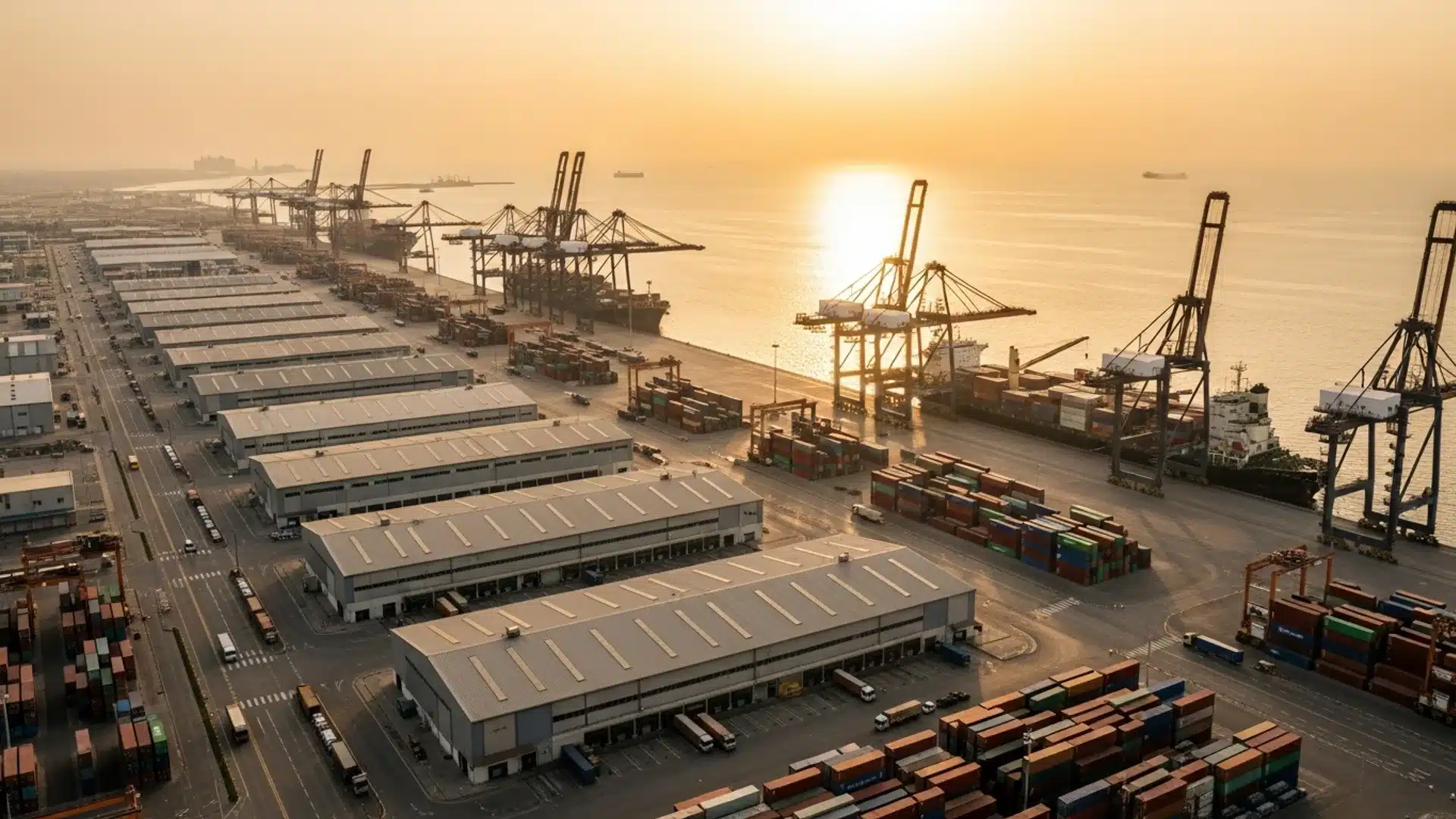
HFZA sits on the coast of Sharjah at Hamriyah, roughly 20–30 minutes north of Sharjah city and about an hour from Dubai. Its defining asset is the combination of industrial land, a deep-water port with an inner harbour, and price points well below Dubai zones. Headline facts:
- Founded: 1995 by Emiri decree, making it one of the UAE's longest-running free zones.
- Scale: approximately 30+ million square metres of leasable land — one of the largest industrial free zone footprints in the region — hosting thousands of companies from over 160 countries.
- Port access: its own harbour facilities for bulk and project cargo, plus proximity to Port Khalid and Khorfakkan (Sharjah's east-coast container port with direct Indian Ocean access, bypassing the Strait of Hormuz), and about an hour's drive to Dubai's Jebel Ali.
- Sector strengths: oil and gas services, steel and metals fabrication, petrochemicals, maritime, timber, plastics, food processing (it hosts a dedicated food park), building materials, and general trading.
- Ownership and tax: 100% foreign ownership, zero personal income tax, full capital and profit repatriation, and no currency restrictions — the standard UAE free zone proposition. Corporate tax now applies UAE-wide at 9% on taxable profits above AED 375,000, with a 0% rate available to Qualifying Free Zone Persons on qualifying income under the Federal Tax Authority's rules — more on that below.
The honest positioning: HFZA is an industrial and trading zone, not a glossy startup campus. If your business needs a warehouse, a fabrication yard, quayside access or cheap land at scale, it is one of the strongest options in the country. If you need a prestige Dubai address for a consultancy, a Dubai zone or mainland licence may fit better — compare via our business setup in Dubai guide.
HFZA licence types
HFZA issues licences under a straightforward taxonomy:
- Industrial licence — manufacturing, processing, assembly, packaging. Requires a physical facility (warehouse or land) and environmental/civil-defence approvals appropriate to the activity.
- Commercial licence — import, export, distribution and trading of specified goods. Available from small "E-Office" packages up to warehouse-backed operations. A general trading variant covers a wide span of tradable goods for a higher fee.
- Service licence — consultancy and service activities conducted from the zone.
Entities can be formed as a Free Zone Establishment (FZE) with one shareholder or a Free Zone Company (FZC) with two to five shareholders, or registered as a branch of an existing foreign or UAE company. HFZA historically markets minimum share capital of AED 150,000 for an FZE/FZC — capital is declared rather than escrowed in most cases, but confirm current treatment with the authority.
HFZA costs in 2026: realistic numbers in AED
Free zone pricing is package-driven and promotional, so the table below reflects well-established public ranges. The authority's quotation is the only binding number — verify current packages with HFZA directly or through a registered consultant before budgeting.
| Cost item | Typical range (AED) | Notes |
|---|---|---|
| E-Office / smart desk commercial package | ~9,000–15,000 per year | Entry point: licence + shared facility; limited visa quota (often 1–2) — verify current promo pricing |
| Commercial licence (standard, office-backed) | ~12,000–20,000 per year | Licence fee plus mandatory office lease |
| General trading licence | ~15,000–25,000+ per year | Wider activity span commands a premium |
| Service licence package | ~10,000–16,000 per year | Consultancy/service activities |
| Industrial licence (excl. facility) | ~12,000–20,000 per year | Facility lease and approvals are the larger cost |
| Executive office suite (small) | ~15,000–30,000 per year | Per size band and building |
| Pre-built warehouse (from ~200–600 m²) | ~100–250 per m² per year (~25,000–100,000+) | Among the UAE's cheapest; varies by spec and phase |
| Industrial land lease | ~10–30 per m² per year | Long leases (up to 25 years, renewable); development obligations apply |
| One-time registration / incorporation fee | ~9,000–10,000 | Payable at formation for FZE/FZC — verify current schedule |
| Establishment card (immigration file) | ~1,500–2,500 initial/renewal | Required before any visa processing |
| Employment visa (per person, all-in) | ~3,500–6,000 | Entry permit, status change, medical, Emirates ID, stamping; varies by category |
| Bank guarantee / deposit per employee | ~1,500–3,000 (refundable) | Some categories; confirm current policy |
Rule-of-thumb budgets: a one-person trading setup with a smart-desk package and one visa lands around AED 15,000–22,000 in year one; a small warehouse-backed trading or light-industrial operation with three or four staff typically runs AED 60,000–140,000 in year one once the facility, visas and approvals are counted. Renewal years drop the one-time fees.
Corporate tax and VAT at HFZA
Two federal regimes apply regardless of which free zone you choose, both administered by the Federal Tax Authority (FTA):
- Corporate tax: 9% on taxable profits above AED 375,000. Free zone companies can access the 0% Qualifying Free Zone Person rate on qualifying income (broadly, certain transactions with other free zone persons and specified activities such as manufacturing and distribution from a designated zone) if they maintain adequate substance, prepare audited accounts, and meet de-minimis conditions. The rules are detailed and activity-specific — review them on the FTA's official site at tax.gov.ae and take advice before assuming 0%.
- VAT: 5%, with mandatory registration once taxable supplies exceed AED 375,000 per year. Parts of Hamriyah's fenced areas are treated as designated zones for VAT, which changes how goods movements are treated — valuable for re-export businesses, but it demands correct documentation.
All HFZA companies must also register employees correctly for immigration and labour purposes; free zone work permits run through the zone's own system in coordination with federal authorities rather than through the Ministry of Human Resources and Emiratisation (MOHRE), which governs mainland employment — a distinction that matters if you later add a mainland branch, at which point MOHRE registration, WPS payroll and mainland labour rules apply to those staff.
Visas at HFZA
Visa allocation is tied to your facility:
- Smart desk / E-Office packages: typically 1–2 visas.
- Executive offices: commonly 1 visa per ~9–10 m² of office space.
- Warehouses and industrial land: quotas scale with facility size and activity — industrial operations can sponsor large workforces, and HFZA provides on-zone labour accommodation zones for industrial staff.
The process: company obtains its establishment card, then applies per employee for an entry permit, in-country status change (if applicable), medical fitness test, Emirates ID biometrics and residence stamping. Emirates ID and residency records sit with the Federal Authority for Identity, Citizenship, Customs and Port Security (ICP) federally. All of it is filed through the HFZA portal — one more reason to keep that login healthy. Budget ~AED 3,500–6,000 all-in per visa and two to four weeks per employee, longer if security approvals apply to the nationality or role.
Investor/partner visas for shareholders follow the same mechanics and are typically issued for two years, renewable.
Warehouses, industrial plots and the port
This is HFZA's real differentiator, so it deserves specifics:
- Pre-built warehouses from roughly 200 m² up to several thousand square metres, many with built-in office blocks, three-phase power and loading bays. Rates in the ~AED 100–250 per m² per year band undercut Dubai equivalents (Jebel Ali/DIP warehousing commonly runs AED 300–500+ per m²) by a wide margin.
- Industrial land on long leases (commonly up to 25 years, renewable) at rates that can fall to single-digit or low-double-digit AED per square metre annually for large plots — among the cheapest serviced industrial land in the UAE. Lessees build to their own spec under HFZA's development and environmental controls, with utilities (including gas for some phases) brought to plot.
- The harbour: an inner harbour and quay access for project cargo, bulk materials and marine services — a genuine advantage for steel, oil-and-gas services and heavy fabrication businesses that need to move oversized loads without road permits.
- Sector parks: dedicated clusters such as the food park, maritime city area, and oil-and-gas zones concentrate suppliers and simplify approvals for those activities.
Environmental permits, civil defence approval and (for food) municipality food-safety controls apply per activity; factor approval timelines of several weeks into industrial project plans.
How to set up a company in HFZA: step by step
- Define activity and licence type. Match your real operations to HFZA's activity list; mismatched activities cause bank-account and customs friction later.
- Reserve the trade name and submit the application with passport copies of shareholders, a simple business profile, and (for corporate shareholders) attested parent-company documents.
- Choose the facility — smart desk, office, warehouse or plot — since it fixes both cost and visa quota.
- Receive initial approval and sign the Memorandum and Articles for the FZE/FZC and the lease agreement.
- Pay the invoice (licence + registration + facility) and receive the trade licence — for desk/office packages this can complete in a few working days; industrial facilities take longer due to approvals.
- Immigration setup: establishment card, then visas as above.
- Bank account: UAE banks will want the licence, MOA, lease, shareholder passports and a business plan with expected flows. Industrial and trading companies with real premises generally clear compliance faster than paper-only setups.
- Tax registrations: corporate tax registration with the FTA is mandatory for all companies; add VAT registration when thresholds are met.
A registered agent or consultancy (this is exactly what Noble Core does across Sharjah's zones) compresses this to a largely remote process — typically only biometrics require presence.
Documents checklist before you apply
Have these ready and formation moves at the fast end of every timeline above: passport copies for all shareholders and the manager (six months' validity minimum), passport-size photos, a short business profile or plan describing activities and expected trade flows, proof of address, and — for corporate shareholders — the parent company's certificate of incorporation, memorandum, board resolution approving the HFZA entity, and an incumbency certificate, all attested and legalised for UAE use. Individual-shareholder files are usually accepted as plain copies; corporate documents are where weeks are won or lost, so start attestation before anything else. Bank onboarding will additionally want six months of personal or parent-company bank statements and, for trading businesses, sample supplier and customer contracts or invoices that evidence the flows you described.
HFZA vs SAIF Zone: which Sharjah free zone fits?
Sharjah's two flagship zones get compared constantly. The short version:
| Factor | HFZA (Hamriyah) | SAIF Zone (airport) |
|---|---|---|
| Location logic | Deep-water port, coastal industrial belt | Adjacent to Sharjah International Airport |
| Best for | Heavy industry, fabrication, bulk cargo, warehousing at scale | Air-cargo trading, light industrial, aviation-linked services |
| Land availability | Vast, cheap industrial land | More constrained, airport-side premium |
| Entry package cost | ~AED 9,000–15,000 | Broadly similar entry pricing |
| Cargo mode | Sea (own harbour) + road | Air (24/7 cargo airport) + road |
If your goods fly, look at SAIF; if they float or need a yard, Hamriyah wins. We break down the airport zone in our SAIF Zone company setup guide, and compare every Sharjah option — including SHAMS for media and services — in the Sharjah free zone company formation guide. For lean service businesses without cargo at all, SHAMS packages often undercut both industrial zones.
Worked cost examples: three real HFZA budgets in AED
Package tables blur together, so here are three concrete year-one budgets built from the established public ranges. Every figure below should be re-quoted with the authority before you commit — promotions and package restructures move these numbers.
Budget 1 — solo trader, smart-desk package. E-Office commercial licence at ~AED 12,000, one-time registration at ~AED 9,500, establishment card ~AED 2,000, one investor visa all-in ~AED 4,500. Year one: roughly AED 28,000; renewal years: roughly AED 16,500 once the one-time fees drop away. Add a corporate bank account (no government fee, but expect minimum-balance requirements of AED 25,000–50,000 at many banks) and basic accounting at ~AED 6,000–12,000 per year for corporate tax compliance.
Budget 2 — trading company with a small warehouse. Commercial licence ~AED 16,000, registration ~AED 9,500, 300 m² pre-built warehouse at ~AED 150/m² = AED 45,000, establishment card ~AED 2,000, four visas at ~AED 4,500 each = AED 18,000, plus insurance, utilities deposits and fit-out contingency of ~AED 15,000. Year one: roughly AED 105,000; renewal years: roughly AED 80,000–85,000. This is the classic HFZA profile — the same warehouse in a Dubai zone would add AED 45,000–100,000 to the annual line on rent alone.
Budget 3 — light manufacturer on leased land. Industrial licence ~AED 16,000, registration ~AED 9,500, 5,000 m² plot at ~AED 20/m² = AED 100,000 per year on a long lease, environmental and civil defence approvals ~AED 10,000–25,000 depending on activity, construction to the operator's own budget, establishment card, and a first tranche of ten visas at ~AED 45,000. Year-one authority-and-land cost: roughly AED 185,000–200,000 before construction. The land rate is the entire argument: comparable serviced industrial land closer to Dubai commonly costs multiples of this.
Who HFZA suits: five founder scenarios
- The steel fabricator or oil-and-gas services contractor. Needs a yard, cranage, quay access for project cargo and cheap power at scale. HFZA is arguably the strongest single option in the UAE; the inner harbour removes road-permit headaches for oversized loads.
- The commodity or building-materials trader. Needs bonded warehousing, customs efficiency and re-export VAT treatment. HFZA's designated-zone status and warehouse rates fit exactly, with Jebel Ali an hour away when a shipment must route through Dubai.
- The food processor. The dedicated food park clusters suppliers, cold-chain logistics and municipality food-control processes in one place — faster approvals than a generalist zone.
- The lean consultant or e-commerce founder with no cargo. Honest answer: HFZA works, but a services zone such as SHAMS usually undercuts it on price, and a Dubai zone may serve client-perception needs better. Compare before defaulting to an industrial zone.
- The manufacturer selling into the UAE mainland. HFZA plus a mainland distribution arrangement (or a second mainland entity) is the standard structure — plan the corporate tax treatment of mainland revenue from day one rather than retrofitting it.
HFZA setup timeline: week by week
A realistic schedule for a desk- or office-based company with individual shareholders:
- Week 1: activity selection, name reservation, application submission with passport copies and business profile; initial approval typically follows within days.
- Week 2: sign the MOA and lease, pay the invoice, receive the trade licence. Corporate shareholders add two to six weeks here for attestation and legalisation of parent-company documents — start that paperwork first if it applies.
- Weeks 2–3: establishment card issuance, opening the immigration file.
- Weeks 3–6: visas — entry permit, status change, medical, Emirates ID biometrics and stamping run about two to four weeks per person and can be parallelised.
- Weeks 4–8: bank account onboarding; industrial and trading companies with real premises and clear flows generally clear compliance in three to six weeks.
- Within FTA deadlines: corporate tax registration on EmaraTax — do not leave this for renewal season.
Industrial projects run a second track on top: facility handover or construction, environmental permits and civil defence approvals, each of which can add several weeks and should anchor the project plan rather than trail it.
Common Mistakes
- Chasing the "hfza login" page through third-party links. Portal credentials control your visas and licence payments; bookmark the official hfza.ae portal and never enter credentials on lookalike domains.
- Letting the registered email go stale. Password resets and renewal notices go to the email on file; when it belongs to an ex-employee or old agent, investors get locked out at renewal time.
- Budgeting only the headline licence fee. Registration fee, establishment card, visas, facility lease, insurance and attestations push real year-one cost well past the advertised package number.
- Picking a smart desk when you need a warehouse quota. Visa allocations follow facility size; upgrading mid-year means new leases and re-papering.
- Assuming 0% corporate tax automatically. Qualifying Free Zone Person status has substance, audit and qualifying-income conditions under FTA rules; mainland-facing revenue can be taxed at 9%. Get advice before pricing contracts.
- Ignoring designated-zone VAT mechanics. Goods moving in and out of the fenced zone have specific VAT treatments; wrong paperwork creates assessments later.
- Trading outside the licensed activity. Customs codes, bank compliance and insurance all key off the activity list — add activities properly rather than improvising.
- Missing renewal deadlines. Late licence renewal triggers fines and can freeze visa processing for the whole company; calendar the licence, establishment card and lease dates together.
Talk to Our Experts
Set up your hfza with Noble Core — license, visas, banking and approvals handled end-to-end. Free 20-minute consultation.
Frequently Asked Questions
### What is HFZA?
HFZA is the Hamriyah Free Zone Authority, the government body that runs the Hamriyah Free Zone in Sharjah, UAE. Established in 1995, it is one of the country’s largest industrial free zones, spread across roughly 30 million square metres beside a deep-water harbour on the Arabian Gulf. It offers 100% foreign ownership, zero personal income tax, full profit repatriation and low-cost warehouses and industrial land, and it is home to thousands of companies in sectors like oil and gas services, steel, petrochemicals, maritime, food processing and general trading.
How do I access the HFZA login portal?
Go to the official Hamriyah Free Zone Authority website at hfza.ae and follow the investor or e-services login link. Sign in with the company credentials issued at registration — access is normally held by the authorised signatory or PRO. Through the portal you can renew your licence, pay invoices, process employee visas, request NOCs and certificates, and track applications. If credentials are lost, use the password-reset flow tied to your registered company email or contact HFZA customer service with your registration number. Only ever log in via the official domain.
How much does an HFZA licence cost in 2026?
Entry-level commercial packages with a shared smart-desk facility start around AED 9,000–15,000 per year, standard office-backed commercial licences run roughly AED 12,000–20,000, and general trading sits higher at about AED 15,000–25,000+. Add a one-time registration fee of roughly AED 9,000–10,000, an establishment card, and around AED 3,500–6,000 per employment visa. A one-person setup typically lands at AED 15,000–22,000 in year one. Packages and promotions change, so verify the current schedule with the authority before budgeting.
What is the difference between an FZE and an FZC at HFZA?
Both are limited-liability companies incorporated inside the free zone. An FZE (Free Zone Establishment) has a single shareholder, which can be an individual or a corporate entity; an FZC (Free Zone Company) has between two and five shareholders. Liability is limited to share capital in both cases, and HFZA has historically referenced minimum capital of AED 150,000, generally declared rather than blocked — confirm current treatment with the authority. Existing foreign or UAE companies can alternatively register a branch, which is not a separate legal entity.
How many visas can an HFZA company get?
The quota follows your facility. Smart-desk and E-Office packages typically carry one to two visas, executive offices commonly allocate about one visa per nine to ten square metres, and warehouses or industrial land scale much higher with facility size and activity — industrial operators can sponsor large workforces with on-zone labour accommodation available. Each visa costs roughly AED 3,500–6,000 all-in for the entry permit, medical, Emirates ID and stamping, and processing takes about two to four weeks per employee once the establishment card is issued.
Can an HFZA company do business in mainland Dubai or Sharjah?
A free zone licence covers business inside the zone and internationally. To sell into the UAE mainland, goods must be imported through a customs-registered channel with duties paid, or you can appoint a mainland distributor; services delivered onshore may require a mainland presence such as a branch. Many HFZA companies operate a dual structure — the free zone entity for manufacturing, warehousing and re-export, plus a mainland entity for local contracts. Mainland-sourced income can also affect your corporate tax position, so structure this deliberately with advice.
Is Hamriyah Free Zone cheaper than Dubai free zones?
For industrial space, substantially. HFZA warehouses in the roughly AED 100–250 per square metre per year band undercut comparable Jebel Ali or Dubai Investments Park space, which commonly runs AED 300–500+ per square metre, and its long-lease industrial land is among the cheapest serviced land in the UAE. Licence packages from about AED 9,000–15,000 also sit below most Dubai zone entry points. The trade-offs are location — about an hour from Dubai — and a less corporate-prestige address, which matters little for industrial and trading firms.
HFZA or SAIF Zone — which should I choose?
Choose by cargo mode and facility need. HFZA has the deep-water harbour, vast cheap industrial land and heavy-industry ecosystem, making it the pick for fabrication, bulk goods, marine services and large warehousing. SAIF Zone wraps around Sharjah International Airport, so it suits air-cargo trading, aviation services and light industrial businesses that ship time-sensitive freight. Entry pricing is broadly similar, so the decision is rarely about the licence fee. If you have no cargo at all, a services zone like SHAMS may be cheaper than either.
Does corporate tax apply to HFZA companies?
Yes — UAE corporate tax applies to free zone companies, and every company must register with the Federal Tax Authority. The standard rate is 9% on taxable profits above AED 375,000, but a Qualifying Free Zone Person can access a 0% rate on qualifying income if it maintains adequate substance in the zone, prepares audited financial statements, stays within de-minimis limits on non-qualifying revenue and meets the FTA’s activity conditions. The rules are technical and mainland-facing income is usually taxable, so take professional advice rather than assuming 0%.
How long does HFZA company formation take?
For desk and office packages with individual shareholders, initial approval and licence issuance can complete in a few working days once documents are in order — passport copies, application forms, and signed MOA and lease. Corporate shareholders add time for attestation and legalisation of parent documents. Industrial licences take longer because facility fit-out, environmental permits and civil defence approvals run their own timelines, often several weeks. After licensing, allow one to two weeks for the establishment card and two to four weeks per employee visa, then bank onboarding.