Quick answer
JAFZA industrial license starts at AED 50,000/year for Standard FZE and AED 75,000+ for Light Industrial Unit setups. — Setup takes 8–12 weeks for LIU, 16–24 weeks for industrial land plots.
- Adjacent to Jebel Ali Port (world’s 11th-busiest, handling 14.7 million TEUs annually)
- 100% foreign ownership with bonded warehousing and integrated DP World Tradenet customs
- Hosts over 9,000 companies including 100+ Fortune 500 multinationals
Best for: global trade manufacturers and port-volume operations requiring Fortune 500 supply chain access.
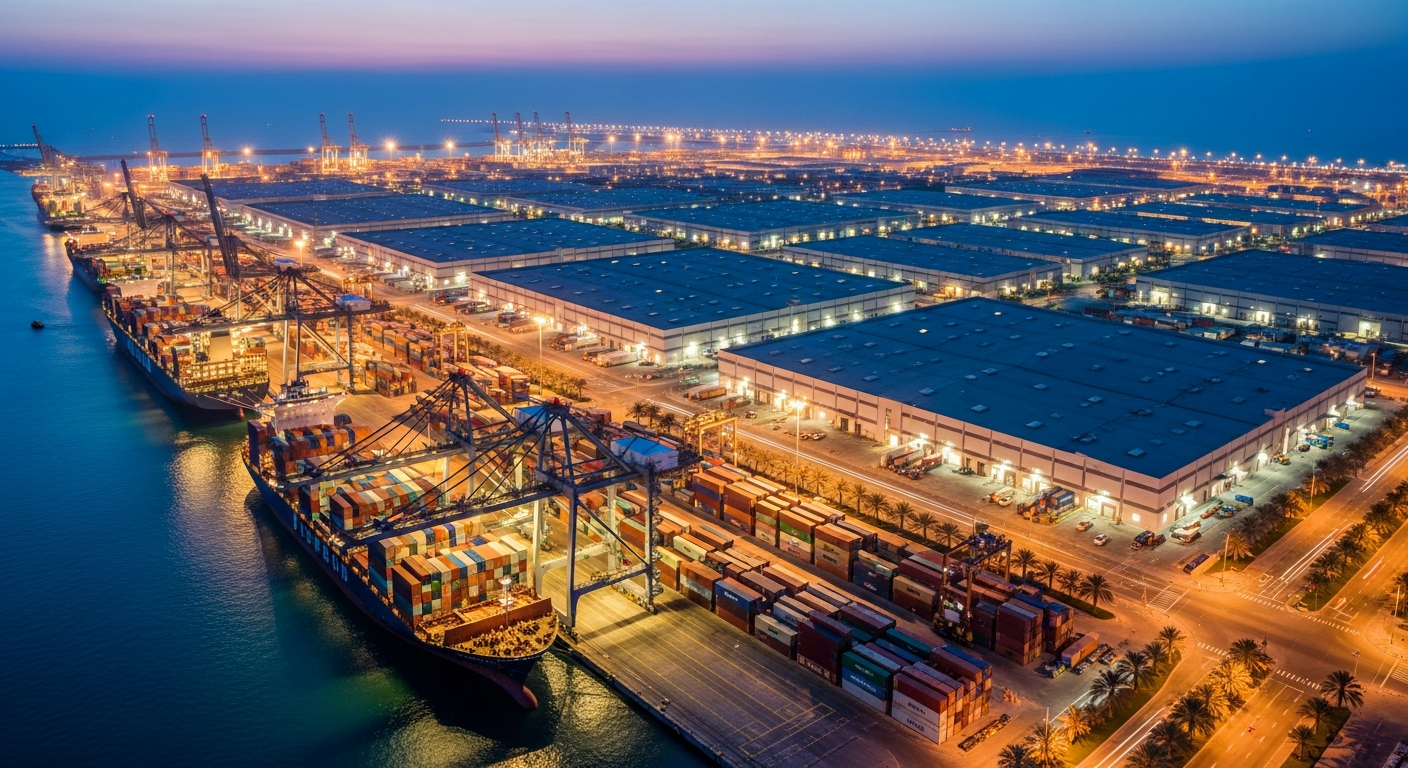
Jebel Ali Free Zone (JAFZA) is the UAE’s largest and most established industrial free zone, hosting over 9,000 companies including 100+ Fortune 500 multinationals. For manufacturers and logistics operators where port access matters, JAFZA’s adjacency to Jebel Ali Port — the busiest container port between Rotterdam and Singapore — is a competitive moat that no other UAE free zone can match in 2026.
This guide covers the JAFZA industrial license in 2026: real fees (starting AED 50,000+ for setup), the four license categories, plot sizes, the 8-step process, customs benefits, and where JAFZA wins (or loses) against RAKEZ, Hamriyah, and DMCC for industrial setups.
What Is a JAFZA Industrial License?
A JAFZA Industrial License authorises manufacturing, processing, assembly, and packaging activities within Jebel Ali Free Zone. Issued by the Jebel Ali Free Zone Authority (Jafza), it covers four sub-categories: Industrial, General Trading, Service, and E-Commerce — with Industrial being the highest-fee tier due to land allocation and port access privileges.
The licence sits under DP World’s umbrella alongside Jebel Ali Port operations, giving licensees integrated customs clearance, bonded warehousing, and direct quayside access for heavy-equipment and container-volume manufacturers.
JAFZA Industrial License Cost Breakdown 2026
| Setup tier | License fee (AED) | Workspace | Year-1 total |
|---|---|---|---|
| Standard FZE | AED 50,000+ | Office (200+ sq m) | AED 80,000–110,000 |
| Standard FZCO | AED 60,000+ | Office (200+ sq m) | AED 95,000–130,000 |
| Light Industrial Unit (LIU) | AED 75,000+ | Pre-built warehouse 250–1,000 sq m | AED 200,000–400,000 |
| Industrial Land Plot | AED 100,000+ (license) + lease | 5,000+ sq m allocated land | AED 350,000+ |
Hidden costs to budget: initial approval (AED 5,000), bank guarantee for visas (AED 3,000/visa), Civil Defense fire safety approval (AED 8,000–15,000), DP World logistics setup (variable), and Customs Authority registration (AED 2,500). Land plots also incur infrastructure connection fees.
Industrial Activities Allowed at JAFZA
JAFZA authorises over 700 industrial activity codes including:
- Heavy industry: Steel, automotive assembly, marine equipment, oil-and-gas equipment manufacturing
- Manufacturing: Chemicals, plastics, packaging, food processing, electronics assembly
- Logistics-integrated: Container handling, repacking, value-added warehousing, freight forwarding
- Trading-cum-manufacturing: Import-light-process-re-export operations
JAFZA’s Port Adjacency Advantage
JAFZA’s defining feature is Jebel Ali Port — the world’s 11th busiest container port, handling 14.7 million TEUs annually. For licensees, this translates to:
- Bonded warehousing with goods cleared into the FZ without UAE customs duties until re-export
- Same-day port-to-warehouse truck movement (vs 1–2 days for other free zones)
- Direct ship-to-warehouse for licensees with quayside facilities
- Integrated customs portal via DP World’s Tradenet system
- Air-Sea-Land triangulation — JAFZA is 30 minutes from Al Maktoum Airport and connects to UAE’s federal road network
Step-by-Step: How to Get a JAFZA Industrial License
- Initial application (Day 1). Submit company name, shareholders, intended activities, and workspace requirement to JAFZA Customer Service.
- Initial approval (Day 2–5). JAFZA reviews and issues conditional approval. Pay initial fee.
- Document submission (Day 5–10). Attested passport copies, board resolution, parent company docs (for branches), MOA template signed.
- License issuance (Day 10–15). Trade license, share certificate, and establishment card issued together. Bank account application can begin.
- Workspace allocation (Day 15–30 for office, Day 30–60 for industrial unit). Office tenancy or warehouse lease finalised; for land plots, the timeline extends to 90+ days.
- Civil Defense approval (Day 30–45 for industrial units). Fire safety clearance, sprinkler system approval, and building plan endorsement.
- Visa processing (Day 30–60). Establishment card → entry permits → status change → medical → Emirates ID → visa stamping.
- Operational launch (Day 60+). Customs registration, utility connections, supplier onboarding.
Realistic end-to-end timeline: 8–12 weeks for an LIU (Light Industrial Unit), 16–24 weeks for an Industrial Land Plot.
JAFZA vs RAKEZ vs Hamriyah for Industrial Setup (2026)
| Criterion | JAFZA | RAKEZ | Hamriyah |
|---|---|---|---|
| Setup cost (5,000 sq m) | AED 350,000+ | AED 200,000+ | AED 175,000+ |
| Setup time | 16–24 weeks | 6–8 weeks | 6–8 weeks |
| Port adjacency | Jebel Ali (world #11) | RAK Port (smaller) | Khalid Port (medium) |
| Multinational ecosystem | 100+ Fortune 500 | Mid-market focus | Heavy industry focus |
| License flexibility | Strict per-activity | Multi-activity in one license | Multi-activity flexible |
| Best for | Global trade, fortune 500 supply chain | Cost-conscious manufacturing | Heavy industry, port logistics |
Common Mistakes Setting Up at JAFZA
- Underestimating setup time. JAFZA’s 16-24 week land-plot timeline catches founders off-guard. RAKEZ or Hamriyah is faster if speed matters.
- Choosing wrong tier. Standard FZE is too small for serious manufacturers; jump straight to LIU.
- Skipping Civil Defense early. Fire safety approvals can be the longest pole — submit on Day 1 not Day 60.
- Ignoring DP World logistics integration. The customs benefit only realises if you actively use DP World Tradenet.
- Mainland sales blindness. Like all FZ companies, JAFZA-to-UAE-mainland sales attract 5% customs — plan distributor relationships from the start.
Talk to Our Experts
Set up your JAFZA industrial license with Jebel Ali Port access — license, land, customs, banking handled end-to-end. Free 20-minute consultation.
Common Mistakes Setting Up at JAFZA in 2026
From auditing dozens of JAFZA setups in 2024-2026, these are the mistakes that turn a 12-week project into a 9-month one or burn AED 100,000+ unnecessarily.
1. Assuming JAFZA workspace is “easy to find”
JAFZA’s pre-built warehouse stock is consistently 85-95% occupied across the year. By the time you reach the workspace allocation step, your preferred 500 sq m unit may not exist. Lock in workspace conditional on license issuance — JAFZA allows pre-allocation with a refundable deposit, which most founders skip until it’s too late.
2. Choosing FZE when you should choose FZCO
FZE is a single-shareholder structure. The moment you have a co-founder, an investor, or any second equity holder, you’re FZCO. Most founders pick FZE for simplicity, then have to dissolve and re-incorporate when their first investor signs. The dissolution-to-new-FZCO process costs AED 8,000-12,000 in fees plus 4-6 weeks of operational pause. Pick FZCO from day one if there’s even a 30% chance of a co-investor in 24 months.
3. Underbudgeting Civil Defense costs
For Light Industrial Units, Civil Defense fire safety approval involves: sprinkler systems (AED 25,000-50,000 for 500 sq m), fire alarm panel (AED 15,000), emergency lighting (AED 8,000), exit signage and emergency exits (AED 12,000), and the inspection fee itself (AED 8,000-15,000). Founders routinely budget AED 20,000 and end up paying AED 80,000.
4. Skipping DP World Tradenet integration
JAFZA’s biggest customs benefit is integration with DP World’s Tradenet portal — but it’s not automatic. You must register separately, get assigned a customer code, and integrate your customs broker. Founders who skip this step pay 15-20% higher container handling costs and lose the same-day port-to-warehouse advantage that justified picking JAFZA over RAKEZ in the first place.
5. Treating mainland sales as an afterthought
Goods crossing from JAFZA to UAE mainland attract 5% customs duty. If 60% of your customer base is UAE-domestic, that 5% compounds into a real margin hit. The right structure for hybrid market companies: JAFZA industrial entity for production and re-export + a Dubai mainland LLC distributor for UAE sales. The mainland LLC absorbs the 5% as cost of goods, the JAFZA entity keeps 0% Corporate Tax on qualifying export income.
JAFZA Use-Case Deep Dives (2026)
Use Case A: Auto Parts Distributor (5,000 sq m LIU)
A typical JAFZA auto-parts distributor running container-volume imports from Asia and re-exports to Africa via Jebel Ali Port. Year-1 economics: License AED 75,000, warehouse lease AED 700,000, fit-out AED 200,000, customs/handling AED 40,000, 8 visa quota AED 48,000, total Year-1 AED 1,063,000. Margin model: 18-25% gross margin on parts trade with bonded-warehousing customs efficiency. Break-even typically at 18-24 months.
Use Case B: Food Processing (Industrial Land Plot)
10,000 sq m plot for halal food production targeting GCC + Africa export. Year-1: License AED 100,000, land lease AED 350,000/yr (25-yr), Civil Defense + MOCCAE AED 200,000, warehouse construction AED 4-6M (capex), 25 visa quota AED 150,000, total operational Year-1 AED 800,000+ excluding capex. Strategic: leverage halal certification + Jebel Ali Port for direct shipments to Egypt, Morocco, Saudi Arabia. Break-even on capex: 36-48 months at 12% EBITDA.
Use Case C: Electronics Assembly (Pre-built LIU)
1,000 sq m pre-built warehouse for consumer electronics assembly + repacking. Year-1: License AED 75,000, warehouse AED 180,000, equipment AED 800,000-1.5M, 12 visa quota AED 72,000, total Year-1 AED 1.2-1.9M. Right fit when component imports from China + finished goods re-export to Saudi/Kuwait/Bahrain via UAE customs union. JAFZA’s bonded warehousing means components can be held duty-free until incorporated into finished goods.
JAFZA vs Other Manufacturing Hubs in the GCC (2026)
| Hub | Setup cost (LIU) | Land lease/yr | Customs efficiency | Best for |
|---|---|---|---|---|
| JAFZA Dubai | AED 75,000+ | AED 200K-350K | Highest (DP World Tradenet) | Global trade, port-volume |
| KEZAD Abu Dhabi | AED 50,000+ | AED 150K-280K | High (Khalifa Port) | AD government tenders |
| Hamriyah Sharjah | AED 35,000+ | AED 100K-175K | Medium (Khalid Port) | Heavy industry, mid-budget |
| RAKEZ Ras Al Khaimah | AED 17,500+ | AED 125K-225K | Medium (RAK Port) | Cost-conscious manufacturing |
| SAIF Zone Sharjah | AED 25,000+ | AED 80K-150K | Medium (SAIF Port) | Air-cargo light industrial |
| King Salman Industrial City KSA | SAR 50,000+ | SAR 100K-200K | High (King Abdullah Port) | KSA-domestic manufacturing |
Your 2026 JAFZA Setup Action Checklist
Print this. Tick each item as you complete it. The order matters — sequencing approvals in parallel saves 4-8 weeks vs. doing them sequentially.
- ☐ Decide structure (FZE vs FZCO) — pick FZCO if there’s any chance of co-investor in 24 months
- ☐ Secure pre-allocated workspace with refundable deposit (week 1)
- ☐ Submit JAFZA initial application with full activity codes (week 1-2)
- ☐ Submit Civil Defense fire safety preliminary plans in parallel (week 2)
- ☐ Submit MOCCAE environmental approval if applicable (week 2)
- ☐ Document attestation: passport copies, board resolution, MOA template (week 2-3)
- ☐ License issuance + share certificate + establishment card (week 3-5)
- ☐ Register with Dubai Customs + DP World Tradenet (week 4-5)
- ☐ Workspace fit-out + utility connections (week 5-10)
- ☐ Civil Defense final inspection + approval (week 8-12)
- ☐ Bank account opening (Mashreq, Emirates NBD, FAB — week 5-9)
- ☐ Visa processing for shareholders + first hires (week 6-10)
- ☐ Operational launch — first shipment, first customer (week 12-16)
- ☐ 90-day post-launch audit: are bonded warehousing benefits actually being captured? Are mainland sales properly structured through a sister entity?
2026 Regulatory Context You Should Know Before Setting Up
UAE business setup in 2026 operates under a substantially evolved regulatory framework compared to even 2024. Understanding the changes that affect your specific setup option saves both money and compliance risk:
Corporate Tax Framework (introduced 2024, refined through 2026)
The UAE Corporate Tax regime imposes 9% federal corporate income tax on taxable income exceeding AED 375,000 annually. Three carve-outs matter for setup decisions:
- Qualifying Free Zone Person (QFZP): Companies registered in qualifying UAE free zones meeting specific substance requirements pay 0% on Qualifying Income (e.g., re-export, B2B-FZ-to-FZ trade, certain headquarters activities). UAE-mainland sales remain at 9% above the AED 375K threshold. The 2026 enforcement is significantly stricter than 2024 — directors must hold board meetings in UAE, decisions must be documented as taking place in UAE, and the entity must demonstrate adequate operating substance.
- Small Business Relief: Companies with revenue under AED 3M annually can elect for 0% Corporate Tax through the AED 3M Small Business Relief programme. This applies through tax year 2026, with potential extension. For solo founders and early-stage operators, this is a meaningful saving.
- Pillar Two Global Minimum Tax: Multinational groups with consolidated revenue exceeding EUR 750M face a 15% global minimum tax under OECD Pillar Two rules — but standalone UAE businesses below this threshold are unaffected.
VAT Registration and Compliance
UAE VAT operates at a standard 5% rate with mandatory registration at AED 375,000 annual taxable supplies and voluntary registration available from AED 187,500. Critical 2026 dates: registration must occur within 30 days of crossing the threshold; failure to register attracts AED 10,000 penalty plus retroactive VAT obligations. For e-commerce and trading businesses approaching the threshold rapidly, voluntary registration at AED 187,500 is often the safer play to avoid penalty risk.
Economic Substance Regulations (ESR)
Banking, fund management, intellectual property holding, distribution-and-service-centre, headquarter, holding company, lease-finance, insurance, and shipping activities all attract ESR. Annual ESR notifications and substance reports must be filed with the regulator. Non-filing penalties begin at AED 20,000 and escalate. Many setup providers don’t mention ESR; founders are routinely surprised in Year 2 audits.
Beneficial Ownership Disclosure
UAE companies must maintain a Beneficial Ownership Register identifying all individuals owning 25%+ of shares (directly or indirectly). The register must be filed with the regulator and updated within 15 days of any change. 2026 enforcement is active: missing or outdated disclosures attract penalties from AED 50,000.
Realistic 24-Month Total Cost of Ownership Model
License fees are the visible cost. Below is the 24-month total cost-of-ownership for a typical mid-market operator using this setup option, including everything most “starting from” guides hide:
| Cost item | Year 1 (AED) | Year 2 (AED) | Notes |
|---|---|---|---|
| License fees (initial + renewal) | 15,000 – 60,000 | 12,000 – 50,000 | Range based on tier + jurisdiction |
| Workspace (office or warehouse) | 20,000 – 200,000 | 22,000 – 220,000 | Includes Ejari + utilities |
| Visa processing (per founder + 2 hires) | 14,000 – 21,000 | 0 – 5,000 | Year 1 includes initial issuance |
| Bank account opening + fees | 1,000 – 5,000 | 500 – 3,000 | Setup + monthly maintenance |
| Accounting + bookkeeping | 6,000 – 24,000 | 6,000 – 24,000 | Outsourced; mandatory for VAT-registered |
| VAT registration + filing | 2,500 – 8,000 | 3,000 – 8,000 | Once threshold crossed |
| Corporate Tax filing | 3,000 – 10,000 | 3,000 – 10,000 | Annual TR filing + audit if applicable |
| Insurance (PI, employer’s liability) | 4,000 – 15,000 | 4,000 – 15,000 | Activity-dependent |
| Software, telecoms, basic operations | 10,000 – 30,000 | 10,000 – 30,000 | Communication, tools, hosting |
| 24-month total | — | — | AED 150,000 – 750,000+ |
The ranges reflect the difference between solo founder bootstrap and 5-8 person mid-market team. Add 30-50% on top if your activity requires Civil Defense (industrial/F&B), MOCCAE (chemicals/food/plastics), Dubai Municipality food permits, or Ministry of Health pre-approvals.
Worked Examples: Three Real Setup Scenarios in 2026
Scenario A: Solo founder, pre-revenue (Year-1 budget AED 25,000)
A solo founder with AED 50,000 capital testing market fit. Optimal play: cheapest viable license tier with flexi-desk, Mashreq Neo direct-partner banking (48-hour opening), 1 visa quota, manual bookkeeping for first 6 months, voluntary VAT registration deferred until revenue projections crystallize. Total Year-1 fixed: AED 18,000-25,000. Goal: validate product-market fit cheaply, upgrade structure once monthly revenue exceeds AED 30,000.
Scenario B: Mid-market team, AED 200K-500K revenue (Year-1 budget AED 100,000)
3-5 person team with established revenue. Optimal play: Standard or Premium tier in chosen jurisdiction, dedicated office or substantial flexi-desk, 3-5 visa quota, multi-bank relationships (Emirates NBD + FAB), outsourced accounting from month 1, voluntary VAT registration. Total Year-1 fixed: AED 80,000-130,000. Goal: optimize unit economics, set up tax-efficient structure (consider mainland sister entity if UAE-domestic > 40% revenue).
Scenario C: Series-A funded scaleup, AED 5M+ raised (Year-1 budget AED 400,000+)
VC-backed team scaling fast. Optimal play: premium jurisdiction (DIFC for tech/AI, ADGM for fintech, DMCC for trade), formal office presence (200+ sq m), 8-15 visa quota, premium banking (HSBC Private, Emirates NBD Private), full-time CFO or fractional CFO, audit-ready financials from month 1, dedicated tax advisor for QFZP substance compliance. Total Year-1 fixed: AED 350,000-650,000. Goal: investor-grade structure ready for Series-B + due diligence.
What to Expect From a Noble Core Setup Engagement
Most setup providers offer the same core service: license issuance + visa + workspace + banking introduction. The differences that compound into a meaningfully better outcome:
- Pre-decision strategic consult. Before you pay anything, we model your 24-month customer mix, tax exposure, and growth trajectory — then recommend the structure that minimizes 24-month total cost-of-ownership, not just the cheapest license.
- Parallel-track approval management. Trade license, regulatory approvals, workspace, banking — all run simultaneously, not sequentially. Saves 4-12 weeks vs the typical sequential approach.
- Banking pre-engagement. We pre-introduce your structure to 2-3 banks before license submission, so account opening starts in week 1, not week 6.
- Substance compliance from Day 1. QFZP eligibility, ESR notification, beneficial ownership filings — built into onboarding, not retrofitted in Year 2 audits.
- Post-setup operating support. Most providers disappear after license issuance. We stay engaged through your first VAT filing, first Corporate Tax return, first ESR notification — so the setup actually translates to compliant operations.
The 5 Questions Every Founder Should Answer Before Choosing a Setup
- What % of your 24-month revenue will come from UAE-mainland customers? If > 40%, mainland or hybrid structure is structurally cheaper after 5% customs is factored in.
- Do you need investor-grade contracts (English Common Law)? If yes, DIFC or ADGM. UAE Civil Law works for everyone else.
- How many visas in 24 months — realistic projection? Pick the package that fits, not the cheapest one. Mid-year upgrades are expensive.
- What’s your annual revenue trajectory hitting AED 3M? If yes within Year 2, plan VAT + Corporate Tax compliance from Day 1.
- Are you part of a multinational group with EUR 750M+ consolidated revenue? If yes, Pillar Two minimum tax applies — restructure consideration.
Most founders haven’t thought through these explicitly before they choose a jurisdiction. The setup providers who don’t ask are setting you up to overpay or to face surprise compliance issues in Year 2.
Frequently Asked Questions
How much does a JAFZA industrial license cost in 2026?
JAFZA industrial license starts at AED 50,000 for Standard FZE setup (200 sq m office), AED 75,000+ for a Light Industrial Unit (pre-built warehouse 250-1,000 sq m), and AED 100,000+ plus land lease for an Industrial Land Plot (5,000+ sq m). Year-1 total typically runs AED 80,000–400,000+ depending on scale.
What’s the difference between JAFZA and RAKEZ industrial licenses?
JAFZA wins on Jebel Ali Port adjacency and Fortune 500 ecosystem. RAKEZ wins on cost (30-50% cheaper) and faster setup (6-8 weeks vs 16-24 weeks). Choose JAFZA if port logistics or multinational supply-chain integration is core; choose RAKEZ for cost-efficient mid-market manufacturing.
How long does JAFZA setup take?
Standard FZE: 4-6 weeks. Light Industrial Unit (pre-built warehouse): 8-12 weeks. Industrial Land Plot: 16-24 weeks (including Civil Defense approvals, infrastructure connections, and warehouse construction).
Can I sell to UAE mainland from JAFZA?
Yes, but indirectly. UAE mainland sales from any free zone attract 5% customs duty. JAFZA licensees typically sell through mainland distributors or appoint a commercial agent. The 5% applies on goods crossing from FZ to mainland, not on services or B2B re-exports.
Does JAFZA allow 100% foreign ownership?
Yes. As a UAE free zone, JAFZA allows 100% foreign ownership with no Emirati partner or sponsor required. Profits and capital are fully repatriable.
What’s the visa quota for JAFZA industrial licenses?
Visa quota scales with workspace under MOHRE rules: typically 1 visa per 9-10 sq m for office space, with industrial units supporting 30-100+ visas depending on plot size and labour-intensity ratings.
Is JAFZA worth it vs Hamriyah Free Zone for heavy industry?
Hamriyah is 30-40% cheaper and offers Khalid Port adjacency for heavy-cargo movement. JAFZA wins only when Jebel Ali Port specifically (its scale, customs facilities, multinational ecosystem) is required. For pure heavy industry without port-volume requirements, Hamriyah is usually the better value.
What customs benefits does JAFZA offer?
JAFZA licensees get 0% customs duty on imports/exports within the free zone, bonded warehousing for goods awaiting re-export, integrated customs clearance via DP World Tradenet, and same-day port-to-warehouse movement. The customs advantage only translates to bottom-line if you actively re-export goods rather than selling to UAE mainland.
Related guide: For more, see UAE Free Zone Business Setup.
Related guides: Restaurant License Dubai 2026: Full Cost, Steps Documents G… · General Trading License Dubai 2026: 7,000+ Activities Covere…