What Noble Core charges
From AED 24,999
Dubai mainland (DET) company: licence, approvals, establishment card and our fee. Investor visa AED 4,500 and each employment visa AED 4,000, added to suit your setup.
Quote this licence on WhatsAppQuick AnswerKiosk license Dubai 2026 — AED 15,000-35,000 setup, mall vs metro vs street locations, DET activity classification, real founder economics.
A kiosk business in Dubai is one of the most accessible retail entry points — lower capital than a full store, smaller operational footprint, established mall and metro distribution channels. The opportunity exists for the right product in the right location but suffers when either is wrong. This guide covers the actual licensing path, location strategy, cost structure, and operational reality of Dubai kiosk businesses in 2026.
Your setup cost, in 10 seconds
Package prices. Health insurance is required by law and not included.
Thank you.
Your written quote follows on WhatsApp.
Kiosk machine in Dubai: licensing the unit
To operate a kiosk machine in Dubai, such as a retail cart, vending unit or self-service kiosk, you generally need a kiosk trade licence plus approval for the specific location from the relevant authority. In mainland Dubai this is licensed through the Department of Economy and Tourism (DET), while a mall or free-zone kiosk follows that operator’s rules. Activity scope, location approvals and fees vary, so confirm current kiosk licensing requirements and fees with the official authority before setup.
What "kiosk business" means in Dubai 2026
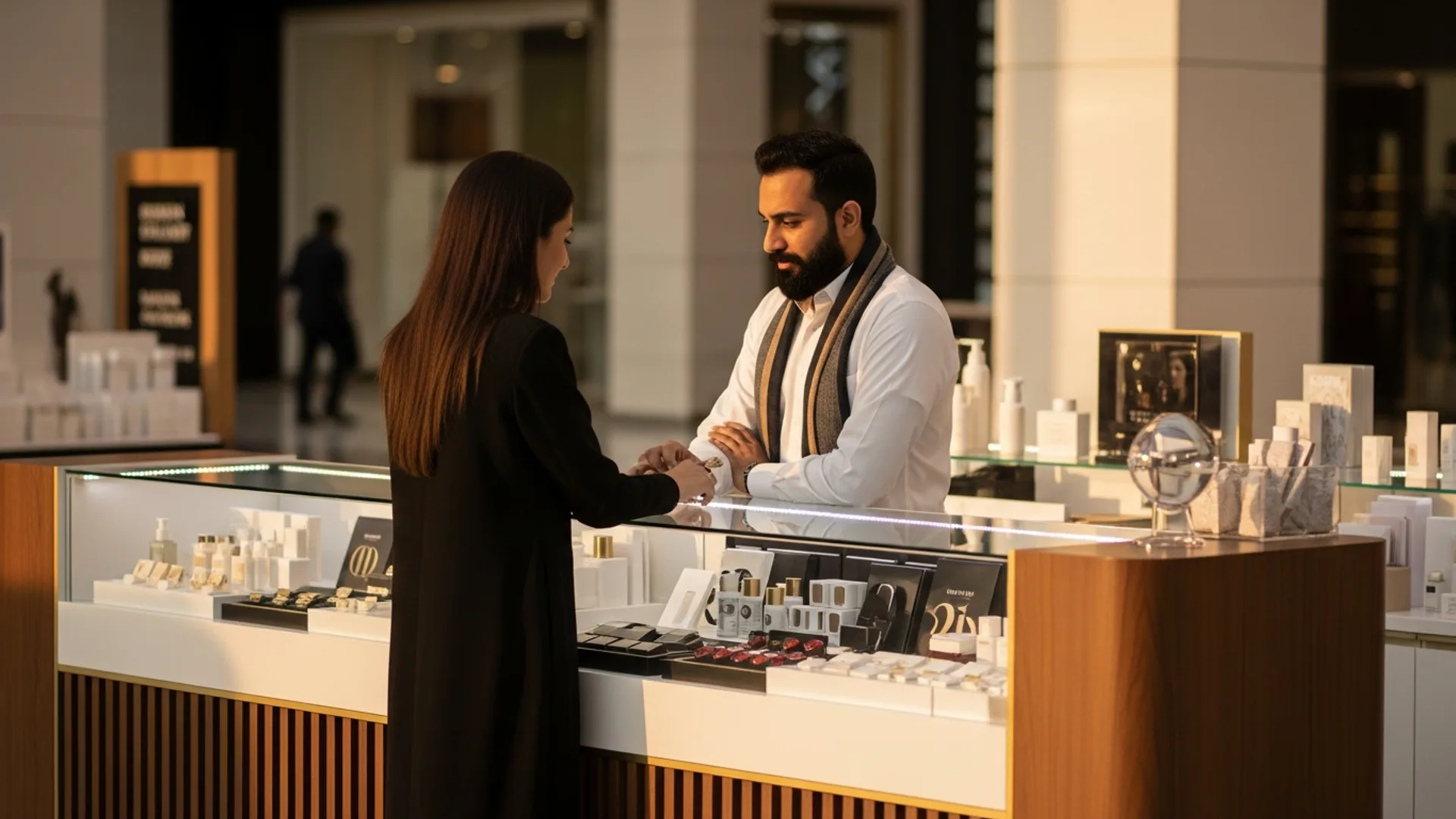
A kiosk is a small retail outlet typically 30-100 square feet, often standalone or attached to walkways in malls, metro stations, or other high-traffic locations. Operational models include:
F&B kiosks: Juice bars, ice cream, coffee, snacks, specialty foods. Most common kiosk category in Dubai.
Accessories kiosks: Phone accessories, jewellery, sunglasses, watches, fashion accessories.
Beauty kiosks: Cosmetics samples, mini-beauty services (eyebrows, lashes), perfumes.
Gift and seasonal kiosks: Themed gift items, holiday products, novelty items.
Service kiosks: Key cutting, watch repair, shoe shine, photo printing.
Specialty kiosks: Premium niche products, limited editions, brand showcases.
Each category has different operational needs, profit margins, and location requirements. The Dubai Department of Economy and Tourism (det.gov.ae) handles trade licensing. Mall management or relevant location operators handle location-specific approvals.
Licensing path
Step 1 — DET Dubai trade licence
Apply for mainland commercial licence with activity matching products:
- "Kiosk Trading" (general kiosk)
- Specific activity codes (F&B requires food activities, accessories require fashion accessories code, etc.)
Cost: AED 15,000-25,000.
Step 2 — Location approval
Different processes for different location types:
Mall locations: Apply to mall management (Emaar Malls, Majid Al Futtaim, Nakheel Malls, etc.). Each mall has its own application process, design requirements, approval timeline. Some malls have waiting lists for prime kiosk spots.
Metro station locations: Apply to RTA / metro authority. Limited locations available.
Public space locations: Apply to Dubai Municipality. More limited options. Permits often seasonal or event-specific.
Hotel/Resort locations: Direct negotiation with property management.
Community centre locations: Apply to developer/community management.
Location approval often takes longer than the trade licence itself.
Step 3 — Specific category approvals
F&B kiosks need:
- Dubai Municipality food safety registration
- Civil Defence approval if cooking
- Trade Mark and labelling compliance
Beauty/service kiosks may need:
- Dubai Health Authority approval for some services
- Service-specific certifications
Step 4 — Establishment card and visas
Standard process. Kiosk typically operates with 1-3 staff requiring visas.
Full cost breakdown — typical mall kiosk
Realistic year-1 cost for a mid-tier mall kiosk:
| Item | Cost (AED) |
|---|---|
| DET trade licence | 22,000 |
| Trade name + initial | 1,500 |
| Establishment card | 2,000 |
| Mall location rent (year, mid-tier mall) | 120,000 |
| Mall location deposit | 30,000 |
| Kiosk fit-out (custom design, signage) | 45,000 |
| POS system + equipment | 12,000 |
| Initial inventory | 30,000 |
| 2 staff salaries year 1 | 90,000 |
| Visa fees (2 staff) | 11,000 |
| Utilities (often included in rent) | 5,000 |
| Insurance | 6,000 |
| Marketing | 8,000 |
| Working capital | 35,000 |
| Year 1 total realistic | AED 417,500 |
For F&B kiosks add: AED 40,000-100,000 for cooking equipment and refrigeration plus Civil Defence approval AED 3,000-5,000.
For premium mall locations (Dubai Mall, Mall of the Emirates main areas): rent can be AED 250,000-500,000+ annually.
Contact Us For Free Consultation
or
Ask on WhatsApp insteadLicensed UAE consultancy. One reply, no spam.
Thank you.
A consultant will reply on WhatsApp shortly.
Location strategy — the make-or-break factor
Location determines kiosk success more than any other variable. Best Dubai locations 2026:
Top tier malls (highest rent, highest foot traffic):
- Dubai Mall: AED 200-500k/year for prime locations
- Mall of the Emirates: AED 150-350k/year
- City Centre Mirdif, Deira City Centre: AED 100-250k/year
Mid-tier malls (moderate rent, solid traffic):
- Festival City: AED 80-180k/year
- IBN Battuta: AED 70-150k/year
- Mercato: AED 80-150k/year
- Times Square Center: AED 60-120k/year
Community malls (lower rent, neighbourhood traffic):
- Mirdif City Centre community areas
- JVT mall locations
- Spinneys community locations
- AED 40-80k/year
Metro stations:
- Major interchange stations (Burj Khalifa/Dubai Mall, Mall of the Emirates, Union, BurJuman): AED 80-180k/year
- Other metro stations: AED 40-100k/year
Beachfront and tourist locations:
- JBR beach area: AED 100-200k/year (seasonal demand)
- Marina walk: similar
- Limited Municipality permits available
Wrong locations include: low-traffic mall corners, residential building lobbies (insufficient traffic), industrial area access points (wrong demographic), most office tower lobbies (restricted access patterns).
Revenue economics by category
Average daily revenue by kiosk category:
| Category | Daily revenue (AED) | Notes |
|---|---|---|
| Coffee/juice bar in busy mall | 3,000-12,000 | High foot traffic conversion |
| Ice cream/dessert | 1,500-8,000 | Seasonal variation |
| Mobile accessories | 1,500-6,000 | Impulse + need-based |
| Jewellery/fashion accessories | 1,000-5,000 | Lower volume, higher AOV |
| Beauty samples/services | 1,500-7,000 | Premium positioning |
| Key/watch repair | 800-3,000 | Service-based, lower volume |
| Specialty/niche products | 500-4,000 | Category-dependent |
Monthly revenue ranges from AED 25,000 (small specialty) to AED 350,000+ (premium F&B in top mall). Net margins after rent typically 15-35%.
Common Mistakes founders make with kiosk businesses
Mistake 1: Wrong location. Saving on rent in a low-traffic location consistently produces revenue too low to cover even reduced costs.
Mistake 2: Wrong product for location. Premium products in budget malls. Budget products in premium malls. Match positioning to traffic profile.
Mistake 3: Skipping mall management requirements. Mall design standards, hours, staff appearance requirements, periodic refurbishment requirements. Non-compliance triggers location loss.
Mistake 4: Under-staffing. One staff member missing lunch break or sick day means kiosk closed. Plan for 2 staff minimum even for solo operations.
Mistake 5: Poor visual merchandising. Kiosk presentation matters. Cluttered, dim, or unprofessional kiosks convert dramatically worse than well-presented ones.
Mistake 6: Ignoring upselling. Kiosk customers often make additional impulse purchases if presented well. Train staff for upselling.
Mistake 7: Wrong category for foot traffic profile. Tourist-heavy mall floor favours different products than office-worker traffic. Study location before committing.
What changes for free zone vs mainland
Kiosks operating in malls and other Dubai locations require DET Dubai mainland licence — they're physical retail in Dubai. Free zone licences don't qualify. Always mainland for kiosk businesses.
Specific founder profiles we work with
The first-time retail entrepreneur entering through kiosk format finds the lower capital and operational footprint compared to full retail attractive. This is a reasonable entry path for testing product concepts and learning retail operations before scaling. We typically recommend mid-tier mall location with proven product category, treating year one as both revenue-generating and learning experience.
The experienced retail operator adding kiosk format to existing retail operation benefits from supplier relationships and operational infrastructure already in place. Kiosk format becomes lower-marginal-cost expansion rather than de novo startup. Often viable as test for new product categories or new geographic locations within Dubai.
The brand owner using kiosk for product distribution sees kiosk as customer touchpoint and brand-building venue rather than primary revenue source. Premium brands sometimes use kiosks as sampling or limited-edition venues alongside primary retail or wholesale distribution. Different optimisation criteria than pure-revenue operators.
The food entrepreneur testing concepts via kiosk before committing to full restaurant or cloud kitchen finds the lower commitment attractive. F&B kiosks can test product-market fit and operational fundamentals at lower risk than full restaurant. Success at kiosk scale supports later scale-up decisions.
The franchise operator running kiosk-format franchise (coffee chains, juice bars, specialty food brands) brings franchise expertise and brand recognition. Capital requirements similar to independent kiosk but operational risks lower due to proven brand and operational systems.
Each profile has different optimal cost tier, location strategy, and operational approach. Match the approach to your specific situation rather than treating kiosk businesses as commodity opportunity.
Operational considerations during the first year
The first year of kiosk operation involves substantial learning across multiple dimensions. Customer flow patterns at the location require observation and adaptation. The traffic profile that mall management showed during application typically differs in detail from actual operational experience. Weekday versus weekend patterns, time-of-day patterns, seasonal variations all require active observation and operational adjustment.
Product mix optimisation continues throughout year one as sales data reveals which products move and which don't. The opening product range typically requires substantial adjustment by month three or four as customer preferences become clear. Slow-moving products tie up capital that should fund fast-movers. Active inventory analysis and replenishment discipline matters.
Staff training and quality consistency requires ongoing attention. Initial staff training establishes baselines but operational quality typically requires reinforcement and refresher training as new patterns emerge. Customer service quality directly affects repeat patronage in kiosk format where customer interactions are brief and frequent.
Visual merchandising evolution shapes customer attraction and conversion. The kiosk that looks identical for twelve months becomes invisible to repeat visitors. Successful operators refresh visual presentation periodically — new product displays, seasonal themes, special promotions, lighting adjustments. The visual freshness directly affects customer attention.
Promotional activity supports revenue building beyond baseline organic traffic. Mall management often offers promotional opportunities at modest cost — featured kiosk placement, mall event participation, joint promotions with neighbouring tenants. Operators who engage promotional opportunities typically build revenue faster than those who treat the kiosk as passive presence.
Customer relationship building, even in brief kiosk interactions, supports repeat business and recommendation. Recognising regular customers, remembering preferences, maintaining personal connection differentiates successful operators from passive transactional kiosks.
These operational considerations distinguish kiosks that grow revenue throughout year one from kiosks that experience revenue plateau or decline despite the same location and basic product offering.
Year 2 expansion considerations
After successful year one, kiosk operators typically face decisions about expansion paths. Second location in different catchment area is one path — replicate the proven model, gain procurement leverage from increased volume, build brand recognition across multiple locations. Most successful kiosk operators reach 2-4 locations within 3-5 years.
Format expansion is another path — adding services beyond kiosk such as small permanent retail, online ordering with kiosk pickup, or wholesale supply to other businesses. Format expansion can multiply revenue per brand without proportional increase in fixed costs.
Brand licensing or franchising is a path for operators with strong brand and operational systems. Other operators can license the brand and operational playbook in different locations. This converts proven operational model into multiplication leverage.
Acquisition of competing or complementary kiosks accelerates growth for operators with capital. Acquiring existing kiosks with established customer base and location avoids the ramp period of new openings.
Premium positioning evolution moves from mid-tier kiosk format to higher-value-per-square-foot positioning. Some operators evolve from cost-conscious entries to premium positioning as brand and product quality justify.
Each expansion path has different capital requirements and operational implications. Match expansion path to founder ambition, available capital, and operational capability.
Final considerations for prospective kiosk operators
The Dubai kiosk business in 2026 remains an accessible entry point into retail for founders willing to commit to operational discipline and proper location selection. The model has proven economics across hundreds of operators in the city. The path is well-trodden but requires the same discipline as any retail business.
The honest assessment for prospective operators is that kiosk business succeeds when the location, product, and operational execution all align. Each individual element being correct without the others produces mediocre outcomes. All three aligned produces sustainable profitability that can compound across multiple locations over time.
The capital requirement is moderate by retail standards. A kiosk in mid-tier mall location with proper inventory and working capital typically costs AED 200,000 to AED 500,000 year one. This is substantial commitment but accessible to many prospective entrepreneurs. The capital efficiency per square foot of revenue is among the best in retail.
The operational complexity is real but manageable for owners willing to engage. Daily operations including inventory management, staff supervision, customer service, and sales analysis require active engagement rather than passive ownership. Successful operators typically run year one hands-on before delegating to trusted managers.
The competitive environment is real but not impossible to navigate. Other kiosks in the same mall compete for foot traffic but don't typically share product categories. Well-positioned kiosks with clear differentiation can build sustainable customer base even in busy mall environments.
The growth potential exists for operators who prove year one model. Second locations, format expansion, brand licensing all offer paths to scale beyond single-location operations. Multi-location kiosk operators routinely build substantial businesses over five to ten year horizons.
For founders with appropriate capital, product concept, and operational discipline, kiosk business in Dubai 2026 remains a viable entrepreneurial path with proven economics and clear scaling potential.
Common product-location matching patterns
Successful kiosk operators in Dubai 2026 demonstrate consistent product-location matching patterns that distinguish them from struggling operators who picked combinations that don't work. Premium F&B products like artisan coffee, premium juice bars, and gourmet ice cream consistently outperform in upscale malls where customer demographic supports higher pricing and premium positioning matters. The same products in budget malls struggle because the local customer base may not support the pricing that justifies the kiosk economics.
Mobile and tech accessories perform consistently across mall tiers because the demand is universal and the product category supports both budget and premium positioning depending on brand and product mix. Operators successful in this category typically maintain product mix flexibility to match the specific mall demographic rather than running identical product mix across all locations.
Beauty samples and mini-services tend to perform well in malls with strong female demographic foot traffic and in malls associated with shopping and leisure rather than purely transactional shopping. Locations near hair salons, spas, and fashion retail benefit from the broader beauty ecosystem.
Specialty and niche products require careful matching to demographic-specific locations. South Asian-targeted products perform in malls serving South Asian community; European specialty products perform in malls serving expatriate demographic; Filipino specialty products perform in malls with significant Filipino demographic. Wrong demographic kills these products despite quality.
Tourist-oriented products like souvenirs, themed merchandise, and high-end gift items perform in tourist-heavy locations including downtown malls and certain beach-area venues. Office-area locations rarely support tourist products despite foot traffic.
Service kiosks like watch repair, key cutting, and shoe polish perform consistently across mall tiers because the services are universally needed and the customer demographic doesn't significantly affect demand. These tend to be steady-revenue, lower-growth operations.
The pattern across product-location matching is that successful operators study the specific location's customer demographic carefully before committing to product mix rather than assuming products that work in one location will work in another. Adaptation matters significantly to outcomes.
For founders weighing kiosk business entry in Dubai 2026, the realistic assessment is that the model offers genuine entrepreneurial opportunity with proven economics for operators willing to commit appropriate capital and operational attention. The format succeeds when location, product, and execution all align across the year-one operational learning curve and into sustainable year-two operations. Match preparation to opportunity and the kiosk format continues to deliver meaningful returns for serious operators across Dubai's retail ecosystem.
Final operational reflections
The Dubai kiosk business in 2026 sits in a mature retail segment with established economic patterns, well-understood location dynamics, and proven product categories. New entrants benefit from this maturity because the operational playbook is well-documented and reproducible for founders willing to engage with the discipline that successful operators consistently demonstrate.
The maturity also means competition is real. Easy entry was available in earlier years when fewer operators competed. Today's market requires clearer differentiation, better location selection, and tighter operational discipline. The barrier to mediocre entry is low but the barrier to successful operation has risen.
For founders evaluating kiosk businesses against alternative retail formats, the comparison typically favours kiosk when capital is constrained, when concept is product-focused rather than experience-focused, when foot traffic locations are accessible, and when founder has hands-on operational capacity for year one. Kiosk often wrong choice for founders wanting passive ownership, for concepts requiring substantial physical space, or for founders without retail operational background.
Match the operational approach to your specific situation and the path becomes navigable for serious entrants across the Dubai market.
What to do next
If you're planning a kiosk business in Dubai 2026, the next step is rigorous location analysis combined with product/category matching. We help founders evaluate location options across mall tiers, metro stations, and community locations, and structure the licensing and approvals process. A 20-minute call clarifies whether your concept and capital fit a viable Dubai kiosk operation.
The pattern across successful Dubai kiosks is matching the right product to the right location with adequate operational discipline. Capital requirements are moderate but location quality is the dominant variable. Match commitment to opportunity and the path becomes navigable.
For founders with AED 200-500k available capital and clear product concept, kiosk businesses in good locations remain a viable Dubai retail entry. The model has proven economics for hundreds of operators. Success requires location discipline and product-fit clarity rather than maximum capital alone.
The Dubai kiosk market continues to favour disciplined operators with clear positioning. New entrants face real competition but the structural opportunity persists for operators who execute well across location selection, product fit, and operational discipline. The path is straightforward when these elements align and difficult when they don't.
Plan the location decision rigorously. Pick the product to match the location. Invest in proper kiosk presentation. Train staff for service quality. These fundamentals consistently distinguish successful kiosk operators from struggling ones across the Dubai market.
For founders weighing whether kiosk fits their available capital, the realistic floor is around AED 150,000 for a low-tier setup and AED 300,000-500,000 for a mid-tier mall location with proper inventory and working capital. Below these levels, the operation typically lacks resources for proper location, staffing, or operational continuity through the ramp period.
Successful kiosk operations typically expand to second locations after proving the model. Multi-location kiosk operators benefit from procurement leverage and brand recognition. The path from single kiosk to small chain is well-established for operators who execute the first location well.
Match the cost tier to your ambition. Pick location rigorously. Plan the marketing and customer development beyond launch. These elements consistently determine outcomes in the Dubai kiosk market for founders entering in 2026.
Talk to Our Experts
kiosk license setup Dubai
Frequently Asked Questions
What licence do I need for a kiosk business in Dubai 2026?
Kiosk business in Dubai requires a DET Dubai mainland commercial licence with activity classification matching the products sold (e.g., ‘Kiosk Trading’, ‘Mobile Cart Operations’, or specific activity for products). Plus location-specific approvals: mall management approval, metro station approval, or street location municipality approval. Setup cost AED 15,000-35,000.
How much does it cost to start a kiosk business in Dubai 2026?
Total realistic kiosk setup cost AED 80,000-300,000 year 1. Licence and approvals AED 25-35k. Kiosk location rent AED 50,000-200,000/year (mall locations highest). Kiosk fit-out AED 20,000-60,000. Initial inventory AED 15,000-80,000. Staff AED 40,000-80,000. Working capital and ongoing operations AED 30,000-80,000.
Where can I open a kiosk in Dubai?
Kiosk locations in Dubai 2026: shopping malls (Dubai Mall, Mall of the Emirates, City Centre, Festival City, IBN Battuta — highest rent), metro stations (mid-tier rent), public parks and beaches (location-dependent permits), market squares, hotel lobbies, residential community centres. Mall locations command premium rent for high foot traffic.
Can a foreigner own a kiosk business in Dubai 2026?
Yes. 100% foreign ownership applies to kiosk businesses under 2021 reforms. No Emirati partner required. Setup process identical for foreign and Emirati founders. Mall management may have their own approval process but ownership isn’t restricted by nationality.
What products work best for Dubai kiosk businesses?
Successful Dubai kiosk products: F&B (juice bars, ice cream, snacks, coffee), accessories (phone accessories, jewellery, sunglasses), beauty (cosmetics samples, mini-services), gifts and seasonal items, services (key duplication, photo printing, watch repair). Match products to location foot traffic profile.
How profitable is a Dubai kiosk business?
Profitability varies dramatically by location and category. Successful mall kiosks: AED 30,000-200,000 monthly revenue, 15-35% net margin = AED 4-70k monthly net. Failed kiosks (often wrong location or poor product) lose AED 50-150k before closing. Location quality is the dominant variable.
How long does it take to start a kiosk business in Dubai?
Realistic timeline 6-12 weeks. DET licence 2-3 weeks. Location approval (mall or other) 4-8 weeks parallel. Kiosk fit-out 2-4 weeks. Inventory and operational setup 1-2 weeks. Staff hiring 2-3 weeks parallel. Total kickoff to opening: 2-3 months.
Do I need Civil Defence approval for a kiosk?
For F&B kiosks with cooking equipment yes. For non-food kiosks usually no. For kiosks in malls, the mall management handles building-level fire safety; kiosk-specific approvals are typically lighter. F&B kiosks always need Dubai Municipality food safety registration regardless of location.
Related Noble Core deep-dives
- Restaurant license Dubai (F&B kiosk variant)
- Boutique license Dubai (small retail context)
- Dubai trade license guide