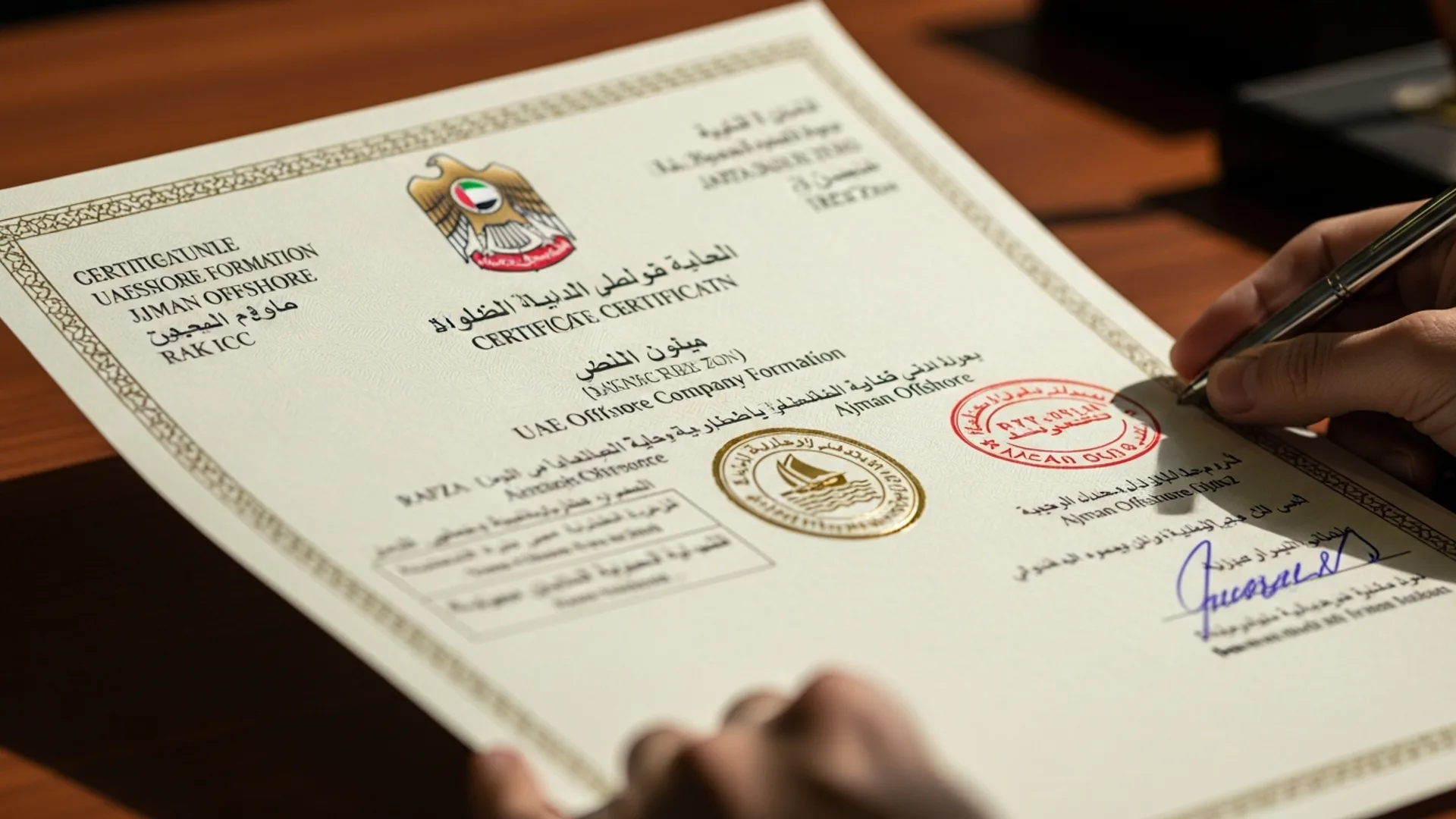
Quick AnswerOffshore business setup Dubai 2026, JAFZA, RAK ICC, Ajman Offshore options. Cost AED 12,500–55,000, tax benefits, banking reality.
Your setup cost, in 10 seconds
Package prices. Health insurance is required by law and not included.
Thank you.
Your written quote follows on WhatsApp.
Offshore business setup Dubai 2026, cost, jurisdictions, reality
A UAE offshore company is a structural entity used for international holdings, asset protection, and cross-border arrangements, NOT for operating businesses serving UAE customers. The cost is AED 12,500-55,000 in 2026 across the three available jurisdictions (JAFZA Offshore, RAK International Corporate Centre, Ajman Offshore), making offshore one of the most cost-effective UAE corporate structures. The trade-off: offshore companies cannot conduct local UAE business, hire UAE-resident employees, or get UAE visas. Founders who confuse offshore with free zone often regret their choice within months.
This guide is built from real offshore company setups across JAFZA Offshore, RAK International Corporate Centre, and Ajman Offshore, under the Federal Law on Commercial Companies (Federal Decree-Law No. 32 of 2021), Ministry of Economy (MOEC) framework, Central Bank UAE (CBUAE), and offshore jurisdiction-specific rules. It covers what offshore is, when to use it, the three UAE offshore jurisdictions compared, banking reality, and the limits that distinguish offshore from mainland/free zone.
What offshore actually means in UAE 2026
Offshore in UAE has a very specific meaning that differs from how the term is used in places like BVI, Cayman, or Mauritius:
UAE offshore is NOT
- A regular operating company
- Able to serve UAE-resident customers
- Able to hire UAE-resident employees
- Eligible for UAE visas
- Permitted to lease office space (typically)
- Allowed to trade goods physically located in UAE
UAE offshore IS
- A registered corporate entity in UAE jurisdiction
- Permitted to hold international assets
- Permitted to engage in international trade not involving UAE customers
- A vehicle for IP holdings, IP licensing structures
- A holding company for international subsidiaries
- Tax-efficient for qualifying international activities
- Often used for family wealth structures and succession planning
This distinction matters. Many founders ask "should I set up offshore or free zone?", they're actually asking different questions. Offshore is structural; free zone is operational. For the operational side, our guide to business setup in Dubai walks through mainland and free zone companies step by step.
For UAE offshore framework see Central Bank UAE https://www.centralbank.ae/. Federal commercial law at Ministry of Economy https://www.moec.gov.ae/. DET rules at https://www.det.gov.ae/.
The three UAE offshore jurisdictions
UAE has three offshore jurisdictions with subtle but important differences:
JAFZA Offshore (Dubai)
- Established 2003
- Operated by Jebel Ali Free Zone Authority
- Highest prestige internationally
- Best for Dubai-positioned holdings, asset protection
- Cost AED 30,000-55,000 setup, AED 18,000-30,000 annual
- Banking acceptance: 30-45% at UAE banks (slightly easier than other offshore due to JAFZA brand)
RAK International Corporate Centre (RAK ICC)
- Established 2016 (consolidated from older RAK offshore)
- Operates under English common law principles
- Most-used UAE offshore in 2026
- Excellent for international holding structures
- Cost AED 12,500-25,000 setup, AED 8,000-15,000 annual
- Banking acceptance: 25-40% at UAE banks
Ajman Offshore
- Established 2014
- Operated by Ajman Free Zone Authority
- Cheapest offshore in UAE
- Suitable for cost-conscious basic offshore needs
- Cost AED 12,000-22,000 setup, AED 7,000-12,000 annual
- Banking acceptance: 15-30% at UAE banks
For each jurisdiction, choice depends on use case, banking expectations, and cost tolerance.
When to use UAE offshore
Offshore is the right structure when:
International holding company
You want to hold ownership of international subsidiaries (e.g., your UK company, your US LLC, your Indian Pvt Ltd). UAE offshore holds the shares; subsidiaries do the operating business.
IP holding
Trademarks, patents, copyrights, software licenses, held by the offshore entity. Operating subsidiaries pay royalties to offshore for IP use. Tax-efficient structure.
Asset protection
Personal real estate, investments, art collection held by offshore entity. Provides separation from personal liability and inheritance complexity.
Family wealth structure
Family-owned offshore company holds investments and family business interests. Used for succession planning across generations.
Cross-border trading
You buy from Asia, sell to Africa, with funds flowing through UAE offshore. No UAE operations, but UAE entity for banking and structure.
International consulting
You provide consulting services to international clients only (zero UAE clients). Offshore entity invoices internationally. UAE residency visa not required for the offshore.
When NOT to use offshore (most common mistake)
Operating a UAE business
If you want to serve UAE customers, hire UAE staff, lease an office, or have any UAE-based operations, offshore is wrong. Use mainland DET or free zone.
Need UAE residence visa
Offshore doesn't issue visas. If you need UAE residency, use free zone (IFZA, DMCC, Meydan) or mainland (DET).
Have UAE customers
Selling to UAE-based clients requires mainland or free zone. Offshore is forbidden from invoicing UAE customers.
Need physical presence
Offshore is virtual-only. No physical office, no warehouse, no retail space.
Want bank financing easily
Offshore banking is materially harder than mainland/free zone. If you need active bank facilities (LCs, working capital), use operational entities.
Want easy ongoing operations
Offshore is for structural purposes. Operating companies use other structures.
The real cost breakdown
For JAFZA Offshore (the highest-prestige option):
| Line item | AED (2026) |
|---|---|
| JAFZA Offshore registration | 18,000–28,000 |
| Initial share capital declaration | 0 (no paid-up required) |
| Trade name reservation | 1,000 |
| Drafting & notarisation | 3,500–7,500 |
| Notary fees | 500–1,500 |
| First-year office address service | 2,000–5,000 |
| Setup advisor (if used) | 5,000–15,000 |
| Total year 1 | AED 30,000–55,000 |
| Annual renewal | AED 18,000–30,000 |
For RAK ICC:
| Line item | AED (2026) |
|---|---|
| RAK ICC registration | 8,500–15,000 |
| Trade name reservation | 500–1,000 |
| Drafting & notarisation | 2,500–5,000 |
| First-year office address | 1,000–3,000 |
| Setup advisor | 3,000–10,000 |
| Total year 1 | AED 12,500–25,000 |
| Annual renewal | AED 8,000–15,000 |
For Ajman Offshore:
| Line item | AED (2026) |
|---|---|
| Ajman Offshore registration | 7,500–13,000 |
| Trade name reservation | 500 |
| Drafting & notarisation | 2,000–4,000 |
| First-year office address | 1,000–2,500 |
| Setup advisor | 2,500–8,000 |
| Total year 1 | AED 12,000–22,000 |
| Annual renewal | AED 7,000–12,000 |
Contact Us For Free Consultation
or
Ask on WhatsApp insteadLicensed UAE consultancy. One reply, no spam.
Thank you.
A consultant will reply on WhatsApp shortly.
The setup process
Step 1: Choose jurisdiction (Week 1)
Based on use case:
- International holding for institutional structures → JAFZA or RAK ICC
- IP holding → RAK ICC (best regulatory clarity)
- Family wealth → JAFZA (prestige) or RAK ICC
- Basic offshore → Ajman Offshore (cheapest)
Step 2: Reserve trade name (Day 1-3)
Submit 2-3 trade name options. Most offshore jurisdictions require "Ltd", "Limited", "Inc" or similar suffix. Names rejected if they suggest UAE-business activity (since offshore can't do UAE business).
Step 3: Draft MOA and AOA (Day 3-7)
Standard offshore template MOA covers: ownership, share capital declaration, business activities (international only), board structure if applicable, director appointments.
Step 4: Submit application (Day 7-10)
Online or in-person at offshore jurisdiction office. Pay registration fees. Documents required:
- Notarised MOA
- Director(s) passport copies
- Beneficial owner KYC
- Shareholder declarations
- Business plan summary (some jurisdictions request)
Step 5: Registration certificate issued (Day 10-15)
Offshore registration certificate issued. Company exists legally.
Step 6: Get registered office address (Day 15-20)
Use jurisdiction's registered office service (typical) or private mailbox service. Required for ongoing communications.
Step 7: Apply for bank account (Week 3-12)
UAE bank account opening for offshore is the longest single step. Banks require:
- All registration documents
- Beneficial owner KYC + UAE residence verification
- Source of funds documentation (often 6-12 months bank statements)
- Business plan with non-UAE customer base
- Higher minimum deposits (AED 100K-500K typical)
Banks willing to accept offshore: Mashreq Private Banking, RAK Bank Private, some Emirates NBD Private tiers. Standard SME banks (Wio, Mashreq NEO) typically decline offshore companies.
Step 8: First operations (Week 12+)
Once licensed and banked, offshore can begin its specific purpose (holding shares, IP licensing, international trading, etc.).
Common mistakes that cost offshore founders money
- Mistake 1: Confusing offshore with free zone. Founder sets up Ajman Offshore expecting to serve UAE customers. Discovers limitations 3 months in. AED 12K wasted. Always clarify use case before incorporation.
- Mistake 2: Underestimating banking difficulty. Founder pays AED 30K for JAFZA Offshore. Then spends 6 months trying to open bank account that gets declined. Inactive offshore wastes the initial investment.
- Mistake 3: Choosing cheapest without understanding banking implications. Ajman Offshore is cheap but banking is hardest. JAFZA costs more but banks accept it more often. Penny-wise pound-foolish.
- Mistake 4: Wrong jurisdiction for use case. JAFZA Offshore for personal asset holding is overkill. Ajman Offshore for institutional IP holdings is inadequate. Match jurisdiction to need.
- Mistake 5: Not planning for substance. Pure shell offshore companies face increasing scrutiny. Plan for some substance (board meetings, business activities, real economic purpose) to maintain credibility.
Offshore and UAE corporate tax
UAE offshore companies typically qualify for 0% on qualifying income under the Ministry of Finance framework. Qualifying income for offshore includes:
- Investment income from international assets
- IP royalty income from international licensing
- Dividend income from international subsidiaries
- Capital gains on international investments
- Cross-border trading without UAE customers
Non-qualifying income (would be taxed at 9% but typically not earned by pure offshore):
- UAE-resident customer revenue
- UAE-source operational income
- UAE-based business operations
For most offshore companies, all income is qualifying = 0% tax. This is one of the cleanest tax structures available.
Federal Tax Authority registration is still required for offshore companies, file annual returns even with no taxable income. Cost AED 1,500-4,500 annually for tax agent.
Substance requirements
UAE introduced Economic Substance Regulations (ESR) in 2019 affecting offshore companies. Substance requirements depend on activity type:
- Holding company activity, minimum substance requirements (registered office, qualified directors)
- IP holding, significant substance requirements (qualifying staff, board meetings, decision-making in UAE)
- Distribution/service centre, moderate substance
- Banking, insurance, high substance (these typically aren't done via offshore)
Most family wealth and asset holding offshore companies meet substance requirements via the standard jurisdiction services. Active IP licensing offshore companies need more careful planning.
Banking, the critical practical issue
UAE banks tightened materially on offshore accounts since 2024 due to anti-money laundering global pressures. Practical reality in 2026:
Banks accepting offshore (with conditions)
- Mashreq Private Banking, accepts JAFZA Offshore, RAK ICC. Requires AED 250K-500K minimum balance.
- RAK Bank Private, accepts RAK ICC primarily, also JAFZA. AED 200K minimum.
- Emirates NBD Private, accepts JAFZA Offshore. Higher tier private banking only.
- Some international banks, HSBC, Standard Chartered private banking accept offshore with relationship banking.
Banks generally declining offshore
- Wio Bank
- Mashreq NEO Biz (standard tier)
- Emirates NBD Business Banking (standard SME)
- ADCB Business Banking (standard)
- RAK Bank Business (standard SME)
For offshore banking, plan: AED 250K-500K minimum balance per account, 6-12 week onboarding, comprehensive documentation, private banking tier service. Don't expect standard SME banking ease.
Offshore for foreign founders vs UAE residents
Foreign founders (non-UAE residents)
Offshore is straightforward. No visa needed. Director can be foreign. Beneficial owner is the foreign founder. Banking may be even harder than for UAE residents.
UAE residents
Many UAE residents use offshore for international diversification. The offshore entity is separate from their operating UAE business. Banking acceptance better than pure foreign owners (existing UAE relationship helps).
Mixed structures
Some founders use multi-entity setups: UAE mainland operating company + UAE offshore holding company. The mainland operates the business; offshore holds the shares. Tax-optimised structure for institutional positioning.
Comparison: offshore vs free zone vs mainland
| Aspect | Offshore | Free Zone | Mainland |
|---|---|---|---|
| Operate within UAE | No | Limited | Yes |
| Hire UAE staff | No | Yes | Yes |
| UAE visas | No | Yes | Yes |
| Physical office | No (virtual only) | Yes (in zone) | Yes (anywhere) |
| Setup cost | AED 12K–55K | AED 12K–35K | AED 25K–35K |
| Annual renewal | AED 7K–30K | AED 12K–25K | AED 15K–22K |
| Bank account difficulty | Hard | Moderate | Easy |
| Tax position | Often 0% | Often 0% | 9% standard |
| Best for | Holding, asset protection | International + some UAE biz | UAE-domestic operations |
Multi-entity structures
Sophisticated founders often use multiple entities:
UAE Holding + Operating
- UAE offshore holding company owns the operating entity
- Operating entity is mainland DET or free zone
- Holding company manages tax, governance, ownership
- Operating entity runs daily business
International Group structure
- UAE offshore is the regional holding
- Subsidiaries in UAE (mainland), other GCC, MENA
- UAE offshore receives dividends and licensing fees
- Centralised governance from UAE
Family Office Structure
- UAE offshore holding for family wealth
- Subsidiaries in property, securities, business interests
- Trust-like governance via offshore directorship
- Succession planning built into structure
These structures take legal advisory + tax planning. Cost AED 25,000-100,000+ for proper setup. Maintenance fees ongoing.
What changes if you are foreign-owned vs UAE-resident
Offshore rules are identical for foreign-owned and Emirati-owned entities. 100% foreign ownership applies, no Emirati partner required.
For foreign founders without UAE residence, offshore is one of the few UAE corporate vehicles available since most operating structures require UAE-resident directors or visas.
When offshore is the right answer
Quick decision framework:
✅ Use offshore when:
- Pure international holding/investment activity
- No UAE customers, no UAE staff, no UAE operations
- Family wealth structure across generations
- IP holding for international licensing
- Cross-border trading with non-UAE customers
❌ Don't use offshore when:
- Serving UAE customers
- Hiring UAE-resident employees
- Need UAE visa
- Need active UAE banking facilities (LCs, working capital)
- Operating physical business in UAE
What your first 90 days look like
For an offshore setup (e.g., RAK ICC):
- Days 1-7: Choose jurisdiction. Reserve trade name. Begin documentation.
- Days 8-14: MOA drafted and notarised. Application submitted.
- Days 15-21: Registration certificate received. Company exists.
- Days 22-45: Banking application begins. Documents prepared.
- Days 45-90: Banking onboarding. Source of funds review. Account opening.
For some offshore companies (pure holding structures with no banking needs), the first 90 days complete in week 3. Banking is the long pole.
Common misconceptions we hear weekly
"Offshore means tax-free forever." Not anymore. UAE introduced 9% corporate tax in 2023. Offshore entities are still subject to UAE corporate tax if they earn UAE-sourced income or fall into a taxable category. Pure foreign-source passive income (dividends from foreign shareholdings, capital gains on qualifying shareholdings) generally remains exempt under participation exemption rules, but you cannot assume zero tax without proper structuring.
"Offshore gives me a UAE visa." No. Offshore companies do not issue establishment cards, do not sponsor employment visas, and do not get the holder a UAE residence. If you want a UAE visa, you need a free zone or mainland company, or a Golden Visa route. Many founders pick offshore for cost, then discover six months later they cannot move to Dubai under it.
"Offshore is faster than free zone." Sometimes, sometimes not. Registration is fast (5-10 working days). But banking takes 6-12 weeks for offshore vs 2-4 weeks for a well-prepared free zone applicant. Net timeline is often longer.
"I can run my Amazon store through offshore." Not if you ship to UAE customers. Selling into UAE is local activity. You need a free zone or mainland e-commerce licence. Offshore can hold IP or own shares in your trading company, but it cannot be the trading vehicle itself for UAE-facing sales.
"Offshore protects me from lawsuits." Asset protection varies massively by jurisdiction and is not automatic. RAK ICC has stronger asset protection than JAFZA Offshore. Asset protection works when set up early, before any claim exists. Set up after a dispute starts, it usually fails.
Substance requirements you cannot ignore
UAE introduced Economic Substance Regulations (ESR) and now corporate tax substance rules. Offshore companies that conduct "relevant activities" (banking, holding company, headquartering, distribution, lease-finance, intellectual property, shipping, finance and leasing) must demonstrate substance, meaning real management decisions made in UAE, qualified staff, premises, and operating expenditure proportionate to the activity.
For a pure holding offshore that only holds shares and collects dividends, substance requirements are light, board meetings in UAE, basic records. For an IP-holding offshore, substance is heavy, you need qualifying personnel and R&D activity. Offshore is no longer a paper exercise. Each year you need to file ESR notification, file a CT return, and demonstrate substance proportionate to your activity. Build that compliance cost into your decision.
Real founder scenarios we see every month
Scenario 1, The Crypto Founder. A UK-based founder running an international crypto venture wants to hold tokens and trading profits outside the UK tax net while building substance in Dubai. We typically recommend a hybrid: offshore RAK ICC for the IP and token holding, plus a DMCC or VARA-licensed free zone entity for the operating arm. Offshore alone fails because banking refuses crypto without an operating licence somewhere.
Scenario 2, The Family Office. A Saudi family wants a centralised holding vehicle for shareholdings in five operating companies across UAE, KSA, India, and UK. RAK ICC is usually the answer, strong corporate governance, common-law jurisdiction, recognised internationally. Offshore here is correct and powerful.
Scenario 3, The Amazon Seller. A founder selling on Amazon UAE and Amazon UK asks for offshore "for tax." Wrong tool. They need a free zone licence (DMCC or IFZA e-commerce) for the UAE-facing sales, and the UK sales are taxed in the UK regardless of where the company sits. Offshore would not save tax and would block banking.
Scenario 4, The Inheritance Planner. An expat couple with AED 12M in property and investments wants succession planning. Offshore for the holding plus a UAE will + DIFC Wills Service. Offshore here helps consolidate assets and clarify succession, separate from any tax goal.
Scenario 5, The Pure Investor. A founder wants to hold listed equities and private investments globally with no operating activity. RAK ICC offshore is ideal. Costs AED 18,000-25,000 annually all-in. Compliance light. Banking achievable with proper introductions.
These scenarios share one pattern: offshore works when the actual use case is holding, IP, or succession, not operations.
What to do next
If you're considering offshore for clear structural purposes (international holding, IP, family wealth), the next step is jurisdiction selection. The 3 UAE offshore options have meaningful differences. A 20-minute call clarifies which jurisdiction fits your specific use case (asset protection, IP holding, international trading, family structure) and helps avoid the most common mistake, confusing offshore with operational structures. We'll never set you up offshore if you actually need free zone or mainland for your business model.
Talk to Our Experts
Set up your UAE offshore company through the right jurisdiction. JAFZA Offshore, RAK ICC, or Ajman Offshore, banking, holding structures, asset protection handled. Free 20-minute consultation.
Frequently Asked Questions
What is an offshore company in Dubai/UAE 2026?
A UAE offshore company is a corporate entity incorporated in a designated offshore jurisdiction (JAFZA Offshore, RAK International Corporate Centre, Ajman Offshore) that operates internationally but cannot conduct business with UAE residents or trade physical goods within UAE. Offshore is used for: international holding companies, asset protection, IP holdings, family wealth structures, cross-border trading, and tax-optimised group structures. NOT used for operating businesses serving UAE customers.
How much does offshore company setup cost in Dubai 2026?
UAE offshore setup costs AED 12,500–55,000 in 2026 depending on jurisdiction. JAFZA Offshore: AED 30,000–55,000 (highest prestige). RAK International Corporate Centre (RAK ICC): AED 12,500–25,000 (most popular). Ajman Offshore: AED 12,000–22,000 (cheapest). Annual renewal AED 8,000–25,000. Add USD 2,500–10,000 for nominee director services if used.
Can an offshore company in UAE open a bank account?
Yes, but with material limitations in 2026. Banking offshore UAE companies has tightened significantly since 2024. Acceptance rates: JAFZA Offshore, 30-45% acceptance at UAE banks. RAK ICC, 25-40%. Ajman Offshore, 15-30%. UAE banks typically require: documented source of funds, beneficial owner KYC, business plan with non-UAE customer base, often higher minimum deposits (AED 100K-500K).
What’s the difference between offshore and free zone in UAE?
Free zone companies (IFZA, DMCC, JAFZA, etc.) CAN operate within the free zone, hire UAE-resident employees, and serve UAE customers (limited). Offshore companies CANNOT do any of those, they are international-only entities. Free zones have physical office requirements; offshore is virtual-only. Free zones offer visas; offshore does not. Free zones are operational; offshore is structural.
Which offshore jurisdiction is best for UAE?
JAFZA Offshore for prestige and Dubai-positioning (banking marginally easier given JAFZA’s reputation). RAK ICC for most international holding structures (English common law, recognised globally, mature regulatory framework). Ajman Offshore for cost-conscious basic offshore needs. For international holding companies serving institutional investors, JAFZA or RAK ICC. For solo founder personal asset holding, Ajman Offshore is sufficient.
Does an offshore UAE company qualify for 0% corporate tax?
Yes for qualifying activities. UAE offshore companies are typically taxed at 0% on income that doesn’t relate to UAE-based business. The 0% qualifying income rules apply to offshore similar to free zones. Offshore is one of the cleanest paths to 0% tax for international holdings, IP holdings, and cross-border trade, provided the structure doesn’t involve UAE-resident customers or UAE-based operating activities.
Can a UAE resident own an offshore UAE company?
Yes. UAE residents can own offshore UAE companies for: international asset holding, international investments, IP holdings, family wealth structures, cross-border trading not involving UAE customers. The offshore company simply cannot conduct business within UAE. The owner’s UAE residence visa is unaffected. Many UAE residents use offshore companies for international diversification.
How long does offshore company setup take?
RAK ICC offshore: 2-5 working days. Ajman Offshore: 3-7 working days. JAFZA Offshore: 5-10 working days. Faster than mainland/free zone setup because no establishment card, no MOHRE labour file, no visa quota. Banking, however, adds 4-12 weeks. Total time from offshore decision to operational with bank: 6-15 weeks.
Related Noble Core deep-dives
- ADGM company setup Abu Dhabi 2026, for common-law jurisdiction alternatives to offshore
- Ajman trade license cost 2026, for the lowest-cost operational UAE entity
- Renew trade license Dubai 2026, for managing ongoing licence compliance