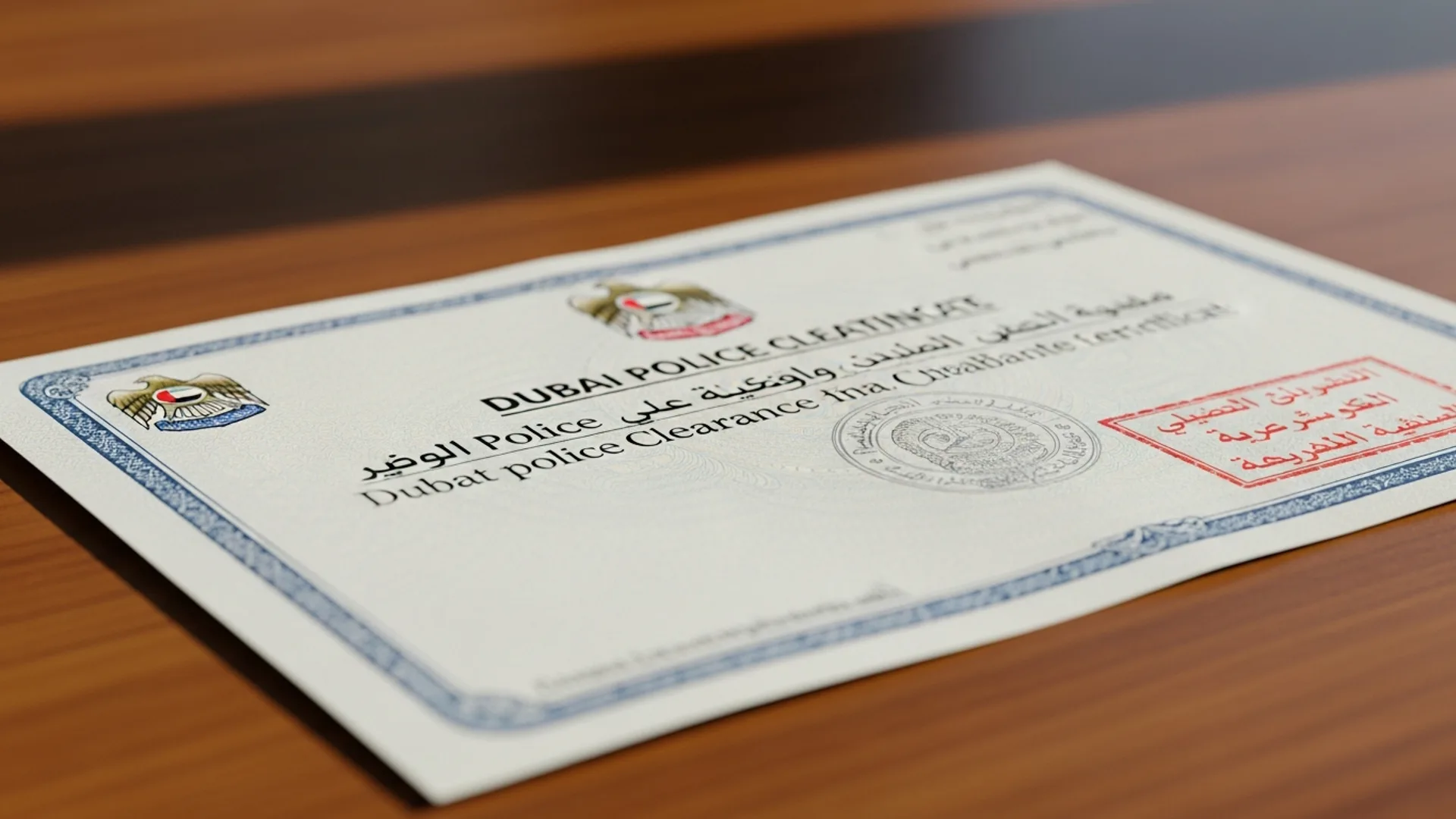
Quick AnswerPolice clearance certificate Dubai 2026: how to apply via Dubai Police, documents, indicative fee, processing time, attestation and validity.
📋 This guide is part of our complete UAE Government Services & Portals directory — every federal and Dubai e-service in one place.
Dubai Police NOC and good conduct certificate in Dubai
A good conduct certificate in Dubai, also known as a Dubai Police NOC (police clearance certificate), is issued by Dubai Police to confirm you have no recorded criminal convictions in the UAE. You can usually apply through the Dubai Police website or app, paying a service fee (confirm current official fees) and providing your Emirates ID, passport, and photo. Many employers and immigration authorities request this certificate. Processing times and document requirements vary, so verify the latest details directly with Dubai Police.
How do I get a police clearance certificate in Dubai in 2026?
To get a police clearance certificate in Dubai in 2026, you apply through Dubai Police, either via the Dubai Police smart app, the Dubai Police website, or the Ministry of Interior (MOI) UAE portal. You submit your Emirates ID and a passport copy, provide a recent photograph, give your fingerprints where they are required for your purpose, and pay the prescribed fee. As an indicative 2026 guide the standard resident certificate commonly costs in the region of AED 200 to AED 220, with attested or from-abroad versions costing more. For most residents whose biometrics are already on file, Dubai Police often issue the certificate the same day once your identity is verified. These figures are indicative — confirm current official fees with the authority — and first-time or overseas applicants usually wait longer because fingerprints must be captured and matched first.
A Dubai police clearance certificate, frequently called a good-conduct certificate or a "to whom it may concern" certificate of no criminal record, is one of those documents that seems trivial until you actually need it, at which point it almost always sits on a deadline. A new employer wants it before your start date, a foreign immigration office wants it as part of a residency file, or a regulator wants it before signing off on a licence or a permit. The encouraging news is that Dubai Police have made the process genuinely efficient and largely digital for residents whose biometrics are already recorded, and predictable even for those applying from overseas. The friction is rarely the police themselves; it is the small avoidable errors — a name that does not match across documents, a fingerprint set taken on the wrong form, or attestation discovered too late — that turn a one-day errand into a multi-week scramble. This guide from Noble Core Ventures walks you through exactly who issues the certificate, what it is for, the documents you need, the indicative 2026 fees, the step-by-step process for both in-country and overseas applicants, the attestation chain for using it abroad, how it connects to a Dubai business setup, and the mistakes residents and founders most often make, so you can get yours cleanly the first time.
What a Dubai police clearance certificate actually is and who issues it
A police clearance certificate is an official statement from the relevant police authority confirming that, as of the date of issue, there are no recorded criminal convictions or adverse records held against you in that jurisdiction. In Dubai, this certificate is issued by Dubai Police, the emirate-level policing authority that operates the smart application, website, service centres and verification systems behind the certificate. Across the country the same kind of document is also available at federal level through the Ministry of Interior (MOI), which is why people sometimes talk about a "UAE police clearance certificate" and a "Dubai police clearance certificate" almost interchangeably. They are closely related, but they are not identical, and choosing the right one for your purpose saves real time.
The simplest way to think about it is by who is asking and why. When you have lived in Dubai and a local employer, a Dubai-based regulator, a visa step inside the UAE, or a Dubai business licensing process needs proof of your good conduct, the emirate-level certificate from Dubai Police is usually the natural fit. When the request comes from outside the country — a foreign immigration department, an overseas employer, or a residency application in another nation — the requesting body will often specify a UAE-wide or federal certificate that reflects records across all emirates, because they want national coverage rather than a single emirate. Both versions confirm the same essential thing: an absence of adverse records. The practical difference for most residents is simply which channel they go through and which authority's name appears on the document. If you are unsure which one the receiving organisation expects, the most reliable move is to ask them in writing, and to read our companion UAE police clearance certificate guide to compare the federal route side by side before you commit to an application. You can begin a Dubai application directly on the official Dubai Police website or smart app.
It is worth being precise about terminology, because forms and HR departments use several names for the same thing. You will see "good conduct certificate," "good standing certificate," "certificate of no criminal record," "certificate of no conviction," and the older phrase "to whom it may concern" certificate. In the Dubai and wider UAE context these all refer to the same family of document issued by the police. When an employer or authority asks for any of these, a Dubai Police good-conduct certificate is what they generally mean, provided your relevant residence and history were in Dubai. Knowing the synonyms matters because a request worded one way can sometimes confuse applicants into thinking they need a different, exotic document when in fact the standard police clearance certificate covers it. If your history spans more than one emirate, that is precisely where the federal Ministry of Interior version becomes relevant, and we return to that distinction in detail later in this guide.
Why people in Dubai need a police clearance certificate
The reasons people request a Dubai good-conduct certificate cluster into a handful of recognisable situations, and understanding which one applies to you shapes the documents you should prepare and whether you will need attestation. The most common trigger is employment. Many employers in Dubai, and a growing number of sectors generally, ask for a good-conduct certificate as part of onboarding, particularly for roles involving finance, security, education, healthcare, childcare and other positions of trust. If a Dubai employer has made you an offer, expect the certificate to appear on the checklist, and expect it to carry a deadline tied to your start date, sitting alongside the standard labour formalities overseen nationally by the Ministry of Human Resources and Emiratisation (MOHRE). Because the resident process is often same-day, employment requests are usually the easiest to satisfy quickly, provided your documents are in order.
The second major trigger is immigration and migration, both inbound and outbound. People moving abroad, applying for permanent residency, citizenship by investment, skilled-migration programmes, or long-term study visas in another country are very frequently asked to produce a police clearance certificate covering every country where they lived for a meaningful period, which means a current or former Dubai resident will be asked for a UAE certificate covering their time here. This is the scenario where attestation almost always comes into play, because the certificate has to be recognised by a foreign government. The third cluster is local processes: certain UAE visa and residency stages handled in Dubai through the General Directorate of Residency and Foreigners Affairs (GDRFA), some professional licensing and registration steps, adoption and fostering procedures, firearm or specialised permits, and selected tenancy or partnership arrangements can call for a current good-conduct certificate. The fourth is business: while many Dubai company setups do not demand one as a routine step, particular regulated activities, partner due-diligence checks, and some residence-visa stages connected to a licence can request it, which we cover in detail further below.
Recognising your scenario early matters because it determines two things that are easy to get wrong: whether you need the Dubai emirate certificate or the federal UAE one, and whether the certificate has to be attested for use abroad. A resident obtaining the certificate for a local Dubai employer has a simple, fast, frequently same-day path. A person assembling an immigration file for another country has a longer path involving the correct national-level certificate and a full attestation chain through the Ministry of Foreign Affairs (MOFA). Both are entirely manageable, but they are different journeys, and starting down the wrong one is the most common reason people lose time. If your need is tied to a UAE visa step rather than an overseas move, our overview of UAE visa types can help you map which residency or entry route you are actually working toward before you request the certificate.
Documents you need for a Dubai police clearance certificate
The document checklist for a Dubai good-conduct certificate is short, but each item has to be correct, because Dubai Police verify your identity against official records and any mismatch stalls the application. For a resident applying inside the UAE, the core set is a valid Emirates ID, which is the primary identity anchor for the whole process; a clear colour copy of your passport, including the photo page and, for residents, the residence visa page; and a recent passport-sized photograph taken against a plain, light background to current specifications. These three items cover the majority of straightforward in-country requests where your biometrics are already on file from your residence process.
Beyond the core set, several supporting items appear depending on your purpose and history. Fingerprints are required for most first-time applicants and for many specific purposes; these are captured at a Dubai Police centre, although applicants whose prints already exist on file from a prior application or their residence process may not need to repeat them. A stated purpose for the certificate is generally required, and for some cases a supporting or request letter is needed, stating the reason you require the certificate — whether for an employer, an immigration authority, a licensing body or a personal reason — and sometimes naming the entity the certificate is addressed to. If you have held a previous good-conduct certificate, a copy can speed verification. People applying from outside the UAE additionally need a complete, clear set of fingerprints taken on the official fingerprint form at a police station in their current country and certified locally, because Dubai Police cannot capture biometrics remotely. Where the certificate is bound for use abroad, you should also be ready for the receiving country to ask for a certified translation alongside the attested original.
A point worth emphasising is consistency across documents. Your name must be recorded identically on your Emirates ID, your passport and your application, including the order and spelling of each name part. Minor differences that seem harmless to applicants — a dropped middle name, a different transliteration, an extra or missing space — are exactly the kind of discrepancy that triggers a manual review or a rejection, because the police are matching you against records where precision is the whole point. Before you apply, it is worth running a quick Emirates ID status check to confirm your card is valid and current, since an expired Emirates ID is one of the most common and most avoidable reasons an application stalls. If your documents disagree with each other, resolve that first rather than during the application, make sure your passport copy is in date and your residence visa is current, and confirm your photograph meets the current specification, since a non-compliant photo is a frequent and entirely avoidable reason for a resubmission.
Step-by-step: applying for a Dubai police clearance certificate inside the UAE
For a resident applying from within the country, the process is refreshingly direct once you know the sequence. The first step is to confirm your route and eligibility. Dubai Police offer the Dubai Police smart app, the Dubai Police website, and access through the Ministry of Interior UAE portal, and the right one for you depends mainly on whether your fingerprints are already on file. If they are, you may be able to complete the entire request digitally — uploading your documents, paying online and receiving a verifiable electronic certificate, often the same day. If you are a first-time applicant or your purpose requires fresh biometrics, you will need to attend a service centre or a smart-services point at some stage to give fingerprints and verify your identity. Checking this first, on the official Dubai Police channels, prevents the common frustration of starting online only to discover you must visit in person anyway.
The second step is to select the good-conduct certificate service, choose the correct purpose, and enter your details, then submit your documents: your Emirates ID, passport copy, recent photograph and, where applicable, your supporting letter. Through the digital route you upload clear scans; in person, you present originals and copies, often with help from a service-centre desk. The third step is biometrics where required, capturing your fingerprints so they can be matched against records. The fourth step is payment of the prescribed fee, which can be made electronically through the app or website or at the centre. Once submitted, your application enters verification, where Dubai Police confirm your identity and check for any adverse records. For a standard, complete resident application this verification is quick, and the certificate is frequently issued the same day, sometimes within minutes to a few hours for simple digital cases. The final step is delivery: you either download a verifiable digital certificate as a PDF or collect a printed copy, and you request any additional copies, or a different language version, at this point rather than coming back later.
Throughout the process the single biggest determinant of speed is the completeness and accuracy of what you submit. A clean application with matching names, in-date documents, a compliant photo and clear fingerprints flows through verification without friction and is exactly why so many residents receive the certificate the same day. An application with a single mismatch or a blurred print gets pulled aside for manual handling, which is where days disappear. Because Dubai Police periodically refine their app, website and digital services, it is always worth a quick check of their current official process before you begin, so that you are following the latest route rather than an out-of-date description. The structure above — confirm route, select the service and purpose, submit documents, give biometrics, pay, verify, receive — holds steady even as the specific screens and counters evolve.
Applying through the Dubai Police app, website and the MOI UAE portal
Because the digital channels are where most residents now apply, it is worth understanding how the three official routes relate. The Dubai Police smart app is the most convenient for residents already inside the country: you authenticate, find the good-conduct or police clearance certificate service, complete the request, pay and, in eligible cases, receive a verifiable PDF without leaving home. The Dubai Police website offers the same service through a browser, which some people prefer for uploading documents and printing. The Ministry of Interior UAE portal is the federal gateway that links the policing services of the emirates, and it is particularly relevant when your request touches the national level or when you are guided there from a unified government services entry point. For a purely Dubai, in-country resident request, the Dubai Police app or website is typically the most direct path; for a federal or multi-emirate need, the Ministry of Interior route comes into focus.
Whichever channel you use, the underlying logic is the same: the system authenticates you, matches you against records using your Emirates ID and biometrics, takes your fee, and issues a certificate that can be verified electronically. The verifiable nature of the digital certificate matters, because receiving organisations can confirm its authenticity rather than relying on a paper document alone, which is part of why the process is both fast and trusted. If you have a UAE Pass or equivalent secure digital identity, the sign-in step is smoother still. The practical advice is to start on the official Dubai Police channel for a Dubai request, keep your documents ready as clear scans before you begin so you are not hunting for them mid-application, and only switch to the Ministry of Interior portal if your purpose or the receiving body specifically calls for the federal-level certificate. As always, since government platforms are continually improved, confirm the current screens and exact service names on the official site at the time you apply.
Applying from outside the UAE, and for former residents
A significant share of Dubai police clearance requests come from people who are no longer in the country, or who are abroad temporarily, and the good news is that Dubai Police accommodate this. Former residents commonly need the certificate because a foreign employer or an immigration authority in their new country wants confirmation of a clean record during the years they lived in the UAE. The defining difference from an in-country request is biometrics: because Dubai Police cannot capture your fingerprints remotely, you must have them taken on the official fingerprint form at a police station in your current country, have that form certified locally, and then submit it as part of your application. Everything else — your passport copy, your former Emirates ID or residence details, a recent photograph and the fee — is submitted through the appropriate online channel.
Two practical realities shape the overseas route. First, it takes longer than a resident's same-day request, because the certified fingerprints have to be received, checked and matched against historic records before the certificate is produced, so you should start well ahead of any deadline the receiving body has set. Second, almost everyone applying from abroad is doing so for use in another country, which means attestation is usually part of the journey, and the certificate will need to be legalised so the foreign authority will accept it. Plan the application and the attestation chain together rather than sequentially, because discovering the attestation requirement only after the certificate is issued is one of the most common and most frustrating delays. If you are coordinating an international move, treat the police clearance certificate as one item in a wider relocation file — alongside attested educational and personal documents — and sequence them so they all reach the receiving authority fresh and properly legalised at the same time.
Fees for a Dubai police clearance certificate in 2026
Fees are the area where applicants most want a precise number and where it is most important to hedge, because government tariffs are reviewed periodically and the figure that applies to you depends on exactly what you are requesting. As an indicative 2026 guide, the standard good-conduct certificate for a resident requested inside the UAE through Dubai Police commonly sits in the region of AED 200 to AED 220. Requesting the certificate from outside the country, or in additional languages, can cost more, and additional printed copies usually carry a small extra charge. Government transactions in the UAE can also attract small knowledge and innovation fees, which are added at the point of payment. None of these figures should be treated as guaranteed; they are guideline ranges to help you budget, and the only authoritative number is the one shown to you by Dubai Police at the moment you apply.
Crucially, the certificate fee is not the same as the cost of using the certificate abroad. If your certificate needs attestation for use in another country, you will pay separate fees to the Ministry of Foreign Affairs (MOFA) for attestation and, in many cases, further fees to the destination country's embassy or consulate for legalisation, plus the cost of any certified translation and any courier charges. These attestation and legalisation costs are entirely separate from the police fee and can, depending on the destination, add up to more than the certificate itself. The sensible approach is to budget in two parts: the Dubai Police certificate fee, and the attestation chain if you need it. For a resident using the certificate locally, only the first part applies, which is one reason a Dubai good-conduct certificate is so inexpensive and quick for in-country employment purposes. As with every figure in this guide, confirm the current official fees directly with the relevant authority before you commit, since they can change without much notice.
Attestation: making your Dubai certificate valid abroad
Attestation is the single most misunderstood part of the whole process, and getting it right is the difference between a certificate that a foreign government accepts and a piece of paper they reject. A Dubai Police good-conduct certificate is fully valid for use inside the UAE on its own. The moment you intend to use it abroad, however, the destination country generally needs proof that the document is genuine and was issued by a legitimate UAE authority, and that proof comes from attestation. The standard UAE chain involves attestation by the Ministry of Foreign Affairs (MOFA), which confirms the document's authenticity at the federal level, followed by legalisation at the embassy or consulate of the country where you will use it. Where the destination country is part of an apostille arrangement that the UAE participates in, an apostille may replace the longer embassy-legalisation step, simplifying the chain considerably. Some destinations additionally require a certified legal translation of the certificate into their official language.
The order matters. You obtain the certificate from Dubai Police first, then take it through MOFA attestation, then through the destination country's embassy or consulate or the apostille process, and finally arrange any required translation so that the translated version is itself accepted. Because each step has its own fee, its own timeline, and its own queue, and because the certificate's validity window is limited, you should map the entire chain before you start and sequence the steps so the document does not expire midway. A frequent and painful mistake is to obtain the certificate, let weeks pass while sorting other parts of a relocation, and then discover that by the time it reaches MOFA and the embassy, the receiving authority considers it stale. Treat attestation as part of the application, not an afterthought. If you are managing an overseas move and are unsure exactly which steps your destination requires, this is precisely the kind of detail where a short conversation with an advisor who handles attestation regularly saves both time and rework.
Validity: how long a Dubai police clearance certificate lasts
A good-conduct certificate is, by its nature, a snapshot. It states your record only up to the date it is issued, so it does not carry a long shelf life the way a passport or an Emirates ID does. In practice, most authorities, employers and immigration bodies treat a Dubai police clearance certificate as valid for around three months from the date of issue, and some will accept a slightly longer window, but the decisive point is that the receiving organisation sets its own acceptance period. One foreign immigration department might insist on a certificate issued within the last three months; an employer might be comfortable with one issued within six. You cannot assume; you confirm with whoever is asking.
The practical consequence is timing. Because the certificate ages from the moment it is issued, the goal is to have it fresh when the receiving party actually evaluates your file, not to obtain it as early as possible. For a straightforward local employment request this is rarely an issue, since the certificate is requested and used within days. For an international move with a long attestation chain and a slow-moving immigration process, timing is everything: you want the certificate issued late enough that it is still within the acceptance window when it lands on the assessor's desk, but early enough to complete attestation. If a process drags on and your certificate ages out, the remedy is simple — you apply again, which for a resident already on file with Dubai Police is usually quick and often same-day. The cost of a fresh certificate is small compared with the cost of a rejected application, so when in doubt about timing, it is better to re-apply than to submit a certificate that is past the receiving body's window.
Dubai certificate versus the federal UAE certificate
One distinction trips up more applicants than almost any other: whether you need the Dubai-level certificate from Dubai Police or the federal, UAE-wide certificate available through the Ministry of Interior (MOI). The Dubai Police certificate is the emirate-level good-conduct certificate, processed through Dubai's own smart app, website and service centres. It is the natural choice when your relevant history is in Dubai and a local employer, a Dubai regulator, or an in-country process needs it. The federal certificate, by contrast, reflects records across the whole country and is issued through national Ministry of Interior channels; it is frequently the version that foreign immigration authorities, overseas employers and multi-emirate processes expect, precisely because they want assurance covering all of the UAE, not just one emirate.
For many residents the difference is invisible in practice, because both certificates confirm the same essential fact — an absence of adverse records — and the choice simply comes down to which channel you apply through and which authority's name appears on the document. The complication arises when your time in the UAE spans more than one emirate, or when the receiving organisation is specific about wanting "national" or "federal" coverage. If you lived in Dubai throughout, a Dubai Police certificate usually suffices for local needs; if you lived in several emirates, or the requesting body explicitly asks for a UAE-wide certificate, the federal route through the Ministry of Interior is the safer choice. The single most reliable way to avoid obtaining the wrong one is to ask the receiving party, in writing, exactly which they require before you apply. To compare the two routes in depth, see our UAE police clearance certificate guide; and if your history also touches a neighbouring emirate, our Sharjah police clearance certificate guide walks through that emirate's process so you can line everything up correctly.
Do founders and employees in Dubai need one for business setup?
For founders, the question is usually whether a police clearance certificate is part of forming a company in Dubai, and the honest answer is that it depends on the activity, the legal structure and the licensing route. Many standard Dubai mainland and free zone setups do not require a good-conduct certificate as a routine step, so a founder establishing a typical trading or services company often will not be asked for one during the licence itself. However, certain regulated activities, partner due-diligence and "fit and proper" checks, and some visa or residency stages connected to the setup can call for one, particularly where the business sits in a sensitive or licensed sector. The practical guidance is to confirm the exact requirements for your specific activity and jurisdiction early in the planning, so that if a certificate is requested you can produce it without holding up the licence or the residence process.
For employees and for founders sponsoring their own residence visa, the more common touchpoint is the visa and onboarding stage rather than the licence. A Dubai employer may ask a new hire for a good-conduct certificate as part of onboarding, and some residency or status steps can request one. Because the resident process is frequently same-day, this rarely becomes a bottleneck as long as your Emirates ID is valid and your documents are consistent — which again is why confirming your Emirates ID status before you start is a small step that prevents a large headache. If you are simultaneously setting up a company, sponsoring staff and arranging visas, it is worth knowing where a police clearance certificate could appear so the requirement does not surprise you mid-process. Our team handles these adjacent documents and approvals alongside the core setup, so that a good-conduct certificate, when needed, slots into the timeline rather than disrupting it. If you are still mapping your own residency route, our UAE visa types overview is a useful companion to this section.
Biometrics and what fingerprinting actually involves
Because fingerprints sit at the centre of the process, it helps to understand what biometric capture actually means in practice and when you can avoid repeating it. Fingerprinting is how the police link your application to their records with certainty; a name and a passport number alone could in theory be duplicated or mistyped, but a fingerprint set is unique to you, which is why it is the backbone of a good-conduct certificate. For a resident, fingerprints were typically captured during the residence-visa and Emirates ID process administered by the Federal Authority for Identity, Citizenship, Customs and Port Security (ICP), which is why so many residents can later request the certificate digitally without attending in person — their prints are already on file and the system simply matches against them. This is the mechanism behind the same-day, app-based experience that many residents enjoy.
You are most likely to need fresh fingerprinting in three situations: you are a first-time applicant whose prints are not yet on file; your specific purpose requires a new capture; or you are applying from outside the UAE, in which case you provide certified prints taken on the official form at a police station in your current country. For the in-country cases, capture takes place at a Dubai Police service point and is quick, but it does mean an in-person visit, so it is worth confirming whether your situation requires it before assuming you can complete everything online. For overseas applicants, the quality of the certified prints matters: a smudged or incorrectly taken set on the wrong form is a leading cause of delay and re-submission, so follow the official fingerprint-form instructions carefully and have the form certified exactly as required. Clear, correctly taken prints are, quietly, one of the biggest factors in how fast your certificate is issued.
Common Mistakes
Most delays and rejections come from a short list of avoidable errors, and knowing them in advance is the easiest way to keep your application to a single day. The first and most common is a name spelling that does not match your passport. Your name must appear identically on your Emirates ID, your passport and your application — same parts, same order, same transliteration, same spacing. A dropped middle name or a different romanisation of your name is enough to trigger a manual review, because the police are matching you against records where exact identity is the entire point. Resolve any inconsistency between your documents before you apply, not during.
The second is not attesting through MOFA for use abroad. A certificate that is perfectly valid inside the UAE will be rejected by a foreign government if it has not gone through the proper attestation chain — Ministry of Foreign Affairs attestation, then embassy or consular legalisation, or an apostille where applicable, plus any required translation. Applicants who treat attestation as an afterthought routinely find their certificate has expired or is unacceptable by the time it reaches the destination authority. The third common error specifically affects non-residents and former residents who overlook the fingerprint requirement. If you are abroad, Dubai Police cannot capture your prints, so you must provide certified fingerprints taken on the official form at a police station in your current country; forgetting this, or submitting prints on the wrong form or poorly taken, is a leading cause of stalled overseas applications.
The fourth is applying for the wrong purpose or the wrong certificate — selecting a purpose in the system that does not match what the receiving body actually needs, or obtaining the Dubai emirate certificate when the requesting authority specifically wanted the federal UAE one (or vice versa). Always confirm in writing which certificate and which purpose the receiving organisation requires before you apply. The fifth is an expired Emirates ID or another out-of-date document. Because the Emirates ID is the identity anchor for the whole process, an expired card, an outdated residence visa, or a non-compliant photograph will stall the application or force a resubmission. A quick Emirates ID status check before you begin, and a glance at your Emirates ID application or renewal process if it needs updating, removes this risk entirely. Avoid these five, and the overwhelming majority of applications go through cleanly and fast.
A practical checklist before you apply
Before you start your application, a brief self-check will save you the most common round-trips. Confirm that your Emirates ID is valid and not near expiry, and that your residence visa is current. Lay your passport copy, Emirates ID and a recent compliant photograph side by side and verify that your name is spelled and ordered identically across all of them. Decide, in writing if you can, whether the receiving body wants the Dubai-level certificate or the federal UAE one, and which purpose you should select. Establish early whether your situation requires fingerprints in person — first-time applicant, specific purpose, or applying from abroad — so you are not surprised mid-application. And if the certificate is destined for use in another country, map the full attestation chain, MOFA then embassy or apostille plus any translation, before you obtain the certificate, so the document does not age out while you arrange legalisation.
Having those items settled turns the application itself into a quick, mostly administrative exercise, which for a resident is frequently completed the same day. It is also where working with people who do this routinely pays off, because they spot the mismatches and the attestation requirements before they become problems rather than after. Whether you handle it yourself or with help, the principle is the same: a clean, consistent, correctly purposed application is the entire secret to a fast certificate, and almost every delay traces back to a small detail that a few minutes of preparation would have caught.
How Noble Core Ventures can help
Most residents can obtain a Dubai police clearance certificate themselves through the Dubai Police app or website, and for a simple local employment need that is often the fastest path. Where our help genuinely saves you time and stress is when the certificate is one moving part in a larger picture: an overseas relocation that needs the right certificate plus a full MOFA-and-embassy attestation chain; a business setup or visa process where a good-conduct certificate may surface at a particular stage; a former resident applying from abroad with certified fingerprints; or simply a situation where you cannot afford a rejection on a deadline and want it done right the first time. We routinely coordinate these adjacent documents and approvals so they line up with the rest of your setup rather than disrupting it, and we keep an eye on the details — name consistency, the correct certificate level, attestation sequencing, validity timing — that cause most of the avoidable delays.
If you would like a hand getting your Dubai police clearance certificate and any related documents sorted correctly the first time, including attestation if you need it abroad, talk to our team. We will tell you honestly whether you can do it yourself in minutes or whether your situation genuinely benefits from support, and we will make sure nothing is missed.
Talk to Our Experts
Need your Dubai police clearance certificate, or attestation for use abroad, handled correctly the first time? We sort the certificate, the right federal-or-emirate version, and the full MOFA and embassy attestation chain end-to-end. Free 20-minute consultation.
Frequently asked questions
The questions below cover the points residents and founders ask most often about the Dubai police clearance certificate. As with everything in this guide, treat fees and timelines as indicative and confirm the current official position with Dubai Police, the Ministry of Interior or the Ministry of Foreign Affairs at the time you apply, since government processes are refined regularly. For closely related needs, our guides on the UAE police clearance certificate and the Emirates ID application process sit alongside this one and answer the adjacent questions in depth.
Talk to Our Experts
getting your Dubai police clearance certificate and related documents sorted correctly the first time, including attestation if you need it abroad
Frequently Asked Questions
How do I get a police clearance certificate in Dubai in 2026?
To get a police clearance certificate in Dubai you apply through Dubai Police, either via the Dubai Police smart app, the Dubai Police website, or the Ministry of Interior UAE portal, by submitting your Emirates ID and passport copy, providing a recent photograph, giving fingerprints where they are required for your purpose, and paying the prescribed fee. As an indicative 2026 guide the certificate for residents commonly costs in the region of AED 200 to AED 220, with attested or from-abroad versions costing more. For most residents whose biometrics are already on file it is often issued the same day once identity is verified. Because official fees and steps change, always confirm the current fee and requirements directly with Dubai Police before you apply.
How much does a Dubai police clearance certificate cost in 2026?
As an indicative 2026 estimate, a good-conduct certificate from Dubai Police usually falls around AED 200 to AED 220 for the standard resident certificate requested inside the UAE, while versions requested from outside the country, or in additional languages, can cost more. On top of the base fee you may pay small charges for extra printed copies and, separately, for attestation by the Ministry of Foreign Affairs and any foreign embassy if the certificate is needed abroad. Knowledge and innovation fees may also apply to government transactions. These figures are guideline ranges only and exclude attestation and courier costs. Because Dubai Police periodically update their tariff, treat any price you read online as indicative and confirm the exact, current fee with Dubai Police at the moment you apply.
What documents do I need for a Dubai police clearance certificate?
The core documents are usually a valid Emirates ID, which anchors your identity for the whole process; a clear colour copy of your passport, including the photo page and, for residents, the residence visa page; and a recent passport-sized photograph against a plain, light background to current specifications. Depending on your purpose you may also be asked for fingerprints captured at a Dubai Police centre, a stated purpose for the certificate, and, for some cases, a supporting or request letter. People who have already left the UAE typically need to provide a clear set of fingerprints taken locally on the official form and certified by their local police. Requirements vary slightly by purpose, so confirm the exact checklist with Dubai Police before applying to avoid a rejected submission.
How long does it take to get a police clearance certificate in Dubai?
For a standard application made inside the UAE by a resident with complete documents and biometrics already on file, a Dubai good-conduct certificate is frequently issued the same day, and in many simple digital cases it can be ready within minutes to a few hours once your identity is confirmed. First-time applicants who must give fingerprints in person, and applicants requesting the certificate from outside the country, usually wait longer because the prints have to be submitted, checked and matched against records before the certificate is produced. The most frequent causes of delay are incomplete paperwork, blurred fingerprints, or a mismatch between the name on your passport and the name on your Emirates ID. Submitting a complete, correctly formatted pack with identical names across documents is the single most reliable way to keep processing fast.
Can I get a Dubai police clearance certificate online?
Yes, in many cases. Dubai Police offer digital application routes through the Dubai Police smart app and website, and the certificate can also be requested through the Ministry of Interior UAE portal, allowing eligible residents to request a good-conduct certificate, upload documents, pay electronically and receive a verifiable certificate without queuing in person, particularly where prior fingerprints already exist on file. First-time applicants or certain purposes may still require an in-person visit to capture fingerprints and verify identity, and applicants outside the UAE generally cannot complete the whole process purely online because biometrics must be collected and certified locally. The online route is the fastest option when it applies to your situation, so it is worth checking your eligibility on the official Dubai Police channels before deciding whether you need to attend in person.
Do I need fingerprints for a Dubai police clearance certificate?
Often, yes. Fingerprints are central to how a police clearance certificate confirms there is no adverse record against you, so most first-time applicants and many specific purposes require biometric capture at a Dubai Police service centre. If your fingerprints are already held on file from a previous application or from your residence process, you may be able to apply digitally without giving them again, which is why so many residents complete the request online same-day. Applicants who have already left the UAE almost always need to provide fingerprints taken on the official form at their local police station and certified, then submit them to Dubai Police with the supporting documents. Because the fingerprint requirement depends on your purpose and history, confirm with Dubai Police whether you need to attend in person before you start.
Does a Dubai police clearance certificate need to be attested for use abroad?
It depends entirely on where you will use it. If the certificate is for use inside the UAE, for an employer, a visa step or a Dubai business licence, it usually does not need further attestation beyond the official certificate itself. If you intend to use it abroad, for immigration, a foreign employer or a visa application in another country, it commonly needs to be attested by the UAE Ministry of Foreign Affairs (MOFA) and then legalised by the relevant foreign embassy or consulate, or apostilled where the destination accepts an apostille, and some destinations also require a certified translation. Attestation is a separate process with its own fees and timelines, so if your certificate is destined for overseas use, plan the attestation chain from the start rather than discovering the requirement after the certificate is issued.
How long is a Dubai police clearance certificate valid?
A good-conduct certificate reflects your record only up to the date it is issued, so it is treated as a snapshot rather than a document with a long shelf life. In practice most authorities, employers and immigration bodies accept it as valid for around three months from the date of issue, and some accept longer, but the receiving organisation always sets its own acceptance window. Because of this, you should time your application so the certificate is fresh when the receiving party actually needs it, rather than obtaining it far in advance. If a process drags on and your certificate ages past the accepting body’s window, you typically just apply again, which is straightforward and often same-day for a resident whose details are already on file with Dubai Police.
Can I get a Dubai police clearance certificate from outside the UAE after I have left?
Yes. Dubai Police provide a route for former residents who need a good-conduct certificate after leaving the country, which many foreign employers and immigration authorities request to confirm a clean record during your time in the UAE. The process generally requires you to have your fingerprints taken on the official fingerprint form at a police station in your current country, have that form certified, and then submit it together with copies of your passport, your former Emirates ID or residence details, a recent photograph and the fee through the appropriate Dubai Police or Ministry of Interior channel online. Because remote applications involve uploading or posting certified biometrics and verifying historic records, they take longer than in-country requests, so apply well ahead of any deadline set by the body that needs the certificate.
What is the difference between a Dubai police clearance certificate and a UAE federal one?
A police clearance certificate issued by Dubai Police is the emirate-level good-conduct certificate processed through Dubai’s own smart app, website and service centres, and it is the natural choice when you have lived in Dubai and a local or in-country body needs it. A UAE-wide or federal good-conduct certificate, available through Ministry of Interior national channels, reflects records across the country and is often the version requested for international immigration, foreign employment or multi-emirate purposes. For many residents the practical difference is simply which channel they apply through, since both confirm an absence of adverse records. If you are unsure which version the receiving organisation expects, ask them directly, and read our dedicated UAE police clearance certificate guide to compare the federal route before you apply.
Do I need a police clearance certificate to start a business in Dubai?
Not always, but it can be required depending on your activity, your legal structure and the licensing route you choose. Many standard Dubai mainland and free zone setups do not demand a good-conduct certificate as a routine step, but certain regulated activities, partner due-diligence checks, and some visa or residency stages tied to a business setup may ask for one. If you are establishing a company and sponsoring your own residence visa, plan for the possibility that a certificate is requested at a later stage. The practical approach is to confirm the exact requirements for your specific activity and jurisdiction early, so that if a certificate is needed you can obtain it without delaying your licence or your residence process, since for a resident it is usually a quick, often same-day, request.
Contact Us For Free Consultation
Licensed UAE consultancy. One reply, no spam.
Thank you.
A consultant will reply on WhatsApp shortly.