What Noble Core charges
From AED 24,999
Dubai mainland (DET) company: licence, approvals, establishment card and our fee. Investor visa AED 4,500 and each employment visa AED 4,000, added to suit your setup.
Quote this licence on WhatsAppQuick AnswerTyping center business Dubai 2026 — licence AED 15,000-30,000, MOI/GDRFA accreditation, profit reality, location, real founder economics.
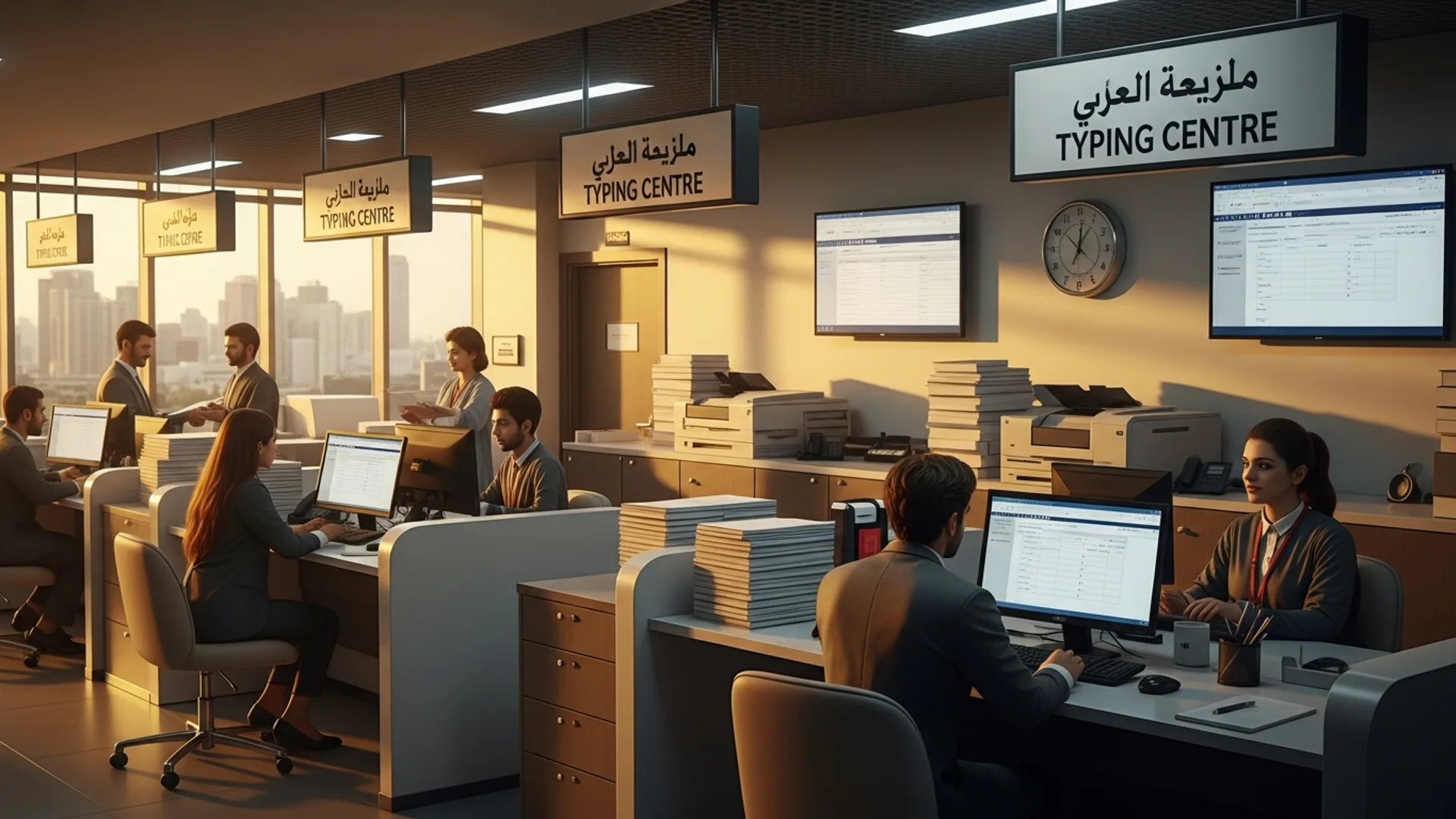
A typing centre in Dubai is the visible front door of the UAE government services economy. Every visa application, Emirates ID renewal, MOHRE submission, and licence registration flows through typing centres that bridge applicants and government portals. The business model is decades-old but still profitable when executed well. This guide covers what it actually takes to start one in 2026, the real economics, and where founders go wrong.
Your setup cost, in 10 seconds
Package prices. Health insurance is required by law and not included.
Thank you.
Your written quote follows on WhatsApp.
What a typing centre actually does
A typing centre is a licensed retail business that:
- Inputs applicant data into government online portals (GDRFA, MOI, MOHRE, DLD, DET, FTA, Dubai Police)
- Prepares and submits visa applications, Emirates ID issuances/renewals, labour contracts
- Notarises MOAs and legal documents
- Processes typing for government attestations
- Handles utility bill payments, telecom services, immigration medical bookings
- Provides photocopy, photo, and stationery services as add-ons
The business sits at the intersection of government bureaucracy and the public. Every UAE resident interacts with a typing centre eventually. The Federal Authority for Identity, Citizenship, Customs & Port Security (icp.gov.ae) and Dubai Police authenticate typing centres before granting portal access.
The licensing path
Starting a typing centre requires multiple sequential approvals:
Step 1 — Trade licence (2-3 weeks)
Apply to Dubai DET (or relevant emirate's economic department) for a commercial licence with activity code for "Typing Services" or "Secretarial Services." This is the foundation.
Cost: AED 15,000-30,000 depending on activity classification and location.
Step 2 — Retail premises (parallel)
Sign a retail lease with proper Ejari registration. Typing centres need a physical, accessible storefront — not a flexi-desk. Location matters enormously for foot traffic.
Cost: AED 30,000-150,000/year depending on area.
Step 3 — MOI typing centre approval (4-8 weeks)
The Ministry of Interior reviews the operator, premises, and proposed staffing. Approval includes:
- Background check on owner / operator
- Premises inspection
- Equipment audit
- Staff credentials verification
- Security clearance
This is the gating approval. Without it, the centre cannot access government portals.
Step 4 — GDRFA integration (4-6 weeks)
The General Directorate of Residency and Foreigners Affairs grants portal access for visa and Emirates ID typing services. Integration includes:
- Portal training
- System credentials
- Audit trail setup
- Compliance briefing
Step 5 — MOHRE / other authority access (as needed)
MOHRE access for labour contract typing requires separate approval. DLD access for property transactions, Dubai Police for traffic/policing services, FTA for tax filings.
Each authority has its own integration process. Most centres start with MOI + GDRFA and add others over time.
Full cost breakdown 2026
Realistic year-1 cost for a 4-workstation typing centre in a mid-tier Dubai location:
| Item | Cost (AED) |
|---|---|
| Trade name + initial approval | 1,200 |
| DET commercial licence | 18,000 |
| Retail premises (shop) | 60,000 |
| Ejari registration | 220 |
| Fit-out (counters, signage, basic interior) | 35,000 |
| Workstations (4 × AED 12,000 PCs+monitors) | 48,000 |
| Multifunction printers (2) | 12,000 |
| Fingerprint scanners (4) | 8,000 |
| Photo booth setup | 6,000 |
| MOI typing centre licence fee | 8,500 |
| GDRFA system integration fee | 7,500 |
| Establishment card | 2,000 |
| Staff hiring (3 staff × AED 4,500 monthly first 3 months) | 40,500 |
| Salaries year 1 (3 staff full year) | 162,000 |
| Utilities + internet (year) | 12,000 |
| POS system + queue management | 8,000 |
| Bank account opening | 0-2,500 |
| Working capital buffer | 30,000 |
| Year 1 total | ~AED 459,200 |
For a leaner setup (2 workstations, smaller location, owner as primary operator):
| Item | Cost (AED) |
|---|---|
| Trade licence + initial approvals | 22,000 |
| Smaller retail space | 35,000 |
| Fit-out | 18,000 |
| 2 workstations + printer | 25,000 |
| Government integration fees | 16,000 |
| Equipment (scanners, photo) | 10,000 |
| 1 staff salary (year) | 54,000 |
| Utilities + supplies | 8,000 |
| Year 1 total | ~AED 188,000 |
Contact Us For Free Consultation
or
Ask on WhatsApp insteadLicensed UAE consultancy. One reply, no spam.
Thank you.
A consultant will reply on WhatsApp shortly.
Revenue economics — what typing centres actually earn
Pricing per transaction in 2026 (typical Dubai centre):
| Service | Customer pays (AED) | Notes |
|---|---|---|
| Visa application typing | 75-150 | Plus govt fees passed through |
| Emirates ID typing | 40-80 | Plus govt fees |
| Labour contract typing | 50-100 | Plus MOHRE fees |
| MOA notarisation typing | 200-500 | Complex documents higher |
| Photocopy per page | 0.50-2 | Volume business |
| Passport photo | 20-40 | Quick add-on |
| Document attestation typing | 100-300 | Multi-step |
| Utility bill payment | 5-20 | Convenience fee |
Volume varies dramatically by location:
- High-traffic centre near GDRFA Karama: 150-300 transactions/day, AED 4,500-9,000 daily gross
- Mid-tier centre in Bur Dubai: 60-150 transactions/day, AED 1,800-4,500 daily gross
- Small neighbourhood centre: 20-60 transactions/day, AED 600-1,800 daily gross
Annual gross revenue ranges:
- High-traffic: AED 1.6M-3.2M
- Mid-tier: AED 650k-1.6M
- Small: AED 220k-650k
Net margin after rent, staff, integration fees, and operational costs typically 15-30% for well-run centres. So:
- High-traffic centre: AED 240k-960k net annually
- Mid-tier: AED 95k-480k net
- Small: AED 30k-195k net
The economics work if the location is right. Wrong location = struggling business.
Location is everything
The single biggest determinant of typing centre success is location. Best location patterns:
Near government service centres — Tas'heel offices, AMER centres, GDRFA branches, MOHRE centres, Dubai Court complexes. Walk-in foot traffic is automatic.
In high-density expat residential areas — International City, Discovery Gardens, Dubai Investment Park, Mirdif, Karama, Bur Dubai. Resident base needs regular government services.
Near labour camps and worker accommodation — Industrial areas, Sonapur, Muhaisnah, Al Quoz. High visa renewal volume.
In commercial / business clusters — Business Bay, Sheikh Zayed Road, JAFZA, near corporate HR offices that need bulk services.
Wrong locations include: high-rent retail malls (foot traffic doesn't convert), tourist areas (wrong audience), pure residential luxury (low transaction volume per resident).
Operational reality — what running it looks like
A typing centre runs on volume, accuracy, and turnaround speed. Day-to-day:
- 8am-9am: Open, queue management starts. Early commuters do quick services before work.
- 9am-1pm: Peak window. Mix of individual walk-ins and business clients dropping off batches.
- 1pm-4pm: Lunchtime dip but corporate account processing happens here.
- 4pm-7pm: Second peak — after-work residents and last-chance same-day services.
- 7pm-10pm: Evening trickle. Some centres close, some stay open.
Staffing needs:
- Counter operators: 2-4 trained on government portals
- Cashier / front desk: 1 handling queue and payments
- Manager: 1 handling escalations and corporate clients
- Owner: Often hands-on year 1, optional later
Training is the bottleneck. New staff need 4-8 weeks to be fully proficient. Mistakes on government applications cost money (rework fees, customer compensation, sometimes regulatory issues).
The "typing centre" myth — what it isn't
Common misconceptions:
"It's a passive business." No. Typing centres need constant staff supervision, queue management, error correction, and customer service. Daily owner involvement typical in year 1.
"You just need a computer." No. MOI/GDRFA integration takes months, costs money, and requires compliance audits. Equipment is the easy part.
"Anyone can open one." Not really. The MOI approval process screens operators. Previous business issues or compliance flags can block approval.
"It's recession-proof." Largely true. Government services are always needed. But UAE moves toward digital self-service (UAE Pass, ICP portal) is slowly eating low-end typing centre volume. Centres that focus on complex/business services are more durable.
"Profit margins are huge." Margins are 15-30% net, not 50%+. Rent and staff eat the rest. Good business, not a goldmine.
Digital disruption — what's changing in 2026
UAE government services are progressively digitising:
- UAE Pass lets individuals authenticate and submit many applications directly
- ICP portal allows direct visa and Emirates ID actions
- MOHRE TAWA does direct contract registration for employers
- DET Trader Licence allows self-service registration
This shifts the typing centre model. Pure individual-walk-in services for visa renewals, Emirates ID updates, and basic government interactions are slowly declining in volume.
What's growing:
- Business services (bulk MOHRE for HR teams, corporate visa management)
- Complex document services (MOA notarisation, attestation chains)
- Multi-step services (typing + medical booking + Emirates ID + insurance)
- Foreign worker support (full-service typing for staff onboarding)
Typing centres that pivot toward business/complex services maintain growth. Pure walk-in centres face pressure.
Best free zone or mainland for typing centre
Typing centres are mandatorily mainland — they need a retail storefront with public access in Dubai municipal area. Free zone licences don't qualify for MOI typing centre approval. Always DET Dubai (or relevant emirate's economic department) mainland.
The cheapest mainland route: sole establishment professional licence ~AED 15,000 + premises + standard process. Or LLC if multi-shareholder or limited liability matters.
Common Mistakes founders make opening typing centres
Mistake 1: Wrong location. Saving rent in a low-traffic area kills the business. A AED 60k/year shop near a GDRFA centre outperforms a AED 30k/year shop in a residential building 10× over.
Mistake 2: Under-equipping technology. Cheap PCs and slow printers cost more in lost productivity than the savings. Buy proper equipment day one.
Mistake 3: Under-staffing year 1. One operator can't manage peak hours. Customers walk out. Reputation tanks. Always staff for peak, not average.
Mistake 4: Skipping the corporate sales effort. Walk-in revenue caps at the foot-traffic ceiling. Corporate accounts (companies outsourcing all HR typing) double or triple revenue. Build corporate sales from month 1.
Mistake 5: Ignoring digital trends. Pure walk-in model is in slow decline. Build business services and complex-document capabilities to stay ahead.
Mistake 6: Mishandling sensitive data. Typing centres handle passport copies, Emirates IDs, salary details, family records. Data breach or misuse triggers serious legal exposure. Operational security matters.
Mistake 7: Skipping the MOI compliance updates. MOI changes typing centre rules periodically. Centres that fall behind on compliance lose access — and rebuilding access takes months. Stay current.
Who succeeds in this business
Profile of founders who run profitable typing centres:
- Hands-on operators who run year 1 from the counter
- Background in customer service, retail, or government processing
- Network with HR managers and corporate purchasing
- Capital for proper year 1 setup (AED 200k+ available)
- Patience for the 6-12 month maturity curve
- Willingness to add services as government processes evolve
Profile of founders who struggle:
- Absentee owners expecting passive income
- Under-capitalised (less than AED 150k for setup + working capital)
- Wrong location chosen on rent savings
- No corporate sales effort
- Treating it as a side project
What changes for foreign vs UAE-resident founders
Foreign founders can fully own a typing centre under 2021 reforms — no Emirati partner needed. However:
- MOI approval scrutinises operator background
- Foreign operators benefit from having a UAE-resident manager day-to-day
- Banking opens normally for the company
- Customer trust often favours local-feeling operations (Arabic-speaking staff important)
For pure absentee foreign owners, hire an experienced UAE-resident manager from day one.
Multi-emirate vs single-location strategy
Most successful typing centre businesses start with one location, prove the model, then expand:
- Year 1: Single location, prove unit economics
- Year 2-3: Open second location in different catchment area
- Year 4+: Build a small chain of 3-5 strategically located centres
A chain offers operational leverage (bulk corporate accounts, shared back-office, brand recognition). A single location is simpler operationally but caps revenue at one catchment.
Funding options
Typing centres are bootstrap-friendly:
- Personal capital is the most common funding source
- Bank loans available after 12-18 months operating history
- Some founders bring in silent partners for 20-30% stake
- Khalifa Fund and similar SME-support programs occasionally fund (eligibility-dependent)
- Venture capital generally NOT interested (low-tech, slow-growth)
Don't over-finance. AED 200-400k from founder + working capital line is typical and sufficient for a single-location launch.
Sample P&L for a mid-tier centre
Realistic Year 2 P&L for a 4-workstation Dubai typing centre (after ramp-up):
Revenue:
- Walk-in transactions (100/day × 350 days × AED 60 avg) = AED 2,100,000
- Corporate account services (AED 25,000/month × 12) = AED 300,000
- Notarisation and complex docs (AED 8,000/month × 12) = AED 96,000
- Photocopy/photo/stationery = AED 60,000
- Total gross revenue: AED 2,556,000
Costs:
- Rent + Ejari = AED 65,000
- Salaries (3 staff full year + manager part-time) = AED 215,000
- Government integration fees (annual) = AED 22,000
- Trade licence renewal = AED 18,000
- Equipment depreciation = AED 25,000
- Utilities + internet = AED 18,000
- Marketing + signage = AED 12,000
- Software + POS = AED 14,000
- Insurance + misc = AED 9,000
- Owner cost (if drawing salary) = AED 180,000
- Total operating cost: AED 578,000
Net before tax: AED 1,978,000
Corporate tax (9% above AED 375k): AED 144,270
Net after tax: AED 1,833,730
This is a successful mid-tier centre. Many run at half this volume. Wrong-location centres struggle to clear AED 500k gross. The variance is enormous.
Multi-emirate replication path
Once a Dubai centre is profitable, the natural expansion:
- Year 2: Replicate to Sharjah (high resident base, lower rent)
- Year 3: Add Abu Dhabi presence
- Year 4: Northern emirates if compelling locations exist
Each new location costs roughly half the original setup (no MOI licence re-application — extension under same operator), but staffing and premises remain full cost. Multi-location operators benefit from shared back-office, corporate account leverage, and brand recognition.
Adjacent services that boost margin
High-margin add-ons that successful centres layer on:
- Insurance brokerage (motor, health, travel) — commission revenue
- Telecom resale (Etisalat, du SIM cards and packages) — small commission
- Translation services (Arabic-English) — high margin
- Document attestation chains (one-stop MOFAIC + embassy + UAE attestation)
- Visa medical bookings — small commission
- Tax / VAT filing assistance for SMEs
- Notary public services (where licensed)
Layering these can add 15-30% to gross revenue without proportional cost increase.
Compliance ongoing — what stays current
After launch, ongoing compliance:
- Annual trade licence renewal
- Annual MOI typing centre approval renewal
- GDRFA integration audit (annual)
- Staff visa renewals
- Corporate tax registration and annual return
- VAT registration (mandatory above AED 375k revenue)
- ESR notification annually
- Data protection compliance (sensitive customer data handling)
- Staff training updates as government processes change
Budget AED 25,000-50,000 annually for compliance + accounting overhead.
What changes for foreign-owned vs UAE-resident
Foreign founders can fully own a typing centre under 2021 federal reforms. No Emirati partner required for the business structure itself. However, the operational success layer typically benefits from local insight:
- Arabic-speaking staff: Critical for serving Arabic-speaking customers (significant portion of typing centre walk-ins)
- UAE government portal familiarity: Months of practical experience navigating MOI/GDRFA/MOHRE processes
- Local supplier and corporate relationships: Most easily built by UAE-resident manager
- Regulatory updates: Government workflow changes happen quietly; local presence catches them
Foreign owners running typing centres successfully usually pair with an experienced UAE-resident operations manager who handles day-to-day. The owner provides capital and strategy; the manager runs the centre.
Marketing and customer acquisition
Typing centres rely heavily on:
Foot traffic — primary acquisition channel for individual customers. Location does the marketing.
Corporate B2B sales — needs proactive outreach. Approach HR managers at companies with 20+ employees. Pitch: outsource all government typing, save HR time, predictable monthly fee.
Word of mouth — accuracy and speed drive repeat usage. One mistake on someone's visa renewal kills the relationship.
Google Maps presence — essential. Verified Business Profile with hours, photos, response to reviews.
WhatsApp business line — many customers prefer messaging to walk-in for query/status.
Service centre partnerships — informal relationships with nearby Tas'heel staff often drive referrals.
Multilingual signage — Arabic, English, Hindi/Urdu, Filipino depending on neighbourhood demographics.
Marketing budget is typically low (AED 5,000-15,000/year) — most acquisition is organic.
Insurance and risk
Risks unique to typing centres:
- Data breach exposure: Passports, Emirates IDs, salary records pass through. Cyber liability insurance recommended (AED 5,000-15,000 annual premium).
- Errors and omissions: Mistakes on visa applications can cost customers thousands. E&O insurance protects (AED 8,000-20,000 annual premium).
- Physical security: Cash handling, premise security. Standard commercial insurance covers (AED 3,000-8,000).
- Employee dishonesty: Crime insurance covers staff theft of customer cash or data (AED 5,000-12,000).
Total annual insurance budget: AED 20,000-50,000 for proper coverage. Worth it given the risk exposure.
Real founder profiles we work with
Profile 1 — The career operator. Worked 8 years managing typing/secretarial operations at an established centre. Now wants to start own location. Brings operational expertise but limited capital. Recommendation: AED 200k bootstrap setup in a mid-tier location, hands-on year 1. Strong success probability.
Profile 2 — The investor-operator. Has AED 500-800k available and corporate background. Wants to set up a centre and hire operations team. Recommendation: hire experienced typing centre manager first (AED 12-18k monthly), then build centre around their expertise. Higher capex but lower personal time investment.
Profile 3 — The franchise expansion. Existing 1-2 location centre wants to add a 3rd location. Recommendation: replicate proven model with shared back-office and bulk corporate accounts. Lower marginal cost per new location.
Profile 4 — The wrong-fit founder. Tech founder with no operational background, looking at typing centre as a "passive" investment. Recommendation: this isn't the business. Look elsewhere.
These scenarios share one truth: typing centre success correlates with operational discipline, not capital amount. Founders with operational experience consistently outperform well-capitalised but inexperienced founders.
What to do next
If you're considering opening a typing centre in Dubai 2026, the next step is location validation. Pick 3 candidate locations, sit outside each for 4 hours during peak times, count walk-in footfall to nearby typing centres. The data tells you which catchment is real. We help founders model unit economics for specific locations and navigate the MOI/GDRFA approval sequence. A 20-minute call clarifies whether your candidate location justifies the AED 150-400k investment.
Talk to Our Experts
typing center business setup
Frequently Asked Questions
How much does it cost to start a typing center business in Dubai 2026?
Total setup for a typing centre business in Dubai 2026 lands AED 80,000-180,000 year 1 including trade licence (AED 15,000-30,000), retail premises (AED 30,000-80,000/year), MOI/GDRFA system integration fees, equipment, and 2-3 staff costs. Cheapest realistic entry is around AED 80,000 with a co-located space in a service-business cluster.
What approvals do I need for a typing center in Dubai?
A Dubai typing centre needs: DET commercial licence (typing/secretarial services activity), Ministry of Interior (MOI) typing centre approval, GDRFA system integration for visa/Emirates ID typing, sometimes MOHRE approval for labour-related typing, and tenancy contract for the retail premises. Total approval timeline 6-12 weeks.
Is a typing center business profitable in Dubai 2026?
Typing centres can be profitable with the right location and operational model. A well-placed centre processing 50-150 transactions daily generates AED 1,500-6,000 daily gross revenue. Net margin after rent, staff, and tech fees runs 15-30%. Top centres in high-traffic locations clear AED 800,000-2M+ annually. Poorly located centres struggle to break even.
Where should a typing center be located in Dubai?
Best locations are near government service centres (Tas’heel, AMER, GDRFA service centres), labour camps, areas with high visa-applicant footfall (Karama, Bur Dubai, Deira, International City, Al Quoz, JAFZA staff areas). Proximity to a service centre often matters more than the building itself.
How long does it take to open a typing center in Dubai?
Realistic timeline 8-14 weeks. Licence and trade name 2-3 weeks, retail premises and Ejari 2-4 weeks, MOI typing centre approval 4-8 weeks, GDRFA system integration 4-6 weeks, equipment setup and staff hiring 2-3 weeks. Most processes run in parallel.
Can a foreigner own a typing center in Dubai 2026?
Yes. Since 2021 reforms, 100% foreign ownership applies to most commercial activities including typing/secretarial services. No Emirati partner required for the typing centre business itself. However, the MOI typing centre licence has its own approval process that scrutinises operator credentials.
What technology and equipment does a typing center need?
Standard equipment: 4-8 workstations with high-spec PCs, multifunction printers, fingerprint scanners (for Emirates ID applications), photo capture booth (for visa photos), document scanners, online MOI/GDRFA portal access (paid integration), POS payment system, queue management system, and Arabic-English keyboards. Total tech setup AED 60,000-120,000 initially.
Who are the customers of a Dubai typing center?
Customers include: employers processing labour contracts and visa renewals, individuals applying for visas/Emirates IDs/MOHRE services, businesses needing MOA notarisation typing, foreign workers paying utility bills, residents filing labour complaints, and SMEs outsourcing all government paperwork. High-volume centres serve mostly business clients with corporate accounts.
Related Noble Core deep-dives
Related Guides
Related guides
- Vending Machine Business Dubai: Licence & Cost 2026: costs, steps and requirements for 2026