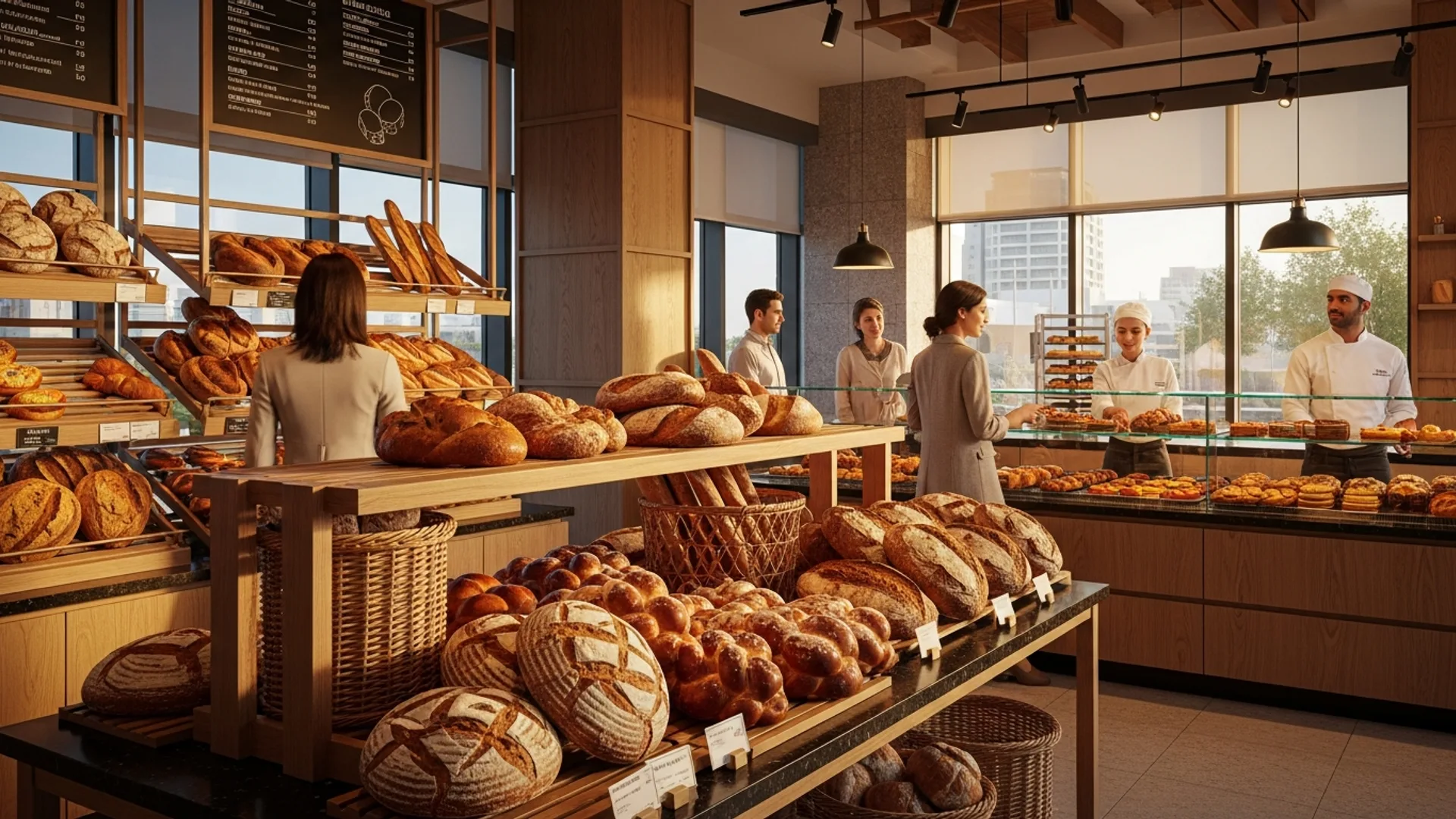
Quick AnswerBakery business Dubai 2026 — full setup cost AED 250,000-1.5M, licence, Municipality permits, location strategy, real founder economics.
A bakery business in Dubai sits at the intersection of high consumer demand, well-established operational templates, and intense competition from chains and existing artisan operations. The opportunity for new entrants exists but requires honest planning around location, capital commitment, and operational discipline. This guide covers the actual licensing path, realistic cost structure, location strategy, and unit economics that determine which Dubai bakeries succeed in 2026.
Your setup cost, in 10 seconds
Package prices. Health insurance is required by law and not included.
Thank you.
Your written quote follows on WhatsApp.
What "bakery business" actually means in Dubai 2026
Dubai's bakery segment spans multiple operational models:
Artisan retail bakery: Smaller premium-positioned shopfront selling hand-crafted bread, pastries, cakes. Direct-to-consumer focus. Higher margins per item.
Mid-tier bakery with seating: Bakery plus small café area. Bread, pastries, coffee, light meals. Mixed revenue from baked goods and beverages.
Production bakery (wholesale): Larger facility producing volume baked goods sold to hotels, restaurants, cafes, supermarkets. B2B revenue model.
Specialty bakery: Focused on specific products — French pastry, sourdough specialty, vegan/gluten-free, ethnic specialty (Middle Eastern, South Asian, Filipino), cake shops.
Cloud bakery / delivery-only: Production without retail shopfront, selling through Talabat, Careem, or own delivery channels.
Each model has different capital requirements, operational rhythm, and customer relationships. The Dubai Department of Economy and Tourism (det.gov.ae) handles licensing. Dubai Municipality handles food safety permits.
Licensing path
Step 1 — DET Dubai trade licence
Apply for mainland commercial licence with activity classification:
- "Bakery" (general baking)
- "Cakes Trading" (for cake shops)
- "Bread Production" (for specific bread focus)
- "Pastry Shop" (for pastry focus)
- Multiple activities possible (small additional fees)
Cost: AED 18,000-30,000 for the trade licence.
Step 2 — Premises lease
Bakeries need retail space with food production capability:
- Ground-floor retail strongly preferred (foot traffic, visibility)
- Ventilation for oven exhaust
- Power capacity for commercial ovens
- Water supply for production
- Storage area for ingredients
Typical premises sizes:
- Artisan retail: 300-700 sqft
- Mid-tier with seating: 800-1,500 sqft
- Production-focused: 1,500-5,000 sqft
Rent: AED 60,000-300,000+/year depending on location and size.
Step 3 — Dubai Municipality food safety
Mandatory for all food businesses. Requirements:
- PIC certified Food Safety Manager
- Kitchen layout meeting hygiene standards
- HACCP compliance
- Pest control contract (annual)
- Cleaning and hygiene protocols documented
- Annual inspections
- Staff hygiene training
Cost: AED 3,000-8,000 initial + AED 5,000-12,000 annual ongoing.
Step 4 — Dubai Civil Defence approval
Kitchen layout reviewed for fire safety. Critical for ovens, gas connections.
Cost: AED 2,000-5,000 + any modifications.
Step 5 — Establishment card and visas
Standard process. Bakery staff (head baker, helpers, counter staff) need visas.
Cost: AED 2,000 establishment card + AED 4,500-6,500 per staff visa.
Full cost breakdown — small artisan bakery
Realistic year-1 cost for a 400-600 sqft artisan bakery in a mid-tier Dubai residential area:
| Item | Cost (AED) |
|---|---|
| DET trade licence | 22,000 |
| Trade name + initial | 1,500 |
| Establishment card | 2,000 |
| Municipality food safety | 5,000 |
| Civil Defence approval | 3,500 |
| Premises Ejari (year, mid-tier residential) | 80,000 |
| Fit-out (counters, display cases, signage) | 60,000 |
| Commercial ovens (2-3 units) | 80,000 |
| Mixers and bakery equipment | 50,000 |
| Refrigeration (display + storage) | 40,000 |
| POS and tools | 12,000 |
| Initial inventory (flour, sugar, ingredients) | 25,000 |
| 3-4 staff salaries year 1 (baker + helpers + counter) | 180,000 |
| Visa fees | 20,000 |
| Utilities + gas (year) | 30,000 |
| Branding, packaging, photography | 20,000 |
| Marketing first 3 months | 25,000 |
| Insurance | 10,000 |
| Working capital reserve | 60,000 |
| Year 1 total realistic | AED 726,000 |
For larger mid-tier bakery with seating:
- Premises: 150,000-280,000/year
- Fit-out + equipment: 250,000-450,000
- Total Year 1: AED 900,000-1,500,000
For production bakery (wholesale focus):
- Premises: 100,000-250,000/year (industrial area)
- Equipment: 300,000-700,000
- Staff: 250,000-500,000 (year 1)
- Total Year 1: AED 1,000,000-2,000,000+
Contact Us For Free Consultation
or
Ask on WhatsApp insteadLicensed UAE consultancy. One reply, no spam.
Thank you.
A consultant will reply on WhatsApp shortly.
Revenue economics
Revenue varies dramatically by format and location:
Artisan retail bakery:
- Average customer spend: AED 25-65
- Daily customers: 80-250
- Daily revenue: AED 2,000-16,250
- Monthly revenue: AED 60,000-487,500
Mid-tier bakery with seating:
- Higher AOV from food + beverages: AED 50-120
- Daily customers: 120-350
- Daily revenue: AED 6,000-42,000
- Monthly revenue: AED 180,000-1,260,000
Production bakery (wholesale):
- B2B orders typically large: AED 1,000-50,000 per order
- Monthly revenue: AED 300,000-2,000,000+
Margin reality
Bakery margin structure:
| Category | Gross margin | Notes |
|---|---|---|
| Bread (basic) | 30-50% | Volume product |
| Pastries (basic) | 50-70% | Better margin |
| Specialty cakes | 60-80% | Custom orders highest |
| Coffee + beverages | 70-85% | Highest margin item |
| Sandwiches and prepared foods | 50-65% | Time-consuming |
| Premium artisan products | 65-80% | Brand premium |
Blended gross margin for typical Dubai bakery: 45-60%. After rent, staff, utilities, and operations, net margin lands 12-25% for well-run bakeries. Wholesale-focused production bakeries run thinner margins (8-18%) but higher volume.
Location strategy
Location is the single biggest variable for bakery success. Best Dubai locations 2026:
Mid-tier residential neighbourhoods without premium bakery competition:
- International City (massive expat density)
- Discovery Gardens / Al Furjan
- Mirdif (family-oriented, no major premium bakery yet)
- Town Square / Akoya (new developments)
- JVC / JVT (growing density)
- Al Quoz residential pockets
Mixed-use foot traffic locations:
- City Walk side streets
- Boxpark
- Al Seef
- Side streets of Marina (avoid main strips – too expensive)
- Side streets of Downtown (avoid main mall – chains dominate)
Specialty / ethnic-focused locations:
- Karama (South Asian-focused demographics)
- Bur Dubai (similar)
- Deira (Middle Eastern-focused)
- Specific cuisine-aligned neighbourhoods
Avoid:
- Mall locations (rent too high vs revenue potential)
- Areas served by Carrefour/Lulu bakery sections within 500m
- Areas with established artisan bakery nearby (competing for same customers)
- Pure office areas with no residential foot traffic
Common Mistakes founders make opening bakeries
Mistake 1: Wrong location. Saving on rent in low-traffic area kills the business. Pay for the right location.
Mistake 2: Over-investing in equipment day one. AED 200k of equipment for a bakery that should have AED 80k of equipment ties up capital that should be marketing or working capital.
Mistake 3: Inadequate baker quality. Bakery success depends heavily on head baker skill. Underpaying for talent produces inconsistent product. Pay for proper baker.
Mistake 4: Wrong product mix for location. Premium French pastry in budget-conscious residential area. Generic supermarket-grade bread in premium location. Match products to local demand.
Mistake 5: Skipping social media presence. Bakery is visual. Instagram is essential for new customer acquisition. Most successful Dubai bakeries have strong Instagram presence.
Mistake 6: Poor packaging for delivery. Bakery items in cheap packaging arrive damaged. Spend on proper packaging for Talabat/Careem orders.
Mistake 7: Ignoring corporate orders. Office orders for breakfast meetings, event catering, hotel partnerships add 20-40% to revenue. Active corporate outreach matters.
Mistake 8: Inconsistent product quality. Customers expect identical product every time. Variation in cooking, ingredients, or finishing kills repeat business.
Delivery and online integration
Modern Dubai bakeries operate across channels:
Direct retail: In-store foot traffic. Main channel for small bakeries.
Talabat / Careem delivery: Adds 20-40% to revenue typically. Commission 25-30%.
Own delivery: WhatsApp ordering + own delivery for premium/B2B customers.
Catering and events: Corporate orders, weddings, events. Higher AOV.
Online cake ordering: Specialty cake shops often have dedicated online ordering with delivery.
Subscription/standing orders: Hotels, restaurants, offices placing recurring orders.
Multi-channel approach optimises revenue beyond pure retail foot traffic.
What changes for free zone vs mainland
Bakery operations require Dubai Municipality food safety permits which are mainland-jurisdiction. Free zone licences don't qualify for bakery production. Always DET Dubai mainland for bakery activities.
Exception: cloud bakery / delivery-only operations using shared kitchen facilities (Kitopi, similar) can sometimes operate under free zone trade licence with the shared kitchen's mainland Municipality permit. Specific arrangements vary.
What changes for foreign vs UAE-resident founders
100% foreign ownership applies under 2021 reforms. Same setup process. Practical advantages of UAE-resident operational management:
- Arabic-speaking customer service
- Local supplier relationships
- Familiarity with Dubai Municipality processes
- Staff hiring (often South Asian / Filipino bakery staff)
Foreign owners can fully own. UAE-resident manager or partner often beneficial for ground operations.
VAT and corporate tax
Bakery operations subject to standard UAE tax:
- VAT 5% mandatory above AED 375k revenue (most bakeries exceed)
- Some basic food items zero-rated or exempt (varies by category)
- Corporate tax 9% above AED 375k profit
- Audit may be required above threshold
Compliance complexity higher than service businesses. Plan AED 20-40k annually for proper accounting.
Year 1 ramp expectations
Realistic ramp for new artisan bakery:
- Month 1-2: Soft opening. AED 30-80k revenue. Operating loss.
- Month 3-4: Building awareness. AED 60-150k revenue. Near break-even.
- Month 5-6: Scaling. AED 100-220k revenue. Profitable.
- Month 7-12: Growth. AED 150-350k+ revenue. Solid profitability.
Bakeries take 4-8 months to reach steady profitability. Working capital must bridge this gap.
Year 2+ expansion strategy
Successful single-location bakeries typically evolve:
- Year 2: Refine product mix, build wholesale relationships, expand delivery channels
- Year 3: Second location in different catchment area
- Year 4+: 3-5 location chain, central commissary for production efficiency
- Year 5+: Brand expansion, packaged goods for supermarkets
Multi-location operators benefit from procurement leverage, brand recognition, operational efficiency.
Specific founder scenarios
The trained pastry chef opening their own bakery: Strongest success pattern. Operational expertise plus founder skin in the game. Recommend mid-tier setup AED 600k-1M.
The investor-operator partnership: Investor capital + experienced operator. Common Dubai model. Operator earns share of profits, investor recovers capital.
The franchise from international brand: Eric Kayser, Paul, others. Higher capital required for franchise fees + setup. Brand recognition advantage.
The specialty niche (gluten-free, vegan, keto): Premium positioning, smaller customer base, higher margins. Often viable as cloud bakery initially.
The wholesale-focused production: B2B model. Requires established hotel/restaurant relationships. Capital-intensive but stable revenue.
Operational details that distinguish successful bakeries
The operational reality of running a bakery in Dubai involves multiple interconnected workstreams that successful operators manage with discipline. The production workstream covers daily baking schedules, ingredient management, recipe consistency, and product quality control. Successful bakeries typically start production overnight or very early morning to have fresh products available when customers begin arriving in early morning hours. The production schedule needs to balance fresh availability against waste from over-production.
The supply chain workstream involves managing relationships with ingredient suppliers, ensuring consistent quality of flour, butter, sugar, and specialty ingredients, and maintaining adequate inventory without tying up excessive capital. Many ingredients have shelf life considerations that require careful turnover management. Established bakeries develop relationships with two to three primary suppliers per major ingredient category to ensure supply continuity.
The retail workstream covers shop presentation, customer service, point of sale operations, and daily cash management. The customer experience from entering the bakery through receiving their order shapes whether they return. Visual merchandising of products, cleanliness of the space, friendliness of staff, and speed of service all matter.
The marketing workstream extends beyond launch into ongoing customer acquisition and retention. Social media presence focused on visual product content, partnerships with food influencers, participation in local food events, and corporate catering outreach all contribute to sustainable customer base growth. Bakeries that stop marketing after launch typically watch revenue plateau or decline.
The wholesale workstream for bakeries serving B2B customers (hotels, restaurants, cafes, offices) operates differently from retail. Sales cycles are longer. Order volumes are larger. Customer relationships matter more. Successful artisan bakeries often layer wholesale onto retail to add stable recurring revenue without proportionally increasing fixed costs.
The financial workstream involves daily reconciliation, weekly P&L tracking, monthly accounting close, and ongoing cash flow management. Bakeries with thin margins need rigorous financial discipline because small operational issues compound into meaningful losses quickly.
The staff management workstream covers hiring, training, retention, and performance management. Bakery staff turnover affects quality consistency directly. Investing in proper training programmes and reasonable working conditions reduces turnover-related quality problems.
Each workstream requires dedicated attention. Owner-operators in early years typically engage across all simultaneously. As operations mature, dedicated managers handle individual workstreams while owner provides strategic oversight.
Seasonal and event-based revenue opportunities
Dubai bakeries benefit from seasonal and event-based revenue spikes beyond baseline daily operations. Ramadan creates substantial demand for specific products — dates, savoury pastries for iftar, sweets for suhoor, and gift-grade items for hosting. Bakeries preparing for Ramadan with specific menu lines often generate 30-50% revenue spike during the holy month.
Eid celebrations create gift-purchase demand. Premium-packaged sweet selections, cakes, and pastries become popular gifts during Eid Al Fitr and Eid Al Adha. Successful bakeries develop gift-format products specifically for these occasions.
Christmas and end-of-year holidays create demand for traditional baked goods among the expat community. European Christmas cookies, panettone, Yule logs, gingerbread — these all see significant demand from December through early January.
Birthday and wedding cake markets are continuous high-margin opportunities. Custom cake orders typically command AED 200-2,000+ per cake with margins of 60-80%. Establishing custom cake capability adds significant revenue line.
School events and graduation seasons create catering opportunities. Sandwiches, mini-pastries, and themed cakes for school events represent recurring annual demand.
Corporate office catering for meetings, breakfast events, and corporate gift-giving represents another recurring opportunity. Building relationships with corporate procurement teams can deliver substantial annual recurring revenue.
Successful bakeries plan calendar-driven product menus that align with these revenue opportunities rather than running static menus year-round.
Final operational considerations
Bakery success in Dubai depends on consistent execution across multiple dimensions over extended periods. The first six months establish baseline customer base. Months six through twelve grow it through quality consistency and word-of-mouth. Year two through three solidifies the operation and creates options for expansion. Operators who treat the business as a year-long commitment minimum consistently outperform those expecting quick results.
The financial discipline required includes daily tracking of unit economics, weekly P&L review, monthly close with formal accounting, and quarterly strategic review. Bakeries with thin margins cannot afford loose financial discipline. Small operational issues compound into meaningful losses quickly without rigorous tracking.
The product discipline required includes maintaining recipe consistency, managing wastage tightly, refreshing menu seasonally without losing baseline winners, and continuously improving product quality based on customer feedback. Bakeries that get complacent on product quality typically see gradual customer decline that becomes difficult to reverse.
The team discipline required includes investing in proper baker training, maintaining reasonable working conditions to reduce turnover, building career pathways for staff retention, and managing performance fairly. High staff turnover affects quality consistency directly and visibly to customers.
The customer discipline required includes responding to feedback consistently, managing online reviews actively, building corporate relationships systematically, and maintaining service quality even during busy periods. Customer relationships in bakery business are personal and immediate. Negative experiences propagate quickly through word of mouth and online reviews.
These disciplines compound into operational excellence that creates sustainable competitive advantage. Bakeries that maintain these standards consistently outperform competition over multi-year periods regardless of competitive pressure.
The Dubai bakery opportunity in 2026 remains genuinely attractive for founders who approach the model with proper preparation across capital, location, baker quality, product mix, and operational discipline. The market continues to favor quality operators with clear positioning rather than casual entries chasing perceived ease of entry. Match commitment to opportunity scale and the path becomes a meaningful entrepreneurial endeavor with real reward potential for serious operators willing to invest the time and resources required.
For founders weighing entry, the realistic assessment is that the Dubai bakery business rewards proper preparation and consistent execution while punishing casual approaches with minimum capital. Plan the entry with adequate capital matched to format ambition and the path forward becomes navigable. The Dubai market continues to favour quality operators who treat the business with appropriate seriousness over multi-year horizons.
Successful bakery operators consistently combine all the elements discussed throughout this guide into coherent operational practice over multi-year horizons.
The Dubai bakery industry rewards quality, consistency, and operational discipline. Founders who treat these elements seriously consistently outperform those treating bakery business as a hobby venture with minimum capital and casual approach to operations.
Match commitment to opportunity and the Dubai bakery business continues to offer rewarding entrepreneurial paths for serious operators willing to invest the necessary time, capital, and operational discipline across multi-year horizons of sustained customer engagement.
The market rewards quality combined with operational discipline applied consistently across multi-year time horizons of customer engagement.
What to do next
If you're planning a bakery business in Dubai 2026, the next step is matching format (artisan, mid-tier, production, specialty) to your capital availability, operational capability, and target market. We help founders evaluate location options realistically, navigate the Municipality and Civil Defence approval sequence, and structure the licensing path appropriately. A 20-minute call clarifies whether your situation fits artisan entry, mid-tier scale, or production focus.
The pattern across successful Dubai bakeries is adequate capitalisation combined with proper location selection, baker quality investment, and multi-channel revenue strategy. Casual entry with minimum capital and casual operational discipline typically produces predictable failure within the first year. Serious commitment to the business produces meaningful outcomes.
For founders with AED 250-500k available capital and baking expertise, small artisan bakery in the right location is the path. For founders with AED 500k-1M and growth ambition, mid-tier bakery with seating captures more revenue per location. For founders with AED 1M+ and B2B sales capability, production bakery focusing on wholesale offers more predictable revenue.
Match capital to format honestly. Pick location rigorously. Invest in baker quality. Build wholesale/corporate relationships from month one. Maintain product consistency religiously. These disciplines consistently distinguish successful operators from struggling ones.
The Dubai bakery market continues to favour quality operators with clear positioning. New entrants face real competition but the structural opportunity remains substantial for founders who execute well.
Talk to Our Experts
bakery business setup Dubai
Frequently Asked Questions
How much does it cost to start a bakery business in Dubai 2026?
Total realistic cost to start a bakery business in Dubai 2026 ranges AED 250,000-1,500,000+ depending on format. Small artisan bakery (300-600 sqft): AED 250-450k. Mid-tier bakery with seating (800-1,500 sqft): AED 500-900k. Larger production bakery serving wholesale: AED 800k-1.5M. Costs include licence, fit-out, equipment, initial inventory, staff, and working capital.
What licence do I need for a bakery in Dubai 2026?
Dubai bakery requires DET Dubai mainland commercial licence with ‘Bakery’ or ‘Baking Products’ activity classification. Plus Dubai Municipality food safety permit, Dubai Civil Defence approval for kitchen layout, and trade name registration. Some bakeries also need additional permits for specific products (alcohol-flavoured baked goods, etc.).
Can a foreigner own a bakery business in Dubai 2026?
Yes. 100% foreign ownership applies to bakery and F&B activities under 2021 federal reforms. No Emirati partner required. Setup process identical for foreign and Emirati founders. Operational success often benefits from Arabic-speaking front-of-house staff for customer service.
How profitable is a Dubai bakery in 2026?
Profitability varies. Successful artisan bakeries: AED 80,000-300,000 monthly revenue, 12-25% net margin = AED 10-75k monthly net. Mid-tier bakeries with seating: AED 150-500k monthly, similar net margin = AED 18-125k monthly net. Production bakeries serving wholesale: AED 300k-1M+ monthly at thinner margin. Failed bakeries lose AED 100-300k before closing.
What location is best for a bakery in Dubai 2026?
Best locations: high-density residential neighbourhoods without nearby premium bakery (Mirdif, JVT, Al Quoz residential, Discovery Gardens), mixed-use developments with foot traffic (Downtown, JBR side streets), expat-heavy areas with specific bakery demand (Karama, Bur Dubai for South Asian, Deira for Middle Eastern). Avoid: areas served by Carrefour bakery + speciality bakeries within 500m.
How long does it take to open a bakery in Dubai?
Realistic timeline 14-22 weeks. Licence and Municipality 6-10 weeks. Civil Defence 2-4 weeks parallel. Premises lease and fit-out 6-12 weeks. Equipment installation 2-4 weeks. Staff hiring and training 4-6 weeks parallel. Marketing setup 2-3 weeks. Total kickoff to opening day: 4-6 months.
What’s the difference between artisan bakery and production bakery?
Artisan bakery focuses on hand-crafted, often premium-positioned products sold direct to consumers from a retail shopfront. Production bakery focuses on volume production sold wholesale to hotels, restaurants, cafes, supermarkets. Artisan: smaller space, higher margins, customer-facing. Production: larger space, thinner margins, B2B customers. Different operational models and capital requirements.
Do I need a Dubai Municipality food safety certificate to run a bakery?
Yes, mandatory. Every food business in Dubai must have at least one staff member with PIC (Person in Charge) food safety certification. Premises must meet hygiene standards. Annual inspections required. Failure to comply triggers fines and potential closure orders. Budget AED 3,000-8,000 for initial compliance + ongoing training.
Related Noble Core deep-dives
- Bakery license Dubai 2026 (regulatory companion)
- Restaurant license Dubai
- Cloud kitchen license Dubai