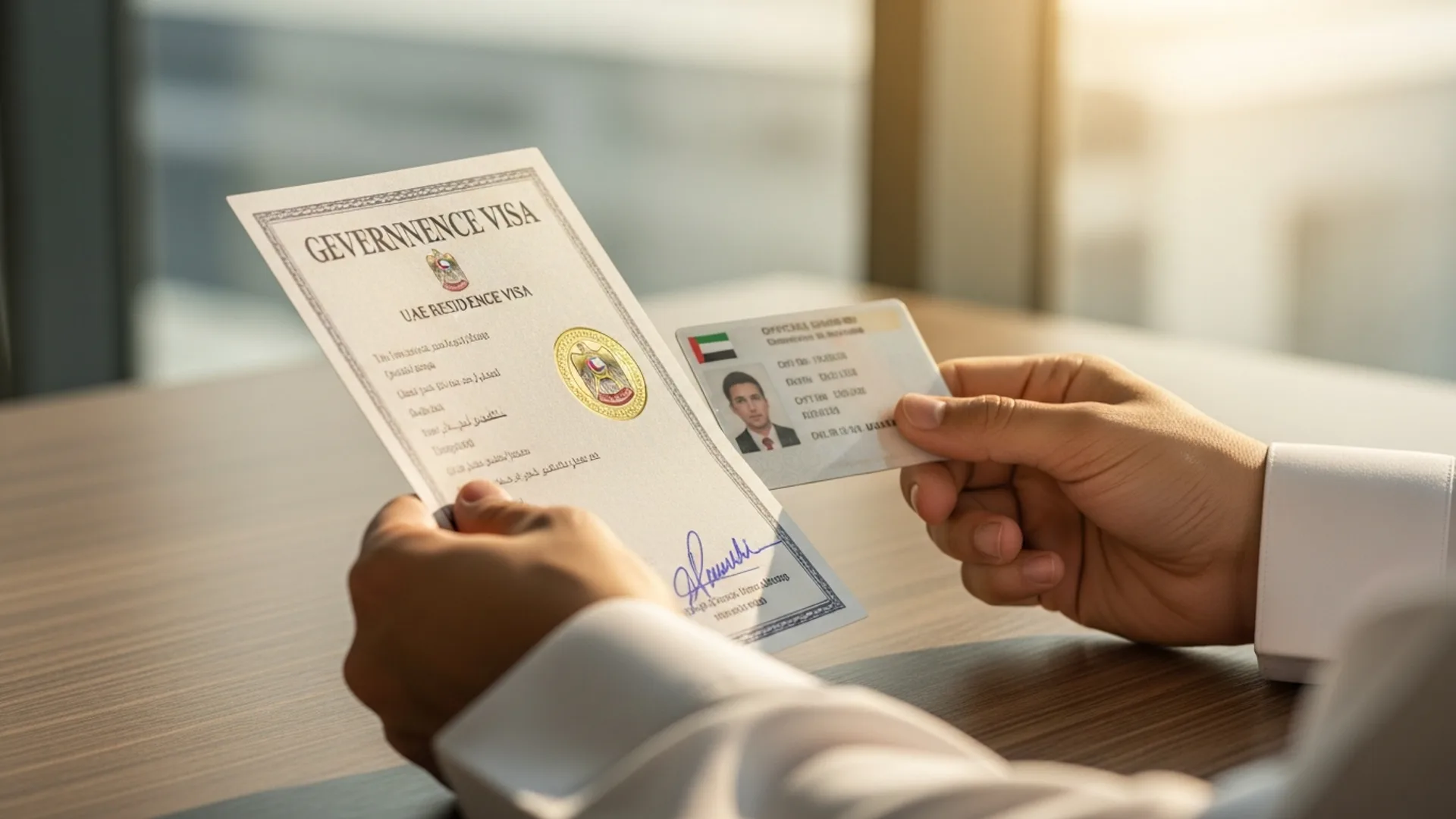
Quick AnswerUAE residence visa 2026 — all visa types, cost AED 4,500-15,000, process, renewal, family sponsorship, and how to choose the right route explained.
The UAE residence visa is the foundation of living and working in the Emirates — it's what transforms a visitor into a resident with the right to live, work, bank, school children, and build a life in the country. But "UAE residence visa" covers a whole family of visa types, each with different eligibility, cost, duration, and benefits. This guide explains every UAE residence visa route in 2026, what each costs, how to choose the right one, and the process from application to renewal.
What a UAE residence visa actually is
A UAE residence visa is the legal permit that allows a foreign national to reside in the UAE. It is distinct from a visit or tourist visa (temporary) — the residence visa establishes you as a resident with the associated rights and obligations. It comes paired with an Emirates ID, the national identity card required for daily life.
Residence visas are administered federally by the Federal Authority for Identity, Citizenship, Customs and Port Security (ICP) at icp.gov.ae, and at the Dubai emirate level by GDRFA (the General Directorate of Residency and Foreigners Affairs). The labour/work-permit side, for employment-based visas, runs through MOHRE (the Ministry of Human Resources and Emiratisation).
What a residence visa enables: living in the UAE legally, opening bank accounts, signing tenancy contracts, enrolling children in school, accessing healthcare, obtaining a UAE driving licence, sponsoring eligible family members, and generally participating in UAE life as a resident. It is the key that unlocks everything else about establishing yourself in the country.
The residence visa is always linked to a basis — a sponsor or a qualifying route. Understanding these routes is the key to choosing the right path for your situation.
The main UAE residence visa types
The UAE offers several residence visa routes, each suited to different profiles. Understanding them helps you identify your best path.
The employment visa is the most common. It is sponsored by an employer when you take a job in the UAE. The employer handles the work permit (through MOHRE) and the residence visa (through ICP/GDRFA). It typically runs 2 years and is tied to that employer — changing jobs means transferring or getting a new visa. This is the standard route for employed professionals.
The investor or partner visa is for business owners. When you set up a company in the UAE (mainland or free zone) or hold equity in one, you can sponsor your own residence visa through the company. It typically runs 2 years and continues as long as the company is active. This is the standard route for founders and entrepreneurs, enabled by 100% foreign ownership of companies.
The Green Visa is a 5-year self-sponsored residence visa introduced to attract skilled professionals and freelancers without tying them to an employer. Eligible skilled employees (meeting salary and qualification criteria) and freelancers (with a freelance permit and income proof) can self-sponsor for 5 years. This offers more stability and independence than the 2-year employer-tied visa.
The Golden Visa is the premium 10-year residence visa for investors, entrepreneurs, specialized talents, and other eligible categories. It offers maximum stability, family inclusion for 10 years, and freedom from employer/company dependency. Routes include AED 2 million property investment, AED 2 million business investment, specialized talent, and high-salary professional categories.
The family or dependent visa allows a resident to sponsor family members — spouse, children, and (at higher income) parents. The dependent visa duration matches the sponsor's visa. This is how residents bring their families to live with them in the UAE.
The retirement visa is a 5-year residence visa for those aged 55+ meeting income, savings, or property criteria, designed for retirees wanting to settle in the UAE without active employment or business.
The domestic worker visa allows residents meeting income thresholds to sponsor household staff such as housemaids, drivers, and nannies, under a specific framework.
Cost of UAE residence visas
Understanding residence visa costs requires looking at each route, as they vary.
Standard employment and investor visas cost approximately AED 4,500-6,500 in government and processing fees, covering the entry permit, medical fitness test, Emirates ID, visa stamping, and typing/processing. For employment visas, the employer typically pays; for investor visas, the founder pays through their company.
The Green Visa costs approximately AED 5,500-8,500, reflecting its 5-year duration and self-sponsored nature. The Golden Visa costs approximately AED 9,500-15,000 in processing fees, with the qualifying investment (e.g., AED 2 million property) being separate.
Across all routes, health insurance is a mandatory additional cost, ranging from AED 1,500 for basic compliance plans to AED 15,000+ for comprehensive family coverage annually. Family/dependent visas have their own per-person costs of approximately AED 2,500-4,500 each.
These costs are the investment in establishing legal residence. For most routes, the cost is modest relative to the value residence provides — the ability to live and work in a tax-efficient, opportunity-rich environment.
How to choose the right residence visa route
Choosing the right residence visa route depends on your situation. The decision framework is straightforward once you understand the options.
If you're taking a job in the UAE, the employment visa is your route — your employer sponsors it. Your focus is on ensuring the employer is reputable and handles the process properly, and verifying your registered contract matches your agreement.
If you're setting up a business, the investor visa via your company is the standard route. You set up the company (mainland or free zone), and the company sponsors your residence visa. This is the entrepreneur's path, giving you residence tied to your business.
If you're a skilled professional or freelancer wanting independence from an employer, the Green Visa offers 5-year self-sponsored residence. Skilled employees meeting the criteria and freelancers with a permit can pursue this for stability without employer dependency.
If you have capital to invest or specialized talent, the Golden Visa offers 10-year residence with maximum stability. Property investors, business investors, and recognized talents should consider this premium route for its long-term benefits.
If you're joining family already in the UAE, the family/dependent visa is your route, sponsored by your resident family member.
If you're retired and want to settle in the UAE, the retirement visa suits those 55+ meeting the criteria.
Most people's situation points clearly to one route. For founders, the common path is starting with an investor visa via company setup, then upgrading to the Golden Visa once eligible — a progression that captures the benefits of each stage.
The residence visa process
The process for obtaining a UAE residence visa follows a consistent pattern across most routes, with variations by type.
The first step is establishing the basis — getting a job (employment), setting up a company (investor), securing the freelance permit and income proof (Green Visa), or qualifying for the Golden Visa route. This basis is what enables the visa.
The second step is the entry permit, issued by ICP/GDRFA, which authorizes entry (for those applying from abroad) or status change (for those already in the UAE on another visa). The entry permit is typically valid for 60 days.
The third step, after entry or status change, is the medical fitness test (mandatory for adults), which screens for specific conditions, and the Emirates ID biometrics (fingerprints and photo), which generates the Emirates ID.
The fourth step is visa stamping, which records the residence visa in the federal system and links it to your passport. The Emirates ID is then produced and delivered.
The entire process typically completes in 4-6 weeks when documents are ready. Attestation of educational certificates (for some routes) and other documentation should be prepared in advance, as attestation can add weeks if not done early. The Golden Visa may take longer (4-12 weeks) depending on the route and verification required.
Renewal and maintaining residence
Residence visas require renewal at the end of their term — every 2 years for standard visas, 5 years for Green Visa, 10 years for Golden Visa. Renewal through ICP or GDRFA involves confirming continued eligibility, completing a renewed medical fitness test and Emirates ID, paying fees, and receiving the renewed visa.
Renewing on time matters. Standard residence visas have a grace period (typically 30 days) after expiry, but letting a visa lapse beyond the grace period triggers overstay fines that accrue daily. Renewing 30-60 days before expiry ensures continuity and avoids fines.
Maintaining residence also requires keeping the basis valid. Employment visas depend on continued employment; investor visas on the active company; Green and Golden visas on continued eligibility. If the basis changes — leaving a job, closing a company — the visa must be addressed, either through transition to a new basis or proper cancellation.
For residents planning long-term UAE life, the Golden Visa's 10-year duration dramatically reduces the renewal burden compared to the 2-year cycle of standard visas. This is one reason many established residents pursue the Golden Visa upgrade when eligible.
Family sponsorship through your residence visa
A major benefit of residence is the ability to sponsor family. Residence visa holders meeting income thresholds can sponsor spouse and children, and at higher income, parents and domestic workers.
The income threshold for sponsoring spouse and children is typically AED 4,000/month plus accommodation, or AED 6,500/month all-inclusive, though it varies by emirate and relationship. Sponsoring parents requires a higher threshold (typically AED 20,000+/month). The family visa duration matches the sponsor's visa, so a Golden Visa holder sponsors family for 10 years, while a standard visa holder sponsors for 2 years.
Family sponsorship requires documentation including attested marriage and birth certificates, proof of income, and suitable accommodation. Planning family sponsorship alongside your own residence — particularly attestation of family documents in advance — smooths the process of bringing your family to the UAE.
How residence visa connects to Emirates ID and other essentials
The residence visa is part of an integrated system. It comes with the Emirates ID, the national identity card required for nearly everything in daily UAE life — banking, telecom, government services, healthcare, and official transactions. The Emirates ID is renewed alongside the residence visa.
The residence visa also enables a UAE driving licence (for eligible nationalities, through conversion or testing), bank account opening, tenancy contracts and Ejari registration, school enrollment for children, and health insurance enrollment (which is mandatory). Each of these builds on the foundation of legal residence.
Understanding that the residence visa is the keystone — unlocking the Emirates ID, which unlocks daily life — helps new residents appreciate the importance of establishing and maintaining valid residence. Everything else flows from it.
Common Mistakes people make with UAE residence visas
A frequent mistake is choosing the wrong route — for example, staying on a 2-year employer-tied visa indefinitely when eligible for the more stable Green or Golden Visa. Reviewing your eligibility as your situation evolves ensures you're on the optimal route.
Another mistake is letting attestation delay the process — educational and family documents requiring attestation should be prepared early, as attestation can add weeks. Starting attestation before you need the visa prevents delays.
Some people let visas lapse, incurring overstay fines. Tracking expiry dates and renewing 30-60 days early prevents this. The grace period on standard visas helps, but relying on it is risky.
Others underestimate health insurance costs, which are mandatory and can be substantial for families. Budgeting realistically for health insurance alongside visa costs prevents surprises.
For founders, a common mistake is not planning the progression from investor visa to Golden Visa, missing the stability benefits when they become eligible. Planning this progression as part of a multi-year UAE strategy captures the Golden Visa's advantages at the right time.
Finally, some sponsors don't verify income thresholds before applying for family visas, leading to rejections. Confirming you meet the threshold for the family members you want to sponsor prevents wasted applications.
What changes for free zone vs mainland for residence visas
The residence visa rules are federal and apply uniformly, but the processing channel differs slightly. Free zone investor visas are processed through the free zone authority's systems (DMCC, IFZA, JAFZA, etc.), often faster. Mainland investor and employment visas process through MOHRE and ICP/GDRFA directly.
The underlying visa, rights, and obligations are identical regardless of whether your basis is a free zone or mainland company. The choice between free zone and mainland for your business affects the processing channel and some business operations, but not the fundamental nature of your residence visa.
For founders choosing between free zone and mainland setup, the residence visa is generally not the deciding factor — both enable investor visas equally. The decision rests on business operational factors (target market, activity, cost) rather than visa differences.
The residence visa journey over time
For most UAE residents, the residence visa is not a one-time event but a journey that evolves over years. Understanding this journey helps founders and professionals plan their UAE future strategically rather than treating each visa as an isolated transaction.
The journey typically begins with entry — arriving on an employment visa sponsored by an employer, or setting up a company and self-sponsoring through an investor visa. This initial residence establishes the foundation: legal residence, an Emirates ID, the ability to bank and live in the UAE. For many, this first stage is about establishing themselves and assessing whether the UAE is right for their long-term future.
As people settle in and their situation develops, the journey often progresses. An employee might switch employers (transferring the visa), or move from employment to starting a business (converting to an investor visa). A founder might grow their business and accumulate assets. A skilled professional might reach the thresholds for the Green Visa's self-sponsored stability. These transitions reflect the natural evolution of a UAE career and life.
For those committing to a long-term UAE future, the journey often culminates in the Golden Visa — the 10-year residence that provides maximum stability, family inclusion, and freedom from sponsorship dependency. Reaching the Golden Visa, whether through property investment, business investment, or professional achievement, marks the transition from establishing a UAE presence to committing to a long-term future in the country.
Understanding this journey helps residents plan deliberately. Rather than reacting to each visa renewal, the strategic resident thinks about where they are in the journey and where they want to go, making choices — about business structure, asset accumulation, and visa routes — that move them toward their long-term goals. The residence visa system, with its progression from standard to Green to Golden visas, supports this journey, offering increasing stability and benefits as one's commitment to the UAE deepens.
Residence visa and your broader UAE life
The residence visa underpins not just the legal right to live in the UAE but the entire fabric of life there. It is worth understanding how central it is to everything else, because this underscores why establishing and maintaining it properly matters so much.
With a residence visa and Emirates ID, you can open bank accounts that enable your financial life, sign tenancy contracts that give you a home, enroll children in schools that shape their future, access healthcare for your family's wellbeing, obtain a driving licence for mobility, and sponsor family members so your loved ones can join you. Each of these foundational elements of life depends on the residence visa.
For founders, the residence visa also underpins the business: it enables the banking that runs the company, the ability to sponsor employees, and the stable presence from which to build. The residence visa and the business are intertwined, each supporting the other.
This centrality is why treating the residence visa seriously — choosing the right route, maintaining it properly, planning its evolution — is so important. It is not mere paperwork but the foundation upon which your entire UAE life and business are built. Residents who understand this and manage their residence proactively build stable, secure lives in the UAE, while those who treat it carelessly risk disruptions that ripple through every aspect of their life and business.
What to do next
If you're planning to establish UAE residence in 2026 — through employment, business setup, the Green Visa, the Golden Visa, or family sponsorship — choosing the right route for your situation is the first step. We help founders and professionals establish UAE residence through the optimal route, particularly investor visas via business setup and the progression to Golden Visa. A 20-minute call clarifies your best residence path and the process to follow.
The pattern across successful UAE residence is matching the route to your situation and planning the progression over time. Employees take the employment route; founders take the investor route via company setup; skilled professionals consider the Green Visa; those with capital or talent pursue the Golden Visa. Many progress through routes as their situation evolves, starting with a standard visa and upgrading to longer-term options.
For founders specifically, UAE residence through business setup is a well-trodden path: set up a company with 100% foreign ownership, sponsor your investor visa through it, establish your residence and bring your family, and as your business and assets grow, upgrade to the Golden Visa for long-term stability. This progression captures the full value of UAE residence — the tax efficiency, the business opportunities, the lifestyle, and the stability — building a foundation for a multi-year future in the Emirates.
The UAE residence visa system is comprehensive and well-designed, offering routes for employees, entrepreneurs, skilled professionals, investors, talents, families, and retirees. Understanding the options, choosing the right route, and managing the process and renewals properly establishes the foundation for everything else you'll build in the UAE. Whether you're taking your first step toward UAE residence or optimizing your existing status, the right residence visa is the key that unlocks your future in the Emirates in 2026. Take the time to understand the routes, choose the one that fits your situation, and plan the progression that will carry you toward the long-term stability that committed UAE residents ultimately achieve.
Talk to Our Experts
UAE residence visa route selection
Frequently Asked Questions
What is a UAE residence visa in 2026?
A UAE residence visa is the permit allowing a foreign national to legally reside in the UAE, linked to a sponsor (employer, company, family member) or self-sponsored routes (Green Visa, Golden Visa). It comes with an Emirates ID and enables living, banking, schooling, and access to services. Standard residence visas run 2 years; Green Visa 5 years; Golden Visa 10 years.
How much does a UAE residence visa cost in 2026?
A UAE residence visa costs AED 4,500-6,500 for standard employment/investor visas, AED 5,500-8,500 for the 5-year Green Visa, and AED 9,500-15,000 for the 10-year Golden Visa, including entry permit, medical, Emirates ID, and stamping. Health insurance is additional (AED 1,500-15,000/year).
What are the main types of UAE residence visa?
Main UAE residence visa types in 2026: employment visa (employer-sponsored, 2yr), investor/partner visa (company ownership, 2yr), Green Visa (self-sponsored skilled/freelance, 5yr), Golden Visa (investor/talent, 10yr), family/dependent visa (sponsored by resident), retirement visa (5yr for 55+), and domestic worker visa. Each has its own eligibility and cost.
How long does a UAE residence visa take to process?
A UAE residence visa typically takes 4-6 weeks end-to-end: entry permit 1-2 weeks, medical fitness and Emirates ID biometrics about 1 week, visa stamping 3-7 days. Golden Visa can take 4-12 weeks depending on route. Processing is faster when documents (including attestations) are ready in advance.
Can a foreigner get a UAE residence visa in 2026?
Yes. UAE residence visas are designed for foreign nationals. Routes include employment (job offer), investor (company setup), Green Visa (skills/freelance), Golden Visa (investment/talent), and family sponsorship. 100% foreign ownership of mainland and free zone companies means foreigners can self-sponsor through business setup.
How do I renew my UAE residence visa?
Renew a UAE residence visa through ICP (icp.gov.ae) or GDRFA before expiry: confirm sponsor/eligibility still valid, complete renewed medical fitness and Emirates ID, pay fees, and receive the renewed visa. Standard visas renew every 2 years, Green every 5, Golden every 10. Renew 30-60 days before expiry to avoid fines.
Can I sponsor family on my UAE residence visa?
Yes, if you meet income thresholds (typically AED 4,000-6,500/month for spouse and children). Residence visa holders can sponsor spouse, children, and (at higher income) parents and domestic workers. Family visa duration matches the sponsor’s visa, so Golden Visa holders sponsor family for 10 years.
What is the difference between standard, Green, and Golden residence visas?
Standard residence visa: 2 years, tied to employer or company. Green Visa: 5 years, self-sponsored for skilled employees and freelancers, no employer dependency. Golden Visa: 10 years, for investors and talents, maximum stability and flexibility. Duration, sponsorship dependency, and eligibility criteria are the key differences.
Companies sponsoring residence visas process them through the UAE eChannel system, the online immigration portal explained in our dedicated guide.
Once your residence visa is processing, you can track the card via checking your Emirates ID status online.
Some visa and employment steps also need a police clearance certificate.
See also our guide to investor visa dubai.
See also our guide to employment visa cancellation uae.
For details, see our guide to Emirates ID status check.
Related: see our full guide to MOHRE enquiry services.
Related: try our end-of-service gratuity calculator to estimate your end-of-service pay.
Related: see our guide to the UAE work permit and labour card.
Related: see our guide to ICA Smart Services.
Related: see our guide on health insurance Dubai.
Related: see our guide to UAE unified number (UID).
Related: see our Golden Visa vs standard residence visa comparison.
Related: 1-year maid visa in Dubai.
Related: freelance visa vs employment visa.
Related: minimum salary to sponsor family.
Related: Al Aweer immigration office.
Related: visa-free countries for UAE residents.
Related: family visa cost.
Related: UAE visa number.
UAE Visa & Immigration Guides (2026)
Status & documents: Emirates ID replacement · Entry permit vs residence visa · Medical fitness test · Establishment immigration card · Tawjeeh vs Tasheel vs Amer
Fines, bans & grace periods: Overstay fines · Visa grace period · Entry ban check · Change visa status inside the UAE · Visit visa to employment visa
Long-term visas: Retirement visa · Blue visa · Property visa · Golden Visa for nurses, teachers & creators · Golden Visa medical & Emirates ID steps · GCC unified tourist visa
Related Guides
The company-formation routes behind a residence visa.
- IFZA free zone — Dubai packages from AED 12,900
- Sharjah free zone — the lowest published entries in the UAE