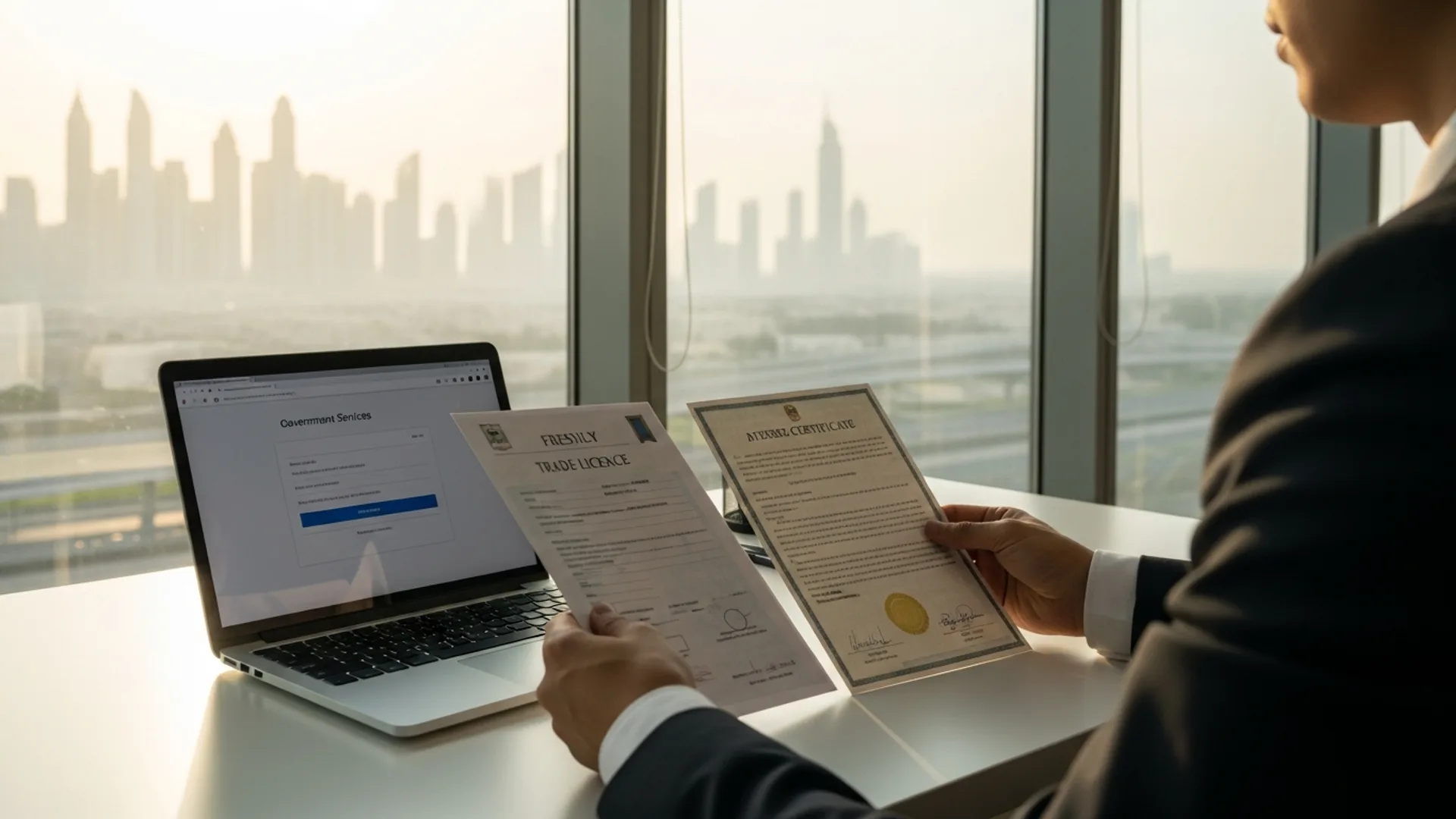
Quick AnswerProfessional licence in Dubai 2026: what it covers vs commercial, activities, 100% ownership, local service agent and indicative cost, explained simply.
What is a professional licence in Dubai?
A professional licence in Dubai is a trade licence issued for service-based and knowledge-based activities that rely on individual skill, expertise and intellectual effort rather than on buying and selling physical goods, and it is issued on the Dubai mainland by the Department of Economy and Tourism (DET), still widely called the DED. It covers professions such as management consultancy, marketing, IT services, engineering consultancy, accounting, auditing, legal consultancy, design and education services. The defining feature is that you are selling a service or expertise, which separates it cleanly from a commercial licence for trading goods and an industrial licence for manufacturing. In most cases a foreign professional can now own 100% of a professional company, and where an older sole-establishment form is used a local service agent may be appointed who holds no shares and no profit, only an administrative role. As an indicative 2026 estimate, a Dubai professional licence commonly lands in the region of AED 12,000 to AED 25,000 or more for the first year once you combine the licence fee, approvals, market fees and a flexi-desk or Ejari-registered office, with visas and any regulator approvals costed separately. In short, if your business sells expertise rather than goods, the professional licence is almost certainly the category you need.
That single answer hides several decisions that decide whether your setup is clean and cost-efficient or messy and expensive to fix later. The licence category you choose has to match what you genuinely do, because the activity printed on your licence is what you are legally permitted to invoice clients for. The legal form you choose decides whether you need a local service agent and how ownership is structured. The office you choose decides how many visas you can sponsor. And the activity you choose decides whether a regulator must approve your licence before it can be issued. None of these are difficult once you understand how they fit together, but getting one wrong is the most common reason a setup costs more, takes longer or has to be amended within months. This guide walks through what a professional licence covers, how it differs from commercial and industrial licences, the ownership and local-service-agent rules, the activities it includes, the indicative 2026 costs, the visas it supports and the mistakes founders most often make, so you can choose with confidence.
Professional, commercial and industrial: the three licence families
The UAE organises mainland business activity into three broad licence families, and understanding the distinction is the foundation of choosing correctly. The professional licence sits at one end of the spectrum and is built around services, skill and intellectual output. When the value you deliver to a client is your knowledge, your advice, your design, your code or your professional judgement, you are in professional-licence territory. A management consultant who advises companies on strategy, a marketing agency that builds campaigns, a software house that writes applications, an engineering consultancy that designs systems, an accountant who keeps the books and a designer who creates brand identities are all classic professional-licence holders. Nothing physical changes hands as the core of the transaction; the client is paying for expertise.
The commercial licence sits in the middle and is built around trading goods. When the core of your business is buying, selling, importing, exporting, distributing or stocking physical products, you need a commercial licence. A company that imports electronics and sells them, a wholesaler that distributes building materials, a retailer that runs a shop and a business that holds a broad general trading licence to deal in many product categories all fall here. The commercial family is about the movement and exchange of goods, and it often involves considerations a professional setup does not, such as warehousing, customs and stock. If you are weighing a trading setup, our guide to the general trading licence in the UAE explains how a broad commercial licence works and what it covers, which is a useful contrast to the professional category covered here.
The industrial licence sits at the far end and is built around manufacturing and production. When your business transforms raw materials or components into finished goods, whether that is food production, assembly, fabrication or any form of factory output, you are in industrial-licence territory. Industrial licences typically involve the most additional requirements, because they touch on physical premises, machinery, safety, environmental considerations and approvals from authorities concerned with industry and municipality matters. Most founders setting up a service business will never need this category, but it completes the picture and clarifies why the professional licence is defined the way it is. The simplest way to place yourself is to ask one question: is the client paying for my expertise and service, for physical goods I supply, or for products I manufacture? The honest answer points directly to the correct licence family, and the professional licence is the answer whenever expertise and service are the heart of the offering.
What activities a professional licence covers
The range of activities that fall under a Dubai professional licence is genuinely wide, and seeing the breadth helps founders recognise where their own business fits. Consultancy of almost every kind is the largest cluster: management consultancy, business and economic consultancy, marketing consultancy, human-resources consultancy, project-management consultancy, environmental consultancy and many more specialised advisory niches. Technology activities form another large group, covering IT services, software development, web and application development, IT consultancy, cybersecurity services and digital-transformation advisory. Creative and marketing activities sit alongside these, including advertising, graphic design, content creation, media services, branding, social-media management and event-related services where they are service-led rather than goods-led.
Technical and engineering activities also live within the professional family, although several of these are regulated and require an external approval before issuance. Engineering consultancy, architectural design, interior design and a variety of technical-services activities fall here, and the engineering and architectural ones in particular often involve approval tied to Dubai Municipality, which oversees standards relevant to the built environment. Financial and accounting activities such as bookkeeping, accounting services and auditing belong to the professional category too, as do legal consultancy and a range of advisory services in regulated fields. Education and training activities, from corporate training to certain tutoring and skills services, are professional activities, and healthcare-related consultancy activities can be professional where the relevant health regulator, such as the Dubai Health Authority, permits and approves them.
What ties this diverse list together is the same thread that defines the whole category: the activity centres on providing a service, an expertise or an intellectual output. The practical point for a founder is that each of these activities has a precise official name and code in the Department of Economy and Tourism activity list, and your licence is issued against the specific activities you select, not against a vague description of your business. This is why the activity-selection step matters so much. If you describe yourself loosely as a consultant but actually provide a specific regulated service, you may select the wrong code and either be unable to invoice for your real work or face a compliance gap. Choosing the exact activities that match what you will genuinely do, and adding closely related activities you expect to offer, is one of the most important decisions in the whole setup, and it is worth taking advice on rather than guessing from the activity names alone.
Ownership and the local service agent explained
One of the most reassuring features of the professional licence, especially for foreign founders, is its long history of foreigner-friendly ownership. For many years, even before the broader foreign-ownership reforms, professional activities could be structured so that a foreign professional owned the business outright. This was achieved through a professional sole establishment or a civil company, where the foreign professional held full ownership of the business and its profits, and an Emirati national or Emirati-owned company was appointed as a local service agent. The defining and frequently misunderstood point is that the local service agent holds no shares, no ownership stake and no entitlement to profit. The agent's role is administrative, helping with certain dealings with government departments, and is compensated through an agreed annual fee rather than through any share of the business. The foreign professional remains in full control and keeps all the profit.
More recently, the position has become even more favourable. The expansion of full foreign ownership across a wide range of mainland activities under the Department of Economy and Tourism means that many professional activities can now be set up as fully foreign-owned companies, including limited-liability structures, without appointing a local service agent at all. This has simplified the picture considerably for founders, because the choice is no longer professional-with-an-agent versus a partnership; in many cases it is now a straightforward fully owned company. The exact answer for your business depends on the specific activity code you select and the legal form you choose, since a small set of activities of strategic national importance still carry their own conditions. The reforms are broad and have opened up the great majority of professional activities to full foreign ownership, but the right way to confirm your position is to map your precise activity to the current rules rather than assume.
The legal form you select interacts directly with the local-service-agent question, which is why the two are best decided together. A professional sole establishment owned by one individual is the classic form that historically used a local service agent. A limited-liability structure for professional activities, now available for many, can often be fully foreign-owned without an agent. A civil company, used where two or more professionals practise together, has its own characteristics. Each form has implications for liability, the number of owners, visa allocation and how the business is perceived by clients and banks. The cost difference between forms is usually modest compared with the long-term consequences of choosing the wrong one, so this is a decision worth making deliberately. Founders who want a fuller picture of mainland structures and ownership generally can read our guide to mainland company formation in the UAE, which sets the professional licence in the wider context of how mainland companies are owned and run.
What a professional licence in Dubai costs in 2026
Cost is naturally one of the first questions founders ask, and the honest answer is that a professional licence does not have a single price, because the total depends on several choices that you control. The licence fee itself is only one component. To it you add the trade-name reservation and initial approval, the market fees and service charges levied as part of the process, the cost of your workspace, and then, separately, the cost of visas, any attestation of qualifications, any regulator approval and a local service agent fee if your chosen form uses one. The biggest single variable is usually the workspace, because a flexi-desk arrangement is far less expensive than a fully fitted Ejari-registered office, and your workspace choice also determines how many visas you can sponsor, which links cost to capacity. The table below gives indicative 2026 ranges so you can see how the pieces combine, but every figure should be treated as a guideline to confirm with the authority.
| Cost component | Indicative 2026 AED range (indicative — confirm current fees with the authority) | Notes |
|---|---|---|
| Trade name reservation and initial approval | 600 – 2,000 | One-off at the start of the process |
| Professional licence fee and market fees | 8,000 – 15,000 | Varies by activity and number of activities |
| Flexi-desk workspace (per year) | 5,000 – 12,000 | Lower-cost option, supports a small number of visas |
| Ejari-registered physical office (per year) | 15,000 – 40,000+ | Higher cost, supports more visas, depends on size and area |
| Local service agent fee (where applicable, per year) | 5,000 – 15,000 | Only if your legal form uses an agent; agent holds no equity |
| Typical first-year all-in (single activity, flexi-desk) | 12,000 – 25,000+ | Excludes visas, attestation and regulator approvals |
| Residence visa (per person, separate) | 4,000 – 7,000+ | Costed per visa; tied to workspace allocation |
The way to read this table is to start from the bottom line and work back. A simple single-activity professional sole establishment or company using a flexi-desk, with no external regulator approval required, sits toward the lower end of the typical first-year range. As you add activities, move from a flexi-desk to a physical office, increase your visa count, or operate a regulated activity that needs approval, the total climbs accordingly. None of this is hidden; it is simply a function of the choices you make, which is why a clear conversation about what you actually need produces a far more accurate budget than any single headline number. It is also why comparing a professional licence with a commercial one purely on the sticker price is misleading, because a trading business on a flexi-desk can cost much the same as a professional one. The right sequence is always to choose the licence that genuinely matches your activity first, and then optimise the cost within that correct category.
A final and important point on cost: the licence fee and the official government fees are distinct from any consultancy service fee you pay a setup partner to handle the process. A transparent provider itemises both, so you can see exactly what is an official government charge and what is the service charge for managing your application, attestation, approvals and visas. When you ask any provider for a quote, ask them to split the official fees from their service fee and to confirm which figures are guidelines that may change. This protects you from surprises and makes it easy to compare quotes on a like-for-like basis. For a step-by-step walkthrough of the licensing process itself, our guide on how to get a trade licence in Dubai covers the sequence that applies to professional licences as well as other categories.
Visas, workspace and capacity on a professional licence
A professional licence is not only permission to operate; it is also the basis on which you sponsor residence visas, and understanding how that works prevents one of the most common planning mistakes. The number of visas a professional licence can support is tied directly to your workspace. A flexi-desk arrangement, which gives you a registered business address and shared facilities at low cost, typically supports a small number of visas, often enough for a founder and perhaps one or two staff. A larger Ejari-registered physical office supports more visas in proportion to its size and the area it is in, because immigration allocations are linked to the registered workspace. This is why the workspace decision is really two decisions in one: it sets your annual office cost and it sets your hiring ceiling. A founder who plans to build a team of ten cannot do so on a flexi-desk allocation, and a solo consultant does not need to pay for a large office to sponsor a single visa.
The visa process itself runs through several authorities working together, and a professional licence gives you the legal standing to engage them. Residence visa processing and immigration matters run through the General Directorate of Residency and Foreigners Affairs, identity and Emirates ID processing run through the ICP, and where you employ staff their labour permits are handled through the Ministry of Human Resources and Emiratisation. Each employee's file therefore has an immigration side and a labour side that must stay aligned, and each visa carries its own cost separate from the licence. When budgeting, treat the licence, the workspace and the visas as three connected line items rather than one lump sum, because they scale differently. The licence is largely fixed for your activity set, the workspace scales with how many people you need to house and sponsor, and the visas scale per person.
The link between workspace and capacity also shapes how you should think about growth. A sensible approach for many founders is to start lean, with a flexi-desk and the visas you need on day one, and to upgrade the workspace only when hiring genuinely requires more allocation. This keeps your first-year cost down while leaving a clear path to scale. Others, who know they will hire quickly, take a physical office from the outset to avoid the friction of upgrading mid-year. Neither approach is universally right; the correct choice depends on your hiring plan and cash position. What matters is that you make the choice knowingly, understanding that the office you pick is also the hiring ceiling you are buying. A good setup partner will model this with you so the workspace you commit to matches the team you actually intend to build in the first year, rather than leaving you to discover a visa shortfall after you have signed a tenancy.
Approvals and regulated professional activities
Many professional activities are issued by the Department of Economy and Tourism without any third-party sign-off, but a meaningful number are regulated and require approval from the relevant authority before the licence is granted. This is not an obstacle so much as a quality safeguard, and it explains why activity selection and approvals must be planned together rather than discovered in sequence. Engineering and architectural activities, for instance, often involve approvals connected to Dubai Municipality, which oversees standards relevant to the built environment and the technical professions that serve it. Healthcare-related activities involve the Dubai Health Authority, which sets and checks the standards for health services in the emirate. Certain financial, legal and education activities have their own regulators that confirm the professional and the activity meet the requirements of that field before clients can be served.
The practical effect of a regulator approval is twofold. First, it adds a step to your timeline, because the approval must be obtained before the licence is issued, and the duration of that step depends on the authority and the completeness of your submission. Second, it adds documentation requirements, because the regulator will want evidence that you and your activity meet its standards, which can include attested qualifications, professional experience, and sometimes membership of a professional body. None of this is unusual or burdensome when it is anticipated, but it becomes a frustrating source of delay when it is discovered late. The single biggest cause of stalled professional-licence applications is reaching the issuance stage only to learn that a regulator approval was needed and was never started. Mapping the required approvals at the very beginning, alongside activity selection, turns these from surprises into scheduled steps.
This is also where the attestation of qualifications often enters the picture. Several regulated professional activities require that your degree or professional certificate be attested, which is the formal process of having a document verified through a chain of authorities so that it is recognised in the UAE. Attestation can take time, particularly when documents must be processed in your home country first, so starting it early is essential where the activity demands it. A founder who knows their activity is regulated can begin attestation in parallel with the rest of the setup, keeping the overall timeline tight. A founder who does not realise their activity needs attested qualifications can find their licence held up for weeks while documents travel back and forth. The lesson is consistent: regulated professional activities are entirely manageable, but only if their approval and documentation requirements are identified and sequenced from the outset rather than encountered one at a time at the end.
Mainland versus free zone for a professional service business
Although this guide focuses on the mainland professional licence issued by the Department of Economy and Tourism, founders setting up a service business will naturally weigh whether a free zone might suit them instead, and a brief comparison helps frame the mainland choice. A mainland professional licence lets you serve clients anywhere in the UAE directly, including government bodies and other mainland companies, without restriction on where your clients are located, which is a significant advantage for consultancies, agencies and service firms whose clients are spread across the local market. Free zones, by contrast, offer their own licensing with attractive packages and bundled services, and they have historically been popular for their simplicity and full foreign ownership, but a free-zone company serving mainland clients may need to consider how it does so. For a service business whose clients are predominantly UAE-based businesses and individuals, the mainland professional licence is frequently the cleaner fit.
The ownership advantage that once strongly favoured free zones has narrowed considerably, because full foreign ownership is now available for many mainland professional activities, removing what used to be the headline reason many service founders chose a free zone. That said, free zones still appeal to some founders for reasons such as specific industry clusters, particular facilities, or packages tailored to a niche. The decision is no longer a simple ownership question but a fit question: where are your clients, what activities do you need, what facilities matter to you, and how do you intend to grow. Because the answer is genuinely business-specific, this is one of the most valuable conversations to have with an experienced setup partner before committing, since switching jurisdiction later is more disruptive than choosing well at the start.
For a service business, the most common decisive factor is client location. If you will primarily serve clients across the UAE mainland market, including dealing directly with mainland companies and public bodies, a mainland professional licence gives you the broadest, most frictionless reach. If your work is more naturally suited to a particular free-zone ecosystem, or your clients are international, a free-zone licence may serve you better. Cost, as discussed, tends to be comparable once you account for workspace and visas, so it rarely settles the question on its own. The right approach is to start from where your clients are and what your activity requires, and let those facts point to the jurisdiction, rather than starting from a jurisdiction and trying to make your business fit it.
Common Mistakes to Avoid
The first and most damaging mistake is choosing a licence category that does not match what you actually do. Founders sometimes pick a professional licence because it sounds cheaper, or a commercial licence because it sounds broader, without checking that the licensed activity covers the work they will genuinely invoice for. Because your licence defines what you may legally charge clients for, a mismatch is not a cosmetic problem; it can leave you unable to bill for your real work or operating outside your licensed activity. Always start from an honest description of what you will sell, map that to the precise activity codes, and let the activity decide the category, rather than choosing the category first and forcing your business into it.
The second mistake is misunderstanding the local service agent. Newcomers often assume a local service agent is a partner who takes a share of the profits or a measure of control, and that fear leads them to overpay for structures they do not need or to avoid the mainland altogether. In reality, where a local service agent is used at all, the agent holds no equity, no ownership and no profit entitlement; the role is administrative and compensated by a fixed annual fee. With full foreign ownership now available for many professional activities, a large number of setups need no agent whatsoever. Confirm the current requirement for your exact activity rather than acting on outdated assumptions, because the rules have moved substantially in founders' favour.
The third mistake is underestimating regulator approvals and attestation. Founders frequently budget and plan only for the licence itself, then hit a wall when they discover that their activity is regulated and needs approval from a body such as Dubai Municipality or the Dubai Health Authority, or that their qualifications must be attested before issuance. These steps are entirely manageable when anticipated and started early, but discovering them at the end turns a few-day setup into a multi-week one. Identify every required approval and document at the very beginning, alongside activity selection, so they can be sequenced in parallel rather than encountered one at a time.
The fourth mistake is choosing the wrong workspace for your hiring plan. Because visa allocation is tied to your workspace, a founder who takes a flexi-desk to save money and then tries to hire a team discovers a visa ceiling that blocks growth, while a founder who takes a large office for a one-person consultancy pays for capacity they never use. Match the workspace to the team you genuinely intend to build in the first year, and treat the licence, the workspace and the visas as three connected line items, so your structure supports your plan instead of fighting it.
The fifth mistake is confusing official fees with service fees and budgeting from a single headline number. The licence fee, the government charges and any agent fee are distinct from the consultancy service fee for managing the process. Without an itemised breakdown, founders cannot compare quotes fairly or anticipate the full first-year cost, which includes visas, attestation and approvals on top of the licence. Always ask for a split between official fees and service fees, and confirm which figures are guidelines that may change, so your budget reflects the real total rather than an optimistic fragment of it.
How Noble Core Ventures helps
Setting up a professional licence in Dubai is entirely achievable, and the rules have moved firmly in founders' favour with the broad availability of full foreign ownership and the streamlined issuance of many activities. What separates a clean, fast, cost-efficient setup from a slow and expensive one is not luck; it is getting the early decisions right, namely the activity selection, the legal form, the ownership structure, the workspace and the sequencing of any approvals and attestation. Each of these decisions is straightforward when you understand how they fit together, and each is a costly mistake when guessed at in isolation. The whole purpose of this guide has been to make those decisions visible so you can approach your setup with a clear picture rather than a series of surprises.
At Noble Core Ventures we set up professional licences for founders across consultancy, technology, marketing, engineering, finance, education and many other service fields, and we handle the whole sequence as one accountable relationship. That means mapping your real activity to the exact codes, confirming whether full foreign ownership applies or whether a local service agent is needed, choosing the legal form and workspace that match your hiring plan, identifying and sequencing any regulator approvals and attestation, and processing your licence and visas through to issuance. We itemise official fees separately from our service fee, confirm which figures are current guidelines, and keep your timeline tight by assembling a complete document pack the first time. If you are weighing a professional licence in Dubai, the most useful next step is a short conversation about what you actually intend to do, so we can confirm the right activity, structure and cost for your specific business and get it issued cleanly rather than amended later. You can also read the official mainland licensing information published on the Dubai Department of Economy and Tourism business portal to see how the authority frames the process, and then let us translate that into the precise steps for your activity.
Talk to Our Experts
choosing the correct professional licence activities and getting your Dubai professional licence issued cleanly the first time
Frequently Asked Questions
What is a professional licence in Dubai?
A professional licence in Dubai is a category of trade licence issued for service-based and knowledge-based activities that rely on individual skill, expertise or intellectual effort rather than on buying and selling physical goods. It covers professions such as consultancy, management advisory, marketing, IT services, engineering consultancy, accounting and auditing, legal consultancy, design, education services and many other service activities. The licence is issued on the Dubai mainland by the Department of Economy and Tourism, still widely called the DED, and it lets the holder offer their services legally across the UAE. The defining feature of a professional licence is that it is built around providing a service or expertise, which separates it clearly from a commercial licence for trading goods and an industrial licence for manufacturing.
What is the difference between a professional licence and a commercial licence in Dubai?
The core difference is the nature of the activity. A professional licence is for service-based and intellectual activities such as consultancy, IT services, marketing, engineering consultancy and education, where you are selling expertise and skill. A commercial licence is for trading activities, meaning the buying, selling, import, export and distribution of physical goods, including a general trading licence that covers a broad basket of products. The two also historically differed in ownership and legal form, because professional activities could be fully foreign-owned through a civil company or sole establishment using a local service agent, whereas commercial trading often required a different structure. Today, with expanded foreign-ownership rules on many mainland activities, the practical choice usually comes down to which licence matches what you actually intend to do, because the licence must reflect your genuine activity.
Can a foreigner own 100% of a professional licence in Dubai?
In most cases, yes. Professional activities on the Dubai mainland have long been the most foreigner-friendly category, because a professional sole establishment or civil company could be fully owned by the foreign professional while appointing a local service agent who held no equity. More recently, the expansion of full foreign ownership across a wide range of mainland activities under the Department of Economy and Tourism has made 100% ownership available for many business types, including numerous professional activities, without needing an Emirati shareholder. The exact position depends on the specific activity code and the legal form you choose, because a small set of strategic-impact activities still carry their own conditions. A consultant who maps your activity to the correct structure can confirm whether full ownership applies in your case before you commit.
What activities fall under a professional licence in Dubai?
Professional licence activities are service-based and expertise-driven, and the list is long. Common examples include management consultancy, business and economic consultancy, marketing and advertising services, IT and software services, engineering and technical consultancy, accounting and bookkeeping, auditing, legal consultancy, architecture and interior design, educational and training services, healthcare-related consultancy where permitted, media and content services, recruitment consultancy and a wide range of other advisory and creative activities. Each activity has a precise name and code in the Department of Economy and Tourism activity list, and some require additional approvals from the relevant regulator before the licence is issued. Choosing the exact activity that matches your work is essential, because the licensed activity defines what you may legally invoice clients for, and operating outside it can create compliance problems.
Do I need a local service agent for a professional licence in Dubai?
It depends on the legal form you select. A professional sole establishment owned by an individual foreign professional traditionally required a local service agent, who is an Emirati national or an Emirati-owned company appointed to handle certain dealings with government departments in exchange for an annual fee. Crucially, the local service agent holds no shares, no ownership and no profit entitlement in the business; the role is administrative rather than financial. With the broadening of full foreign ownership and the availability of limited-liability structures for many professional activities, some setups no longer require a local service agent at all. Whether you need one comes down to the specific activity and legal form, so it is worth confirming the current requirement for your exact activity before assuming either way.
How much does a professional licence in Dubai cost in 2026?
As an indicative 2026 estimate, a professional licence on the Dubai mainland commonly lands in the region of AED 12,000 to AED 25,000 or more for the first year once you combine the licence fee, name reservation and initial approval, market fees, and either an Ejari-registered office or a flexi-desk arrangement. A simpler single-activity sole establishment using a flexi-desk sits toward the lower end, while a multi-activity civil company with a physical office and several visa allocations sits higher. These figures exclude visa costs, attestation of qualifications, any regulator approvals and a local service agent fee where one applies. Because official fees change and depend on your activity, jurisdiction and office choice, treat these as guideline ranges only and confirm current fees with the authority before budgeting.
Is a professional licence cheaper than a commercial licence in Dubai?
Often, yes, but not always, and cost should not be the only factor. Professional licences can be slightly more economical to establish because some forms avoid the need for a large physical retail or warehouse space and can operate from a flexi-desk, and certain professional sole establishments have historically had lower minimum requirements. However, the real determinant of cost is your activity, your office choice, the number of visas you need and any regulator approvals, not the licence category label alone. A commercial trading business with a flexi-desk can be comparable in cost to a professional setup. The right approach is to choose the licence that genuinely matches your activity first, then optimise the cost within that correct category, rather than picking the cheaper-sounding licence and risking a mismatch with what you actually do.
Can I get visas on a professional licence in Dubai?
Yes. A professional licence allows you to sponsor residence visas for yourself as the owner and for employees, with the number of visas you can obtain linked to the size and type of your office or workspace. A flexi-desk arrangement typically supports a small number of visas, while a larger Ejari-registered physical office supports more, because immigration allocations are tied to the registered workspace. Visa processing runs through the General Directorate of Residency and Foreigners Affairs and identity processing through the ICP, and labour permits for staff are handled through the Ministry of Human Resources and Emiratisation. Visa costs are separate from the licence fee itself, so when budgeting a professional setup you should plan for the licence, the workspace and the visas as three connected but distinct line items.
Do professional licence activities need external approvals?
Some do. While many professional activities are issued by the Department of Economy and Tourism without a third-party sign-off, a number of regulated professions require approval from the relevant authority before the licence is granted. For example, engineering consultancy may need approval tied to Dubai Municipality, healthcare-related activities involve the Dubai Health Authority, and certain financial, legal and education activities have their own regulators. These approvals confirm that the professional and the activity meet the standards set for that field, which protects clients and upholds the quality of services in the market. A consultant familiar with your activity will know in advance which approvals apply, so they can be sequenced into the setup rather than discovered as a surprise that delays your licence issuance.
How long does it take to get a professional licence in Dubai?
For a straightforward professional activity with no external regulator approval required, a professional licence on the Dubai mainland can often be issued within a few business days once all documents, the trade name reservation and the initial approval are in order. Activities that require approval from a regulator such as Dubai Municipality or the Dubai Health Authority take longer, because that approval step is added to the timeline. The biggest cause of delay is usually incomplete or incorrectly formatted paperwork, particularly attestation of qualifications where the activity demands it, which leads to rejections and repeat submissions. Preparing a complete, correctly sequenced document pack from the start is the single most effective way to keep issuance fast, which is exactly where experienced setup support pays for itself.
Related: teacher licence in the UAE.
Related: DHA licence in Dubai.


