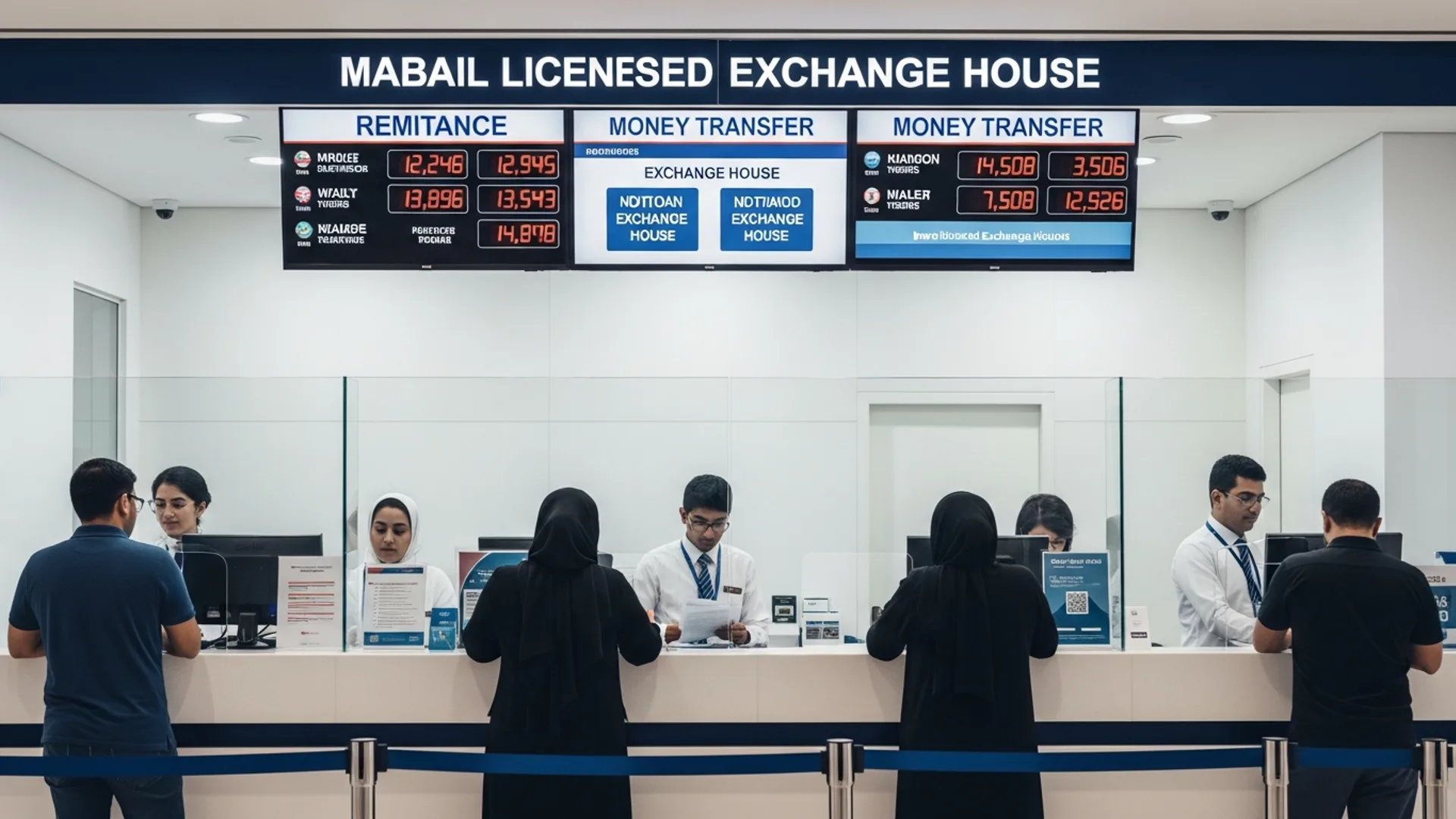
Quick AnswerMoney exchange license UAE 2026: CBUAE capital from AED 2M to AED 50M, remittance and WPS rules, bank guarantee, steps and compliance.
Opening a currency-exchange or remittance business in the Emirates starts with a single controlling permission: a money exchange license UAE authorities issue only through the Central Bank of the UAE (CBUAE). This is one of the most tightly supervised activities in the country, and the capital bar is high. Paid-up capital begins at AED 2 million for pure currency exchange, rises to AED 5 million once you add remittances, reaches AED 10 million to disburse workers' wages, and stands at AED 50 million where the licensed person is a limited liability company.
Those figures are the first thing any serious applicant must internalise, because they shape the entire business case. Add the mandatory bank guarantee, the 10% capital uplift for every branch, and continuous anti-money-laundering obligations, and it becomes clear that an exchange house is a financial institution — not a retail shop. The upside is that this rigour also creates a moat: once licensed and trusted, an exchange house operates in a market with high barriers to entry and durable demand from residents, businesses, and the millions who remit money home each year. This guide sets out the capital tiers, the LLC rule, the guarantees, the application steps, and the ongoing compliance and tax duties, so you can plan a compliant launch rather than discover the requirements the hard way.
Your setup cost, in 10 seconds
Package prices. Health insurance is required by law and not included.
Thank you.
Your written quote follows on WhatsApp.
Do you need a money exchange license in the UAE?
Yes — you cannot buy, sell, or remit foreign currency commercially in the UAE without a money exchange license from the CBUAE. Paid-up capital starts at AED 2 million for pure currency exchange, rises to AED 5 million with remittance and AED 10 million to disburse wages through the Wages Protection System, and reaches AED 50 million for a limited liability company under the Central Bank's rules.
There is no informal route and no "small operator" exemption. Handling other people's money across currencies is precisely the activity the CBUAE was built to supervise, and operating without a licence carries serious consequences. The table below summarises the capital tiers so you can position your intended activities before you spend a dirham on setup.
| Activity tier | What it permits | Minimum paid-up capital |
|---|---|---|
| Currency exchange only | Buy, sell and exchange foreign banknotes, coins and travellers cheques | AED 2 million |
| Exchange plus remittance | Adds money transfers within and outside the UAE | AED 5 million |
| Exchange, remittance and wages | Adds salary disbursement via the Wages Protection System | AED 10 million |
| Limited liability company (LLC) | Any of the above, where the licensee is an LLC | AED 50 million |
| Each additional branch | Extra capital on top of the base requirement | +10% of paid-up capital |
Treat this table as the backbone of your business plan. The activity you choose sets the capital floor; the legal form you adopt can raise it dramatically; and every branch you add compounds it further. Getting the structure right at the start is far cheaper than restructuring after submission.
What a licensed exchange house can and cannot do
An exchange house is defined by a specific, permitted list of activities — and by clear limits on everything else. Understanding the boundary matters, because straying outside your licensed scope is a compliance breach even if the adjacent activity seems harmless.
Within the CBUAE framework, a licensed exchange house may typically:
- Buy and sell foreign currencies in the form of banknotes, coins, and travellers cheques.
- Provide remittance services to send and receive money within and outside the UAE, once it holds the AED 5 million tier.
- Disburse wages for employers by connecting to the Central Bank's system under the Wages Protection System, at the AED 10 million tier.
- Issue and cash certain payment instruments connected to these core services, within the terms of its licence.
What an exchange house is generally not permitted to do is equally important. It cannot take deposits like a bank, it cannot lend, and it cannot offer investment products or hold customer balances as a stored-value wallet without the separate authorisations those activities require. If your plan blends currency exchange with, say, lending or e-wallet features, you are looking at multiple licences — or a different corporate structure altogether. Mapping your intended services precisely against the permitted list is the single most valuable exercise you can do before applying.
Capital requirements by activity tier
The CBUAE structures capital around what you actually do, which is why the four tiers exist. The logic is proportionality: the more risk you introduce — cross-border flows, wage disbursement, larger balances — the more capital you must hold to absorb shocks and protect customers.
At the base, AED 2 million supports a business that only buys, sells, and exchanges foreign currencies in physical form. This is the leanest exchange model, suited to a currency-desk operation serving travellers and residents.
Add remittance — sending and receiving money within and outside the UAE — and the floor rises to AED 5 million. Remittance introduces correspondent relationships, cross-border settlement, and a far larger sanctions and money-laundering surface, which is why the capital roughly doubles.
Add wage disbursement through the Wages Protection System, and the requirement climbs to AED 10 million. Handling the payroll of UAE workers is a socially critical function, so the Central Bank expects a stronger balance sheet behind it. This tier also requires a technical connection to the CBUAE's system so that salary payments are traceable and timely.
Layered on top of all of this is the crucial legal-form rule, which frequently pushes new applicants to the highest tier regardless of the activity they choose — as the next section explains.
The LLC rule: why many new exchange houses need AED 50 million
Here is the point that catches most first-time applicants by surprise. The CBUAE sets paid-up capital at AED 50 million where the legal status of the licensed person is a limited liability company (LLC), regardless of activity. In other words, if you incorporate your exchange house as an LLC — the most common corporate form in the UAE — the AED 50 million figure can apply even if your activities alone would only demand AED 2 million or AED 5 million.
This rule reflects the Central Bank's expectation that exchange houses are substantial, well-capitalised institutions rather than lightly funded start-ups. It also explains why the sector is dominated by established groups: the entry cost is deliberately high to ensure stability, protect remitters, and reduce the risk of financial-crime abuse in a high-cash business.
The practical implication is that your legal structure is a first-order decision, not an afterthought. You must model the interaction between the activity you want to perform and the corporate form you adopt, because the two together determine the capital you must lock away. This is where specialist structuring advice pays for itself many times over — choosing the wrong form can add tens of millions to your capital requirement or, worse, produce a plan the CBUAE will not accept. Always confirm the current requirement directly, as the Central Bank periodically updates its standards.
Bank guarantees and the CBUAE backstop
Capital is not the only financial commitment. Every exchange-house applicant must provide a bank guarantee drawn in favour of the CBUAE, issued by a bank licensed in the UAE. This guarantee is a backstop the Central Bank can call on if the exchange house fails to meet its obligations, adding a second layer of protection for customers on top of the paid-up capital.
The guarantee is sized dynamically. Its value at any point must be at least the higher of 100% of the minimum paid-up capital required, or 5% of the monthly remittance average value of the previous financial year, subject to a maximum of AED 75 million. In plain terms, as your remittance volumes grow, the guarantee grows with them — until it hits the AED 75 million ceiling. A high-volume remittance business will therefore carry a materially larger guarantee than a small currency desk.
For planning purposes, this means your total financial commitment is capital plus guarantee, and both scale with ambition. A founder projecting rapid remittance growth should model the guarantee at the higher, volume-linked level rather than the minimum, so the balance sheet is never caught short. The guarantee must also be kept live and renewed; letting it lapse is a serious supervisory failing.
Branches, expansion and the 10% rule
Growth is not free under this framework. The CBUAE requires paid-up capital to increase by 10% for each additional branch an exchange house opens. A network strategy therefore has a direct, compounding capital cost that must be built into your expansion model from the outset.
Consider the arithmetic. If your base paid-up capital is AED 50 million as an LLC, each new branch adds AED 5 million of required capital. Opening five branches would push the requirement toward AED 75 million on the capital side alone, before considering the parallel growth in your bank guarantee as remittance volumes rise. Expansion, in other words, is a capital-raising exercise as much as a real-estate and hiring exercise.
This rule rewards deliberate, well-funded growth and penalises over-extension. The smartest operators plan their branch roll-out around capital availability and demonstrated demand, rather than racing to plant flags. When you build your five-year plan, model the capital uplift for every planned branch and stress-test whether the network can fund itself — because the Central Bank will expect exactly that discipline.
Costs and capital: a worked planning example
Numbers in isolation are hard to plan around, so consider a realistic scenario. Suppose you want to launch an exchange house offering currency exchange and remittance — but not wage disbursement — as a limited liability company with two branches in year one, in addition to the head office.
Your activity alone (exchange plus remittance) would point to AED 5 million. But because you are an LLC, the AED 50 million rule applies, setting your base paid-up capital at AED 50 million. Two branches beyond the head office add 10% each — AED 5 million per branch — taking required capital to roughly AED 60 million. On top of that sits your bank guarantee, valued at the higher of 100% of minimum capital or 5% of your prior-year monthly remittance average, capped at AED 75 million.
| Planning line | Basis | Indicative figure |
|---|---|---|
| Base paid-up capital (LLC) | AED 50 million rule | AED 50 million |
| Two additional branches | +10% capital each | AED 10 million |
| Total required capital | Base plus branches | AED 60 million |
| Bank guarantee | Higher of 100% capital or 5% remittance average | Up to AED 75 million |
| Operating and compliance costs | Staff, systems, audit, rent | Annual, ongoing |
The lesson is stark: an exchange house is a large-capital undertaking. Before committing, model your capital, guarantee, and operating costs together, and confirm every figure with the CBUAE, because the interaction of legal form, activity, and branch count drives the real number well above the headline minimums. This is compliance and structuring guidance, not investment advice — the aim is simply to help you plan with eyes open.
Step by step: applying for an exchange business licence
The CBUAE application is thorough and evidence-led. While every file differs, the journey below reflects the typical sequence from concept to a live licence, and it usually spans several months.
- Define your activities and tier. Decide whether you will offer currency exchange only, add remittance, or add wage disbursement — and confirm the capital tier and legal-form implications.
- Structure the company. Establish the corporate vehicle, taking specialist advice on legal form and ownership so the AED 50 million LLC rule and control requirements are handled correctly. The emirate-level trade licence comes from the Department of Economic Development, or in Dubai the Department of Economy and Tourism (DET).
- Lock the capital and guarantee. Deposit the paid-up capital with a UAE bank and arrange the bank guarantee in favour of the CBUAE.
- Build the application file. Prepare the business plan, financial projections, ownership and source-of-funds evidence, governance and management structure, and a complete AML and compliance framework.
- Submit fit-and-proper documentation. Provide detailed information on shareholders, directors, and senior managers so the Central Bank can assess their suitability.
- Engage through review. Respond to CBUAE queries on capital, AML systems, technology, and controls, refining the file as required.
- Approval, setup and go-live. On approval — often in-principle first — complete the operational build, connect to required systems such as the WPS if relevant, and begin serving customers under ongoing supervision.
AML, WPS and ongoing compliance
Once licensed, an exchange house lives inside a demanding compliance regime, because cash-based currency and remittance businesses are inherently exposed to money-laundering and sanctions risk. The CBUAE expects institution-grade controls, not box-ticking.
Core obligations include rigorous customer due diligence, ongoing transaction monitoring, sanctions and watch-list screening, record-keeping, and the prompt filing of suspicious-transaction reports through the goAML platform operated by the UAE Financial Intelligence Unit. You will need a qualified, resident compliance officer, a documented AML policy, staff training, and independent audit of your controls. AML supervision in the UAE is coordinated across the Central Bank and the Ministry of Economy for the sectors each oversees, and expectations continue to tighten in line with international standards.
If you offer wage disbursement, you also connect to the Wages Protection System, the electronic salary-transfer mechanism operated in coordination with the Ministry of Human Resources and Emiratisation (MOHRE) to ensure workers are paid the correct amount on time. You can review the labour-side framework via MOHRE. Handling payroll flows adds its own controls and reporting, so treat WPS participation as a serious operational commitment rather than a bolt-on feature.
Technology, records and reporting systems
Modern exchange-house supervision is data-driven, and the CBUAE expects the systems to match. Your operation must capture, store, and report transaction data reliably, retain records for the periods the regulations require, and produce accurate returns on demand. Weak systems are not merely an operational nuisance — they are a compliance failure that can jeopardise your licence.
Practically, you will need robust core software to process exchanges and remittances, integrated sanctions-screening and monitoring tools, secure customer-data handling in line with UAE data-protection expectations, and business-continuity and cybersecurity controls. If you disburse wages, your connection to the Central Bank's system must be reliable and auditable so that salary payments are traceable end to end. The Central Bank also expects periodic prudential and statistical reporting, so your finance function must be able to produce timely, accurate submissions.
Founders sometimes treat technology as a late-stage build, but in this sector it is core infrastructure that the regulator assesses before approval. Budget for enterprise-grade systems and specialist staff, and design your data architecture around reporting and auditability from day one. A licence granted on the strength of a strong systems plan can still be lost if the live operation cannot deliver the monitoring and reporting the plan promised.
Tax and corporate obligations
An exchange licence sits on top of the standard UAE tax framework, and you must register accordingly. The Federal Tax Authority administers corporate tax at 0% on taxable income up to AED 375,000 and 9% above, with registration through the EmaraTax portal and returns due nine months after the financial-year end. Large multinational groups may face the 15% Domestic Minimum Top-up Tax under the OECD Pillar Two rules for financial years starting on or after 1 January 2025.
VAT also applies, at a standard rate of 5%, with mandatory registration once taxable supplies exceed AED 375,000 and voluntary registration from AED 187,500. The VAT treatment of exchange and remittance revenue is nuanced — margin-based currency exchange and certain financial services can be exempt while related fee income may be standard-rated — so map each revenue line carefully. Confirm the current position with the Federal Tax Authority, and note that the Ministry of Finance sets the overarching tax policy the UAE follows. Getting the VAT classification right at launch avoids painful reassessments later. You should also plan for corporate-tax record-keeping, transfer-pricing documentation where relevant to related-party dealings, and clear separation of exempt and taxable revenue streams in your accounting system, so that your first return is straightforward rather than a scramble.
Ownership, management and fit-and-proper standards
Beyond capital and guarantees, the CBUAE scrutinises who owns and runs the business. It expects a clear ownership structure with identifiable ultimate beneficial owners, transparent sources of funds, and shareholders who meet fit-and-proper standards. Senior management and the compliance function must be suitably qualified and, in key roles, resident in the UAE.
Because exchange houses sit at the front line of financial-crime risk, the Central Bank places particular weight on the integrity and competence of controllers. Expect detailed background checks and a genuine assessment of whether your team can run a compliant institution. Ownership conditions in this sector are specialist and can change, so rather than assume a particular structure will be accepted, confirm the current requirements with advisers before you incorporate — restructuring after submission is expensive and slow.
Renewal, supervision and staying compliant
A money exchange licence is not a one-time achievement; it is an ongoing relationship with the Central Bank. Licences must be maintained through continuous compliance, periodic reporting, and cooperation with supervisory reviews and inspections. The CBUAE can examine your books, test your AML controls, and require corrective action, so the standards you demonstrated at application must be sustained every single day thereafter.
Capital adequacy must be preserved at all times — if your position weakens, you are expected to act quickly and transparently to restore it. Your bank guarantee must be kept live and resized as remittance volumes change. Your compliance officer must keep policies, screening lists, and training current, and suspicious activity must be reported without delay. Annual audited financials and prudential returns are part of the rhythm, as are notifications to the regulator of any material change in ownership, management, or business model.
The operators who thrive treat supervision as a partnership rather than a burden. They build a genuine compliance culture, invest in systems and people, and keep open lines with the Central Bank. That posture not only protects the licence — it builds the trust and reputation that let an exchange house grow its correspondent network and customer base sustainably. In a sector defined by trust in the movement of money, compliance is the product as much as the service itself.
Common Mistakes to avoid
Applicants stumble on the same issues repeatedly. Avoid these:
- Ignoring the AED 50 million LLC rule — budgeting for AED 2 million or AED 5 million based on activity alone, then discovering the legal form triggers the top tier.
- Underfunding the bank guarantee — planning only for the minimum rather than the volume-linked 5% figure that scales with remittance turnover.
- Forgetting the 10% branch uplift — building a multi-branch roll-out without funding the compounding capital each new outlet demands.
- Treating AML as an afterthought — bolting on compliance late instead of designing customer due diligence, screening, and goAML reporting from day one.
- Straying outside licensed scope — adding lending, deposits, or wallet features that the exchange licence does not permit.
- Skipping tax registration — overlooking corporate tax and VAT registration with the Federal Tax Authority while focusing only on the CBUAE.
- Weak fit-and-proper documentation — presenting an unclear ownership chain or under-qualified management the Central Bank cannot approve.
- Assuming ownership rules — proceeding on out-of-date ownership assumptions instead of confirming current CBUAE conditions before incorporating.
Set up your exchange house with Noble Core
An exchange-house licence is among the most capital-intensive and compliance-heavy permissions in the UAE, and success depends on getting the structure, capital, and application file right the first time. Noble Core helps founders model the capital tiers, choose the correct legal form, prepare a CBUAE-ready application, and build the company behind it.
We support the wider business setup in Dubai around your licence — from corporate structuring and ownership to substance and management. Because an exchange house depends entirely on strong banking, we help you open a corporate bank account in the UAE and weigh the best business bank accounts for 2026 so your settlement and guarantee arrangements are in place early. We also align your structure with the UAE corporate tax framework so your EmaraTax and VAT registrations are correct from the start.
If you are planning a currency-exchange or remittance business, begin with a conversation. Book a free 20-minute consultation and we will map your capital tier, legal form, guarantee, and timeline — and tell you candidly what your CBUAE application will require.
Talk to Our Experts
Noble Core helps founders structure an exchange house, meet CBUAE capital and ownership rules, prepare the licence file, and set up the company, banking and tax registrations behind it. Free 20-minute consultation.
Frequently Asked Questions
Who regulates money exchange businesses in the UAE?
The Central Bank of the UAE (CBUAE) licenses and supervises all exchange houses under its Regulations Re Licensing and Monitoring of Exchange Business, covering currency exchange, remittances, and wage disbursement.
What is the minimum capital for a money exchange licence?
Paid-up capital starts at AED 2 million for currency exchange, AED 5 million with remittance, AED 10 million to disburse wages, and AED 50 million where the licensee is an LLC.
Why do many exchange houses need AED 50 million?
The CBUAE sets AED 50 million paid-up capital where the licensed person is a limited liability company, regardless of activity. Most modern exchange houses are structured as LLCs.
Do I need a bank guarantee for an exchange licence?
Yes. A bank guarantee to the CBUAE from a UAE-licensed bank is required, valued at the higher of 100% of minimum capital or 5% of monthly remittance average, capped at AED 75 million.
Can an exchange house pay salaries through the WPS?
Yes, with the higher AED 10 million capital tier and CBUAE system connection. The Wages Protection System is operated with MOHRE to ensure workers are paid correctly and on time.
How much capital does each extra branch require?
The CBUAE requires paid-up capital to increase by 10% for each additional branch you open, so a multi-branch network needs materially more capital than a single outlet.
Do exchange houses pay UAE corporate tax?
Yes. Corporate tax applies at 0% up to AED 375,000 and 9% above, administered by the Federal Tax Authority through EmaraTax, alongside VAT registration where thresholds are met.
What AML obligations apply to exchange houses?
Extensive ones. Exchange houses must run customer due diligence, transaction monitoring, sanctions screening, and file suspicious-transaction reports through the goAML platform operated by the UAE Financial Intelligence Unit.
Can foreigners own a UAE exchange house?
Ownership must satisfy CBUAE requirements on capital, control, and fit-and-proper standards. Structuring is specialist work, so confirm the current ownership and management conditions before you commit.
Contact Us For Free Consultation
Licensed UAE consultancy. One reply, no spam.
Thank you.
A consultant will reply on WhatsApp shortly.