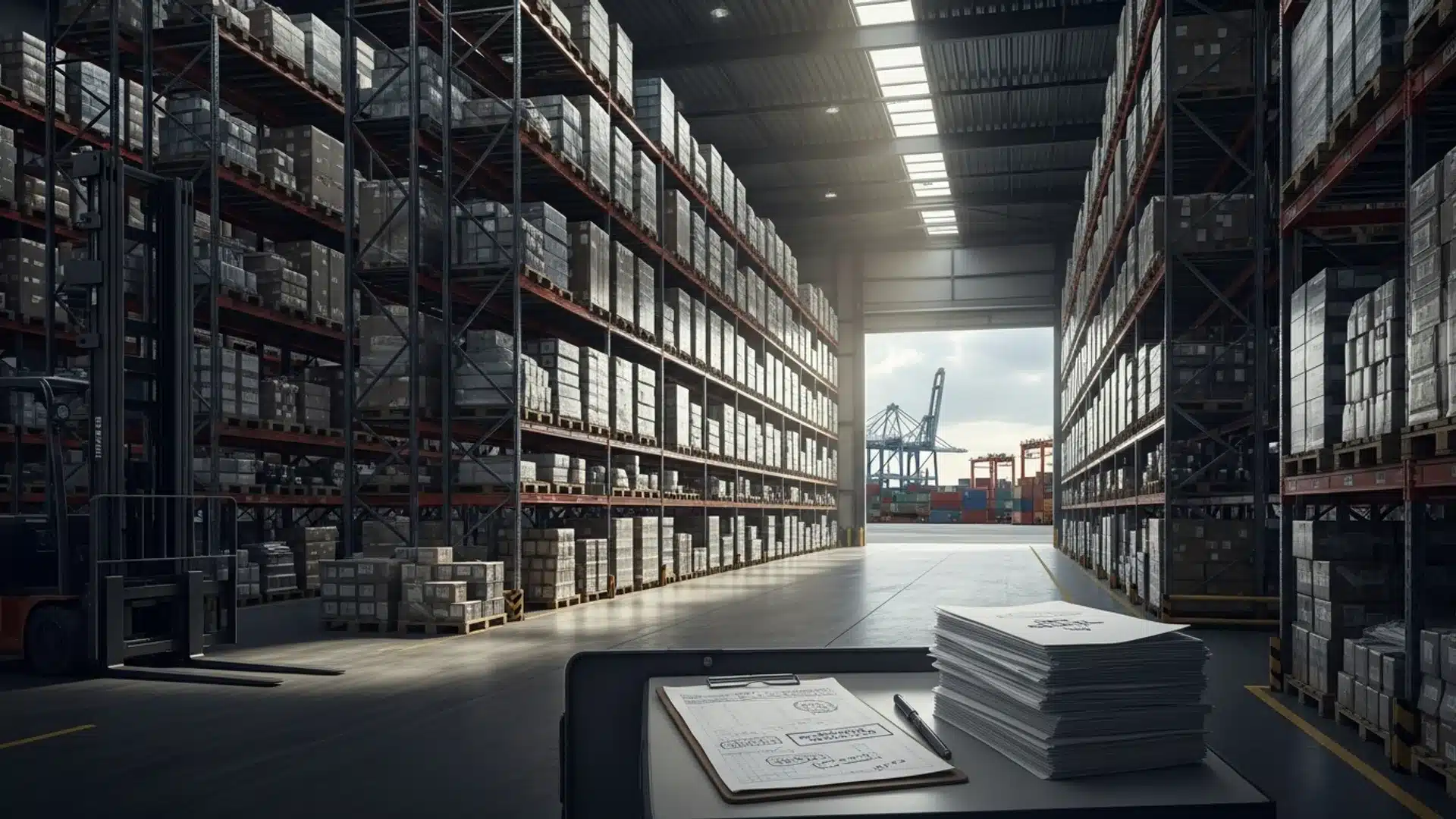
Quick AnswerCustoms duty exemptions UAE 2026: free zones, GCC origin, re-export, industrial inputs, transit. Who qualifies and why 5% VAT still applies.
Understanding customs duty exemptions UAE rules is one of the highest-return pieces of homework a trading business can do, because the difference between structures is measured in working capital rather than in paperwork. The baseline under the GCC Common Customs Law is a 5% common external tariff on the customs value of most imported goods, with 5% VAT applied separately, and corporate tax at 0% up to AED 375,000 of taxable income and 9% above it. On a AED 500,000 consignment, the duty alone is AED 25,000 — recurring, on every container.
Exemptions are not loopholes. They are deliberate features of the system designed to support re-export trade, regional manufacturing, GCC integration and legitimate transit. This guide sets out where each one comes from, who genuinely qualifies, how to evidence a claim, and the single most misunderstood point in the whole area: that duty relief and VAT relief are entirely different questions.
Who qualifies for customs duty exemptions in the UAE?
Relief comes from five main routes: designated free zone storage, GCC origin with a valid certificate, re-export and drawback, industrial inputs for licensed manufacturing, and transit. Each suspends or removes the standard 5% GCC tariff. None of them removes VAT at 5%, which the Federal Tax Authority applies separately to most mainland imports.
That distinction is worth stating twice because it causes more unbudgeted cost than any other misunderstanding in UAE trade. A free zone company can hold stock for two years without paying a dirham of duty and still face a full VAT charge the day that stock moves into the mainland.
| Route | What it does to the 5% duty | What it does to 5% VAT | Key evidence needed |
|---|---|---|---|
| Designated free zone storage | Suspends until mainland entry | Special zone rules; VAT arises on mainland entry | Free zone declarations, stock records |
| GCC origin | Removes for qualifying goods | No effect | Valid GCC certificate of origin |
| Re-export | Refunds or releases the deposit | Export usually zero-rated with evidence | Export declaration, exit proof |
| Industrial inputs | Removes for approved inputs | No automatic effect | Industrial licence, approval, consumption records |
| Transit | Not liable | Not liable | Transit declaration, security, exit confirmation |
| Diplomatic and charitable | Removes | Separate rules apply | Official exemption approval |
| Personal effects | Removes within reason | Not applicable to genuine personal use | Passport, residence evidence, packing list |
| Temporary admission | Suspends for the permitted period | Suspends while conditions are met | Carnet or temporary import declaration |
Every route above shares one requirement: contemporaneous evidence. Customs administrations conduct post-clearance audits, and an exemption you cannot document years later is an exemption you did not have.
Where the 5% baseline comes from and how it varies
The GCC Common Customs Law harmonises tariff treatment across member states, establishing a single external tariff and a customs union in which goods circulate between members without internal duty once they have been cleared. The headline rate is 5% ad valorem on the customs value of most goods, calculated on the cost, insurance and freight value at the port of entry.
Around that baseline sit variations. A small number of categories carry higher protective rates. Certain goods, including tobacco products, attract substantially higher treatment and additional excise. Many basic food staples, pharmaceuticals and some capital goods receive relief or a zero rate. Because the treatment is set by tariff line, the correct instruction to any importer is the same: confirm the treatment of your specific HS codes before you commit to a purchase order. A five-percentage-point assumption error on a container programme is a large number by the end of a year.
Customs value itself deserves attention. It is not the invoice price alone; it is the transaction value adjusted to include freight and insurance to the port of entry, plus certain additions such as royalties or assists in some circumstances. Undervaluation — declaring a lower figure to reduce duty — is the fastest route to penalties, seizure and a permanently elevated inspection profile. Related-party pricing attracts particular scrutiny, and businesses importing from an overseas affiliate should be able to demonstrate that their transfer price reflects a genuine commercial value.
The tariff sits within a policy framework overseen at federal level. The Ministry of Finance is responsible for the fiscal framework in which customs revenue and tax policy operate, and the Ministry of Economy for trade policy and the commercial environment. Operational administration is handled by the customs authority of each emirate, with Dubai Customs the largest by volume. Those emirate-level administrations are the bodies your broker interacts with daily.
Free zones: suspension, not forgiveness
The single most valuable relief available to a UAE trading business is the designated free zone. Goods brought into a designated zone are treated as outside the customs territory for duty purposes. You can land, store, consolidate, repack, label and re-export without duty ever becoming payable.
The critical nuance is in the word suspension. Duty is not forgiven; it is deferred, and it crystallises at the moment goods leave the zone for the mainland market. A free zone entity in DMCC or DAFZA holding AED 5,000,000 of stock has no duty liability while that stock sits in the warehouse. Move AED 500,000 of it to a Dubai retailer, and duty at 5% on that portion becomes payable at the point of mainland entry, along with the applicable VAT.
This structure is genuinely transformative for three business models. Regional distributors serving Africa, the Levant, Central Asia and the wider Gulf can consolidate in Dubai and ship onward without ever touching UAE duty. Businesses with long, unpredictable sales cycles avoid paying duty on stock that may not sell for a year. Companies doing value-adding work such as kitting, assembly or labelling can perform it on duty-suspended goods.
It is a poor fit for a business whose customers are overwhelmingly in the UAE mainland. If ninety percent of your stock will eventually enter the local market, you are deferring rather than avoiding, and you are paying free zone storage costs plus mainland entry procedures for the privilege. A mainland licence from DET with straightforward import clearance is usually cheaper and simpler for that profile.
Designated zones also have their own VAT logic, which is not identical to the customs logic. Supplies within and between designated zones can fall outside the scope of VAT in defined circumstances, but the conditions are specific and the Federal Tax Authority publishes detailed guidance at https://tax.gov.ae/. Assuming that free zone means VAT-free is a costly error; the two regimes overlap but they are not the same map.
GCC origin and preferential arrangements
Goods that genuinely originate in a GCC member state move between members without duty, provided the origin is supported by a valid GCC certificate of origin and the goods satisfy the local value-added requirement. This matters in both directions: it is why a UAE manufacturer can supply Saudi Arabia, Kuwait or Oman competitively, and it is why an importer bringing goods from another member state should not be paying duty at all.
Origin is not the same as shipment. Chinese-origin goods warehoused in Jebel Ali and shipped to Riyadh remain Chinese in origin and attract the 5% common external tariff on entry. Origin is conferred by manufacture or by substantial transformation, tested against value-added and processing rules. Simple repacking, relabelling or splitting a bulk consignment does not confer origin, and claiming otherwise is a serious matter.
Beyond the GCC customs union, the UAE participates in preferential arrangements including the wider Arab free trade framework and a growing programme of bilateral economic partnership agreements. Each has its own origin rules, its own certification requirements and its own product coverage. The practical approach is to check, for your specific product and supplier country, whether a preferential arrangement applies, what certificate is required, and what origin threshold must be met. Where it does apply, the saving is the full duty rate and it recurs on every shipment — comfortably worth the administrative effort.
For businesses considering where to locate production, origin is a strategic variable rather than an administrative one. Establishing manufacturing, assembly or blending in the UAE can convert third-country goods into GCC-origin goods, unlocking duty-free access to a market of considerable size. That decision moves you from a trading licence to an industrial one and brings the Ministry of Economy industrial framework into play, but for the right product the arithmetic is compelling.
Re-export, drawback, transit and temporary admission
Re-export is the classic Dubai trade. Goods are imported, duty is paid or a deposit is lodged, and the goods leave again. Where duty was paid, a drawback or refund mechanism allows recovery on proof of re-export, typically subject to a time limit and to the goods being identifiable as the same goods. Where a deposit was lodged, it is released on the same evidence. Both routes work, and both depend entirely on your ability to demonstrate that what left is what arrived.
Transit covers goods passing through the UAE to a destination elsewhere without entering the local market. Transit goods are not liable to duty, but they are secured — usually by a guarantee — and the security is discharged when exit is confirmed. Cross-stuffing, where cargo is transferred between containers or consolidated in transit, is permitted under supervision but adds documentary steps.
Temporary admission covers goods entering for a defined purpose and period: exhibition goods, professional equipment, machinery for a project, items for testing or repair. Duty is suspended against a deposit, a guarantee or an ATA Carnet, and is discharged on re-export. If the goods stay, the suspension collapses and duty plus VAT plus penalties become payable.
The failure mode across all three is identical and worth internalising: the relief depends on an exit event that must be evidenced at the time. A shipment that leaves without a properly filed export declaration is, from the administration's perspective, a shipment that never left. Build the evidence step into your operational process rather than treating it as accounting cleanup.
Industrial, institutional and personal reliefs
Industrial relief is available to licensed manufacturers on raw materials, components, machinery, spare parts and production inputs used in approved manufacturing. It is not automatic; it requires an industrial licence, an approved list of inputs, and record-keeping demonstrating that the relieved materials were actually consumed in production rather than sold on. Customs administrations audit this, and the arithmetic is straightforward: relieved inputs in must reconcile against finished goods out plus documented wastage. Manufacturers who cannot reconcile face assessments covering the whole relieved volume.
Institutional reliefs cover diplomatic missions, international organisations, military and security imports, and approved charitable and humanitarian consignments. These are granted on official approval rather than on the importer's own claim, and the approval must be in place at the time of import.
Personal effects relief applies to used household goods and personal items accompanying a person relocating to the Emirates, within reasonable quantities and subject to the goods being clearly used rather than new. It is not a mechanism for importing commercial stock, and quantities that look commercial will be treated as commercial regardless of who is carrying them.
Ship stores and aircraft supplies — fuel, provisions and consumables loaded for use in international transport — receive their own treatment, as do certain agricultural, veterinary and basic staple categories that are relieved on policy grounds. Sector regulators including Dubai Municipality for food safety may still impose approvals even where duty is relieved, and it is worth repeating that a duty exemption is never a regulatory exemption.
Duty versus VAT: modelling a real shipment
Consider a AED 500,000 consignment of electronics of Chinese origin, imported by a UAE business. The table below shows how the duty and VAT position changes with the route chosen. Figures use the standard 5% duty and 5% VAT rates and are illustrative of the mechanics rather than a quotation.
| Route | Duty position | VAT position | Cash impact at entry |
|---|---|---|---|
| Direct mainland import for local sale | 5% on AED 500,000 = AED 25,000 | 5% on AED 525,000 = AED 26,250 | AED 51,250, VAT recoverable as input tax if registered |
| Free zone storage, no mainland entry yet | Suspended, AED 0 | Designated zone rules, generally no VAT yet | AED 0 |
| Free zone storage, later mainland release of 20% | 5% on AED 100,000 = AED 5,000 at release | VAT on the released portion | Deferred and proportionate |
| Import then re-export within the permitted period | Deposit lodged, refunded on exit proof | Export commonly zero-rated with evidence | Deposit only, temporarily |
| Pure transit to a third country | Not liable | Not liable | Security only, discharged on exit |
| Same goods but of GCC origin with certificate | Duty removed | VAT unchanged on mainland supply | VAT only |
Three observations follow. First, the free zone route wins decisively on cash flow for anything not destined for immediate local sale. Second, VAT is recoverable for a registered business, so the real cost of the VAT line is timing rather than value — which makes early Federal Tax Authority registration a working-capital decision as much as a compliance one. Third, the duty line is a genuine cost, not a timing difference, unless a relief applies.
Registration thresholds are worth restating: VAT registration is mandatory once taxable supplies exceed AED 375,000, with voluntary registration available from AED 187,500. An importer trading below the mandatory threshold and choosing not to register is absorbing import VAT permanently, which for a goods business is usually the wrong answer.
Claiming, evidencing and surviving an audit
An exemption is claimed on the customs declaration, supported by whatever document establishes entitlement: the certificate of origin, the industrial approval, the free zone declaration, the transit security, the official exemption letter. The declaration is where the claim is made, and the declaration is what an auditor will start from years later.
Build a file per consignment containing the declaration, the commercial invoice, the packing list, the transport document, the entitlement document, and — critically — the evidence of what subsequently happened to the goods. For re-export and transit that means the exit declaration and confirmation. For industrial relief that means the production records linking input to output. For free zone stock that means inventory records showing the goods entering, sitting and leaving.
Post-clearance audits look backwards over several years and they focus on patterns rather than single shipments. Common triggers include a mismatch between declared imports and declared onward movements, industrial relief volumes that do not reconcile with production, free zone stock records with unexplained shrinkage, and origin claims from a supplier country that has no plausible manufacturing base for the product.
If you find an error yourself, disclosing it voluntarily is almost always treated more favourably than waiting for it to be found. The difference between a corrected declaration with duty paid and an audit finding with penalties is large, and the administrative relationship you preserve is worth more than the amount at stake on any single shipment.
Worked example: an electronics distributor rebuilding its structure
A Dubai electronics distributor imports consumer devices from China and sells them across three channels: UAE retailers, regional wholesalers in East Africa, and project customers in Saudi Arabia and Oman. In its first two years it operated a single mainland licence, imported everything through a normal declaration, and paid duty on every container.
Reviewing the numbers, the split turned out to be roughly forty percent local sales and sixty percent onward regional movement. On an annual import value of AED 24,000,000, the business was paying around AED 1,200,000 of duty at the standard 5% rate, of which the portion attributable to re-exported goods was recoverable in principle but was rarely reclaimed because nobody kept the exit evidence in a form the refund process would accept. In practice, several hundred thousand dirhams a year was leaking.
The restructure had three parts. First, a free zone entity was established to hold and consolidate the stock destined for regional customers, so that sixty percent of the import volume never entered the customs territory at all. Duty on that portion stopped being paid and stopped needing to be reclaimed. Second, the mainland entity was retained for local sales and now imports only what it will actually sell in the UAE, releasing stock from the free zone entity as demand materialises rather than clearing a full container up front. Third, the documentary discipline was rebuilt: every outbound movement now generates an export declaration filed at the time, filed against the consignment record, and reviewed monthly.
Two further points emerged from the exercise. The company had been treating its Federal Tax Authority obligations as a compliance chore rather than a cash-flow tool; once the import VAT recovery was properly claimed each period, a further working-capital improvement followed. And a small assembly step it performed on one product line — fitting regional power units and packaging locally — was assessed against the origin rules to see whether it amounted to substantial transformation. It did not, in that case, but the question was worth asking, because had it qualified the Saudi and Omani shipments would have moved without the 5% tariff entirely.
The lesson generalises. The relief that saved this business the most was not an exotic exemption; it was choosing a structure that matched where its goods actually went, and then keeping evidence good enough to prove it.
Common Mistakes with UAE Customs Duty Exemptions
- Confusing free zone duty suspension with duty forgiveness. Duty crystallises on mainland entry. Model the full landed cost of goods you expect to sell locally, not just the free zone position.
- Assuming duty relief means VAT relief. The Federal Tax Authority applies VAT under its own rules. The two systems overlap but are decided separately.
- Claiming GCC origin for warehoused third-country goods. Storage in Dubai does not confer origin. Substantial transformation does, and only with documentation.
- Losing the exit evidence. Re-export refunds, transit discharges and temporary admission closures all depend on an evidenced departure. No declaration, no relief.
- Industrial relief without consumption records. If relieved inputs cannot be reconciled to finished goods, expect an assessment on the entire relieved volume.
- Undervaluing goods to reduce duty. It raises your risk profile permanently, invites examination on every future container, and carries penalties far exceeding the saving.
- Choosing a free zone structure for a mainland customer base. You add storage costs and an extra clearance step to defer a duty you will pay anyway.
- Never checking the actual tariff line. The 5% baseline is a baseline. Confirm the treatment of your own HS codes rather than budgeting on a general assumption.
- Leaving refunds unclaimed. Deposits and drawbacks expire. Assign one person responsibility for closing every open refund file within the permitted window, and review the list monthly.
- Treating a duty exemption as a regulatory pass. Food, electrical, cosmetic and controlled goods still need their sector approvals from bodies such as Dubai Municipality regardless of the duty position.
Structuring for Duty Efficiency with Noble Core
Duty efficiency in the Emirates is a structuring question that has to be answered before stock is ordered, not after. The businesses that pay the least are rarely the ones with the cleverest claims; they are the ones that matched their licence, their warehousing and their origin position to where their customers actually are.
Noble Core works through that with you from first principles. Our guide to the import-export licence in the UAE covers the licence types, the customs code and how mainland and free zone routes differ for a goods business. The declaration mechanics, valuation rules and relief procedures your broker will operate are explained in our walkthrough of how Dubai Customs works, while the systems where declarations, deposits and refunds are actually processed are covered in our guide to the Dubai Trade portal. If the structure itself is the open question, our overview of business setup in Dubai compares mainland and free zone options on cost, visa allocation and market access.
Send us your product list, supplier countries and target customers, and we will model the duty and VAT outcome across the realistic structures before you commit. Free 20-minute consultation.
Talk to Our Experts
Noble Core helps traders choose between free zone and mainland structures, evidence origin correctly, and model duty and VAT outcomes before stock is ordered. Free 20-minute consultation.
Frequently Asked Questions
What is the standard UAE customs duty rate?
The GCC common external tariff is 5% of customs value on most goods. A small number of categories carry higher protective rates, and many basic staples are relieved entirely.
Are free zone imports duty exempt?
Goods held in a designated zone are duty-suspended rather than forgiven. Duty becomes payable if and when the goods enter the UAE mainland market.
Do GCC-origin goods pay duty?
Goods genuinely originating in a GCC member state, supported by a valid GCC certificate of origin and meeting local value-added rules, generally move between members without duty.
Can I reclaim duty on re-exported goods?
Yes, through deposit-and-refund or duty drawback mechanisms depending on the route used. You must evidence the re-export, and refunds take time to process.
Does a customs duty exemption also exempt VAT?
No. Customs duty and VAT are separate systems. VAT at 5% is administered by the Federal Tax Authority and generally applies to mainland imports regardless of duty relief.
Do manufacturers get relief on raw materials?
Industrial entities can obtain relief on raw materials, machinery and production inputs used in licensed manufacturing, subject to approval and to record-keeping showing actual consumption.
What is transit and does it attract duty?
Transit goods pass through the UAE to another destination without entering the market. They are not liable to duty, but they must be secured and evidenced out.
Is there relief for personal effects?
Used personal effects and household goods accompanying a relocating individual are typically relieved within reasonable quantities. Commercial quantities of any item are treated as an import.
How do I evidence an exemption?
Retain the declaration, the supporting certificate or approval, commercial documents, and proof of the goods’ movement. Post-clearance audits can look back years, so keep files complete.
What happens if a claimed exemption is disallowed?
You become liable for the duty, plus any penalties. Voluntary disclosure before an audit finds the error is usually treated far more favourably than a discovery.
Contact Us For Free Consultation
Licensed UAE consultancy. One reply, no spam.
Thank you.
A consultant will reply on WhatsApp shortly.