Quick AnswerSignboard permit Dubai 2026: costs from AED 500, Arabic naming rules, approval steps, fines for unpermitted signs and a full fee table by sign type.
Fixing a sign to a shopfront in Dubai is a regulated act, not a decorating decision. A signboard permit in Dubai is required from Dubai Municipality before any exterior sign is installed, and the permit cost is indicatively AED 500 to AED 2,500 depending on sign type and size — a small number next to the AED 15,000 to AED 80,000 you are likely to spend fabricating and installing a decent illuminated fascia. The reason to get it right is not the fee. It is that an unpermitted sign can be ordered down at your expense, and a sign whose wording does not exactly match your DET trade licence will be rejected after it has already been manufactured.
Two rules cause more re-work than everything else combined: Arabic must appear on the sign and is generally given prominence, and the business name displayed must match the trade name on your licence rather than the shortened brand your designer prefers. "Bella Roma Pizzeria" on the licence cannot become "Bella's" on the fascia. This guide covers every sign type that needs approval, the Arabic and dimensional rules, the full approval sequence including landlord NOCs and approved contractors, an indicative fee table, renewal, enforcement, and how signage interacts with fit-out and Civil Defence work.
What is a signboard permit in Dubai and who needs one?
A signboard permit is Dubai Municipality approval to install exterior signage displaying your business identity. It is mandatory for mainland premises, costs an indicative AED 500 to AED 2,500 in permit fees, is typically valid for one year and renewed with the trade licence, and requires artwork matching your DET trade name exactly, Arabic text, a landlord NOC and an approved signage contractor.
The permit is premises-specific. Three branches mean three permits. Change the sign, change the brand, or move the unit, and you re-apply rather than amend.
| Sign type | Indicative permit fee (AED) | Indicative fabrication + installation (AED) | Typical approval time |
|---|---|---|---|
| Fascia sign (standard shopfront) | 500 – 1,500 | 15,000 – 60,000 | 1 – 2 weeks |
| Illuminated channel-letter fascia | 800 – 2,000 | 25,000 – 80,000 | 1 – 3 weeks |
| Projecting / blade sign | 500 – 1,500 | 6,000 – 20,000 | 1 – 2 weeks |
| Window vinyl / glass graphics | 300 – 800 | 1,500 – 8,000 | 3 – 10 days |
| Directional / wayfinding sign | 300 – 1,000 | 2,000 – 10,000 | 1 – 2 weeks |
| Pylon / totem sign | 1,500 – 4,000 | 40,000 – 150,000 | 3 – 8 weeks |
| Rooftop sign | 2,500 – 8,000+ | 100,000+ | 6 – 12 weeks |
| Temporary promotional banner | 200 – 800 | 500 – 3,000 | 3 – 10 days |
| Vehicle branding (RTA route) | 200 – 700 per vehicle | 1,500 – 8,000 per vehicle | 1 – 3 weeks |
| Sign removal order penalty exposure | Fine plus removal cost | — | — |
All AED figures are indicative market ranges reflecting typical experience, not official published tariffs. Confirm current permit fees with Dubai Municipality and vehicle branding requirements with the RTA before budgeting.
Which signs need approval
The scope is broader than most founders expect. Anything visible from outside the unit that identifies or promotes the business generally needs approval:
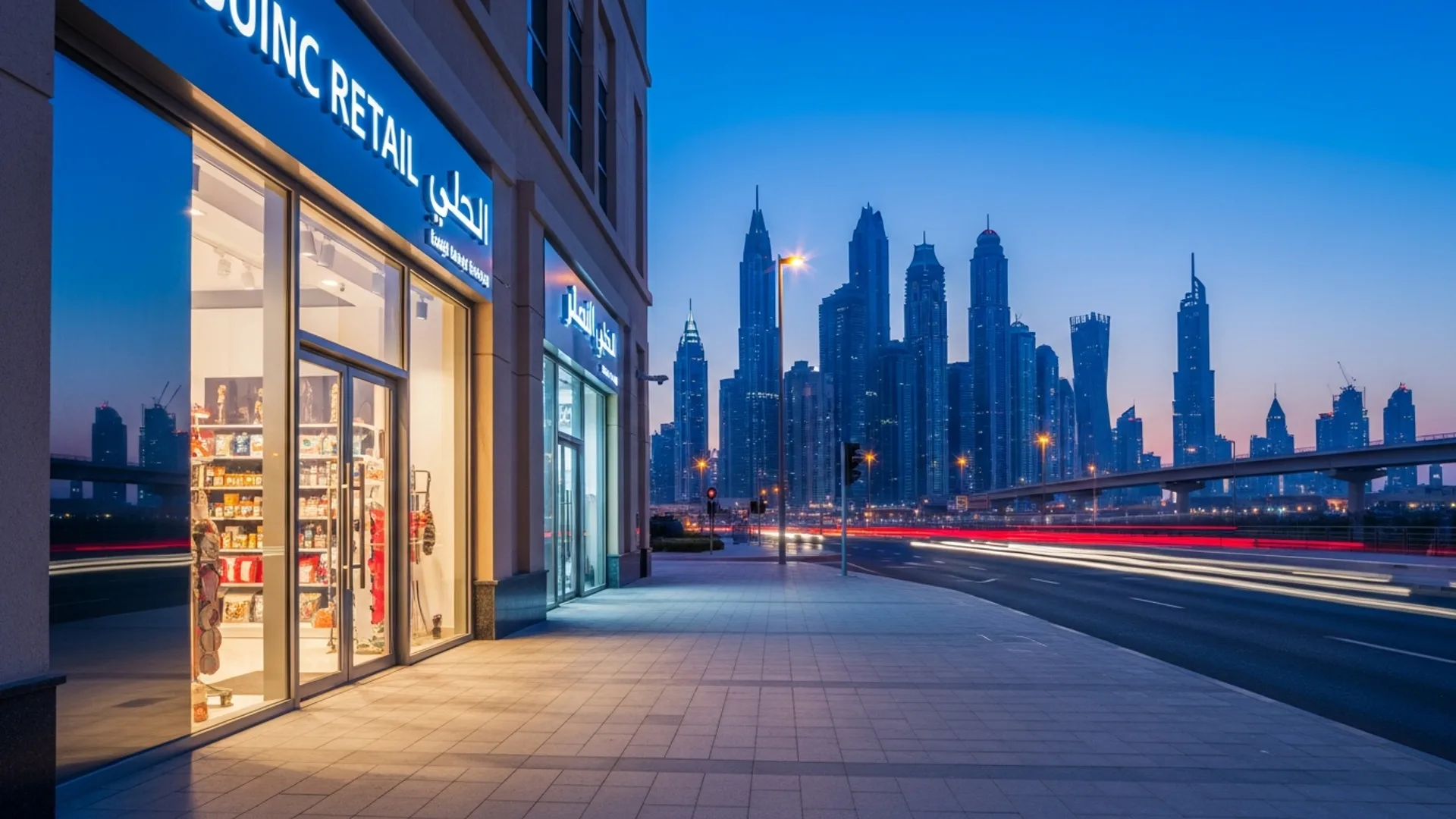
Fascia signs. The main sign above the shopfront. The default requirement for any retail, F&B or customer-facing unit, and the most commonly permitted type.
Projecting or blade signs. Signs mounted perpendicular to the facade, visible along the street. Subject to clearance rules over pavements and often to stricter dimensional limits.
Pylon and totem signs. Free-standing structures, common at showrooms, standalone restaurants and petrol-station-style plots. These are structures, not decoration, and attract structural review.
Rooftop signs. The most heavily regulated category, involving structural engineering, wind loading, illumination limits and — for anything visible from a major road — additional coordination. Timelines run into months.
Window and glass graphics. Vinyl lettering, frosted graphics and full window wraps. Frequently installed without permits by tenants who assume vinyl "doesn't count". It does. Coverage limits also apply, because Dubai Municipality and Civil Defence both have an interest in visibility into the premises.
Directional and wayfinding signage. Entrance markers, parking direction, service entry signs.
Temporary and promotional signage. Opening banners, seasonal promotions, sale signage and pop-up branding. These need temporary permits with defined display periods. "It's only up for two weeks" is not an exemption.
Digital and LED displays. Screens and animated displays face additional restrictions on brightness, animation speed and content, particularly where they face traffic.
Vehicle branding. Livery on company vehicles is regulated through the RTA rather than through the building signage route. Delivery fleets, service vans and branded cars all require the correct vehicle branding permits.
Interior signage visible from outside. A large internal light box positioned against the glazing is, functionally, an exterior sign.
The naming and Arabic rules
This is where artwork most often dies. The core rules:
Arabic is mandatory. Mandatory business identification must appear in Arabic. English is permitted alongside, and bilingual signs are the norm. Arabic is generally expected to be given prominence rather than relegated to small secondary text.
The name must match the trade licence. The trade name registered with DET is the name that goes on the sign. Designers routinely propose a shortened or stylised version — dropping "LLC", dropping a suffix, or using a parent brand rather than the licensed entity. That mismatch is a straightforward rejection and, worse, is often discovered after fabrication.
Transliteration must be correct and consistent. The Arabic rendering of a foreign brand name must be a proper transliteration, and it should be consistent across all your outlets and materials. Ask a native Arabic reviewer to check it before submission; a poor transliteration is both a compliance risk and a brand embarrassment.
No unapproved additions. Slogans, taglines, phone numbers, website addresses, social handles and third-party brand logos on a fascia sign may need explicit approval. Adding a delivery-platform logo or a payment-network mark without approval is a common finding.
Franchise and multi-brand situations need care. If your licensed entity operates a franchised brand, the relationship between the licensed name and the displayed brand must be clear, and the franchise agreement may be requested.
No misleading descriptors. Terms implying regulated activity you do not hold — "clinic", "pharmacy", "bank", "university", "consultancy" in certain contexts — are checked against your licensed activity.
Dimensional, structural and illumination rules
Signage rules exist mostly for safety and streetscape consistency. In practice you will be assessed on:
- Sign area relative to facade width. Signs are expected to be proportionate to the frontage rather than dominating it.
- Height and position. Fascia signs sit within the designated signage band of the building. Signs that stray above the band, onto residential floors, or across architectural features are refused.
- Projection and clearance. Projecting signs must clear the pavement by a safe height and must not project so far as to obstruct pedestrian movement.
- Structural adequacy. Anything substantial requires fixing details, and pylon and rooftop signs require engineering calculations including wind loading.
- Illumination. Internally illuminated channel letters are standard. Exposed neon, flashing or animated illumination, and excessive brightness facing residential windows or traffic, are restricted.
- Electrical safety. Sign power supplies must be properly isolated and installed, and this interfaces with your DEWA connection and Civil Defence requirements.
- Materials. Fire performance of sign materials matters, particularly for signs fixed to a building facade or within a mall.
Malls and managed buildings add a further layer. Mall operators typically impose their own signage manual — permitted depth, illumination type, mounting method, even the typeface treatment — and their approval must be obtained alongside the regulatory one. In a mall, the operator's design review is frequently the harder gate.
Step-by-step: getting a signboard permit approved
Step 1 — Fix the trade name first
Before any design work begins, confirm the exact trade name on the DET licence, including its Arabic form. Design to the licensed name, not to the brand you hope to use. If the licensed name is genuinely unworkable for signage, amend the trade name at DET before you design, not after you fabricate.
Step 2 — Secure the landlord or building management NOC
Anything fixed to a building requires the owner's consent. Obtain a written No Objection Certificate specifying the sign type, dimensions and mounting location. In managed buildings and malls, this stage includes design review against the building's signage manual, and it is the stage most likely to force a redesign.
Step 3 — Prepare the artwork and drawings
A complete submission normally includes: scaled artwork showing Arabic and English text; a facade elevation showing the sign in position with dimensions; a section or mounting detail showing how it fixes; material and illumination specification; a photograph of the existing frontage; and for larger signs, structural calculations.
Step 4 — Appoint an approved contractor
Fabrication and installation must be carried out by a signage contractor registered and approved for the work. Many contractors will make the submission on your behalf as part of their scope, which is usually the efficient route because they already hold the technical documentation. Verify the contractor's registration status before signing — accepting a cheap quote from an unregistered fabricator is one of the most reliable ways to lose both the money and the sign.
Step 5 — Submit and respond to comments
Submit through the applicable Dubai Municipality channel with your trade licence, Ejari tenancy registration, landlord NOC and the drawing set. Respond to comments in full and in one round. Typical first-round comments concern Arabic prominence, name mismatch, dimensions exceeding the signage band, or missing structural detail.
Step 6 — Fabricate only after approval
The discipline that saves the most money: do not release artwork to production until the permit is approved. Fabricating in parallel to save two weeks routinely costs a full re-manufacture.
Step 7 — Install, inspect and file
Install per the approved drawings using the approved contractor. Keep the permit, approved drawings, NOC and contractor details in your premises compliance file alongside your food permit and Civil Defence documentation.
Step 8 — Renew
Signboard permits are commonly annual and are renewed alongside the trade licence. Renewal is simple where nothing has changed. A rebrand, a name change or a physical replacement means a new application.
How signage fits into the wider fit-out programme
Signage is usually treated as the last item and consequently becomes the item that delays opening. Sequence it deliberately:
- Design stage: confirm trade name, obtain building signage manual, design to it.
- Lease signature: negotiate the signage rights and the NOC into the tenancy discussion rather than requesting them afterwards. Tenants who assume a signage position is theirs sometimes discover the landlord has allocated it to another unit.
- Fit-out mobilisation: submit the signboard application in parallel with fit-out permits, not after. Approval time runs alongside construction time at no cost.
- First fix: ensure the electrical supply and fixing substrate for the sign are installed during first fix. Chasing a cable to a fascia after the facade is finished is expensive and ugly.
- Civil Defence coordination: sign materials, illumination and any facade penetration interact with fire and life safety approvals. Raise signage with your Civil Defence consultant early rather than presenting it as a surprise at inspection.
- Pre-opening: install once approved, photograph the completed installation, and file the documentation.
For F&B operators in particular, signage runs alongside Dubai Municipality food approvals and can be submitted in the same window, which is why running licensing, food permits, Civil Defence and signage as one programme rather than four saves weeks.
Enforcement: fines, removal orders and facade reinstatement
Dubai Municipality actively inspects streetscape signage. Enforcement for unpermitted or non-compliant signs typically escalates from a notice with a correction deadline, to an administrative fine, to a removal order, with repeat findings attracting escalated penalties.
The financial exposure is rarely the fine. It is the composite cost of: removing the non-compliant sign, making good the facade where fixings were drilled, re-designing to a compliant specification, re-fabricating, re-installing, and trading in the interim with no sign at all. A retailer who spent AED 45,000 on a fascia that must come down has effectively spent AED 90,000 on signage by the time a compliant replacement is up.
Because published penalty schedules are periodically revised, confirm current amounts directly with Dubai Municipality rather than relying on figures quoted on third-party sites.
Two categories attract disproportionate enforcement attention: temporary promotional signage displayed beyond its permitted period, and window vinyl installed by tenants without any application at all. Both are easy for an inspector to see from the pavement.
Mainland versus free zone: who approves what
Where your premises sit determines who reviews the sign, and founders frequently assume that a free zone address removes the requirement altogether. It does not; it changes the counterparty.
Mainland premises are regulated directly by Dubai Municipality, with the trade licence issued by DET. The route described above applies in full, and the streetscape is actively inspected.
Free zone premises are generally governed by the free zone authority together with the building or park management. A unit in DMCC, IFZA, DAFZA or a similar jurisdiction will have a signage policy issued by the authority or the facility operator, specifying permitted sign types, dimensions, mounting method and, in many towers, a single uniform directory format that leaves very little scope for individual expression. Applications go to the authority rather than to Dubai Municipality, and approval is still mandatory before installation.
The substance is broadly equivalent across both routes: Arabic requirements, a name matching the licence, structural and electrical safety, landlord consent, and use of an approved contractor. What differs is the discretion. Free zone office towers frequently permit nothing more than a standardised suite-entrance plaque and a lobby directory line, which matters commercially if your business model assumed street visibility.
Two mixed situations deserve care. First, a free zone company operating a mainland branch or a customer-facing outlet on mainland premises follows the mainland route for that outlet. Second, signage visible from a public road — even from within a free zone plot — attracts additional scrutiny because road-facing displays engage traffic-safety considerations.
Digital displays and vehicle branding
Digital and LED signage is treated more restrictively than static signage, for obvious reasons. Brightness is limited, particularly at night and where a screen faces residential windows. Animation, video and rapid content changes are constrained where the display is visible to drivers, because anything that draws sustained attention from the carriageway is a road-safety issue rather than a design choice. Content itself may also be reviewed. If a digital facade is central to your concept, raise it at the earliest design stage rather than presenting it as a variation late in fit-out — it is one of the few signage categories where a flat refusal is a realistic outcome.
Vehicle branding follows a separate route through the RTA rather than the building signage process. Delivery fleets, service vans, branded cars and food trucks all require the appropriate vehicle-related permits, and the rules cover the extent of coverage, reflective and illuminated elements, and the requirement that branding corresponds to the licensed business. Operators launching a delivery arm often budget for the wraps and forget the permits, then discover the issue when a vehicle is stopped.
VAT and corporate tax treatment of signage spend
Signage is a taxable supply of goods and services. Fabrication and installation invoices are standard-rated at 5% VAT, recoverable as input tax where your business is registered with the Federal Tax Authority and making taxable supplies. Registration is mandatory above AED 375,000 in taxable supplies and voluntary above AED 187,500. Permit fees charged by a government authority follow their own treatment; take advice rather than assuming.
For corporate tax, the distinction that matters is capital versus revenue. A permanent illuminated fascia forming part of the fit-out is generally capital expenditure, recovered over its useful life through depreciation in the accounts and treated accordingly for tax. A temporary promotional banner for a two-week campaign is ordinary marketing expenditure deductible in the period. Corporate tax applies at 0% up to AED 375,000 of taxable profit and 9% above, registered through EmaraTax with returns due nine months after the financial year end.
Keep signage invoices separated in your ledger between capitalised installation and expensed promotional work from day one. Reconstructing the split two years later during a review is tedious and rarely favourable.
Worked example: a retail unit on Sheikh Zayed Road
A specialist retailer takes a 1,400 sq ft ground-floor unit in a managed tower on Sheikh Zayed Road.
Design stage. The licensed trade name is longer than the brand the founders use day to day. Rather than risk a mismatch, they amend the DET trade name at licence renewal so the licence and the intended fascia wording align. A native Arabic reviewer signs off the transliteration.
Building approval. The tower's management issues a signage manual permitting only halo-lit channel letters of a maximum depth, mounted on a specified backing rail. The original design — a full illuminated light box — is rejected at this stage, before any regulatory submission. The design is revised and the NOC is issued.
Submission. The appointed contractor, registered for signage work, submits the artwork, elevation, mounting detail and material specification with the trade licence, Ejari and landlord NOC. One comment is returned asking for greater Arabic prominence; the layout is adjusted and approved in the second round.
Programme. Because the application ran in parallel with fit-out, the sign was approved before first fix completed, and the power supply and backing rail were installed during construction rather than retrofitted.
Indicative cost. Permit fee AED 800–2,000. Design and Arabic adaptation AED 2,000–5,000. Fabrication and installation of a halo-lit channel-letter fascia AED 30,000–70,000. Window vinyl permit and production AED 1,800–8,800. Total indicative AED 34,600 to AED 85,800, of which the permits themselves are around 3%.
The lesson is that permit fees are a rounding error and the real risk sits in the two decisions taken before any submission: the exact name and the building's own design rules.
Common Mistakes With Signboard Permits in Dubai
- Fabricating before approval. Releasing artwork to production to save two weeks routinely costs a full re-manufacture when the permit comes back with comments on Arabic prominence or dimensions.
- Using the brand name instead of the licensed trade name. The name on the sign must match the DET licence. Dropping a suffix or shortening the name for aesthetics is a guaranteed rejection.
- Treating Arabic as an afterthought. Arabic is mandatory and is expected to carry prominence. Squeezing it in as small secondary text at the end of the design process produces an unbalanced sign and a rejection.
- Assuming window vinyl does not need a permit. Glass graphics are signage. Tenants install them without any application constantly, and they are the easiest violation to spot from the pavement.
- Skipping the landlord or mall design review. Building signage manuals are often stricter than the regulatory rules, and discovering them after fabrication forces a complete redesign.
- Appointing an unregistered contractor. A cheap quote from a fabricator not approved for signage work means the submission fails and you pay twice.
- Leaving promotional banners up past their permitted period. Temporary permits have defined display windows, and expired banners are actively enforced.
- Forgetting the electrical first fix. Sign power routed after the facade is complete is expensive, visible and sometimes impossible without damaging finished work.
Getting Your Signboard Permit Right With Noble Core
A signboard permit is a cheap approval attached to an expensive object. Everything that goes wrong goes wrong before submission — the wrong name, an unreviewed Arabic transliteration, a building signage manual nobody read, or a fabricator who was never registered. Fix those four things and the permit itself is routine.
Noble Core Ventures runs signage as part of the wider Dubai Municipality approvals programme. We check your artwork against your licensed trade name before design is finalised, review the Arabic, obtain the landlord or mall NOC, coordinate an approved signage contractor, prepare and submit the drawing set, and manage comments so the permit lands while fit-out is still running rather than after it.
For food and beverage operators, signage sits alongside food permits, kitchen layout approval and Civil Defence work — our guide to the restaurant licence in Dubai sets out how to run all four as a single programme. If you are still choosing structure and jurisdiction, start with business setup in Dubai, and confirm the exact trade name and activity you need in our Dubai business licence directory — because the name on your licence is, quite literally, the name that will appear above your door.
Book a free 20-minute consultation and we will review your proposed signage against your licence, your building's rules and Dubai Municipality requirements, and give you a realistic cost and programme before you commission a single panel.
Talk to Our Experts
Noble Core Ventures handles signboard permits in Dubai end to end — artwork and Arabic naming compliance, landlord NOCs, approved contractor coordination, Dubai Municipality submission and renewals alongside your DET trade licence. Free 20-minute consultation.
Frequently Asked Questions
Do I need a permit for a shop sign in Dubai?
Yes. Any exterior sign displaying your business identity requires a signboard permit from Dubai Municipality before installation, including fascia signs, window vinyl and directional signage.
How much does a signboard permit cost?
Permit fees are indicatively AED 500 to AED 2,500 depending on sign type and size. Fabrication and installation are separate and typically cost far more than the permit itself.
Must my sign be in Arabic?
Yes. Arabic must appear and is generally given prominence. English may appear alongside. The name shown must match your DET trade licence name exactly, not a marketing abbreviation.
How long does approval take?
A complete submission with correct artwork, NOCs and drawings is often approved within one to two weeks. Complex, rooftop or road-facing signage takes longer and may need extra clearances.
Can I use any signage company?
No. Fabrication and installation must be carried out by a contractor registered and approved for signage work. Using an unregistered contractor is a common cause of rejection.
What happens if I install without a permit?
Dubai Municipality can issue fines and removal orders. You bear the cost of removal, any reinstatement of the facade, and re-fabrication of a compliant replacement sign.
Do free zone businesses need a permit?
Free zone premises are usually governed by the free zone authority and building management rather than Dubai Municipality, but approval is still required. The standards are broadly equivalent.
Is a landlord NOC required?
Almost always. Building owners or management companies must consent to anything fixed to the facade, and Dubai Municipality expects to see that consent in the file.
How long is a signboard permit valid?
Permits are commonly issued for one year and renewed alongside the trade licence. Renewal is straightforward if the sign, artwork and trade name are unchanged.
Is VAT charged on signage work?
Yes. Signage fabrication and installation are standard-rated at 5% VAT, recoverable as input tax by a business registered with the Federal Tax Authority making taxable supplies.
Contact Us For Free Consultation
Licensed UAE consultancy. One reply, no spam.
Thank you.
A consultant will reply on WhatsApp shortly.