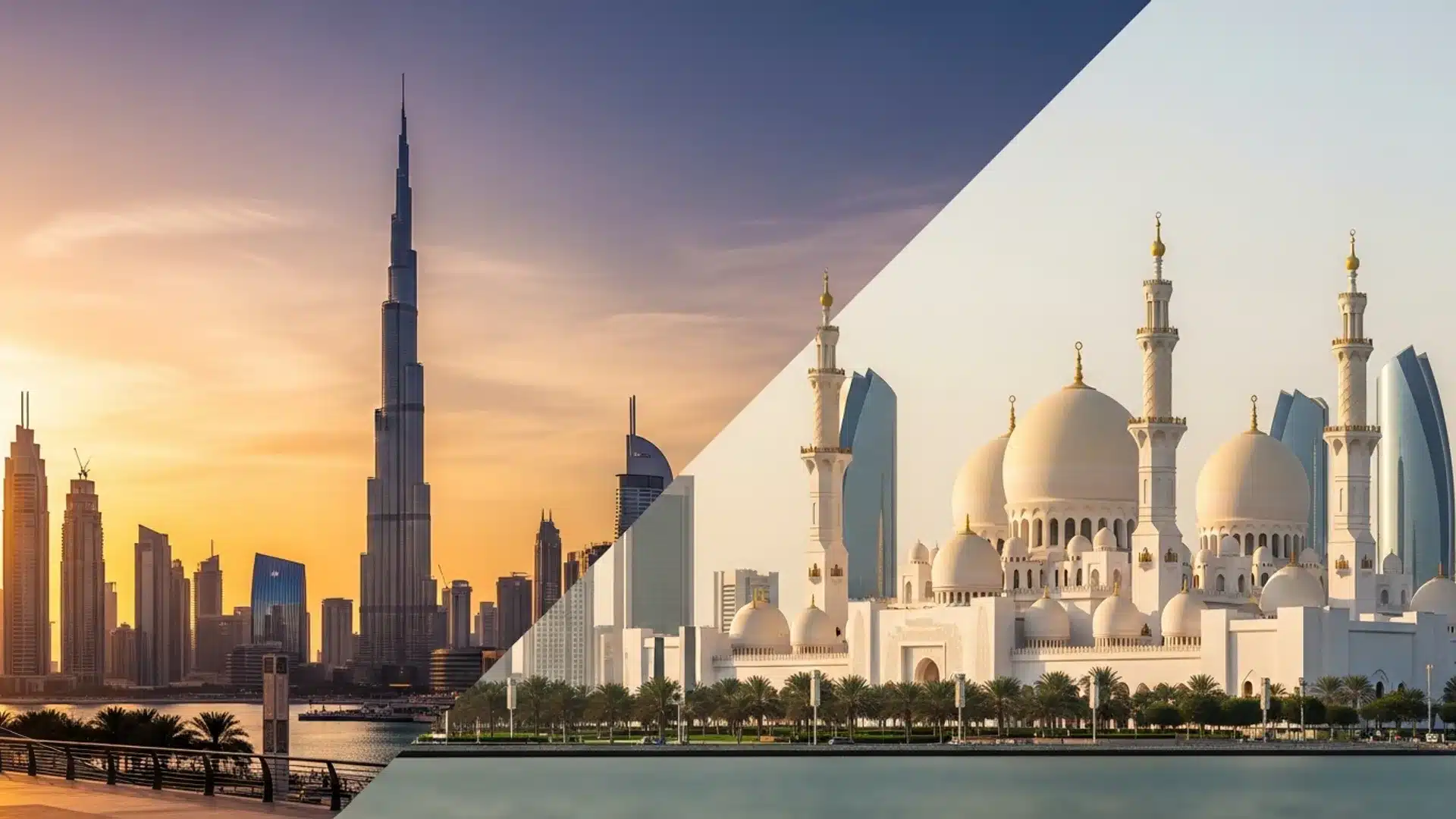
Quick AnswerDubai vs Abu Dhabi business setup compared for 2026: cost, free zones, sectors and ecosystem. A founder’s guide to choosing the right emirate.
Dubai vs Abu Dhabi business setup in 2026 — the short answer
For most founders weighing Dubai vs Abu Dhabi business setup in 2026, Dubai is the stronger choice for trading, e-commerce, media, logistics and consumer-facing companies that want global connectivity and a deep talent pool, while Abu Dhabi is the stronger choice for finance, fintech, energy, advanced technology, deep tech and government-linked work. Both sit inside the same federal UAE framework, share the same corporate tax regime administered by the Federal Tax Authority, and both offer 100% foreign ownership in their free zones. Entry-level free zone packages in both emirates land in broadly similar AED ranges, so the decision is driven less by raw cost and more by where your customers are, which sector incentives apply, and which ecosystem accelerates your first year of revenue. Dubai is regulated onshore by DET; Abu Dhabi's headline financial free zone is ADGM. Always confirm current figures with the relevant authority before you commit.
This guide is a decision framework, not a price sheet. It is built to sit alongside our deeper jurisdiction guides rather than repeat them, so you can use it to choose an emirate first and then dive into the mechanics. If you already know you want Dubai, our Dubai business setup guide walks through the mainland and free zone mechanics in detail, and our Dubai free zones guide compares the individual zones. If Abu Dhabi is on your shortlist, our Abu Dhabi free zone license cost guide covers the numbers there. What follows is the layer above all of those: how to decide which emirate fits the business you are actually building.
Why this is the wrong question to ask in isolation
Founders often arrive at the Dubai-versus-Abu-Dhabi question expecting a single winner, as if one emirate is objectively better than the other. That framing leads to bad decisions. The UAE is a federation, and at the federal level the two emirates share far more than they differ. The currency is the same dirham, pegged to the dollar. Corporate tax is a federal regime under the Ministry of Finance and collected by the Federal Tax Authority, so the headline rate does not change when you cross the emirate line. VAT at the standard 5% rate applies nationwide. Labour rules for mainland staff flow through MOHRE on a federal basis, and residence visas are processed through federal immigration via ICP and GDRFA regardless of which emirate licensed your company. Even the customs union means goods moving between the two emirates are not treated as imports.
So the real question is not which emirate is better in the abstract. It is which emirate is better for your specific business, given your sector, your customers, your hiring plans, your capital needs and the way you want to live while you build. A logistics company importing consumer goods for regional distribution will reach a very different conclusion than a fintech founder raising a seed round, and both can be right. The honest answer is that the gap between the two emirates has narrowed considerably over the past few years. Abu Dhabi has invested heavily in becoming a credible alternative to Dubai for high-value sectors, and Dubai has continued to deepen its lead in trade and consumer markets. The decision is now a matter of fit, not a matter of one place being a clear mistake.
That said, fit matters enormously, and choosing the wrong emirate for your model can cost you years. A consumer brand that sets up in the wrong location can find itself far from its customers and talent. A regulated financial firm that picks the wrong jurisdiction can find it cannot get the license it needs at all. The rest of this guide breaks the decision into the dimensions that actually move the needle.
The regulatory landscape: DET in Dubai, ADGM and others in Abu Dhabi
Understanding who regulates what is the foundation of this comparison, because the authority you deal with shapes everything from your license activities to your legal recourse. In Dubai, mainland companies are licensed and regulated by DET, the Department of Economy and Tourism, which carries forward the function historically associated with the DED. When you set up a mainland trading or services company in Dubai, your trade license, activity codes and renewals run through DET. Dubai also hosts dozens of free zones, each with its own authority, such as DMCC for commodities and general trade, DAFZA at the airport, and IFZA as a popular cost-efficient option for SMEs. Each free zone issues its own licenses and sets its own packages, while still operating inside the federal system for tax and immigration. You can read about the official mandate of the Dubai authority directly at DET.
Abu Dhabi's structure is different in an important way. Its headline free zone for high-value services is ADGM, the Abu Dhabi Global Market, located on Al Maryah Island. ADGM is unusual because it operates under English common law with its own independent courts and its own financial regulator, which makes it especially attractive to fund managers, fintech firms, family offices and professional services that want a familiar legal environment. This is a genuine point of difference: an English common-law framework with dedicated commercial courts is something Dubai matches mainly through DIFC, its own financial free zone, rather than through DET-regulated mainland activity. Abu Dhabi also operates broader-economy free zones, including KEZAD for industrial and logistics activity, twofour54 for media and creative businesses, Masdar City for clean technology, and the Hub71 ecosystem for startups, which sits within the ADGM environment and channels founders toward capital and mentorship.
For mainland activity in Abu Dhabi outside these free zones, the emirate has its own economic department handling onshore commercial licensing, the counterpart to Dubai's DET. The practical takeaway is that Dubai gives you a very wide menu of free zones plus a large, mature mainland regulated by a single recognisable authority, while Abu Dhabi gives you a smaller but highly specialised set of zones, anchored by an internationally credible common-law financial centre in ADGM. If your business is finance, funds, fintech or anything that benefits from a common-law court system and a tier-one financial regulator, that single fact may decide the question for you before you even look at cost.
Cost: closer than the reputation suggests
The stubborn myth is that Abu Dhabi is dramatically cheaper or, conversely, that Dubai is always the budget option. Neither is reliably true in 2026. For a straightforward single-shareholder free zone company with one or two visas, entry-level packages in both emirates tend to land in broadly comparable AED ranges once you account for the license fee, the establishment card, basic visa allocation and a flexi-desk or virtual office. Dubai's advantage on cost is breadth rather than absolute floor: because Dubai hosts so many competing free zones, there is almost always a low-cost option such as IFZA fighting for SME business, which pushes entry prices down through sheer competition. Abu Dhabi's free zones are fewer in number, so you see less of that race-to-the-bottom dynamic, but the emirate frequently counters with sector-specific incentives, grants, subsidised office space and ecosystem support, particularly for technology, finance and sustainability companies it wants to attract.
Where costs genuinely diverge is at the higher end and in specialised licensing. A regulated financial services license inside ADGM carries application, regulatory and ongoing supervision costs that are in a different category from a simple trading license, but those costs buy you a regulated status that you cannot obtain from a general free zone at any price. Similarly, industrial and warehousing setups in Abu Dhabi's KEZAD can be very competitive on land and utility costs given the scale of available space, which can tilt the maths for manufacturers and heavy logistics players. Office rents, staff accommodation and general operating costs have historically run a little lower in Abu Dhabi than in prime Dubai districts, though this varies by area and has narrowed.
The mistake is to choose an emirate on the headline license fee alone. The license is often the smallest line in your first-year budget once you add visas, office space, the bank account process, deposits and operating costs. A few thousand dirhams of difference in the license fee is irrelevant if one emirate puts you next to your customers and the other adds a daily commute or a weaker talent pool. Treat cost as a tiebreaker between otherwise-equal options, not as the primary axis. And because published packages change and promotional pricing comes and goes, confirm current figures directly with the specific free zone authority or with an advisor before you build a budget around any number you read online, including the ranges in this guide. For the Dubai numbers in depth, lean on our Dubai free zones guide, and for Abu Dhabi, the Abu Dhabi free zone license cost guide carries the current detail.
Sector fit: where each emirate genuinely shines
The single most useful way to choose between Dubai and Abu Dhabi is to ask which one is built for your sector, because the ecosystems have specialised in different directions and that specialisation compounds over time.
Trade, e-commerce, retail and consumer brands
Dubai is the natural home for anything that buys, sells, moves or markets physical and digital goods to consumers. Its position as a re-export hub, the scale of Jebel Ali port, the density of logistics infrastructure and the sheer volume of consumer spending make it the default for trading companies, e-commerce operators, retail brands, food and beverage concepts and consumer-facing services. The depth of the supplier base, the availability of fulfilment and last-mile partners, and the marketing and creative talent pool all reinforce the advantage. If your model depends on reaching a large, diverse, high-spending consumer population and on moving goods efficiently, Dubai's ecosystem is hard to beat, and the breadth of its free zones means you can usually find a license structure that matches your activity precisely.
Finance, fintech, funds and family offices
This is Abu Dhabi's strongest card, and it is largely about ADGM. The combination of an English common-law legal system, dedicated commercial courts, an internationally respected financial regulator and a concentration of institutional capital, including sovereign wealth, makes Abu Dhabi the more credible base for fund managers, asset managers, fintech firms, payment companies and family offices that need regulated status and want to sit close to capital allocators. Hub71 adds an early-stage layer, funnelling startups toward investors and giving technology founders a community and incentive package. Dubai competes seriously in this space through DIFC, so the contest is real, but if your business is regulated finance or you are raising from institutional UAE capital, Abu Dhabi deserves a very serious look.
Technology, deep tech, energy and sustainability
Abu Dhabi has deliberately positioned itself at the frontier of advanced technology, artificial intelligence, energy and clean tech. Masdar City anchors the sustainability and clean-energy cluster, the emirate's investment in compute and research draws deep-tech founders, and its long-standing energy sector creates demand and partnership opportunities for companies in oil, gas, renewables and the wider energy transition. If your company sits in energy, climate, advanced manufacturing, AI infrastructure or research-heavy deep tech, Abu Dhabi's ecosystem and capital are increasingly aligned with you. Dubai is no slouch in technology, with strong programs of its own, but the gravitational pull of energy and frontier-tech capital is stronger in Abu Dhabi.
Media, creative and professional services
Both emirates compete here. Dubai offers scale, a large creative talent pool and a dense network of agencies, production houses and media companies. Abu Dhabi offers twofour54, a focused media free zone with production incentives and rebates designed to draw content and creative businesses. Professional services such as consultancy, legal advisory and accounting can thrive in either, though regulated professional services tied to finance often gravitate toward ADGM, while general consultancies frequently choose Dubai for its client density and the convenience of operating where most regional headquarters sit.
Industrial, manufacturing and logistics
Abu Dhabi's KEZAD is a serious contender for manufacturers and heavy logistics operators thanks to the scale of available industrial land, competitive utility costs and integrated port and logistics infrastructure. Dubai counters with Jebel Ali and a mature industrial base of its own. For light manufacturing and assembly close to consumer markets, Dubai often wins on proximity; for large-footprint industrial operations where land and energy costs dominate, Abu Dhabi's KEZAD can be compelling.
Ecosystem, talent and connectivity
Beyond sector fit, the surrounding ecosystem shapes how fast you can hire, raise and grow. Dubai's headline advantage is connectivity and density. It is one of the most globally connected cities on the planet, with an airport network that puts most of the world within a single flight, an enormous expatriate population that supplies talent across every function, and a critical mass of regional headquarters that makes it easy to find partners, suppliers, advisors and customers without leaving the city. For a founder who values speed, optionality and the ability to staff up quickly across many disciplines, Dubai's ecosystem reduces friction at almost every turn.
Abu Dhabi's ecosystem is more curated and capital-rich. It is the seat of federal government and home to substantial institutional and sovereign capital, which matters enormously if your growth depends on large investment, government partnerships or public-sector contracts. The talent pool is deep in finance, energy, technology and government-adjacent fields, and the presence of major universities and research institutions feeds the deep-tech and knowledge economy. Abu Dhabi can feel less frenetic and more relationship-driven than Dubai, which suits founders building businesses where trust, regulatory standing and long-term institutional relationships matter more than speed and volume. Hub71 in particular has built a genuine startup community with capital, mentorship and subsidised costs that can meaningfully extend a young company's runway.
Connectivity within the UAE links the two anyway. The roughly ninety-minute drive between the cities, a single domestic market and integrated infrastructure mean that choosing one emirate does not wall you off from the other. Many founders build in one and serve the whole country, and a growing number maintain a presence in both once they reach scale.
Lifestyle and the human factors
The decision is not purely commercial, because where you set up is also where you and your team are likely to live, and lifestyle affects hiring and retention. Dubai offers an intense, cosmopolitan, fast-paced environment with an enormous range of housing, schools, dining and entertainment, a vast international community and a reputation that helps when recruiting talent from abroad. For many expatriate professionals, Dubai is simply the more familiar and immediately attractive destination, which can make it easier to convince a key hire to relocate.
Abu Dhabi offers a calmer, more spacious and family-oriented environment, often with more competitive housing costs, strong schools and cultural institutions, and a quieter pace that many professionals and families come to prefer. For founders whose teams value space, lower congestion and a less frenetic rhythm, Abu Dhabi can be a genuine advantage in attracting and keeping senior people. Neither is better in the abstract; they appeal to different temperaments. The practical point is to consider where your key people, including you, will want to live for several years, because that decision quietly drives recruitment, retention and your own sustainability as a founder. Both emirates are safe, well-served and welcoming, and both respect the cultural framework of the UAE that founders should honour in how they operate and present their businesses.
A practical decision framework
To turn all of this into a decision, work through it in a deliberate order rather than starting from cost. First, locate your customers and partners. If your first two years of revenue clearly sit in consumer trade, retail, e-commerce, media or general services across the region, Dubai's density and connectivity usually win. If your revenue depends on regulated finance, institutional capital, energy, government-linked contracts or deep tech, Abu Dhabi's specialised ecosystem and capital often win. Second, check whether your activity requires a specific regulated license, because a regulated financial firm may simply need ADGM, which ends the debate. Third, map your talent needs and ask which city makes it easier to hire the specific people you need. Fourth, layer in lifestyle, because where your team wants to live affects retention. Only then bring in cost as a tiebreaker between options that are otherwise close.
It also helps to think in terms of your next round of growth rather than only your launch. A company that expects to raise institutional capital within two years should weigh proximity to that capital heavily today. A company that expects to scale a consumer brand across the region should weigh logistics and talent depth. And remember that the choice is reversible at a cost: you can add a branch in the other emirate later, set up a second entity, or in defined cases re-domicile between certain free zones, as ADGM permits in some situations. That reversibility should lower the stakes of the initial decision and free you to choose the emirate that shortens your path to your first cohort of paying customers, rather than agonising over a permanent commitment that is not actually permanent.
If after this framework you lean toward Dubai, move into the mechanics with our Dubai business setup guide, which covers the mainland-versus-free-zone choice, activity codes and the DET process in detail. If you lean toward Abu Dhabi, our Abu Dhabi free zone license cost guide takes the numbers further. This page is intended to get you to the right emirate; those guides get you to the right structure inside it.
Common Mistakes to Avoid
The most common and most expensive error is choosing the emirate on headline license cost alone. As covered above, the license fee is usually a small slice of your first-year spend, and a marginally cheaper license in the wrong location can cost you far more in lost proximity to customers, weaker talent access or a longer commute for your team. A second frequent mistake is assuming corporate tax differs between the emirates; it does not, because tax is a federal regime under the Federal Tax Authority and the Ministry of Finance, and the rate is the same whether you license in Dubai or Abu Dhabi. A third error is regulated firms trying to operate from a general free zone that cannot grant the license they need, when ADGM or DIFC was the only viable route from the start. A fourth is ignoring the question of where founders and key staff will actually live, then struggling with retention. A fifth is over-committing to one emirate as if the decision were permanent, when adding a branch or a second entity later is a well-trodden path. The final mistake is budgeting from outdated or promotional figures found online instead of confirming current numbers directly with the relevant authority before you commit any money.
Bringing it together
The Dubai versus Abu Dhabi decision is real, but it is a question of fit rather than of one emirate being a mistake. Dubai rewards companies that thrive on global connectivity, trading depth, consumer reach and a vast, fast-moving talent pool, all regulated onshore by DET and supported by a wide menu of competitive free zones. Abu Dhabi rewards companies in finance, fintech, energy, deep tech and government-linked work, anchored by the common-law credibility of ADGM and the gravitational pull of institutional capital. Both sit inside the same federal framework, share the same currency and corporate tax regime under the Federal Tax Authority, offer 100% foreign ownership in their free zones, and remain easy to bridge given the short distance and single domestic market between them. Choose the emirate that shortens your path to paying customers, confirm current costs with the authority before you commit, and treat the decision as a starting structure you can extend rather than a permanent one-way door.
At Noble Core Ventures, we help founders make exactly this call, matching your sector, budget, client base and visa needs to the right emirate and then to the right license structure within it, whether that means a DET mainland company in Dubai, a Dubai free zone, or an ADGM or other Abu Dhabi setup. If you are weighing the two, we will map your first two years of revenue to a location, confirm the current figures with the relevant authority, and build you a clear, honest setup plan with no wasted dirhams.
Talk to Our Experts
Choosing between Dubai and Abu Dhabi for your company setup, matched to your sector, budget, client base and visa needs
Frequently Asked Questions
Is it cheaper to set up a business in Dubai or Abu Dhabi in 2026?
For most small and mid-sized companies, entry-level free zone packages in Dubai and Abu Dhabi land in broadly similar AED ranges, so neither emirate is automatically cheaper. Dubai has a wider spread of low-cost options because of intense free zone competition, while Abu Dhabi sometimes offers incentives and grants for priority sectors. Always confirm current figures directly with the authority before budgeting.
Which is better for a startup, Dubai or Abu Dhabi?
It depends on your sector and client base. Dubai suits trading, e-commerce, media, logistics and consumer-facing startups that want a deep talent pool and global connectivity. Abu Dhabi suits fintech, financial services, energy, advanced technology, deep tech and government-linked work, especially through ADGM. Many founders pick the emirate where their first ten customers actually are, then expand to the other later.
Can a Dubai company do business in Abu Dhabi, and vice versa?
Yes. A company licensed in one emirate can usually trade with clients across all seven emirates, since the UAE is a single federal market for most commercial purposes. The nuance is physical presence and government contracts: serving Abu Dhabi government entities or opening a physical branch there can require local registration or a branch license. Confirm sector-specific rules before signing contracts.
What is the difference between DET and ADGM?
DET, the Department of Economy and Tourism, is Dubai’s mainland economic regulator and successor to the former DED function, issuing mainland trade licenses and regulating onshore commercial activity in Dubai. ADGM, Abu Dhabi Global Market, is a financial free zone with its own English common-law courts and an independent regulator. DET governs general Dubai mainland business, while ADGM specialises in finance, fund management and professional services under its own legal framework.
Does Abu Dhabi have free zones like Dubai?
Yes. Abu Dhabi has several established free zones including ADGM on Al Maryah Island, KEZAD covering industrial and logistics activity, twofour54 for media and creative companies, Masdar City for clean technology and sustainability, and Hub71 as a startup ecosystem. Dubai has a larger number of free zones overall, but Abu Dhabi’s are increasingly competitive and often paired with sector incentives. Confirm current packages with each authority.
Which emirate is better for corporate tax purposes?
Corporate tax in the UAE is a federal regime administered by the Federal Tax Authority, so the headline rate is the same whether you set up in Dubai or Abu Dhabi. The standard rate is generally 9% on taxable profit above the threshold, with qualifying free zone income potentially at 0% under Ministry of Finance rules. Tax treatment depends on your activity and client mix, not on which emirate you choose, so seek professional advice.
Is Dubai or Abu Dhabi better for getting investor and employee visas?
Both emirates issue investor, partner and employee visas through their respective licensing authorities and federal immigration channels via ICP and GDRFA. Dubai’s larger volume of setups means more service providers and often faster turnaround for standard cases. Abu Dhabi has streamlined its processes considerably and offers competitive long-term residence routes. Visa quotas depend on your office type and license, not just the emirate, so plan around your hiring needs.
How do I choose between Dubai and Abu Dhabi for my company?
Start with where your customers and partners are, then layer in sector fit, cost, talent availability and lifestyle. Dubai wins on global connectivity, trading depth and consumer reach. Abu Dhabi wins on finance, energy, deep tech, government-linked work and capital access. Map your first two years of revenue to a location, confirm current license costs with the authority, and choose the emirate that shortens your path to paying customers.
Can I move my company from Dubai to Abu Dhabi later?
Yes, though it is not a single click. Options include opening a branch in the other emirate, setting up a second entity, or migrating a company between certain free zones where re-domiciliation is supported, as ADGM allows in defined cases. The practical route depends on your current jurisdiction, license type and contracts. Many founders simply add a branch rather than fully relocate, so plan structure early with proper advice.
Related: Dubai vs Sharjah business setup.
Related: Dubai vs Ras Al Khaimah.
Related: business licence in Abu Dhabi.


