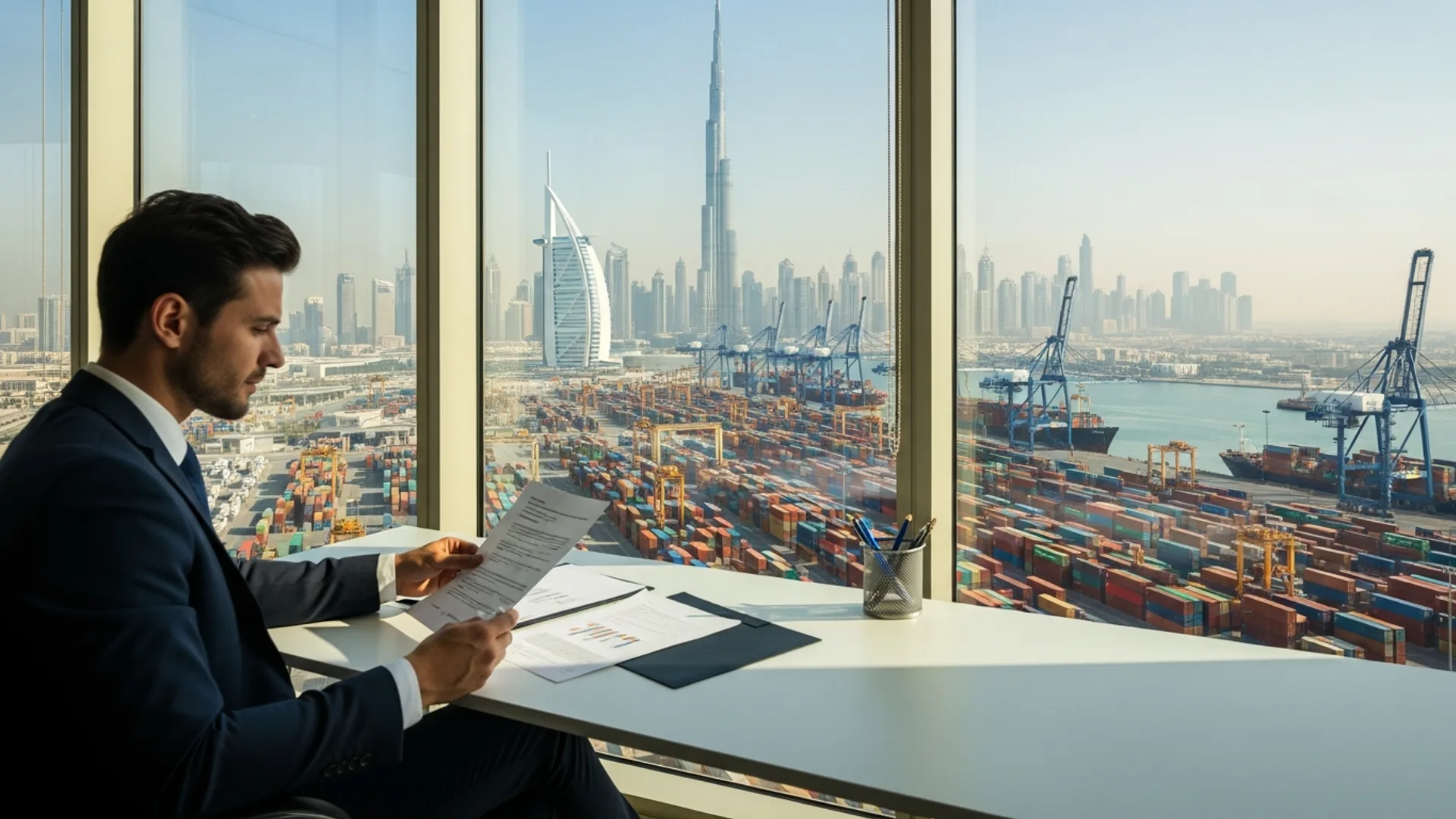
Quick AnswerBusiness setup in Dubai for Chinese investors in 2026: 100% ownership, remote setup, re-export trading hub, banking, KYC and residence visa explained.
Your setup cost, in 10 seconds
Package prices. Health insurance is required by law and not included.
Thank you.
Your written quote follows on WhatsApp.
Can a Chinese investor set up a business in Dubai in 2026?
Yes — a Chinese investor can set up a business in Dubai in 2026 with 100% foreign ownership in almost every sector, and in most cases the entire setup can be completed remotely from China without flying in. Mainland companies licensed by the DET no longer require an Emirati partner for the vast majority of activities, and free zone companies have always allowed full foreign ownership. A residence visa is optional, not mandatory, for owning the company. As a practical 2026 guide, a lean free zone trading licence can start from an indicative AED 12,500 to AED 20,000 in the first year, while a fuller package with a visa and flexi-desk runs roughly AED 18,000 to AED 35,000. Corporate tax of 9% applies above AED 375,000 in taxable profit through the Federal Tax Authority, with qualifying free zone income potentially at 0%. Treat every figure here as indicative — confirm current fees with the authority before you budget.
That headline is the reason Dubai has become one of the most attractive bases on earth for Chinese entrepreneurs who want regional reach without leaving home. The emirate sits at the meeting point of Asia, Africa and Europe, its trade relationship with China is deep and growing, and its ports, free zones and customs facilitation are purpose-built for exactly the kind of import-and-re-export model that so many Chinese manufacturers and traders run. But the simple word "yes" hides a sequence of decisions — mainland versus free zone, how to bank, how much physical presence you need, how to handle tax — that separate a smooth setup from a frustrating one. This guide from Noble Core Ventures walks through each of those stages in plain language so you can build a Dubai trading base that actually works. If you want comparative context, our guide on setting up a Dubai business from India covers a very similar non-resident journey, our starting a business in Dubai as a foreigner explainer details the full setup path, and our mainland vs free zone in Dubai breakdown helps you pick the right jurisdiction for your trade.
Why Dubai is built for Chinese traders and investors
The case for Dubai begins with geography, and for a trading business geography is destiny. Dubai sits within a few hours' flight of roughly two-thirds of the world's population, bridging the manufacturing powerhouses of East Asia with the fast-growing consumer markets of the Gulf, the Levant, the Indian subcontinent and Africa. For a Chinese exporter, this position transforms the economics of regional distribution. Instead of shipping individual consignments from China to a dozen scattered destinations, goods can move in volume to Dubai once, be held in free zone or bonded warehousing, and then be broken into smaller shipments and re-exported across the region on demand. The emirate becomes a forward distribution hub that sits much closer to the end customer than any base in China could, shortening delivery times and giving regional buyers a local point of contact.
Layered on top of that geography is one of the most sophisticated logistics ecosystems anywhere. Jebel Ali Port is among the largest container ports in the world, Dubai's airports move enormous volumes of air cargo, and the road network connects the UAE seamlessly into the wider GCC. Customs processes are designed to keep goods flowing rather than to obstruct them, and re-export through the emirate is a well-trodden, well-understood path. For Chinese manufacturers whose competitive edge depends on getting product to market quickly and cheaply, this infrastructure is not a nice-to-have; it is the entire point. A container that lands in Jebel Ali in the morning can be on a truck to Saudi Arabia or loaded for onward shipment to East Africa within days.
There is also a deep, established commercial relationship between China and the UAE that makes Chinese businesses feel at home. Dubai has long been a magnet for Chinese traders, and that history has created an ecosystem of supporting services, communities and marketplaces tuned to Chinese commerce. The most visible symbol of this is Dragon Mart, one of the largest trading hubs for Chinese products outside China itself, where thousands of outlets give Chinese manufacturers a permanent retail and wholesale shopfront in the heart of the region. A Chinese company that lists its products there, or that sets up a trading entity to supply the retailers operating there, plugs directly into an existing river of regional demand rather than having to build awareness from scratch. The combination of geography, logistics and an entrenched China-friendly trading culture is what makes Dubai uniquely suited to Chinese investors, and it is why this market deserves a dedicated playbook rather than a generic one.
The 100% ownership question, answered clearly
For many Chinese investors, the single biggest historical reservation about the Gulf was the old requirement to take a local partner. That concern is now largely obsolete. Following reforms to the UAE Commercial Companies Law, foreign investors can own 100% of most mainland companies licensed by the DET, removing the need for an Emirati shareholder across the great majority of commercial, trading, services and industrial activities. Free zone companies, meanwhile, have always permitted complete foreign ownership. The upshot is that a Chinese founder — whether sitting in Yiwu, Shenzhen, Guangzhou or anywhere else — can hold the entirety of a Dubai entity and control every decision it makes, without surrendering equity to a partner they did not choose.
It is worth being precise about the exceptions, because clarity matters. A limited number of strategic activities, and certain regulated sectors, still involve local participation or specific approvals. But these are the exception, not the rule, and they rarely touch the kinds of businesses Chinese investors typically launch in Dubai: general trading, specialised commodity trading, e-commerce, logistics and freight forwarding, electronics, textiles and garments, machinery, building materials, consumer goods and consultancy. For the overwhelming majority of trading and services models, the answer to "can I own all of it?" is simply yes. This is the legal foundation on which everything else rests, and it puts a Chinese founder on the same footing as any other international investor — and on far better footing than was available a few years ago.
Ownership being open does not mean every structure is identical, however. The choice between mainland and free zone, the activities listed on your licence, and the visas you attach all flow from your commercial plan. The point to internalise is that nationality is not a barrier and a local partner is not a requirement. With that settled, the real work becomes choosing the structure that matches how you actually intend to trade.
Mainland versus free zone for a Chinese trading business
The mainland-versus-free-zone decision is the most consequential one a Chinese investor makes, and the right answer depends almost entirely on where your customers sit. A free zone company is the natural home for an import-and-re-export model. Free zones offer 100% ownership, fast and largely online setup, packages tailored to international founders, and crucially the warehousing and bonded-storage options that physical traders need. Zones such as DMCC, which is a global centre for commodities trade, IFZA, which is popular for cost-effective trading and services licences, and DAFZA, which sits beside the airport for logistics-heavy businesses, are all well practised at onboarding non-residents. If your model is to bring goods in from China, hold them, and ship them out across the region, a free zone is usually where you start.
The trade-off is domestic market access. A free zone company is, by design, oriented toward international and intra-zone trade; selling directly into the UAE local market from a free zone typically requires working through a distributor or taking additional steps. This is where a mainland licence through the DET earns its place. A mainland company can sell directly to UAE businesses and consumers anywhere in the country, open multiple retail outlets, and contract with government entities. For a Chinese investor whose end buyers are UAE-based retailers, contractors or consumers — rather than re-export customers in other countries — the mainland route removes a layer of friction and lets you serve the local market head-on.
In practice, many of the most successful Chinese operations in Dubai do not choose one or the other; they combine both. A common pattern is a free zone entity that handles import, storage and re-export to the wider region, paired with either a mainland licence or a local distribution arrangement to capture domestic UAE sales. This dual structure lets you enjoy the warehousing, ownership and re-export efficiency of the free zone while still reaching the local market through a compliant mainland channel. It adds some cost and administration, but for a serious trading business with both regional and domestic ambitions it is frequently the most profitable design. The decision should be driven by a clear-eyed look at your customer base — regional re-export, UAE domestic, or both — rather than by a generic preference, and it is precisely the kind of question worth modelling carefully before you commit.
Setting up remotely from China: how it actually works
One of the most reassuring facts for a Chinese founder is that you generally do not need to relocate, and in most cases you do not even need to travel for the setup itself. Incorporation and trade licence issuance, particularly in the free zones, are now heavily digitised. You can submit applications, sign incorporation documents and obtain your licence and establishment card through online portals or through a registered agent acting on your behalf. Where a physical signature or a local action is genuinely required, you grant a power of attorney to a trusted representative or to your consultancy, which is attested and legalised between China and the UAE so they can complete licence issuance, lease signing and many formalities without you boarding a flight.
The mechanics of remote setup do require attention to documentation, because paperwork crossing borders is where timelines stretch. Your passport, any corporate shareholder documents if a Chinese company rather than an individual is the shareholder, and the power of attorney itself typically need attestation and legalisation through the proper channels between the two countries. This is not difficult, but it is sequential, and getting it right the first time avoids weeks of delay. A good corporate services provider will prepare a precise document checklist up front, structure the power of attorney narrowly so your representative can only do what you authorise, and manage the legalisation chain so that everything arrives in the correct order. With clean, correctly legalised documents, a straightforward free zone trading licence can often be issued within roughly one to two weeks.
The one stage where a short trip is sometimes still worthwhile is banking, which we cover in detail below. But it is important to separate the two: company formation and licensing are very achievable from China, and many founders complete that entire phase before ever considering travel. The residence visa, too, can be initiated remotely, with the medical and biometric steps completed on a brief visit if you choose to take one. The overall picture is that Dubai has made remote incorporation genuinely practical for Chinese investors, and the friction that remains is concentrated in banking and in document legalisation rather than in the formation itself.
Banking and KYC: the part that needs the most planning
If there is one stage that rewards preparation, it is opening a UAE business bank account. UAE banks operate under strict know-your-customer and anti-money-laundering frameworks, and they scrutinise new business accounts carefully — examining the source of funds, the nature of the trade, the counterparties involved and the supporting documentation. Being based in China is not a disqualifier, and Chinese trade flows through Dubai are entirely normal, but you should expect a thorough process rather than a rubber stamp. The banks are not trying to obstruct legitimate business; they are managing their own compliance obligations, and the applicants who succeed are the ones who make the bank's job easy.
The practical way to do that is to arrive with a complete, credible file. That means a clear business plan that explains what you trade and with whom, evidence of genuine commercial activity such as supplier agreements, invoices or contracts, a well-defined company structure, and ideally an Emirates ID obtained through an investor visa. Several UAE banks still prefer or require the authorised signatory to attend at least one in-person branch meeting and to complete biometric registration, which is the most common reason a Chinese founder schedules a short trip to Dubai. Others, along with regulated fintech providers, increasingly support remote or non-resident onboarding, and the available options shift over time as banks adjust their policies.
Because the banking landscape changes and because acceptance depends heavily on your specific profile, this is an area where local knowledge pays for itself many times over. A consultancy that works with new accounts every week knows which banks currently welcome China-linked trading businesses, which ones expect an in-person meeting, what documents each institution demands, and how to present a source-of-funds narrative that satisfies compliance teams. Rather than applying blindly and risking a rejection that can complicate future applications, the smarter path is to target the right bank for your profile from the outset, with a file prepared to that bank's expectations. Treat banking as a project to be managed, not a formality to be ticked off, and budget realistically for it to take from a couple of weeks to longer.
Residence visa, Emirates ID and the China connection
Owning a Dubai company and holding a UAE residence visa are two separate things, and many Chinese investors run their companies for a long time before deciding whether they want personal residence. The company exists and trades on the strength of its licence alone; your visa is about you, not the business. That said, a residence visa is genuinely useful, and most serious founders take one. As a shareholder you can apply for an investor or partner residence visa, processed through the GDRFA and ICP channels, which grants you an Emirates ID and the right to enter and reside in the UAE freely. It does not require you to leave China or live in Dubai full time; it simply gives you the option and removes a great deal of practical friction.
The biggest practical benefit of the visa is banking. As discussed above, an Emirates ID materially smooths the path to a business bank account, and that alone is often reason enough. Beyond banking, residence lets you sign documents in person whenever needed, demonstrates a real link between you and your company, and allows you to come and go as your trade demands without arranging entry permits each time. For founders building a substantial regional base, the long-term Golden Visa can extend residence for up to ten years where the investment qualifies, and it allows you to sponsor family members so they can live with you in the UAE. As of 2026 the qualifying criteria and categories continue to evolve, so verify the current thresholds before relying on any particular route.
For Chinese investors specifically, the visa also intersects with how you want to manage the China–Dubai relationship over time. Some founders keep their primary life and manufacturing base in China and treat Dubai purely as a forward trading and distribution hub, visiting periodically and managing the company remotely between trips. Others gradually shift more of their operations and time to Dubai as the regional business grows. The residence visa supports either path: it gives you full optionality without forcing a choice, which is precisely why it is the most popular optional add-on to a Dubai company for non-resident founders. The decision is yours, and you can take the visa now or later as your strategy develops.
Indicative 2026 setup costs for Chinese investors
Costs depend on the structure you choose, the activities on your licence, the number of visas you need, and whether you take warehousing. The table below gives indicative 2026 ranges to help you frame a budget. These are starting points, not quotes, and actual figures move with government fees, the specific free zone or DET schedule, and your activity mix.
| Setup element | Indicative 2026 cost (AED) — indicative, confirm current fees with the authority | Notes for Chinese investors |
|---|---|---|
| Free zone trading licence (no visa) | 12,500 – 20,000 | Leanest re-export base; suits testing the market from China |
| Free zone package with 1 visa + flexi-desk | 18,000 – 35,000 | Common starting structure; Emirates ID helps banking |
| Mainland trading licence (DET) | 20,000 – 45,000+ | Adds external approvals and an Ejari-registered office |
| Investor / partner residence visa | 4,000 – 8,000 per visa | Processed via GDRFA / ICP; smooths banking |
| Bonded / free zone warehousing | Scales with space taken | Needed for physical import and re-export volumes |
| Document legalisation (China–UAE) | Varies by document set | Attestation of passport, POA and corporate papers |
The headline takeaway is that a Chinese investor can establish a credible Dubai trading presence for a first-year outlay that is modest relative to the regional market it unlocks. A lean free zone licence gets you a legal base and a foothold; a fuller package with a visa and a flexi-desk gives you the Emirates ID and presence that make banking and day-to-day operations easier. Warehousing and a mainland presence are additions you take when volumes and domestic ambitions justify them, not necessities on day one. Because every figure here is indicative, the sensible next step is a tailored scope that prices your exact activity, jurisdiction and visa needs against the current official fee schedules.
Contact Us For Free Consultation
or
Ask on WhatsApp insteadLicensed UAE consultancy. One reply, no spam.
Thank you.
A consultant will reply on WhatsApp shortly.
Tax, substance and staying compliant
A Dubai company is attractive partly because the UAE's tax regime is competitive, but "competitive" is not the same as "non-existent", and Chinese investors should plan with clear eyes. Since June 2023 the UAE applies a 9% federal corporate tax on taxable profits above AED 375,000, administered by the Federal Tax Authority, and a UAE-incorporated company is generally within scope. The important nuance for traders is that qualifying free zone businesses may access a 0% rate on qualifying income provided they meet substance and other conditions — which is one reason the choice of free zone and the structuring of your trade flows matter so much. You can read the official position straight from the source on the Federal Tax Authority website before you finalise any structure.
Value-added tax is the second piece. VAT applies at a standard rate of 5%, with registration required once turnover crosses the mandatory threshold. For a re-export business this is often more favourable than it first appears, because exports and certain international supplies may be zero-rated, while domestic UAE sales attract the standard rate. The practical implication is that the same company may handle different VAT treatments depending on whether a given sale is a re-export to another country or a domestic supply within the UAE, so clean record-keeping by transaction type is essential. As of 2026 the thresholds and rules continue to evolve, so verify the current position with a qualified UAE tax adviser rather than relying on a general summary.
Underlying both taxes is the concept of economic substance — the expectation that a UAE company has genuine activity, decision-making and presence proportionate to the income it books in the country. For a Chinese-owned trading company, building credible substance usually means having real premises or warehousing appropriate to the trade, local administration, and documented management decisions, rather than running a pure letterbox. Substance is not only a tax consideration; it strengthens your banking position and your standing with counterparties. The good news is that the kind of business most Chinese investors run — physically moving real goods through the UAE — naturally generates substance, because warehousing, logistics and local activity are inherent to the model. The task is to document it properly and to size your UAE footprint to match your declared activity.
Common Mistakes to Avoid
The most frequent and costly mistake Chinese investors make is choosing the jurisdiction before understanding their own customer base. Founders sometimes default to a free zone because it is cheaper and faster, then discover they cannot easily sell into the UAE domestic market they actually wanted; others take a mainland licence with a costly office when a lean free zone re-export base would have served their regional model perfectly. The fix is to map your buyers first — regional re-export, UAE domestic, or both — and let that map drive the structure. The licence should follow the trade, not the other way around, and a short scoping conversation before you commit prevents an expensive restructuring later.
A second common error is underestimating the banking stage and treating it as an afterthought. Founders who complete their licence quickly and then approach a bank with a thin file, no Emirates ID and no clear source-of-funds narrative are the ones who hit delays and rejections. Because a rejection at one bank can complicate applications elsewhere, it pays to prepare the banking file in parallel with the licence, to obtain an investor visa where it helps, and to target a bank known to accept your profile rather than applying blindly. Banking is a project that deserves the same planning as the company formation itself, and Chinese founders who treat it that way move far faster than those who do not.
The third recurring mistake is mishandling documentation between China and the UAE. Passports, corporate shareholder papers and powers of attorney generally require attestation and legalisation, and doing this out of order, with the wrong copies, or without the right translations adds weeks to an otherwise quick setup. A related error is granting a power of attorney that is broader than necessary, which creates unnecessary risk. The remedy is to work from a precise document checklist from the outset, to legalise everything in the correct sequence, and to scope the power of attorney narrowly to exactly what your representative needs to do. Finally, do not assume the tax position; confirm corporate tax and VAT treatment for your specific activity with the Federal Tax Authority guidance and a qualified adviser, and never treat indicative cost ranges as guaranteed quotes — always confirm current fees with the relevant authority before you budget.
Your next step with Noble Core Ventures
Dubai offers Chinese investors a rare combination: full ownership, a remote-friendly setup, a world-class re-export platform sitting between China and the markets of the Gulf, Africa and beyond, and a residence option that keeps every door open. The fundamentals could hardly be more favourable. What turns those fundamentals into a working business is getting the sequence right — choosing the structure that matches your customers, preparing the banking file properly, legalising your documents in order, and sizing your UAE presence to your real trade. Each of those steps is straightforward with the right guidance and frustrating without it.
Noble Core Ventures specialises in exactly this journey: helping international founders, including Chinese entrepreneurs and trading companies, set up in Dubai with the structure, banking, visa and compliance handled end to end. We will scope your activity against current official fee schedules, recommend the mainland or free zone path that fits your customer base, prepare your China–UAE document chain, and guide your banking application to the institutions most likely to welcome your profile. If you are ready to turn Dubai into your regional trading base, the most valuable thing you can do is start with a clear, tailored plan rather than a generic package — and that is precisely where we begin.
Talk to Our Experts
setting up a Dubai company as a Chinese investor — 100% ownership, re-export trade licence, banking and residence visa handled end-to-end
Frequently Asked Questions
Can a Chinese citizen own 100% of a Dubai company?
Yes, a Chinese citizen can own 100% of a Dubai company in almost all sectors. Following reforms to the UAE Commercial Companies Law, foreign investors no longer need an Emirati partner for the vast majority of mainland activities licensed by the DET, and free zone companies have always permitted full foreign ownership. Your nationality does not change this entitlement — a founder in Shenzhen, Yiwu or Guangzhou has the same ownership rights as one already living in Dubai. A small list of strategic or regulated activities still requires a local partner or agent, but trading, e-commerce, logistics, consulting and technology businesses are fully foreign-ownable, which is exactly why so many Chinese entrepreneurs incorporate in Dubai while continuing to manage operations from China.
Can I set up a Dubai company from China without flying there?
In most cases yes, you can complete the entire setup from China without travelling to the UAE. Incorporation, trade licence issuance and many free zone formalities are now handled online or through a registered agent acting under a power of attorney that you sign and legalise in China. This lets you obtain your licence and even your establishment card remotely. The one stage that often still requires an in-person step is opening a traditional UAE business bank account, since several banks ask the signatory to attend a branch meeting and complete biometric registration. Many Chinese founders therefore plan one short trip for banking, or choose banks and fintech providers that currently support remote onboarding for non-residents.
Why is Dubai a good re-export and trading hub for Chinese businesses?
Dubai sits at the crossroads of Asia, Africa and Europe, within a few hours’ flight of roughly two-thirds of the world’s population, and its ports and airports are among the busiest on earth. For a Chinese trader, that geography means goods manufactured in China can land in Dubai, be stored in bonded or free zone warehousing, and then be re-exported across the GCC, the wider Middle East and into Africa with minimal friction. Established marketplaces such as Dragon Mart give Chinese products a permanent retail and wholesale shopfront in the region. Combined with strong UAE–China trade ties, world-class logistics and customs facilitation through Dubai Customs, the emirate functions as a natural distribution base for Chinese manufacturers seeking regional reach.
Should a Chinese investor choose mainland or a free zone in Dubai?
It depends on who your customers are and how you intend to trade. A free zone company suits Chinese investors focused on import, storage and re-export, because it offers 100% ownership, streamlined online setup, bonded warehousing options and packages designed for international founders, with zones like DMCC, IFZA and DAFZA well practised at onboarding non-residents. A mainland company licensed by the DET lets you sell directly into the UAE domestic market, open multiple retail outlets and contract with government, which matters if your end buyers are local UAE businesses and consumers. Many Chinese traders run both: a free zone entity for re-export and a mainland licence, or a local distributor arrangement, for domestic sales. The right structure follows your customer base rather than any blanket rule.
How much does it cost for a Chinese investor to set up a company in Dubai?
Costs vary widely with the structure, activity and number of visas you need, so treat all figures as indicative ranges and confirm current fees with the relevant authority before budgeting. As a guide for 2026, a lean free zone trading licence with no visa can start from roughly AED 12,500 to AED 20,000 in the first year, while a fuller free zone package with a residence visa, establishment card and flexi-desk typically runs around AED 18,000 to AED 35,000. A mainland trading licence through the DET generally sits higher once external approvals, an Ejari-registered office and visa quotas are factored in. Banking, document legalisation between China and the UAE, and any warehousing add further costs that a consultancy can scope precisely for your plan.
Can I get a UAE residence visa as a Chinese company owner?
Yes. As a shareholder you can apply for an investor or partner residence visa, processed through the GDRFA and ICP channels, which grants you an Emirates ID and the right to enter and reside in the UAE. The visa does not force you to relocate from China, but it makes opening a business bank account far easier, lets you sign documents in person when needed, and demonstrates a genuine link to your company. Larger investments may qualify for the long-term Golden Visa, which can extend residence for up to ten years and allow you to sponsor family members. For most serious Chinese founders building a regional trading base, an investor visa is the single most useful optional add-on to the licence itself.
How hard is it to open a UAE business bank account as a Chinese owner?
Opening a UAE business bank account is the most demanding part of the process and benefits from preparation. UAE banks apply strict know-your-customer and anti-money-laundering checks, and they look closely at the source of funds, the nature of the trade and the supporting documents. Being based in China does not disqualify you, but it lengthens timelines, so most successful applicants come with a clear business plan, evidence of genuine trade such as supplier contracts and invoices, an Emirates ID where possible, and a credible UAE presence. Many Chinese founders smooth the process by taking an investor visa first, choosing banks experienced with China-linked trade, or working with a consultancy that knows which institutions currently accept their profile and what each one requires.
Will my Dubai company have to pay UAE corporate tax and VAT?
Possibly, and you should plan for both rather than assume an exemption. Since June 2023 the UAE applies a 9% federal corporate tax on taxable profits above AED 375,000, administered by the Federal Tax Authority, and a UAE-incorporated company is generally within scope. Qualifying free zone businesses may access a 0% rate on qualifying income if they meet substance and other conditions, which is why structure matters for traders. Separately, value-added tax applies at the standard 5% rate, with registration required once turnover crosses the mandatory threshold, although re-exports and certain international supplies may be zero-rated. As of 2026 these rules continue to evolve, so verify the current thresholds and your specific position with a qualified UAE tax adviser before relying on any outcome.
Do I need a physical office or warehouse to trade from Dubai?
It depends on your activity and chosen jurisdiction. Many free zones let trading and consulting companies start with a flexi-desk or shared workspace rather than a full office, which keeps first-year costs low for Chinese founders testing the market. If your model is physical import and re-export, you will likely want bonded or free zone warehousing to store goods before onward shipment, and the cost scales with the space you take. A mainland licence through the DET generally requires a leased commercial premises registered on Ejari. The practical answer is to match your premises to your real operations: a desk for a lean trading office, dedicated warehousing once volumes justify it, and a retail unit only if you sell directly to UAE customers.
How long does it take to set up a Dubai company from China?
Timelines depend mainly on the activity, the jurisdiction and document legalisation between China and the UAE. A straightforward free zone trading licence can often be issued within roughly one to two weeks once your documents are in order, and some packages move faster. Mainland setups through the DET can take a little longer where external approvals are needed. The element most likely to extend the timeline is paperwork crossing borders: passports, any corporate shareholder documents and powers of attorney usually need attestation and legalisation, which adds days. Banking is then a separate track that can run from a couple of weeks to longer depending on the institution. Preparing complete, correctly legalised documents up front is the single biggest factor in keeping the whole process quick.
Related: Dubai setup for Russian investors.
Related: Dubai setup for US citizens.