Quick AnswerCivil defence approval Dubai 2026: fit-out drawing approval, fire NOC steps, AMC rules, timelines and indicative costs from AED 3,000. Avoid closure risk.
Fitting out any commercial premises in Dubai means passing through fire and life safety review. Civil defence approval in Dubai is the chain of clearances — design approval, material approval, inspection and finally a fire NOC or completion certificate — that permits you to occupy and trade. Budget an indicative AED 3,000 to AED 15,000 in approval, consultant and inspection fees, plus AED 40,000 to AED 250,000 for the fire protection works themselves depending on the size and use of the space. Without the NOC you cannot lawfully open, and in practice you often cannot energise the premises either.
The approval itself is technical rather than bureaucratic, and that is exactly why founders underestimate it. It is not a form; it is a design review against the UAE Fire and Life Safety Code of Practice, carried out by engineers, at three separate stages, with named registered consultants and contractors who must be appointed before anything is drawn. Businesses that treat it as end-of-project paperwork routinely lose six to ten weeks and rebuild sections of a finished fit-out. This guide sets out the full sequence, what each occupancy type needs, realistic costs and timelines, the interaction with Dubai Municipality and DEWA, renewal obligations, and the specific reasons submissions get rejected.
What is civil defence approval in Dubai and when is it needed?
Civil defence approval is Dubai Civil Defence clearance that a premises meets the UAE Fire and Life Safety Code. It runs in three stages — drawing approval, material and equipment approval, and site inspection — ending in a fire NOC or completion certificate. Expect 8 to 16 weeks end to end and indicative fees of AED 3,000 to AED 15,000, excluding the fire protection works themselves.
Approval is triggered by new construction, any fit-out, any change of use, and material alterations to an existing layout. Moving a partition that affects a means-of-escape route is a change requiring approval, even if nothing else changes.
| Item | Indicative cost (AED) | Typical timeline | Notes |
|---|---|---|---|
| Design consultant fees (small to mid fit-out) | 8,000 – 35,000 | 2 – 4 weeks to produce | Must be a registered consultant |
| Drawing approval fees | 1,500 – 6,000 | 2 – 4 weeks review | Varies by area and occupancy |
| Material and equipment approval | 1,000 – 4,000 | 1 – 3 weeks | Approved product listings required |
| Inspection and NOC issue fees | 1,500 – 6,000 | 1 – 3 weeks | Re-inspection charged again |
| Fire alarm and detection installation | 15,000 – 90,000 | 2 – 5 weeks | Area and device count dependent |
| Sprinkler works / modification | 15,000 – 80,000 | 2 – 5 weeks | Where the base build requires change |
| Emergency lighting and exit signage | 5,000 – 25,000 | 1 – 2 weeks | Mandatory on escape routes |
| Fire-rated partitions and doors | 10,000 – 60,000 | 2 – 4 weeks | Occupancy separation |
| Kitchen hood suppression (F&B) | 12,000 – 45,000 | 2 – 4 weeks | Required for commercial kitchens |
| Annual maintenance contract (AMC) | 4,000 – 20,000 per year | Ongoing | Required for NOC and renewal |
| Indicative total, 2,000 sq ft F&B fit-out | 90,000 – 260,000 | 10 – 16 weeks | Excluding general fit-out |
All AED figures are indicative market ranges based on typical experience and vary substantially with area, occupancy class, base-build condition and contractor. Confirm current official fees directly with the authority, and check your tax position with the Federal Tax Authority.
The three-stage approval chain
Understanding that this is three distinct approvals — not one — is the single most useful mental model.
Stage 1: Design and drawing approval
Before any construction begins, a registered fire and life safety consultant prepares a drawing set demonstrating compliance with the UAE Fire and Life Safety Code of Practice. The submission typically includes:
- Architectural layout showing the proposed partitioning, occupancy and furniture layout
- Means of escape drawings showing travel distances, exit widths, exit counts, dead-end limits and escape route protection
- Occupancy load calculations — how many people the space is designed to hold, which drives almost every other requirement
- Fire detection and alarm layout — detector types, coverage, sounders, manual call points, panel location and interface with the base-build system
- Sprinkler layout and hydraulic calculations where sprinklers are affected
- Emergency lighting and exit signage layout
- Fire-rated construction details — partitions, doors, ceiling and floor penetrations, fire stopping
- Smoke control and ventilation interface, including stair pressurisation and any kitchen extract
- Firefighting equipment schedule — extinguishers, hose reels, fire blankets
- Specialist systems — hood suppression for commercial kitchens, gas suppression for server rooms, gas detection where fuel gas is used
Reviewers assess this against the Code. Comments are returned; the consultant responds; approval is issued. This stage typically takes two to four weeks per round, which is why a well-prepared first submission is worth paying for.
Stage 2: Material and equipment approval
Products installed in fire systems must be approved and listed. Panels, detectors, sprinkler heads, fire doors, cables, fire-stopping products, suppression systems, emergency luminaires and exit signs all need to come from approved product families with valid certification.
Contractors substituting a cheaper equivalent mid-project is one of the classic failure modes: the system works perfectly, and the inspection still fails because the model number is not the approved one. Lock the equipment schedule down at approval stage and put a written no-substitution clause in the contractor's scope.
Stage 3: Inspection and fire NOC
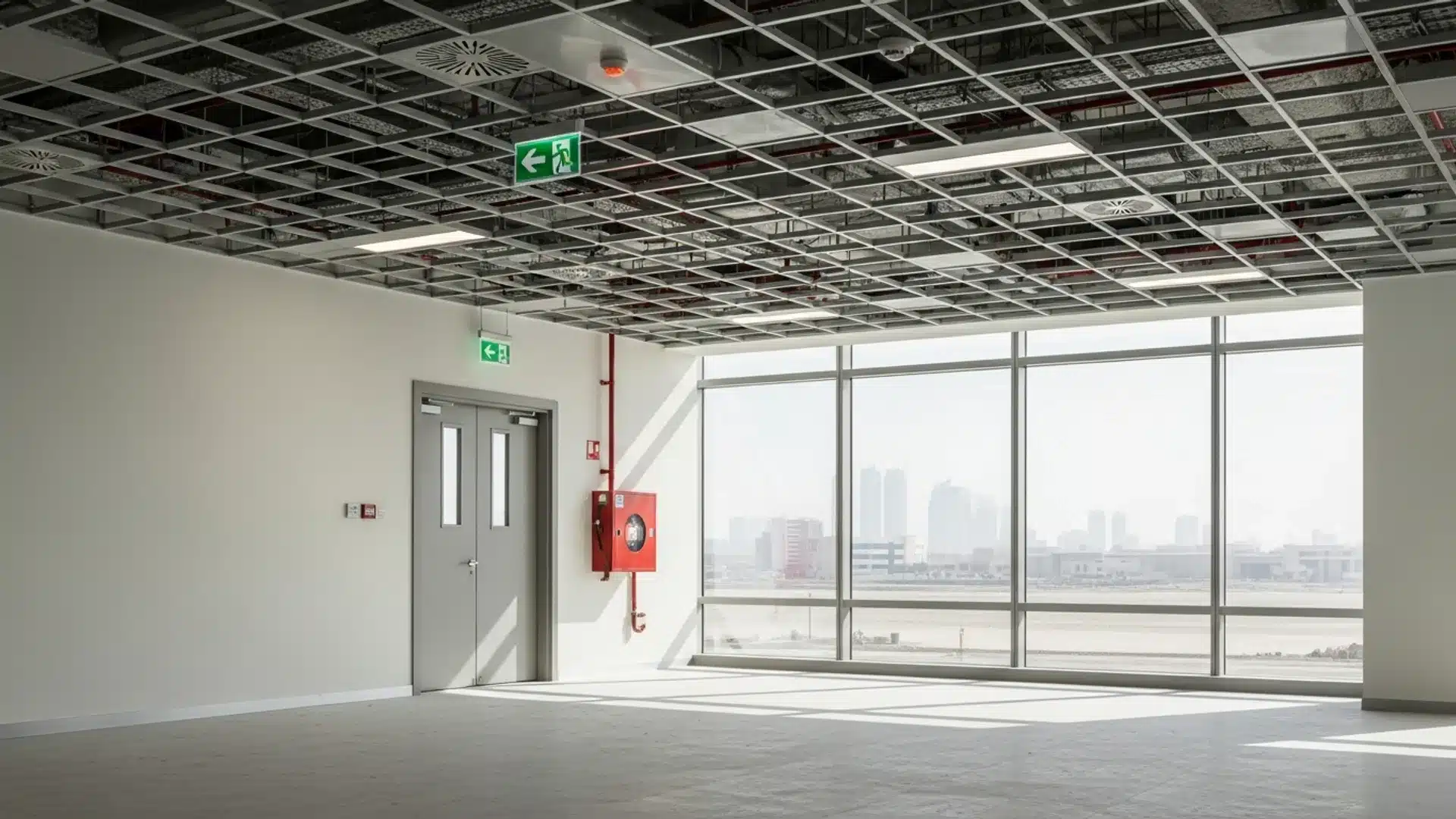
When installation is complete, the site is inspected against the approved drawings and the approved material schedule. Systems are function-tested — alarms sounded, detectors triggered, emergency lighting tested under simulated power loss, suppression systems verified, doors checked for self-closing and correct hardware.
The inspector is checking the as-built against the as-approved. Anything moved during construction becomes a finding. When the site passes and a valid AMC is in place, the fire NOC or completion certificate is issued.
What different occupancy types need
Requirements scale sharply with occupancy classification, and the classification is determined by use and occupant load, not by your description of the business.
Office and business occupancy. The lightest tier. In a modern tower with a compliant base build, an office fit-out typically involves extending detection and sprinkler coverage into the new partition layout, providing emergency lighting and exit signage on escape routes, maintaining travel distances, and fire-stopping any penetrations. Small suites in already-compliant floors sometimes require only a light-touch review — but never no review.
Retail (mercantile) occupancy. Higher occupant loads and higher fuel loads. Expect stricter attention to exit capacity, storage-area separation, and shopfront closure arrangements. Mall units additionally face the mall operator's own fit-out authority, which is often stricter than the regulatory baseline.
Assembly occupancy — restaurants, cafés, cinemas, gyms, event spaces. The most demanding common category, because a large number of people gather in one space. Requirements typically include multiple remote exits, exit doors opening in the direction of travel with panic hardware, generous exit width based on calculated occupant load, emergency lighting throughout, comprehensive detection, and clear travel-distance compliance. Assembly classification is triggered by occupant load, and businesses that increase seating after approval quietly move themselves into a stricter class.
Commercial kitchens. A specific set of requirements sits on top of the assembly baseline: a wet-chemical hood suppression system covering the cooking line, correctly interlocked so that activation shuts down fuel and power to the appliances; fire-rated separation between the kitchen and other areas; grease-resistant, cleanable extract ductwork with appropriate fire protection; and an appropriately rated extinguisher for cooking oils. Hood suppression is one of the largest single line items in an F&B fire budget and one of the most common causes of a failed first inspection when the interlock has not been properly wired.
Storage and warehouse occupancy. Driven by commodity classification and storage height. Racking arrangement, aisle widths, in-rack sprinkler requirements and separation of hazardous materials all matter. Warehouse operators who change what they store without re-approval are a frequent enforcement finding.
Industrial and hazardous processes. Additional requirements for flammable materials, spray processes, gas storage and specialist ventilation.
Server rooms and technical spaces. Frequently require dedicated gas suppression and separate detection.
How civil defence fits with Dubai Municipality, DET and DEWA
Civil defence approval never happens in isolation. Four workstreams interlock:
DET licensing. Your trade licence with the correct activity, plus your Ejari-registered tenancy, are prerequisites. The activity on the licence should be consistent with the occupancy classification presented in the fire submission; a mismatch between a "cafeteria" licence and a full assembly-occupancy restaurant design invites questions.
Dubai Municipality building and fit-out approvals. Dubai Municipality approves the building works and, for food businesses, the kitchen layout against food safety requirements. Those two reviews look at the same drawings from different angles — Dubai Municipality wants raw and ready-to-eat flows separated and enough hand-wash basins; Civil Defence wants exit routes clear and travel distances short. Design once for both, because a layout revised to satisfy one reviewer can break compliance with the other. Coordinating the submissions is where a good consultant earns their fee. Current guidance sits on the Dubai Municipality portal.
DEWA connection. Permanent power energisation is sequenced with completion clearances, so a delayed fire NOC frequently becomes a delayed DEWA connection, and a delayed connection becomes a delayed opening. Businesses running commissioning on temporary supply discover this at the worst possible moment. Plan DEWA application dates backwards from your expected NOC date, not forwards from your fit-out start.
Landlord and building management. In towers and malls, the base-build fire systems belong to the landlord. Any tenant work that ties into the base-build alarm panel, sprinkler main or smoke control system needs the landlord's technical consent and often the base-build contractor's involvement. Getting this consent late is a common two-week delay.
Free zone variations
Free zone premises follow the same technical code, but the administrative route differs. Free zone authorities such as DMCC, IFZA and DAFZA typically operate their own fit-out approval processes, often with an in-house or appointed engineering reviewer, and with the free zone acting as the interface. Some free zones maintain panels of pre-approved fit-out contractors, which simplifies contractor selection but narrows your pricing options.
The practical differences to plan for: approval routing through the authority rather than directly; base-build systems controlled by the free zone facility management; and in many cases a stricter, more standardised specification because the authority is protecting a whole park rather than reviewing one unit. The code requirements themselves — escape routes, detection, suppression, fire-rated construction, AMC — do not soften.
Annual maintenance contracts and ongoing obligations
The NOC is not permanent, and this surprises operators who filed it and forgot it.
An annual maintenance contract with an approved fire maintenance company is required. The AMC covers scheduled testing and servicing of alarm and detection systems, sprinkler and firefighting equipment, emergency lighting, suppression systems and fire doors. Certificates issued under the AMC are the evidence that your systems remain functional.
Ongoing obligations typically include:
- Scheduled testing on defined intervals with records retained on site
- Extinguisher servicing and replacement on cycle
- Suppression system servicing, including hood suppression in kitchens
- Keeping escape routes permanently clear — the most frequently breached requirement of all
- Ensuring fire doors remain self-closing and are never wedged open
- Maintaining an accessible, up-to-date fire safety file
- Staff fire safety awareness and evacuation drills
- Re-approval for any subsequent alteration
Periodic re-inspection and renewal apply, generally annually and aligned with the AMC. Systems found untested, or escape routes found obstructed, are treated seriously precisely because they represent live risk rather than paperwork gaps.
Penalties, closure risk and operating without an NOC
Enforcement follows the familiar graduated pattern: a written observation with a correction deadline, an administrative fine, re-inspection, escalated penalties for repeat findings, and in serious cases suspension of operations until the defect is closed. Because published penalty schedules are revised periodically, verify current amounts with the authority rather than relying on figures circulating on third-party sites.
What separates fire and life safety from most other compliance areas is that immediate closure is a realistic outcome rather than a theoretical one. Defects treated as imminent danger — an impaired or isolated alarm system, a sprinkler system out of service, blocked or locked escape routes, hood suppression that does not function, or trading with no valid NOC at all — put people at risk in real time, and enforcement responds accordingly.
Three specific situations catch otherwise diligent operators. The first is the "soft opening": trading for friends, family or a media preview before the NOC is issued. Occupied premises are occupied premises, and the fact that nobody paid for dinner is not a defence. The second is the lapsed AMC — systems that were perfect at handover but untested for eighteen months because nobody renewed the contract. The third is creeping alteration: a partition added here, a storage rack there, a corridor gradually colonised by stock, until the approved fire strategy no longer describes the building you actually occupy.
The mitigation is unglamorous. Put the NOC expiry, the AMC renewal and the testing schedule into the same tracker that holds your trade licence and Ejari renewal dates, and require any layout change — however small — to be signed off against the approved fire drawings before work starts.
Why submissions get rejected
The recurring reasons, in rough order of frequency:
- Travel distances and exit provision non-compliant. The layout puts someone too far from an exit, or provides only one exit where the occupant load demands two remote ones.
- Occupant load understated. A restaurant declaring 60 covers while the seating plan clearly holds 100 triggers a recalculation and usually a redesign.
- Unregistered consultant or contractor. The submission fails on the identity of the party, not the content.
- Material substitution. Installed equipment does not match the approved schedule.
- As-built deviating from as-approved. Partitions moved, doors relocated, a detector omitted because a duct was in the way.
- Fire stopping not done or not visible. Penetrations through fire-rated construction left unsealed, or sealed after the ceiling was closed so nothing can be verified.
- Interlocks not proven. Hood suppression not shutting down gas and power; alarm not interfacing with the base-build panel; magnetic door holders not releasing.
- Missing AMC at inspection. Everything installed correctly, no maintenance contract in place, NOC withheld.
- Escape route obstructed on inspection day. Fit-out debris, stock or furniture in a corridor is enough to fail the visit.
Every one of these is preventable, and eight of the nine are preventable at zero cost through sequencing and supervision.
Tax treatment of fit-out and fire safety expenditure
Fire protection works are part of your fit-out and are treated accordingly. Contractor invoices for design, supply, installation and maintenance are standard-rated at 5% VAT, recoverable as input tax where you are registered with the Federal Tax Authority and making taxable supplies. VAT registration is mandatory above AED 375,000 in taxable supplies and voluntary above AED 187,500.
For corporate tax, the capital-versus-revenue split matters. Installed fire systems, fire-rated partitions and hood suppression are capital expenditure forming part of the leasehold improvement asset, recovered through depreciation in the accounts over the useful life or the lease term. The annual maintenance contract, extinguisher servicing and periodic testing are ordinary revenue expenses deductible in the period incurred. Corporate tax applies at 0% up to AED 375,000 of taxable profit and 9% above, registered via EmaraTax with returns due nine months after the financial year end.
Separate these in your ledger from the first invoice. Fit-out contractors typically issue one lump-sum invoice covering everything; ask for a cost breakdown between capital works and first-year maintenance at contract stage, because reconstructing it later is guesswork.
There is also an insurance dimension worth noting alongside tax. Property and business-interruption policies generally require valid statutory approvals and maintained fire systems. A fire in premises trading without a valid NOC, or with an expired AMC, gives an insurer a serious coverage argument. Compliance here protects a balance sheet, not just a licence.
Worked example: a 2,000 sq ft restaurant fit-out
An operator takes a 2,000 sq ft ground-floor unit in a mixed-use tower for a 110-cover restaurant with a full hot kitchen.
Weeks 1–2. DET licence issued with the correct F&B activity; tenancy registered through Ejari. A registered fire and life safety consultant is appointed alongside the fit-out designer. Crucially, the food-safety kitchen layout and the fire escape strategy are developed on the same drawing rather than in sequence — the first design placed the dry store across the secondary escape route, which the consultant caught before submission.
Weeks 3–5. Occupant load calculated at 110 covers plus 18 staff, confirming assembly occupancy and the need for two remote exits with panic hardware. Drawings submitted to Civil Defence and, in parallel, the kitchen layout submitted to Dubai Municipality. Landlord technical consent obtained for tie-in to the base-build alarm panel.
Weeks 5–7. Civil Defence comments returned on exit door swing and emergency lighting coverage in the back-of-house corridor. Revised and approved. Material schedule submitted and approved; the contractor's proposed alternative detector brand is rejected and the approved model reinstated.
Weeks 7–13. Installation. Fire-rated separation between kitchen and dining area built, hood suppression installed and interlocked to gas and power, sprinkler heads relocated to suit the new ceiling, emergency lighting and exit signage installed, fire stopping photographed before ceilings close — a small discipline that saves a fortune when verification is requested.
Week 14. AMC signed with an approved maintenance company. Site inspection carried out. Two findings: a wedged-open kitchen fire door and an untested emergency luminaire. Both corrected within the day. NOC issued.
Week 15. DEWA permanent connection energised, Dubai Municipality final food inspection passed, food permit issued, restaurant opens.
Indicative cost. Consultant AED 15,000–35,000; approval, material and inspection fees AED 4,000–16,000; alarm and detection AED 25,000–60,000; sprinkler modification AED 20,000–50,000; emergency lighting and signage AED 8,000–20,000; fire-rated partitions and doors AED 20,000–55,000; hood suppression AED 15,000–45,000; first-year AMC AED 6,000–18,000. Total indicative AED 113,000 to AED 299,000 for the fire and life safety scope alone.
The decisive moment in this example was week one: designing the kitchen layout and the escape strategy together. Operators who submit to Dubai Municipality first and Civil Defence afterwards routinely find the two approvals demand incompatible layouts, and the resulting redesign costs more than the consultant would have.
Common Mistakes With Civil Defence Approval in Dubai
- Starting the fit-out before drawing approval. Building first and submitting later means demolishing finished work. This single error accounts for more lost weeks than every other cause combined.
- Designing for food safety and fire safety separately. Dubai Municipality wants separated food flows; Civil Defence wants short, clear escape routes. Solve both on one drawing or you will solve neither.
- Understating the occupant load. Declaring fewer covers than the seating plan actually holds is quickly recalculated at review, and the correction usually forces additional exits.
- Allowing contractor material substitution. A cheaper equivalent detector or door that is not on the approved schedule fails inspection even though the system works. Put a no-substitution clause in the contract.
- Appointing unregistered consultants or contractors. The submission fails on who prepared it, regardless of quality. Verify registration before signing.
- Closing ceilings before fire stopping is verified. Photograph every penetration and seal before the ceiling goes up, or expect to open it again.
- Leaving the AMC until after inspection. A complete, correct installation still cannot get its NOC without a valid maintenance contract in place.
- Forgetting that alterations re-trigger approval. Adding seating, moving a partition, changing what you store, or converting an office into a training room all change the fire strategy and require fresh approval.
Getting Civil Defence Approval Right With Noble Core
Civil defence approval is an engineering process wearing a bureaucratic disguise. The businesses that sail through are not the ones with the biggest budgets; they are the ones who appointed a registered consultant in week one, designed the kitchen and the escape routes on the same sheet, locked the equipment schedule against substitution, and had the AMC signed before the inspector arrived.
Noble Core Ventures coordinates the whole programme as part of the wider Dubai Municipality approvals chain. We appoint and manage registered fire and life safety consultants, align the fire submission with your Dubai Municipality building and kitchen approvals so a single layout satisfies both, manage drawing and material submissions, supervise the inspection readiness walk, arrange your AMC and sequence DEWA energisation against a realistic NOC date. Running these in parallel rather than in series is typically worth four to eight weeks on an opening date.
For food and beverage projects, where hood suppression, assembly occupancy and kitchen layout all collide, read our guide to the restaurant licence in Dubai for the full opening sequence. If you are still choosing structure, jurisdiction and premises, start with business setup in Dubai, and confirm the exact activity your concept requires in our Dubai business licence directory — because the activity on your licence should match the occupancy classification your fire submission relies on.
Book a free 20-minute consultation and we will review your premises, use and layout against the fire and life safety requirements that will apply, and give you a realistic cost range and programme before you sign a fit-out contract.
Talk to Our Experts
Noble Core Ventures manages civil defence approval in Dubai end to end — consultant appointment, drawing submissions, material approvals, inspection coordination, fire NOC and AMC setup alongside your DET licence and Dubai Municipality permits. Free 20-minute consultation.
Frequently Asked Questions
What is civil defence approval in Dubai?
It is fire and life safety clearance from Dubai Civil Defence covering design, materials and installation. The final output is a fire NOC or completion certificate permitting lawful occupancy.
Do all businesses need it?
Any premises undergoing fit-out, change of use or new construction needs approval. Simple office suites in already-compliant buildings may need only a light-touch review, but never zero.
How much does civil defence approval cost?
Approval and inspection fees are indicatively AED 3,000 to AED 15,000. The fire protection works themselves usually cost far more, often AED 40,000 to AED 250,000 depending on scope.
How long does it take?
Drawing approval commonly takes two to four weeks. A full fit-out cycle from design submission to final NOC typically runs eight to sixteen weeks, longer for complex projects.
Can I use any contractor?
No. Design consultants, fire system contractors and maintenance companies must be registered and approved. Using unregistered parties is one of the most common causes of rejection.
What is an AMC and why do I need one?
An annual maintenance contract with an approved company covers testing and servicing of fire systems. A valid AMC certificate is required for the NOC and for annual renewal.
Do restaurants need extra approvals?
Yes. Commercial kitchens require hood suppression systems, fire-rated separation, and specific ventilation provisions on top of the standard sprinkler, alarm and exit requirements.
Can I open without the NOC?
No. Operating without a valid fire NOC exposes you to fines and closure, and insurers may decline claims arising from fire in premises without valid clearance.
Does DEWA depend on this?
Permanent power connection is generally sequenced with fire and life safety clearance, so delays in civil defence approval frequently delay DEWA energisation and therefore your opening.
How often is re-inspection required?
Periodic renewal and re-inspection apply, generally annually alongside your AMC. Systems must be tested on schedule and records kept available on site for inspection.
Contact Us For Free Consultation
Licensed UAE consultancy. One reply, no spam.
Thank you.
A consultant will reply on WhatsApp shortly.