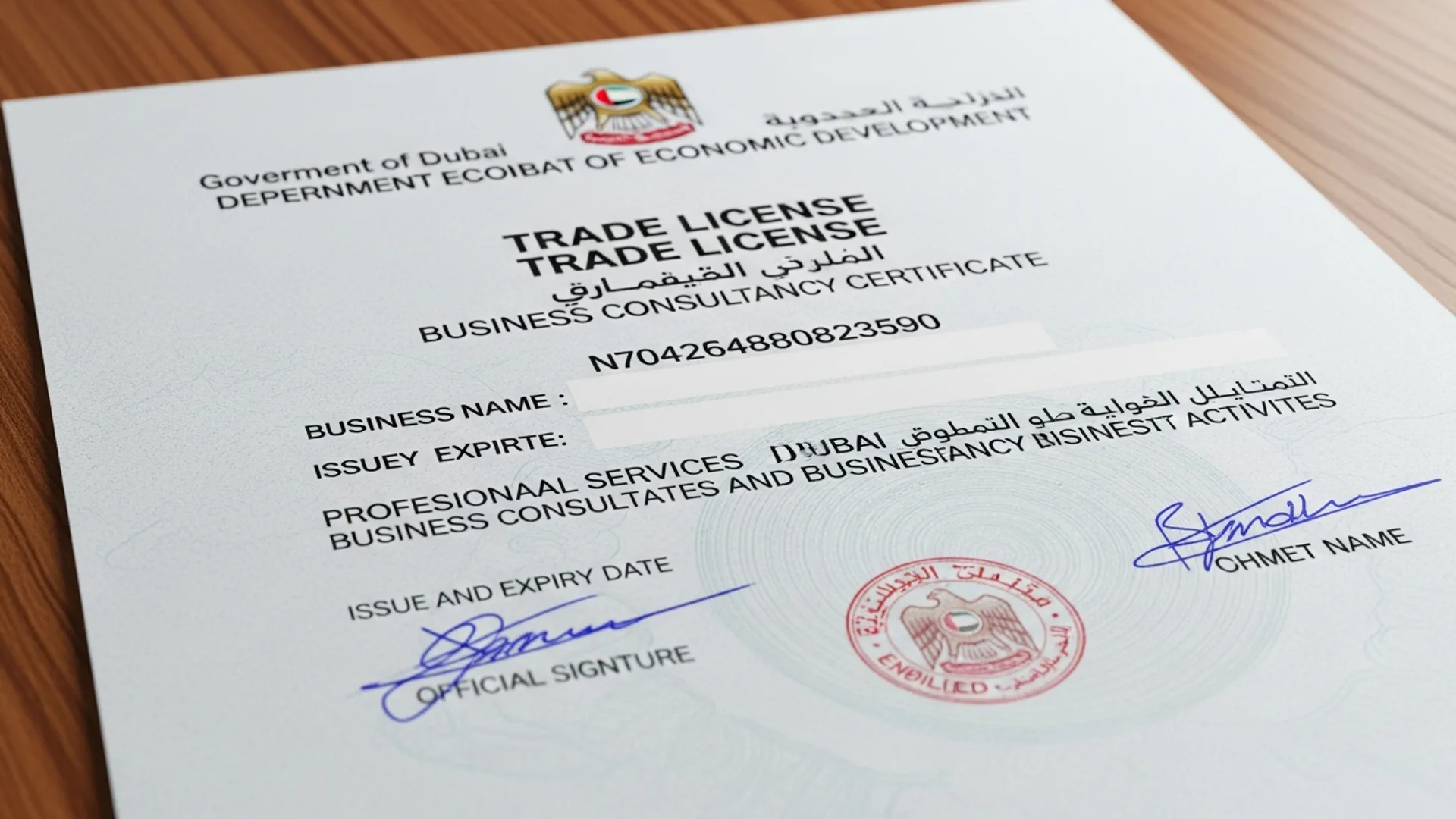
What Noble Core charges
From AED 4,899
Free zone company: licence, registration and establishment card (Ajman Nu Ventures, no visas). With 1 visa from AED 10,800. Your exact price depends on the zone, the activity and the number of visas.
Quote this licence on WhatsAppQuick AnswerA Dubai consultancy license costs AED 12,500–28,000 in 2026. Activity code choice changes everything. Full code map, free zone vs mainland.
Your setup cost, in 10 seconds
Package prices. Health insurance is required by law and not included.
Thank you.
Your written quote follows on WhatsApp.
Consultancy license Dubai 2026 — activity codes, cost, real numbers
A consultancy license in Dubai costs AED 12,500 to 28,000 in 2026. IFZA at AED 12,500 is the most-used free zone option for solo and small-team consultancies. Dubai mainland Professional License is AED 15,000–22,000. DMCC consultancy starts at AED 34,340. The price is not what matters most — what matters is the activity code you register and whether it actually permits the services you intend to deliver.
This guide is built from real consultancy setups across management, marketing, IT, HR, financial, engineering, and specialised advisory. It covers the activity code system, the Professional vs Commercial license distinction, the free zone vs mainland decision (different from product businesses), and how to structure your license for tax efficiency under the 2023 corporate tax regime.
Related: IFZA
Our cost research checks what each authority actually publishes, so you can compare like with like:
- IFZA Dubai company setup — publishes zero prices sitewide — a channel-partner model
Professional License vs Commercial License — the distinction that catches new founders
DET classifies licenses by what the business does:
- Professional License — service-only activities. Consultancy, advisory, IT services, design, marketing, training. The "product" is the consultant's expertise.
- Commercial License — trading physical or digital goods. Buying, selling, importing, exporting, retail, wholesale.
- Industrial License — manufacturing and production.
- Tourism License — travel agencies, tour operators, hotels.
A consultancy almost always needs a Professional License. If you trade goods on the side (e.g., consult on retail AND resell branded merchandise), you need both, or a Commercial License with consultancy as a secondary activity.
For mainland Professional Licenses, the historic rule required a UAE-national Local Service Agent (LSA) — an unincorporated arrangement where a UAE national lent their name to the license for an annual fee (AED 5,000–25,000). The 2021 amendments to Federal Law on Commercial Companies allowed 100% foreign ownership for many activities, but Professional Licenses still often use the LSA model. Free zone Professional Licenses have always been 100% foreign-owned with no LSA requirement.
The activity code system — the choice that defines your business
DET maintains a structured list of 2,000+ activity codes across all license categories. For consultancy, over 200 codes exist. Pick the wrong code and you face two problems: rejection at application, or worse, post-launch enforcement when DET determines your invoices don't match your registered activity.
Common consultancy activity codes for 2026:
| Code | Activity | Typical use |
|---|---|---|
| 7022.04 | Business Consultancy | Generic management advisory |
| 7022.01 | Management Studies & Consultancies | Strategic planning, organisational design |
| 7022.02 | Human Resources Consultancy | HR strategy, hiring, comp & ben |
| 7022.05 | Financial Consultancy | Corporate finance advisory, M&A support |
| 7022.06 | Internal Auditing | Audit and compliance services |
| 7311.01 | Marketing Services | Marketing strategy, brand consulting |
| 7311.02 | Public Relations | PR and communications |
| 6202.01 | IT Consultancy | Software architecture, IT strategy |
| 6202.02 | Computer Systems Design | System integration and design |
| 7110.10 | Engineering Consultancy | Requires Society of Engineers approval |
| 7490.01 | Project Management Services | PM-as-a-service offerings |
| 8559.10 | Training and Educational Activities | Corporate training, leadership development |
The activity code dictates two practical things:
- What you can legally invoice for. If your registered activity is Marketing Services and you invoice for IT system architecture, you are out of scope and the invoice can be challenged by FTA or the client.
- Professional qualification requirements. Engineering, legal, medical, and accounting consultancies require specific approvals from professional bodies (UAE Society of Engineers, Ministry of Justice, DHA, Federal Tax Authority respectively). Generic management consultancy has no such requirement in 2026.
A common multi-activity setup for a B2B consultancy is: Business Consultancy + Marketing Services + Management Studies + IT Consultancy. This combination covers strategy work, brand and demand-gen, organisational design, and digital transformation under one license.
The real cost of a consultancy license in 2026
Here is the line-item breakdown for the most-used setup — IFZA Free Zone, one shareholder, one investor visa, virtual office.
| Line item | AED (2026) | Who collects it |
|---|---|---|
| IFZA license, 1 activity | 12,500 | IFZA |
| Each extra activity (up to 7) | 750 each | IFZA |
| Establishment card | 600 | GDRFA |
| Investor visa (3 years) | 3,750–4,500 | GDRFA |
| Medical exam and Emirates ID | 750 | DHA + ICP |
| Change of status (if in-country) | 1,650 | GDRFA |
| Notarisation (MOA) | 250–500 | Notary |
| Bank account opening (broker assist) | 1,500–5,000 | Bank or broker |
| Total realistic year-1 setup | AED 21,000–32,250 |
For Dubai mainland Professional License (DET), swap the IFZA fee for AED 15,000–22,000 DET fee plus Ejari (AED 220) plus LSA agreement (AED 5,000–25,000/year if applicable to the activity).
For the latest fee schedule check the Department of Economy and Tourism at https://www.det.gov.ae/, IFZA at https://ifza.com/, and the corporate tax rules at the Ministry of Finance https://mof.gov.ae/ before submitting.
Contact Us For Free Consultation
or
Ask on WhatsApp insteadLicensed UAE consultancy. One reply, no spam.
Thank you.
A consultant will reply on WhatsApp shortly.
Free zone vs mainland for consultancy — a different decision than products
For product businesses, mainland is mandatory if you want to sell to UAE walk-in customers. Consultancy is fundamentally different — services are not restricted by physical location. A free zone consultancy can invoice mainland clients all day long. So the free zone vs mainland decision for consultancies is driven by other factors:
| Factor | Free Zone (IFZA, DMCC, Meydan) | Mainland (DET Professional) |
|---|---|---|
| 100% foreign ownership | Yes, always | Yes, since 2021 (some activities still need LSA) |
| UAE government client work | Limited (need mainland branch for some tenders) | Yes, full access |
| 0% qualifying income | Possible on foreign-client revenue | No, 9% over AED 375K |
| Setup cost (year 1) | AED 12,500–34,340 | AED 15,000–25,000 + LSA |
| Visa quota | Fixed per package | Linked to office size |
| Office requirement | Virtual office included in most packages | Real office required (or DET business centre) |
| Prestige | Mixed — DMCC very prestigious, IFZA neutral | High for established sectors |
| Sub-licensing branches | Restrictive | Easier for branch offices |
| Best for | Foreign-client consultancies, solo founders | UAE-mainland-focused B2B, government work, prestigious sectors |
For a consultancy serving primarily foreign or free-zone clients, IFZA or DMCC offer better tax position and lower friction. For a consultancy that targets UAE mainland enterprises (banks, telcos, retailers, government), Dubai mainland with DET gives full credibility and access to government tenders. DMCC sits in between — it is technically a free zone but its prestige and central location make it work well for high-end advisory firms.
DMCC business setup is the most-used premium consultancy free zone. IFZA business setup covers cost-effective solo and small-team consultancy. For mainland comparisons see Dubai mainland license breakdown.
The full setup process — step by step
Step 1: Pick activity codes and jurisdiction (Week 1)
Decide your service lines and pick 1–4 activity codes that genuinely match. If your service is project-management consulting with a marketing-strategy angle, register Project Management Services + Marketing Services + Management Consultancy. Avoid over-stuffing the activity list — DET treats clearly unrelated combinations (e.g., medical consultancy + heavy industry consultancy) as suspect and may reject.
Pick jurisdiction based on your client mix:
- 70%+ foreign or free-zone clients → IFZA or DMCC
- Mixed UAE mainland enterprise + foreign → DMCC (prestige + flexibility)
- 70%+ UAE mainland and government → DET mainland Professional
- Budget-constrained solo founder → IFZA at AED 12,500
Step 2: Trade name reservation (Week 1)
Submit three name choices to DET or your chosen free zone. Consultancy names typically follow founder-led ("[Founder Surname] Advisory"), descriptive ("Apex Strategy Partners"), or sector-specific ("Gulf HR Consulting") patterns. Names that include "Consultancy", "Advisory", "Partners" or "Group" are common and clear quickly. Avoid names that imply licensed activities you have not registered for ("Tax Advisors" without FTA registration, "Legal Consultants" without Ministry of Justice approval).
Step 3: License application and MOA (Week 2)
Submit shareholder details, passport copies, business plan summary and activity selection. For multi-shareholder structures, draft an MOA covering profit share, decision rights, exit terms and IP ownership of consultancy work. We see partnership disputes most often around the IP-ownership clause for client work — name it explicitly.
Step 4: License issuance, establishment card, MOHRE labour file (Week 2–3)
Most free zones issue the license in 3–7 working days. Mainland DET takes 3–5 days. Establishment card and MOHRE labour file follow within a week.
Step 5: Investor visa and Emirates ID (Week 3–5)
Foreign founders: entry permit (2–5 days), enter UAE, medical exam, Emirates ID biometrics (1 week), investor visa stamping (5–7 days). UAE-resident founders: transition existing visa to investor visa under the new license.
Step 6: Corporate bank account (Week 4–10)
Consultancies have slightly easier banking than physical product businesses because there is no inventory, no customs, and predictable invoice patterns. Mashreq NEO Biz and Wio Bank typically approve in 2–4 weeks. Emirates NBD takes 3–4 weeks. ADCB and HSBC 6–10 weeks.
Banks ask consultancies for: a list of likely clients (with letters of intent if possible), typical invoice size and frequency, source of working capital, and a 12-month revenue projection. Founders with prior UAE corporate experience or international consulting backgrounds get faster approvals.
Step 7: VAT and corporate tax registration (Week 6–post-launch)
Register for VAT with the Federal Tax Authority once 12-month turnover crosses AED 375,000. Consultancies almost always cross this threshold within months. Voluntary registration from AED 187,500 is allowed and recommended — it lets you reclaim input VAT on business expenses (office, software, training).
Corporate tax registration is mandatory regardless of profit level. File a tax return annually even if profit is below the AED 375,000 threshold.
Common mistakes that cost consultancy founders money
- Mistake 1: Registering an activity that does not match actual services. Founders pick "Business Consultancy" because it sounds broad, then invoice for marketing campaigns. When FTA or a client challenges the invoice, the scope mismatch creates real legal exposure. Pick activity codes that match what you actually deliver.
- Mistake 2: Skipping the qualifying-income analysis for tax. A free zone consultancy can qualify for 0% corporate tax on foreign-client income — but only if structured correctly. Founders who don't separate UAE-mainland-client revenue from foreign-client revenue end up paying 9% across the board. The split needs to be visible in invoicing and accounting from day one.
- Mistake 3: Choosing DMCC for the prestige before verifying client fit. DMCC's AED 34,340 license is justified when your clients are international and you need DMCC's positioning to win deals. For founders whose clients are local SMEs, the same AED 34,340 in marketing budget produces more revenue than the DMCC prestige does.
- Mistake 4: Adding 7 activities to "future-proof" the license. Each extra activity is AED 750. AED 5,250 in unused activities is real money on a solo founder's year-one budget. Add activities when you actually have a client paying for the new service line, not on speculation.
- Mistake 5: Ignoring LSA agreement renewals. Mainland Professional Licenses that still use the LSA model require a written annual agreement. The fee renews each year. Founders who lose touch with their LSA find the license stuck at renewal time with no signature on the agreement.
Tax position for consultancies — qualifying income explained
Free zone consultancies have a specific tax advantage worth understanding. The Ministry of Finance qualifying-income rules (Cabinet Decision 55 of 2023, amended by Cabinet Decision 100 of 2023) classify income as qualifying or non-qualifying:
- Qualifying income (0% rate): Income from transactions with other free zone entities, exports of services to foreign clients outside the UAE, and certain wholesale and distribution activities. For consultancies, this primarily means foreign-client revenue.
- Non-qualifying income (9% rate over AED 375K): Income from UAE-mainland clients (including UAE government), most retail sales, and any activity not on the qualifying list.
The practical implication: a free zone consultancy with a 70/30 split (foreign clients vs UAE-mainland clients) can run the 70% at 0% and the 30% at 9% — provided the books separate the revenue streams cleanly and the consultancy meets the "de minimis" requirement (non-qualifying revenue under 5% of total or AED 5 million, whichever is lower, in 2026 rules).
For consultancies expecting heavy UAE-mainland enterprise business, the qualifying-income advantage shrinks and the free zone vs mainland decision tilts toward mainland with a 9%-everywhere structure.
Confirm your specific position with a registered tax agent before structuring. The cost of getting tax wrong on a consultancy is materially higher than the cost of a 90-minute conversation with a tax adviser at incorporation.
Banking for consultancies — what to prepare
Banks treat consultancies favourably compared to physical product businesses (no inventory risk, no customs exposure, predictable digital invoicing). What they ask for at the meeting:
- Trade license, MOA, share certificate, board resolution
- Passport, Emirates ID, residence visa
- Source of funds (6 months personal bank statements typical)
- A list of likely clients (3–5 named entities with countries and approximate invoice sizes)
- Letters of intent or signed engagement letters if available (massively speeds approval)
- A 12-month revenue and expense projection
- LinkedIn profile (yes, banks check this — your consulting credibility shows in your network)
The single biggest factor in fast consultancy bank approval is the presence of one or more named-client letters of intent or signed engagement letters. Founders launching with "I'll find clients after the license" face longer scrutiny. Founders launching with "I have a signed AED 150,000 retainer with [Client X]" get approved in 2–3 weeks.
What your first 90 days actually look like
Real timeline for an IFZA-licensed solo consultancy launching with one anchor client:
- Days 1–7: Trade name, IFZA application, activity selection (Business Consultancy + Marketing Services + Management Studies). MOA notarisation. Anchor client engagement letter signed.
- Days 8–14: License issued, establishment card, MOHRE labour file. Investor visa entry permit (if foreign).
- Days 15–28: Medical exam, Emirates ID, visa stamped. Two bank applications submitted (Mashreq NEO + Emirates NBD). Office or co-working signed. Email and domain setup.
- Days 29–45: Mashreq NEO approved. First invoice raised to anchor client. Pipeline development. VAT voluntary registration filed.
- Days 46–75: Second client signed. Cash flow first month positive. Accounting cadence established (monthly close). Quarterly VAT filing scheduled.
- Days 76–90: Third client closed. Hiring decision (analyst or junior consultant). First MOHRE-compliant employment contract drafted. Tax agent engaged for corporate tax filing.
That is realistic for a consultancy launching with at least one signed anchor client. Without an anchor client, the first 90 days are dominated by pipeline development and the first invoice may not land until day 100+.
What changes if you are foreign-owned vs UAE-resident
License process is identical. Foreign founders need an entry permit + medical + Emirates ID + visa stamping cycle adding 2–3 weeks. UAE-resident consultants typically have an easier banking experience because banks already have KYC documentation on the founder.
100% foreign ownership applies to most consultancy activities through free zones, and through Dubai mainland under the 2021 amendments for activities that no longer require Emirati shareholding. Verify the specific activity's foreign ownership status before applying — a small number of consultancy activities still require LSA arrangements.
Specialised consultancy categories that need extra approvals
Generic management or marketing consultancy has no special approval beyond DET or free zone license. Several specialised categories require additional approvals from professional regulators in 2026:
- Engineering consultancy — UAE Society of Engineers (SOE) registration is mandatory. Each engineer working on UAE projects must be SOE-certified. The license activity 7110.10 cannot be issued without the founder's SOE membership confirmed.
- Legal consultancy — Ministry of Justice approval and a law degree recognised by the UAE. Foreign lawyers must obtain a UAE Legal Consultant certificate; full UAE court appearance rights require Emirati lawyer status.
- Medical consultancy — DHA license required for the consulting individual. Activities are limited to advisory and cannot include clinical diagnosis or treatment unless tied to a licensed clinic.
- Tax and audit consultancy — Federal Tax Authority registration as a tax agent requires specific qualifications (typically chartered accountancy plus UAE tax exams). Audit firms additionally need Ministry of Finance audit-firm approval.
- Real estate consultancy — Real Estate Regulatory Agency (RERA) certification under broker-equivalent rules.
- Investment and wealth management consultancy — Securities and Commodities Authority (SCA) license. Cannot give specific investment advice without it; "general financial planning" is a grey zone.
- Insurance consultancy — Central Bank UAE (formerly Insurance Authority) approval as an insurance broker or consultant.
If your activity falls in any of these specialised categories, the timeline lengthens by 3–8 weeks for the regulator approval. Budget AED 5,000–25,000 in additional regulator fees and qualification verification. Most generic consulting activities (management, marketing, HR, PMS, training) have no such requirement.
Pricing and packaging your consultancy services in Dubai
Beyond the license, the practical question is what you charge. UAE consultancy market 2026 rate cards we see for solo or small-team consultancies:
- Junior strategy / marketing consultant — AED 800–1,500 per day, AED 12,000–25,000 monthly retainer
- Senior strategy consultant — AED 2,500–5,500 per day, AED 35,000–90,000 monthly retainer
- Specialist (HR, IT, finance, regulatory) — AED 3,000–8,000 per day, AED 40,000–120,000 retainer
- Big-four-equivalent partner-level work — AED 8,000–18,000 per day, AED 120,000–400,000 retainer
- Fixed-scope project — AED 25,000–500,000 depending on duration and seniority
Free zone consultancies pricing in foreign currencies often quote in USD or EUR for foreign clients, simplifying the qualifying-income analysis for corporate tax purposes. Mainland consultancies invoicing UAE enterprise clients typically quote AED.
Retainers vs project pricing: retainers smooth cash flow and ease bank-account approval (predictable revenue). Project pricing maximises revenue per engagement but creates lumpy cash flow that some banks scrutinise. Most established UAE consultancies run 60–70% retainer revenue, 30–40% project revenue.
What to do next
If you have decided on your service lines, you can pick activity codes and jurisdiction in a 30-minute conversation. The right activity code map and jurisdiction structure can save AED 30,000–80,000 in tax and AED 10,000+ in unnecessary fees over year one. We will not push DMCC if IFZA matches your client mix, and we will not push free zone if mainland actually serves you better given your government-client ambitions. A 20-minute call clarifies the path.
Talk to Our Experts
Set up your Dubai consultancy with the right activity code, jurisdiction and visa structure. DET or free zone path matched to your service lines and target clients. Free 20-minute consultation.
Frequently Asked Questions
How much does a consultancy license cost in Dubai in 2026?
A Dubai consultancy license costs AED 12,500 to 28,000 in 2026. IFZA at AED 12,500 is the most common free zone choice. Dubai mainland Professional License is AED 15,000–22,000. DMCC consultancy starts at AED 34,340. The right number depends entirely on which activity code you select and whether you serve UAE government clients.
What is the difference between a Professional License and a Commercial License for consultancy?
A Professional License is for service-only activities (consultancy, advisory, design, IT services). A Commercial License is for trading goods. Consultancies almost always need Professional, not Commercial. Professional license rules require either a UAE national Local Service Agent (LSA) for mainland or 100% foreign ownership in a free zone.
Which activity codes are available for a consultancy license in Dubai 2026?
Over 200 specific consultancy activity codes exist. The most common: Management Consultancy (DET 7020.01), Marketing Services (7311.01), Management Studies & Consultancies (7022.01), HR Consultancy (7022.02), IT Consultancy (6202.01), Financial Consultancy (7022.05), Business Consultancy (7022.04). Pick the activity that matches your actual service — generic ‘Business Consultancy’ is rejected if your work is clearly marketing or IT.
Do I need professional qualifications for a consultancy license?
Depends on activity. Generic management consultancy does not require formal qualifications. Engineering consultancy requires UAE Society of Engineers approval. Medical consultancy requires DHA license. Legal consultancy requires Ministry of Justice approval and law degree. Accounting and audit need MoF and FTA registration. Check the specific activity’s professional requirement before you apply.
Can I use a free zone consultancy license to serve UAE clients?
Yes. Unlike retail and physical product trading, consultancy services are not restricted by physical location. A free zone consultancy can invoice clients anywhere in the UAE, GCC and internationally. Free zone licenses cannot serve UAE government clients directly without a mainland branch — most government contracts require a mainland or local partnership. Since Executive Council Resolution 11 of 2025, a Dubai free zone company can also apply to Dubai Economy and Tourism for a mainland branch licence (AED 10,000 a year) or a temporary activity permit (AED 5,000 for six months) for approved activities.
Do consultancy licenses qualify for 0% UAE corporate tax in free zones?
Some yes, some no. Under the Ministry of Finance qualifying-income rules, free zone consultancy services to non-UAE clients (export of services) generally qualify for the 0% rate. Consultancy services to UAE-mainland clients are typically excluded from qualifying income and taxed at the standard 9% rate over AED 375,000 profit. The exact treatment depends on your client mix.
How long does it take to launch a consultancy in Dubai?
License issuance is 3–7 working days for most free zones, 3–5 days for mainland. Add 3–5 weeks for investor visa (foreign founders), 3–8 weeks for bank account. Realistic time to first invoice: 5–10 weeks from decision.
Can I run multiple consultancy services under one license?
Yes. You can register up to 5–10 activities under a single consultancy license depending on jurisdiction. IFZA includes 1 activity in base fee and charges AED 750 per additional activity up to 7. DET mainland allows up to 10 activities per license. Pick activities that genuinely overlap — DET rejects clearly unrelated stacks (e.g., medical + heavy industry).
Related: best free zone for consulting.