Quick AnswerA Dubai fitness studio or gym license costs AED 22,000–55,000 in 2026 plus DSC approval. Full cost, gym permits, trainer rules, real numbers.
Your setup cost, in 10 seconds
Package prices. Health insurance is required by law and not included.
Thank you.
Your written quote follows on WhatsApp.
Fitness studio gym license Dubai 2026 — the real numbers
A fitness studio or gym license in Dubai costs AED 22,000 to 55,000 in 2026 for the DET commercial license plus Dubai Sports Council (DSC) sports facility approval, Dubai Municipality clearance, Civil Defence and Ejari. The license is only the start. Real first-year cost once you add rent, equipment, fit-out, trainer salaries and visas runs AED 350,000–1.5 million depending on whether you are launching a 100 sqm functional studio or a 1,200 sqm full-service health club.
This guide is built from real fitness facility openings in Dubai under the Department of Economy and Tourism (DET), Dubai Sports Council, Dubai Municipality, the Ministry of Human Resources and Emiratisation (MOHRE), and the General Directorate of Residency and Foreign Affairs (GDRFA). It covers activity codes, DSC compliance, trainer licensing, equipment specs and the realistic capital needed to make a gym work financially.
The fitness market in Dubai — what you are launching into
Dubai has roughly 850–1,000 fitness facilities in 2026 across boutique studios, mainstream gyms, hotel gyms, free community fitness in parks, and specialised facilities (CrossFit, climbing, MMA, F45). The market splits into clear segments:
- Premium chains (Fitness First, Gold's Gym, Warehouse Gym, Embody) — large facility, AED 350–800 monthly membership
- Boutique studios (Barry's, F45, Reformer, Crank) — 80–200 sqm, AED 700–1,800/month or pay-per-class AED 80–150
- Specialty gyms (CrossFit affiliates, climbing, MMA, hot yoga) — AED 500–1,400/month
- Hotel and residential gyms — closed to public membership, included in tenancy
- Functional and PT studios — 60–150 sqm, AED 4,000–25,000 per private training package
Saturation in mainstream gym segment is real. Differentiated boutique concepts, specialty offerings and PT-led studios still have room. Before signing a 5-year lease at AED 80,000/month for a 400 sqm space, verify there is actually demand for your concept in that catchment.
DSC approval — the licensing layer that catches new founders
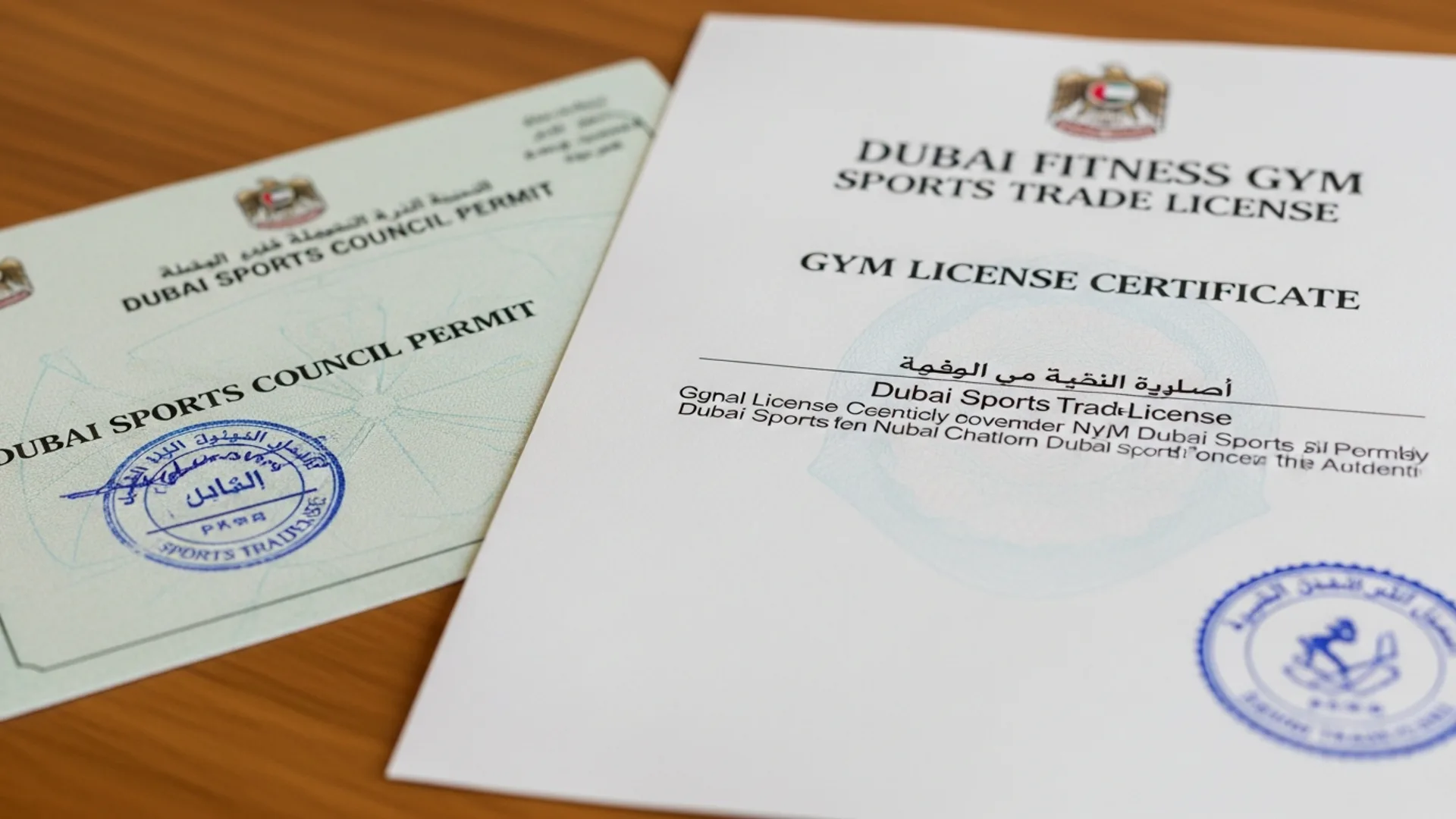
Dubai Sports Council (DSC) is the regulator for all sports and fitness facilities in Dubai. Established by Decree 9 of 2005 and reformed in 2017 and 2022, DSC issues the sports facility license that operates parallel to the DET commercial license.
DSC approval is mandatory before you can open. The approval covers:
- Facility safety — minimum space per equipment, structural load capacity, ventilation rate, lighting levels
- Equipment compliance — only DSC-approved manufacturers and models, with maintenance log requirements
- Trainer qualifications — internationally recognised certifications, DSC trainer license per trainer
- Hygiene and sanitation — cleaning protocols, locker room standards, swimming pool standards (where applicable)
- Capacity calculations — maximum simultaneous users based on space and equipment
- Insurance — minimum public liability and employer's liability coverage
- Emergency protocols — AED location and accessibility, staff first aid certification
The DSC inspection takes place after fit-out is complete and before opening. Inspectors check equipment installations, safety signage, fire extinguishers, emergency exits, and trainer credentials. Failure to clear DSC inspection is the single biggest reason gym openings are delayed in Dubai 2026 — facilities sit empty for 3–8 weeks while corrections are made.
For DSC application requirements check the Dubai Sports Council at https://dsc.gov.ae/. For DET commercial license rules see https://www.det.gov.ae/ and Dubai Municipality at https://www.dm.gov.ae/.
The real cost of a fitness studio license in Dubai 2026
Here is the line-item breakdown for the government-paid portion of opening a 200 sqm boutique fitness studio in Dubai mainland.
| Line item | AED (2026) | Who collects it |
|---|---|---|
| Trade name reservation | 620 | DET |
| Initial approval | 235 | DET |
| Commercial license fee, sports class | 16,000–22,000 | DET |
| Each extra activity code beyond 3 | 500–1,500 | DET |
| Establishment card | 600 | GDRFA |
| Tasheel labour file | 2,000 | MOHRE |
| Ejari tenancy registration | 220 | RERA |
| Dubai Municipality clearance | 2,500–5,500 | Dubai Municipality |
| Civil Defence approval | 1,200–3,500 | Civil Defence |
| DSC sports facility license | 4,500–12,000 | Dubai Sports Council |
| DSC trainer license (per trainer) | 1,500–3,000 each | Dubai Sports Council |
| Public liability insurance (year 1) | 4,500–22,000 | Insurer |
| Total government and insurance cost | AED 36,375–84,355 |
This excludes equipment, rent, fit-out, salaries and marketing. Those typically run AED 350K–1.5M in year one. The license layer alone is AED 22K–55K of the total above.
Costs founders underestimate
- Equipment. Commercial-grade cardio (Life Fitness, Technogym, Matrix) at AED 18,000–55,000 per machine. Strength (racks, plates, dumbbells) AED 150,000–350,000 for a mid-size facility. Functional gear (rigs, slam balls, kettlebells) AED 35,000–80,000. Group fitness studio mirrors, sound system, lighting AED 25,000–80,000.
- Fit-out. Flooring (commercial gym tile or rubber) AED 220–450 per sqm. Mirrors, paint, signage. AED 150,000–600,000 total fit-out budget for a mid-size facility.
- Trainer salaries. Senior trainer AED 8,000–18,000/month. Mid-level trainer AED 5,000–9,500. Junior or group instructor AED 3,500–6,500. Add visa cost AED 5,500–7,500 per trainer per visa cycle.
- Marketing. Pre-opening marketing AED 30,000–120,000. Ongoing digital and influencer AED 15,000–60,000/month.
- Class management software. Mindbody, Zen Planner, Glofox at AED 800–4,500/month depending on member count.
Activity codes for fitness facilities in 2026
DET has specific codes for sports and fitness. Pick those that match what you actually offer.
| Code | Activity | Use case |
|---|---|---|
| 9311.01 | Sports Facilities Operating Activities | Main code for any gym or studio |
| 9311.02 | Fitness Center | Boutique studios, group fitness |
| 9319.10 | Specialised Sports Activities | CrossFit, MMA, climbing, etc. |
| 8551.01 | Sports Education and Training | Personal training, coaching |
| 8551.03 | Yoga Training | Yoga studios specifically |
| 8551.05 | Martial Arts Training | MMA, BJJ, karate, taekwondo |
| 9329.01 | Spa and Massage Services | Spa add-ons to fitness |
| 4763.07 | Sports Equipment Trading | Pro shop, retail merchandising |
A typical setup for a boutique fitness studio: 9311.01 + 9311.02 + 8551.01 + 4763.07. This covers the facility operation, fitness centre service, training delivery, and retail merchandise (sports drinks, supplements, branded apparel).
The full setup process — step by step
Step 1: Concept, location and lease (Week 1–3)
Define concept (boutique studio, mainstream gym, specialty), space requirement, target catchment. Look at 3–5 properties before signing. Negotiate 60–120 day fit-out grace period in the lease — DSC and DM approvals take time.
Step 2: Trade name and DET initial approval (Week 1)
Reserve trade name. Submit shareholder details and business plan to DET. Initial approval is typically 1–2 working days. For multi-shareholder structures, draft the MOA covering profit share, ownership of brand IP, and trainer exclusivity terms.
Step 3: Ejari registration (Week 2–3)
Register the tenancy through the Real Estate Regulatory Agency (RERA) Ejari system. AED 220 fee. One working day once contract is signed.
Step 4: DET commercial license issuance (Week 3)
With initial approval, MOA and Ejari in, DET issues the commercial license in 3–5 working days. Establishment card and MOHRE labour file follow within a week.
Step 5: Fit-out and equipment (Week 3–10)
Fit-out drawings submitted to Dubai Municipality. Equipment ordered. International equipment shipment is 4–8 weeks from order. Local supply from regional dealers is 2–4 weeks. Coordinate so equipment arrives just before fit-out completion — storing AED 600K of equipment for a month is expensive.
Step 6: Dubai Municipality and Civil Defence (Week 6–10)
DM clears the layout, signage, ventilation and waste. Civil Defence clears fire safety, emergency exits, hood and sprinkler installation where applicable. Both must be cleared before DSC will inspect.
Step 7: DSC sports facility license (Week 10–14)
Submit DSC application with DM clearance, Civil Defence approval, equipment list with manufacturer details, trainer credentials, insurance certificates, and class schedule. DSC inspection is on-site. Pass-rate first time is roughly 60% — corrections are typically equipment spacing, missing safety signage, or trainer certification gaps.
Step 8: Trainer visas and DSC trainer licenses (Week 11–16, parallel)
Each trainer needs a UAE work visa under your sponsorship plus a DSC trainer license. Visa is 3–4 weeks per trainer from offer letter to Emirates ID. DSC trainer license is 1–2 weeks once visa is stamped. Time these so trainers are licensed before opening day.
Step 9: Soft launch and grand opening (Week 14–18)
Friends and family soft launch 1–2 weeks before public opening. Member onboarding flow tested. Class booking software live. Insurance active. Trainers DSC-licensed. Then public opening.
Common mistakes that cost gym founders money
- Mistake 1: Signing the lease before scoping DSC space requirements. Founders sign a 350 sqm space for a CrossFit gym, then discover DSC requires 6 sqm per rig + 4 sqm per person at full capacity. The space caps at 32 simultaneous users instead of the 50 they planned for. Revenue ceiling drops 35%.
- Mistake 2: Buying budget equipment that fails DSC inspection. AED 22,000 saved on a generic Chinese treadmill becomes AED 22,000 lost when DSC rejects the model and you have to replace it before opening. Stick to approved brands: Life Fitness, Technogym, Matrix, Cybex, Precor, Hammer Strength.
- Mistake 3: Hiring trainers before visa quota is confirmed. Promise five trainer jobs, get three visas approved, lose two excellent candidates. MOHRE quota is linked to space — confirm before any offer letter.
- Mistake 4: Underbudgeting marketing. Build it and they will come is wrong for fitness. Boutique studios need AED 60,000–180,000 pre-opening marketing to fill the first month classes. Without that spend, opening month revenue is 20–35% of projection.
- Mistake 5: Ignoring class capacity utilisation math. A boutique studio with 12 classes/day × 18 attendees × AED 95 average ticket = AED 20,520/day potential = AED 615,600/month theoretical. Actual achieved is rarely above 55%. Build financials on 50% utilisation, not 100%.
Boutique studio vs full-service gym — the model that fits your capital
A boutique studio (Barry's, F45, Reformer) and a full-service gym (Fitness First, Gold's Gym) are different businesses with different economics.
| Model | Space | Capital (year 1) | Revenue model | Margin | Member count |
|---|---|---|---|---|---|
| Boutique HIIT or strength studio | 120–250 sqm | AED 350K–800K | Class packs, monthly unlimited | 30–45% | 200–500 active |
| Functional and PT studio | 80–180 sqm | AED 250K–600K | PT packages, semi-private | 35–55% | 50–200 active |
| Yoga or pilates studio | 80–150 sqm | AED 200K–450K | Monthly unlimited, drop-in | 25–40% | 150–400 active |
| Full-service mid-size gym | 400–800 sqm | AED 1.2M–3M | Monthly membership, PT addon | 18–28% | 800–2,500 active |
| Premium full-service | 800–1,500 sqm | AED 3M–7M | Premium membership, spa, PT | 22–32% | 1,500–4,000 active |
| Specialty (CrossFit, MMA) | 300–600 sqm | AED 600K–1.5M | Coaching packages, monthly | 30–45% | 200–600 active |
Boutique and functional studios have better margins and lower capital. Full-service gyms have higher revenue ceiling but more competitive market and higher capital intensity. Most new fitness operators in 2026 start with boutique or functional, then expand to a second location if the first proves out.
Trainer licensing — the practical reality
Every personal trainer and group instructor in your gym needs a DSC trainer license. The license requires:
- Internationally recognised certification (NASM, ACE, ACSM, ISSA, NSCA-CPT, REPs Level 3, Precision Nutrition for nutrition coaches, RYT-200 for yoga)
- Valid UAE work visa under your gym's sponsorship
- First aid certification (Red Cross or equivalent)
- Specialty certifications for specialty disciplines (kettlebell, Olympic lifting, mobility, etc.)
The DSC trainer license is per-trainer and per-gym. If a trainer changes gym, the license must be transferred. This creates a practical lock-in — trainers move less between gyms in Dubai than in other markets.
Trainer compensation in Dubai 2026 follows three common structures:
- Salary-only: AED 5,000–12,000/month, all PT revenue accrues to gym
- Commission-only: Trainer keeps 50–70% of PT revenue, gym takes 30–50%
- Hybrid: Base salary AED 3,500–6,500 + 30–50% commission on PT and class revenue
The hybrid model is most common and produces the best trainer retention. Pure commission attracts hustlers who churn quickly. Pure salary attracts maintenance trainers who don't drive new PT sales.
Insurance and liability for a Dubai gym
Dubai gym insurance covers three risk pools:
- Public liability — member injuries on premises. DSC mandates minimum AED 1 million coverage; AED 3–5 million is common for medium-size gyms. Premium: AED 4,500–18,000/year.
- Employer's liability — staff injuries during work. MOHRE-mandated. Premium: AED 2,000–6,500/year.
- Property and equipment — fit-out and equipment damage. Landlord often requires. Premium: AED 3,500–12,000/year for AED 400K–1.5M equipment value.
Personal training waivers signed by members are common but enforceability is limited under UAE law — they reduce friction but don't replace insurance. Treat insurance as non-negotiable, not optional.
Banking timeline for a fitness facility
Bank account opening for a gym typically takes 3–8 weeks. Banks ask for:
- DET commercial license, DSC license (or pending application), MOA
- Source of funds (initial capital and equipment investment)
- 6 months personal bank statements
- Business plan with member acquisition targets, breakeven analysis
- Equipment supplier invoices (helps demonstrate capital deployment)
- Lease agreement showing facility commitment
Most fitness facilities open accounts at Emirates NBD, Mashreq, or Wio. Wio is fastest (2–3 weeks) for under AED 1M capital. Emirates NBD provides better merchant services and recurring billing tools important for monthly membership models.
The monthly membership billing model creates banking complexity. You need a corporate account with recurring billing setup (Direct Debit Authorisation or stored card payments via Network International or PayTabs). Setup takes 2–4 weeks after the corporate account is approved.
Tax position for fitness facilities
UAE corporate tax at 9% applies to taxable profit above AED 375,000. Fitness facilities operate under standard rules — there is no free-zone qualifying-income shortcut for a Dubai mainland gym serving local members.
VAT at 5% applies to all membership fees, class packages, PT sessions and retail (merchandise, supplements). Register with the Federal Tax Authority at https://www.tax.gov.ae/ once 12-month turnover crosses AED 375,000. For most gyms this happens within months. Quarterly VAT filings.
A practical VAT note: members paying upfront annual memberships have VAT chargeable in full at point of sale, even though the service is consumed over 12 months. This creates a cash flow benefit for the gym (you collect VAT upfront) and an accounting requirement to track the unearned revenue properly.
What your first 90 days actually look like
Real timeline for a 200 sqm boutique HIIT studio in Dubai Marina:
- Days 1–14: Concept finalised, location toured, lease signed with 90-day fit-out grace. Trade name reserved. DET initial approval.
- Days 15–28: Commercial license issued. Equipment ordered. Architect engaged for fit-out drawings.
- Days 29–60: Fit-out construction. Equipment arrival and installation. Trainer recruitment and visa applications. Marketing campaign launches (pre-opening waitlist).
- Days 61–80: Dubai Municipality and Civil Defence inspections. DSC application submitted. Insurance bound. Class schedule finalised. Booking software live.
- Days 81–90: DSC inspection. Trainer DSC licenses issued. Soft launch to founding members and influencers. Final corrections. Public opening.
Faster than 75 days is rare. Slower than 120 days usually means equipment shipping delays or DSC inspection rejections requiring re-inspection.
Membership pricing and unit economics
Dubai fitness pricing in 2026 stratifies by segment:
- Mainstream gym — AED 250–550/month, AED 2,400–4,800 annual
- Boutique studio (HIIT, strength) — AED 700–1,500/month, AED 95–180 drop-in, 10-class pack AED 800–1,400
- Premium boutique (Barry's, Reformer-style pilates) — AED 1,200–2,200/month, AED 130–220 drop-in
- Specialty (CrossFit, MMA, climbing) — AED 550–1,400/month
- Yoga and pilates studio — AED 450–950/month, AED 80–140 drop-in
- PT-led functional studio — AED 4,000–25,000 per package, 8–24 sessions
Boutique studios typically achieve 50–65% revenue from monthly unlimited members, 25–35% from class packs, and 10–20% from PT and retail. Specialty gyms tilt more toward package and coaching revenue.
For a 200 sqm boutique HIIT studio: 350 active members at AED 1,200 monthly average = AED 420,000 monthly revenue. Minus AED 95,000 rent, AED 95,000 trainer payroll, AED 22,000 software and marketing, AED 18,000 other = AED 190,000 monthly contribution. Reasonable target by month 12.
A 700 sqm full-service gym: 1,800 active members at AED 380 monthly average = AED 684,000 monthly revenue. Minus AED 220,000 rent, AED 180,000 payroll, AED 45,000 marketing, AED 35,000 other = AED 204,000 monthly contribution. Higher revenue but similar dollar contribution due to higher overhead.
The boutique segment is more capital-efficient. Two boutique studios at AED 800K each produce more contribution than one full-service gym at AED 1.6M.
What changes if you are foreign-owned vs UAE-resident
License process is identical. Foreign founders need an entry permit + medical + Emirates ID + visa stamping cycle adding 2–3 weeks. 100% foreign ownership applies to the Sports Facilities Operating Activities class under the 2021 amendment. No UAE partner required.
UAE-resident founders typically have faster bank account approval (existing KYC) and faster trainer-quota approval (MOHRE has their employment history).
When to add a second location
Most successful boutique fitness operators in Dubai consider a second location once the first has stabilised at 75%+ class utilisation and AED 350,000+ monthly contribution for at least four consecutive months. Going too early dilutes brand quality, splits founder attention and stretches capital. Going too late hands the catchment to a competitor opening nearby. The right window for location two is typically months 14–24 from opening location one.
What to do next
If you have decided on concept and have a target catchment, the next step is location scouting and lease negotiation with the fit-out grace period built in correctly. We have helped boutique studios, CrossFit affiliates and full-service gyms launch in Dubai across multiple districts. The license is the easy part — DSC compliance, equipment selection and trainer recruitment are where most opens stall. A 20-minute call clarifies whether your concept and capital match the realistic Dubai fitness market, and what the right activity code mix and license path look like.
Related Noble Core deep-dives
Companion guides for founders working on fitness studio setup or adjacent topics:
- Beauty salon license Dubai — adjacent service business in personal care
- Medical clinic license Dubai — regulated facility setup
- Dubai mainland license cost breakdown — mainland licensing for facility businesses
Talk to Our Experts
Open your Dubai fitness studio or gym with all approvals handled end-to-end. DET license, Dubai Sports Council certification, Dubai Municipality, Civil Defence, trainer registration. Free 20-minute consultation.
Frequently Asked Questions
How much does it cost to open a gym or fitness studio in Dubai in 2026?
A Dubai gym or fitness studio license costs AED 22,000 to 55,000 in 2026 including DET commercial license, Dubai Sports Council (DSC) sports facility approval, Dubai Municipality clearance, Civil Defence and Ejari. Real first-year total (rent, equipment, trainer visas) is AED 350,000 to 1.5 million depending on concept and size.
What is Dubai Sports Council (DSC) approval and is it mandatory?
Yes. Every fitness facility in Dubai must obtain a DSC sports facility license in addition to the DET commercial license. DSC inspects equipment, safety, trainer qualifications, ventilation, hygiene and capacity. Without DSC approval the DET license is conditional and you cannot legally open. Approval takes 2–4 weeks after physical inspection.
Do trainers need a separate license in Dubai?
Yes. Personal trainers and group fitness instructors require a DSC-issued Trainer License. To qualify the trainer needs an internationally recognised certification (NASM, ACE, ACSM, REPs Level 3, ISSA, NSCA-CPT, or equivalent) plus a UAE work visa under your gym’s sponsorship. Trainer license costs AED 1,500–3,000 per year per trainer.
What activity codes do I need for a gym or fitness studio license?
The main DET activity code is 9311.01 (Sports Facilities Operating Activities). Most gyms also add 9311.02 (Fitness Center) and 8551.01 (Sports Education) for training and class instruction. Cross-fit gyms add 9319.10 (Specialised Sports Activities). Yoga and pilates studios use 9311.02 plus 8551.03 (Yoga Training).
Can I open a gym in a Dubai free zone?
Limited. Most free zones do not offer sports facility licenses because the activity requires DSC approval and DSC primarily licenses mainland and gated-community facilities. JAFZA and Meydan offer limited fitness centre options inside their gated complexes. For a public gym serving Dubai residents the only viable path is DET mainland with DSC approval.
How much space do I need for a gym in Dubai?
Minimum 80–120 sqm for a small functional studio, 250–450 sqm for a mid-sized gym, 600–1,500 sqm for a full-service health club. DSC has minimum space per equipment ratio (typically 4–6 sqm per machine) and requires changing rooms, toilets, showers and a reception area. The space requirement is the single biggest cost driver.
What insurance is required for a Dubai gym?
Public liability insurance (minimum AED 1–5 million coverage) is mandatory under DSC rules. Employer’s liability for trainers and staff is required by MOHRE. Many landlords additionally require property insurance for fit-out and equipment. Total annual insurance cost: AED 4,500–22,000 depending on facility size.
How long does it take to open a gym in Dubai?
Plan for 10 to 18 weeks. License is 3–5 days. Equipment ordering and shipment is 4–8 weeks. Fit-out and Dubai Municipality clearance is 4–8 weeks. DSC inspection and approval is 2–4 weeks. Trainer visas add 3–4 weeks per trainer. The DSC inspection is often the binding constraint — it cannot start until fit-out is complete.
Contact Us For Free Consultation
Licensed UAE consultancy. One reply, no spam.
Thank you.
A consultant will reply on WhatsApp shortly.