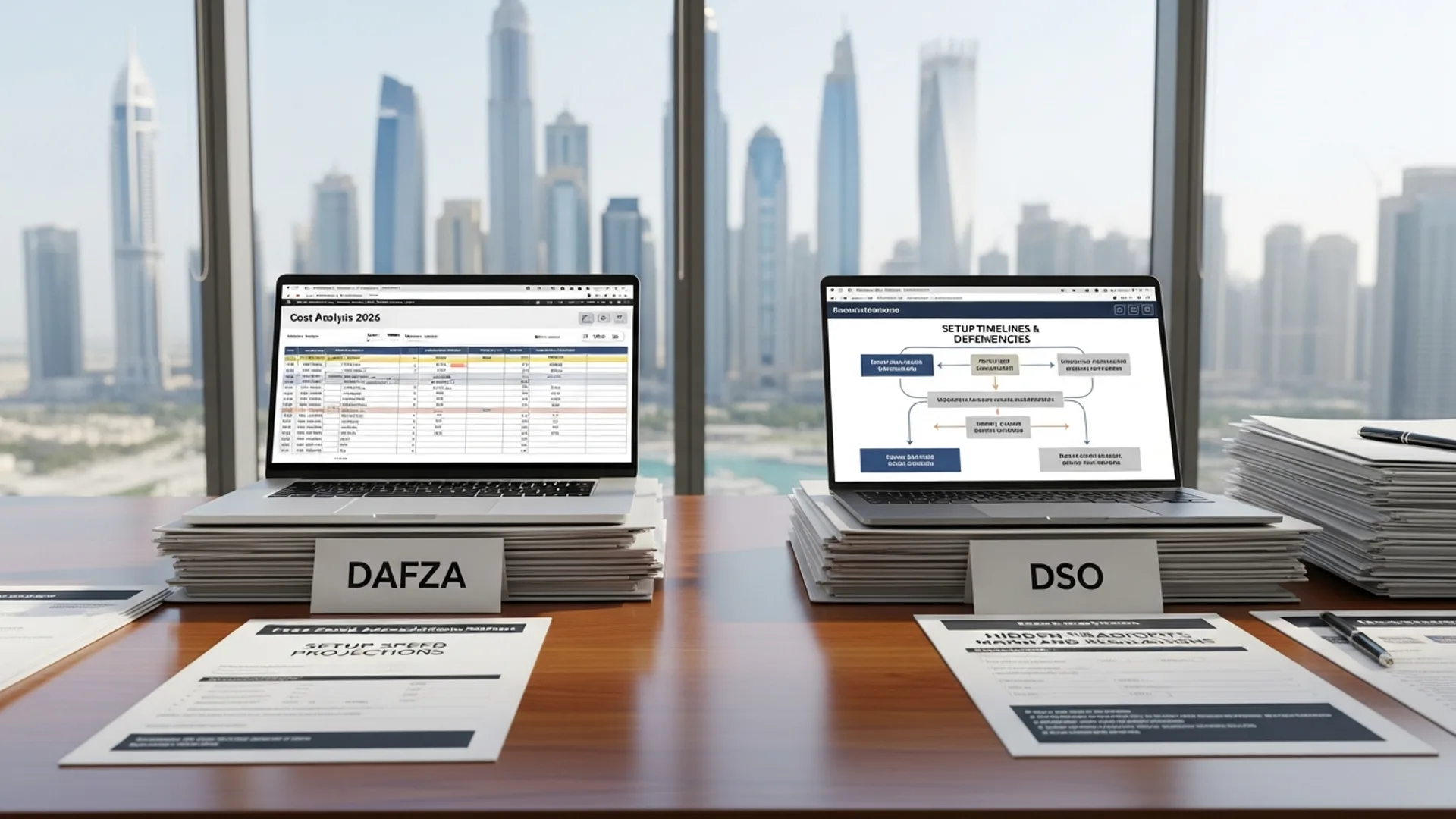
DAFZA costs AED 5,750 with a 10-day setup and 2-week visa approval; DSO averages AED 8,500 with a 15-day setup and 3-week visa processing. Neither has corporate tax below AED 375K annual profit (2026 rule), but both offer 100% foreign ownership and zero personal income tax. Choosing between them hinges on your industry, team size, and visa timeline urgency—not just the setup fee.
Your setup cost, in 10 seconds
Package prices. Health insurance is required by law and not included.
Thank you.
Your written quote follows on WhatsApp.
DAFZA vs DSO: Year-1 Cost Breakdown
| Cost Item | DAFZA (AED) | DSO (AED) | Notes |
|---|---|---|---|
| Licensing Fee (1 year) | 5,750 | 8,500 | DAFZA trade license; DSO business license + tech surcharge |
| Office/Unit Rent (annual, minimum) | 12,000 | 18,000 | DAFZA: 100–150 sqm shared office. DSO: 80–120 sqm tech office, higher per-sqm |
| Visa (1st employee, 2-year) | 3,500–4,200 | 3,500–4,200 | Same fee; DAFZA processes 2 weeks faster |
| Deposit (refundable, 1-3 yrs) | 5,000 | 5,000 | Security deposit on trade license; returned on exit |
| Bank Account Setup & Compliance | 0–1,500 | 0–2,000 | DSO may charge extra for tech-sector due diligence |
| Documentation & Attestation | 1,000–1,500 | 1,500–2,000 | Passport copies, contracts, MOFA attestation if needed |
| Corporate Tax (9%, on profits above AED 375K) | 0 (below threshold) | 0 (below threshold) | 2026 rule: only if annual profit >AED 375K. Both zones apply same rate. |
| Renewal (Year 2+) | 5,750 | 8,500 | Annual license renewal; visa renewal ~AED 1,400/yr per staff |
| TOTAL YEAR 1 (Solo + 1 employee, shared office) | AED 33,000–35,450 | AED 45,500–49,700 | Excludes accountant/legal; assumes no additional staff |
Related: verified UAE free zone costs
Our cost research checks what each authority actually publishes, so you can compare like with like:
- Dafza free zone — DAFZA — visa quotas by office size
10-Factor Comparison: DAFZA vs DSO vs Alternatives
| Factor | DAFZA | DSO | DMCC | IFZA (Ajman) |
|---|---|---|---|---|
| License Cost (Yr 1) | AED 5,750 | AED 8,500 | AED 7,500–12,000 | AED 4,500–6,000 |
| Setup Timeline (days) | 10–12 | 15–18 | 14–21 | 7–10 |
| Visa Approval (days) | 14 | 21 | 21–28 | 14 |
| Office Space (sqm/min) | 100–150 | 80–120 | 50–100 | 100–150 |
| Foreign Ownership % | 100% | 100% | 100% | 100% |
| Industry Focus | Trading, logistics, general | Tech, software, digital | Precious metals, trading | General (all sectors) |
| Personal Income Tax | 0% | 0% | 0% | 0% |
| Corporate Tax Exemption | 9% over AED 375K | 9% over AED 375K | 9% over AED 375K | 9% over AED 375K |
| Visa Quota per License | 1 sponsorship tier varies | 1–2 (tech tier higher) | 2–4 (higher tier) | 1–2 |
| Reputation/Brand Value | Established, logistics hub | Premium tech ecosystem | Highest tier globally | Good value, lower profile |
What Makes DAFZA & DSO Different: Honest Breakdown
DAFZA: The Logistics & Trading Play
DAFZA (Deira Free Zone Authority) is managed by the Dubai Department of Economy and Tourism (DET) and sits in Deira, Dubai’s historic port district. It’s the cheaper option at AED 5,750/year because it caters to commodity traders, logistics operators, and general importers. Setup is the fastest in the comparison (10–12 days) because the authority has streamlined processes for volume-based licensing.
Real advantage: DAFZA’s visa queue is processed faster (14 days vs DSO’s 21 days) because the free zone handles fewer high-compliance applications. If you’re sponsoring your first employee and need a residence visa urgently (say, within 4 weeks total), DAFZA wins. The office space is typically larger shared units in warehouse-style buildings—not glamorous, but functional and cheap (AED 12,000–15,000/year for 100–150 sqm).
Hidden caveat: DAFZA doesn’t offer dedicated tech infrastructure (no high-speed fiber guarantees, no co-working networks). If your business relies on cloud services, you’ll want independent VSAT or fiber verification. Also, DAFZA’s visa sponsorship quota is pegged to your trade license tier—a basic license typically allows 1 visa; upgrading to a higher tier adds 1–2 more but costs AED 2,500–3,000 extra.
DSO: The Tech-First Ecosystem
Dubai Silicon Oasis is marketed as a technology free zone and managed as a separate entity under DET. It costs more (AED 8,500 base license + AED 18,000–25,000 annual office rent) because you’re paying for curated networking, tech infrastructure, and a brand that signals “innovation.” DSO is where SaaS founders, app developers, digital agencies, and e-commerce platforms tend to cluster.
Real advantage: If your co-founder or investor base is tech-savvy or international, DSO’s address carries implicit credibility. The free zone also offers co-working amenities, event space, and regular networking sessions—genuine value for a startup that needs to build partnerships. Fiber speeds are guaranteed at 1Gbps+ with dedicated support.
Hidden caveat: DSO’s visa processing is slower (21 days) because the zone applies stricter KYC rules for tech companies (DT and ADIB scrutinize funding sources more closely). Also, DSO’s office leases are typically 2–3 year minimums; you can’t month-to-month like some DAFZA sub-tenants. If you hire a second employee, DSO’s visa tier bumps to 2 visas, but you’ll need to prove sustained revenue or comply with additional due diligence from Dubai’s Cybercrimes Directorate.
2026 Corporate Tax Reality: Both Zones Are Equal
Under the Federal Tax Authority (FTA) rules for 2026, both DAFZA and DSO apply the same 9% corporate tax on annual profit above AED 375,000. This is a common myth: founders think free zones exempt you from corporate tax. They don’t. You’re exempt up to AED 375K in profit; above that, you owe 9%. This applies equally whether you’re in DAFZA, DSO, IFZA, or DMCC.
What does change by zone is the filing complexity and residency requirement. DAFZA and DSO both require you to maintain a physical office and active business operations in the zone (no dormant licenses). If you’re a solopreneur, you can work from your registered office address; no requirement to hire staff. However, if you’re scaling to 3+ employees, you’ll need a larger office, which impacts your real estate cost more in DSO than DAFZA.
Visa Sponsorship: The Overlooked Bottleneck
This is where the real hidden cost emerges. Both zones allow you to sponsor visas (residence permits), but the quota and timeline differ:
- DAFZA: Sponsorship eligibility starts with 1 visa on a basic trade license (AED 5,750). To sponsor a 2nd visa, you must upgrade to a “company” tier license (AED 8,000–9,500 annually), adding cost and paperwork. Visa approval: 14 days after submission.
- DSO: Tech businesses can sponsor up to 2 visas on a standard license. However, Dubai’s Department of Human Resources (DHR) and the Ministry of Human Resources and Emiratisation (MOHRE) now require proof of minimum monthly salary (AED 3,000+ per visa). Visa approval: 21 days.
Cost implication: If you’re hiring your first employee and need the visa fast, DAFZA is 7 days quicker and costs AED 2,250 less in year 1 (AED 5,750 vs 8,500). If you’re planning a 3-person team by month 4, DAFZA forces an upgrade halfway through the year (unexpected AED 2,750 invoice), whereas DSO’s base license already covers 2 visas upfront.
Setup Timeline: Where DAFZA Wins (And Where It Doesn’t)
DAFZA is objectively faster for the first 10 days:
| Stage | DAFZA (days) | DSO (days) | Notes |
|---|---|---|---|
| Application submission to license approval | 3–5 | 5–7 | DSO performs additional tech-sector due diligence |
| Physical office activation | 2–3 | 3–5 | DAFZA has more sub-tenants; DSO offices need IT setup |
| Bank account opening | 5–7 | 7–10 | Same banks (FAB, ADIB); DSO accounts flagged for extra AML checks |
| Visa application to approval (1st employee) | 14 | 21 | DAFZA processes via DET; DSO via MOHRE + extra vetting |
| TOTAL (license + 1st visa ready to use) | 24–29 days | 36–42 days | Real-world: add 3–5 days for document courier delays |
One critical caveat: Both zones require your office to be “ready for occupation” before visa approval. If you’re renting a sub-unit in DAFZA, the landlord may hold keys until AED 5,000–10,000 is deposited. This isn’t part of the official timeline but delays actual occupancy 2–3 extra days. DSO offices are typically turn-key, so this is less of an issue.
Which Zone Is Right for Your Business?
Choose DAFZA If:
- You’re in trading, import-export, logistics, or wholesale distribution.
- You need your first visa approved within 4 weeks and budget is tight.
- You’re a solo founder with no immediate hires planned for 6+ months.
- You want a lower-profile address (Deira is not as trendy as DSO) but lower cost.
- Your clients are regional B2B (Middle East, Asia); they don’t care about a “tech” zone address.
Choose DSO If:
- Your business is software, SaaS, digital services, mobile apps, or e-commerce.
- You’re raising venture capital or pitching to international investors; the DSO address carries brand credibility.
- You plan to hire 2+ people in year 1 and want visa flexibility built in.
- You need guaranteed high-speed internet, co-working space, or networking events.
- Your budget allows AED 45K–55K for year 1 (office + license + visa); cost isn’t the primary driver.
Consider IFZA (Ajman) or DMCC If:
- IFZA: Lowest cost (AED 4,500–6,000) and equal visa speed to DAFZA, but further from Dubai. Best for remote teams or businesses that don’t need a physical customer footprint.
- DMCC: Premium tier—highest visa quota (4+), strongest international reputation, but AED 12,000+ year 1 and stricter compliance. Only if you’re serious about scaling or trading high-value goods.
Contact Us For Free Consultation
or
Ask on WhatsApp insteadLicensed UAE consultancy. One reply, no spam.
Thank you.
A consultant will reply on WhatsApp shortly.
Common Mistakes When Choosing Between DAFZA & DSO
- Mistake 1: Assuming free zones are tax-exempt. You owe 9% corporate tax on profit above AED 375K in both zones. Under-reporting due to this misconception triggers FTA audits. Consequence: back taxes + 5–10% penalty.
- Mistake 2: Choosing based on cost alone, ignoring visa quotas. A founder hires 2 people in month 6 expecting DSO to support both under the base license, but DAFZA requires a license upgrade (AED 2,750 extra). Consequence: emergency cash outlay + 5-day visa delay.
- Mistake 3: Not verifying office space lease terms. Many DAFZA sub-tenants have 1-year minimum leases; early exit costs 50% forfeiture. DSO offices often lock 2–3 year terms. Consequence: stuck in an unprofitable location.
- Mistake 4: Underestimating visa sponsorship salary requirements. MOHRE now requires AED 3,000+/month minimum salary per visa. If you try to sponsor a part-time hire at AED 2,000, the visa is rejected. Consequence: rehire delay, lost team momentum.
- Mistake 5: Expecting DSO’s “tech” label to land clients automatically. DSO’s reputation doesn’t convert sales; your product does. Paying extra for a prestige address doesn’t replace marketing. Consequence: wasted AED 40K in year 1 vs DAFZA with no ROI increase.
- Mistake 6: Ignoring FTA corporate tax filing timeline. Free zone companies must file corporate tax returns by June 30 annually (2026 rule). Failure triggers a fine of AED 5,000+ per month late. Consequence: cumulative penalties exceed the tax owed.
- Mistake 7: Not budgeting for office upgrade when scaling. A solo founder in a shared DAFZA office can’t add 2 employees to the same 100-sqm unit. Upgrading to 200 sqm costs AED 25,000+. Consequence: forced relocation mid-year, visa paperwork chaos.
- Mistake 8: Confusing “visa approval” with “residence visa ready.” Even after FTA/MOHRE approves the visa in 14 days (DAFZA) or 21 days (DSO), the employee still needs to exit the UAE and re-enter for activation (if on a visit visa). Consequence: hidden 2-week delay not accounted for in your hiring timeline.
2026 Regulatory Context: What Changed & What Stays the Same
In April 2026, the Federal Tax Authority (FTA) confirmed that free zone corporate tax rules remain unchanged: 9% on profits above AED 375,000. However, two new wrinkles emerged:
- Personal visa quotas are now zone-specific. DAFZA and DSO cannot “bank” visas across multiple years. If you don’t use a visa quota in 2026, it doesn’t roll over to 2027. This incentivizes founders to hire or lose the opportunity.
- Tax Authority introduced “beneficial ownership” reporting. Both DAFZA and DSO now require annual beneficial ownership disclosure (Form MOE-36). Failure to file triggers a fine of AED 10,000 per zone per year starting 2027.
For most small teams (1–5 people), these changes don’t add cost, but they do add compliance overhead. Budget AED 1,500–2,500/year for tax filing and beneficial ownership paperwork if you’re not using an accountant.
The Real Differentiator: Your Hiring Timeline
Here’s the honest truth: the choice between DAFZA and DSO comes down to one question: When do you need your first employee sponsored?
- Within 4 weeks: DAFZA. You’ll have visa approval 7 days faster, saving 1 week of onboarding delays.
- By month 3–4: Either zone works equally well; cost and brand alignment matter more.
- By month 6+ with 2+ hires: DSO. The base license already covers 2 visas; DAFZA forces an upgrade, adding cost and complexity mid-year.
- Bootstrapped, no hires planned: DAFZA. Save the AED 12,500 year-1 difference and reinvest in product.
If you’re raising funding or want investor-friendly optics, DSO’s address and ecosystem justify the premium. If you’re bootstrapped and time-to-revenue is the metric, DAFZA wins on cost and speed.
Hidden Cost Alert: Renewal & Compliance in Year 2
Most founders focus on year 1, but renewals introduce surprises:
- DAFZA renewal: AED 5,750 + office rent (increases ~5–8% annually) + visa renewal (AED 1,400 per person per 2-year cycle). Year 2 total: AED 25,000–28,000.
- DSO renewal: AED 8,500 + office rent (higher base, similar 5–8% increase) + visa renewal. Year 2 total: AED 35,000–40,000.
- New in 2026: Both zones now require annual beneficial ownership declaration (Form MOE-36). Non-filing = AED 10,000 fine. If you use a registered agent or accountant to file, budget AED 1,500–2,000 extra.
This is why DAFZA’s year-1 savings (AED 12K+) matter less if you’re in it for 3+ years; the gap narrows as office rents converge. However, DAFZA’s visa upgrade avoidance saves money if you stay under 2 employees.
Pro Tip: Negotiating Office Rent in DAFZA vs DSO
DAFZA offices are often sub-letted by larger trading companies; landlords have more flexibility and may offer 3-month free periods or rate discounts for annual upfront payment. DSO offices are managed by the authority or branded co-working spaces; rates are fixed, but you get service guarantees (internet, utilities, reception). If cash flow is tight in month 1, DAFZA sub-tenants may waive the first 2 months’ rent if you sign a 2-year lease. DSO won’t.
How Noble Core Ventures Can Help You Choose
Navigating DAFZA vs DSO involves tax planning, visa strategy, and financial modeling. Noble Core Ventures’ UAE business setup guides include personalized zone recommendations based on your industry, team size, and funding status. We also help with visa quota planning to avoid mid-year surprises and tax compliance setups to prevent FTA issues. If you’re ready to launch in 2026, we recommend a 15-minute call to map your hiring timeline against zone visa quotas; it’ll save you thousands in avoidable costs and weeks of delays.
Additionally, if you’re comparing free zones beyond DAFZA and DSO, our complete guide to UAE free zones in 2026 covers IFZA, DMCC, and emerging options in Ras Al Khaimah and Fujairah, so you can benchmark all costs and timelines in one place.
Bottom Line: DAFZA vs DSO Decision Matrix
DAFZA wins if: Cost + speed matter more than prestige. You’re trading/logistics. Visa approval deadline is tight. Budget under AED 40K year 1.
DSO wins if: You’re tech/SaaS. Investors expect a premium address. You’ll hire 2+ people by month 6. Budget AED 50K+ year 1 comfortably.
Truth: Both are legitimate. Neither is a “trap.” The difference in real cost over 3 years is ~AED 60K–80K. If your business generates AED 500K+ revenue annually, zone choice is noise compared to execution quality. Choose based on your actual hiring plan and industry fit, not on internet debates.
Talk to Our Experts
Get end-to-end support from a Noble Core advisor — license, visas, banking, FTA and federal approvals handled for you. Free 20-minute consultation.
Frequently Asked Questions
What’s the real difference in cost between DAFZA and DSO?
DAFZA costs AED 5,750/year for licensing vs DSO’s AED 8,500, a difference of AED 2,750. However, office rent in DAFZA averages AED 12,000–15,000/year (shared space) vs DSO’s AED 18,000–25,000/year, making the year-1 total gap about AED 12,000–15,000 combined. DAFZA is the cheaper option if you’re bootstrapped and solo; DSO’s premium justifies itself only if you’re raising funding or prioritize tech networking.
Which zone processes visas faster?
DAFZA approves visas in 14 days; DSO takes 21 days. The difference exists because DAFZA (managed by Dubai Department of Economy and Tourism) uses streamlined logistics-sector vetting, while DSO requires additional tech-sector due diligence from cybercrime and AML teams. If your visa deadline is critical, DAFZA saves a full week.
Do I pay corporate tax in DAFZA or DSO?
Yes, both zones are subject to the 9% corporate tax on annual profit above AED 375,000 (2026 FTA rule). Below AED 375K, you pay zero corporate tax. The zone itself doesn’t exempt you; the profit threshold does. Personal income tax is 0% in both zones regardless of profit level.
How many employees can I sponsor in each zone?
DAFZA: typically 1 visa on a basic trade license; upgrading to a company license adds 1–2 more visas but costs AED 2,750–3,000 extra. DSO: 2 visas on a standard tech license. If you need 3+ visas, DSO requires an additional investment or a higher-tier license. Plan your hiring timeline accordingly to avoid mid-year license upgrades.
What’s the hidden catch with DSO’s ‘tech zone’ branding?
DSO’s address doesn’t convert sales or replace marketing. Many founders overpay for prestige expecting investor interest; instead, they spend AED 40K+ in year 1 with no revenue increase vs DAFZA. The real value is networking and infrastructure (guaranteed 1Gbps internet, co-working events). If you’re not actively using those benefits, DAFZA is smarter financially.
Can I switch from DAFZA to DSO mid-year without penalties?
Technically yes, but it’s costly and slow. You’d need to cancel your DAFZA license (losing the AED 5,000 refundable deposit and paying AED 1,500–2,000 exit fees), then re-apply for DSO (15–18 days setup + 21-day visa reprocessing). Total timeline: 5+ weeks + AED 8,000–10,000 extra cost. Better to choose correctly from the start based on your hiring plan.
Is DAFZA’s office space really ‘warehouse-style’?
Yes, most DAFZA units are sub-letted shared spaces in logistics/trading buildings—functional but not designed for client meetings. DSO offices are branded co-working suites with reception areas, which matters if you’re hosting investors or clients. If your business is 100% B2B or remote, DAFZA’s ‘warehouse’ vibe doesn’t hurt. If you pitch clients or raise capital, DSO’s appearance pays for itself.
What happens if my business doesn’t file the 2026 beneficial ownership form (MOE-36)?
Both zones now require annual beneficial ownership disclosure (Form MOE-36) starting 2026. Failure to file triggers a fine of AED 10,000 per zone per year. This is a new compliance requirement, not a free zone preference issue—both DAFZA and DSO apply it equally. Budget AED 1,500–2,500/year for compliance if you’re not using an accountant.