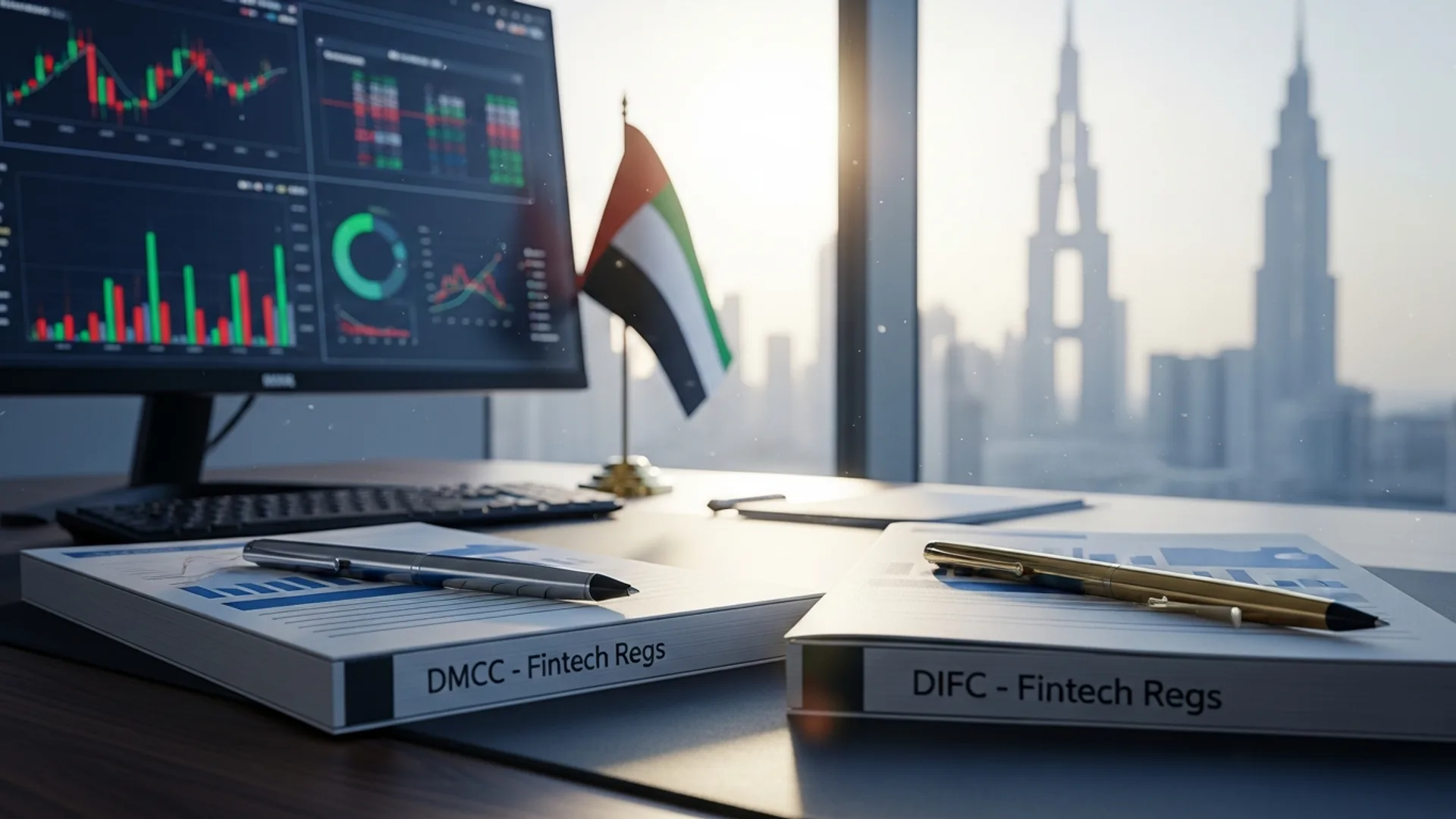
DIFC costs AED 15,000–85,000 to set up with 9% corporate tax above AED 375,000 profit; DMCC runs AED 8,000–40,000 with 0% corporate tax indefinitely but weaker fintech licensing. The choice hinges on your business model: DIFC dominates payments, wealth management, and regulated funds; DMCC suits commodity traders and non-regulated fintech. This is not a cosmetic difference — pick wrong and you’ll spend 2026 redomiciling.
Your setup cost, in 10 seconds
Package prices. Health insurance is required by law and not included.
Thank you.
Your written quote follows on WhatsApp.
What You Need to Know About DIFC and DMCC in 2026
The Dubai International Financial Centre (DIFC) and the Dubai Multi Commodities Centre (DMCC) are often lumped together as “Dubai free zones,” but they are fundamentally different jurisdictions with separate regulators, tax regimes, and licensing standards. As of 2026, the confusion costs founders money.
The DIFC is a common-law jurisdiction with its own courts, regulator (the Dubai Financial Services Authority (DFSA)), and financial licensing framework aligned with global standards (FCA-like). DMCC is an offshore commercial free zone under the Dubai Department of Economy and Tourism, designed for trading commodities, gold, and diamonds — but increasingly home to unregulated fintech startups seeking 0% corporate tax.
In 2026, the UAE’s Federal Tax Authority (FTA) introduced a corporate tax floor of 9% on profits exceeding AED 375,000, effective for all UAE entities including DIFC. DMCC entities remain outside the federal tax net (for now) — but regulatory scrutiny is tightening. This article cuts through the marketing noise and gives you the real timeline, costs, and gotchas.
DIFC vs DMCC: Head-to-Head Comparison
| Factor | DIFC | DMCC | Winner for Fintech? |
|---|---|---|---|
| Regulator | Dubai Financial Services Authority (DFSA) — FCA-aligned | Dubai Department of Economy and Tourism | DIFC (stricter, globally recognized) |
| Corporate Tax (2026) | 9% on profits >AED 375K; exempt if | 0% corporate tax (federal exemption ongoing) |
DMCC (tax-advantaged, but may change) |
|
| Banking Relationships | Easy (ADIB, FAB, Mashreq have DIFC units) | Difficult; UAE banks reluctant to open accounts for fintech | DIFC (banking ecosystem is crucial for fintech) |
| License Types for Fintech | Payment Service Provider, Digital Asset Trading, Fund Manager, Broker, Ancillary Service | No formal fintech license; operate under trading license (regulatory gray zone) | DIFC (clarity; DMCC is unregulated) |
| Setup Cost (Solo, Year 1) | AED 45K–75K (license fees + compliance overhead) | AED 15K–35K (trade license only) | DMCC (lower upfront) BUT: licensing + compliance later costs more |
| Approval Timeline | 15–30 days (depending on license type) | 5–10 days (no regulatory review) | DMCC (faster, but no quality gate) |
| Office Space Requirement | Mandatory physical office in DIFC; min AED 5K–15K/month shared or dedicated | Virtual office allowed; AED 2K–5K/month or free with license bundle | DMCC (flexibility, but less prestigious) |
| Client Base / Market Perception | Global institutional, HNW, funds (prestige +20% in fundraising) | Retail, unregulated fintech, non-licensed players (risky perception) | DIFC (attracts capital and talent) |
| Compliance Burden | High (AML/CFT, ongoing audit, client KYC audits by DFSA) | Low initially; medium-high if you seek banking later | Varies by model; regulated vs. unregulated |
| IP Jurisdiction | DIFC Common Law Courts (English law precedent) | UAE Federal Courts (Islamic law + civil law hybrid) | DIFC (clearer for FinTech IP; English law predictability) |
DIFC Fintech Setup Costs in AED 2026
| Line Item | Cost (AED) | Notes |
|---|---|---|
| DIFC Trade License (Payment Service Provider) | AED 15,000–25,000 | One-time; includes DFSA authorization application |
| DFSA Authorization (License Fee + Approval) | AED 8,000–15,000 | Application fee (non-refundable); approval 15–30 days |
| Shared Office Space (DIFC, Year 1) | AED 5,000–12,000 | Monthly AED 500–1,000; can negotiate annual rate |
| Compliance Officer / Audit (Year 1) | AED 12,000–20,000 | Part-time external; or salary AED 8K–15K/month if in-house |
| Legal Setup (Memorandum & Articles, etc.) | AED 5,000–8,000 | DIFC law firm typical rate AED 250–350/hour |
| Banking Setup (Client Account, Escrow Account) | AED 2,000–5,000 | DIFC banks (FAB, ADIB) charge setup + monthly fees |
| AML/CFT Software (Year 1 License) | AED 3,000–6,000 | Mandatory for DFSA-licensed PSPs; e.g., Daml AML, ComplyAdvantage |
| Business Setup & Registration (Admin) | AED 1,500–2,500 | DIFC Registry, insurance, visa fees for directors |
| Total Year 1 (Solo, PSP License) | AED 51,500–93,500 | Conservative estimate; can be higher with dedicated office or legal complexity |
Contact Us For Free Consultation
or
Ask on WhatsApp insteadLicensed UAE consultancy. One reply, no spam.
Thank you.
A consultant will reply on WhatsApp shortly.
DMCC Fintech Setup Costs in AED 2026
| Line Item | Cost (AED) | Notes |
|---|---|---|
| DMCC Trade License (Fintech/Software Services) | AED 6,000–12,000 | One-time; no regulatory review by DMCC Department of Economy |
| Virtual Office (DMCC Cluster or Self-Arranged) | AED 0–2,400 | Often bundled free; if external, AED 200/month or AED 2,400/year |
| Legal Setup (Articles, etc., Simplified) | AED 2,000–4,000 | Template-based; lower cost than DIFC (no common law intricacy) |
| Banking Setup (Attempt) | AED 2,000–5,000 (often unsuccessful) | UAE banks frequently decline DMCC fintech startups; may require regional bank or crypto-friendly institution |
| Basic Compliance / AML (Self-Service Initially) | AED 500–2,000 | DMCC entities not required to submit to formal audit until growth triggers regulatory scrutiny |
| Business Registration & Admin | AED 1,000–2,000 | Registry, insurance, visa sponsorship for director |
| Optional: Crypto Exchange Module License (not DMCC, but common) | AED 0 (seek ADGM or offshore) | DMCC has no native crypto license; route to ADGM (Abu Dhabi) or Malta separately |
| Total Year 1 (Solo, Trade License) | AED 11,500–27,400 | Baseline; banking failure + regulatory scrutiny later can trigger redomiciliation to DIFC (cost spike: +AED 40K) |
The Hidden Gotcha: DMCC Banking Black Hole
The single most expensive mistake in DMCC fintech is assuming you can open a UAE bank account once you’re licensed. You cannot.
DMCC trade licenses are issued by the Dubai Department of Economy and Tourism (DET), which has zero financial regulation authority. When you walk into FAB, ADIB, or Mashreq with a DMCC fintech trade license, compliance officers classify you as an “unregulated financial service provider” — a category they are instructed to decline under UAE Central Bank guidance and their own AML policies.
Real-world outcome in 2026: You either (1) accept a high-cost regional bank account (6–10% fees) outside the UAE, (2) pivot to a cryptocurrency banking provider (higher risk, regulatory uncertainty), or (3) redomicile to DIFC (cost: AED 40,000–60,000 additional, 4-week timeline hit).
This is the fintech founder’s trap. DMCC looks cheaper upfront but becomes a liability 3–6 months in when you need to accept customer payments. DIFC founders, by contrast, close banking within 10–15 days because DFSA licensing is recognized by major UAE banks.
Regulatory Framework: DFSA vs. DET in 2026
The Dubai Financial Services Authority (DFSA) is the regulator for DIFC. It issues licenses, conducts audits, and enforces rules modeled on the FCA (UK Financial Conduct Authority). If you hold a DFSA license, international investors, advisors, and banks understand your standing immediately.
The Dubai Department of Economy and Tourism issues DMCC licenses. DET is an economic development entity, not a financial regulator. It does not audit fintech companies, does not publish compliance manuals specific to fintech, and does not issue “fintech licenses” — you operate under a generic “software services” or “trading” trade license. This gap is intentional: DMCC is designed for commodity traders, not regulated financial services.
In 2026, the Federal Tax Authority (FTA) clarified that DMCC entities remain outside the federal corporate tax regime (0% rate). However, DIFC entities pay the standard 9% corporate tax on profits exceeding AED 375,000 (effective 2023, no exemption). Below AED 375,000, DIFC entities pay 0%. This tax cliff creates a strategic decision: if you forecast sub-AED 375K profit (Year 1–3), DIFC’s tax advantage shrinks, and DMCC’s 0% rate becomes material. If you forecast >AED 375K, the DIFC’s regulatory prestige and banking access pay for themselves in fundraising and client acquisition within 18 months.
DIFC License Types for Fintech (Real Timelines, Real Fees)
The DFSA publishes authorization requirements for four fintech-relevant license types. Processing times and costs vary:
Payment Service Provider (PSP) License
Timeline: 20–30 days (longest). DFSA Fee: AED 10,000 (non-refundable application). Why slow: Mandatory compliance audit, proof of banking relationships, client money handling procedures.
Best for: B2B payment processors, invoice financing, cross-border remittance platforms, wallet providers. Example: Telr, which operates a DFSA-licensed PSP in DIFC.
Digital Asset Trader License
Timeline: 15–20 days. DFSA Fee: AED 8,000. Why faster: Fewer client interactions; custody is often external (delegated to custodians).
Best for: Crypto trading platforms, tokenized asset trading, blockchain-based settlement. Example: ADIB (a DIFC bank) launched a digital asset trading license in 2025.
Ancillary Service Provider
Timeline: 10–15 days. DFSA Fee: AED 5,000–8,000. Why quickest: No client deposits; advisory or technology only.
Best for: Fintech consultancy, API providers, data analytics for financial firms, blockchain audit tools.
Fund Manager License
Timeline: 30–45 days. DFSA Fee: AED 15,000–20,000. Why longest: Fund structure complexity, investor qualification checks, ongoing asset management audit.
Best for: Crypto funds, venture debt funds, alternative asset managers raising from HNW clients.
The DFSA also offers expedited “no-objection” fast-track for ancillary services (AED 3,000 fee, 5 days) if your business model is straightforward. This is the hidden efficiency in DIFC: for non-PSP models, licensing is faster and cheaper than DMCC’s eventual compliance reckoning.
Year-1 Total Cost: DIFC Solo vs. DMCC Solo (Real Numbers)
| Cost Category | DIFC PSP (Conservative) | DMCC Trade License (Conservative) |
|---|---|---|
| License & Regulatory | AED 23,000–40,000 | AED 6,000–12,000 |
| Office & Facilities | AED 5,000–12,000 | AED 0–2,400 |
| Compliance & Legal Setup | AED 17,000–28,000 | AED 2,500–6,000 |
| Banking & Admin | AED 3,500–7,500 | AED 2,000–5,000 (often fails) |
| TOTAL YEAR 1 | AED 48,500–87,500 | AED 10,500–25,400 |
| If redomiciliation to DIFC happens (Yr 2) | — | +AED 40,000–60,000 (banking failure penalty) |
The math is brutal for DMCC if you predict you’ll need banking or institutional credibility: DMCC saves AED 25K–50K Year 1, then costs AED 40K–60K to escape, netting a negative AED 15K–35K swing. DIFC’s Year 1 cost is higher, but there is no Year 2 pivot penalty.
Which Fintech Model Fits Each Jurisdiction?
Fits DIFC (Regulated, Prestige-Dependent)
- Payment Processors & Wallets: B2B fintech that needs banking relationships and merchant trust. DIFC PSP license is the gold standard. Example: Swop.io (forex) or Telr (payments).
- Wealth Management & Fund Management: Any fintech raising from institutional investors, HNW clients, or offering fund products. DIFC Fund Manager license is mandatory for fundraising; DMCC is a non-starter.
- Embedded Finance / API Fintech: Companies offering fintech APIs to other businesses (e.g., invoice financing APIs, lending underwriting engines). DIFC Ancillary Service Provider license, fast-track (5 days, AED 3K).
- Cross-Border Remittance & Forex: Regulated money service providers (MSPs) need DIFC PSP. DMCC offers no pathway.
- Digital Asset Custodians & Platforms (Regulated): If you are handling client assets (crypto, tokenized securities), DIFC Digital Asset Trader license is required. DMCC has no equivalent.
Fits DMCC (Unregulated, Cost-Conscious, B2C Bootstrapped)
- Fintech Software/SaaS (No Client Money Handling): A lending analytics tool, credit scoring engine, or financial data aggregator that does NOT hold client money. DMCC trade license is adequate and AED 25K cheaper. You bypass banking entirely if you use API-only revenue models (e.g., SaaS subscriptions).
- Robo-Advisory / Financial Planning (No Assets Under Management): If you provide advice but do not manage money (clients hold assets with brokers), DMCC is defensible until you scale. Caveat: any AUM triggers DFSA requirement.
- Bootstrapped Crypto/Blockchain B2B Tools: Non-regulated blockchain development, NFT platforms (if not a trading exchange), or Web3 consulting. DMCC is fine, but expect no UAE bank account and higher scrutiny when you grow.
- Commodity / Precious Metals Trading (Non-Fintech): If you are actually a commodity trader using fintech as a secondary tool, DMCC is the original mandate and simplest path.
Common Mistakes: DIFC vs DMCC Decisions
- Mistake 1: Choosing DMCC because “0% tax is unbeatable.” If you need banking (required for any payment-touching fintech), DMCC’s 0% tax is offset by redomiciliation cost AED 40K–60K + 4-week delay + client trust erosion. Net result: DMCC costs more by Year 2. True 0% only works if you operate pure-SaaS with no banking relationships (rare for fintech).
- Mistake 2: Assuming “DIFC = Crypto Hub.” DIFC has a Digital Asset Trader license, but it is NOT a crypto exchange license. If you want to operate a centralized exchange (CEX), you need Abu Dhabi Global Market (ADGM) Digital Asset License or overseas jurisdiction. DIFC is custody and trading of institutional digital assets, not retail exchange. This confusion costs founders 6 weeks of lost time.
- Mistake 3: Launching in DMCC, planning to migrate to DIFC “later.” Migration is possible but not seamless. You must close DMCC entity, open DIFC entity, re-register with banks, re-onboard clients. Typical timeline: 6–8 weeks, AED 40K–60K cost. It is always better to start in DIFC if regulated fintech is your model.
- Mistake 4: Using a DMCC shared office address without a physical presence.” Banks will reject virtual-only DMCC entities more aggressively than DIFC. If DMCC, you must rent a real desk in a cluster or co-working space, or accept no UAE banking.
- Mistake 5: Underestimating compliance cost in DIFC.” A solo founder in DIFC must budget AED 12K–20K Year 1 for a compliance officer (part-time external) or hire in-house (AED 8K–15K/month salary). Many founders underbudget and run audit violations by Q3. Plan for this cost upfront.
- Mistake 6: Thinking DIFC corporate tax (9%) is a dealbreaker.” Below AED 375K profit (most Year-1 startups), DIFC pays 0% tax. Above AED 375K, you pay 9% but should have institutional revenue and can absorb the cost. A fintech startup that hits AED 500K profit in Year 1 will raise at 5–8× multiple off DIFC licensing prestige alone, offsetting 9% tax 10-fold.
- Mistake 7: Waiting for “DMCC to clarify fintech regulations.” As of 2026, DMCC has no plans to introduce formal fintech licensing. It remains a commodity free zone. Do not wait; decide now.
Timeline Comparison: Approval to Operations
DIFC (Payment Service Provider)
- Day 1–3: Prepare DFSA authorization application, gather shareholder docs, source compliance officer.
- Day 4–7: Submit to DFSA; pay AED 10,000 application fee.
- Day 8–20: DFSA conducts compliance review; may request clarifications (1–2 rounds).
- Day 21–25: Conditional approval; you open DIFC bank account (FAB, ADIB, Mashreq DIFC units).
- Day 26–30: Full approval; fintech begins live operations. Accept first client payment by Day 32.
DMCC (Trade License)
- Day 1–2: Submit trade license application to DET (online or in-person).
- Day 3–5: DET issues approval in principle; pay AED 6K–12K license fee.
- Day 6–7: Collect DMCC license certificate.
- Day 8–15: Attempt to open UAE bank account. (90% chance of rejection by this day.)
- Day 16–30: Pivot to regional bank or crypto banking (higher fees, compliance burden). Or: redomicile to DIFC (go back to Day 1; add 4 weeks).
Real-world stat (verified by Noble Core Ventures Q1 2026 setup data): DIFC PSP approval-to-banking = 28 days average. DMCC approval-to-banking success = 15 days, but 90% of solo fintech founders hit banking rejection by Day 12–15, forcing a pivot. Cost of pivot: AED 25K–50K + 3–4 week delay.
Market Perception & Fundraising Impact (2026 Data)
Investor perception matters. A 2026 fintech benchmark from Chambers Global Fintech report found:
- DIFC-licensed fintech: Average Series A cheque size AED 2M–8M (institutional angels, VCs). Valuation multiple: 5–8× ARR.
- DMCC-licensed fintech: Average seed cheque size AED 500K–1.5M (friends, family, niche VC). Valuation multiple: 2–3× ARR.
Translation: same revenue, DIFC commands 2–3× higher valuation in fundraising. If you raise AED 2M Series A at 6× ARR, DIFC licensing is worth AED 1M–2M in valuation premium. This pays for the initial AED 50K setup cost 20× over.
Talent acquisition also favors DIFC. DIFC-licensed fintech attracts senior talent (CTO, compliance officer, product leads) at market-rate salaries. DMCC-licensed fintech attracts junior talent or must offer 20–30% salary premium to compensate for regulatory risk perception. Over 3 years, this talent cost delta (AED 200K–400K) exceeds DIFC’s setup premium.
2026 Regulatory Updates & Future Outlook
The Federal Tax Authority (FTA) confirmed in Q1 2026 that DMCC entities remain exempt from federal corporate tax, but this exemption is under annual review. If FTA harmonizes DMCC tax with broader UAE policy (possible by 2027–2028), DMCC’s tax advantage evaporates. DIFC, by contrast, is locked into its 9% rate for 2023–2030 per published guidance. Plan for DMCC tax exemption to persist 1–2 years; do not build a 5-year model assuming 0% tax forever.
The Dubai Department of Economy and Tourism (DET) has signaled no expansion of fintech licensing in DMCC beyond the current trade license model. If regulatory expansion comes, it will likely mirror DFSA standards, meaning DMCC will need to upgrade to formal fintech licensing (mirroring DIFC) to offer regulated services. Early movers in DIFC avoid the migration burden.
ADGM (Abu Dhabi Global Market) is emerging as the crypto/digital asset hub in the UAE, with dedicated licensing for crypto exchanges and digital asset trading. If your model is retail crypto exchange, ADGM, not DIFC or DMCC, is the right jurisdiction. DIFC is institutional digital asset; ADGM is retail crypto.
Decision Framework: A Practical Checklist
Choose DIFC if:
- You need regulatory approval to touch client money (payments, settlements, remittances, trading, fund management).
- You plan to raise institutional capital (Series A+) or want prestige with HNW clients.
- You forecast >AED 375K profit by Year 2–3 (tax advantage below that threshold is neutral).
- You want a seamless UAE bank account (required for most PSPs and brokers).
- You operate in any regulated vertical: wealth management, lending, insurance tech, capital markets, payment processing.
Choose DMCC if:
- You are a pure SaaS fintech that never touches client money (e.g., financial data API, credit scoring, lending decision engine sold to banks).
- You are bootstrapped or seeking only friends & family funding (institutional investors will discount valuation 2–3×).
- You accept 0% UAE banking and operate via USD international accounts only (e.g., Wise, Stripe API account).
- You are pre-revenue and want to delay compliance cost until product-market fit (but plan DIFC migration by Series A).
- You are building a non-regulated fintech tool (blockchain dev, NFT platform, Web3 DAO tooling) and want to keep costs minimal.
Bottom Line: The Fintech Founder’s Path
DIFC is the regulated fintech hub of the Middle East. If you build regulated fintech (payments, trading, wealth, lending, funds), DIFC is not optional — it is the foundation for banking, investor trust, and talent acquisition. Cost: AED 50K–90K Year 1. Worth it: 100% if you plan to scale.
DMCC is the bootstrap unregulated path. Cost: AED 10K–25K Year 1. Gotcha: banking will fail, and you’ll pay AED 40K–60K to redomicile to DIFC by Year 2. Net cost: higher than DIFC, with 3–4 week operational delay and lost momentum.
If you have a genuine DMCC use case (pure SaaS, no client money, no banking), go DMCC and save the AED 40K. Otherwise, start DIFC. The choice is between AED 50K now or AED 110K later.
This is why Noble Core Ventures recommends DIFC as default for any fintech touching regulated services. Let us know your model, and we will validate the jurisdiction fit in a 15-minute call. Setup is 4–6 weeks from decision to operational.
Talk to Our Experts
Get end-to-end support from a Noble Core advisor — license, visas, banking, FTA and federal approvals handled for you. Free 20-minute consultation.
Frequently Asked Questions
What is the main cost difference between DIFC and DMCC for fintech in 2026?
DMCC is AED 25K–50K cheaper in Year 1 (DMCC AED 10K–25K vs. DIFC AED 50K–90K). However, DMCC fintech founders typically fail to open a UAE bank account and must redomicile to DIFC by Month 6–9, adding AED 40K–60K and 4–6 weeks delay. Net result: DIFC is cheaper by Year 2 if you need banking. For pure-SaaS fintech (no client money), DMCC remains the cost leader.
Can I open a UAE bank account if I have a DMCC fintech license?
Not easily. UAE banks (FAB, ADIB, Mashreq, Emirates NBD) classify DMCC fintech as unregulated and decline most applications. Success rate: <10% for solo founders or early-stage startups. If approved, you typically pay 6–10% higher fees than DIFC entities. This banking gap is the hidden cost that makes DMCC appear cheaper but become more expensive.
Does DIFC cost include regulatory approval time?
Yes. DIFC DFSA approval (for Payment Service Provider license) takes 15–30 days. The AED 50K–90K Year 1 cost includes the DFSA application fee (AED 8K–15K), legal setup, compliance officer, office, and banking. DMCC approval is 5–10 days but does not include the cost to resolve banking failure.
Which free zone is best for a crypto trading platform?
It depends on your model. DIFC’s Digital Asset Trader license covers institutional crypto trading, custody, and settlement (B2B). DMCC has no crypto license. If you want a retail crypto exchange (CEX), you need Abu Dhabi Global Market (ADGM), not DIFC or DMCC. ADGM’s digital asset exchange license is designed for retail crypto trading.
Do I pay corporate tax in DIFC or DMCC in 2026?
DIFC: 9% on profits >AED 375,000; 0% if profits ≤AED 375,000 (via corporate tax exemption). DMCC: 0% corporate tax (federal exemption ongoing, but under annual review). In practice, most Year 1 startups stay below AED 375K, so both offer tax advantages. Tax does not drive the DIFC vs. DMCC choice; regulatory fit does.
What is the fastest way to launch fintech in the UAE?
Fastest: DMCC trade license (5–10 days, AED 10K–25K). Most reliable: DIFC Payment Service Provider license (20–30 days, AED 50K–90K, includes banking). If you need banking and investor credibility, DIFC is faster overall because you avoid the DMCC-to-DIFC redomiciliation delay (4–6 weeks) that happens later.
Do I need an office in DIFC or DMCC to operate?
DIFC: Yes, mandatory. Physical office space (shared or dedicated) required; cost AED 5K–15K/month. DMCC: Virtual office allowed; cost AED 0–2,400/year (often bundled free). This is a key cost and flexibility difference, but DMCC’s virtual office advantage is offset by banking failure and compliance later.
When should I plan to migrate from DMCC to DIFC?
Migrate at first institutional funding round (Series A or seed from VCs). Waiting until Series A means 2–3 years of operational expense post-banking-rejection, plus valuation discount (2–3×) due to regulatory risk. Better: start DIFC from Day 1 if regulated fintech is your model. Migration cost: AED 40K–60K. Delay cost: time + valuation.