Quick AnswerDET (formerly DED) eServices Dubai 2026 — what the DET portal does, trade name reservation, licence issuance and renewal, instant licences, and how to use it.
For anyone starting or running a mainland business in Dubai, one portal sits at the centre of it all and quietly governs the legal life of the company: DET eServices — the online services platform of Dubai's economic department. From reserving your trade name to issuing your licence and renewing it each year, this is where the lifecycle of a Dubai mainland company is managed. This guide explains what DET eServices is, what you can do on it, how key processes like licence issuance and renewal work, and how it fits into setting up a business in Dubai. Whether you are launching your first company, renewing an existing licence, or amending one as your business evolves, understanding this portal is fundamental to operating on the Dubai mainland.
The good news is that Dubai has worked hard to make business licensing genuinely accessible — what was once a maze of counters and paperwork is now, for the most part, a structured online process. But accessible does not mean strategy-free: the decisions you make through the portal, from your activity to your structure, shape your business for years, so it pays to understand both the mechanics and the choices behind them.
What Is DET eServices (Dubai Economy eServices) in 2026?
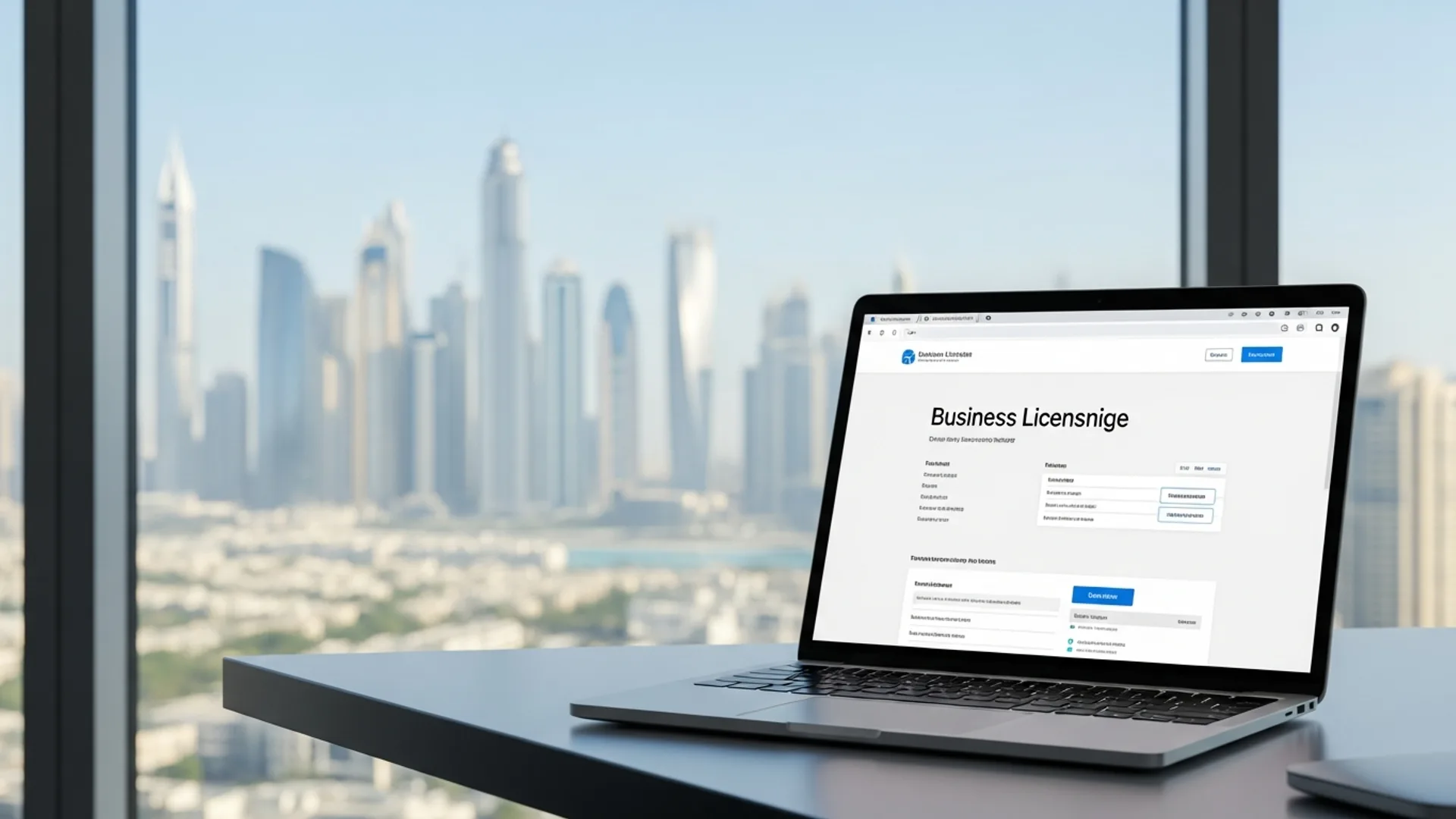
DET eServices is the online services portal of Dubai’s Department of Economy and Tourism (DET — the authority formerly called DET), used to renew a trade licence, pay a DET payment voucher, print a licence, and check a transaction status. In 2026 most of these services also run through the newer Invest in Dubai platform (invest.dubai.ae) with a UAE PASS login, while eservices.dubaided.gov.ae remains live for payments and status checks.
Searches for “eservices ded”, “ded eservices”, “ded e services”, “ded portal”, “ded dashboard” and “ded services dubai” all point to the same system. The most-used services:
- Trade licence renewal — renew online with your licence number
- DED payment / payment voucher — settle fees by card
- Trade licence check & verification — free, no login
- DED activity list — search 2,000+ licensed business activities
- Invest in Dubai (IID) — the unified successor platform
What is DET eServices?
DET eServices is the online services portal of Dubai's economic department — the authority now known as the Department of Economy and Tourism (DET), formerly the Department of Economy and Tourism (DET). Through it, entrepreneurs and businesses handle the full range of mainland business-licensing services digitally: reserving a trade name, obtaining initial approval, issuing a new trade licence, renewing an existing one, amending a licence, and accessing related economic services.
The names cause some confusion, so to be clear: DET is now part of DET, and the two names are used interchangeably for the economic-licensing function. You will still see "DET" used very widely. For business purposes — trade licences, registrations, and economic services in Dubai mainland — they refer to the same authority. The eServices portal is the digital channel that handles these services, and it has transformed what was once a heavily in-person, paperwork-driven process into something that can largely be done online.
For a founder, DET eServices is effectively the front door to a Dubai mainland business. Understanding what it offers and how to use it is fundamental to setting up and maintaining a company in the emirate — it is the system through which your company is born and through which it stays alive and compliant year after year.
What you can do on DET eServices
The portal covers the entire lifecycle of a mainland licence, which is what makes it so central. The core services include:
Trade name reservation — securing the name your business will operate under, in compliance with Dubai's naming rules. Initial approval — the economic department's preliminary consent to start the business, confirming there is no objection to you conducting the proposed activity. Licence issuance — issuing the actual trade licence that legally permits the business to operate. Licence renewal — the annual renewal that keeps the licence valid. Licence amendment — changes such as adding or removing business activities, changing partners or shareholders, updating capital, or modifying other details. And a range of related economic services that support businesses through their lifecycle.
Many of these can be completed online, and Dubai has layered on fast-track options — most notably the instant licence — to make starting a business even quicker for eligible activities. Together, these services mean a founder can move from idea to licensed business, and then maintain that business year after year, largely through one digital channel.
Setting up a Dubai mainland business via DET
To see how the portal fits into the real journey, here is how setting up a mainland business in Dubai typically flows through DET.
It begins with deciding your business activity — what your company will actually do — because the activity determines the licence type and any special approvals needed. Next comes trade name reservation, securing a compliant, available name. Then initial approval confirms the economic department has no objection to you starting the business. Depending on the activity and structure, you prepare the required documents (which for companies includes the Memorandum of Association), secure your business premises and register the tenancy through Ejari (a physical address is generally required for mainland licences), obtain any external approvals that specific activities require from other authorities, and finally the trade licence is issued. After that, you handle post-licence steps such as establishment-card and visa processing for the owners and staff.
The DET eServices portal underpins the licensing parts of this journey. A major reform in recent years is that most mainland activities now allow 100% foreign ownership, removing the old requirement for a local partner for the large majority of commercial and industrial activities — a significant change that has made mainland setup far more attractive to foreign founders.
The instant licence — fast-track setup
One of Dubai's standout innovations is the instant licence, a fast-track route that can issue a mainland licence quickly — often in a single step — for eligible commercial and professional activities, and in many cases without requiring a tenancy contract for the first year. This dramatically lowers the barrier to getting started: an eligible entrepreneur can obtain a licence and begin operating with minimal delay.
The instant licence reflects Dubai's broader strategy of making business setup as frictionless as possible to attract entrepreneurs and investment. Eligibility depends on the activity, and the licence still must be renewed and, over time, complemented with the standard requirements (such as premises). But as a way to start fast, it is a powerful option, and it is one of the reasons Dubai is regularly cited as one of the easier places in the region to launch a business. For founders eager to get moving, understanding whether their activity qualifies for an instant licence can save weeks of waiting and let them begin trading and generating revenue almost immediately.
Renewing your trade licence
A trade licence is not a one-time issuance — it must be renewed annually to remain valid, and renewal is one of the most common reasons businesses use DET eServices. The renewal process involves submitting the renewal application, ensuring your tenancy contract (Ejari) is valid, settling the renewal fees, and obtaining any approvals specific to your activity.
Renewing on time matters: a lapsed licence can incur late-renewal fines and, if neglected, can create complications for the business, its bank accounts, and its visas. The online process has made renewal much faster than the old in-person route, but it still requires attention each year. Many businesses delegate renewals to a PRO or a setup partner precisely so that the date is never missed and the business remains continuously compliant. Building the renewal into your annual calendar — or having someone manage it — is part of running a Dubai business responsibly.
Trade name rules
Because reserving a trade name is one of the first and most important steps, it is worth understanding the rules. A Dubai trade name must be available (not conflicting with an existing registered name), must comply with naming conventions (it should not contain offensive or inappropriate terms, must respect cultural and religious sensitivities, and should not include certain restricted words without authorisation), and should appropriately reflect the business. For companies, the name format follows specific conventions.
Choosing the right name early — one that is compliant, available, and suitable for your brand — avoids delays and rework later in the process. The trade name carries through the rest of the licensing journey and becomes the identity of your business, so it is worth getting right at the reservation stage through DET eServices rather than discovering a problem after you have started building a brand around it.
DET mainland vs free zone — choosing your route
A foundational decision every founder faces is whether to set up on the mainland (licensed by DET) or in a free zone. Both are valid, and the right choice depends on your business.
A mainland DET licence lets you trade directly across the entire UAE market and with government entities, operate from anywhere in Dubai, and — following the ownership reforms — enjoy 100% foreign ownership for most activities. It suits businesses whose customers are in the UAE market: retail, services, contracting, restaurants, and many commercial activities.
A free zone, by contrast, is a designated economic area with its own authority, offering 100% ownership, specific incentives, and a setup designed primarily for operating within the zone and internationally. Free zones can have restrictions on trading directly in the mainland market without an additional arrangement. They suit international, trading, and zone-based operations.
The decision shapes your costs, your market access, and your operations, so it deserves careful thought. DET eServices is the channel for the mainland route; each free zone has its own. Choosing the right one for your specific activity and customer base is one of the most important early decisions in your setup — and getting it wrong can mean restructuring later.
Why understanding DET eServices matters
For a founder, DET eServices is not just a portal to navigate once — it is the system you will return to for renewals, amendments, and the evolution of your business. Understanding it means you can set up correctly, keep your licence valid, and make changes (adding activities, bringing in partners, updating details) smoothly as your business grows. It also means you understand the costs and steps involved rather than being surprised by them.
That said, while the portal has made things far more accessible, the decisions behind the transactions — the right activity, the right structure, mainland versus free zone, the correct approvals — are where real value and risk lie. The portal will process what you tell it; getting the strategy right is what ensures you set up the business that actually fits your goals. This is why many founders combine the convenience of DET eServices with professional setup guidance, using the portal for execution and expert advice for the decisions. The portal is the tool; the judgement about how to use it is what separates a setup that merely exists from one that is genuinely optimised for the business you intend to build.
It is also worth remembering that your relationship with DET does not end at launch. Every year brings a renewal; growth brings amendments; new opportunities may bring new activities or even additional licences. Treating the economic department as an ongoing partner in your business — and keeping your licence accurate and current through its eServices — is part of running a compliant, credible company in Dubai over the long term, not just getting started.
The main types of mainland licence
When using DET eServices, one of the first things that shapes your application is the type of licence, which follows your activity. Dubai mainland licences fall into a few broad categories. A commercial licence covers trading activities — buying and selling goods, general trading, retail, and similar commercial operations. A professional licence covers services and professions based on intellectual or specialised skill — consultancy, IT services, marketing, and many service businesses. An industrial licence covers manufacturing and industrial activities, where goods are produced or processed. There are also specialised licences such as tourism licences for the travel and hospitality sector.
Your activity determines which category applies, and the category in turn affects the requirements, any external approvals, and sometimes the ownership and premises rules. Choosing the correct activity and licence type at the outset is therefore important — it is not merely a label but the foundation that determines what your business can legally do and what it needs to operate. The eServices portal guides the application according to the activity selected, which is why getting the activity right is the single most consequential early decision.
Understanding the costs
A practical question every founder has is what a mainland licence costs, and while exact figures depend on the activity, structure, and configuration, it helps to understand the components. The cost of a Dubai mainland licence typically includes the trade name reservation fee, the initial approval fee, the licence issuance fee itself, market fees (often calculated in relation to premises), and the costs associated with the Memorandum of Association and any required attestations for company structures. On top of the licence, you have premises costs (mainland licences generally require a physical address with an Ejari-registered tenancy), and per-visa costs for the owners and employees you sponsor.
Because these components vary so much by activity and setup, a single headline figure can be misleading. The sensible approach is to get an itemised quote for your specific business rather than relying on a generic number. The instant licence can reduce some upfront costs (such as deferring the premises requirement in the first year for eligible activities), while activities needing external approvals or larger premises will cost more. Understanding the components lets you budget realistically and avoid surprises during the process.
Amending your licence as the business grows
Businesses change, and DET eServices is where you keep your licence aligned with that change through amendments. Common amendments include adding or removing business activities (as your offering evolves), changing partners or shareholders (bringing someone in or out), updating capital, changing the trade name or legal form, and modifying other licence details. Each of these is handled as a service through the portal, often requiring supporting documents and sometimes approvals.
Keeping your licence accurate matters: operating an activity not listed on your licence, or having outdated ownership details, creates compliance risk. As your business grows — adding a new line of products, taking on a partner, expanding capital — processing the corresponding amendment keeps you compliant and your licence a true reflection of the business. This is another area where many companies use a PRO or setup partner to handle the paperwork correctly, ensuring amendments are processed smoothly without disrupting operations.
External approvals — when other authorities are involved
While many activities can be licensed straightforwardly through DET, some require external approvals from other government authorities before the licence is issued. The need for these depends entirely on the activity. For example, food-related businesses involve Dubai Municipality food-safety approvals; healthcare activities involve the health authority; certain industrial, security, transport, financial, and educational activities involve their respective regulators. These approvals exist to ensure businesses in regulated sectors meet the necessary standards.
For a founder, the key is to identify early whether your activity needs external approvals, because they add steps and time to the setup. An activity with no special approvals can be licensed quickly; one requiring multiple external approvals takes longer and needs planning. Knowing this in advance prevents the frustration of an application stalling unexpectedly. Part of good setup planning is mapping the full approval path for your specific activity, so the timeline and requirements are clear from the start.
After the licence — establishment card and visas
Getting the trade licence is a milestone, but a few important steps follow that complete the setup. The establishment card (immigration card) registers the company with the immigration authorities and is what allows the business to sponsor residence visas. With it, the company can process residence visas for its owners and employees — including the founder's own visa, which is often a primary reason for setting up. These steps connect the DET licensing world with the immigration world (GDRFA in Dubai, ICP federally) and the labour world (MOHRE for work permits).
For a founder relocating to run their business, this post-licence phase is what turns the company on paper into a fully operational entity with a resident owner and staff. Planning the whole journey — licence, establishment card, visas, and the associated health insurance — as a connected process ensures there are no gaps between getting the licence and actually being able to live and operate in Dubai. The eServices portal handles the licensing foundation on which all of this is built.
Official sources
For accurate, current information and to access the services directly, always use the official channel. Dubai's economic-licensing services are provided by the Department of Economy and Tourism, whose portal and services information are available at det.gov.ae. Because requirements, fees, and available services are updated over time, relying on the official source rather than third-party summaries ensures you have the current position. For the decisions around your setup — activity, structure, approvals — combining the official channel with experienced guidance gives you both accuracy and strategy.
Common Mistakes to Avoid
- Confusing DET and DET. They are the same authority for economic licensing — don't let the naming throw you.
- Choosing the wrong business activity. The activity drives the licence type and approvals — get it right at the start.
- Picking a non-compliant or unavailable trade name. Check availability and the naming rules before building a brand around it.
- Missing the annual licence renewal. Lapsed licences incur fines and complications — renew on time or delegate it.
- Letting Ejari lapse. A valid tenancy contract is needed for renewal — keep it current.
- Defaulting to mainland or free zone without analysis. Choose based on your customers and activity; restructuring later is costly.
- Treating the portal as the whole job. The transactions are easy; the decisions (structure, activity, approvals) are where you need to get it right.
Set up your Dubai mainland business the right way
DET eServices makes the mechanics of licensing accessible — but the decisions behind them determine whether you build the right business. Noble Core Ventures helps entrepreneurs set up on the Dubai mainland through the Department of Economy and Tourism: choosing the correct activity and structure, reserving the trade name, securing approvals, issuing the licence, and handling renewals and PRO services — so the eServices side is smooth and the strategy behind it is right.
Talk to Our Experts
Dubai mainland business setup, trade licences and PRO services
Frequently Asked Questions
What is DET eServices?
DET eServices is the online services portal of Dubai’s economic department — now the Department of Economy and Tourism (DET), formerly the Department of Economy and Tourism (DET). It lets entrepreneurs and businesses handle mainland business licensing online: reserving a trade name, getting initial approval, issuing a new trade licence, renewing or amending a licence, and related services. It is the main digital channel for setting up and maintaining a Dubai mainland company, replacing what once required in-person visits with online transactions.
Is DET now DET?
Yes. Dubai’s Department of Economy and Tourism (DET) is now part of the Department of Economy and Tourism (DET). The names are often used interchangeably, and you will still see ‘DET’ widely used for the economic-licensing function. For business purposes — trade licences, registrations, and economic services in Dubai mainland — DET and DET refer to the same authority. The eServices portal handles these economic and licensing services regardless of which name you encounter.
What can I do on the DET eServices portal?
On the DET eServices portal you can reserve a trade name, apply for initial approval to start a business, issue a new mainland trade licence, renew an existing licence, amend a licence (such as adding activities, changing partners, or updating details), and access related economic services. Many of these can be completed online, and Dubai also offers fast-track options like instant licences for eligible activities. It is the end-to-end digital channel for the lifecycle of a Dubai mainland business licence.
How do I renew my Dubai trade licence online?
You renew a Dubai mainland trade licence through the DET eServices portal (or approved channels) by submitting the renewal application, ensuring your tenancy contract (Ejari) is valid, settling any fees, and obtaining any required approvals. The licence must be renewed annually to remain valid, and renewing on time avoids fines for late renewal. The online process has made renewal far quicker than before, and many businesses use a PRO or setup partner to manage renewals so nothing lapses.
What is an instant licence in Dubai?
An instant licence is a fast-track Dubai mainland licence that can be issued quickly — often in a single step — for eligible commercial and professional activities, without requiring a tenancy contract for the first year in many cases. It is designed to make starting a business faster and easier. Eligibility depends on the activity, and the licence still must be renewed and complemented with the usual requirements over time. The instant licence is part of Dubai’s push to make business setup as frictionless as possible.
Do I need a trade name before getting a licence?
Yes. Reserving a trade name is one of the first steps in setting up a Dubai business, done through DET eServices. The trade name must comply with the naming rules (no offensive terms, no conflict with existing names, and following the conventions for company names). Once reserved, the trade name is used through the rest of the licensing process. Choosing and reserving an appropriate, available trade name early avoids delays later in the setup.
Can I set up a Dubai mainland business entirely online?
To a large extent, yes. DET eServices has digitised much of the mainland setup process — trade name reservation, initial approval, licence issuance, and renewals can be handled online, and instant licences speed things up further. Some activities require additional external approvals from other authorities, and certain steps may still involve documentation or specific requirements. But the core licensing journey is now largely digital, which is why Dubai is considered one of the easier places in the region to start a business.
What is the difference between DET (mainland) and a free zone?
DET licenses mainland businesses, which can trade directly across the entire UAE market and with government, and are now available with 100% foreign ownership for most activities. A free zone is a designated economic area with its own authority and licensing, offering 100% ownership and specific incentives but primarily designed for operating within the zone and internationally. The choice depends on your customers and activity: a mainland DET licence suits businesses serving the UAE market directly, while a free zone may suit international or zone-based operations.
Related: DED licence check.
Related: Sharjah DED e-services.
Contact Us For Free Consultation
Licensed UAE consultancy. One reply, no spam.
Thank you.
A consultant will reply on WhatsApp shortly.