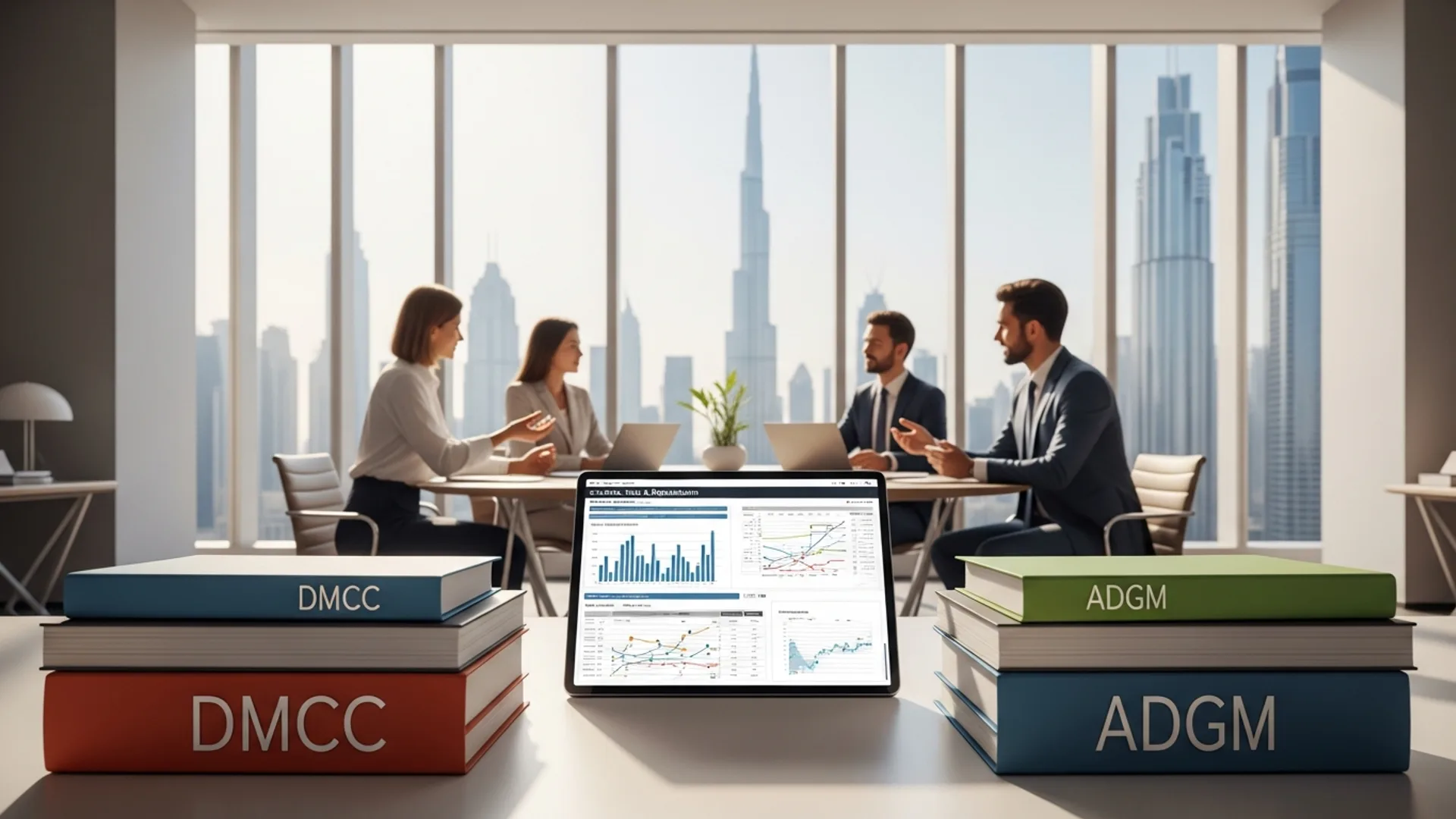
DMCC costs AED 4,500–8,500 for solo traders (year 1), ADGM costs AED 6,000–12,000, but ADGM offers unrestricted repatriation and 0% corporate tax on offshore income while DMCC charges 9% tax above AED 375K turnover starting 2026. The choice depends on your business model, employee count, and whether you’re trading regionally or just holding IP.
Your setup cost, in 10 seconds
Package prices. Health insurance is required by law and not included.
Thank you.
Your written quote follows on WhatsApp.
DMCC vs ADGM: The Honest Comparison
The DMCC (Dubai Multi Commodities Centre) and ADGM (Abu Dhabi Global Market) dominate UAE free-zone incorporation talk, but they’re solving different problems. DMCC is laser-focused on trade, commodities, and tech startups. ADGM is a full financial centre — more expensive, more regulatory overhead, but critical if you’re raising VC, doing M&A, or holding regional IP.
I’ve seen founders waste AED 15,000 setting up in the wrong jurisdiction because they didn’t understand the 2026 corporate tax trigger (9% on UAE-source income above AED 375K). That’s not a gotcha in the law—it’s a gotcha in most setup guides, which still treat DMCC and ADGM as tax-neutral. They’re not, not anymore.
| Factor | DMCC | ADGM |
|---|---|---|
| Year-1 Setup Cost (Solo) | AED 4,500–6,500 | AED 6,000–9,000 |
| Annual License Renewal | AED 2,200–3,500 | AED 3,000–5,000 |
| Corporate Tax on UAE-Source Income | 9% (above AED 375K/year) | 0% (offshore income exempt) |
| Office Space (Desk + Service Address) | AED 1,500–3,500/month | AED 2,500–5,000/month |
| Visa Quota (per 50 shares) | 1 visa per AED 250K capital | 1 visa per AED 300K capital |
| Repatriation of Profits | No restrictions (UAE-based) | No restrictions (ADGM-regulated) |
| Regulatory Authority | Dubai Department of Economy & Tourism (DET) | ADGM Authority |
| Setup Timeline (to trading) | 10–15 business days | 15–25 business days |
| Best For | Traders, tech startups, consultants | VC-backed fintech, regional holding, M&A |
| Foreign Ownership | 100% allowed | 100% allowed |
The 2026 Corporate Tax Trap (and Why It Matters)
Here’s the critical fact nobody emphasizes: the UAE’s 9% corporate tax (effective from 2023, fully enforced by 2026) applies to both DMCC and mainland companies equally—but it has a threshold exemption at AED 375,000 annual profit. The Federal Tax Authority (FTA) has confirmed this applies to DMCC traders generating UAE-source income (sales to UAE customers, consulting for local clients, etc.).
ADGM, however, sits under a different tax regime. Profits from offshore operations—IP licensing, services to non-UAE clients, fund management—are entirely exempt. This is not a loophole; it’s deliberate policy. The Abu Dhabi Global Market Regulatory Authority distinguishes between ADGM-source and external-source income. If you’re running a SaaS platform serving 80% international clients, ADGM saves you 9% on 80% of revenue immediately.
Example: A DMCC consultant earning AED 600K annually pays 9% on AED 225K (everything above the AED 375K threshold) = AED 20,250 tax. An ADGM consultant with identical revenue pays zero, provided the income is classified as offshore (not sales to UAE entities). That’s AED 20,250 difference—more than the setup cost difference itself.
DMCC Setup: Full Cost Breakdown 2026
| Item | Cost (AED) | Notes |
|---|---|---|
| Trade License (yearly) | 2,200–3,500 | Depends on business activity code |
| Office Space/Virtual Address (yearly) | 1,500–3,500 | Virtual desk AED 1,500; co-working AED 2,500–3,500 |
| Ejari Registration (if physical office) | 0–500 | Mandatory for physical spaces; included in office cost often |
| UAE Labour Card (if hiring staff) | 200–300 per employee | First 5 staff included in visa quota |
| Trade Name Registration | 500–800 | One-time; included in license cost |
| Bank Account Setup | 0–500 | Most banks waive; some charge maintenance AED 50–100/month |
| Professional Service Fees (accountant/setup) | 1,000–1,500 | Noble Core negotiates—contact for package rates |
| Visa Sponsorship (1 visa) | 500–1,000 | Requires AED 250K initial capital; processed via GDRFA |
| Total Year 1 (Solo, No Staff) | AED 6,500–10,600 | Includes virtual office + license + setup |
Contact Us For Free Consultation
or
Ask on WhatsApp insteadLicensed UAE consultancy. One reply, no spam.
Thank you.
A consultant will reply on WhatsApp shortly.
ADGM Setup: Full Cost Breakdown 2026
| Item | Cost (AED) | Notes |
|---|---|---|
| Company Registration (Authorised Trader License) | 3,000–4,500 | ADGM Authority fee; includes legal entity setup |
| Annual License Renewal | 3,000–5,000 | Fixed annually; no activity-based pricing |
| Office/Desk Space (yearly) | 2,500–5,000 | ADGM has approved office providers; premium vs DMCC |
| ADGM Rules Compliance (legal review) | 1,500–2,500 | ADGM law is common-law based; requires local counsel |
| Authorized Representative Registration | 500–1,000 | Required if no local director; UAE resident needed |
| Bank Account Setup (ADGM-regulated bank) | 0–750 | FAB ADGM, NBAD ADGM offer preferential rates for startups |
| Visa Sponsorship (1 visa) | 600–1,200 | Requires AED 300K capital; processed via ADGM Immigration |
| Setup & Documentation (accountant/legal) | 2,000–3,000 | Common-law structure + AML compliance = more legal work |
| Total Year 1 (Solo, No Staff) | AED 13,600–22,950 | Higher compliance overhead but zero tax on offshore income |
Visa Quotas and Hidden Limits Nobody Mentions
Both DMCC and ADGM tie visa sponsorship to authorized capital. This is critical if you’re planning to hire a team. The Dubai General Directorate of Residency and Foreign Affairs (GDRFA) enforces these limits strictly, and there’s no workaround in 2026.
DMCC Visa Rules: You get 1 visa per AED 250,000 of authorized capital. If you inject AED 500K, you can sponsor 2 staff visas. Want 5 employees? You need AED 1.25M capital. The visa doesn’t automatically appear—GDRFA processes it, and processing takes 20–30 days currently.
ADGM Visa Rules: 1 visa per AED 300K authorized capital. Same timeline (20–30 days). ADGM visas are processed through the ADGM Immigration Department, not GDRFA, which sometimes moves faster—we’ve seen 14-day approvals for founders with clean compliance records.
Hidden gotcha: If you’re hiring UAE nationals, neither DMCC nor ADGM require Emiratisation quotas (unlike mainland), but the Ministry of Human Resources and Emiratisation (MOHRE) still monitors for abuse of 100% foreign-workforce setups. If you hire 20 people and zero are Emirati, you may face compliance audits. Not a ban, but admin friction.
Tax Treatment: When ADGM Saves Real Money
The offshore tax exemption in ADGM is not theoretical. The ADGM Authority publishes a detailed list of what qualifies as “offshore income.”
DMCC businesses taxed at 9% (above AED 375K threshold):
- Consulting for UAE-based clients (deemed UAE-source)
- E-commerce shipped to UAE addresses
- Software licenses sold to mainland UAE companies
- Commodity trading involving goods in UAE warehouses
ADGM businesses taxed at 0% (if offshore):
- SaaS and cloud services to international clients
- Fintech licenses (proprietary trading, fund management)
- IP licensing to regional holding companies
- Services delivered from ADGM (call centers, back-office) to non-UAE clients
The distinction is strict: if even 20% of ADGM income is UAE-sourced, only that 20% escapes tax (the other 80% is tax-free offshore). DMCC has no such carve-out; all UAE-source income is taxed uniformly above the threshold.
This creates a real arbitrage: two DMCC competitors, each earning AED 1M, split AED 58,500 in tax (9% on AED 650K above threshold). Move one to ADGM with 90% international clients = AED 0 tax on AED 900K income. Over 5 years, that’s AED 292,500 in tax savings (before accounting for ongoing compliance costs).
Regulatory Oversight and Compliance 2026
DMCC Regulation: The Dubai Department of Economy and Tourism (DET) oversees DMCC. As of 2026, DET has harmonized DMCC compliance with mainland UAE standards for anti-money laundering (AML) and know-your-customer (KYC). Audits are routine every 2–3 years for active traders; paperwork-light for dormant entities.
ADGM Regulation: The ADGM Authority (independent, modeled on DIFC in Dubai) applies ADGM Rules, which borrow from English common law. This means more formal contractual standards but also clearer legal predictability. ADGM Authority audits are more frequent (annually for licensed companies) but are non-invasive compliance checks.
Practical difference: DMCC is lighter-touch admin; ADGM requires more documentation upfront (articles of association, common-law governance structure). If you’re raising venture capital or doing investor roadshows, ADGM’s English common-law structure is reassuring to international VCs. If you’re bootstrapping, DMCC’s faster setup saves weeks and cost.
When to Choose DMCC
Pick DMCC if:
- You’re a solo trader or 2–3 person team generating under AED 500K annual revenue (below the tax threshold)
- You need to trade or consult for UAE-based clients (mainland arbitrage is minimal)
- You want the fastest, cheapest setup (10–15 days vs 15–25 for ADGM)
- You’re trading commodities, bullion, or precious metals (DMCC’s core niche)
- You don’t need common-law legal contracts (UAE commercial law suffices)
Real example: A Dubai-based digital marketing freelancer earning AED 180K annually from SME clients in the UAE. DMCC setup cost: AED 7,500 year 1. Tax: AED 0 (below threshold). ADGM setup: AED 15,000. Tax: AED 0. DMCC wins by AED 7,500 with no downside.
When to Choose ADGM
Pick ADGM if:
- You’re a fintech startup (crypto, lending, fund management, payment rails)
- You’re earning over AED 375K annually from any source (tax planning kicks in)
- You’re holding IP or regional assets for a GCC holding structure
- You’re raising Series A or institutional VC (common-law clarity matters)
- Your clients are 70%+ non-UAE (offshore tax exemption justified)
- You need to issue digital assets or operate a fintech license
Real example: A founders’ fund managing AED 50M in assets across GCC. Fintech license cost in ADGM: AED 12,000/year. Operational tax: AED 0 (fund management is offshore). Regulatory credibility with limited partners: priceless. ADGM’s common-law structure also simplifies limited partnership agreements with international LPs.
Application Timeline and Gotchas
DMCC Timeline:
- Submit application + documents to DET (1–2 days processing)
- Receive conditional approval (1–3 days)
- Open business bank account (2–5 days; bank-dependent)
- Pay license fee and receive trade license (same day)
- Start trading (10–15 days total)
Hidden gotcha: DMCC bank account approval requires a signed trade license, not a conditional approval. Some banks process simultaneously; others make you wait for the final license. Noble Core has preferred relationships with banks that parallelize this—reduces delay from 15 days to 10.
ADGM Timeline:
- Submit Authorised Trader License application (2–3 days processing)
- ADGM Authority reviews articles of association and governance (3–5 days)
- Receive license + corporate registration number (5–7 days)
- Open ADGM bank account (3–7 days; requires license number)
- File compliance docs (AML/KYC) (2–3 days)
- Ready for operations (15–25 days total)
Hidden gotcha: ADGM bank accounts currently have a minimum deposit requirement of AED 10,000–25,000 depending on the bank. DMCC doesn’t have this hard minimum—some relationship managers waive it for first-time founders.
Common Mistakes to Avoid
- Mistake 1: Assuming both are completely tax-free. DMCC is taxed on UAE-source income above AED 375K. Many founders discover this after incorporation and realize they chose the wrong structure. Fix: Model your revenue: if over AED 400K with 50% UAE sources, calculate your actual tax liability before choosing.
- Mistake 2: Setting authorized capital too low to hire a team later. You inject AED 250K in DMCC, get 1 visa, then realize you need 3 staff. Increasing capital mid-year is cumbersome and expensive. Fix: If you plan to hire, inject AED 1M capital upfront (cost: one-time extra AED 500–1,000 in corporate documents). You get 4 visas and headroom.
- Mistake 3: Choosing ADGM for pure UAE domestic business. You’re paying AED 8,000 more annually for zero tax benefit (all income is UAE-source, so taxed anyway). Fix: Map your customer geographic: if 80%+ are UAE-based, DMCC is cheaper and simpler.
- Mistake 4: Not registering for corporate tax with FTA (Federal Tax Authority) on time. DMCC entities must self-register with FTA once they exceed AED 375K turnover. Failure to do so incurs penalties of 1% per month on unpaid tax (capped at 25%). Fix: Register with FTA proactively in year 1, even if you’re below threshold. Costs AED 0; takes 15 minutes online.
- Mistake 5: Signing a multi-year office lease in an unauthorized building. Some DMCC “co-working” vendors don’t have valid Ejari registration. Your trade license gets rejected. Fix: Verify Ejari online via Dubai’s official system; ask your office provider for the certificate before signing.
- Mistake 6: Using a business address that’s residential. Both DMCC and ADGM require commercial-zoned addresses. Registering a consulting business at a residential villa leads to license cancellation. Fix: Use an official DMCC/ADGM-approved service office, not your apartment.
- Mistake 7: Assuming visa sponsorship is instant after capital injection. GDRFA processes visas in batches; 20–30 days is standard even if capital is confirmed. Fix: Plan hiring timeline with 5-week buffer. If you hire on day 20, your employee can’t enter the UAE until day 50.
- Mistake 8: Not accounting for annual renewal costs. Founders budget AED 5,000 for setup but forget that renewal every year costs AED 3,500–5,000 ADGM. Over 10 years, that’s AED 45,000 in ongoing costs, not AED 15,000 setup. Fix: Model 3–5 year total cost of ownership, not year-1 only.
Comparing DMCC and ADGM to Other UAE Zones
For context: DMCC and ADGM aren’t your only options in 2026. Dubai Science Park, Dubai Silicon Oasis, and Ajman Free Zone all offer cheaper entry points (AED 2,500–4,000 year 1), but they come with drawbacks—no visa quota, limited to tech/manufacturing, or lower regulatory credibility. If you’re bootstrapping a micro-service (freelancer, digital agent), Ajman Free Zone is tempting at AED 2,900/year. But if you’re hiring, expanding regionally, or raising capital, the visa quota limitations and lower-tier compliance make them false economies.
DMCC and ADGM are the only UAE free zones with globally recognized credibility. ADGM specifically is the gold standard for fintech and international holding companies. Don’t optimize for AED 2,000 in setup cost and end up in a zone that blocks hiring or looks suspect to investors.
How to Make the Final Decision
Decision Tree:
- Is 80%+ of your revenue from non-UAE clients? Yes → ADGM (offshore tax exemption wins). No → Continue.
- Do you plan to hire staff or raise VC in the next 2 years? Yes → ADGM (common-law structure + visa certainty). No → Continue.
- Will you exceed AED 375K annual revenue? Yes → Run tax comparison: ADGM saves 9% on offshore portion. No → Continue.
- Is speed to market critical? Yes → DMCC (10–15 days). No → Either (15–25 days acceptable).
- Budget under AED 10K year-1 total? Yes → DMCC (AED 6,500–8,500). No → ADGM option is viable.
If you answer Yes to either of the first two questions, ADGM is your choice despite higher costs. If you’re a solo bootstrapper earning under AED 400K domestically, DMCC wins on cost and simplicity.
Noble Core’s approach: We guide founders through a 15-minute diagnostic call to model actual tax liability and hiring timeline. Then we provide a side-by-side cost comparison specific to your business. Contact us if you want to avoid choosing wrong—most founders we’ve consulted save AED 30K–50K over 3 years by choosing correctly the first time.
Conclusion: 2026 Landscape
DMCC and ADGM represent two different value propositions. DMCC is the scrappy trader’s choice—fast, cheap, and perfectly legal if your business model and revenue don’t trigger tax complexity. ADGM is the institutional choice—higher upfront cost, but essential if you’re building a venture-scale fintech, managing regional IP, or generating significant offshore revenue.
The 2026 UAE corporate tax regime has crystallized the distinction: DMCC is no longer a tax-free haven for all income. ADGM’s offshore exemption now has real financial impact for scaling companies. Choose based on your business geography and growth trajectory, not on setup cost alone.
Talk to Our Experts
Get end-to-end support from a Noble Core advisor — license, visas, banking, FTA and federal approvals handled for you. Free 20-minute consultation.
Frequently Asked Questions
Do I need to pay corporate tax if I set up in DMCC?
Yes, starting 2026 DMCC businesses are subject to the UAE’s 9% corporate tax on UAE-source income above AED 375,000 annual profit. This applies to consulting for UAE clients, sales to local businesses, and commodity trading in UAE warehouses. ADGM, by contrast, exempts offshore income (non-UAE clients) from tax entirely. Model your revenue sources to calculate actual tax liability before choosing.
What is the exact setup cost for DMCC in 2026?
DMCC year-1 setup costs AED 6,500–10,600 for a solo trader, including: trade license (AED 2,200–3,500), virtual office/address (AED 1,500–3,500), visa sponsorship if required (AED 500–1,000), and professional setup fees (AED 1,000–1,500). Renewal annually costs AED 2,200–3,500 (license only, not office).
What is the exact setup cost for ADGM in 2026?
ADGM year-1 setup costs AED 13,600–22,950 for a solo trader, including: Authorised Trader License registration (AED 3,000–4,500), annual license renewal (AED 3,000–5,000), office space (AED 2,500–5,000), compliance/legal review (AED 1,500–2,500), authorized representative registration (AED 500–1,000), visa sponsorship (AED 600–1,200), and professional setup fees (AED 2,000–3,000).
How many employee visas can I sponsor in DMCC or ADGM?
DMCC: 1 visa per AED 250,000 authorized capital. ADGM: 1 visa per AED 300,000 authorized capital. If you inject AED 500K in DMCC, you can sponsor 2 employees. Increasing capital mid-year to gain more visas is cumbersome; plan upfront. Visa processing takes 20–30 days via GDRFA (DMCC) or ADGM Immigration Department.
Which is better for a fintech or venture-backed startup?
ADGM is the clear choice. Fintech licenses (crypto, lending, fund management) are only available in ADGM. Its common-law structure is also familiar to international venture capitalists and simplifies LP agreements. DMCC lacks fintech licensing and has less regulatory clarity for emerging financial services.
Is there a tax difference if I’m earning international revenue?
Yes—critical. ADGM exempts offshore income (non-UAE sources) from the 9% corporate tax entirely. If 80% of your SaaS revenue is from international clients, ADGM means zero tax on 80% of income. DMCC taxes all UAE-source income uniformly at 9% above AED 375K. For an international business earning AED 1M, ADGM saves AED 58,500/year (9% on 65% of profit) vs DMCC.
How long does setup take: DMCC or ADGM?
DMCC: 10–15 business days from application to trading. ADGM: 15–25 business days. DMCC is faster because it requires fewer compliance documents. ADGM takes longer due to articles of association review and common-law governance setup. Both timelines assume prepared documents and bank account approval in parallel.
Can I move from DMCC to ADGM later if my business grows?
Yes, but it involves migrating your business license, which costs AED 2,000–3,500 in professional fees and takes 10–15 days. You’ll also need to update visa sponsorships and bank accounts. Plan this transition if your revenue reaches AED 600K+ annually with 60%+ offshore income—the tax savings will justify migration cost. Better to choose right initially if possible.