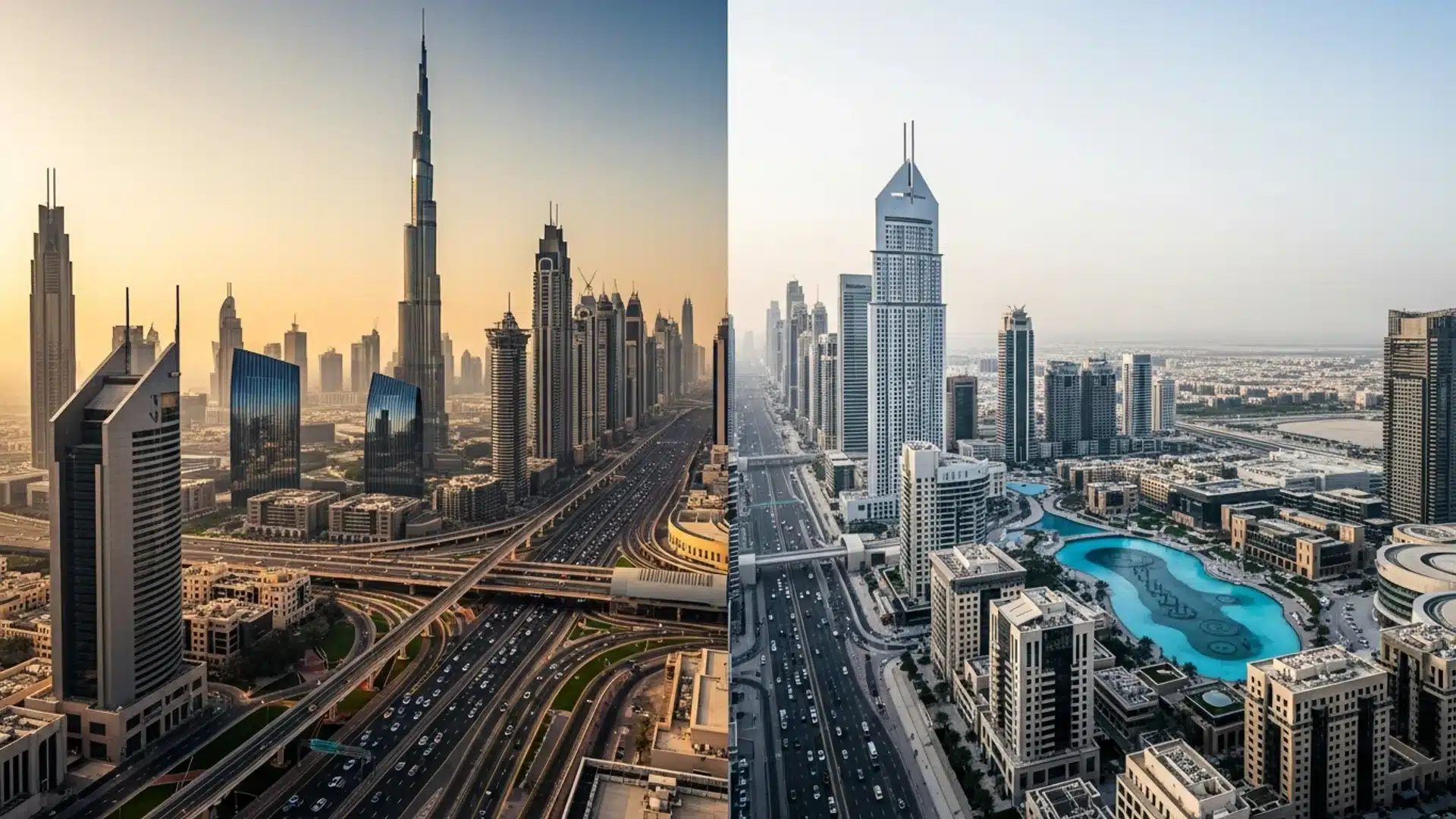
Quick AnswerMainland vs free zone Dubai 2026: compare ownership, market access, cost, visas and office rules to decide which structure fits your business.
Mainland vs Free Zone Dubai: The Quick Answer
If you are weighing mainland vs free zone Dubai for a 2026 company setup, the short answer is this: choose mainland (a licence issued by the Department of Economy and Tourism, known as DET) when your customers are inside the UAE, you want to sell directly to the local market, or you intend to bid for government work; choose a free zone when you are export-focused, international, services-led, or want a fast, bundled, lower-friction entry. Both now allow up to 100 percent foreign ownership for most activities, both are subject to UAE corporate tax administered by the Federal Tax Authority, and both can sponsor residence visas. The real decision is not about prestige or cost alone. It is about where your revenue comes from and how you need to reach your customers. This guide walks through ownership, market access, cost, office requirements, visas, tax, and sector fit so you can decide with confidence rather than guesswork.
Entry-level free zone packages commonly start somewhere in the AED 12,000 to AED 25,000 region, while mainland costs are more variable because office rent and external approvals are itemised separately. Treat every figure here as an illustrative range and confirm current numbers with the relevant authority before you commit, because government fees, zone promotions, and activity-specific approvals all change from year to year.
Why This Decision Matters More Than Any Other
The mainland-versus-free-zone choice is the single most consequential structural decision you make when forming a Dubai company, because almost everything downstream flows from it. It determines who you can sell to without extra permissions, how your office and visas are structured, which authority regulates you, how your corporate tax position is likely to be treated, and how easily you can scale or pivot later. Founders who get this wrong often discover the problem only after signing their first big local contract, when they realise their free zone licence does not let them invoice an onshore client directly, or when a mainland business finds it is paying for office space and approvals it did not strictly need for an export-only model.
This is precisely why we treat this article as a decision and comparison guide rather than a cost sheet or a directory. If you want the granular line-item breakdown of mainland licensing, our companion guide on the Dubai mainland licence cost AED breakdown goes deep on the real numbers. If you want to compare specific free zones against each other, the UAE free zone cost comparison lays out package-by-package figures, and our overview of Dubai free zones explains what each major zone specialises in. This page sits one level above those: it helps you decide which road to take in the first place, so the detailed guides become genuinely useful rather than overwhelming.
What "Mainland" Actually Means
A mainland company, sometimes called an onshore company, is licensed by the Department of Economy and Tourism. You will still see the older abbreviation DED, for Department of Economic Development, used widely in conversation and in older documents, and for practical purposes people use DED and DET to refer to the same licensing authority in Dubai. A mainland licence registers your company in the wider UAE economy rather than inside a single ring-fenced zone. That single fact drives most of the advantages and obligations that follow.
The defining benefit of mainland is unrestricted local market access. A mainland company can open a shop or office anywhere in Dubai, sign contracts directly with private companies and consumers across all seven emirates, and crucially can bid for and service UAE federal and local government tenders, which free zone entities generally cannot do directly. Mainland businesses can also typically take on a wider and more flexible range of activities under one licence, and can open multiple branches across the UAE. If your growth plan involves walk-in customers, physical retail, restaurants, construction, trading with local distributors, or supplying government departments, mainland is usually the natural home.
In exchange for that reach, mainland brings a slightly heavier compliance footprint. You generally need a registered physical premises evidenced by an Ejari tenancy registration, and labour relationships are governed by the Ministry of Human Resources and Emiratisation, commonly referenced as MOHRE, which sets the framework for employment contracts, work permits, and end-of-service entitlements. Depending on your activity, you may also need external approvals from sector regulators before DET issues the licence. None of this is prohibitive, but it is more involved than the bundled simplicity many free zones offer, and it is a reason to plan your budget for both the licence and the surrounding obligations.
What "Free Zone" Actually Means
A free zone is a designated economic area with its own independent registration authority that issues licences, handles company registration, and in most cases sponsors your visas through its own channels. Dubai and the wider UAE host dozens of free zones, each with a flavour. DMCC focuses heavily on commodities, trading, and a broad commercial base; DAFZA serves logistics and aviation-adjacent businesses near the airport; IFZA has built a reputation for cost-effective, flexible packages across many activities. Each zone publishes its own activity list, fee schedule, and visa rules, which is exactly why comparing them properly matters and why our dedicated free zone comparison guide exists.
The core appeal of a free zone is simplicity and speed at entry. Most zones bundle the licence, company registration, and a flexi-desk or shared workspace into a single package, which removes the need to hunt for office space and register a separate tenancy before you can trade. Free zones are purpose-built for international business, holding structures, consulting, technology, media, e-commerce, and import-export through the zone, and they have historically been the entry point of choice for foreign founders precisely because they offered 100 percent ownership long before mainland reforms made that common everywhere. Administratively, a free zone can often get you from application to licence faster than the mainland route, which appeals to founders who want to start invoicing quickly.
The trade-off is market access. A free zone company is, by design, oriented outward and toward its own zone rather than directly into the onshore UAE consumer market. You can absolutely serve UAE clients, and many service businesses do so comfortably, but selling physical goods into the local market or running onshore retail typically requires a workaround: appointing a UAE-registered distributor, opening a mainland branch, or securing specific permissions. For a purely export, holding, consulting, or digital business, this limitation may never bite. For a business whose customers are UAE consumers buying physical products, it can be a real constraint that you must design around from day one.
Ownership: The Old Difference That Mostly Disappeared
For many years the headline reason founders chose a free zone was 100 percent foreign ownership, because mainland companies historically required a local Emirati partner holding a majority share for many activities. That gap has largely closed. Following reforms to the UAE Commercial Companies Law, foreign investors can now own 100 percent of a Dubai mainland company across the large majority of commercial and professional activities, without needing a local partner. This is one of the most significant changes to the setup landscape in recent years and it has made the mainland route far more attractive to international founders than it once was.
There are still nuances worth respecting. A defined list of strategic-impact activities can carry specific ownership conditions, additional approvals, or sector rules, and certain regulated professions have their own licensing requirements layered on top. Because the list of activities and conditions is reviewed and updated over time, the safest approach is never to assume. Confirm the current ownership rule for your exact activity directly through the official Department of Economy and Tourism portal or with an experienced setup adviser. The practical upshot for most founders, though, is that ownership is no longer the deciding factor it used to be, which means the decision now rests far more on market access, cost structure, and operational fit.
Market Access: The Real Decision Driver
If you strip away the marketing, the genuine fork in the road is market access. Ask yourself a simple question: where do your paying customers actually sit, and how do they need to buy from you? A mainland company can sell directly to anyone in the UAE, onshore and across emirates, with no intermediary required. A free zone company is structured for international and intra-zone business, and reaching onshore customers with physical goods usually needs an additional mechanism. This is the lens through which every other comparison should be read, because it is the difference that cannot be bought away with a cheaper package.
Consider a few concrete patterns. A management consultant whose clients are multinational firms and who invoices internationally fits a free zone beautifully, because the work crosses borders and rarely requires onshore retail presence. A boutique that wants to open a physical store in a Dubai mall and sell to walk-in shoppers needs mainland, because that is direct onshore retail. A trading company importing goods and selling them to UAE supermarkets and shops will generally want mainland or a mainland distribution arrangement, because the customers are onshore wholesalers and retailers. A holding company that owns shares in other businesses and earns dividends fits a free zone, because it is not selling into the local consumer market at all. Mapping your real customer base against these patterns answers most of the question before you have even looked at fees.
It is also worth noting that government and semi-government contracts are typically reserved for mainland-licensed entities. If a meaningful share of your pipeline involves supplying UAE government departments, public-sector projects, or large semi-government organisations that require onshore suppliers, mainland is effectively mandatory. No free zone discount changes that calculus, which is why we always push founders to validate their target customers before optimising for the lowest sticker price.
Cost: How to Compare Honestly
Cost comparisons between mainland and free zone are frequently misleading because the two are packaged differently, and comparing a bundled free zone fee against an unbundled mainland licence is not a fair like-for-like. Free zone packages typically roll the licence, registration, and a flexi-desk into one headline number, often starting somewhere in the AED 12,000 to AED 25,000 range for a basic package with a small visa quota, though premium zones and larger quotas push well beyond that. Because the workspace is included, the headline figure is closer to your true year-one outlay. For the full package-by-package picture across zones, our free zone cost comparison guide is the place to go.
Mainland costs are more modular and therefore more variable. The DET licence fee is one component, but you also budget separately for your office or Ejari-registered premises, any external regulatory approvals tied to your activity, immigration and visa establishment costs, and notarisation or attestation where required. A lean mainland setup using a small serviced office can be very competitive, while a mainland business taking a full commercial unit in a prime area will spend considerably more on rent than a flexi-desk free zone package. The honest way to compare is to build a total year-one cost for each option that includes office, visas, and approvals, not just the licence line. Our mainland licence cost AED breakdown does exactly this with realistic ranges, and we strongly recommend modelling your own numbers rather than trusting any single headline figure, because promotions and government fees shift year to year.
A final cost nuance: think in multi-year terms, not just setup. A free zone package that looks cheap at entry may carry renewal and visa-renewal costs that add up, while a mainland setup with a real office is a larger fixed commitment but may unlock revenue, such as government contracts or onshore retail, that a cheaper free zone licence simply cannot access. The cheapest licence is not the best value if it locks you out of your most lucrative customers.
Office and Premises Requirements
Office requirements are one of the clearest practical differences between the two routes. Free zones are built for flexibility here. Most allow you to start with a flexi-desk, shared workstation, or small co-working allocation included in your package, which means you can be licensed and operational without signing a separate lease or registering a tenancy. As you grow and need more visas, you scale into dedicated offices within the zone. This light footprint is a genuine advantage for early-stage, remote-first, and solo founders who do not need a customer-facing physical location.
Mainland generally expects a registered physical premises evidenced through Ejari, the tenancy registration system. The space can range from a modest serviced office or business-centre arrangement up to a full commercial unit, and the size of that space often influences how many staff visas you can hold. For a customer-facing business this is not a burden at all, because you needed premises anyway, but for a purely digital business it can feel like paying for space you do not use. This is one of the most common reasons remote founders lean toward free zones, and one of the most common reasons retail, hospitality, and trading founders accept the mainland office requirement as simply part of doing business onshore. Match the office model to how your business actually operates rather than to a theoretical preference.
Visas: Quotas, Sponsorship, and Staff
Both structures let you sponsor UAE residence visas for yourself, your staff, and in many cases your family, but the mechanics differ. In free zones, your visa quota is usually tied to your package and the workspace you lease: a flexi-desk might support a handful of visas, while a private office supports more. The free zone authority typically handles much of the immigration processing through its own one-stop channels, which many founders find streamlined. Federal immigration and identity processes still run through the Federal Authority for Identity, Citizenship, Customs and Port Security, commonly referenced as ICP, and entry and residence permits in Dubai involve the General Directorate of Residency and Foreigners Affairs, known as GDRFA, so the underlying framework is the same UAE system regardless of route.
On mainland, visa capacity is generally linked to the size of your Ejari-registered office and the labour framework administered by MOHRE. A larger leased space supports more employee visas, which suits businesses planning to scale a local team. Mainland employment relationships sit squarely within the federal labour law framework, with standardised contracts, work permits, and end-of-service entitlements. For a business planning to hire significantly in Dubai and build an onshore team, mainland visa scaling tied to real office space is logical. For a lean team of one to five people, a free zone package with a modest quota is often more than enough. As always, confirm exact current visa quotas with your chosen authority, because they are set per package and per office and do change.
It is worth being realistic about the human side of visas too, because they are rarely just about your own residence. If you intend to sponsor family members, hire foreign staff who will relocate, or bring on partners who need UAE residence to operate, your visa quota becomes a genuine planning constraint rather than a footnote. A founder who chooses a minimal free zone package and then needs to sponsor a spouse, two children, and three employees within the first year can find the quota too tight, forcing an upgrade to a larger office tier sooner than budgeted. The lesson is to estimate your realistic headcount and family sponsorship needs for the first eighteen months before locking in a package, and to choose a tier with a little headroom. Both routes ultimately draw on the same federal immigration system through ICP and GDRFA, so the residence and Emirates ID experience is broadly similar once granted; the difference is mainly in how the quota is allocated and how the processing is channelled.
Corporate Tax and Compliance in 2026
UAE corporate tax now applies nationwide and is administered by the Federal Tax Authority, and this is an area where the mainland-versus-free-zone distinction has real nuance that founders must understand rather than assume. Mainland companies are subject to the standard corporate tax regime, paying the headline rate on taxable profits above the established threshold, with smaller profits below that threshold effectively shielded. This is straightforward and well understood, and it applies regardless of whether your customers are local or international.
Free zones can be more advantageous on tax, but only under strict conditions. A free zone entity may qualify as a Qualifying Free Zone Person and access a zero percent rate on qualifying income, provided it meets demanding substance requirements, derives income from qualifying activities, maintains adequate operations within the zone, and complies with transfer-pricing and documentation rules. This is not an automatic benefit that comes with any free zone licence; it is a regime you must actively qualify for and maintain, and income that falls outside the qualifying definitions can be taxed at the standard rate. Because the detail is technical and the rules are administered and updated by the Federal Tax Authority, you should treat the zero-rate possibility as a planning opportunity to verify with a qualified tax adviser, never as a guaranteed outcome. Both mainland and free zone companies also have registration, record-keeping, and filing obligations, so build compliance into your operating budget from the outset rather than treating it as an afterthought.
Which Structure Suits Which Business
The cleanest way to decide is to match your business model to the structure that removes friction from your revenue. Export-focused traders, international consultants, holding companies, technology and SaaS firms serving global customers, media and creative agencies billing across borders, and freelancers building a remote service practice generally fit a free zone, because their customers are not primarily onshore UAE consumers buying physical goods, and they benefit from bundled packages and faster setup. The free zone removes office friction and speeds entry without costing them market access they would actually use.
Conversely, retailers and restaurants wanting walk-in onshore customers, trading companies selling to UAE distributors and shops, construction and contracting firms, healthcare and clinic operators, businesses bidding for government and semi-government contracts, and any company whose growth depends on direct onshore sales generally fit mainland, because that route unlocks the local market and government pipeline that a free zone cannot reach directly. Some businesses legitimately end up running both: a free zone entity for international operations and a mainland entity or branch for onshore sales, which is a common scaling pattern once revenue justifies the dual structure. There is no universally superior choice; there is only the structure that matches where your money comes from, and the discipline to choose based on that rather than on the lowest advertised price or the most familiar name.
A Simple Decision Framework
When founders ask us to make the call quickly, we run them through a short sequence of questions, and you can do the same yourself. First, where are your paying customers: onshore UAE consumers and businesses, or international and cross-border clients? If overwhelmingly onshore and physical, lean mainland; if international or services-led, lean free zone. Second, will you sell physical goods directly to UAE consumers or hold local stock? If yes, mainland or a mainland distribution route; if no, free zone is likely fine. Third, do you need government or semi-government contracts? If yes, mainland is effectively required. Fourth, how lean do you need to start, and do you need a physical office anyway? If you want minimal commitment and no customer-facing premises, free zones shine; if you need a shopfront or large team regardless, the mainland office requirement is no burden. Fifth, what is your true year-one total cost for each option including office, visas, and approvals, not just the licence? Build both numbers honestly before deciding.
Run those five questions and the answer usually becomes obvious. The mistake is to start from the licence price and work backwards; the correct order is to start from your customers and your revenue model and let the structure follow. A slightly more expensive setup that reaches your most valuable customers is almost always better value than a cheap licence that locks you out of them.
It also helps to think one or two years ahead rather than only about the launch month. Ask where the business realistically needs to be by the end of year two. If you expect to hire a local sales team, open a second location, or start supplying onshore retailers, you are describing a mainland trajectory even if your first few months look light enough for a free zone. Conversely, if you expect to stay lean, serve clients remotely, and keep your team small while revenue grows, a free zone that you renew and lightly expand each year is a perfectly sensible long-term home. Choosing for the business you are becoming, not just the business you are today, saves the cost and disruption of restructuring later. Founders rarely regret picking the structure that matched their two-year plan; they frequently regret picking the cheapest option that fit only their first quarter.
Switching Later: Possible, But Plan Ahead
A question we hear constantly is whether a company can simply switch from free zone to mainland, or the reverse, once it has grown. The honest answer is that it is possible but it is not a single toggle. Moving from a free zone to mainland generally means establishing a fresh mainland licence or a mainland branch, transferring or re-signing client contracts under the new entity, migrating employee visas, and in some cases winding down or restructuring the original free zone company. Each of those steps carries cost, paperwork, and a window where you must manage two structures at once. None of it is insurmountable, and many successful businesses do exactly this when their onshore revenue justifies it, but it is meaningfully more work than getting the choice right at the start.
This is the single strongest argument for spending real time on the decision now rather than deferring it. The reforms allowing full foreign ownership on mainland have removed the historic reason many founders chose a free zone reluctantly, so for the first time the choice can be made purely on business fit. Use that freedom. If your honest two-year plan points to onshore sales or government work, starting on mainland avoids a later migration; if it points to international, services-led, or holding activity, starting in a free zone keeps you lean without trapping you. And because some businesses genuinely outgrow a single structure, remember the dual-entity pattern exists as a deliberate scaling strategy, not a failure: a free zone arm for international operations alongside a mainland arm for onshore sales is a mature, common setup once revenue supports it.
Common Mistakes to Avoid
The most damaging mistakes in this decision are predictable, and a little foresight avoids all of them.
- Choosing a free zone purely on the cheapest headline price, then discovering you cannot invoice your onshore UAE clients directly or sell physical products into the local market without a costly workaround.
- Assuming you still need a local Emirati partner for mainland, when 100 percent foreign ownership is now available for most activities, and over-paying for sponsorship arrangements you no longer require.
- Comparing a bundled free zone package against an unbundled mainland licence as if they were like-for-like, instead of building a full year-one cost that includes office, visas, and approvals for both.
- Treating the free zone zero-rate corporate tax possibility as automatic, when it is a Qualifying Free Zone Person regime with strict substance and activity conditions that must be met and maintained, and verified with the Federal Tax Authority.
- Picking a free zone without checking whether your exact activity is on that specific zone's approved activity list, then finding you must restructure or add activities later.
- Ignoring government-contract eligibility when a real part of your pipeline is public-sector work that only mainland entities can service directly.
- Under-budgeting for renewals and visa-renewal costs, focusing only on setup, and being surprised by year-two outflows.
- Failing to confirm current fees and rules with the relevant authority before committing, when government fees, zone promotions, and ownership rules all change year to year.
Avoiding these eight errors puts you ahead of most first-time founders, who tend to optimise for the sticker price and then pay far more later to correct a structure that never fit their business.
Putting It All Together
By 2026 the mainland-versus-free-zone decision has matured into a question of fit rather than a question of ownership or prestige. The old reflex of defaulting to a free zone simply to secure 100 percent ownership no longer holds, because mainland now offers full foreign ownership for most activities. The real differentiators are market access, the cost structure once you include office and visas, your office and premises model, your hiring plans, your corporate tax position, and above all where your customers sit and how they need to buy from you. Mainland buys you direct onshore reach and government eligibility at the cost of a heavier office and compliance footprint. Free zones buy you speed, simplicity, bundled workspace, and an international orientation at the cost of direct onshore market access for physical goods. Neither is better in the abstract; one is better for you.
Use this comparison to make the directional call, then go deep with the companion guides to nail the numbers. For zone-level detail, study our overview of Dubai free zones; for a side-by-side package comparison, use the UAE free zone cost comparison; and for the full mainland figures, read the Dubai mainland licence cost AED breakdown. Together these turn a directional decision into a costed, confident plan.
At Noble Core Ventures, we help founders make this exact call every week, mapping the customer base to the right structure first and the cheapest compliant path second, so the licence you buy actually serves the business you are building. Because government fees, ownership rules, free zone packages, and corporate tax treatment all evolve, we always verify the latest position directly with the Department of Economy and Tourism (DET) and, on tax, with the Federal Tax Authority before finalising any structure. Decide from your customers inward, confirm the current rules, and you will choose between mainland and free zone with confidence rather than guesswork.
Talk to Our Experts
choosing between mainland and free zone setup
Frequently Asked Questions
What is the main difference between mainland and free zone in Dubai?
The main difference is jurisdiction and market access. A mainland company is licensed by the Department of Economy and Tourism (DET) and can trade freely across the UAE local market and bid for government contracts. A free zone company is licensed by an independent free zone authority and is optimised for international trade, holding, and services, with defined rules for selling onshore.
Can a foreigner own 100% of a mainland company in Dubai?
Yes, for most commercial and professional activities foreign investors can now own 100 percent of a Dubai mainland company without a local Emirati partner, following reforms to the UAE Commercial Companies Law. A small number of strategic-impact activities still carry specific ownership or approval conditions, so you should always confirm the current rule for your exact activity with DET before committing.
Is a free zone or mainland cheaper to set up in 2026?
Free zone packages often look cheaper at entry because they bundle licence, registration and a flexi-desk into one fee, with starting points frequently in the AED 12,000 to AED 25,000 range depending on the zone and visa quota. Mainland costs vary more widely because office rent (Ejari) and external approvals are separate line items. Always confirm current figures, as both move.
Can a free zone company do business on the Dubai mainland?
A free zone company can serve mainland clients, but selling goods or services directly into the local market usually requires a route such as appointing a mainland distributor, opening a mainland branch, or obtaining specific permissions. Many service and consulting activities work comfortably with clients across the UAE, while physical retail and distribution onshore typically need a mainland presence or partner.
How many visas can I get with a free zone versus mainland licence?
Free zone visa quotas are usually tied to your package and the office space you lease, so a flexi-desk might allow one to six visas while a private office allows more. Mainland visa capacity is generally tied to your physical office size approved through Ejari and labour rules, so a larger leased office supports more staff visas. Confirm exact quotas with your authority.
Do mainland and free zone companies pay UAE corporate tax?
UAE corporate tax applies across the country and is administered by the Federal Tax Authority. Mainland companies are subject to the standard regime on taxable profits above the threshold. A free zone company may access a Qualifying Free Zone Person regime with a zero rate on qualifying income if it meets strict substance and qualifying-activity conditions. Always verify your status with a tax adviser and the Federal Tax Authority.
Which is better for a consulting or services business in Dubai?
For many solo consultants, agencies and remote-first service businesses, a free zone is often the efficient choice because of bundled packages, simpler setup, and easy international invoicing. However, if most of your clients are UAE government bodies or you need to sell physical products onshore, mainland may suit you better. The right answer depends on where your customers actually are.
Can I convert a free zone company to mainland later?
It is generally possible to move from a free zone to mainland, but it is not a single switch. In practice it usually means establishing a new mainland licence or branch, transferring contracts, migrating visas, and possibly closing or restructuring the free zone entity. Because this adds cost and admin, it is better to choose the right structure from the start based on your real customer base.
Do I need a physical office for a mainland licence in Dubai?
Mainland licences typically require a physical address registered through Ejari, which can range from a serviced desk arrangement to a full commercial unit depending on your activity and visa needs. Some smaller setups use shared or business-centre space. Free zones, by contrast, commonly allow flexi-desk or shared workspace as part of the package, which is one reason free zones can be lighter on office commitment.
Which structure is best for an online or e-commerce business?
For purely online businesses targeting international or cross-border customers, a free zone with an e-commerce activity is often efficient and cost-effective. If you plan to hold local stock, run last-mile delivery, or sell directly to UAE consumers at scale, a mainland licence or a mainland distribution arrangement usually gives smoother local market access. Map your fulfilment model before deciding.
Related: best free zone in Dubai.
Related: office requirements for a trade licence.
Related: minimum capital to start a company.
Related: trade licence vs business licence.
Related: convert a free zone licence to mainland.
Related: DIFC company formation.
Related: Dubai business setup for Chinese investors.
Related: Business Bay company setup.
Related: Ajman offshore company.