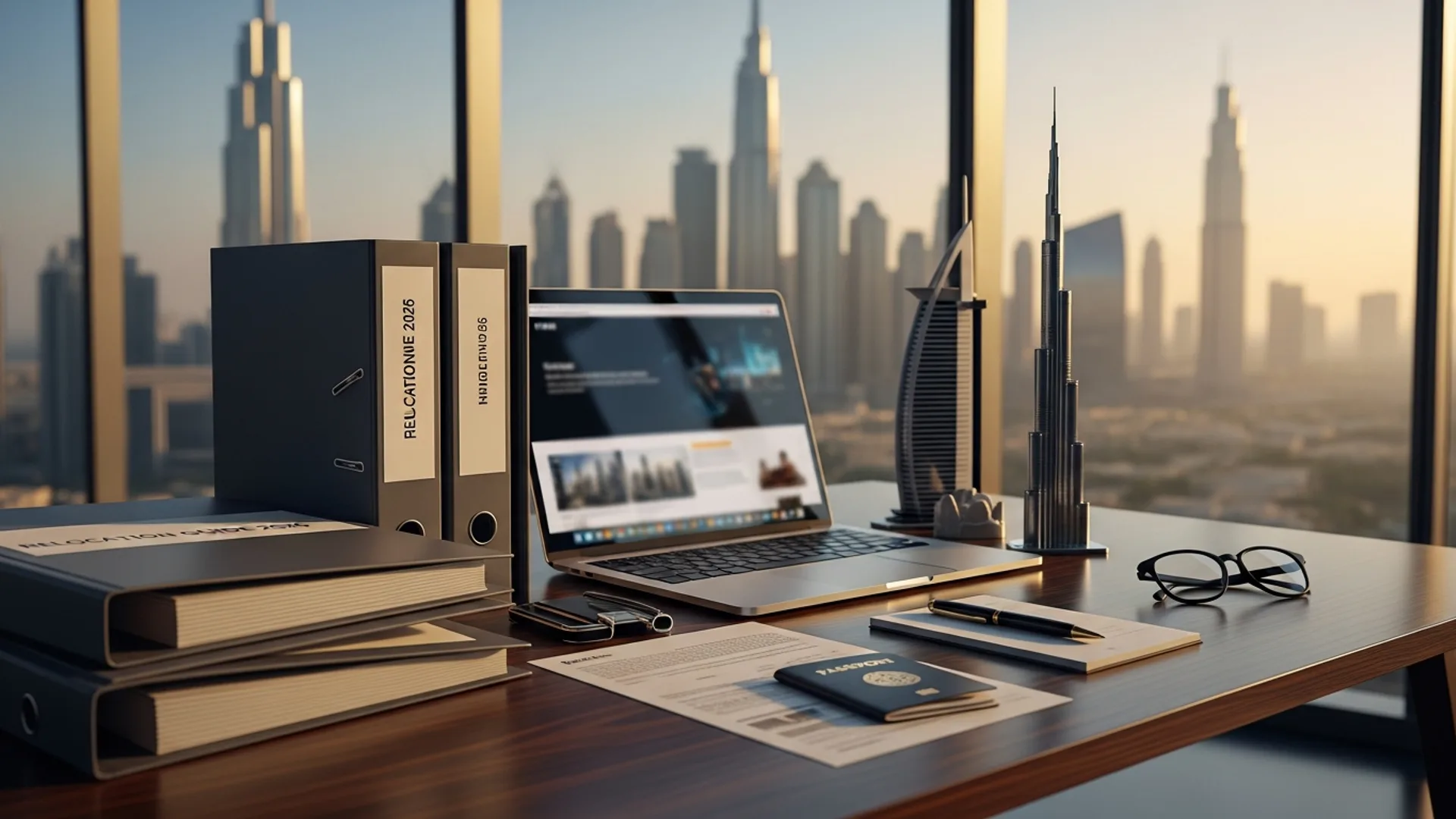
Quick AnswerMoving to Dubai in 2026? Your step-by-step guide to visas, Emirates ID, housing, DEWA, schools, driving licence, banking and cost of living.
Moving to Dubai in 2026 involves a clear, practical sequence: securing a route to a UAE residence visa (through employment, a freelance permit, the Golden Visa, or by setting up your own company), then applying for your Emirates ID, finding housing and registering it through Ejari, activating DEWA utilities, arranging schools through the KHDA system if you have children, obtaining or converting a driving licence with the RTA, opening a bank account, arranging mandatory health insurance, and budgeting honestly for the cost of living. Residency is the gateway that unlocks everything else, so most people plan that first. This guide walks you through each step in the order it usually happens, with honest, hedged guidance throughout so you arrive informed rather than overwhelmed.
Why So Many People Are Moving to Dubai
Dubai has built a reputation as one of the world's most welcoming destinations for professionals, entrepreneurs and families, and that reputation is well earned. The city offers a safe, modern environment, world-class infrastructure, a genuinely international community, excellent connectivity to Europe, Asia and Africa, and a business-friendly framework that has attracted people from almost every country on earth. Walk through any neighbourhood and you will hear a dozen languages, see cuisines from every continent, and meet people who arrived only months ago alongside others who have made the emirate home for decades. That blend of newcomer energy and established community is part of what makes settling in feel achievable rather than daunting.
For many newcomers, the appeal is a combination of opportunity and lifestyle, and it is worth understanding both halves of that equation before you commit. On the opportunity side, Dubai is a major hub for trade, finance, logistics, technology, real estate and tourism, which creates a steady and diverse flow of jobs and business openings. The regulatory environment has been deliberately shaped to welcome foreign investment and entrepreneurship, with streamlined company formation, a growing roster of free zones, and government services that are increasingly digital and efficient. On the lifestyle side, the quality of housing and amenities, the convenience of daily life, the year-round sunshine and the relative ease of getting things done all combine to make the city an attractive place to put down roots, whether you are arriving alone, as a couple, or with a family.
It is worth approaching the move with realistic expectations rather than only the glossy version you may have seen online. Dubai is a fast-moving city with its own rhythms, customs and rules, and a successful relocation rewards good preparation far more than it rewards improvisation. Summers are genuinely hot, the cost of certain things such as housing and private schooling can be significant, and the administrative steps, while straightforward, do require attention to detail and the right documents at the right time. None of this should put you off, but going in with clear eyes helps enormously. The steps that follow are designed to help you arrive informed, sequence your tasks sensibly, and settle in with as little friction as possible. Think of the whole process as an ordered checklist rather than one overwhelming leap, and it becomes very manageable.
Step One: Choose Your Residence Visa Route
Almost everything in Dubai flows from your residence visa, so this is the decision that deserves the most thought before you arrive. Without residency, you cannot easily open a local bank account, sign a long-term tenancy, register utilities in your own name, enrol children in some schools, or sponsor family members to join you. The residence visa is the keystone, and the route you choose to obtain it shapes the cost, the timeline and the flexibility of your entire move. For that reason it makes sense to settle this question early, ideally before you book one-way flights, and to understand how the main routes differ from one another.
The most common path for people arriving with a job already lined up is the employment visa. If you are moving for a role with a UAE-based employer, that employer typically sponsors your residence visa as part of your package. The company applies for an entry permit on your behalf, you complete a medical fitness test and biometric capture once you arrive, and your residence visa and Emirates ID are then issued. Much of the administrative legwork is handled by the employer's public relations officer or human resources team, which makes this route relatively smooth from the employee's perspective. The trade-off is that your residency is tied to that employment, so it is worth understanding the terms of your contract and what happens if your circumstances change.
Freelancers and independent professionals have a different and increasingly popular option. Several free zones offer freelance permits and packages aimed at consultants, creatives, media professionals, technology specialists and other independent workers. A freelance permit allows you to work for yourself and sponsor your own residence visa, without needing a single employer to back you. This route suits people who value flexibility, who have multiple clients rather than one employer, or who want to test the waters of self-employment in a new market. Packages, costs and the activities each permit covers vary between free zones, so it pays to compare a few before deciding which one fits the kind of work you do.
For those who qualify, the UAE's Golden Visa is an appealing long-term route. The Golden Visa is a longer-validity residence visa available to certain categories of people, such as investors, entrepreneurs, highly skilled professionals in fields like medicine and science, outstanding students, and others who meet the published criteria. Its main attractions are the longer validity, which reduces how often you need to renew, and the ability to self-sponsor without a traditional employer. Because eligibility rules are specific and can be updated over time, it is genuinely worth checking the current requirements through official channels before counting on this route as your plan, rather than assuming you qualify based on older information.
For many entrepreneurs and remote founders, though, the most flexible path of all is to register their own company and have that company sponsor their residence visa. This is sometimes called the company-setup or self-sponsorship route, and it is the area where Noble Core Ventures focuses its expertise. When you establish a business in Dubai, you can choose between a free zone business setup and a mainland company, each with its own advantages around ownership, office requirements, the activities you can carry out, and where you can trade. Once the company is formed, it obtains an establishment card and can then sponsor your residence visa, usually as an owner, partner or manager, and very often the visas of your spouse and children as well. This route lets you live in Dubai, work entirely legally within your own venture, and build a genuine business asset all at the same time, which is why so many founders find it the most rewarding option.
Because the visa route shapes the entire relocation, it is genuinely worth comparing your options carefully rather than defaulting to the first one you hear about. The right choice depends on whether you have a job offer, whether you intend to work for yourself, whether you meet Golden Visa criteria, and how much flexibility and control you want over your own residency. Our team regularly helps newcomers weigh the employment, freelance, Golden Visa and company-setup routes against their goals, their budget and their timeline, so they choose with full information. For a fuller overview of the categories available and how each one works in practice, our detailed guide to UAE visa types is a sensible next read once you have a sense of which direction appeals to you.
Step Two: Get Your Emirates ID
Once your residence visa is in process or approved, the next milestone is your Emirates ID, and it is one you will come to appreciate quickly because it touches almost everything you do. This national identity card is issued by ICP, the Federal Authority for Identity, Citizenship, Customs and Port Security, and it is mandatory for every resident of the country regardless of how they obtained their visa. The card carries a chip that stores your details and serves as the single most important piece of identification you will hold during your time in the UAE.
The Emirates ID is far more than a formality or a card you tuck away in a drawer. It is your primary proof of identity and residency, and you will be asked for it constantly throughout daily life: when opening a bank account, when signing a tenancy contract, when registering for DEWA utilities, when accessing healthcare, when collecting a parcel, and when using almost any government or private service. The application typically runs alongside the residence visa process and includes biometric capture, so in practice the two steps are closely linked, and the physical card is usually delivered within a short period after your visa is finalised. Because it is so central to everything, getting it sorted promptly removes a great deal of friction from the steps that follow.
A few practical habits help here and are worth adopting from day one. Keep the physical card on you, because you will be surprised how often it is requested. Make a note of your Emirates ID number somewhere secure, since many online forms ask for it even when you do not have the card in hand. And set yourself a reminder to renew the card well before it expires, because an expired ID can quietly interrupt your access to banking and government services at exactly the moment you need them. Treat the Emirates ID as the backbone of your administrative life in Dubai and keep it current, and a great many small headaches simply never arise. Official information on identity and residency services is published by ICP, the authority that issues the card, and is available through the regulator's own channels at ICP.
Step Three: Find Housing and Register Your Ejari
With residency secured and your Emirates ID in hand, you can turn your attention to housing, which for most people is both the most exciting and the most consequential part of the move. The great majority of newcomers rent rather than buy, especially in their first year, because renting gives you the freedom to get a genuine feel for the different communities before committing to a purchase. Dubai is a city of distinct neighbourhoods, each with its own character, price point and lifestyle, and what looks ideal on a map can feel quite different once you have spent a week commuting from it, so a degree of patience early on pays real dividends.
The range of housing is enormous, spanning high-rise apartment districts with restaurants and nightlife at your doorstep, quieter master-planned villa communities built around schools and parks, waterfront developments, and everything in between, all at a wide spread of price points to suit different budgets. You can search online listings to get a sense of the market, engage a licensed real estate agent who knows the areas you are considering, and arrange viewings to see properties in person. When you are weighing options, look beyond the rent itself to the things that shape daily life: the length and difficulty of your commute, the proximity of schools if you have children, the amenities within the community, and the general feel of the neighbourhood at different times of day. The right home is the one that fits your routine, not simply the one with the best photographs.
Once you agree to rent a property, you sign a tenancy contract, and that contract must be registered through Ejari, the official tenancy registration system in Dubai. This registration matters far more than it might first appear, because a valid Ejari is generally required before you can activate utilities in your own name, sponsor family members to join you, and complete several other formalities. In most cases the agent or landlord handles the Ejari registration for you, but it is genuinely worth confirming that it has been done and keeping a copy of the certificate yourself, because assuming it has been registered when it has not can stall your next few steps. A small amount of diligence here prevents a frustrating delay later on.
It is also wise to plan carefully for the upfront costs of renting, which can catch newcomers off guard if they are used to a different system. Beyond the rent itself, you should budget for an agency fee, a refundable security deposit, and the rent payment, which in Dubai is often paid in one lump sum or a small number of instalments across the year rather than monthly as in many other countries. Because housing is usually the single largest line in any Dubai budget, being realistic and well-prepared here makes the whole move feel calmer. Our detailed breakdown of the cost of living in Dubai can help you set sensible expectations for rent and deposits before you commit to a contract, so there are no unwelcome surprises when it comes time to sign.
Step Four: Activate Your DEWA Utilities
In most of Dubai, electricity and water are supplied by DEWA, the Dubai Electricity and Water Authority, and getting your connection activated is one of the more straightforward steps in the whole relocation. Once your tenancy contract is registered through Ejari, you apply to DEWA to activate the electricity and water connection for your new home, and in most cases the entire process can be completed online or through the DEWA mobile app without needing to visit an office in person. For a move that involves a fair amount of paperwork elsewhere, this is a refreshingly simple piece of the puzzle.
To activate your connection you will generally need to provide your Ejari certificate, your Emirates ID or visa details, and a few other particulars about the property, and you will pay a refundable security deposit. The amount of that deposit usually depends on whether your home is an apartment or a villa, with villas typically attracting a higher deposit because of their larger consumption. Once your documents are in order the activation is often quick, sometimes the same day, so you can move into a home that is comfortable and fully functional from the moment you arrive rather than waiting around in the heat without air conditioning.
There is one nuance worth understanding before you sign any tenancy, and it relates to how cooling is billed. Some communities and buildings in Dubai are served by separate district cooling providers, which deliver chilled water for air conditioning and bill those charges separately from your main DEWA account. Because air conditioning is a meaningful part of any household's running costs in this climate, it is genuinely worth asking your agent or landlord about the cooling arrangement for a specific property before you commit, so that your utility budget is accurate and there are no surprises on your first bills. Setting up your utilities early, and understanding exactly what you will be charged for, means your new home works smoothly from day one and your monthly budgeting starts on solid ground.
Step Five: Sort Out Schools If You Have Children
Families relocating with children will want to address schooling as early as possible, ideally before they even arrive, because demand for the most sought-after schools can be high and places fill up. The good news is that Dubai is genuinely renowned for the breadth and quality of its private education sector, which is one of the reasons so many international families choose the city in the first place. Schools across the emirate offer a wide variety of curricula, including British, American, International Baccalaureate, Indian, French and many others, so most families can find an option that maintains educational continuity for their children or matches the system they prefer.
Most private schools in Dubai are regulated and inspected by KHDA, the Knowledge and Human Development Authority, which plays an important role in maintaining standards across the sector. KHDA carries out inspections and publishes school inspection ratings, and those ratings are a genuinely useful tool for parents trying to compare quality and shortlist schools that fit their child's needs. Rather than relying solely on a school's own marketing, you can consult the published ratings to get an independent sense of how a school performs, which brings welcome transparency to what can otherwise feel like a difficult decision made from a distance.
The admissions process itself usually involves submitting an application, completing an assessment appropriate to the child's age, and providing documents such as the child's passport, residence visa, Emirates ID and previous school reports or transcripts. Because places at popular schools can be limited and competition for them real, applying early is strongly advisable, and many families begin the process well before they physically relocate. It is also important to plan financially, because tuition fees vary considerably by school, curriculum and grade level, and for families with several children education can become one of the largest items in the household budget after housing. Building school fees into your financial planning from the outset, alongside a clear understanding of the application timelines, helps ensure your children settle into the right school without last-minute stress.
Step Six: Get Your Driving Licence
Many residents choose to drive in Dubai, and given the layout of the city and the climate, having your own transport can make daily life considerably easier. To drive legally as a resident, however, you need a valid UAE driving licence, and licensing in Dubai is overseen by the RTA, the Roads and Transport Authority. The path you take to obtain that licence depends largely on your nationality and the licence you already hold, so it is worth understanding which category you fall into before you make assumptions about how quickly you will be behind the wheel of your own car.
Residents from certain countries may be eligible to convert their existing foreign licence to a UAE licence without having to complete a full course of driving lessons, which is obviously the quicker and cheaper path. Others, whose home-country licences are not on the eligible list, will need to enrol at an approved driving school, take a prescribed number of lessons, and pass both theory and road tests before a licence is issued. In either case you will generally need to present your Emirates ID, your residence visa, the results of an eye test, and passport-style photographs as part of the process. Because the eligibility rules determine whether you face a simple conversion or a fuller course, confirming your status early helps you plan both your time and your budget realistically.
The reassuring part is that you are never stranded while you sort this out. Until you hold a UAE licence, getting around Dubai is genuinely easy, because the city has an extensive and modern metro network, comprehensive bus services, plentiful taxis, and widely used ride-hailing apps. Many newcomers rely happily on this mix of public and private transport for their first weeks or months and only pursue a licence once they have settled the more pressing relocation steps. For the specifics of conversion eligibility, the documents required, the tests involved and the likely costs, our dedicated guide to the driving licence in Dubai walks through the whole process in detail so you know exactly what to expect for your particular nationality.
Step Seven: Open a Bank Account
A local bank account makes day-to-day life in Dubai far simpler, and opening one is usually high on the list once your residency and Emirates ID are in place. With a local account you can receive your salary or business income, pay rent, settle utility bills, transfer school fees and manage everyday spending without relying on overseas banking, which quickly becomes cumbersome and expensive. To open a personal account, banks typically require your Emirates ID, your residence visa and a proof of address, and for business owners there will be additional company documentation to provide as part of the process.
Dubai is served by many reputable local and international banks, each offering a range of personal and business accounts with different features, benefits and requirements. Some account types ask for a minimum monthly balance to be maintained, with fees applying if you fall below it, while others are more flexible and better suited to people whose income arrives irregularly or who prefer not to lock up funds. Because these terms vary meaningfully from bank to bank, it is worth comparing a few options and choosing an account that genuinely matches your income pattern, your spending habits and the level of service you want, rather than simply opening an account with the first bank you walk into.
For business owners arriving through the company-setup route, opening a bank account is an integral part of the broader launch process rather than a separate afterthought. Banks will want to understand your business, see properly prepared company documents, and in some cases learn about your expected activity, so having your paperwork in good order from the start helps the account-opening go more smoothly and avoids repeated requests for additional information. This is one of the areas where working with experienced advisors who understand both company formation and the local banking landscape can save you a meaningful amount of time and back-and-forth, so that your business is operationally ready soon after it is formed.
Step Eight: Arrange Health Insurance and Healthcare
Health insurance is mandatory for residents in Dubai, and it is generally tied directly to your residence visa, so this is not a step you can skip or postpone indefinitely. The structure of who provides the cover depends on your situation. Employers are typically required to provide health insurance for their employees as part of their obligations, and sponsors are usually responsible for arranging cover for the dependents they sponsor, such as a spouse and children. If you are self-sponsored through your own company under the company-setup route, then you arrange your own policy and, where relevant, policies for the family members you sponsor.
The range of available plans is broad, stretching from basic essential cover that meets the minimum requirements through to comprehensive international policies that offer wider networks and richer benefits. Premiums are shaped by factors such as your age, the level of coverage you select, and any optional extras you add, so it is worth thinking about what level of cover genuinely suits your circumstances rather than defaulting to either the cheapest or the most expensive option. Families, in particular, benefit from looking carefully at network hospitals, maternity cover where relevant, and how dependents are handled under a given plan.
In terms of the care itself, Dubai is well served by a strong network of public and private hospitals, clinics and pharmacies, so access to medical services is generally good and waiting times for many treatments are reasonable. Keeping a valid health insurance policy is not only sensible for your own wellbeing and financial protection, it is also part of remaining compliant with the residency requirements, since cover is linked to your visa status. Treat your insurance as a standing obligation to keep current, much like your Emirates ID, and you protect both your health and your legal standing as a resident at the same time.
Step Nine: Plan Your Cost of Living
A realistic budget is one of the most valuable things you can prepare before moving to Dubai, and giving it proper attention up front prevents a great deal of stress later. The honest truth is that the cost of living varies enormously depending on your lifestyle, the size of your family, and the community you choose to live in, so headline figures you read online are only a rough guide. A single professional living modestly in a shared or compact apartment will spend a fraction of what a family renting a large villa and sending two or three children to a premium international school will spend, and both are perfectly normal ways to live in the city.
Housing is almost always the largest single expense, and it can swing dramatically depending on the area and property type you choose, so it is the line that most rewards careful thought. For families, education usually comes next, since private school fees can be substantial and scale with the number of children and the curriculum. Beyond those two big items, you will budget for transport, whether that means the costs of running a car or relying on public transport and ride-hailing, for utilities including your DEWA electricity and water and any separate cooling and internet charges, for groceries and dining out, which span a wide range to suit every budget, and for your mandatory health insurance premiums. Mapping each of these categories against your own circumstances gives you a far more accurate picture than any generic average could.
Many residents find that the absence of personal income tax helps offset the higher costs of housing and schooling, leaving them with more disposable income than they might have at a similar salary elsewhere, though everyone's situation is genuinely different and it would be unwise to assume any particular outcome. The sensible approach is to build a realistic monthly budget before you move, add a comfortable buffer to cover the one-off setup costs that inevitably cluster in your first few months, and then review and adjust the budget once you are settled and can see your actual spending. Our dedicated guide to the cost of living in Dubai goes into detail on each category and helps you build that picture with confidence before you arrive.
Contact Us For Free Consultation
or
Ask on WhatsApp insteadLicensed UAE consultancy. One reply, no spam.
Thank you.
A consultant will reply on WhatsApp shortly.
Step Ten: Settle In and Build Your Network
Once the formal steps are complete, the genuinely rewarding part of the move begins, which is actually living in Dubai and making it feel like home. Building a network, whether professional, social or both, makes a real and often underestimated difference to how quickly the city stops feeling like a destination and starts feeling like home. Because the community here is so genuinely international, with people from almost everywhere finding their footing at the same time, there are countless professional associations, industry groups, interest-based communities, sports clubs and social events through which to connect, and most newcomers find that putting a little effort into this early pays off handsomely.
It also helps to spend time simply exploring and learning the practical rhythms of the city in those first weeks. Visit different neighbourhoods to understand their character, get to grips with the metro and bus map so you can move around confidently, discover where to shop and eat near your home, and learn the small everyday conventions that make daily life smoother. Many newcomers find that the first few months involve a genuine learning curve, after which daily life becomes remarkably easy and the things that once felt unfamiliar become second nature. Giving yourself permission to take that learning period in stride, rather than expecting to have everything figured out on day one, makes the whole transition more enjoyable.
A Realistic Relocation Timeline
While every move has its own particulars, it helps to have a sense of the typical sequence so you can plan your time and manage your expectations. Before you arrive, the most valuable work is research and preparation: choosing your visa route, gathering and attesting the documents you will need, and exploring neighbourhoods, schools and budgets remotely so that you arrive with a plan rather than improvising on the ground. The more of this groundwork you complete in advance, the faster everything else tends to move once you land, and the less time you spend in expensive limbo.
In the first week or two after arrival, the focus is usually on the visa and identity foundations. You enter on the appropriate entry permit, complete your medical fitness test and biometric capture, and progress your residence visa, with your Emirates ID following closely behind. From roughly the second to the fourth week, with residency taking shape, you begin searching seriously for housing, viewing properties and narrowing down a community, while your Emirates ID arrives and unlocks the next set of tasks. Around weeks three to six, you sign a tenancy contract, register your Ejari, activate your DEWA utilities and open your bank account, at which point your home and finances are functional. Running in parallel throughout this period, you finalise school admissions if you have children, arrange your mandatory health insurance, and begin the driving licence process so that none of these longer-lead items is left to the last minute.
By the second or third month, most people have completed the core relocation steps and shifted into settling in, building their network and tidying up any remaining administrative odds and ends. The crucial thing to remember is that the visa and company-setup stages sit at the gateway of this whole sequence, which is precisely why good preparation and experienced support pay off most there. Once residency and the Emirates ID are firmly in place, the remaining steps tend to flow comfortably in parallel rather than blocking one another, and the move that once seemed daunting reveals itself to be a very manageable series of ordered tasks.
Common Mistakes
Even well-planned moves can hit avoidable snags, and being aware of the most common pitfalls in advance is one of the easiest ways to keep your relocation smooth. Perhaps the most consequential mistake newcomers make is leaving the visa route to chance, or starting it too late. Because residency unlocks almost everything else, choosing the wrong route for your circumstances, or beginning the process only after you arrive, can delay your entire relocation and leave you unable to rent, bank or settle children into school. Deciding your route early, and seeking advice where it helps, prevents this domino effect, and the company-setup route in particular rewards upfront planning rather than last-minute improvisation.
A second frequent misstep is underestimating the upfront housing costs. Because rent in Dubai is often paid in one lump sum or a small number of instalments, on top of a refundable deposit and an agency fee, newcomers who are expecting to pay monthly can be caught short at exactly the wrong moment. Budgeting for those larger one-off sums from the outset avoids a stressful scramble. Closely related is the mistake of forgetting to confirm that the Ejari registration has actually been completed. Some people simply assume their tenancy is registered when it is not, and without a valid Ejari certificate they then struggle to activate utilities or sponsor family members, so always insist on receiving and keeping the certificate yourself.
Several other mistakes recur often enough to be worth flagging plainly. Overlooking district cooling charges trips up people in communities where cooling is billed separately from DEWA, so ask about it before signing. Applying to schools too late leaves families competing for scarce places, so research KHDA ratings and apply early. Assuming an automatic driving licence swap leads to disappointment for those whose nationality requires lessons, so confirm your conversion eligibility with the RTA in advance and plan your transport in the meantime. Skipping a financial buffer leaves no margin for the one-off setup costs that cluster in the first few months, so arrive with some cushion. And finally, trying to go it alone on the genuinely complex parts, especially the visa and company-setup formalities with their specific document and process requirements, frequently causes delays that a knowledgeable partner would have avoided entirely. Recognising which parts of the move benefit from expert help is itself a mark of a well-planned relocation.
How Noble Core Ventures Helps You Relocate Through Company Setup
For entrepreneurs, remote founders and professionals who want maximum flexibility and control over their move, setting up a company is one of the most attractive ways to relocate to Dubai. It gives you a legal basis to live and work in the city on your own terms, lets you sponsor your own residence visa and those of your family members, and builds a genuine business asset in the very process of moving, so your relocation and your venture advance together rather than competing for your time and money. For the right person, it turns the cost of moving into an investment in something that can grow.
Noble Core Ventures specialises in exactly this kind of relocation. We help newcomers compare free zone and mainland options against their goals, choose the right business activities and the most suitable package, register the company correctly, obtain the establishment card, and arrange the sponsorship of residence visas, so that the relocation and the business launch happen together as one coordinated process rather than as two disconnected projects. Because we work across the whole journey, we can also point you toward trusted partners for the adjacent steps such as banking, insurance and other essentials, smoothing the parts of the move that sit just outside company formation itself.
If the company-setup route fits your goals, getting the structure right from the very start makes the rest of your move to Dubai significantly smoother, because so many later steps depend on the company and the visa being set up cleanly. A small amount of expert guidance at the outset can save weeks of avoidable delay later. To explore the path that suits you, you can review our free zone business setup options or read through the full range of UAE visa types to understand which residency route best matches your circumstances before you commit. Where relevant, you can also confirm employment-related obligations such as mandatory health cover through the federal labour regulator at MOHRE.
Final Thoughts
Moving to Dubai in 2026 is very achievable when you approach it as an ordered sequence of manageable tasks rather than one overwhelming undertaking. Secure your residence visa route first, since it is the keystone that unlocks everything else, then get your Emirates ID, find a home and register your Ejari, activate your DEWA utilities, sort out schools through the KHDA system if you have children, obtain your RTA driving licence, open a local bank account, arrange your mandatory health insurance, and budget honestly and realistically for the cost of living. Tackle these steps in roughly the right order, prepare your documents thoroughly in advance, and lean on experienced advisors for the visa and company-setup stages where their help matters most, and you will find yourself settling into one of the world's most dynamic and welcoming cities far sooner, and far more smoothly, than you might have expected when you first started planning the move.
Talk to Our Experts
company-setup-as-residence-route
Frequently Asked Questions
What is the first step when moving to Dubai?
The practical first step is securing a route to a UAE residence visa, because almost everything else in Dubai depends on having residency. Most people obtain residency through an employer who sponsors them, through a freelance or self-sponsorship permit, through the long-term Golden Visa, or by setting up their own company and sponsoring themselves. Once a residence visa is approved you can apply for an Emirates ID, open a bank account, sign a tenancy contract, register utilities and complete the other steps. Many newcomers plan the visa route before they arrive so the rest of the relocation flows smoothly and without avoidable delays.
Can I move to Dubai by starting a business?
Yes, and for many entrepreneurs and remote founders this is one of the most flexible relocation routes available. When you register a company in a Dubai free zone or on the mainland, the company can apply for an establishment card and then sponsor your residence visa, typically as an owner, partner or manager. This is often called self-sponsorship. It removes the need to find an employer first, lets you work legally in your own venture, and can usually include visas for family members too. Processing times and costs vary by free zone and activity, so it is wise to compare options carefully before committing to any single structure.
What is an Emirates ID and why do I need one?
The Emirates ID is the national identity card issued by the Federal Authority for Identity, Citizenship, Customs and Port Security (ICP) to every UAE resident and citizen. It is mandatory and acts as your primary proof of identity and residency. You will be asked for it when opening a bank account, signing a tenancy contract, registering for utilities, accessing healthcare and using most government services. The card is normally applied for alongside your residence visa, and it includes a chip that stores your details. Keep it with you at all times, and renew it before it expires to avoid any interruptions to your services.
How do I find and rent accommodation in Dubai?
Most newcomers rent rather than buy, at least initially. You can search listings online, work with a licensed real estate agent, and view properties across a wide range of communities and price points. Once you agree terms, you sign a tenancy contract and the agent or landlord registers it through the Ejari system, which is the official tenancy registration platform in Dubai. A registered Ejari is important because you generally need it to set up utilities, sponsor family members and complete other formalities. Budget for an agency fee, a refundable deposit and rent, which is often paid in one to a few instalments rather than monthly.
How do I set up electricity and water (DEWA) in Dubai?
Utilities in most of Dubai are provided by the Dubai Electricity and Water Authority, known as DEWA. After you have a registered tenancy contract, you apply to DEWA to activate the electricity and water connection for your home, usually online or through their app. You will typically provide your Ejari, Emirates ID or visa details and pay a refundable security deposit, with the amount depending on whether the property is an apartment or a villa. Activation is usually quick once documents are in order. Some communities are served by separate district cooling providers, so cooling charges may be billed separately from your main DEWA account.
How do schools and education work for families in Dubai?
Dubai has a large selection of private schools offering many curricula, including British, American, IB, Indian and others, which makes it popular with international families. Most private schools in Dubai are regulated and inspected by the Knowledge and Human Development Authority (KHDA), and inspection ratings are published to help parents compare quality. Admission usually involves an application, an age-appropriate assessment and submission of documents such as the child’s passport, visa, Emirates ID and previous school reports. Demand for popular schools can be high, so families often apply early. Tuition fees vary widely by school, curriculum and grade, so plan your education budget carefully and well in advance.
How do I get a driving licence in Dubai?
Driving in Dubai requires a valid UAE driving licence once you are a resident. The Roads and Transport Authority (RTA) oversees licensing in Dubai. Residents from certain countries may be eligible to convert their existing licence without taking a full driving course, while others must enrol at an approved driving school, complete lessons and pass theory and road tests. You will generally need your Emirates ID, residence visa, an eye test and passport-style photos. Until you hold a UAE licence, public transport, taxis and ride-hailing apps are widely available, so many newcomers rely on these while they complete the licensing process.
What is the cost of living when moving to Dubai?
The cost of living in Dubai varies a great deal depending on your lifestyle, family size and the community you choose. Housing is usually the largest expense, followed by schooling for families, transport, utilities, groceries and health insurance. A single professional living modestly will spend far less than a family renting a large villa and sending children to a premium school. Many residents find that the absence of personal income tax helps offset higher housing and education costs. It is sensible to build a realistic monthly budget before you move and to keep a financial buffer for one-off setup costs in your first few months.
Do I need health insurance to live in Dubai?
Yes. Health insurance is mandatory for residents in Dubai, and it is generally a requirement linked to your residence visa. Employers are typically required to provide health cover for their employees, and sponsors are usually responsible for arranging cover for the dependents they sponsor. If you are self-sponsored through your own company, you arrange your own policy. Plans range from basic essential cover to comprehensive international policies, with premiums depending on age, coverage level and any add-ons. Dubai has a wide network of public and private hospitals and clinics, and keeping valid insurance ensures you can access care and remain compliant with residency rules.
How long does it take to fully settle in Dubai?
Many people complete the core relocation steps within a few weeks to a couple of months, though timelines vary with your visa route and how prepared you are. Securing the residence visa and Emirates ID is the gateway, and these can often move quickly once documents are ready. Finding the right home, registering Ejari, activating DEWA, opening a bank account, arranging schooling and converting or obtaining a driving licence then follow in parallel. Working with experienced advisors for the visa and company-setup stages can compress the timeline and help you avoid the common delays caused by missing or incorrect paperwork.