Quick AnswerPromotion permit Dubai 2026: DET rules for discounts, prize draws and giveaways, 30-day lead times, prize security, 5% VAT and 9% corporate tax.
If you are planning a discount campaign, a prize draw, a mall activation or even a social media giveaway for UAE customers, you almost certainly need a promotion permit Dubai businesses obtain from the Department of Economy and Tourism before any advertising goes live. Dubai regulates promotional marketing under its consumer-protection framework precisely because promotions involve claims, prizes and money, and the permit exists to make sure the offer a customer sees is the offer they actually get. Apply at least 30 days ahead, and expect a prize draw to carry security over the declared prize value until winners are paid out.
The requirement surprises founders far more often than it should. Businesses that would never dream of running an event without approval assume a "20% off" banner or an Instagram giveaway is unregulated marketing. It is not. The rules apply to the licensed business making the offer, regardless of whether the channel is a shopfront, a mall atrium, an app or a social feed. This guide sets out which campaigns need approval, how the application works, what your terms and conditions must contain, the cost and tax picture, and the mistakes that get campaigns pulled mid-flight.
Which Campaigns Need a Promotion Permit in Dubai?
A DET promotion permit is required for advertised discounts, prize draws, raffles, giveaways, loyalty rewards, sampling and most consumer-facing marketing offers made by Dubai-licensed businesses. Apply at least 30 days before launch. Prize draws typically require security over the full declared prize value, discounted sales carry 5% VAT on actual consideration, and business profits above AED 375,000 are taxed at 9%.
The regulator's test is functional rather than technical. If your marketing induces a consumer to buy, enter or engage on the strength of a price reduction, a free item or a chance to win, it is promotional activity. That covers a wider range than most marketing teams assume.
Price-based promotions. Percentage or value discounts, clearance and end-of-season sales, buy-one-get-one offers, bundle pricing, introductory offers, and time-limited flash sales. The core concern is price-claim honesty: the "was" price must be genuine, the discount must be real, and exclusions must be disclosed.
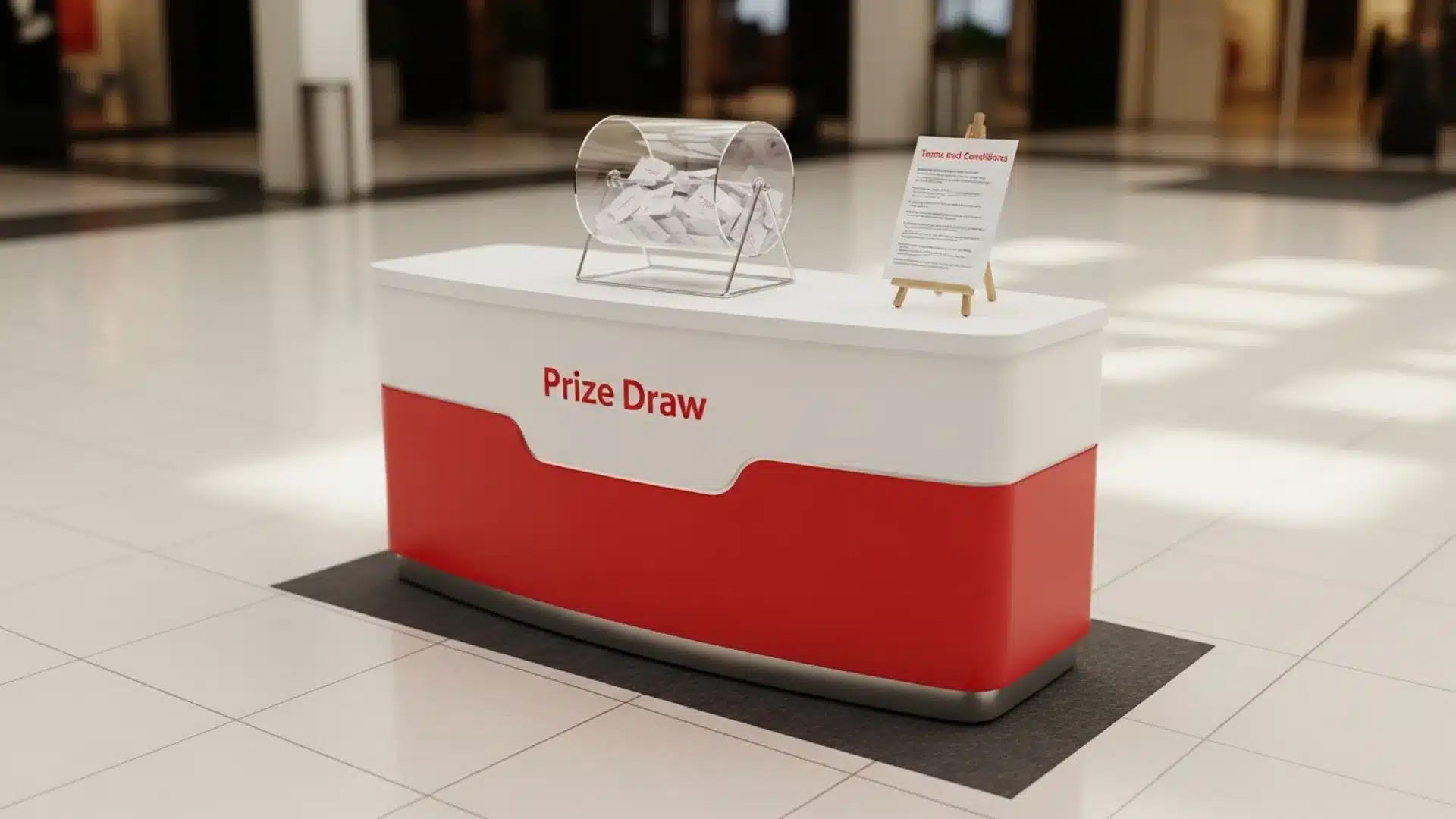
Prize-based promotions. Raffles and prize draws, scratch cards, instant-win mechanics, spin-to-win, competitions with a prize, and social media giveaways. These carry the heaviest requirements because the business holds out a prize to the public. Note carefully: gambling is not permitted in the UAE. An approved prize draw is a marketing campaign in which entry follows a purchase or a qualifying engagement — the consumer does not pay a separate stake for a chance to win, and the campaign is approved, supervised and recorded.
Reward and loyalty promotions. Points multipliers, cashback offers, gift-with-purchase, referral rewards and tiered membership benefits. The concern is that accrued value is honoured and expiry terms are clear.
Experiential promotions. Product sampling, demonstrations, roadshows, mall kiosks and brand activations. These add a physical dimension, pulling in venue NOCs and, for outdoor or public placements, Dubai Municipality and RTA considerations.
Here is the indicative cost picture. Fees vary by campaign type, duration, prize value and channel, and are confirmed at application.
| Cost item | Indicative range (AED) | When | Notes |
|---|---|---|---|
| DET promotion permit (discount campaign) | 500 – 5,000 | Per campaign | Duration and scale dependent |
| DET permit (prize draw / raffle) | 1,000 – 15,000+ | Per campaign | Scales with prize value |
| Prize security or guarantee | Full declared prize value | Held | Released after prize delivery |
| Mall or venue NOC | Variable | Per activation | Commercial negotiation |
| Kiosk or stand placement | 5,000 – 60,000 | Per campaign | Location and footfall driven |
| Dubai Municipality approvals | 500 – 8,000 | Per campaign | Outdoor structures, sampling of food |
| RTA approvals | Variable | Per campaign | Where public roads or transport affected |
| Advertising content clearance | 500 – 5,000 | Per campaign | Creative and claims review |
| Draw supervision / observer | Variable | Per draw | Where required by the permit |
| VAT on discounted supplies | 5% | Per sale | On actual consideration received |
| Corporate tax on profit | 0% to AED 375,000, 9% above | Annual | Federal Tax Authority |
Who Applies, and the Licence Behind the Permit
The permit applicant is the licensed business making the offer. That means a valid Dubai trade licence with activities consistent with what is being promoted. A retailer promotes its own goods; a restaurant promotes its own menu; a brand with no UAE licence cannot simply run a Dubai campaign in its own name.
This creates a real constraint for three common scenarios.
International brands without a UAE entity. The campaign must be run by a licensed UAE distributor, franchisee or agency that holds the customer relationship and takes responsibility for the offer. The brand can fund and design the campaign; the licensed entity applies, holds the permit and answers for delivery.
Free zone companies. A DMCC, IFZA or DAFZA entity operates within its zone and internationally. Promoting directly to mainland Dubai consumers generally exceeds that scope. The workable routes are to establish a mainland entity, or to run the campaign through a licensed mainland partner who holds the permit.
Marketplaces and platforms. Where a platform runs a campaign across many merchants, responsibility for the offer needs to be clearly allocated. Whoever makes the promise to the consumer is who the regulator will look to when a customer complains.
If you need to establish the licensed entity first, the mainland sequence is conventional: trade name reservation, DET initial approval, tenancy and Ejari registration, MOA notarisation, licence issue, establishment card, MOHRE registration and residence visas processed through ICP and GDRFA. Allow four to eight weeks, and do not schedule a launch campaign inside that window.
The Application: Documents, Terms and Lead Times
A promotion permit application is essentially a description of exactly what you intend to promise the public, and the evidence that you can deliver it.
Expect to submit: a copy of the trade licence; a full campaign description with mechanics, start and end dates and participating locations or channels; the proposed advertising creative and claims; the complete terms and conditions; prize details with declared values and supplier invoices or quotations where prizes are goods; the security arrangement for prize value; venue or mall NOCs for physical activations; and a description of the draw method and winner-notification process.
Your terms and conditions are the heart of the file, and thin terms are the most common reason for a request for clarification. They should state the promoter's identity and licence, precise eligibility criteria including age and residency where relevant, the exact entry mechanic and any purchase requirement, the campaign period with time zone, the full prize schedule with values, how and when the draw takes place, how winners are notified and by when, what happens if a winner cannot be contacted, whether prizes are transferable or exchangeable for cash, who bears delivery and any associated costs, and how complaints are handled. Vague terms are not a commercial advantage in Dubai — they are the fastest route to a consumer complaint you will lose.
Lead times: a simple discount campaign in your own premises, 30 days. A prize draw with meaningful prize value, 30 to 45 days because the security arrangement takes time. A mall activation, 45 to 60 days given the venue's own internal approval process. An outdoor or road-adjacent activation, 60 days or more, since Dubai Municipality and RTA involvement is not quick. Guidance and service channels for municipal approvals are published at https://www.dm.gov.ae/, and road and transport matters at https://www.rta.ae/.
Prize Draws: Security, Supervision and Winner Obligations
Prize-based campaigns carry the heaviest conditions because the public is being asked to act on the promise of something they have not yet received.
Security over prize value. DET commonly requires a bank guarantee, deposit or equivalent security covering the full declared value of prizes, held until winners have actually received them. This is a straightforward consumer-protection mechanism: it guarantees the prize exists. Plan the cash-flow effect early, because tying up the value of a car or a large cash prize for the campaign duration plus fulfilment is a real balance-sheet event for a small business. Where prizes are goods supplied by a partner, supplier confirmations and invoices support the declared value.
Supervision and transparency. Draws must be conducted in the manner the permit specifies. Depending on scale that can mean an authorised observer present, a documented randomisation method, sealed entry handling, and a recorded outcome. Electronic draws need a demonstrable random selection method — a spreadsheet sorted by someone's judgement is not that.
Winner handling. Announce winners as the permit requires and within the stated timeframe. Keep evidence of notification attempts. Have a documented process for unclaimed prizes, and follow the permit's requirements for what happens to them; you cannot simply keep an unclaimed prize because the winner did not answer the phone twice. Retain the full record — entries, draw evidence, notifications, delivery confirmations — because this is what resolves a dispute or an inspection in minutes rather than weeks.
Fulfilment. Deliver prizes within the stated period. Late or partial fulfilment on a permitted campaign is precisely the failure the security exists to remedy, and it lands on your compliance record.
Consumer Protection, Advertising Claims and Content Standards
Dubai's consumer-protection framework, administered through DET's commercial compliance function with the Ministry of Economy setting the federal backdrop, governs what you may claim.
Price claims must be truthful. If you advertise a reduction, the original price must have been genuinely charged for a meaningful period. Inflating a reference price before a sale is a recognised breach and one that inspectors actively look for during promotional seasons.
Exclusions must be visible, not buried. "Selected lines" needs definition. "Up to 70% off" requires that a genuine quantity of stock is actually at 70%. Stock availability claims must be honest, and if an advertised item sells out early, that must be handled fairly rather than used as a footfall device.
Advertising content itself must respect UAE cultural and community standards and is subject to clearance. Submit creative early. This is a normal part of campaign planning in the UAE and is rarely a problem when the work is submitted with time to adjust.
Complaints matter more than their volume suggests. Dubai's consumer channels are responsive and a pattern of unresolved promotional disputes is a licence-standing issue, not merely a customer-service metric. Log every complaint, resolve quickly, and record the resolution.
Tax Treatment of Promotions
Corporate tax applies at 0% on taxable income up to AED 375,000 and 9% above it. Registration with the Federal Tax Authority through EmaraTax is mandatory regardless of profit, and the return falls due nine months after the financial year-end. Promotional spend, prize costs and permit fees are ordinary business expenses, but keep them clearly evidenced — per-campaign records make the position simple to defend. Full guidance is published at https://tax.gov.ae/.
VAT at 5% is where promotions get technical, and it is worth resolving before the campaign runs rather than at the return.
Discounts reduce the consideration, so VAT is accounted for on the amount actually received. A AED 100 item sold at 20% off is a AED 80 taxable supply, and the tax invoice should reflect that.
Buy-one-get-one-free is generally treated as a single supply at the total consideration received, with the "free" item forming part of that bundle rather than a separate gift.
Genuine giveaways and prizes raise deemed-supply considerations. Goods on which input tax was recovered and which are then given away free can create a deemed supply, subject to the de minimis and sample rules. This is a genuine trap for high-value prize campaigns.
Vouchers and cashback have their own treatment depending on whether the voucher is single-purpose or multi-purpose and whether cashback is a discount or a separate payment.
None of this is exotic, but all of it is easier to document in advance than to unwind across thousands of transactions. Get the treatment of each promotional mechanic written down before launch, and register for VAT once taxable turnover exceeds AED 375,000 — voluntary registration is available from AED 187,500.
Step-by-Step: From Campaign Brief to Approved Permit
Step 1 — Classify the mechanic. Before anything else, write down in one sentence what the consumer is being offered and what they must do to get it. Price reduction, free item with purchase, chance to win, points accrual, free sample. That sentence determines which permit type applies, what security you need and how long approval takes. Marketing teams that skip this step routinely design a mechanic that is far more heavily regulated than the commercial idea required.
Step 2 — Confirm the permit holder. Verify that the applying entity holds a valid Dubai trade licence with activities consistent with the promoted goods or services. If the brand has no mainland entity, identify the licensed distributor, franchisee or agency who will hold the permit and, with it, the responsibility for delivering the offer.
Step 3 — Fix the campaign parameters. Start and end dates, participating locations and channels, eligible products, prize schedule with values, expected entry volumes and the draw date. These go into the application and are what you will be held to, so agree them internally before filing rather than negotiating changes afterwards.
Step 4 — Draft the terms and conditions. Write them properly, in the detail set out earlier. This document does more work than any other part of the file.
Step 5 — Arrange prize security and supplier evidence. For prize campaigns, engage your bank early on the guarantee or deposit, and collect supplier invoices or quotations substantiating declared prize values.
Step 6 — Secure venue and site approvals. Mall NOCs, landlord consents, and Dubai Municipality or RTA approvals for outdoor, kiosk or road-adjacent placements. These run in parallel with the DET application, not after it.
Step 7 — Submit the DET application. File the complete pack, including creative. Expect at least one clarification request; respond quickly, because the clock effectively restarts on each round trip.
Step 8 — Hold the media buy until the permit issues. Book flexible cancellation terms on media wherever the permit is not yet in hand. This single discipline saves more money than any other on this list.
Step 9 — Brief the frontline. Store staff, call-centre agents and social media moderators must know the mechanic, the exclusions and the complaint route. Most consumer disputes originate in a frontline answer that contradicts the published terms.
Step 10 — Run, record and close out. Execute the draw as specified, notify and fulfil, retain the complete evidence pack, release the prize security, and file the campaign records with your accounting for the corporate tax and VAT position.
Planning Around Dubai's Promotional Calendar
Dubai's retail year has pronounced peaks, and permit processing is busiest exactly when everyone wants to launch. The major shopping seasons, the summer retail period, Ramadan and Eid trading, and the year-end festive window concentrate an enormous volume of promotional applications into a handful of weeks.
The practical consequences are three. First, lead times stretch during peaks — the 30-day guideline is comfortable in a quiet month and tight in the run-up to a major shopping season. Second, prime activation space in malls and high-footfall locations is contracted months ahead, so the venue NOC that gates your application may itself be gated by a leasing conversation you have not had. Third, your competitors are running near-identical mechanics, which increases both the scrutiny on claim accuracy and the likelihood that an inspector visits.
Build a promotional calendar twelve months out and file permits in waves rather than individually. Businesses running frequent campaigns benefit from standardising their terms and conditions template, their prize-security banking arrangement and their evidence pack, so that each new filing is a variation on an approved pattern rather than a fresh drafting exercise. Regulators, like everyone else, process familiar, complete files faster than novel, incomplete ones.
Also plan the quiet months deliberately. A well-constructed loyalty or gift-with-purchase campaign in a low-competition window frequently outperforms a discount campaign fighting for attention during a peak, and it clears approval in a fraction of the time.
Worked Example: A Retail Group's Prize-Draw Campaign
Consider a Dubai-licensed retail group with eleven stores planning a six-week campaign: every AED 250 spent earns one entry into a draw for a car and ten secondary prizes of electronics, with a supporting 15% discount on selected categories.
Week one, the mechanic is classified. Two permits are in scope conceptually — a prize draw and a price promotion — and the group elects to file them as a single coordinated campaign with clearly separated mechanics, since both run in its own stores under its own licence.
Week two, terms and conditions are drafted. Eligibility is set at UAE residents aged eighteen and over, excluding employees and their immediate families. The entry mechanic, campaign window with time zone, draw date and location, notification method and a thirty-day unclaimed-prize procedure are all specified. Prize values are substantiated with dealer and supplier quotations totalling a declared value in the mid six figures.
Week three, the bank issues the guarantee covering the full declared prize value. The finance director notes, correctly, that this is working capital committed for roughly ten weeks — six weeks of campaign plus fulfilment and release.
Week four, the DET application is filed with creative, terms, prize evidence and the security letter. A clarification is raised regarding the discount element's "selected categories" wording, which is tightened to name the specific departments and to state the genuine prior prices. The permit issues in week six.
The media buy, held on flexible terms, is confirmed on permit issue and the campaign launches in week seven. Frontline staff across all eleven stores are briefed on exclusions and the complaint route. Entry slips are collected in sealed drums and reconciled daily against till data.
The draw takes place in week thirteen under the permit's supervision conditions, with the method documented and outcomes recorded. Winners are notified within the stated period; one secondary-prize winner is uncontactable and the documented unclaimed-prize procedure is followed. All prizes are delivered by week fifteen and the bank guarantee is released.
On tax, the discounted sales are accounted for at 5% VAT on actual consideration received. The prize goods, on which input tax had been recovered, are reviewed against deemed-supply rules and the position is documented before the return. Campaign costs are recorded as a discrete cost centre for the corporate tax computation, where the group's profits sit well above AED 375,000 and are taxed at 9%.
Elapsed time from brief to launch: seven weeks. The group's next campaign, reusing the approved terms template and the same banking arrangement, files in three.
Common Mistakes with Dubai Promotion Permits
- Assuming social media giveaways are exempt. A prize-based campaign run by a Dubai-licensed business targeting UAE consumers is regulated promotional activity, whatever the channel. Digital does not mean unregulated.
- Advertising before the permit is issued. Creative goes live, the campaign is discovered without approval, and DET orders it stopped. Pulling a launched campaign is far more damaging than delaying it.
- Writing thin terms and conditions. Missing eligibility rules, unclear draw dates, undefined "selected lines" and silent unclaimed-prize provisions are the leading cause of clarification requests and lost consumer complaints.
- Inflating the reference price before a sale. The "was" price must have been genuinely charged. This is actively inspected during promotional seasons and is treated as a misleading-claim breach.
- Ignoring the cash-flow effect of prize security. Security over full declared prize value is held until winners receive prizes. A large prize can tie up working capital for months without warning.
- Running a mainland consumer campaign on a free zone licence. Free zone entities generally cannot promote directly to mainland Dubai consumers. Since Executive Council Resolution 11 of 2025, a Dubai free zone company can also apply to Dubai Economy and Tourism for a mainland branch licence (AED 10,000 a year) or a temporary activity permit (AED 5,000 for six months) for approved activities. Use a mainland entity or a licensed mainland partner as permit holder.
- Improvising the VAT treatment. Discounts, bundles, free prizes and vouchers each have different treatments, and deemed-supply rules can bite on high-value giveaways. Document the position before launch.
- Failing to record the draw properly. Without evidenced randomisation, notification attempts and delivery confirmations, a single winner dispute becomes an investigation you cannot answer quickly.
Run Compliant Dubai Campaigns with Noble Core
Promotion permits are not difficult, but they are unforgiving of last-minute planning. Campaigns are built on fixed media buys and fixed retail calendars, and a permit that arrives two weeks late does not just delay the launch — it wastes the spend behind it.
Noble Core Ventures handles the whole file for retailers, brands, restaurant groups and agencies. We classify your campaign correctly, prepare the DET application and supporting pack, draft terms and conditions that survive a consumer complaint, arrange and release prize security, secure mall and venue NOCs, coordinate Dubai Municipality and RTA approvals for physical activations, and document the VAT treatment of each mechanic before you launch. Where you need a licensed mainland entity to hold the permit, we establish it — trade name, DET licence, Ejari, establishment card, MOHRE registration and visas through ICP and GDRFA — and register you with the Federal Tax Authority for corporate tax and VAT.
If your campaign is built around a physical show, launch or ticketed experience rather than a retail offer, our Dubai event management licence guide explains the separate permits that activity triggers. If your prize is a holiday or your promotion packages travel, note that selling travel is a regulated tourism service — see our guide to the travel agency licence in Dubai before you promise a trip. To check which licence and activities your business actually needs, browse our Dubai business licence directory. And if you are establishing your first UAE company, start with our complete guide to business setup in Dubai.
Book a free 20-minute consultation. Send us the campaign mechanic and the launch date, and we will tell you which permit applies, what it will cost, and the last safe date to file.
Talk to Our Experts
Noble Core prepares and files DET promotion and raffle permits in Dubai — campaign classification, terms drafting, prize security, mall NOCs and tax treatment. Free 20-minute consultation.
Frequently Asked Questions
What is a promotion permit in Dubai?
It is an approval from the Department of Economy and Tourism allowing a business to run a defined marketing campaign — discounts, prize draws, giveaways or sampling — within set dates and declared terms.
Do I need a permit for a simple discount sale?
Often yes. Advertised price reductions, percentage-off campaigns and buy-one-get-one offers are regulated promotional activity in Dubai and generally require DET approval before advertising begins.
Are social media giveaways regulated?
Yes, where the business is Dubai-licensed and the campaign targets UAE consumers. Prize-based social campaigns are treated as promotional activity requiring approval and published terms.
Is a raffle the same as gambling?
No. Gambling is not permitted in the UAE. DET-approved prize draws are marketing campaigns tied to a purchase or engagement, with no separate stake paid for a chance to win.
How far ahead should I apply?
Allow at least 30 days before the campaign start, and longer for prize draws requiring security arrangements, mall NOCs or outdoor placement approvals from other authorities.
Do I need to deposit the prize value?
Prize-draw permits commonly require security over the declared prize value, held until winners receive their prizes. The form and amount are confirmed by DET during the application.
Can a free zone company run a Dubai promotion?
Only for its own permitted activities. Promoting to mainland Dubai consumers usually requires a mainland licence or a licensed mainland partner holding the permit and the customer relationship.
Who supervises the prize draw?
Draws must be conducted transparently under the conditions of the permit, typically with an authorised observer present, and winners must be announced and recorded as the permit specifies.
Does VAT apply to promotional prizes?
Discounted supplies are taxed at 5% on the actual consideration received. Free prizes and giveaways raise deemed-supply and input-recovery questions that should be documented before the campaign runs.
What happens if I promote without a permit?
DET can order the campaign stopped, issue fines against the licensed business and require consumer remedies. Repeat breaches escalate toward licence-level consequences and damage renewal standing.
Contact Us For Free Consultation
Licensed UAE consultancy. One reply, no spam.
Thank you.
A consultant will reply on WhatsApp shortly.