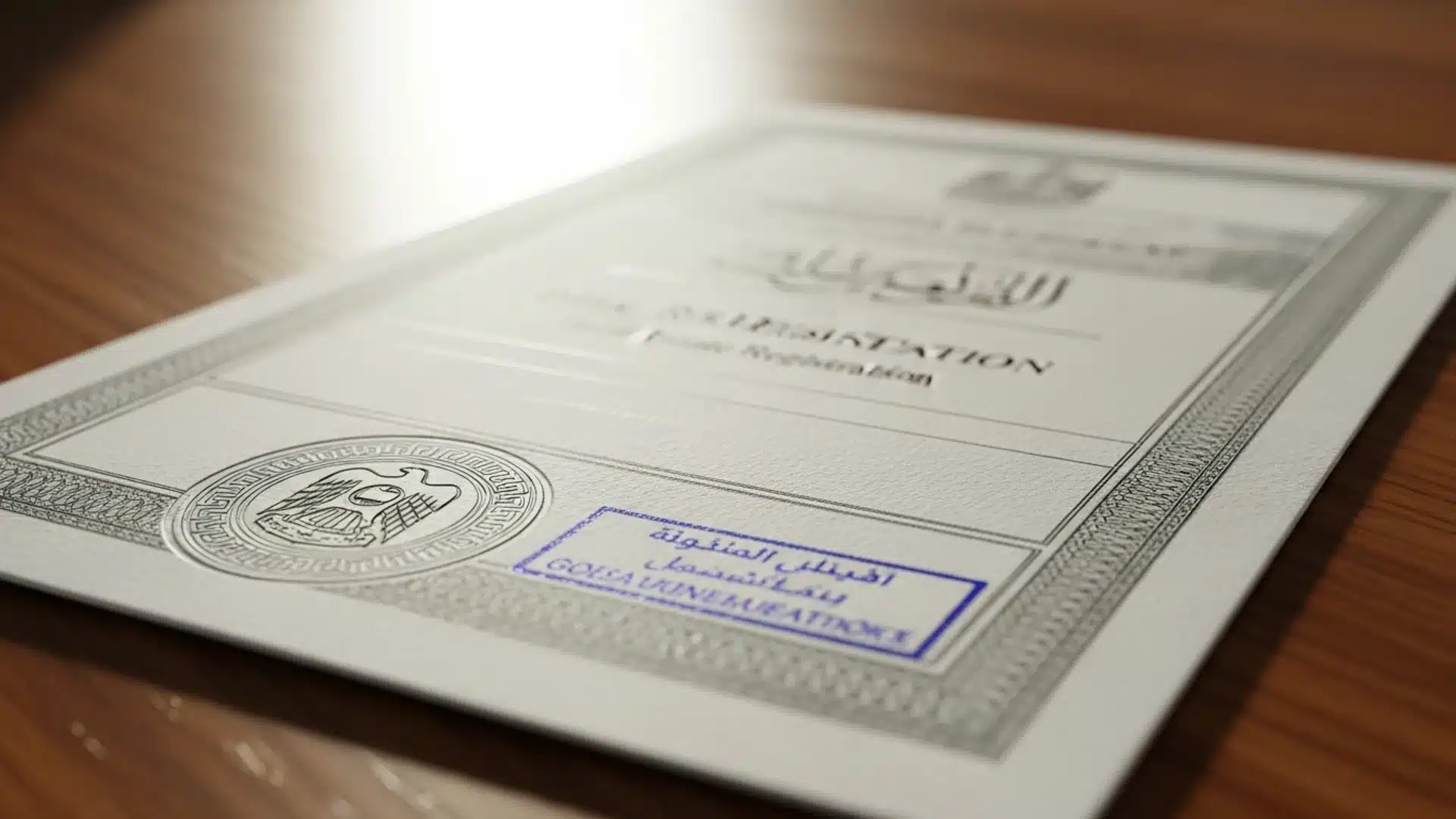
Quick AnswerTitle deed verification Dubai 2026: verify ownership, mortgages and restrictions before you pay. Steps, documents, the 4% transfer fee and red flags.
Buying property in Dubai is a fast process — a clean transfer can complete inside a fortnight — and that speed is exactly why title deed verification in Dubai matters so much. By the time funds move at a trustee office, the questions you should have asked are no longer open. A deed that looks immaculate on a phone screenshot can belong to a different unit, a different owner, or a property carrying a mortgage the seller never mentioned. On a AED 2,000,000 purchase, the 4% Dubai Land Department transfer fee alone is AED 80,000 — money you do not want to commit to a title you have not independently checked.
The verification itself is neither expensive nor difficult. Dubai maintains one of the most digitised property registers in the region, and most of what a buyer needs is available through official channels in minutes. What trips buyers up is not knowing which checks exist, which ones the agent has actually done, and which ones only a trustee office can complete. This guide sets out the full sequence — from reading the deed correctly, through restriction and mortgage checks, to seller identity, service-charge clearance and corporate due diligence — with the costs, the timelines and the red flags that should stop a deal.
How do you verify a title deed in Dubai before buying?
Verify a Dubai title deed through three layers: scan the deed's QR code and validate it on the Dubai REST app or the Land Department portal; obtain a current property status certificate showing mortgages, attachments and restrictions; then confirm ownership in person at a Real Estate Registration Trustee office before releasing funds. Budget the 4% transfer fee plus fixed admin and trustee charges, and allow 7 to 14 days for a clean transfer.
Each layer catches a different failure. The QR and portal check confirms the document is genuine and issued by the register. The status certificate reveals encumbrances that a deed copy simply will not show, because a mortgage registered after the deed was issued does not retroactively appear on the buyer's paper copy. The trustee office check confirms that the person standing in front of you is the person named on the register, and that nothing has changed between your search and your signature.
| Verification step | Where | Typical cost | Time |
|---|---|---|---|
| QR code / online deed validation | Dubai REST app or Land Department portal | Free | Minutes |
| Property status / restriction certificate | Land Department service, trustee office | Nominal official fee | Same day |
| Trustee office ownership confirmation | Real Estate Registration Trustee | Included in transfer service fee | Same day |
| Developer NOC | Developer's office | Developer-set fee | 3–14 days |
| Service-charge clearance | Owners' association / management | Nominal or included in NOC | 1–7 days |
| Mortgage discharge | Seller's bank | Bank-set settlement fees | 5–15 days |
| DLD transfer fee | Trustee office at transfer | 4% of value | At transfer |
| Fixed admin, knowledge and innovation fees | Trustee office | Fixed schedule amounts | At transfer |
What a Dubai title deed actually contains
A Dubai title deed — often called the Melkiya — is issued by the Dubai Land Department and is the definitive record of ownership. Read every field, because each one is a potential mismatch.
The deed number and issue date identify the document. A deed reissued recently is not suspicious in itself — deeds are reissued after mortgage discharge, name corrections or replacement of a lost original — but a very recent issue date on a property the seller claims to have owned for a decade is worth a question.
The property type distinguishes a unit, a villa, a plot or a whole building, and the plot number, building name, project name and community locate it. Compare all of these against the listing and against what you physically viewed. Buyers occasionally discover that the unit they toured and the unit on the deed are different lines in the same tower.
The area is stated in square metres. Dubai advertising almost always quotes square feet, so convert and compare: one square metre is roughly 10.764 square feet. A material discrepancy between the registered area and the advertised area is a price issue, since Dubai deals are usually negotiated per square foot.
The owner name and ownership share matter enormously. Where a property is jointly owned, every owner must consent to the sale and appear at transfer, or be represented by a valid power of attorney. A 50% share on the deed means the seller cannot convey the whole property alone.
Finally, the deed carries a QR code. Scanning it should resolve to an official Land Department record matching the printed details. A QR that fails to resolve, resolves to a different property, or resolves to a screenshot-style image rather than a live record is a hard stop.
The three official verification routes
Dubai REST. The Land Department's official app offers a title deed validation service alongside a broader set of property services. It is the fastest first-pass check and it is free. Enter or scan the deed details and confirm the record matches. Treat this as necessary but not sufficient — it validates the document, not the property's encumbrance position.
The Land Department portal. The Land Department's online services at https://dubailand.gov.ae/ include deed verification and related enquiry services. This is also where property valuation certificates, ownership certificates and restriction enquiries are requested.
A Real Estate Registration Trustee office. Trustee offices are the authorised private centres that process transfers on the Land Department's behalf. They can confirm the register position live, issue certificates, and are the venue where the transaction ultimately completes. For any purchase of consequence, an in-person trustee check on the day of transfer — not a week before — is the check that actually protects you, because it closes the window in which a new mortgage or attachment could be registered.
Alongside these, RERA's role is worth understanding. RERA is the regulatory arm governing Dubai's real-estate profession and its projects: broker registration, escrow supervision for off-plan developments, the rental index and owners' association oversight. A RERA-registered brokerage with a valid broker card is not a guarantee of a clean title, but an unregistered "agent" operating without a DET trade licence and a broker registration number is a reason to walk away before you look at a deed at all.
Restrictions, mortgages and attachments: the checks that matter most
The deed tells you who owns the property. It does not reliably tell you what claims sit over it. That is the job of a current property status or restriction certificate, and it is the document most first-time buyers never request.
Mortgages. If the seller has an outstanding home loan, the bank holds a registered mortgage over the title. The property cannot transfer until that mortgage is discharged. In practice this is handled through a structured settlement: the buyer's funds (or the buyer's own bank) settle the seller's outstanding balance, the seller's bank issues a liability letter and then a mortgage release, and the discharge is registered before or simultaneously with the transfer. This adds one to three weeks to the timeline and introduces the deal's single largest coordination risk. Never pay a seller directly to "clear their mortgage" — settlement should run through the trustee office and the banks.
Court attachments and travel bans. A property can be attached by court order in enforcement of a judgment debt. An attached property cannot be freely transferred. A status certificate reveals this; a deed copy does not.
Developer restrictions. Some titles carry restrictions from the master developer — usage limitations, resale conditions, or requirements to obtain consent before certain changes. Off-plan units frequently carry a restriction on resale until a defined percentage of the price has been paid.
Service-charge arrears. Owners' association service charges attach to the property. Unpaid arrears become the incoming owner's problem, and in practice the developer or management company will refuse to issue the no-objection certificate required for transfer until they are cleared. Request a statement of account and a clearance letter, and check what period it covers.
Utility accounts. DEWA accounts must be settled and closed by the seller so the account can be opened in the buyer's name. An unpaid DEWA balance will not block the deed transfer, but it will delay your ability to energise the unit.
Verifying the seller, not just the property
Deed fraud in any market is rarely about a forged register entry; it is usually about impersonation. Three checks matter.
Identity. The person signing must be the person named on the deed. At a trustee office this is verified against official records, which is precisely why completing at a trustee office rather than through informal arrangements is non-negotiable.
Power of attorney. Where a representative acts for the owner, the POA must be notarised or properly attested, still within its validity period, not revoked, and specific enough to authorise the sale of that property. A general POA drafted abroad for unrelated purposes will not do. POAs executed outside the UAE need legalisation and legal translation into Arabic. Ask when it was issued and whether the principal is contactable — a representative who resists any direct contact with the owner is a warning sign.
Corporate sellers. If the registered owner is a company, verification extends to the company itself. You need its trade licence — a DET licence for a Dubai mainland company, or the equivalent from the relevant free zone or offshore registrar — its memorandum and articles, a current shareholder and director register, and a board or shareholder resolution authorising this specific sale and naming the signatory. Confirm the licence is not expired and that the company's registered name matches the deed exactly. Where the company is an offshore SPV holding a single property, also confirm the underlying shareholder position, because the register may only show the corporate name.
Freehold, leasehold and off-plan: what you are actually buying
Dubai's ownership landscape has three practical categories, and the deed will tell you which one applies.
Freehold areas permit outright ownership of the property and, for villas, the plot, available to UAE nationals, GCC nationals and foreign buyers alike within designated zones. This is what most international buyers assume they are getting.
Leasehold grants rights for a long fixed term, typically up to 99 years, after which the interest reverts. A leasehold interest is a genuine asset but it is not freehold, and advertising that blurs the two is a misrepresentation. Check the term remaining, not just the term granted.
Usufruct and musataha rights confer use or development rights over land for a period without conveying the freehold. These appear more often in commercial and industrial contexts.
Off-plan units have no title deed at all until handover. Instead they are recorded on the interim register through an Oqood registration, and the developer's project must be registered with escrow arrangements in place. When verifying an off-plan purchase or an assignment of one, the Oqood record substitutes for the deed, and the developer's no-objection certificate for assignment substitutes for a straightforward resale consent. Confirm the escrow account details independently and pay into the escrow account, never into a developer's or agent's general account.
Step-by-step pre-purchase verification checklist
One — obtain the deed copy early. Ask for it before you make an offer, not after. A seller or agent who will not produce a deed copy at offer stage has told you something useful.
Two — validate the document. Scan the QR, check the Dubai REST or portal record, and compare every field to the listing: unit number, building, community, area, owner name, ownership share.
Three — request a property status certificate. This is the encumbrance check. Read it for mortgages, attachments, restrictions and any pending transactions.
Four — verify the seller. Identity, or POA validity, or full corporate documentation for a company seller.
Five — check the money side. Service-charge statement and clearance, DEWA account status, and — if the unit is tenanted — the Ejari record.
Six — handle tenancy properly. In Dubai, a sale does not automatically terminate a tenancy. The Ejari-registered contract runs to its term and the incoming owner inherits it, together with the rent level and the renewal position determined by RERA's rental index. If you are buying for personal occupation, understand that vacant possession is governed by notice rules, not by the sale itself, and confirm the tenancy position before you commit. Our detailed walkthrough of Ejari registration in Dubai explains how those records are created and what they prove.
Seven — obtain the developer NOC. The developer or master community confirms no outstanding obligations and consents to transfer. This is usually the longest single item, so start it early.
Eight — book the trustee appointment and re-verify on the day. Run the restriction check again immediately before signing. Then complete: manager's cheques exchanged, mortgage discharged if applicable, transfer fee and trustee fees paid, and a new deed issued in your name.
Costs, timelines and a worked example
Consider an apartment in Dubai Marina at an agreed price of AED 2,000,000, mortgage-free, sold with vacant possession.
The 4% Dubai Land Department transfer fee is AED 80,000. Fixed administrative, knowledge and innovation fees apply on top, at amounts set by the official schedule. The trustee office charges a service fee for processing. The agency commission, commonly 2% at AED 40,000, is subject to 5% VAT because brokerage is a standard-rated service — an additional AED 2,000. The developer's NOC fee is set by the developer. Verification searches themselves are nominal.
On timeline, a cash purchase with no mortgage on either side and a cooperative developer typically completes in seven to fourteen days: a few days for the memorandum of understanding and deposit, a week or so for the NOC, then the trustee appointment. Introduce a seller's mortgage and a buyer's mortgage and three to six weeks is realistic, because both banks must be sequenced.
Where a purchase is made through a company rather than personally, add company formation or verification time, and remember the ongoing obligations: registration with the Federal Tax Authority for corporate tax, which applies at 0% on taxable income up to AED 375,000 and 9% above, with the return due nine months after the financial year end. Registration and filing run through EmaraTax at https://tax.gov.ae/. VAT treatment depends on the asset: residential resale is generally exempt, commercial property sales are standard-rated at 5%, and the mandatory VAT registration threshold is AED 375,000 of taxable supplies with voluntary registration from AED 187,500. There is no personal income tax in the UAE.
Two further regulatory touchpoints are worth flagging for buyers with plans for the property. If you intend to let it short-term as a holiday home, DET issues the required permit and operating conditions apply. If you intend to renovate, Dubai Municipality approvals govern fit-out, structural changes and building modifications, and the owners' association will have its own rules. Both are far cheaper to check before purchase than after.
Verifying a plot, a villa or a whole building
Apartments are the simplest case because the unit boundary is fixed. Villas and plots require two extra checks. First, confirm the plot boundary against the affection plan or site plan rather than assuming the garden wall marks the legal edge — extensions, encroachments and unpermitted structures are common, and an unpermitted extension becomes your regularisation problem after transfer. Second, confirm that any built structure has Dubai Municipality building completion approval. A villa extended without permits can face enforcement, and lenders may decline to mortgage it.
Whole-building purchases add a layer again. Verify whether the building is subject to an owners' association or is single-owner, obtain the rent roll and cross-check every unit against its Ejari record, confirm the status of any commercial tenancies including their VAT treatment, and check the position on civil defence and lift certifications. A building purchased with a rent roll that does not reconcile to Ejari registrations is a building whose income you cannot rely on, because unregistered tenancies are harder to enforce and invisible to RERA's rental index at renewal.
For commercial and industrial premises, also confirm the permitted use on the title and with the relevant authority. A unit registered for warehouse use cannot simply be operated as a showroom, and a DET trade licence will not issue against premises whose registered use does not match the activity.
What to do if verification fails
Not every red flag kills a deal, but each one changes what you should do next.
If the QR fails to resolve or the record does not match, stop. Do not pay a deposit. Ask for the original deed and verify at a trustee office in person.
If a mortgage appears that the seller did not disclose, the deal is still workable — most Dubai resales involve mortgage discharge — but the non-disclosure tells you to verify everything else more carefully, and the settlement must be structured through the banks and the trustee office.
If service-charge arrears are significant, negotiate. Either the seller clears them before transfer or the amount comes off the price with a written mechanism. Do not accept a verbal promise to settle after completion; the developer NOC will not issue anyway.
If the area on the deed is materially smaller than advertised, reprice. Dubai deals are per square foot, and the register is the authority.
If a power of attorney looks thin — general wording, old date, no property specified, principal uncontactable — insist the owner attends personally or provides a fresh, specific, properly attested POA.
If a court attachment appears, walk away unless you have specialist advice and the seller can demonstrate a clear path to release.
Common Mistakes in Dubai Title Deed Verification
- Relying on a deed copy sent by WhatsApp. A screenshot proves nothing. Validate through the Dubai REST app or the Land Department portal, and confirm at a trustee office before funds move.
- Skipping the property status certificate. The deed shows ownership; only a current restriction check shows mortgages, attachments and pending transactions. This is the single most-missed step.
- Verifying once, weeks before completion. The register position can change. Re-run the check on the day of transfer, at the trustee office, immediately before signing.
- Assuming the sale ends the tenancy. An Ejari-registered lease survives a sale. Buyers expecting vacant possession sometimes inherit a tenant at a rent well below market, with RERA's index limiting what can be corrected at renewal.
- Paying the seller directly to clear a mortgage. Mortgage settlement must run through the banks and the trustee office. Direct payments to a seller for this purpose are unsecured.
- Accepting a general power of attorney. The POA must be current, attested and specific to the sale of that property. Foreign POAs need legalisation and Arabic translation.
- Ignoring corporate seller documentation. When a company owns the property, the trade licence, memorandum, shareholder register and a resolution authorising the sale are all part of verification — not optional extras.
- Forgetting the service-charge and DEWA position. Arrears attach to the property and block the developer NOC; an open DEWA account delays energising the unit after handover.
Verifying with confidence — how Noble Core helps
Verification is a discipline, not a document. The buyers who get caught are rarely careless people; they are people who trusted that someone else in the chain had already checked. In a market that moves as quickly as Dubai's, the only reliable safeguard is to run the sequence yourself — deed validation, restriction certificate, seller verification, service-charge and utility clearance, and a live re-check on transfer day.
Noble Core Ventures runs that sequence for buyers, family offices and brokerages. If you are on the professional side of the market, our guide to the real-estate brokerage licence in Dubai explains the DET activity, RERA registration and broker card requirements that make your firm's due diligence defensible. For agents and founders building a property business, our walkthrough on how to start a successful real estate business in Dubai covers structure, staffing and compliance from day one. Buyers purchasing through a corporate vehicle should start with our business setup in Dubai comparison of mainland and free-zone routes, and read our detailed Ejari registration guide before taking on a tenanted unit.
We also handle what comes after the deed: Federal Tax Authority corporate tax registration for property-holding companies, VAT positioning where commercial assets are involved, and the bookkeeping that keeps a portfolio compliant. Book a free 20-minute consultation and we will map your purchase, your verification checklist and your ongoing filings onto one timeline.
Talk to Our Experts
Noble Core Ventures runs pre-purchase title deed verification for buyers and brokerages in Dubai — ownership and restriction checks, mortgage and service-charge clearance, power-of-attorney review, corporate seller due diligence and Federal Tax Authority registration for property-holding companies. Free 20-minute consultation.
Frequently Asked Questions
How do I verify a title deed in Dubai?
Use the Dubai REST app or the Dubai Land Department online verification service, scan the deed’s QR code, then confirm at a Real Estate Registration Trustee office before transferring any funds.
Can I check a Dubai title deed online for free?
Yes. The Dubai REST app and the Land Department’s website both offer title deed validation. A full property status certificate showing mortgages and restrictions is a paid service.
What is a property status certificate?
It is an official record showing the current registered owner, the property’s details and any mortgages, court attachments or restrictions on the title. It is the single most useful pre-purchase document.
How much is the Dubai property transfer fee?
The Dubai Land Department transfer fee is commonly cited at 4% of the property value, plus fixed administrative, knowledge and innovation fees and a trustee office service charge.
Does a title deed show if there is a mortgage?
The deed itself may not show a later mortgage. A current property status or restriction certificate will. Always request one rather than relying on the owner’s deed copy.
Can I verify a title deed if the seller uses a power of attorney?
Yes, but verify the POA separately. It must be notarised or attested, still valid, not revoked, and expressly authorise sale of that specific property.
Do off-plan units have title deeds?
No. Off-plan units sit on the interim register under an Oqood registration until handover, when a final title deed is issued in the buyer’s name.
What if the deed area does not match the listing?
Trust the registered area on the deed, not the advertisement. Discrepancies should be raised in writing before signing, as price is usually negotiated per square foot.
Is Ejari relevant when buying?
Yes. If the unit is tenanted, the Ejari record confirms the lease term and rent, which bind you as the incoming owner under Dubai’s tenancy rules.
Do I pay VAT when buying a Dubai home?
Residential resale is generally exempt from VAT. Commercial property sales are standard-rated at 5%, and agency fees are standard-rated regardless of the property type.
Contact Us For Free Consultation
Licensed UAE consultancy. One reply, no spam.
Thank you.
A consultant will reply on WhatsApp shortly.