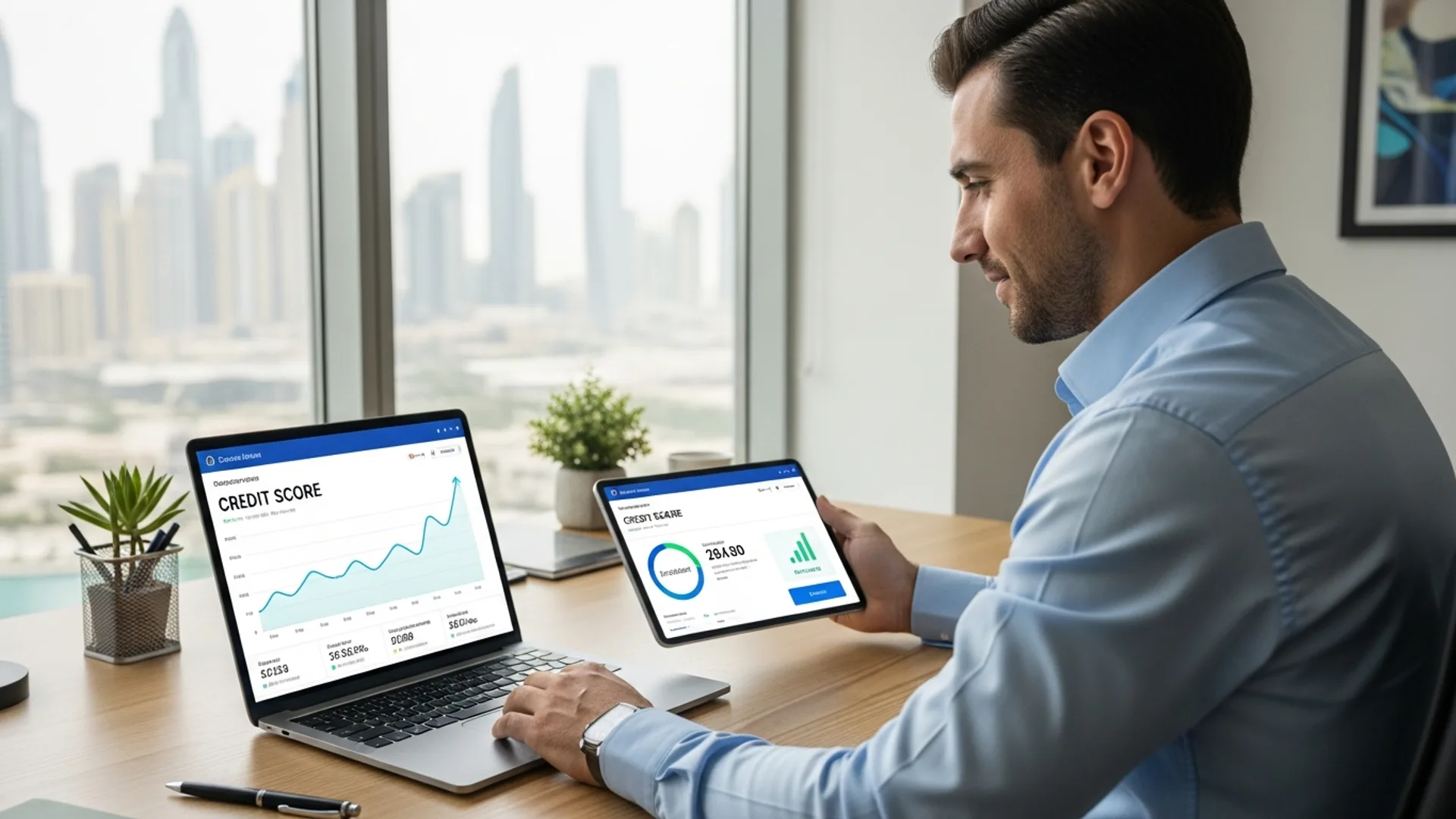
Quick AnswerAECB credit report UAE 2026: business and personal scores 300-900, AED 84-157.50 fees, how to check, and how to improve your company profile.
An AECB credit report is the official record of how an individual or company in the UAE has borrowed and repaid credit, issued by Al Etihad Credit Bureau (AECB) — the federal bureau established under Federal Law No. 6 of 2010 concerning Credit Information. Every report carries a credit score from 300 to 900, where a higher number signals lower risk to lenders. An individual credit report costs AED 84 including VAT and already contains the score, while a company credit report costs AED 157.50, giving founders a clear window into how banks see their business.
This guide is a practical, business-focused walk through the AECB credit report in 2026: who AECB is, what the 300-to-900 score means, how company and personal reports differ, why your business profile matters for finance, how to obtain and improve it, and how clean company structuring and tax compliance support a strong record. It is compliance and structuring guidance only — not investment or personalised financial advice — written for founders who want to understand and strengthen how the UAE credit system sees them.
What Is an AECB Credit Report in the UAE?
An AECB credit report is a record of a person's or company's credit history issued by Al Etihad Credit Bureau, established under Federal Law No. 6 of 2010. It carries a credit score from 300 to 900, where higher means lower lending risk. An individual report costs AED 84 including VAT and a company report AED 157.50, giving lenders a standard basis to assess creditworthiness.
At its core, an AECB report gathers, in one place, the credit information that banks, finance companies and other providers submit about a borrower. For an individual, that includes loans, credit cards, mortgages and, increasingly, telecom and utility accounts, showing balances, limits, and — crucially — the repayment history month by month. For a company, it captures the business's facilities, loans, guarantees and repayment behaviour. From this data, AECB calculates a single score that distils the borrower's risk into one comparable number, which lenders across the UAE rely on to make consistent decisions.
The fee schedule below is indicative and inclusive of VAT; confirm the current pricing through AECB before ordering, as fees are periodically revised.
| Report type | Indicative fee (incl. VAT) | Notes |
|---|---|---|
| Individual credit report | AED 84 | Includes the individual's credit score |
| Sole establishment credit report | AED 84 | For sole establishments |
| Establishment credit score (standalone) | ~AED 10.50 | Score only |
| Company (LLC) credit report | AED 157.50 | For companies and larger entities |
For a founder, the important takeaway is that both you and your company have a credit identity in the UAE, and both matter when you seek finance — so understanding and managing them is a core part of running a fundable business.
It is worth clearing up a common confusion between the two products the bureau sells. The credit report is the detailed document listing every facility, balance and payment; the credit score is the single number distilled from that data. Lenders typically look at both — the score for a quick read of risk, and the full report to understand the story behind it. Founders should review the report in detail, not just the headline score, because it is the underlying entries that a lender scrutinises and that you can correct if they are wrong.
Who Is AECB and What Does It Collect?
Al Etihad Credit Bureau is the UAE's national credit bureau, a federal entity created under Federal Law No. 6 of 2010 concerning Credit Information. Its mandate is to collect credit data from lenders and other providers, maintain accurate credit files on individuals and businesses, and make credit reports and scores available to both the subjects of the data and to authorised institutions assessing them. It operates in coordination with the Ministry of Finance and works alongside the Central Bank of the UAE, which regulates the banks and finance companies that both supply data to and rely on AECB.
The data AECB holds comes primarily from banks and finance companies, which are required to report their customers' facilities and repayment behaviour regularly. Over time the bureau has broadened its sources to include telecom operators and utility providers, so unpaid phone bills or utility accounts can now appear on a credit file. For businesses, the file reflects the company's borrowing — term loans, overdrafts, trade finance, guarantees — and how reliably those obligations have been met. This breadth is deliberate: the more complete the picture, the more accurately lenders can price risk, which ultimately supports a healthier credit market across the Emirates.
Because AECB data drives real lending decisions, its accuracy matters enormously, and the law gives individuals and companies the right to see their own reports and to dispute errors. The bureau's role is not to approve or decline credit — that decision rests with each lender — but to provide the standardised, reliable information on which those decisions are made. Understanding that AECB is a neutral information utility, not a lender or a regulator of your business, helps founders engage with it constructively: the goal is to ensure the record it holds is accurate and reflects a disciplined financial history.
The AECB Credit Score: 300 to 900 Explained
The AECB credit score condenses a borrower's entire credit history into a single number between 300 and 900. The logic is simple: the higher the number, the lower the assessed risk that the borrower will miss payments in the near future, and therefore the more attractive they are to lenders. A low score flags elevated risk and typically leads to declined applications, lower limits or higher pricing, while a high score opens doors to better facilities and terms. The score is dynamic, recalculated as new repayment data arrives, so it reflects recent behaviour, not just a distant history.
Several factors drive the score. Payment history is the single most influential element — a consistent record of paying loans, cards and cheques on time lifts the score, while late payments, defaults and especially bounced cheques drag it down sharply. Credit utilisation, meaning how much of your available credit you are actually using, matters too; running cards and facilities close to their limits signals stress. The mix and age of credit, the number of recent applications, and any adverse events such as court judgments or write-offs all feed in. For a business, the equivalent factors are the company's facility repayments, any defaults, and the discipline of its financial management.
Interpreting the score is straightforward once you know the range. A score sitting comfortably in the upper bands is viewed favourably and supports strong access to finance, while a score in the lower bands warrants attention and remediation before applying for major facilities. Rather than fixating on a single threshold, founders should focus on the direction of travel: a steadily improving score built on disciplined repayment is exactly what lenders want to see. Because the score is a living measure, consistent good behaviour over months genuinely moves it, which is empowering — your record is something you can actively improve.
Business Versus Personal Credit Reports
Founders often assume that only their company's credit matters, but in UAE business finance the two are deeply intertwined. Larger, established companies are assessed primarily on their own credit file — the business's facilities, repayment history and score. For small and medium enterprises, however, lenders very frequently look at the owners' and guarantors' personal AECB reports as well, because a young company has a thin credit history and the founder's personal financial discipline is treated as a proxy for how the business will behave. A founder with a strong personal score materially improves an SME's access to finance.
This is why personal financial discipline is a business asset for an entrepreneur. Missed personal card payments, defaults or bounced cheques on your own account can directly undermine your company's ability to borrow, even if the business itself is performing well. Conversely, a clean personal record gives lenders confidence to extend facilities to a company that would otherwise be too new to assess. The practical implication is that founders should manage their personal credit as carefully as their business credit, treating both as part of the same fundability picture.
The company report itself becomes more important as the business matures and builds its own track record. A company that consistently repays trade finance, honours guarantees and manages its facilities well develops a strong business credit identity that can, over time, support borrowing on its own merits without leaning so heavily on the owners' personal profiles. Building that corporate track record deliberately — starting with modest facilities and repaying them impeccably — is one of the most valuable long-term investments a founder can make in the company's financial independence. It also interacts with how the business is structured and how cleanly its tax affairs are run, which lenders increasingly scrutinise.
Why Your Business Credit Report Matters
A strong AECB profile is not an abstract score; it translates directly into commercial advantage. The most obvious impact is on borrowing. When a company applies for a loan, overdraft, trade-finance facility or equipment lease, the lender pulls the company's AECB report and, for smaller firms, the owners' personal reports, and uses the history and score to decide whether to approve, how much to lend, and at what price. A strong profile means faster approvals, higher limits and better rates; a weak one means rejection or expensive credit. For a growing business, access to affordable finance is often the difference between seizing an opportunity and missing it.
The influence extends beyond banks. Suppliers deciding whether to extend trade credit, landlords assessing a commercial tenant, and partners evaluating a counterparty may all consider creditworthiness, and a demonstrable record of paying on time builds the trust that underpins commercial relationships. In some tenders and larger contracts, financial standing is part of the qualification, so a clean credit history can be a competitive differentiator. Even employee-related matters can touch creditworthiness, as salary payments through the Wages Protection System administered by MOHRE form part of the financial footprint that lenders and providers observe.
For founders, the message is that the business credit report is a strategic asset to be cultivated, not a document to be ignored until a loan is needed. Building a strong profile takes time and consistency, so the businesses that enjoy the best access to finance are those that started managing their credit from day one — paying every obligation on time, avoiding bounced cheques, and keeping their financial affairs orderly. Treating the AECB report as a live scorecard of your business's financial reputation, and managing it proactively, pays dividends precisely when you most need capital to grow.
How to Get Your AECB Credit Report
Obtaining your report is quick and inexpensive, and every founder should do it regularly. AECB offers self-service channels — a mobile app, its website and authorised outlets — through which individuals, establishments and companies can request their own reports. The process involves verifying your identity (using your Emirates ID for individuals and the relevant trade licence and authorisation for a company), selecting whether you want the credit report, the score, or both, and paying the applicable fee. For individuals and sole establishments, the report is usually delivered instantly as a PDF; company reports may follow a slightly different process given the additional verification.
Once you have the report, read it carefully rather than glancing at the headline number. Check that every facility listed is genuinely yours, that balances and limits are accurate, and that the repayment history is correctly recorded. Errors do occur — a payment marked late that was made on time, a closed account still showing as open, or a facility that is not yours at all — and each error can unfairly depress the score. Reviewing the detail is how you catch these problems before a lender does.
If you find an inaccuracy, you have a legal right to dispute it. Raising a dispute with AECB triggers an investigation with the data provider that submitted the information, and verified errors are corrected, which can improve your standing. Because this process takes time, checking your report well before you plan to apply for finance — not the week you need the loan — gives you the runway to fix problems. A sensible discipline is to pull your report and your company's report periodically, treat it as a financial health check, and act on anything that looks wrong or that reveals a pattern you can improve.
AECB, Corporate Tax and Business Compliance
A strong credit profile increasingly goes hand in hand with clean regulatory compliance, and the two reinforce each other. Lenders assessing a company today look beyond the AECB report to the overall health and orderliness of the business, and a firm that is properly registered, files its returns and keeps its affairs transparent presents as a lower-risk borrower. Corporate tax compliance is now part of that picture. The Federal Tax Authority administers UAE corporate tax at 0% on taxable income up to AED 375,000 and 9% above, with returns due nine months after the financial year-end, and a company that meets these obligations cleanly signals the same discipline that supports a good credit record. You can confirm the rules and register at the Federal Tax Authority: https://tax.gov.ae/, and the corporate-tax framework is set by the Ministry of Finance, which you can reference at https://mof.gov.ae/.
The way a business is structured also influences how lenders and the credit system view it. A clean, well-documented corporate structure — with clear ownership, proper accounts and a coherent group of entities — is easier to assess and finance than a tangle of loosely connected companies. Choosing the right jurisdiction and entity type at setup, maintaining proper books, and keeping the company's and the owners' finances appropriately separated all contribute to a fundable profile. The Ministry of Economy oversees the wider commercial framework within which these companies operate, and aligning your structure, tax compliance and financial discipline creates a business that both AECB data and lenders' wider assessments treat favourably.
For founders, the practical synthesis is that building business creditworthiness is not a standalone exercise but part of running a disciplined, compliant company. Pay your facilities and cheques on time, meet your tax and licensing obligations, keep clean accounts, and structure the business sensibly — and the strong AECB profile follows naturally, alongside the broader reputation that opens doors with banks, suppliers and partners. Credit strength, tax compliance and good structuring are three faces of the same well-run business.
How AECB Fits the UAE Financial System
Understanding where AECB sits in the wider financial system helps founders engage with it strategically rather than fearfully. Before a national credit bureau existed, UAE lenders had only a partial view of a borrower's obligations, which made responsible lending harder and pushed up the cost of credit for everyone. By centralising credit information under Federal Law No. 6 of 2010, AECB gave banks and finance companies a shared, reliable picture, which supports more accurate risk pricing and, ultimately, a healthier and more accessible credit market. In this sense the bureau is infrastructure — the plumbing that lets the lending system work efficiently.
The bureau's data also underpins responsible-lending safeguards that the Central Bank of the UAE promotes, such as limits on how much of a borrower's income can go to debt repayment. Lenders use AECB information to calculate a borrower's total existing commitments, so a business owner already carrying heavy personal debt will find their borrowing capacity constrained regardless of the business's own performance. This is why founders benefit from keeping their personal obligations moderate and visible: the system rewards borrowers whose total position is manageable and transparent.
For businesses operating across the UAE, the bureau's national scope means there is nowhere to hide a poor record and, equally, nowhere a good record goes unrecognised. A company that builds a strong repayment history with one bank carries that reputation to every other lender, which is a powerful incentive to behave well from the start. The Ministry of Finance's involvement reflects the strategic importance the UAE places on a sound credit ecosystem as part of a modern, diversified economy. Founders who treat AECB as a shared reputation system — one they contribute to with every payment — position themselves to draw on that reputation exactly when they need capital most.
Building Business Credit From Day One
For a new company, the time to start building a strong AECB profile is immediately, because credit history is cumulative and cannot be manufactured overnight. The most valuable thing a young business can do is establish modest credit relationships and service them impeccably. Opening a business bank account, taking a small, manageable facility such as a corporate card or a modest overdraft, and repaying it on time every month begins to build the repayment record that lenders will later rely on. The size of the early facility matters far less than the flawless consistency of repayment.
Sequencing helps. In the earliest phase, when the company has no track record, lenders lean on the founders' personal AECB profiles, so keeping personal credit strong is the foundation. As the business services its first facilities cleanly, it accumulates its own history, and over 12 to 24 months a disciplined company can develop a corporate credit identity strong enough to support larger borrowing on its own merits. Trade finance and supplier credit, repaid reliably, add further depth to the record. Each on-time payment is a small deposit into the company's financial reputation.
Discipline around the basics protects that progress. Never allowing a cheque to bounce, keeping facility utilisation moderate, spacing out credit applications rather than approaching many lenders at once, and monitoring both the company's and the owners' reports periodically are the habits that separate fundable businesses from perennially credit-starved ones. It also pays to keep the corporate structure and accounts clean and the tax affairs orderly, because lenders increasingly assess the whole business, not just the score. Building business credit is therefore less about clever tactics and more about consistent, boring reliability sustained over time — which is precisely why the businesses that plan for it from day one enjoy such an advantage when the moment to raise capital arrives.
Common Mistakes to Avoid
Managing your AECB profile is straightforward, but these recurring mistakes quietly damage founders' access to finance.
- Mistake 1: Never checking your report. Many founders only look at their AECB report when a loan is declined; by then it is too late to fix errors or repair the record in time.
- Mistake 2: Bouncing cheques. A returned cheque is one of the most damaging entries on a UAE credit file; treat every cheque and direct debit as a hard commitment.
- Mistake 3: Ignoring personal credit. For SMEs, lenders check the owners' personal AECB reports; a weak personal record undermines the company's borrowing even if the business is healthy.
- Mistake 4: Maxing out facilities. Running cards and overdrafts near their limits signals financial stress and depresses the score; keep utilisation moderate.
- Mistake 5: Leaving errors uncontested. Inaccurate entries unfairly lower the score; failing to dispute verified errors leaves a fixable problem in place.
- Mistake 6: Neglecting tax and licensing. Poor corporate-tax compliance and a messy structure make a company harder to finance; orderly compliance supports a fundable profile.
- Mistake 7: Applying for too much credit at once. Multiple applications in a short window flag desperation to lenders; space out and target your finance requests.
Build a Strong Business Credit Profile with Noble Core
A strong AECB credit report is the product of a well-run, well-structured and compliant business — not a document you can fix overnight. Noble Core Ventures helps founders build the foundations that support a fundable profile: the right company structure, clean corporate-tax compliance, and the financial discipline that lenders reward when you seek capital to grow.
Begin with our business setup in Dubai team to establish a clean, well-documented structure that presents well to banks. Because tax compliance now sits alongside creditworthiness, our corporate tax in the UAE specialists keep your obligations orderly and your standing strong. If you are considering a common-law base for a finance-focused entity, our DIFC company setup cost guidance sizes the investment, and for cleanly separating assets, ventures and liabilities our special purpose vehicle in the UAE team designs the right holding structure. Book a free 20-minute consultation to strengthen how the UAE credit system sees your business.
Talk to Our Experts
Noble Core helps founders build a strong business credit profile in the UAE through clean company structuring, tax compliance and financial discipline. Free 20-minute consultation.
Frequently Asked Questions
What is an AECB credit report?
An AECB credit report is a record of an individual’s or company’s borrowing and repayment history, issued by Al Etihad Credit Bureau, established under Federal Law No. 6 of 2010.
How much does an AECB credit report cost?
An individual credit report costs AED 84 including VAT and includes the score. A company credit report costs AED 157.50, and a standalone establishment score around AED 10.50.
What is a good AECB credit score?
The AECB score ranges from 300 to 900. Higher is better; a score comfortably above the mid-600s is generally viewed favourably, while lower scores signal higher lending risk.
Does my company have an AECB credit report?
Yes. Companies and establishments registered in the UAE have credit files at AECB, reflecting their facilities, repayments and defaults. Lenders check these when assessing business finance applications.
Who regulates AECB in the UAE?
AECB is a federal entity established under Federal Law No. 6 of 2010 concerning Credit Information, operating in coordination with the Ministry of Finance and alongside the Central Bank of the UAE.
How can I improve my business credit score?
Pay facilities and cheques on time, keep credit utilisation moderate, avoid defaults and bounced cheques, correct errors on your report, and maintain a consistent, disciplined repayment record over time.
Does AECB affect getting a business loan?
Strongly. Lenders review the company’s AECB report and often the owners’ or guarantors’ personal reports, using the history and score to decide approval, limits and pricing on business finance.
Can I dispute an error on my AECB report?
Yes. If your report contains inaccurate information, you can raise a dispute with AECB, which investigates with the data provider and corrects verified errors, improving your standing.
How do I get my AECB credit report?
Request it through the AECB app, website or authorised channels, verify your identity, pay the fee, and receive the report as a PDF, usually instantly for individuals and establishments.
Contact Us For Free Consultation
Licensed UAE consultancy. One reply, no spam.
Thank you.
A consultant will reply on WhatsApp shortly.