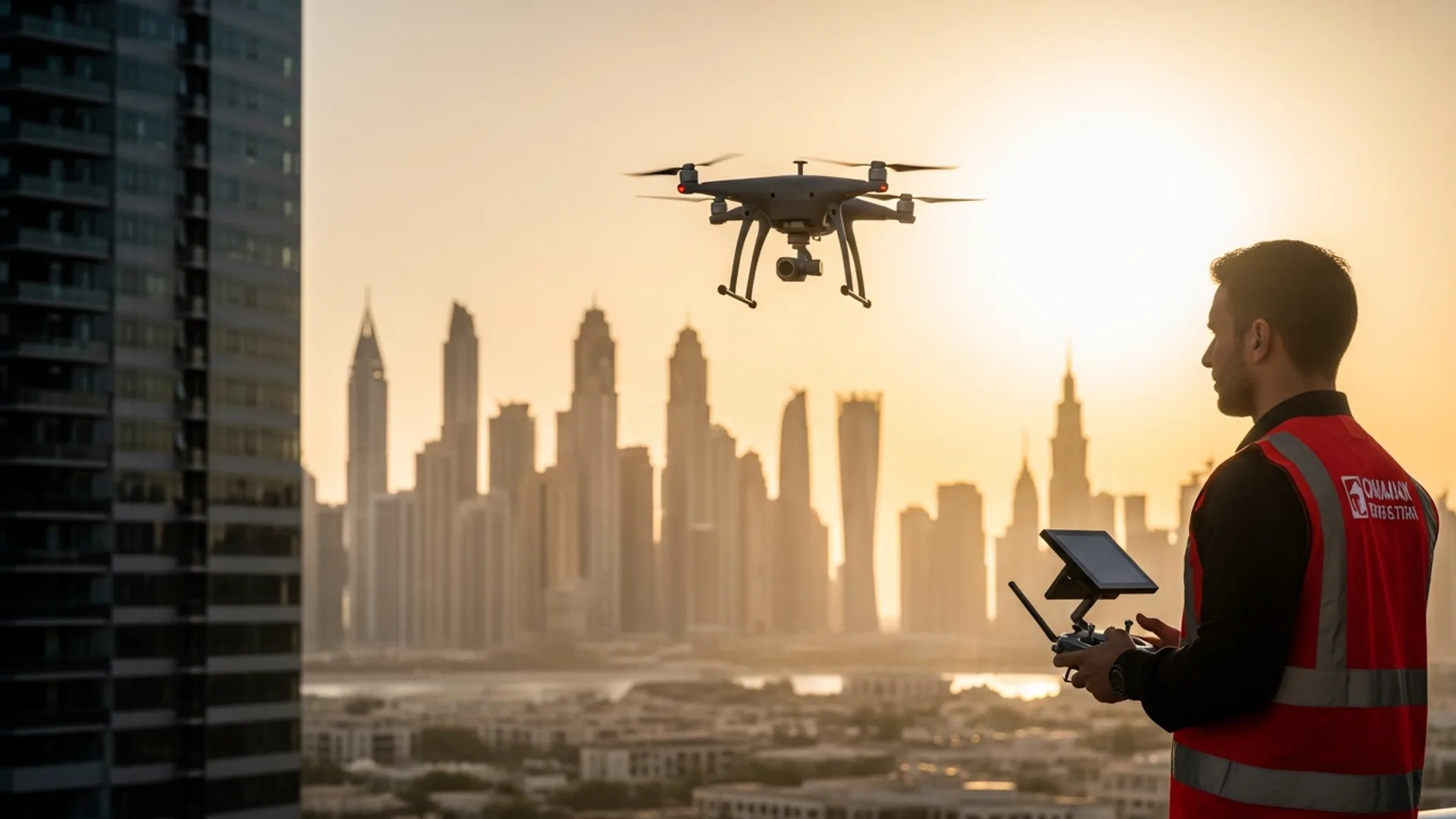
Quick AnswerDrone business license UAE 2026: GCAA registration, DCAA permits, costs from ~AED 12,500, activities and step-by-step approvals explained.
Setting up a drone business in the UAE in 2026 requires two things working together: a trade licence for the aerial activity and aviation approval from the General Civil Aviation Authority (GCAA), plus, in Dubai, permits from the Dubai Civil Aviation Authority (DCAA). Expect to budget from roughly AED 12,500 for a lean free-zone trade licence, with total first-year costs commonly between AED 20,000 and AED 45,000 once you add operator registration, insurance and visas. The trade licence is only half the picture — you cannot legally fly commercially without the aviation layer.
That two-track structure trips up many founders. They register a company, assume they are ready to fly, and discover that the aviation regulator has an entirely separate process governing who may operate an unmanned aircraft, where, and under what safety conditions. This guide walks through the whole path — activities, ownership, the GCAA and DCAA approvals, realistic costs, timelines, tax treatment and the mistakes that stall applications — so you can plan the setup properly the first time.
Your setup cost, in 10 seconds
Package prices. Health insurance is required by law and not included.
Thank you.
Your written quote follows on WhatsApp.
How Much Does a Drone Business License Cost in the UAE?
A drone business licence in the UAE starts from roughly AED 12,500 for a free-zone trade licence, but the realistic first-year total runs AED 20,000 to AED 45,000. That range covers company registration, GCAA drone registration, DCAA operator permits, third-party liability insurance and at least one residence visa. Costs rise with more activities, more visas, heavier drones and beyond-visual-line-of-sight operations.
The reason there is a range rather than a single number is that a drone company has layered fees. First there is the commercial cost: forming the company and getting the trade licence that names your aerial activity. Then there is the aviation cost: registering each aircraft, obtaining the operator approval, and paying for permits tied to specific flights or zones. On top of that sit recurring costs — annual licence renewal, insurance premiums, pilot training and currency, and equipment maintenance.
Below is an indicative breakdown. Treat these as planning figures; the exact amounts depend on the free zone or mainland authority you choose, the number of activities, and the flight categories you intend to operate.
| Cost item | Indicative amount (AED) | Notes |
|---|---|---|
| Free-zone trade licence (single activity) | 12,500 – 18,000 | Varies by free zone and package |
| Mainland trade licence (DET) | 15,000 – 30,000 | Depends on activities and office |
| GCAA drone registration (per aircraft) | 100 – 1,500 | Scales with weight/category |
| DCAA operator permit / NOC (Dubai) | 1,000 – 5,000+ | Per operation or zone; varies |
| Third-party liability insurance | 3,000 – 12,000/yr | Based on cover and operations |
| Residence visa (per person) | 3,500 – 6,500 | Establishment card + visa + medical |
| Pilot training / certification | 3,000 – 10,000 | Per pilot, programme dependent |
| Annual renewal (licence) | 10,000 – 20,000 | Recurring |
A common lean starting point — one activity, one visa, a lightweight drone for photography or inspection — can be assembled for under AED 30,000 in year one. A survey or inspection firm running several heavier aircraft, multiple pilots and beyond-visual-line-of-sight approvals should plan for considerably more, and should build insurance and recurring compliance into the model from day one.
What Activities Does a Drone Licence Cover?
"Drone business" is not a single activity — it is a family of them, and your trade licence must name the specific ones you intend to perform. The activity you register determines both the commercial permissions and, importantly, the aviation approvals you will be asked for. Registering the wrong or an overly narrow activity is one of the most common reasons a founder later has to amend the licence and re-approach the aviation authority.
Typical commercial drone activities include aerial photography and videography, aerial surveying and mapping (photogrammetry and LiDAR), infrastructure and asset inspection (towers, pipelines, solar farms, buildings), precision agriculture and crop spraying, security and surveillance support, drone delivery and logistics trials, and drone sales, distribution, repair and maintenance. Each carries different risk profiles and therefore different approval burdens. Crop-spraying drones, for example, add agricultural-chemical handling considerations; delivery and logistics trials touch on beyond-visual-line-of-sight rules and airspace integration that are far more demanding than a single-operator photography flight.
If your model spans several of these, list them deliberately. It is cheaper and faster to register the right bundle of activities at formation than to amend later, and the aviation regulator will want your operations manual to match what your licence permits. Media and film-related aerial work can also require sign-off from the relevant film and media authority in addition to civil aviation clearance, so factor that in if your clients are broadcasters, agencies or production houses.
Who Regulates Drones in the UAE?
The UAE's drone framework is federal at the top and local underneath. The General Civil Aviation Authority (GCAA) is the federal regulator for all unmanned aircraft systems. It sets the national rules, maintains registration requirements, defines operational categories by risk, and governs matters such as beyond-visual-line-of-sight flight, drone weight classes and airworthiness expectations. Any commercial operator, anywhere in the country, sits under the GCAA's framework. Its official portal is https://www.gcaa.gov.ae/.
In Dubai specifically, the Dubai Civil Aviation Authority (DCAA) administers local registration and permits. Because Dubai's airspace is dense — two major international airports, heliports, controlled zones and frequent events — the DCAA runs its own registration and no-objection process for drones and flights within the emirate. In practice, a Dubai-based operator interacts with both: the GCAA framework nationally, and the DCAA for local registration, zone permissions and per-operation clearances. Other emirates have their own local aviation coordination, so an operator working across the country must clear each jurisdiction it flies in.
Beyond aviation, other authorities touch the sector. The Department of Economy and Tourism (DET) issues mainland trade licences in Dubai. The Federal Tax Authority (FTA) administers corporate tax and, where relevant, VAT. Security and law-enforcement bodies coordinate on surveillance, event and sensitive-site flights. The point to internalise is that your company registration and your permission to fly are governed by different bodies, and both must be satisfied before you take on paying work.
Step-by-Step: Setting Up a Drone Company
The process runs in a logical sequence. Rushing the aviation steps before the company exists — or vice versa — causes avoidable delays, because each stage depends on documents produced by the previous one.
-
Define your activities and choose a jurisdiction. Decide whether a free zone or mainland (DET) suits your clients. Free zones give 100% foreign ownership and are efficient for service exporters; mainland can be preferable if you need to invoice government or work directly across the local market. Pick activities that match your real operations.
-
Reserve the trade name and apply for initial approval. Submit the proposed company name and shareholder details to the chosen authority. Drone-related names sometimes attract extra scrutiny, so keep the name clean and activity-appropriate.
-
Complete company formation and get the trade licence. Provide passports, application forms and the memorandum where required, then pay the licence fee. You now have a legal entity permitted to trade in the named activity — but not yet to fly commercially.
-
Register your aircraft and operator with the GCAA. Each drone is registered; the operator submits documentation covering the fleet, intended operations, pilots and safety management. Heavier aircraft and higher-risk categories require more evidence.
-
Obtain DCAA registration and permits (Dubai). Register the operation locally, secure zone permissions and per-flight or per-project no-objection certificates as needed. Expect to show insurance and an operations manual.
-
Arrange insurance, pilot training and an operations manual. Third-party liability cover is essential and often a prerequisite for permits. Pilots must be trained through recognised programmes. Your operations manual should describe procedures, emergency handling and maintenance.
-
Apply for residence visas and open a bank account. Once the licence and establishment card are issued, process investor and employee visas, then open a corporate account — a step that increasingly requires a clear description of activities and expected flows.
Timelines: How Long Does It Really Take?
Founders consistently underestimate the aviation timeline. The company side is quick: a free-zone trade licence can be issued within a few days to two weeks, and mainland formation is comparable when documents are in order. If all you needed was a licence, you would be trading within a fortnight.
The aviation layer is the long pole. GCAA registration and operator approval, followed by DCAA permits in Dubai, typically add several weeks and can extend further for higher-risk operations that demand detailed safety cases, insurance placement and, in some instances, flight assessments. Beyond-visual-line-of-sight approvals, night operations, flights over people, and work in or near controlled airspace all sit at the demanding end and should be scoped early. A realistic plan for a straightforward aerial-photography operator is roughly four to eight weeks from company formation to fully cleared first commercial flight; complex survey, inspection or delivery operations can run longer. Build this into client commitments so you are not promising flights before your approvals land.
Free Zone vs Mainland for Drone Businesses
The ownership and jurisdiction decision shapes cost, client access and operational reach. Free zones offer 100% foreign ownership, streamlined setup, and packages that bundle visas and office solutions — attractive for a founder exporting aerial services or building a product. Technology-oriented free zones can also place you alongside other engineering and software firms, which matters if your drone business is really a data business dressed in rotors: the value is in the mapping, inspection analytics or AI-driven outputs, not just the flight.
Mainland registration through the DET can be preferable when your clients are UAE-based enterprises or government entities that favour or require a mainland counterparty, or when you want to operate directly across the local market without a distributor arrangement. Mainland activities now widely permit full foreign ownership, though specifics depend on the activity. Crucially, the free-zone-versus-mainland choice governs your commercial footprint — it does not exempt you from GCAA and DCAA approvals. Whichever route you take, the aviation permissions are the same national and emirate-level requirements. Choose the jurisdiction for commercial fit, then layer aviation compliance on top.
Tax Treatment of a Drone Business
The UAE's tax regime is favourable but no longer zero. Corporate tax applies at 9% on taxable profit above AED 375,000, administered by the Federal Tax Authority; profit up to that threshold is taxed at 0%. There is no personal income tax on individuals. Free-zone companies that meet the qualifying conditions — genuine substance, qualifying income and compliance with the regime — may access a 0% corporate tax rate on their qualifying income, but this is conditional, not automatic, and demands proper structuring and record-keeping. You can confirm current rules and register directly with the Federal Tax Authority at https://tax.gov.ae/.
VAT, currently 5%, may apply to your services depending on your turnover and the nature of supplies, so factor registration thresholds into your financial model. A drone company with a mix of local and export clients should get tax advice early: the treatment of cross-border services, the qualifying-income tests for free-zone status, and proper invoicing all affect your effective rate. Treating tax as an afterthought is a false economy — the reliefs available reward companies that set up cleanly from the start.
Insurance, Safety and Ongoing Compliance
Insurance is not optional for a serious operator, and it is frequently a precondition for permits. Third-party liability cover protects against damage or injury caused by your aircraft, and the level of cover scales with the operation — a heavy survey drone over industrial infrastructure carries different risk from a light camera drone on a beach shoot. Hull cover for the equipment itself is a separate, sensible line for expensive fleets.
Ongoing compliance is a continuous obligation, not a one-time hurdle. You will maintain an operations manual, keep pilot qualifications current, log flights and maintenance, respect no-fly zones and airspace restrictions, and renew both your trade licence and aviation registrations on schedule. Sensitive-site, event and surveillance work adds coordination with security authorities. The operators who scale successfully treat safety management as a core function — clear procedures, trained crews, disciplined record-keeping — because the regulator's confidence in your safety case directly determines the operations you are permitted to run. Cutting corners here does not just risk penalties; it caps your growth, because higher-value work (BVLOS inspection, delivery, complex survey) is only opened to operators with a proven compliance track record.
Understanding Drone Operation Categories and Risk
The GCAA framework, like modern drone regulation worldwide, is built around risk rather than around a single blanket rulebook. The heavier your aircraft, the more people it flies over, the further it flies from the operator's sight, and the more complex the airspace, the higher the risk category — and the more evidence the regulator wants before approving your operations. Internalising this logic helps you plan your business model, because the operations you intend to sell dictate the approvals you must earn.
At the lighter end sit low-risk operations: a small camera drone flown within visual line of sight, in daylight, away from crowds and controlled airspace. These are the fastest to approve and the natural starting point for a new aerial-photography or light-inspection operator. In the middle sit operations that add one or more risk factors — heavier aircraft, work near infrastructure, flights closer to populated areas — which demand a more detailed operations manual, stronger insurance and clearer procedures. At the demanding end sit beyond-visual-line-of-sight (BVLOS) operations, night flights, flights over people, and operations in or near controlled airspace. These require robust safety cases, and sometimes technical mitigations such as detect-and-avoid capability, redundancy and defined emergency procedures.
The commercial significance is that the highest-value work — long-range linear inspection of pipelines and power lines, large-area agricultural operations, drone delivery, and complex survey — tends to sit in the higher-risk categories. That work is only opened to operators who have demonstrated competence and built a track record with the regulator. A sensible growth path, therefore, is to start with lower-risk operations, establish a clean safety record and mature your operations manual, then progressively apply for the more complex approvals. Trying to launch straight into BVLOS delivery as a brand-new operator with no history is the fastest way to a stalled application. Plan your capability ladder deliberately, and align your sales pipeline to the approvals you realistically hold at each stage.
A Practical Example: Launching a Drone Survey Firm
Consider a founder setting up a drone surveying and mapping business in Dubai serving construction and real-estate clients. The value they sell is not the flight itself but the deliverable — accurate orthomosaics, digital elevation models, volumetric stockpile measurements and progress-tracking data. This shapes every setup decision. The company is really a data and technology business that happens to collect its raw material by air, which means the software, processing and analytics capability matters as much as the aircraft.
Their setup path runs as follows. First, they register a free-zone company with activities covering aerial surveying, mapping and related technology services, choosing a technology-oriented zone so they sit near other engineering and software firms. Second, they obtain the trade licence — issued within a couple of weeks — giving them a legal entity. Third, they register their survey-grade drone with the GCAA and complete operator approval, and register locally with the DCAA for permits to fly over Dubai project sites. Fourth, they place third-party liability insurance sized to construction-site work, and ensure their pilots hold recognised training. Fifth, they process investor and staff visas and open a corporate account.
Because their clients are construction firms working to deadlines, the operations manual, insurance and per-site permit process become the operational backbone — every new site needs the right clearance before the crew mobilises. The founder builds a lightweight internal workflow to request permits early, so surveying never waits on paperwork. Over time, as their safety record matures, they apply for approvals to work near more complex sites and larger areas, expanding the value of each contract. The lesson generalises: the winners treat compliance not as a cost centre but as the enabler of higher-value work, and they structure the company from day one around the data they deliver, not just the drones they fly.
Renewals, Scaling and Ongoing Obligations
Setting up is a one-time effort; staying compliant is continuous, and founders who plan for the recurring burden scale far more smoothly than those who treat approvals as a launch-day checkbox. Your trade licence renews annually, as do your aviation registrations and insurance. Pilots must keep their qualifications and currency up to date. Your operations manual is a living document that should be updated as you add aircraft, activities or operation types. Maintenance logs, flight records and incident reporting are not optional housekeeping — they are the evidence base that lets you renew smoothly and apply for expanded permissions.
Scaling adds new dimensions. More aircraft means more registrations; more pilots means more training and currency management; new activities mean licence amendments and potentially new approvals. Expanding beyond Dubai means clearing the aviation coordination in each additional emirate you operate in, since permissions are jurisdiction-specific. If you move into higher-risk operations — BVLOS, delivery, night work — you re-enter the approval process at a more demanding level, with fresh safety cases and possibly technical requirements. Building an internal compliance rhythm early, with a clear owner for renewals, records and permit requests, turns what could be a constant scramble into a predictable operating function. Operators who get this right find that their compliance maturity itself becomes a competitive moat, because it unlocks work that less disciplined competitors simply cannot legally perform.
Common Mistakes When Setting Up a Drone Business in the UAE
- Assuming the trade licence lets you fly. It does not. The licence permits the commercial activity; GCAA and DCAA approvals permit the flight. Both are mandatory before paid work.
- Registering the wrong or too-narrow an activity. Aerial photography, surveying and inspection are distinct. A licence that omits your real activity forces costly amendments and re-approval.
- Underestimating the aviation timeline. Founders plan around the two-week licence and forget the multi-week operator approval, then over-promise flight dates to clients.
- Skipping insurance until the last minute. Third-party cover is often a permit prerequisite; leaving it late stalls the whole approval.
- Ignoring no-fly zones and airspace rules. Flying near airports, over crowds or in restricted areas without clearance risks penalties and jeopardises future approvals.
- Overlooking corporate tax and VAT registration. The 9% corporate tax and VAT thresholds apply; assuming a blanket "tax-free" status is a mistake the Federal Tax Authority will not forgive.
- Treating pilot training as a formality. Recognised training and current qualifications underpin your safety case and your permission to operate higher-risk categories.
- Choosing jurisdiction on price alone. The free-zone-versus-mainland decision should follow your client base and reach, not just the cheapest package.
Build Your Drone Business the Right Way with Noble Core
A drone company is one of the clearest examples of why UAE business setup rewards planning: get the two-track structure right — commercial licence plus aviation approvals — and you build a scalable, compliant operation; get it wrong and you spend months amending licences and chasing permits. Noble Core structures the company, secures the right trade licence with correctly scoped activities, and guides you through GCAA and DCAA registration, insurance and pilot compliance so your first commercial flight is fully cleared.
Because so many drone businesses are really data and technology businesses, we help you position accordingly — many founders benefit from reading our guides on IT company setup in Dubai and on establishing in a technology hub such as Dubai Silicon Oasis, where engineering and software firms cluster. If you are a specialist founder or lead engineer, our UAE Golden Visa guide explains the long-term residence categories worth pursuing. For the full picture on structuring, costs and jurisdiction, start with our comprehensive Dubai business setup resource — then book a free 20-minute consultation and we will map your exact path from company formation to cleared flight.
Talk to Our Experts
Noble Core structures your drone company, secures the trade licence, and guides you through GCAA and DCAA operator approvals end to end. Free 20-minute consultation.
Frequently Asked Questions
Do I need a licence to fly a drone commercially in the UAE?
Yes. Commercial drone work requires both a trade licence for the aerial activity and GCAA registration, plus operator approval. In Dubai, the DCAA also issues permits for airspace and flight operations.
Who regulates drones in the UAE?
The General Civil Aviation Authority (GCAA) is the federal regulator for unmanned aircraft. In Dubai, the Dubai Civil Aviation Authority (DCAA) handles local registration, permits and no-objection certificates for flights within the emirate.
How much does a drone business licence cost in the UAE?
Budget from roughly AED 12,500 for a free-zone trade licence, plus GCAA and DCAA registration and permit fees. Total first-year cost typically lands between AED 20,000 and AED 45,000 depending on visas and activities.
Can foreigners own a drone company in the UAE?
Yes. Free zones allow 100% foreign ownership, and many mainland activities do too via the Department of Economy and Tourism. Ownership rules are separate from aviation approvals, which every operator needs.
Do drone pilots need a licence in the UAE?
Commercial remote pilots must be trained and approved through GCAA-recognised programmes, and register on the relevant portals. Requirements scale with drone weight, flight category and the risk of the operation.
Can I fly a drone anywhere in the UAE?
No. Flights near airports, over crowds, in restricted zones or beyond visual line of sight need specific approvals. You must clear each operation through the DCAA in Dubai and follow GCAA no-fly rules nationwide.
Is drone photography a separate activity?
Yes. Aerial photography, surveying, inspection and agriculture are distinct commercial activities. Your trade licence must list the specific activity, and media work may need additional approvals from film and media authorities.
Does a drone company pay UAE corporate tax?
UAE corporate tax is 9% on taxable profit above AED 375,000, administered by the Federal Tax Authority. Free-zone firms meeting qualifying conditions may access a 0% rate on qualifying income.
How long does it take to set up a drone business?
The trade licence can be issued in a few days to two weeks. GCAA and DCAA operator approvals add several weeks, since they involve documentation, insurance, safety cases and sometimes flight assessments.
Contact Us For Free Consultation
Licensed UAE consultancy. One reply, no spam.
Thank you.
A consultant will reply on WhatsApp shortly.