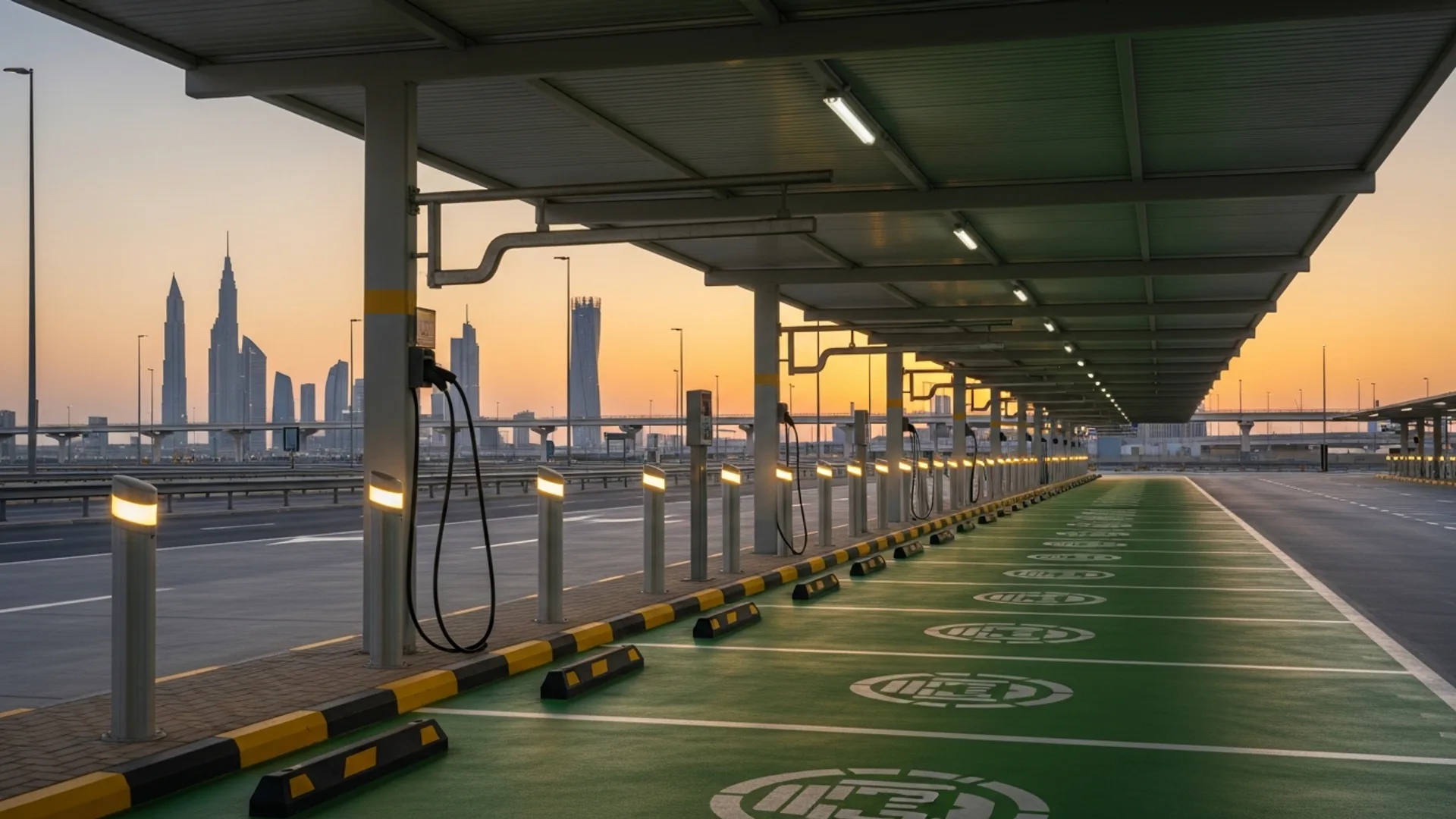
Quick AnswerStart an EV charging business UAE 2026: DEWA registration, DET licence, Dubai Municipality and RTA approvals, 9% corporate tax and real timelines.
Launching an EV charging business UAE founders can actually operate in 2026 is far less about the hardware than newcomers expect. The trade licence is routine — a mainland licence through the Department of Economy and Tourism (DET) is usually issued in one to three weeks, and corporate tax stays at 0% until taxable income passes AED 375,000, then 9% above. What separates a working charge-point operator from a stalled one is the approval chain behind the licence: the utility connection, the car-park permit, the fire-safety sign-off and the contract with whoever owns the land your charger stands on.
That chain runs across several authorities at once. DEWA governs the electrical supply and the registration of chargers connected to its Dubai network. Dubai Municipality governs civil works, excavation, canopies and alterations to parking structures. RTA becomes involved wherever a charger touches public road reserve, public parking or traffic movement. Civil Defence signs off fire and life-safety provisions. And the Federal Tax Authority expects you registered and filing regardless of how many kilowatt-hours you have sold. Knowing the order in which those bodies must be approached is the most valuable planning you can do before spending a dirham on chargers.
Your setup cost, in 10 seconds
Package prices. Health insurance is required by law and not included.
Thank you.
Your written quote follows on WhatsApp.
How Do You Start an EV Charging Business in the UAE in 2026?
Register a company with an electric-vehicle charging or technical services activity, most commonly a mainland licence through DET, then secure landlord consent, DEWA connection approval, Dubai Municipality civil permits and Civil Defence sign-off before commissioning. Budget three to six months to first live charger, register with the Federal Tax Authority (9% corporate tax above AED 375,000; 5% VAT), and expect approvals — not hardware — to set your timeline.
| Element | Typical route | Verified / published figure | Notes |
|---|---|---|---|
| Trade licence (mainland) | DET, Dubai | Trade name reservation AED 620 | Activity must cover EV charging or electromechanical works |
| Trade licence (free zone) | Free zone authority | AMC AED 4,999 (0 visas); UAQ FTZ AED 12,500 with visa; KEZAD AED 9,450 | Half of free zones publish no prices |
| Establishment card | ICP / GDRFA | AED 300 (+ AED 2,000 e-system first time) | Required before sponsoring staff |
| Tenancy registration | Ejari | AED 177.75 (app) / AED 220 (trustee) | Needed for licence and site agreements |
| Electrical connection | DEWA | Published tariff and connection schedules | Via a DEWA-enrolled contractor |
| Civil works permit | Dubai Municipality | Varies by scope | Trenching, foundations, canopies, car-park alteration |
| Public-realm works | RTA | Varies by scope | On-street, public parking, road opening, signage |
| Corporate tax | Federal Tax Authority | 0% to AED 375,000, 9% above | Return due 9 months after year-end |
| VAT | Federal Tax Authority | 5%; threshold AED 375,000 | Voluntary registration from AED 187,500 |
| Imported hardware | Customs | 5% GCC duty on most goods | Plus clearance and conformity steps |
| Emirates ID | ICP | AED 100 per year of residence + AED 100 smart service | Per sponsored employee |
| Residence categories | ICP / GDRFA | Green AED 700 · Golden AED 1,200 | Founder and specialist routes |
Where a fee is shown as "varies by scope", that is deliberate: the utility, municipal and roads authorities price by load, excavation area, bay count and works duration.
Who Actually Needs an EV Charging Licence
The phrase "EV charging business" covers at least four genuinely different companies, and the licence you need depends on which one you are building.
The charge-point operator (CPO) owns and runs the chargers, pays for the electricity, sets session pricing and takes the revenue. It is the most capital-intensive model and carries the deepest approval burden, because the CPO is the party physically altering property and drawing load.
The hardware supplier and installer imports, sells and installs chargers for hotels, malls, developers and fleet depots. It needs a trading activity for the equipment and, critically, an electromechanical or technical services capability to lawfully perform installation. Many newcomers licence the trading side and forget the installation side, then find they cannot legally do the work they just sold.
The e-mobility service provider (eMSP) never touches a charger. It runs the app, the wallet, roaming agreements and the tariff engine, settling with CPOs behind the scenes — a professional-services or IT activity, far lighter on approvals, and where most capital-efficient UAE entrants start. The fleet operator, by contrast, installs depot charging purely for its own vehicles; if no third party ever pays to use it, the commercial licensing question narrows, though electrical and civil approvals do not.
Be honest about which you are, because the activity code determines what you may lawfully invoice for. A company licensed only to trade in electrical equipment that starts billing per kilowatt-hour is operating outside its licence — a mismatch that surfaces at renewal or during an inspection, not on day one.
DEWA, the Green Charger Network and the Registration Route
In Dubai, no charger becomes a business until DEWA says it can be energised. DEWA operates the emirate's public EV Green Charger network — which sets the reference point customers use to judge your pricing, uptime and app experience — and administers the route by which privately owned chargers are registered and connected to the Dubai network.
For a private charger connected in Dubai, the sequence generally runs: appoint a DEWA-enrolled consultant or contractor; confirm the available supply at the premises and whether the existing connection can carry the new load; submit the charger registration and connection application with technical documentation covering the unit specification, protection, earthing and metering arrangement; obtain approval; execute the installation to the approved design; then request inspection and energisation. Details are published and updated at dewa.gov.ae.
Three practical warnings. First, available load is the hidden constraint: a building with spare floor area does not necessarily have spare amperage, and discovering that a 150 kW DC unit needs a substation upgrade after signing a five-year lease is the classic first-project error. Commission a load study before you commit contractually. Second, only enrolled contractors can do the work — the party submitting to and executing for the utility must hold the appropriate enrolment, so budget the qualification effort or subcontract openly. Third, metering determines your economics: whether the charger sits behind the site host's meter or on a dedicated supply decides who pays the electricity bill and whether your margin survives.
Selecting Your Activity with DET on the Mainland
Mainland licensing in Dubai runs through the Department of Economy and Tourism, the successor body to the DET. The steps are familiar: reserve the trade name (AED 620), obtain initial approval, secure premises and register the tenancy through Ejari (AED 177.75 via the app, AED 220 through a trustee), submit the memorandum where required, then pay and collect the licence.
The consequential decision is the activity list. EV charging sits across several established families — electrical and electromechanical contracting, technical and maintenance services, trading in electrical equipment, and IT or software services for the platform layer. Most operating CPOs need a combination rather than a single code, and it is materially cheaper to add the right activities at incorporation than to amend the licence twice in year one.
Two structural points matter. Since the 2021 reforms, most commercial and industrial mainland activities allow 100% foreign ownership, so the assumption that a mainland licence needs a local partner no longer holds for most EV-relevant activities. And premises are still real: mainland licences require a registered tenancy, and a charging company with a spares warehouse plus a modest office is a normal configuration.
If the project involves civil contracting — foundations, canopies, trenching across a car park — a contracting classification sits alongside the trade licence. Do not assume a services licence permits construction. Current activity groupings are published by DET at dubaide.gov.ae and are worth reviewing against your actual scope before you file.
Free Zone Versus Mainland for a Charge-Point Operator
This is the decision founders most often get wrong, because the free zone pitch is genuinely attractive — cheaper published packages, faster incorporation, bundled visa quotas — and genuinely unsuitable for much of this business.
A free zone company is licensed to operate within its zone and outside the UAE. It cannot generally trade inside mainland territory without a mainland presence, a distributor or an appointed agent. Dubai malls, residential communities and hotels are mainland sites, and a free zone licence alone does not authorise you to operate a commercial service there — founders regularly discover this after signing their first site-host term sheet.
Free zones genuinely fit a software or eMSP layer, a holding company, an import and re-export operation, or deployment inside the zone itself.
The cost comparison is also less clear-cut than marketing suggests. Roughly half of UAE free zones publish no prices at all, so most "cheapest free zone" tables online are reconstructed from sales conversations rather than official schedules. Among authorities that do publish, the cheapest licence is Ajman Media City at AED 4,999 with zero visa allocation — genuinely low, and genuinely unsuitable for a company that needs technicians. Add a visa allocation and published all-in options move to around AED 12,500 at UAQ FTZ or AED 9,450 at KEZAD. Zero-visa packages routinely become the more expensive choice once establishment, immigration card and per-person costs stack back on.
For most serious CPOs a mainland DET licence is correct, with a free zone entity added later if a holding or IP structure justifies it.
Dubai Municipality, RTA and Civil Defence Approvals
Once the licence exists, the physical approvals begin, and which authorities you face depends entirely on where the charger sits.
Dubai Municipality governs building and civil works. Foundations for a pedestal charger, canopies, trenching to run cable across a car park, bollards, permanent line-marking changes and any alteration to a parking structure generally require permits, with larger works needing drawings from a registered consultant. Requirements are published at dm.gov.ae. The pattern to internalise: if you are changing the building or the ground, the Municipality is involved.
RTA enters wherever the public realm does — on-street chargers, public parking, road openings, parking-bay redesignation and directional signage sit within the roads authority's remit (rta.ae). This is the slowest lane in most programmes; if your model depends on on-street charging, treat RTA engagement as a six-month workstream, not a form.
Civil Defence covers fire and life safety. High-power DC installations, chargers in enclosed or basement car parks and anything involving battery storage attract closer scrutiny: detection, suppression, ventilation, emergency shutdown, cable routing and firefighting access. Basement provisions can materially change the project budget — another reason to finish the approvals study before signing a lease.
The site host's own consent sits underneath all of it, with its own fit-out process, approved-contractor list and insurance requirements — often stricter than the public authorities'. Sequence matters: landlord consent, then design, then authority submissions, then works.
Contact Us For Free Consultation
or
Ask on WhatsApp insteadLicensed UAE consultancy. One reply, no spam.
Thank you.
A consultant will reply on WhatsApp shortly.
Site-Host Agreements, Ejari and Land Access
The contract with the site host is the asset in this business. It determines your revenue, exclusivity, access rights and — most importantly — how long you have to recover a capital investment bolted to someone else's concrete.
Commercial structures cluster into three families. Fixed rent pays the host a set amount per bay per month regardless of usage — simple, but it transfers all volume risk to you. Revenue share splits session revenue on an agreed percentage; hosts increasingly prefer it, though it demands metering and reporting the host trusts. Charging-as-a-service flips the model: the host buys or leases the hardware and pays you to operate, maintain and bill for it, removing your capital burden entirely.
Whichever you choose, the agreement must address term length against your payback period; site exclusivity; out-of-hours maintenance access; who pays for electricity and how it is metered; who owns and removes the equipment at expiry; what happens if the host sells; signage rights; and liability for damage.
Where you occupy premises — an office, a warehouse, or in some structures the charging site itself — the tenancy must be registered through Ejari, at AED 177.75 via the application or AED 220 through a trustee centre. Ejari is a prerequisite for your DET licence and often for utility applications, so it belongs early in the sequence.
Corporate Tax and VAT with the Federal Tax Authority
Tax obligations begin at incorporation, not at profitability. Register with the Federal Tax Authority through the EmaraTax portal at https://tax.gov.ae/.
Corporate tax applies at 0% on taxable income up to AED 375,000 and 9% above. The return is due nine months after your financial year-end, so a December year-end produces a September deadline. Where revenue is at or below AED 3,000,000, Small Business Relief may be available — directly relevant to a first-year operator with a handful of live sites. Groups with revenue at or above EUR 750 million fall within the Domestic Minimum Top-up Tax at 15%.
VAT is charged at 5% on standard-rated supplies, with registration mandatory once taxable supplies exceed AED 375,000 over twelve months and voluntary registration available from AED 187,500. Two charging-specific points: input VAT on hardware, installation and electricity is recoverable when properly documented, which makes early voluntary registration attractive for a capital-heavy build-out; and session pricing must state clearly whether displayed rates are VAT-inclusive.
Imported hardware attracts the standard 5% GCC customs duty on most goods, plus clearance and any conformity or type-approval steps. Build these into landed-cost modelling rather than quoting supplier FOB prices. And if you run a free zone holding company alongside a mainland operating company, intercompany charges must be at arm's length and documented — a free zone address does not deliver a 0% outcome by itself.
Staffing, Visas and Establishment Cards
An EV charging operation needs technicians, an operations team monitoring uptime, someone owning site relationships, and finance. Almost all of that is hired, and hiring means immigration.
Once licensed, apply for the establishment card — AED 300, plus a first-time e-system fee of AED 2,000 — which registers the company as a sponsor. Employment files then run through ICP federally or GDRFA for Dubai entities. The published components are predictable: employment entry permit AED 300 plus a refundable AED 1,000 deposit; status change AED 500 in-country; residence permit AED 100 plus AED 100 per year plus AED 100 smart service; Emirates ID at AED 100 per year of residence plus AED 100 smart service; and the Dubai medical fitness test at AED 270 standard, AED 700 six-hour VIP or AED 1,020 two-hour VIP.
Founders and senior technical staff may qualify for longer-term residence — the Green visa at AED 700 (five years) or the Golden visa at AED 1,200 (ten years) — removing annual renewal churn for the people you least want distracted by paperwork.
Employment terms follow Federal Decree-Law 33 of 2021: probation capped at six months, notice of 30 to 90 days, 30 days of annual leave, overtime at basic plus 25%, and gratuity at 21 days per year for the first five years and 30 days thereafter, with salaries paid through the Wage Protection System. Two rules bite this sector specifically. The midday break ban prohibits outdoor work between 12:30 and 15:00 from mid-June to mid-September — exactly the window in which open-air car-park installations are otherwise convenient. And field technicians need genuine electrical qualifications; a crew that cannot lawfully work on the equipment it maintains is a compliance problem awaiting an inspection.
Timelines, Renewals and Penalties
A realistic programme for a first mainland site runs roughly as follows. Company formation and licence issuance: one to three weeks where documents are clean. Establishment card and first visas: two to four weeks, in parallel with site work. Site selection, host negotiation and lease execution: four to twelve weeks — where founders lose the most time. Load study, design and utility submission: four to eight weeks. Municipality and, where relevant, RTA permits: four to sixteen weeks. Procurement and shipping: six to twelve weeks unless buying local stock. Installation, inspection and energisation: two to six weeks.
Sequenced with overlaps, three to six months from licence to first live charger is credible for a private-site installation. On-street deployment should be planned at nine to twelve months.
Renewals are annual and unforgiving of drift. The trade licence renews yearly and requires a valid tenancy — a lapsed Ejari blocks it. The establishment card, residence permits, Emirates IDs, utility accounts, insurance and contractor enrolments each carry their own dates. Corporate tax returns fall nine months after year-end; VAT returns quarterly or monthly.
Penalties follow the ordinary UAE pattern: late licence renewal accrues fines and eventually blocks government transactions; visa overstay runs at AED 50 per day; and Federal Tax Authority penalties apply for late registration, filing and payment separately, so one missed deadline can generate several charges. Unpermitted civil works are the most damaging failure here, because remediation may mean removing an installed asset. Put every date in a compliance calendar owned by a named person on day one.
Worked Example: A Six-Charger Destination Network
Consider a founder deploying six AC destination chargers across two Dubai commercial buildings, operating a revenue-share model with the site hosts.
The structure is a mainland DET company with trading and technical services activities, a small office and warehouse, tenancy registered through Ejari at AED 177.75 and a trade name at AED 620. An establishment card at AED 300 plus the AED 2,000 first-time e-system fee enables sponsorship of a founder, two technicians and a coordinator.
Site work begins before the hardware order. Both landlords receive a revenue-share term sheet with a five-year term, two renewal options and clear language on metering and out-of-hours access. A DEWA-enrolled consultant runs load studies at both buildings — one has ample spare capacity, the other forces a redesign around a lower available load, which is precisely why the study preceded the purchase order. Registration and connection applications go to DEWA for both sites. Installations are surface-mounted in existing bays, so civil scope is modest, but the second site needs bollards and repainted bays, triggering a Dubai Municipality permit and, at basement level, Civil Defence review. Neither site touches public road reserve, so RTA is not engaged.
On tax, the company registers with the Federal Tax Authority immediately and elects voluntary VAT registration well before crossing AED 375,000, because recovering input VAT on six chargers, installation labour and electricity materially improves first-year cash flow. Corporate tax sits at 0% while taxable income stays under AED 375,000, and Small Business Relief is assessed given revenue well below AED 3,000,000.
Elapsed time from licence to first energised charger: about four months, with the second site six weeks later. The dominant costs are hardware, installation labour and load-related electrical works — not the licence. That ratio is the most useful thing a first-time founder can internalise.
Common Mistakes in the UAE EV Charging Business
- Buying hardware before running a load study. Available capacity at the site, not the charger specification, decides what you can install. Chargers bought against an assumed load frequently cannot be energised without a costly supply upgrade.
- Choosing a free zone licence for a mainland deployment. A free zone entity generally cannot operate commercially inside mainland territory. Since Executive Council Resolution 11 of 2025, a Dubai free zone company can also apply to Dubai Economy and Tourism for a mainland branch licence (AED 10,000 a year) or a temporary activity permit (AED 5,000 for six months) for approved activities. Founders discover this after signing site agreements, then pay twice to restructure.
- Licensing trading without installation capability. Selling chargers is one activity; lawfully installing them is another. A licence that omits the electromechanical or technical services scope cannot perform the work it sold.
- Signing a site agreement shorter than the payback period. A three-year term against a multi-year asset destroys the return. Negotiate renewal options and early-termination compensation at the outset.
- Leaving metering and electricity liability undefined. If the contract omits whose meter the charger sits behind and who pays for consumption, the margin is unknowable and disputes are certain.
- Starting civil works before permits. Trenching, foundations or bay alterations without Dubai Municipality approval can require removal of installed equipment — the most expensive failure available here.
- Underestimating public-realm timelines. RTA projects coordinate across many more stakeholders; planning them on a private-site schedule guarantees a missed launch date.
- Delaying Federal Tax Authority registration. Corporate tax and VAT obligations attach to the company, not to profitability, and late-registration penalties apply independently of late-filing penalties.
Launch Your EV Charging Business with Noble Core
The technical side of charging is solvable — the equipment is mature and the demand is visible on every UAE forecourt. What derails first-time operators is the sequence: which authority approves what, in which order, and which decision made in week two quietly determines your cost base in month twelve.
Noble Core Ventures structures EV charging and charge-point operator companies across the UAE. We map your model to the correct activity list, choose between mainland and free zone on evidence rather than package pricing, and sequence DEWA, Dubai Municipality, RTA and Civil Defence engagement so approvals run in parallel rather than in series. If installation sits inside your business, we structure it properly — our guide to the technical services licence in Dubai covers the same electromechanical and maintenance classifications that EV installation work depends on.
For founders weighing a facilities-services model — charging bundled with car-park servicing or maintenance contracts — the licensing pattern mirrors our cleaning company licence in Dubai guide, where multi-site labour, permits and site-host contracting drive the economics the same way. If you are still deciding which activity combination fits, our Dubai business licence directory for 2026 sets out the current families side by side. And all of it rests on one foundation — a correctly formed company with the right activities, premises and immigration file — which our complete guide to business setup in Dubai walks through end to end.
Book a free 20-minute consultation and we will map your EV charging project against the real approval chain — licence, utility, municipality, roads and tax — before you commit capital.
Talk to Our Experts
Noble Core Ventures structures EV charging and charge-point operator companies in the UAE — activity selection with DET, technical services licensing, DEWA and Dubai Municipality approval sequencing, site-host contracting, and Federal Tax Authority registration. Free 20-minute consultation.
Frequently Asked Questions
Do I need a special licence to run an EV charging business in the UAE?
You need a commercial or professional trade licence with an activity covering electric vehicle charging equipment, installation or operation, plus utility and municipality approvals before you energise any charger.
Can a free zone company operate public chargers on Dubai mainland?
Not directly. Free zone entities generally cannot trade inside mainland territory, so operators either take a mainland licence, appoint a mainland partner, or restrict deployment to their own free zone.
Who approves the electrical connection for a charger in Dubai?
DEWA approves it. Charger installations connected to the Dubai network are submitted through DEWA’s EV charger registration route by a DEWA-enrolled contractor or consultant, then inspected on site before energisation is permitted.
Is Dubai Municipality approval always required?
Civil works, foundations, canopies, trenching and permanent car-park alterations generally require Dubai Municipality permits, with drawings from a registered consultant. A simple wall-mounted unit inside an existing compliant building may not.
When does RTA get involved in an EV charging project?
RTA is engaged where chargers sit on public roads, public parking or road reserves, or where works affect traffic movement, road openings, directional signage or parking bay allocation.
Does an EV charging company pay corporate tax?
Yes. UAE corporate tax is 0% on taxable income up to AED 375,000 and 9% above that. Register with the Federal Tax Authority through EmaraTax and file within nine months.
Do I have to charge VAT on charging sessions?
Standard-rated supplies attract 5% VAT. Registration is mandatory once taxable supplies exceed AED 375,000 in twelve months, with voluntary registration available from AED 187,500.
How long does it take to launch a UAE EV charging business?
Licensing typically takes one to three weeks. Site approvals, utility connection, procurement and commissioning usually push the first live charger to roughly three to six months.
Can I run a charging network without owning hardware?
Yes. Many operators licence software, roaming and payment services only, then sign revenue-share or charging-as-a-service agreements with site hosts who buy and own the physical units themselves.
What visas can an EV charging company sponsor?
Once the establishment card is issued at AED 300, the company sponsors employment visas through ICP or GDRFA Dubai. Founders may qualify for Green (AED 700) or Golden (AED 1,200) residence.