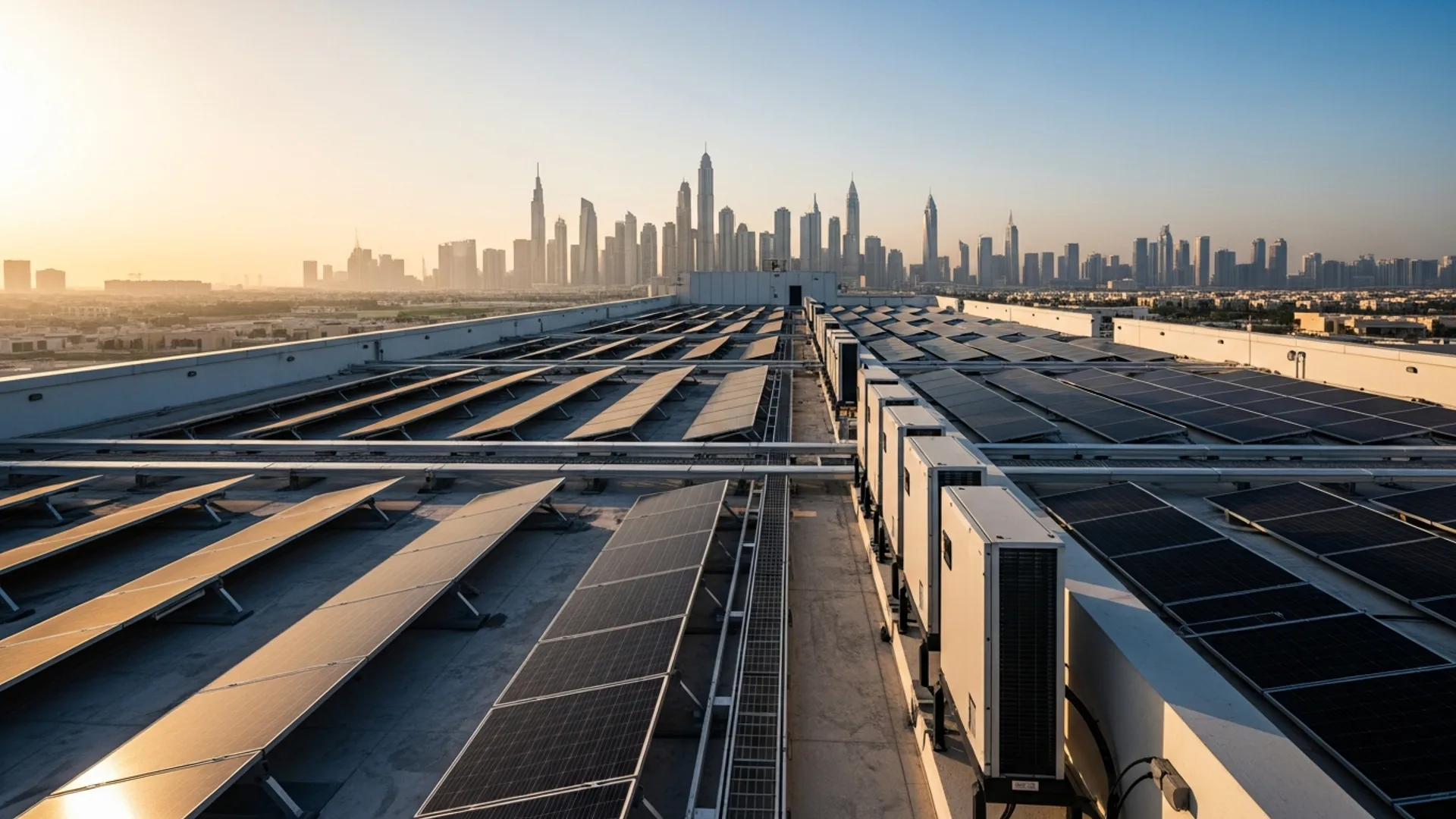
Quick AnswerStart a solar installation business in the UAE in 2026: DEWA enrolment, DET licence, Dubai Municipality approvals, 9% corporate tax and real timelines.
Setting up a solar installation business UAE clients can actually contract with in 2026 sits at an unusually favourable intersection: falling module prices, a national push toward clean energy, and a regulator, DEWA, that has spent a decade building the connection framework for rooftop photovoltaics. But the route is procedural, not entrepreneurial. Before a single panel is bolted to a roof, you need a trade licence carrying the correct contracting activity, enrolment with DEWA as an approved solar contractor, and a compliance stack that runs from Dubai Municipality to Civil Defence to the Federal Tax Authority — where corporate tax is 0% up to AED 375,000 of taxable income and 9% above it.
This guide walks through the whole build: activity selection, DEWA's Shams Dubai programme, engineer qualification, mainland versus free zone, realistic costs and timelines, renewals, penalties, and a worked cost model for a small contracting outfit taking on villa and warehouse rooftops.
Your setup cost, in 10 seconds
Package prices. Health insurance is required by law and not included.
Thank you.
Your written quote follows on WhatsApp.
How do you start a solar installation business in the UAE?
Start with a mainland contracting or technical services licence from Dubai's Department of Economy and Tourism, then enrol with DEWA as an approved solar contractor before quoting grid-connected work. Budget roughly two to four months end to end, register for corporate tax at 9% above AED 375,000, and expect VAT registration once turnover passes AED 375,000.
The sequence matters more than the spend. Firms that reverse it burn payroll on projects they cannot legally connect.
| Item | Indicative position for 2026 |
|---|---|
| Trade licence activity | Contracting / technical services, issued by DET (mainland Dubai) |
| DEWA enrolment | Solar contractor or consultant registration; fees published by DEWA, vary by category |
| Corporate tax | 0% to AED 375,000 taxable income; 9% above |
| Small Business Relief | Available where revenue is at or below AED 3,000,000 |
| VAT | 5% standard rate; mandatory registration at AED 375,000 turnover |
| Golden visa (10-year) | AED 1,200 government fee |
| Green visa (5-year) | AED 700 government fee |
| Emirates ID | AED 100 per year of residence, plus AED 100 smart service |
| Establishment card | AED 300, plus AED 2,000 e-system fee first time |
| Trade name reservation | AED 620 |
| Ejari tenancy registration | AED 177.75 via app, AED 220 via trustee |
| Corporate tax return deadline | 9 months after financial year-end |
Free zone package pricing and DEWA's enrolment schedule vary by category — take the current published number from the authority before quoting.
Who actually needs a solar contracting licence?
Three distinct businesses hide under the phrase "solar company", and they need different licences.
The installer. You survey roofs, design the array, mount rails, run DC and AC cabling, set inverters, and commission the system. This is contracting work performed on a client's property. It requires a mainland contracting or technical services licence, DEWA contractor enrolment, and site-capable staff with the right trade cards and safety training.
The consultant or designer. You produce shading studies, yield modelling, single-line diagrams, structural load assessments and tender documents, but you do not build. DEWA maintains a separate consultant enrolment category. Engineering consultancy activities carry their own professional qualification requirements and are typically tied to a named, degree-qualified engineer.
The trader or distributor. You import modules, inverters, optimisers and mounting systems and sell them to installers. This is a general trading or specialised equipment trading activity and can sit comfortably in a free zone — until you want to sell directly to mainland end-users, at which point distribution arrangements or a mainland entity become relevant.
Many founders start as one and drift into another. Pick the primary revenue engine, licence it properly, and add the second activity later. Adding an activity mid-term is an amendment; operating without it is a violation.
Understanding DEWA's Shams Dubai programme
Shams Dubai is the piece that makes rooftop solar commercially viable in Dubai. Under the programme, DEWA permits eligible customers to install photovoltaic systems on their premises and connect them to the distribution network. Generation offsets the building's own consumption in real time; surplus units are exported and credited against the account, with the settlement mechanics defined by DEWA's connection rules.
For your business, three consequences follow.
First, the customer is the applicant, but you do the work. The building owner or DEWA account holder submits the application, yet the design, documentation and physical installation must come from an enrolled contractor. Your enrolment status is effectively part of your client's application — which is why unenrolled firms cannot win grid-connected work no matter how competitive their price.
Second, the design must satisfy DEWA's technical standards. Equipment selection is not free-form. Inverters, protection devices, metering arrangements and earthing all have to meet DEWA's published requirements, and equipment generally needs to appear on approved lists. Sourcing a cheaper inverter that is not accepted is the single most expensive mistake a new installer can make, because it surfaces at the connection stage after the array is already on the roof.
Third, commissioning is witnessed. Inspection and connection are controlled steps, not formalities. Build your project schedule with the inspection window as a fixed milestone and your cash-flow terms tied to it, not to "installation complete".
Fees, category definitions and the exact document set for enrolment are published by DEWA at dewa.gov.ae and change from time to time. Take them from the source at the point of application rather than from a broker's summary.
Choosing the right DET licence activity
Dubai's Department of Economy and Tourism issues mainland trade licences and controls the activity list. For solar work, founders typically end up with a combination rather than a single line item:
- Electromechanical equipment installation and maintenance — the workhorse activity for mounting, wiring and servicing plant on a client's premises.
- Electrical fitting contracting — covers the electrical installation scope, including DC strings, combiner boxes and AC tie-in.
- Technical services — a broader umbrella often used where the business also performs maintenance, cleaning and monitoring of installed arrays.
- Solar energy systems installation or an equivalent specialised activity, where the activity list offers one.
The practical test is whether every task on your scope of works maps to an activity printed on the licence. Panel cleaning contracts, for instance, are a recurring revenue stream that many solar firms bolt on — and cleaning is its own licensed activity, not an automatic extension of an installation licence. Get the mapping right at initial approval and you avoid an amendment and a re-inspection later.
Contracting activities also come with structural conditions. Expect requirements around a physical office (not a flexi-desk in every case), a registered tenancy contract through Ejari, and in many cases a warehouse or storage facility if you hold stock. External approvals from Dubai Municipality apply to contracting classifications, and your classification grade influences the size of project you may tender for.
Dubai Municipality, Civil Defence and building approvals
A rooftop array is a modification to a building. That pulls in the municipality.
Dubai Municipality governs building permits, fit-out approvals and structural modification consent. A photovoltaic array adds dead load and, more importantly, wind uplift to a roof structure. On existing buildings this typically means a structural assessment by a qualified engineer confirming the roof can carry the ballast or penetrative fixing system proposed. On new builds, the solar provision is integrated into the base building submission. Requirements and permit routes are published at dm.gov.ae.
Civil Defence matters more for solar than most founders expect. A photovoltaic array is a live DC source that cannot be switched off by isolating the building supply — which is precisely the hazard firefighters care about. Practical implications include rapid shutdown provisions, clearly labelled DC isolators, defined access pathways across the roof for firefighting personnel, setbacks from roof edges and parapets, and signage at the main intake indicating the presence of on-site generation. Designing these in from the start costs nothing; retrofitting them after an inspection failure costs a mobilisation.
Access and working at height. Roof work is regulated. Anchor points, edge protection and trained crews are not optional extras, and public liability plus contractor all-risks cover is usually a prerequisite for commercial prequalification.
Abu Dhabi and the northern emirates run parallel frameworks through their own distribution companies and municipalities. Treat each emirate as a separate approvals track.
Engineer qualification and staffing
Solar contracting is a qualification-led business. The typical minimum team for a small installer looks like this:
- An electrical engineer with an attested degree and demonstrable photovoltaic experience, to stamp designs and act as the technical point of contact for DEWA. Degree attestation through the issuing country and the UAE Ministry of Foreign Affairs is a standard prerequisite, and the timeline for attestation is frequently the critical path in the whole setup.
- A site supervisor experienced in electrical installation and working at height.
- Two to four technicians — a mix of electricians and mechanical fitters for rail and module mounting.
- A safety officer, at least part-time, once you run more than one crew.
Employment terms follow Federal Decree-Law 33 of 2021: probation capped at six months, notice of 30 to 90 days, annual leave of 30 days, sick leave of 15 full-pay plus 30 half-pay plus 45 unpaid days per year, and gratuity accruing at 21 days per year for the first five years and 30 days thereafter. Salaries must flow through the Wage Protection System.
Two labour rules bite hard on rooftop work. Overtime is paid at basic plus 25%, rising to plus 50% for work between 22:00 and 04:00 or on rest days, and is capped at two hours per day. And the midday break ban prohibits outdoor work between 12:30 and 15:00 from mid-June to mid-September. For a solar installer, that is a full quarter of the year with a three-hour hole in the working day, in the season with the longest daylight and the highest yield. Price it into your schedules; do not discover it in July.
Contact Us For Free Consultation
or
Ask on WhatsApp insteadLicensed UAE consultancy. One reply, no spam.
Thank you.
A consultant will reply on WhatsApp shortly.
Mainland versus free zone for a solar business
| Factor | Mainland (DET) | Free zone |
|---|---|---|
| On-site installation on mainland property | Permitted with the right contracting activity | Generally not permitted |
| Direct contracting with mainland clients | Yes | Restricted; typically via a mainland partner |
| Government and semi-government tenders | Accessible | Usually restricted |
| Trading and distribution of solar equipment | Yes | Well suited |
| Office requirement | Physical office plus Ejari; warehouse if holding stock | Flexi-desk to full warehouse depending on package |
| Corporate tax | 9% above AED 375,000 | 9% above AED 375,000; qualifying free zone income may differ |
| Setup cost | Higher, activity-dependent | Cheapest published licence AED 4,999 at Ajman Media City with zero visas; AED 12,500 all-in at UAQ FTZ with a visa; AED 9,450 at KEZAD with a visa |
Note that roughly half of UAE free zones publish no prices at all, so any "free zone price table" you find online is largely reconstructed rather than sourced. Where a figure above is quoted, it is because the authority publishes it.
For a genuine installation business, mainland is usually the answer. The free zone route earns its place in two scenarios: a distribution arm importing and warehousing modules, and a regional engineering or project-management office serving clients across the Gulf without performing physical works in the UAE. Several groups run both — a free zone trading entity supplying a mainland contracting entity — which is legitimate but requires clean transfer pricing and proper intercompany documentation once corporate tax is in play.
Corporate tax, VAT and the Federal Tax Authority
Every UAE company registers for corporate tax with the Federal Tax Authority through the EmaraTax portal at https://tax.gov.ae/. The headline mechanics for 2026:
- 0% on taxable income up to AED 375,000; 9% above.
- Small Business Relief where revenue is at or below AED 3,000,000, which lets qualifying businesses elect to be treated as having no taxable income for the period — valuable in the first two or three years of a contracting startup.
- The corporate tax return is due nine months after the end of the financial year. A December year-end means a September deadline.
- Domestic Minimum Top-up Tax of 15% applies to groups with consolidated revenue of EUR 750 million or more — not a startup concern, but relevant if a multinational EPC parent is involved.
- There is no personal income tax, so shareholder salaries and dividends are not separately taxed at individual level.
VAT is charged at 5% and registration is mandatory once taxable supplies exceed AED 375,000 in a rolling twelve months, with voluntary registration from AED 187,500. Contracting businesses reach the mandatory threshold quickly — two mid-size commercial rooftops can do it — so most solar firms register in year one.
Three VAT points specific to solar contracting deserve attention. First, imported equipment: modules and inverters arriving from overseas attract import duty and are handled through Dubai Customs, with 5% GCC duty applying to most goods; the reverse-charge mechanism affects how import VAT is accounted for. Second, milestone invoicing: contracting revenue is usually recognised against progress certificates, and the tax point rules for construction contracts are specific — get your invoicing schedule reviewed rather than assuming a simple cash basis. Third, retention: main contractors commonly hold retention for a defect liability period, which creates a timing gap between VAT accounted for and cash received.
Keep books from day one. Corporate tax filing requires financial statements prepared on an accruals basis, and a contracting business with work in progress cannot reconstruct that from a bank statement in month eleven.
Visas, Emirates ID and immigration logistics
Residence files for a Dubai mainland company run through GDRFA Dubai, with the federal framework administered by ICP at icp.gov.ae. Establishment card issuance is the gateway: AED 300, plus a first-time e-system fee of AED 2,000.
Published government fees you can plan against: employment entry permit AED 300 plus a refundable AED 1,000 deposit; status change AED 500 where the candidate is already in-country; residence permit AED 100 plus AED 100 per year plus AED 100 smart service; Emirates ID AED 100 per year of residence plus AED 100 smart service. Medical fitness testing in Dubai is AED 270 standard, AED 700 for a six-hour VIP service and AED 1,020 for a two-hour service — worth paying for when a project start date depends on one engineer clearing.
Long-term options: the Golden visa is a ten-year residence with a published government fee of AED 1,200, and the Green visa is a five-year route at AED 700. Founders and specialised engineers are common candidates. Overstaying carries a fine of AED 50 per day, which is a trivial-sounding number that becomes a serious problem when a technician's file is missed during a busy quarter.
Visa quota is tied to leased space. A contracting business with six site staff plus office personnel needs a tenancy sized accordingly — another reason the flexi-desk shortcut rarely survives contact with a real installation crew.
Costs, timelines and a worked example
Setup and first-year running costs vary widely with activity mix, office size and headcount, so treat the structure below as a model to populate with live quotations rather than a price list. Where a government-published figure exists, it is used.
Indicative first-year build for a two-crew mainland solar installer
| Line | Basis |
|---|---|
| Trade name reservation | AED 620 (published) |
| Initial approval and licence issuance | DET schedule, varies by activity count and legal form |
| Office tenancy plus Ejari | Ejari AED 177.75 app / AED 220 trustee, plus market rent |
| Establishment card + e-system | AED 300 + AED 2,000 first time (published) |
| DEWA contractor enrolment | Per DEWA's published schedule for the relevant category |
| Municipality and contracting classification | Varies with grade applied for |
| Engineer visa (entry permit, status change, residence, EID, medical) | AED 300 + 1,000 refundable + 500 + 300 + 100/yr + 270 (published) |
| Four technician visas | Same per-head structure, scaled |
| Tools, test equipment, safety kit | Capital purchase, scope-dependent |
| Light commercial vehicle | Purchase or lease |
| Insurance (public liability, contractor all-risks, workmen's compensation) | Underwriter-quoted on turnover and headcount |
| Accounting and corporate tax compliance | Annual retainer |
A revenue sketch. Assume the company completes two villa systems and one small commercial rooftop per month by the second half of year one. Villa systems are typically small arrays with a single string inverter; commercial rooftops are multiples of that. Gross margin in installation contracting generally sits well below what module resale margins suggest, because labour, access equipment, transport and the cost of waiting on approvals all sit inside the job. Model your gross margin on delivered project cost including approval delays, not on equipment markup.
Then layer in the recurring line most new entrants ignore: operations and maintenance. Panels in the UAE lose meaningful output to dust between cleans. An annual O&M and cleaning contract attached to every installed system produces predictable revenue, requires no new approvals beyond the correct activity, and dramatically improves the value of the business. Installers that sell only the install are selling a one-off; installers that sell the install plus a five-year service agreement are building an annuity.
Realistic timeline. Trade name and initial approval, a few days. Licence issuance after tenancy and approvals, one to three weeks. Establishment card and first visas, two to four weeks after that, longer if degree attestation is outstanding. DEWA enrolment, dependent on document completeness and category. Practically, plan on two to four months from first application to first legally connectable project, and do not sign client contracts with delivery dates inside that window.
Renewals, penalties and staying compliant
The trade licence renews annually and depends on a valid registered tenancy. Late renewal attracts escalating monthly fines and, more damagingly, blocks visa transactions — you cannot renew a technician's residence on an expired licence, and an expired residence stops that technician working. One missed renewal can idle a crew.
DEWA enrolment also has a validity period and its own renewal cycle, generally requiring evidence that the qualified staff on whom the enrolment was based are still employed. If your named engineer resigns, your enrolment is exposed; treat that role as a succession risk and keep a second qualified engineer in reserve.
Corporate tax returns are due nine months after year-end, and administrative penalties apply to late registration, late filing and inaccurate returns. VAT returns follow their assigned periods. Both are administered through the Federal Tax Authority, and both are avoidable failures — they are calendar problems, not accounting problems.
Finally, keep site documentation. Test certificates, commissioning records, as-built single-line diagrams and inspection sign-offs are what protect you in a warranty dispute three years later, and what a serious commercial client will ask for during prequalification.
Common Mistakes When Setting Up a Solar Installation Business
- Licensing a trading activity and then trying to install. Equipment trading does not authorise contracting work on a client's property. This is discovered at the approval stage, after the sales pipeline is already built.
- Skipping DEWA enrolment until the first project. Enrolment is a prerequisite for grid-connected work, not a formality to complete alongside it. Start the file before the sales team starts quoting.
- Specifying equipment that is not on the approved list. A cheaper inverter that fails acceptance means removal and replacement at your cost, after installation.
- Ignoring Civil Defence requirements at design stage. Rapid shutdown, DC labelling, roof access pathways and edge setbacks are cheap to design in and expensive to retrofit.
- Forgetting the midday break ban. Outdoor work is prohibited from 12:30 to 15:00 from mid-June to mid-September. Schedules built on eight uninterrupted daylight hours collapse in summer.
- Undersizing the office lease. Visa quota follows leased area. A flexi-desk cannot support a six-person installation crew, and the discovery arrives when the fifth visa is refused.
- Treating corporate tax as a year-three problem. Registration with the Federal Tax Authority and accrual-basis bookkeeping start in year one, and Small Business Relief must be elected, not assumed.
- Selling only the installation. No O&M or cleaning contract means no recurring revenue and no defence when a competitor offers the client a service agreement.
Building Your Solar Installation Business with Noble Core
Solar contracting rewards operators who get the regulatory architecture right before the first roof survey. The licence has to carry every activity your scope touches; the DEWA enrolment has to be live before you quote grid-connected work; the engineer's attested degree has to be in hand before either; and the tax registrations have to exist before the first invoice.
Noble Core Ventures handles that architecture. We map your intended scope of works to the correct DET activities so nothing falls outside the licence, secure trade name and initial approval, structure the tenancy to support your visa quota, and prepare the documentation for technical services and contracting licensing in Dubai. Where the plan includes an O&M and panel-cleaning arm — and for a solar business it should — we licence that correctly from the outset rather than as an afterthought, using the same route as a standalone cleaning company licence in Dubai.
If you are still deciding between mainland contracting, a free zone trading entity, or both in parallel, our Dubai business licence directory for 2026 sets out the activity landscape, and our full guide to business setup in Dubai covers the wider structuring, banking and tax picture.
From company formation and engineer visas through Federal Tax Authority registration and first-year compliance, we run the process so you can spend your time on roofs and clients instead of counters. Book a free 20-minute consultation and we will map your route, your realistic timeline and your true first-year cost.
Talk to Our Experts
Noble Core Ventures structures solar contracting companies end to end — DET technical services and contracting activity selection, trade name and initial approval, Dubai Municipality and Civil Defence readiness, DEWA contractor enrolment paperwork, engineer visas and Emirates ID, Federal Tax Authority corporate tax and VAT registration. Free 20-minute consultation.
Frequently Asked Questions
Do I need a DEWA licence to install solar panels in Dubai?
You need a trade licence first, then enrolment with DEWA as an approved solar contractor or consultant. Only enrolled firms may design, install and commission systems connected under Shams Dubai.
Which trade licence activity covers solar installation?
Mainland firms usually hold a technical services or contracting activity issued by Dubai’s Department of Economy and Tourism, often paired with electromechanical equipment installation and maintenance to cover the full scope.
Can a free zone company install solar panels on Dubai mainland roofs?
Generally no. Physical installation work on mainland property requires a mainland contracting licence. Free zone entities typically handle trading, distribution, consultancy or project management rather than on-site installation.
How long does it take to set up a solar installation company?
The trade licence usually takes one to three weeks. DEWA contractor enrolment, Civil Defence familiarity and staff visas extend the practical start to roughly two to four months.
Do solar companies pay corporate tax in the UAE?
Yes. Corporate tax is 0% on taxable income to AED 375,000 and 9% above that. Register with the Federal Tax Authority through EmaraTax and file within nine months of year-end.
Is VAT charged on solar installation work?
Standard VAT of 5% applies to most contracting supplies. Registration is mandatory once taxable turnover passes AED 375,000, with voluntary registration available from AED 187,500.
What is Shams Dubai?
Shams Dubai is DEWA’s rooftop solar programme. It lets building owners connect photovoltaic systems to the grid, offsetting consumption and exporting surplus units under a net-metering arrangement.
Do I need a qualified engineer on the payroll?
Yes. Contractor and consultant enrolment expects electrical engineers with verified degrees and relevant solar experience, plus certified technicians. Qualifications are attested and submitted with the enrolment file.
How many visas can a solar contracting company get?
Mainland visa quotas are driven by leased office and, where relevant, warehouse space. Fit-out crews and technicians usually require additional area, so plan the tenancy around headcount.
What happens if the trade licence expires?
Late renewal attracts monthly fines and can block visa transactions and DEWA enrolment renewal. Restore the tenancy registration and renew before expiry to avoid work stoppages on live sites.