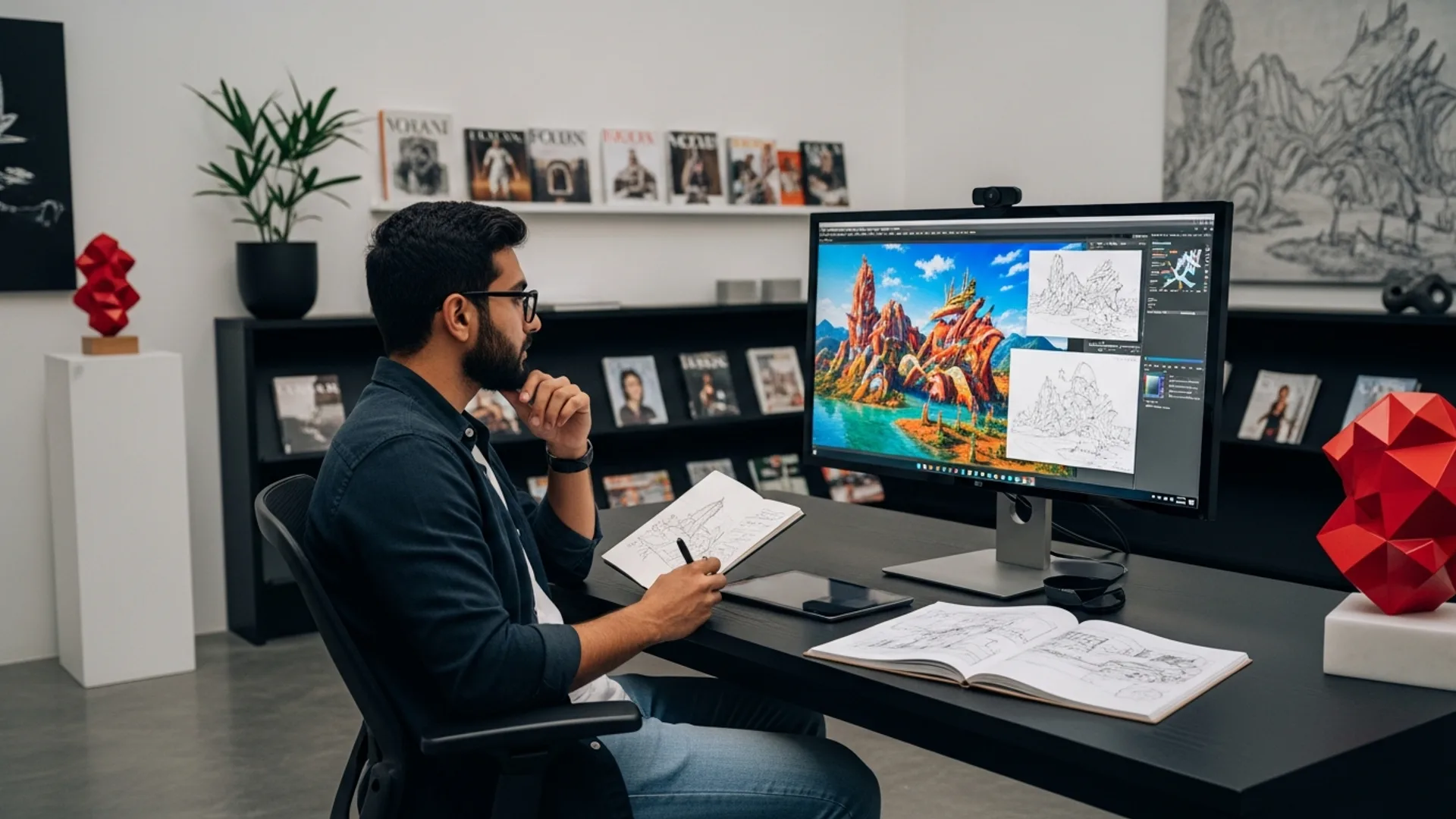
Quick AnswerAI-generated content and copyright in the UAE 2026: who owns AI output, infringement risk, licensing terms and how businesses protect their work.
AI-generated content and copyright in the UAE in 2026 sit in a genuinely uncertain legal space: ownership of purely machine-generated output is unclear because copyright law is built around human authorship, yet businesses are producing and monetising AI-assisted content every day. The practical answer for founders is that content created with meaningful human authorship, selection and creative direction has a far stronger ownership position than output generated from a one-line prompt, and that you must also avoid infringing third-party rights and comply with each AI tool's licence. This guide explains who owns what, where the risks are, and how to protect your work.
This matters for a widening set of businesses — marketing agencies, media companies, software firms, e-commerce brands and any startup producing content at scale. The commercial value of your content, and your ability to stop others from copying it, depends on whether it is protectable. Getting the legal footing right is not academic; it determines whether your brand assets, marketing library and product content are defensible assets or vulnerable ones.
Who owns AI-generated content under UAE copyright law in 2026?
Under UAE copyright law, protection attaches to original works of human authorship, so purely AI-generated output — created with minimal human input — has an uncertain and likely weak ownership position, while AI-assisted work involving genuine human creativity, selection and arrangement is far more likely to be protected. There is no separate "AI copyright"; the strength of your rights scales with the degree of human authorship. Copyright is administered federally, historically under the Ministry of Economy, and lasts, for typical works, decades beyond the author's life.
The reasoning is consistent with copyright systems worldwide. Copyright is designed to protect the products of human creativity, and it assigns rights to authors — a concept that presumes a human. When a machine produces output autonomously, the traditional author is missing, which is why courts and regulators globally are grappling with whether and how such output can be owned. The UAE has not created a bespoke "machine copyright," so the safest working assumption is that the more meaningful human creative contribution went into a piece of content, the stronger your claim to own and protect it.
For businesses this converts into a simple operating principle: treat AI as a tool that assists human creators, not as an autonomous author. Keep humans genuinely involved in selecting, editing, arranging and directing the work, and keep evidence of that involvement.
Copyright basics every UAE business should know
Copyright in the UAE protects original literary, artistic and related works — text, images, software code, audiovisual works, designs and more — without any registration requirement for protection to exist, although recording authorship and dates strengthens your evidential position. The rights holder generally controls reproduction, distribution, communication to the public and adaptation of the work, and protection typically lasts for the author's life plus a long period after death for many categories of work.
Two features matter especially for content businesses. First, copyright protects expression, not ideas — you cannot own a concept, only a particular original rendering of it. Second, ownership rules for works created by employees and contractors depend on the arrangement, so you should use written agreements that clearly assign rights to your business. Do not assume that paying a freelancer automatically transfers full ownership of everything they produce; put it in the contract.
Real-world scenarios UAE businesses face
Abstract principles become clearer against concrete situations, and a handful recur constantly for UAE founders.
Consider a marketing agency in Dubai that uses AI to draft blog articles and social copy for clients. The copy is useful, but if it is published verbatim from the model with no human authorship, the agency cannot confidently claim exclusive copyright over it, and a rival could conceivably produce something very similar. The fix is straightforward: the agency's writers use AI as a first-draft engine, then substantially edit, restructure and add original insight, creating a human-authored final work the agency can own and the client can rely on. The agency also confirms its AI tool's terms permit commercial use of outputs for clients.
Consider an e-commerce brand generating product images and a logo with an AI image tool. The logo is the highest-risk asset: if it resembles an existing mark, the brand faces both copyright and trademark exposure, and if the tool's terms restrict commercial use, the brand may not own it at all. The right approach is to treat the logo as a brand-defining asset — either commission original human design or ensure substantial human refinement — and then register it as a trademark, which gives a clear, enforceable, registered right that does not depend on the fragile copyright status of AI output.
Consider a software company whose developers use AI coding assistants. Here the concerns shift to licensing of generated code, potential inclusion of code resembling existing open-source projects with incompatible licences, and confidentiality of proprietary code fed into the tool. The company adopts an enterprise-tier assistant with appropriate data protections, sets rules about what code may be entered, and reviews generated code for licence compatibility — protecting both its IP and its clients.
In every scenario the pattern is the same: identify which outputs are commercially important, keep humans meaningfully involved in those, check the tool's terms, watch for infringement, and layer trademark and contract protections on top of copyright.
The infringement risk running the other way
Ownership is only half the picture. The more immediate legal risk for many businesses is that AI output infringes someone else's rights. AI models are trained on large bodies of existing work, and outputs can sometimes reproduce or closely resemble protected material — a distinctive style, a recognisable character, a passage of text, or a near-copy of an image. If you publish such output commercially, you can face an infringement claim even though a machine produced it, because liability attaches to the party that uses and distributes the work.
Sensible mitigation is practical, not paralysing. Avoid prompts that explicitly target a specific artist's style, a branded character, or a known protected work. Review AI outputs for obvious resemblance to existing material before commercial use, particularly for logos, key visuals and anything customer-facing. Keep human oversight in the loop. And be especially careful with brand assets: a logo generated by AI that inadvertently mirrors an existing mark can create both copyright and trademark exposure.
AI tool terms of service: read the licence
A frequently overlooked point is that your rights to AI output are shaped first by the terms of service of the tool you used. Different providers take different positions: some assign broad rights in the output to the user, some retain rights or impose usage restrictions, and some distinguish between free and paid tiers. If you generate a logo, a piece of code or a marketing asset with an AI tool and the terms restrict commercial use or reserve rights, you may not have the ownership you assumed.
Before using AI-generated content commercially — and certainly before using it for brand-defining assets like your logo or product identity — read the specific tool's terms, note any restrictions, and keep a record of which tool and tier produced the asset. For anything mission-critical, consider commissioning original human work you can own outright, or combining AI assistance with substantial human authorship.
How to protect your AI-assisted content
Because pure AI output is legally fragile, smart businesses build protection through a combination of measures rather than relying on copyright alone.
Keep human authorship central and documented. Records showing the creative choices, edits and direction your team applied strengthen any copyright claim and evidence your ownership.
Use contracts that assign rights. Ensure employment and contractor agreements clearly assign the intellectual property in work produced for your business, including AI-assisted work, so ownership is unambiguous.
Register trademarks for brand assets. Trademark protection is a powerful complement to copyright for logos, names and brand identity, and unlike copyright it is registered, giving you a clear, enforceable right. Intellectual property registration in the UAE is administered federally, and registering your key marks converts fragile assets into defensible ones.
Protect confidentiality. Trade-secret and confidentiality protections shield proprietary prompts, datasets and processes that give your content an edge, provided you keep them genuinely confidential through NDAs and access controls.
The table below summarises indicative costs of building an IP-protected content or AI business in the UAE. Figures are planning ranges and vary by structure and scope.
| Item | Indicative 2026 range (AED) | Notes |
|---|---|---|
| Free-zone technology / media licence | 12,500 – 30,000/yr | Varies by zone and package |
| Trademark registration (per class) | 6,000 – 12,000 | Strong, registered brand protection |
| IP-assignment contract templates | 3,000 – 15,000 | Staff and contractor agreements |
| Content/IP policy & AI-use guidelines | 5,000 – 20,000 | Internal governance |
| Establishment card + per visa | 1,200 + 3,500 – 6,000 | Per person |
The PDPL angle: content about real people
Content creation increasingly involves personal data — generating marketing that features real individuals, using AI to analyse customer feedback, or producing personalised content. Where identifiable individuals are involved, the UAE's Personal Data Protection Law, the Federal Decree-Law on personal data protection, applies for onshore businesses (with DIFC and ADGM operating separate regimes). You need a lawful basis to process personal data, care over cross-border transfers when AI tools send data abroad, and safeguards for any sensitive data. Overlooking this is a common blind spot for content teams focused on copyright but not privacy.
Trademarks: your strongest protection for brand assets
Because copyright over AI-generated output is fragile, trademarks deserve special attention as the more robust protection for the assets that most define your business — your name, your logo and your brand identity. Unlike copyright, which arises automatically but is uncertain for AI output, a trademark is a registered right. You apply, the registration is examined, and once granted you hold a clear, enforceable monopoly over the use of that mark for the goods and services covered, renewable indefinitely so long as you keep using and renewing it.
For a content or AI business, this changes the risk equation entirely. Even if the copyright status of an AI-assisted logo is debatable, a registered trademark gives you a firm basis to stop competitors using a confusingly similar mark. That is why the sensible strategy for brand assets is to layer protections: use meaningful human authorship to strengthen any copyright claim, and register trademarks to secure enforceable rights over the marks that matter. Register early, before you build significant brand equity, because trademark systems generally reward the first to file, and discovering that someone else has registered a similar mark after you have invested in your brand is a painful and avoidable outcome.
Think too about the classes and markets you register in. Trademark protection is granted for specific classes of goods and services and specific territories, so register in the classes that reflect your actual and planned business, and in the markets where you operate or intend to. For a business trading across the UAE and beyond, a considered filing strategy protects your brand where it counts without wasting money on coverage you will never use. This is precisely the kind of decision where early, deliberate planning pays off far more than reacting after a dispute.
Disclosure, authenticity and audience trust
Beyond the strict legal position, a commercial and reputational dimension is growing in importance: audience and platform expectations around the disclosure of AI-generated content. Consumers, clients and platforms increasingly want to know when content is AI-generated, and norms and rules around labelling are developing. For a content business, getting ahead of this is both an ethical and a strategic move. Being transparent about how you use AI, having a consistent internal policy on when and how AI-assisted content is disclosed, and ensuring that AI use never crosses into deception protects your brand's credibility.
This matters because trust is the currency of a content business. Audiences that feel misled by undisclosed AI content, or that encounter obviously low-quality machine output presented as considered human work, lose confidence quickly. Businesses that use AI to genuinely improve their content — faster production, more iterations, better analysis — while keeping human judgement and integrity at the centre, build durable trust. Those that use AI to cut corners invisibly risk their reputation. As the environment around AI content continues to evolve, a business that has already committed to responsible, transparent, human-led use will be far better positioned than one that has to reckon with its practices after a backlash or a rule change.
Licensing your content or AI business correctly
If content or AI is your business, you must also be licensed for the activity. There is no dedicated "AI copyright licence"; you take a commercial, professional or media licence matched to what you do, through a free zone or mainland via DET (Dubai's Department of Economy and Tourism). A cost-efficient free zone suits lean content and software startups, while a media-focused or technology cluster may fit better depending on your work. Choosing between options such as a Dubai tech licence and a value free-zone licence comes down to cost, credibility and market access — a comparison worth doing carefully rather than defaulting to the cheapest.
Whatever route you choose, your business remains subject to UAE corporate tax: 9% on taxable profit above AED 375,000, administered by the Federal Tax Authority (FTA), with no personal income tax on individuals. The official guidance is at https://tax.gov.ae/. Free-zone entities meeting the Qualifying Free Zone Person conditions may access 0% on qualifying income, but registration and filing with the FTA are required regardless.
How UAE copyright compares with the global picture
It helps to see the UAE position in its international context, because your business likely operates across borders and your content travels. Around the world, copyright offices and courts have converged on a broadly similar stance in 2026: works produced entirely by a machine, without meaningful human creative control, generally do not qualify for copyright, while works where a human made the creative decisions can qualify — with the machine treated as a sophisticated tool, much like a camera or a design program. The dividing line is the degree and nature of human authorship.
The practical upshot for a UAE business is reassuring rather than alarming. You do not need to abandon AI tools to protect your content; you need to use them as instruments of human creativity. A designer who uses AI to generate dozens of drafts, then selects, combines, refines and finishes a final asset with genuine creative judgement, is in a materially stronger position than someone who accepts a single raw output untouched. Document that process. The evidence of human involvement — briefs, iterations, edits, decisions — is what converts a fragile output into a protectable work if a dispute ever arises.
This also shapes how you should think about scale. Businesses generating high volumes of content are tempted to remove humans from the loop entirely for efficiency. That efficiency comes at the cost of protectability and raises infringement risk, because no one is reviewing outputs before they go live. The right balance is to keep human review and creative direction at the points that matter most: brand assets, flagship content, anything customer-facing, and anything you would be upset to see a competitor copy.
Moral rights and attribution
Beyond economic rights, many copyright systems including the UAE's recognise moral rights — an author's right to be attributed and to object to derogatory treatment of their work. Moral rights add a wrinkle to AI-assisted content because they attach to human authors. When you commission human creators, or when your staff contribute meaningfully to AI-assisted work, be clear in your contracts about attribution and the handling of moral rights to the extent they can be addressed, so there is no later dispute about credit or alterations.
For a content business this is not merely legal housekeeping. Clear internal rules about who is credited, how AI-assisted work is labelled, and how outputs may be edited prevent friction inside your team and with freelancers. As disclosure expectations around AI-generated content grow among audiences and platforms, having a consistent internal policy on attribution also protects your brand's credibility.
Building an AI-content policy for your business
The businesses that handle AI content best treat it as a governed process rather than a free-for-all. A workable policy answers a handful of questions clearly. Which AI tools are approved, and at which subscription tier, so that commercial-use rights and data protections are adequate? What content may be produced with AI assistance, and what must be created or reviewed by humans? What may never be entered into a public AI tool — client confidential information, unpublished IP, personal data without a basis? How are outputs reviewed for infringement before publication, especially logos and key visuals? Who owns the resulting work, and how is that ownership secured through contracts and, where relevant, trademark registration?
None of this needs to be bureaucratic. A two-page policy plus a short approved-tools list and a simple review step for high-stakes assets covers most businesses. The return is significant: you reduce infringement risk, strengthen your ownership of valuable content, satisfy the AI-governance questions that enterprise clients increasingly ask, and give your team the confidence to use AI productively within clear guardrails. As the regulatory and market environment around AI content continues to mature, a business that already operates this way will adapt far more easily than one scrambling to retrofit controls after a problem.
Common Mistakes When Using AI-Generated Content in the UAE
- Assuming you own everything AI produces. Pure AI output has uncertain, likely weak protection. Without meaningful human authorship, you may be unable to stop competitors copying your content.
- Ignoring the AI tool's terms of service. Your rights start with the licence. Using content commercially when the tool restricts it — especially for logos — can leave you with no valid ownership.
- Publishing without checking for infringement. AI can reproduce protected work. Distributing an output that mirrors an existing image, text or mark exposes you to claims even though a machine made it.
- Relying on copyright alone for brand assets. Copyright over AI output is fragile. Failing to register trademarks for your logo and brand names leaves your most valuable assets undefended.
- Skipping IP-assignment contracts. Paying a freelancer does not automatically transfer full ownership. Without written assignment, your business may not own the content it commissioned.
- Forgetting the PDPL for personal data. Content featuring or built from real individuals' data engages the Federal personal data protection law. A copyright focus that ignores privacy creates separate exposure.
- Prompting for a specific artist or brand. Deliberately imitating a named creator or protected character raises infringement risk sharply. Direct AI toward original expression, not copies.
Protecting your AI-assisted content with Noble Core
The legal reality of AI content in 2026 is nuanced: ownership scales with human authorship, infringement risk runs in both directions, tool terms shape your rights, and privacy law applies whenever real people are involved. Businesses that build content at scale need a deliberate framework — the right licence, registered brand protection, clear IP-assignment contracts, and sensible AI-use guidelines — to turn fragile output into defensible assets.
Noble Core Ventures structures your content or AI business and builds that framework with you. We license your activity through the right free zone or mainland route via DET, help you register trademarks for your brand assets, prepare IP-assignment agreements for staff and contractors, align your practices with the Federal personal data protection law where personal data is involved, and set up practical AI-use guidelines that protect both your ownership and your compliance.
Start with our complete guide to business setup in Dubai to choose the right structure. If you build software or AI products, read our guides to launching a software company in Dubai and the specialised DIFC AI and coding licence. And when you are weighing licence options on cost, our detailed comparison of the Dubai tech licence versus the IFZA tech licence and their real costs will help you choose. Book a free 20-minute consultation and we will help you protect the value of your AI-assisted content.
Talk to Our Experts
Noble Core structures your content or AI business and builds the IP, contract and compliance framework to protect your work. Free 20-minute consultation.
Frequently Asked Questions
Who owns AI-generated content in the UAE?
Ownership of purely AI-generated content is legally uncertain because copyright frameworks assume a human author. Content created with meaningful human authorship and creative input has a much stronger ownership position.
Is AI-generated content protected by copyright in the UAE?
UAE copyright law protects original works of human authorship. Output generated with genuine human creativity, selection and arrangement is more likely to attract protection than output produced with minimal human involvement.
Can I use AI-generated content commercially in the UAE?
Generally yes, provided you comply with the AI tool’s licence terms and do not infringe third-party rights. Commercial use is common, but strong exclusive ownership over pure AI output cannot be assumed.
Can AI-generated content infringe someone else’s copyright?
Yes. AI output can reproduce or closely imitate protected works, exposing you to infringement claims. You should review outputs, avoid prompts targeting specific protected works, and keep human oversight.
Do AI tools give me ownership of what I create?
That depends on the tool’s terms of service. Some grant you broad rights to outputs; others impose restrictions. Always read the licence before using AI content commercially, especially for logos and brand assets.
Which UAE authority handles copyright?
Copyright and related intellectual property are administered federally, historically under the Ministry of Economy, alongside trademark and patent protections. Businesses should register key brand assets where registration is available.
How do I protect my business’s AI-assisted content?
Keep records of human contribution, register trademarks for brand assets, use clear contracts assigning rights from contractors and staff, and combine copyright with trademark and confidentiality protections.
Does the PDPL affect AI content creation?
Yes, where content generation involves personal data. Inputting or generating content about identifiable individuals engages the Federal Decree-Law on personal data protection, requiring a lawful basis and safeguards.
Contact Us For Free Consultation
Licensed UAE consultancy. One reply, no spam.
Thank you.
A consultant will reply on WhatsApp shortly.