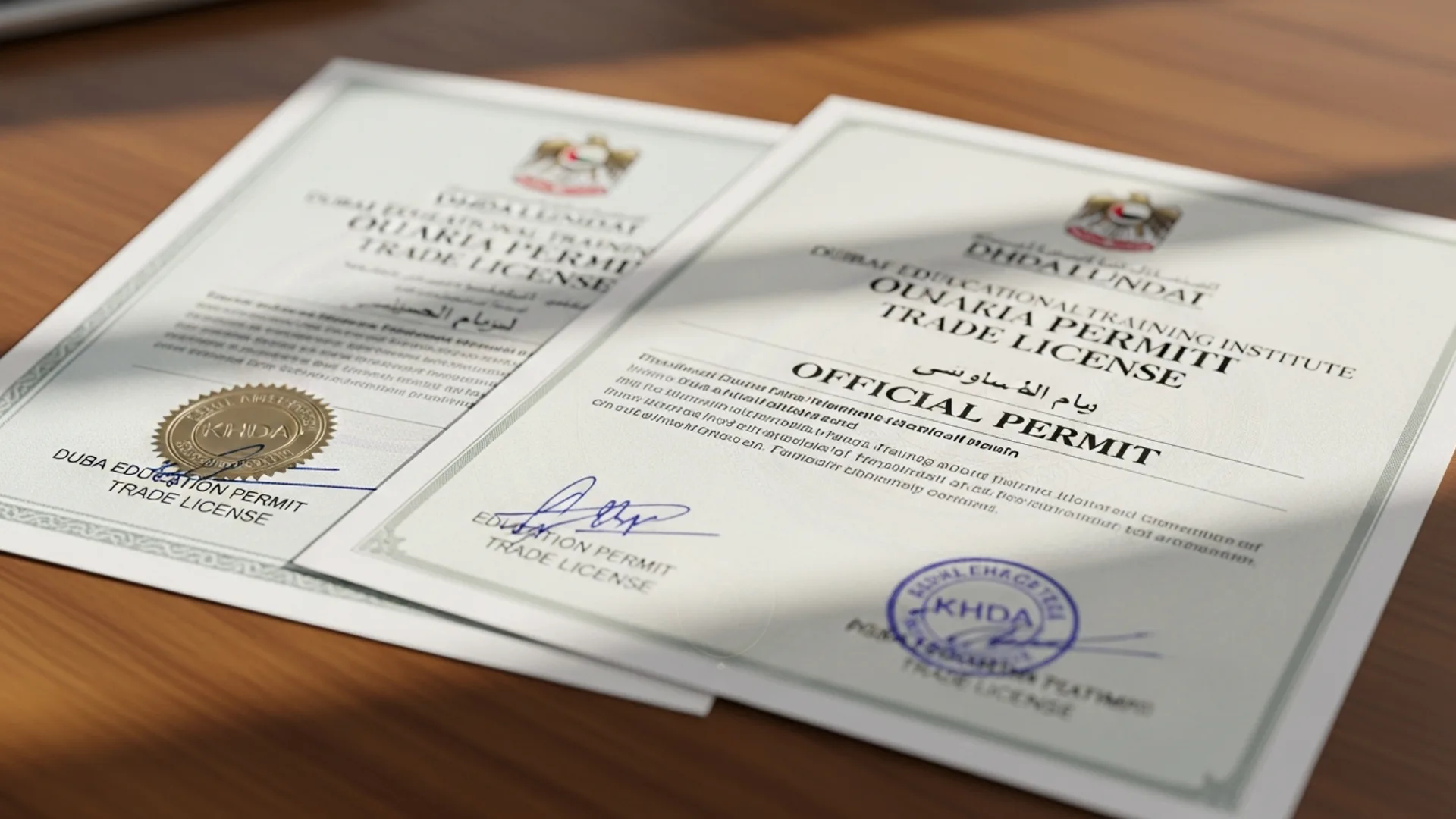
Quick AnswerA Dubai educational institute license costs AED 35,000–150,000 in 2026. KHDA approvals, school setup, training centre rules. Full guide.
Your setup cost, in 10 seconds
Package prices. Health insurance is required by law and not included.
Thank you.
Your written quote follows on WhatsApp.
Educational institute license Dubai 2026 — KHDA, cost, real setup
A Dubai educational institute license costs AED 35,000–150,000 in 2026 for training and continuing education centres. K-12 schools require materially higher investment (AED 250,000–800,000+ in license/approval fees, with facility costs running into the AED 15M–80M+ range). Real first-year cost for a training centre including facility, curriculum development, teacher visas, marketing and operations capital is AED 400,000–2,500,000. Education is one of Dubai's most rigorously regulated sectors with KHDA's comprehensive oversight from facility design through teacher qualifications to student outcomes.
This guide is built from real educational institute openings under the Knowledge and Human Development Authority (KHDA), the Ministry of Education (MoE), the Department of Economy and Tourism (DET), Civil Defence, Dubai Municipality, the Ministry of Human Resources and Emiratisation (MOHRE) and the General Directorate of Residency and Foreign Affairs (GDRFA). It covers KHDA classifications, facility requirements, teacher licensing, curriculum approval and the operational reality of running a Dubai educational institute in 2026.
Dubai education market 2026 — what you are entering
Dubai's private education market is approximately AED 12 billion annually across:
- K-12 private schools — 220+ schools serving 320,000+ students. British, American, IB, Indian, Pakistani, French, German, Japanese, Filipino curricula plus UAE national curriculum.
- Nurseries and early childhood centres — 1,200+ facilities
- Training and continuing education centres — 2,500+ institutes
- Language schools — Arabic, English, Mandarin, Spanish, French, German, Russian, Hindi specialist providers
- Tutorial centres — exam preparation, subject tutoring (academic and IGCSE/A-level focused)
- Higher education — universities, branch campuses (NYU, Heriot-Watt, Middlesex, Manipal, etc.)
- Vocational training — RTA driving schools, professional certifications, technical training
The market is competitive but expanding. K-12 enrolment grew 4–6% annually through 2023–2025 and continues. Training and continuing education segment grew faster with professional upskilling demand. Specialty niches (tech bootcamps, creative arts, neurodiversity support) have strong growth.
KHDA classification system
KHDA classifies educational institutions:
- Training and Continuing Education Centres — Adult education, professional development, language training, tutorial services. Most accessible for new entrants.
- Private Schools (K-12) — Full academic programmes. Substantial facility requirements.
- Nurseries — Children under 4. Specific child safety and care standards.
- Higher Education Institutions — University-level programmes. Subject to additional MoHE accreditation.
- Innovation and Specialised Centres — Niche programmes (coding bootcamps, creative arts, music schools).
This guide focuses primarily on training and continuing education centres given they are the most accessible category for new entrants. K-12 school and university setup is materially more complex with capital requirements 10–100× higher.
For KHDA rules see https://www.khda.gov.ae/. For DET activity codes see https://www.det.gov.ae/. Ministry of Education at https://www.moe.gov.ae/.
The real cost of a Dubai training centre license in 2026
Here is the year-1 license budget for a standard 250 sqm training centre.
| Line item | AED (2026) | Who collects it |
|---|---|---|
| Trade name reservation | 620 | DET |
| Initial approval | 235 | DET |
| Commercial license fee, education class | 22,000–35,000 | DET |
| KHDA training centre license | 35,000–85,000 | KHDA |
| KHDA curriculum approval (per programme) | 5,000–25,000 each | KHDA |
| Each extra DET activity beyond 3 | 500–1,500 | DET |
| Establishment card | 600 | GDRFA |
| Tasheel labour file | 2,000 | MOHRE |
| Ejari tenancy registration | 220 | RERA |
| Civil Defence approval | 2,500–8,500 | Civil Defence |
| Dubai Municipality approval | 1,500–4,500 | Dubai Municipality |
| KHDA teacher registration (per teacher, 4 teachers) | 6,000–18,000 each | KHDA |
| Training delivery technology and materials | 50,000–200,000 | Vendors |
| Insurance | 12,000–40,000 | Insurer |
| Total year-1 license setup | AED 160,675–565,355 |
Plus AED 150K–500K facility fit-out and AED 100K–400K curriculum and materials development.
Capital requirements by education type
- Tutorial centre (50–120 sqm) — AED 400K–900K capital
- Language school (120–250 sqm) — AED 800K–2M capital
- Professional training centre (150–400 sqm) — AED 1M–2.5M capital
- Specialty academy (coding, arts, music) — AED 1.5M–4M capital
- Tech bootcamp (200–500 sqm) — AED 2M–8M capital
- Nursery (300–600 sqm) — AED 3M–8M capital + ongoing
- K-12 private school — AED 15M–80M+ capital + 4–6 year ramp
- Higher education branch campus — AED 50M–250M+ capital
Capital below these ranges typically indicates undercapitalisation.
Contact Us For Free Consultation
or
Ask on WhatsApp insteadLicensed UAE consultancy. One reply, no spam.
Thank you.
A consultant will reply on WhatsApp shortly.
Activity codes for educational institutes
| Code | Activity | Use |
|---|---|---|
| 8559.10 | Training and Educational Activities | Generic training centre |
| 8559.01 | Cultural Education | Arts, music, cultural programmes |
| 8559.02 | Language Training | Language schools |
| 8559.03 | Sports Education | Sports academies (with DSC additional) |
| 8559.04 | Tutoring | Tutorial and exam prep centres |
| 8521.01 | Private Primary Schools | K-6 schools |
| 8531.01 | Private Secondary Schools | 7-12 schools |
| 8541.01 | Private Higher Education | Universities and colleges |
| 8542.01 | Private Vocational Education | Vocational training |
| 8551.01 | Sports Education and Training | Sports coaching |
A standard professional training centre registers: 8559.10 + 8559.02 + 8559.04. This covers training, language and tutoring activities.
The full setup process — step by step (Training Centre)
Step 1: Concept, target market, programmes (Week 1–3)
Define educational focus: corporate training, certifications, languages, tutorial, specialty (coding, design, etc.). Different focus drives different facility requirements, teacher profiles, marketing strategies and capital needs.
Step 2: Trade name and DET initial approval (Week 1–2)
Reserve trade name. Educational institutes often use "Academy", "Institute", "Learning Center", "Training Center", "School" in names.
Step 3: KHDA pre-approval submission (Week 2–8)
KHDA reviews:
- Business plan with educational objectives
- Programme curricula and learning outcomes
- Teacher qualifications planned
- Facility plans and capacity
- Student safety and welfare policies
- Quality assurance framework
Pre-approval is 6–10 weeks. Most applications need 1–2 revision rounds.
Step 4: Ejari and DET license (Week 4–6)
With KHDA pre-approval indication, register Ejari through RERA, obtain DET commercial license.
Step 5: Facility setup (Week 6–18)
Training centre facility requirements:
- Classroom or training rooms with adequate space (typically 2–3 sqm per student)
- Computer labs (if technology training)
- Library and resource centre
- Administration office
- Reception
- Toilet facilities (gender-segregated)
- Prayer rooms
- First aid facilities
- Emergency exits per Civil Defence requirements
- Adequate parking
Step 6: Curriculum and material development (Week 6–18)
KHDA requires detailed curriculum documentation for each programme:
- Learning objectives
- Course outline and module breakdown
- Assessment methodology
- Required materials and textbooks
- Teaching methodology
- Quality assurance procedures
Curriculum approval is 4–8 weeks per programme.
Step 7: Teacher recruitment and KHDA registration (Week 8–22)
Each teacher needs KHDA Teacher License. Requirements:
- Recognised teaching qualification (TEFL/TESOL for language, subject-specific for academic, professional cert for vocational)
- Minimum 2–3 years teaching experience typically
- DataFlow credential verification
- DHA medical clearance
- Background check
Process 4–8 weeks per teacher.
Step 8: KHDA inspection and licensing (Week 18–24)
KHDA inspects facility, reviews staff documentation, samples programme delivery. First-time pass rate around 60–75%. Corrections typically 2–4 weeks.
Step 9: Marketing and student acquisition (Week 16–28)
Begin marketing 6–10 weeks before operational launch. Build pipeline for opening cohort.
Step 10: Operations launch (Week 22–30)
First cohort starts. Quality monitoring. Student feedback. Iterative improvement.
Common mistakes that cost education founders money
- Mistake 1: Underestimating KHDA approval timeline. Founders plan 4-month launch then discover 8+ months realistic. Plan cash flow for extended runway.
- Mistake 2: Hiring teachers before KHDA registration secured. Teachers without KHDA cards cannot legally teach. Hiring before registration means paying salaries to non-productive staff.
- Mistake 3: Underspecifying facility for student capacity. KHDA caps maximum student capacity based on facility size. Founders sometimes plan 200-student cohorts in 150 sqm space — KHDA caps them at 60 students, halving viable revenue.
- Mistake 4: Skipping curriculum approval for "minor" programmes. Every programme delivered needs KHDA-approved curriculum. Running unapproved programmes is enforcement risk.
- Mistake 5: Pricing below market. Education prices in Dubai are anchored by perceived quality. Pricing 30% below market signals low quality and reduces enrolment from quality-conscious customers (who are most Dubai education customers).
Operational economics of training centres
A mid-size professional training centre in Dubai 2026:
- Monthly enrolment: 60–120 students across programmes
- Average programme price: AED 3,500–18,000
- Monthly revenue: AED 250,000–1,200,000
- Teacher costs: 25–35% of revenue
- Facility costs: 15–25%
- Marketing: 8–18%
- Admin and operations: 8–15%
- Net contribution: 15–30%
Professional certifications and language schools typically achieve higher per-student revenue than general tutorial centres. Premium certification training (PMP, CFA, executive education) commands premium pricing.
Pricing education programmes in Dubai 2026
Standard pricing across segments:
- Tutorial sessions (IGCSE, A-level subject): AED 200–550 per hour
- Language courses (10-week programmes): AED 1,800–5,500 per programme
- Professional certifications (PMP, CFA, CIMA): AED 4,500–18,000 per programme
- Tech bootcamps (12-week): AED 25,000–80,000
- Executive education: AED 15,000–250,000 per programme
- Coaching certifications: AED 8,000–35,000 per programme
- Music and arts (10-week beginner): AED 1,800–4,500
- Sports academy (term-based): AED 3,500–12,000 per term
Premium positioning and accredited certifications command top-of-range pricing. Generic tutorial and skills training compete more on price.
Marketing for educational institutes
Effective Dubai education marketing channels in 2026:
- Google Ads and SEO — strong for "PMP training Dubai", "IGCSE tutor Dubai", etc.
- Meta and Instagram ads — particularly for adult professional training
- Education aggregator platforms — Hala, Bayut Education, Edarabia, Coursalytics
- LinkedIn for corporate training — direct outreach to L&D managers
- Parent referrals — strongest source for K-12 and tutorial
- Corporate partnerships — bulk training contracts with companies
- School and university partnerships — for tutoring and supplementary programmes
- Community events — open days, taster sessions
- Influencer partnerships — for specialty programmes (cooking schools, arts academies)
Marketing budget for new training centres: AED 25K–80K/month initially scaling to AED 60K–250K/month at maturity.
Higher-margin specialty positioning
Niche education positions with strong economics in 2026:
- Tech bootcamps (coding, data science, cybersecurity, AI) — AED 25K–80K per 12-week programme
- Executive and leadership development — corporate clients pay AED 50K–500K per programme
- Specialty children's programmes (gifted, special needs, STEM, arts) — premium tuition
- Music academies with internationally recognised exam preparation (ABRSM, Trinity College)
- Sports academies with international affiliation (football, tennis, swimming)
- Cooking and culinary schools with professional certification
- Wellness and mindfulness training — fast-growing segment
- Maritime and aviation training — high-margin vocational with strong UAE demand
Specialist focus typically delivers better economics than generalist tutoring or language services.
K-12 schools — a different category entirely
While this guide focuses on training centres, briefly on K-12 schools given their economic significance:
- Capital required: AED 15M–80M+ for facility, plus AED 5M–25M curriculum and operations setup
- Ramp time: 4–6 years to break even, 6–10 years to mature enrolment
- KHDA inspections rated as "Outstanding", "Very Good", "Good", "Acceptable", "Weak", "Very Weak" — rating affects ability to charge fees and enrolment numbers
- Annual fee increases controlled by KHDA based on inspection rating
- Strong CSPS requirements for child safety
- Substantial curriculum approval and accreditation process
K-12 schools are long-term high-capital investments suited to experienced education operators, not first-time founders.
Tax position for educational institutes
UAE corporate tax (9%) applies to taxable profit above AED 375,000. Educational services have specific VAT treatment:
- Educational services by qualifying institutions — zero-rated for VAT (most KHDA-licensed institutes qualify)
- Educational supplies (textbooks, materials) — varying VAT treatment
- Examination fees — typically zero-rated when bundled with education
- Tutoring and coaching outside qualifying status — taxable at 5%
VAT registration mandatory once turnover crosses AED 375,000. Register at Federal Tax Authority https://www.tax.gov.ae/.
Banking timeline for education institutes
Bank account opening for training centres takes 3–6 weeks typically. Banks like Mashreq NEO, Emirates NBD and RAK Bank handle education sector accounts regularly. For K-12 schools, banks expect tuition fee escrow arrangements protecting parent payments — adds complexity to banking setup.
Insurance for education sector
Mandatory and recommended:
- Public liability — AED 5–25M coverage, mandatory in KHDA rules
- Property and equipment — covers facility and learning materials
- Professional indemnity — covers teacher misconduct, programme delivery failures
- Student welfare insurance — covers minor injuries during programmes
- Cyber insurance — for online learning operations and student data
Total annual insurance for training centre: AED 25K–120K.
What changes if you are foreign-owned vs UAE-resident
License process identical. 100% foreign ownership applies under 2021 amendment. Foreign founders need entry permit + medical + Emirates ID + visa cycle adding 2–3 weeks.
What your first 90 days look like
Real timeline for a new Dubai professional training centre (note: 90 days is preparation, not operational):
- Days 1–30: Concept finalised, KHDA pre-approval submitted, DET license obtained, location secured.
- Days 31–60: KHDA feedback received, facility fit-out begins, curriculum development, first teacher recruitment.
- Days 61–90: Fit-out progress, curriculum approval underway, teacher KHDA registration applications.
Operational launch typically 6–10 months from setup start for training centres.
When to add programmes or expand
A common growth path for training centres:
- Year 1: Establish core programme (1–3 programmes), build reputation and student base
- Year 2: Add complementary programmes (advanced versions, related certifications)
- Year 3: Expand teacher team, run multiple parallel cohorts
- Year 4: Consider second location or specialised vertical
- Year 5+: Multi-location or franchise consideration
Online learning and hybrid delivery
KHDA has developed frameworks for online and hybrid learning since 2020. Modern Dubai training centres in 2026 increasingly offer:
- Hybrid delivery (in-person + online)
- Fully online programmes (KHDA-approved)
- Self-paced asynchronous courses
- Live virtual classrooms
- Recorded session libraries
Online delivery extends geographic reach beyond Dubai (to GCC and broader MENA students) without proportional facility expansion. Production quality matters — Dubai-based online education increasingly competes with international providers and must match production standards.
Teacher recruitment and retention
Dubai education sector recruits internationally:
- K-12 teachers — UK, Ireland, Canada, Australia, South Africa, USA, India
- Language teachers — varies by language (UK/USA for English, native speakers for other languages)
- Professional trainers — industry veterans with relevant experience and certifications
- Higher education faculty — international recruits with PhDs and research backgrounds
Recruitment agencies AED 8K–25K per placement for senior teachers. Direct LinkedIn and education-specific job boards (TES, SeekTeachers) common for direct sourcing.
Teacher retention factors: competitive salary, paid summer holidays, school fee discount for own children, housing allowance, flight allowance, professional development budget. Annual teacher turnover in Dubai education sector typically 15–25%; well-managed institutions achieve 8–12%.
Compliance and KHDA inspections
KHDA conducts regular inspections of training centres and schools:
- Schools — annual or biennial inspection cycles with public ratings published
- Training centres — periodic compliance reviews
- Specialised inspections — programme-specific or complaint-driven
KHDA ratings affect ability to charge fees, recruit students, expand programmes. Building strong quality management systems from day one prevents costly compliance issues later.
Corporate training contracts
A significant revenue stream for training centres is corporate training contracts. Companies budget for employee training annually and Dubai-based training providers compete for these contracts. Typical engagements:
- One-off workshops — AED 25K–250K per workshop (1–5 days)
- Annual learning programmes — AED 250K–2.5M per company
- Cohort-based leadership development — AED 80K–800K per cohort
- Compliance training (mandatory) — AED 35K–250K per company
- Onboarding programmes — AED 25K–150K per cohort
Selling to corporates requires dedicated B2B sales effort. Most successful training centres dedicate a sales/business development resource to corporate accounts within 12–18 months.
Examination and certification operations
Many training centres operate as test centres for international certifications:
- Pearson VUE testing — IT certifications, professional exams
- Prometric testing — medical, IT, professional certifications
- Cambridge Assessment English — IELTS, BEC, etc.
- British Council — IELTS and language assessments
- Edexcel — IGCSE, A-Level examinations
- Cambridge IGCSE/A-Level — examinations for international curriculum students
Test centre operation generates examination fees AED 800–4,500 per candidate. Volume centres earn AED 80K–500K monthly in exam revenue. Setup requires authorisation from each exam body — typically 3–6 months process per accreditation.
When to expand or scale
Training centre growth typically follows:
- Year 1: Establish 1–3 core programmes, prove unit economics
- Year 2: Add complementary programmes, build teacher team
- Year 3: Expand facility or location, diversify revenue
- Year 4: Consider corporate sales focus or specialty vertical
- Year 5+: Multi-location expansion or franchise model
Most successful Dubai training operators in 2026 focus on 1–2 specialty verticals (e.g., tech certifications, language schools, or arts education) rather than generalist offerings.
Student welfare and safeguarding
Training centres serving minors (under 18) must implement child safeguarding policies per KHDA standards:
- Background checks on all staff working with minors
- Safeguarding officer designation
- Reporting protocols for welfare concerns
- Parent communication policies
- Safe transport arrangements
- Anti-bullying policies
Adult-only training centres have lighter safeguarding requirements but still need staff conduct policies and student welfare procedures.
Quality assurance and student outcomes
KHDA expects training centres to track student outcomes systematically: completion rates, certification pass rates, student satisfaction, employer feedback (for professional training). Strong outcome metrics support license renewals, fee increases, and reputation. Build outcome tracking into operations from day one — it's harder to retrofit.
Strategic partnerships
Many Dubai training centres establish partnerships with universities or international training providers to enhance credibility and curriculum access. These partnerships unlock co-branded programmes and shared accreditation.
What to do next
If you have decided on educational focus and have realistic capital, the next step is KHDA pre-approval scoping. Educational institute setup is regulatory-intensive but rewarding given Dubai's strong demand for quality education. A 20-minute call clarifies whether your concept, capital and teacher resources match Dubai market dynamics. We will not push K-12 setup if a training centre matches your year-one ambitions; we will not undersell the timeline or capital required.
Related Noble Core deep-dives
Companion guides for founders working on educational institute setup or adjacent topics:
- Consultancy license Dubai — training & advisory adjacency
- Establishment card UAE — GDRFA card for teacher visas
- DED activity list — education activity codes
Talk to Our Experts
Set up your Dubai educational institute with all KHDA approvals handled end-to-end. DET license, KHDA training center approval, curriculum approval, facility compliance, staff visas. Free 20-minute consultation.
Frequently Asked Questions
How much does an educational institute license cost in Dubai in 2026?
A Dubai educational institute license costs AED 35,000–150,000 in 2026 depending on type and scope. Training and continuing education centres: AED 35,000–75,000. Tutorial and language centres: AED 45,000–95,000. Private schools (K-12): AED 250,000–800,000 plus substantial facility requirements. Higher education: AED 500,000+ plus university accreditation costs.
What is KHDA and what does it regulate?
KHDA (Knowledge and Human Development Authority) is Dubai’s education regulator established 2006. It governs all private education in Dubai including K-12 schools, nurseries, training and tutorial centres, language institutes, professional certifications, and parts of higher education. KHDA approval is mandatory before any educational institution can operate legally in Dubai.
What is the difference between a training centre and a school in KHDA terms?
KHDA categorises educational institutions: Training and continuing education centres (adult education, professional training, language schools, tutorial centres), Private schools K-12 (full academic programmes), Nurseries (children under 4), Higher education institutions (university degrees). Each category has separate licensing pathway, facility requirements, and curriculum approval process.
What activity codes are needed for an educational institute in Dubai?
Main DET activities: 8559.10 (Training and Educational Activities), 8559.01 (Cultural Education), 8559.02 (Language Training), 8559.04 (Tutoring), 8521.01 (Private Primary Schools), 8531.01 (Private Secondary Schools), 8541.01 (Private Higher Education). KHDA uses its own classification system that determines DET activity selection.
Can foreign nationals open an educational institute in Dubai?
Yes. 100% foreign ownership applies to education sector under the 2021 amendment to Federal Law on Commercial Companies. Many major Dubai schools are foreign-owned (GEMS Education, Taaleem, Innoventures, Cognita, Bukhatir Education, Esol). Foreign founders need entry permit, medical, Emirates ID, and visa cycle as standard.
What approvals are needed beyond KHDA for an educational institute?
Beyond KHDA: DET commercial license, Civil Defence (fire safety), Dubai Municipality (building and waste management), Ministry of Education (for K-12 curriculum aligned with national framework), CSPS for child safety in schools, RTA for student transport licensing, food authorities for school cafeterias, and DHA for school health programmes.
How long does it take to launch a Dubai training centre?
Training and continuing education centre: 4 to 8 months. KHDA pre-approval 6–10 weeks. Facility fit-out 8–14 weeks. Curriculum approval 4–8 weeks. Teacher KHDA registration 4–8 weeks per teacher. Operations launch 4–8 months from setup start. K-12 schools take 18–36 months to launch given facility, curriculum and accreditation complexity.
Can a Dubai training centre offer internationally accredited certifications?
Yes. Many Dubai training centres offer international certifications (PMP, CFA, CIMA, ACCA, ISTQB, CompTIA, AWS, Cisco, Microsoft, etc.). The training centre needs KHDA approval to deliver the programmes; the international certification body has its own accreditation requirements that must be met separately.
Related Guides
Related guides
- Training Institute Licence Dubai: Cost & Setup 2026: costs, steps and requirements for 2026