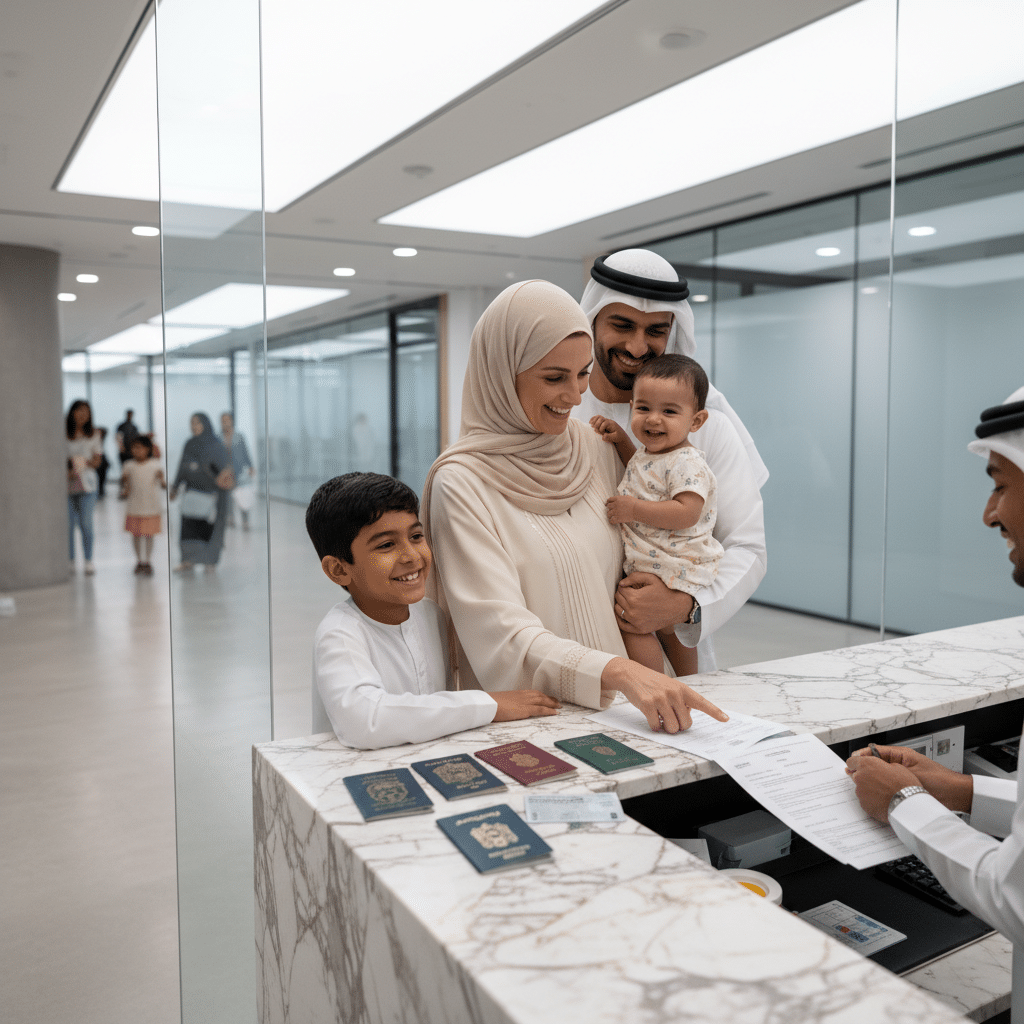
Quick AnswerFamily visa UAE 2026 — sponsor income AED 4,000-6,500, cost AED 2,500-4,500 per dependent, full process, attestations, common rejections explained.
Sponsoring family members for UAE residency is one of the most important administrative decisions a UAE-based founder or employee makes. Get it right and your family lives in UAE on stable visas with consistent access to schooling, healthcare, banking, and government services. Get it wrong and you face delayed applications, surprise documentation gaps, and stress that compounds across months. This guide covers the 2026 rules, real costs, attestation requirements, and the specific traps that catch most sponsors.
Who can sponsor whom in UAE 2026
The UAE federal framework permits sponsorship of immediate family by qualifying residents. The Federal Authority for Identity, Citizenship, Customs & Port Security (icp.gov.ae) publishes the current eligibility rules. Practical categories in 2026:
Spouse sponsorship — male residents have always sponsored wives. As of 2022-2026 reforms, female residents can now sponsor husbands with conditions. Income threshold typically AED 10,000-15,000 monthly depending on emirate, accommodation requirements apply, employer no-objection certificate may be required for some employment categories.
Children sponsorship — both parents (where both reside in UAE) can sponsor biological and legally adopted children. Sons up to age 25 if in full-time education, daughters until marriage, or indefinitely for unmarried daughters and special-needs children. Birth certificate attestation required.
Parents sponsorship — UAE residents earning above the higher threshold (typically AED 20,000+/month) can sponsor parents. Both parents must be sponsored together in most emirates. Deposit/insurance required. Annual renewal with health insurance compliance.
Domestic worker sponsorship — separate visa category with its own rules. Minimum sponsor income, accommodation standards, wage compliance monitoring. Not technically "family visa" but commonly grouped together.
Income thresholds for sponsorship
Income requirements vary by relationship and emirate. Practical 2026 ranges:
For spouse and children:
- Dubai: AED 4,000/month basic + employer-provided accommodation, OR AED 6,500/month all-inclusive
- Abu Dhabi: Similar structure, sometimes AED 5,000-7,000 monthly
- Sharjah and Northern Emirates: typically AED 4,000-6,500 monthly
- Free zone employees: same federal-level rules; specific free zones may have additional requirements
For parents:
- Dubai: AED 20,000+ monthly with suitable accommodation
- Abu Dhabi: AED 20,000+ monthly typically
- Other emirates: AED 15,000-20,000 typically
For domestic workers:
- AED 25,000+ monthly common threshold
- 2-bedroom minimum accommodation
- Health insurance for the worker
- Compliance with domestic worker wage protection rules
Income is verified via salary certificate from employer or audited financials for business owners. Self-employed founders need to demonstrate income via accounting records or bank statements over 6-12 months.
Full cost breakdown per dependent
Realistic 2026 cost for sponsoring one dependent (spouse or child):
| Item | Cost (AED) |
|---|---|
| Entry permit | 1,200 |
| Status change (in-country) or stamping | 750 |
| Medical fitness test | 450 |
| Emirates ID issuance | 270 |
| Visa stamping fee | 460 |
| Typing centre / processing fees | 400-800 |
| Attestation if not pre-done (per document) | 150-400 |
| Express processing (optional) | 500-1,500 |
| Health insurance (mandatory) | 1,500-15,000 annual depending on plan |
| Subtotal government + processing | AED 2,930-4,030 |
| With basic health insurance | AED 4,430-19,030 year 1 |
For 4 dependents (spouse + 3 children): roughly AED 12,000-20,000 in government and processing fees, plus health insurance costs for everyone.
Health insurance is mandatory and frequently underestimated. Family of 4 health insurance plans run AED 8,000-50,000+ depending on coverage tier.
Required documentation for spouse and children
For spouse:
- Passport (6+ months validity)
- Passport-size photos (white background, recent)
- Attested marriage certificate (origin country MFA + UAE embassy + UAE MFA)
- Sponsor's passport copy
- Sponsor's valid Emirates ID and residence visa
- Sponsor's salary certificate (last 3-6 months)
- Tenancy contract / Ejari (sponsor's accommodation)
- Sponsor's labour contract or trade licence
- Bank statements (3-6 months) for income verification
For children:
- Same as above PLUS attested birth certificate (per child)
- Both parents' passports
- If parents divorced/separated: custody documents attested
Attestation chain is the most common source of delay. Attest documents in the home country BEFORE departure if possible — easier and cheaper than chasing attestations from UAE.
The attestation process
Attestation is the multi-step verification that confirms documents are legitimate. Required chain:
- Notary in country of issue — verifies the document
- Ministry of Foreign Affairs in country of issue — adds national stamp
- UAE Embassy in country of issue — adds UAE recognition
- UAE Ministry of Foreign Affairs (MOFAIC) — final UAE attestation
Total time: 4-12 weeks depending on country of origin. Total cost: AED 200-1,000 per document depending on country.
Some countries have specific bilateral arrangements (Apostille recognition) that simplify the process. Common complications:
- US documents need state-level attestation before federal
- Indian and Pakistani documents need state attestation chains
- UK documents have specific UAE embassy process via London
- Filipino documents have DFA channels
Plan attestation 3-4 months before intended UAE family arrival to avoid bottlenecks.
Step-by-step family visa process
Step 1 — Application preparation (Week 1-2)
- Gather and verify all documents
- Confirm attestations are complete and recent
- Verify sponsor income meets threshold
- Confirm accommodation meets requirements (Ejari current)
- Prepare digital copies for online application
Step 2 — Entry permit application (Week 1-2)
- Submit via ICP/GDRFA portal or AMER centre
- Entry permit typically issued 5-10 working days
- Permit valid for 60 days from issuance
- Dependent must travel to UAE within validity
Step 3 — Dependent arrival (Week 2-3)
- Dependent travels to UAE on entry permit
- Documents reviewed at port of entry
- Stamped entry on dependent passport
- 60-day window starts for status conversion
Step 4 — Medical fitness test (Week 2-3)
- Mandatory for all adults age 18+
- Children typically exempt unless specific country origin requires
- Test includes blood, X-ray, sometimes additional based on origin
- Result valid 90 days for visa application
Step 5 — Emirates ID biometrics (Week 3-4)
- Application via ICP
- Biometrics appointment at ICP centre or AMER
- Photo and fingerprint capture
- Emirates ID issued within 2-4 weeks
Step 6 — Visa stamping (Week 3-4)
- Application submitted with medical clearance
- Stamping in dependent passport
- Visa duration matches sponsor's visa duration
Step 7 — Final completion
- Dependent now full UAE resident
- Eligible for banking, government services, school enrolment
- Health insurance must be active
Total realistic timeline: 4-6 weeks from entry permit issuance to full residence.
Common rejections and how to avoid them
Rejection: Income proof insufficient. Sponsor's salary certificate must show consistent income for 3+ months above the threshold. Variable income or recent salary jumps may trigger additional verification.
Fix: Pre-verify income meets threshold. Use audited financials for self-employed founders.
Rejection: Accommodation inadequate. Tenancy contract must show suitable accommodation — a 1-bedroom apartment may not be approved for sponsoring a family of 5.
Fix: Match accommodation to family size before applying. Update Ejari if you've moved.
Rejection: Attestation incomplete or expired. Marriage/birth certificates with missing attestation steps or attestations older than 5 years may be rejected.
Fix: Verify full attestation chain. Re-attest if older than 3-5 years.
Rejection: Sponsor's own visa expired or near expiry. If sponsor's visa expires within 30 days, dependent applications may be paused.
Fix: Renew sponsor's visa first, then apply for dependents.
Rejection: Mismatched names on documents. Passport spelling vs marriage certificate vs birth certificate must match. Different transliterations of Arabic names cause this often.
Fix: Standardise English spelling across all documents before applying. Get name affidavits if necessary.
Rejection: Missing employer NOC for female sponsors. Some employers require NOC for staff to sponsor family.
Fix: Obtain NOC in writing before applying.
Rejection: Children over age limits. Sons over 25 (with exceptions for full-time education) and married daughters not eligible.
Fix: Plan adult children's separate visa paths — Job Exploration, employment, Golden Visa.
Dependent visa for special cases
Newborn babies — must be registered for birth certificate, attested, and visa applied for within 120 days of birth to avoid penalties. Process is straightforward for newborns to sponsor parents already on residence.
Adopted children — require valid adoption documentation attested. Some countries' adoption documents face additional scrutiny.
Step-children — may require additional documentation showing custody and biological parent relationship.
Disabled children over 18 — can be continued as dependents with medical documentation showing inability to be self-supporting.
Children of single parents — can be sponsored by one parent with appropriate custody documentation.
Health insurance — the often-forgotten compliance
UAE requires health insurance for all residents including dependents. Practical implications:
- Dubai: DHA-compliant plan mandatory
- Abu Dhabi: HAAD-compliant plan mandatory
- Sharjah/Northern Emirates: federal compliance level
- Plans vary in coverage and price dramatically
Family plans typically more cost-effective than individual plans. Coverage levels:
- Basic plan (Essential Benefits Plan in Dubai): AED 800-1,500 per person annually
- Standard family plan: AED 5,000-15,000 annually for family of 4
- Premium family plan: AED 25,000-60,000+ annually
Health insurance is mandatory. Plans must be active before visa stamping or shortly after. Lapsed insurance triggers visa complications.
What changes for free zone vs mainland sponsors
The federal family visa rules apply uniformly regardless of whether the sponsor's own visa is via free zone or mainland. Practical differences:
- Free zone sponsors: apply through the free zone's typing centre or direct ICP channels
- Mainland sponsors: apply through AMER centres (Dubai), TAS HEEL (other emirates), or direct ICP
- DIFC and ADGM sponsors: apply through their respective authority systems
The federal-level rules are identical. The local processing portals differ.
What changes for foreign vs UAE-citizen sponsors
UAE citizens have additional rights:
- Generally lower income thresholds
- Wider categories of relatives sponsorable
- Faster processing in some cases
- Some additional benefits (housing allocation, etc.)
For foreign residents (the vast majority of family visa cases), federal rules apply as described. No discrimination by nationality in application processing.
Renewal and ongoing compliance
Dependent visas renew with the sponsor's visa cycle:
- 2-year residence: renew every 2 years
- 5-year Green Visa: renew every 5 years
- 10-year Golden Visa: renew every 10 years
Renewal requires:
- Current income still meets threshold
- Accommodation still suitable
- Health insurance still active
- All Emirates IDs still valid
- No outstanding compliance issues
Plan renewal 30-60 days before expiry. Late renewal triggers fines and potential visa lapse.
Cancellation of dependent visa
When a dependent leaves UAE permanently or relationship changes:
- Visa must be cancelled within 30 days of departure
- Process via ICP or AMER centre
- Surrender Emirates ID
- Cancellation paper required for clean record
Common scenarios:
- Child reaches age limit (university transition)
- Spouse separates (divorce or separation)
- Dependent returns home country permanently
- Sponsor cancels for other reasons
Failure to cancel triggers overstay fines and complications for future sponsorship.
Common Mistakes founders make with family visa applications
Mistake 1: Skipping attestation. Trying to apply with unattested documents causes immediate rejection. Always pre-attest in country of origin before UAE arrival.
Mistake 2: Wrong accommodation size. A 1-bedroom for sponsoring family of 5 will be rejected. Match accommodation to family size before applying.
Mistake 3: Wrong health insurance plan. Basic plans may not meet specific category coverage requirements. Verify your plan meets the dependent's category needs.
Mistake 4: Late renewal. Sponsor's own visa expiring before renewal can cascade dependent visa lapses. Sponsor renewal must complete before dependent renewals.
Mistake 5: Wrong income documentation for self-employed. Audited financials needed, not just bank statements. Talk to accountant for proper documentation 2-3 months before application.
Mistake 6: Underestimating timeline. Family visa applications take 4-6 weeks minimum. School enrolment and other downstream activities require this lead time.
Mistake 7: Not budgeting health insurance. Insurance is often largest year-1 cost. Plan and budget realistically.
Mistake 8: Skipping the labour contract update. Some employers require formal acknowledgement of dependent sponsorship in employment record.
Golden Visa and longer-term family stability
Golden Visa holders (10-year residence) can sponsor dependents for the same 10-year duration. This is dramatically more stable than 2-year cycle:
- Children's schools see uninterrupted enrolment
- Spouse can pursue longer-term career or business commitments
- Banking relationships develop over the full 10 years
- Aging parents can be sponsored with extended stability
If your situation allows Golden Visa eligibility (property AED 2M+, business investment AED 2M+, specialised salary/skills), the family stability benefit alone often justifies the additional investment.
Family visa for entrepreneur and investor sponsors
Self-employed founders and entrepreneurs face slightly different income verification:
- Audited financials for the business
- Personal bank statements showing consistent draws
- Sometimes additional verification through Emirates ID and trade licence chain
For founders earning above thresholds but with variable monthly income, prepare 6-12 months of consistent records before applying. Plan attestation and documentation simultaneously with business setup.
The school year consideration
For families moving to UAE with school-aged children, the school year timing is a major consideration that intersects with family visa planning. UAE schools generally follow either the September to June academic calendar (American, British, and most international curricula) or the April to March calendar (Indian and some other curricula). School admissions are competitive in popular schools, and applications often need to be submitted six to nine months in advance of the desired start date. This means the family visa application timeline needs to integrate with school application timelines that extend well beyond just the visa process itself.
Practical sequencing typically looks like this. Decide on intended start date in UAE. Identify target schools and their application deadlines, which are often six to nine months before the term start. Submit school applications, which require dependents' attested birth certificates and proof of parents' residency or pending residency. Begin family visa application process two to three months before intended arrival. Coordinate so that dependent residence visa is active before school term begins to enable smooth enrolment.
The schools themselves can sometimes accept conditional enrolment subject to visa completion, which provides flexibility for families whose visa processing extends slightly beyond ideal timeline. However, the school then expects visa completion within a defined window after term begins. Plan to have all visas active before school term starts to avoid additional pressure on the family.
International school fees in UAE are substantial, with annual fees ranging from twenty-five thousand dirhams for budget options up to one hundred twenty thousand dirhams for premium schools. These fees are a significant component of family budget planning beyond the visa application costs themselves. School choice also affects accommodation decisions, since some families prioritise proximity to school over other location factors.
The accommodation decision
Family visa sponsorship requires appropriate accommodation, but "appropriate" varies by family size and emirate. As a working rule, the accommodation should reasonably house the sponsored dependents alongside the sponsor. A studio apartment is unlikely to be approved for sponsoring a family of five, regardless of whether everyone fits physically. The Ejari and tenancy contract are reviewed during visa processing.
Accommodation costs in UAE are a major family expense layer. A two-bedroom apartment in mid-tier Dubai areas runs between sixty thousand and one hundred twenty thousand dirhams annually depending on location and building quality. Three-bedroom family-friendly apartments in popular family areas like Mirdif, JVT, Discovery Gardens, or Springs run eighty thousand to one hundred eighty thousand dirhams. Townhouses and villas in family communities can exceed two hundred thousand dirhams annually for premium options.
For families budgeting visa setup alongside accommodation upgrades, the combined cost is substantial. A family of four moving to UAE might spend twenty thousand dirhams on visa government and processing fees, ten to thirty thousand on health insurance, eighty to one hundred fifty thousand on annual accommodation, twenty to one hundred thousand on school fees per child, plus the practical costs of relocation including shipping, furniture, vehicle, and initial setup. The visa cost is often the smallest line item in the total family relocation budget.
Family stability through Golden Visa
For families looking to establish long-term UAE roots, the Golden Visa pathway provides ten-year residence with corresponding ten-year dependent visa duration. This dramatically improves family stability compared to two-year cycles where renewals create ongoing administrative work and small risk of cycle disruption.
The pathways to Golden Visa for family-stability purposes include real estate investment of two million dirhams or more, business investment of two million dirhams or more with substance, specialist talent categories with appropriate qualifications, and entrepreneur recognition for proven business achievements. For families with the capital, the Golden Visa investment route is often the most direct path. For high-skilled professionals earning above thresholds, the specialty route provides ten-year stability without major investment.
Children sponsored on Golden Visa receive the same ten-year duration as the sponsor parent. This allows uninterrupted schooling through major academic transitions like primary to secondary, secondary to university, without visa-driven complications. Some families specifically pursue Golden Visa to provide this multi-year educational stability for children.
Spouses on Golden Visa dependent status receive the same duration. This enables longer-term career planning, business commitments, and educational pursuits that two-year cycles can complicate. For households where both adults pursue independent careers or businesses, Golden Visa stability across both partners simplifies long-term planning substantially.
Long-term family planning intersections
Family visa decisions intersect with broader long-term planning around education, healthcare, financial planning, and retirement. Smart founders think about these intersections rather than treating each as isolated.
Healthcare planning means choosing insurance that covers what your family actually uses, considering both UAE-based care and international coverage if family members travel home regularly. Premium plans cost more but reduce out-of-pocket exposure for major events. Basic plans satisfy compliance but can leave gaps for serious conditions.
Education planning means thinking about curriculum continuity if you might relocate again, university pathways the children might pursue, and the schools' track records placing students in target universities. Choices made at primary school can affect secondary and tertiary education paths significantly.
Financial planning means thinking about emergency funds, savings vehicles, currency exposure, and family financial security in case of sponsor's job change or business setback. Family on dependent visas can experience disruption if sponsor's situation changes abruptly.
Retirement planning, even for younger founders, intersects with family visa stability. If you plan to settle in UAE long-term, the Golden Visa pathway protects family stability. If UAE is a phase before relocation elsewhere, planning the exit timing for family members affects schooling and other transitions.
Specific scenarios we navigate weekly
We work with family visa scenarios across diverse founder profiles. A British founder relocating his family of four from London faces the question of school choice, accommodation in family-friendly areas, attestation of UK documents through the appropriate channels, and timing the move around school term transitions. We typically guide through three to four months of preparation before actual relocation.
An Indian entrepreneur sponsoring his wife and two children faces different documentation chains, schools targeting Indian curriculum, and often coordination with parents who may want to visit on extended visit visas. The process is straightforward but requires careful sequencing.
A female founder sponsoring her husband and children faces the female-sponsorship rules that became more accessible after 2022 reforms but still require careful income documentation, employer NOC where applicable, and accommodation that meets family-size requirements.
A senior executive sponsoring his parents alongside his immediate family faces the higher income threshold for parental sponsorship, deposit requirements, and ongoing health insurance for elderly parents who may have pre-existing conditions affecting premium costs significantly.
Each scenario has standard elements but specific requirements that benefit from experienced guidance through the multi-step process. The framework is consistent; the details vary by family configuration.
What to do next
If you're planning to sponsor family visa applications in UAE 2026, the next step is documenting your income proof and verifying attestation status of all dependent documents. The administrative complexity comes from the attestation chain and income verification — both fixable with planning. We help founders structure their personal income documentation, navigate the attestation chains for various countries, and sequence applications around school year transitions and accommodation moves. A 20-minute call clarifies your eligibility, the right timeline, and the cost-effective way to bring family to UAE on a stable visa structure.
The pattern across successful family visa applications is preparation rather than rushing. Founders who treat the application as a 3-month project with proper sequencing — attestations completed months in advance, accommodation aligned, health insurance researched — face dramatically smoother processing than founders who try to handle attestations and applications simultaneously under time pressure. The administrative work is real but well-defined. Match the work to the time it actually needs and the family visa becomes a routine setup task rather than a stressful obstacle.
Talk to Our Experts
family visa UAE sponsorship
Frequently Asked Questions
What is the minimum salary to sponsor a family visa in UAE 2026?
Minimum salary to sponsor family visa in UAE 2026 is AED 4,000/month basic salary plus accommodation, OR AED 6,500/month all-inclusive if accommodation is not provided. Income thresholds for sponsoring parents are higher at AED 20,000+/month typically. Specific thresholds vary by emirate and dependent type.
How much does a family visa cost in UAE 2026?
Total family visa cost in UAE 2026 ranges AED 2,500-4,500 per dependent. Government fees roughly AED 1,500-2,500 per visa, plus medical AED 400-700, Emirates ID AED 200-370, and processing/typing service fees AED 300-800. Spouse and children dependent visas follow this range; parents and domestic worker visas have additional requirements.
Can a female resident sponsor her husband in UAE 2026?
Yes. As of 2026, female residents can sponsor husbands and children for family visa with conditions: minimum monthly income (typically AED 10,000-15,000 depending on emirate), appropriate accommodation, and employer NOC where applicable. This removed an old restriction that previously required ministerial exemption.
How long does a family visa take to process in UAE 2026?
Family visa processing in UAE 2026 takes 3-6 weeks end-to-end. Entry permit issuance 1-2 weeks. Status change or stamping after dependent arrival 1-2 weeks. Medical fitness and Emirates ID biometrics 1 week parallel. Total typically 4-6 weeks if documentation is complete and attested correctly.
What documents are required for a family visa in UAE 2026?
Required documents: sponsor’s passport and valid UAE residence visa, sponsor’s salary certificate (last 3-6 months), tenancy contract (Ejari), attested marriage certificate for spouse, attested birth certificates for children, dependents’ passports, dependents’ photos, medical fitness certificates (after arrival), and Emirates ID applications.
Can I sponsor my parents on a family visa in UAE 2026?
Yes, but parental sponsorship has higher requirements: typically AED 20,000+/month income, deposit or insurance for the visa (refundable upon visa cancellation), suitable accommodation, and full health insurance coverage. Some emirates require both parents to be sponsored together, not individually.
Does a family visa allow my spouse to work in UAE?
A dependent visa does not automatically grant work rights. To work, your spouse needs a separate work permit issued by an employer or via their own business setup. The dependent visa allows residence but not employment income. Many spouses obtain separate employment visas after arriving on dependent status.
What happens to a family visa if the sponsor’s visa is cancelled?
Dependent visas are tied to the sponsor’s visa. When sponsor visa is cancelled, dependents receive a grace period (typically 30 days, sometimes 60-90 days based on circumstance) to either transfer to a new sponsor or exit UAE. Planning sponsor visa renewals before they lapse is critical for family stability.
Related Noble Core deep-dives
Latest 2026 Noble Core deep-dives
Latest 2026 Noble Core guides
See also our guide to dubai golden visa.
See also our guide to dubai manager visa.
For details, see our guide to 1-year maid visa Dubai cost.
Related: see our guide to ICA Smart Services portal.
Related: family visa vs golden visa.
Related: minimum salary to sponsor family.
Related: family visa cost in Dubai.
Related Guides
Two costs sponsors often miss.
- ILOE quick pay — the mandatory insurance behind every work permit
- freelance visa Dubai — self-sponsorship as the route to family sponsorship