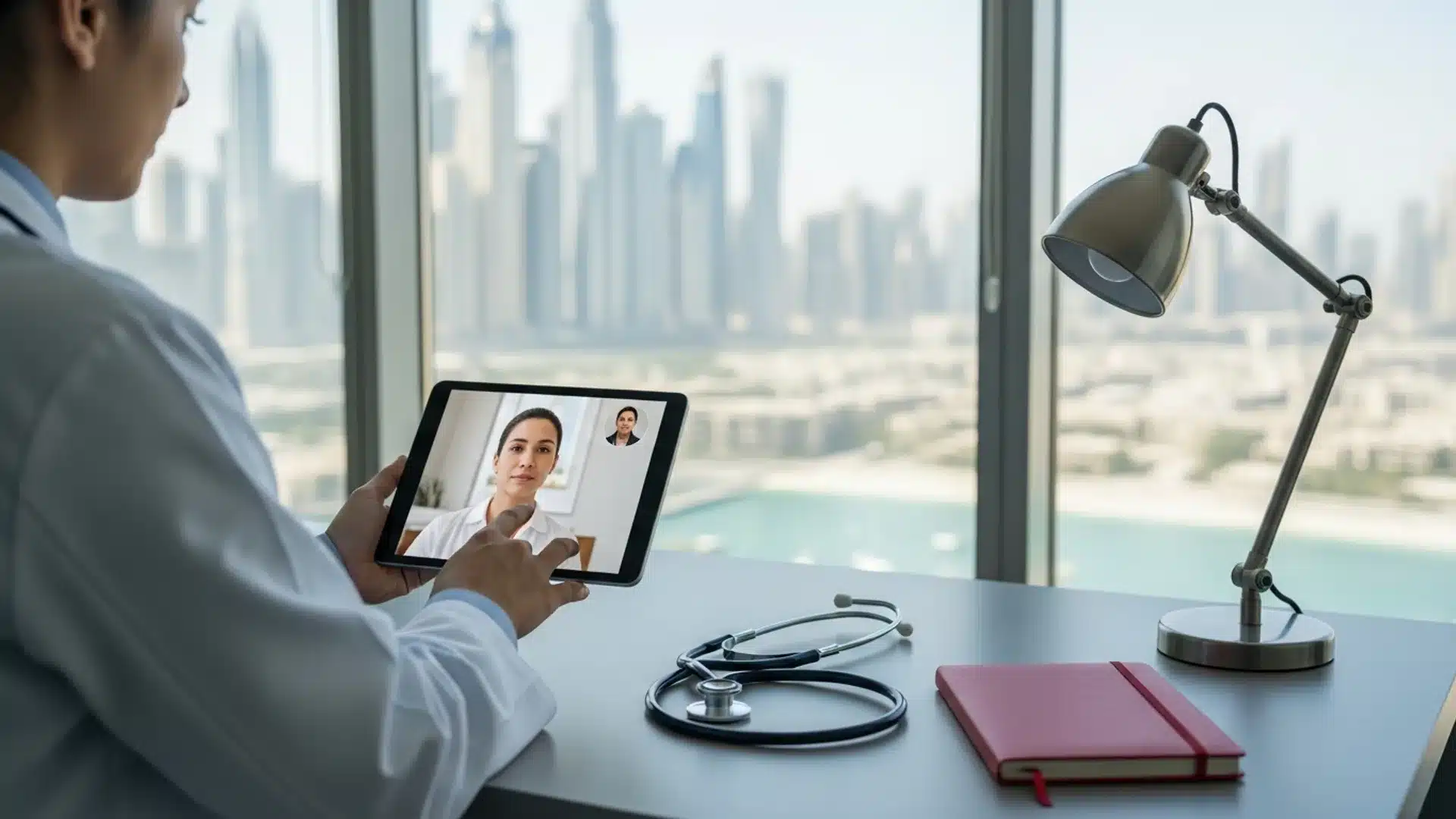
Quick AnswerTelemedicine license Dubai 2026: DHA rules, costs from AED 12,500, licensed doctor requirements, DHCC vs mainland, timelines & tax explained.
Launching a telemedicine or HealthTech venture in Dubai in 2026 can cost as little as from AED 12,500 for a pure software or IT licence, or run into tens of thousands of dirhams once you add a clinical DHA-licensed telehealth facility. Getting a telemedicine license dubai businesses can actually operate under starts with one decisive question: are you building health software, or are you delivering medical care? The answer changes your regulator, your costs and your timeline completely.
This guide walks you through both paths. We cover what HealthTech and telemedicine cover, the crucial split between a commercial software licence and a clinical Dubai Health Authority (DHA) facility licence, where to set up, how doctors get licensed, the real cost ranges, data protection duties, visas, corporate tax and the mistakes that trip founders up. No medical advice here, only clear licensing guidance so you launch on the right footing.
Your setup cost, in 10 seconds
Package prices. Health insurance is required by law and not included.
Thank you.
Your written quote follows on WhatsApp.
How Do You Get a Telemedicine License in Dubai?
To get a telemedicine licence in Dubai, first decide whether you deliver clinical care or only software. Pure HealthTech software takes a commercial or IT licence from around AED 12,500 to 30,000 in a free zone. Delivering consultations requires a DHA-licensed health facility plus DHA-licensed practitioners, costing tens of thousands of dirhams and taking two to four months to complete.
The distinction above is the single most important thing to understand before you spend a dirham. Dubai treats a company that merely builds a booking app or a symptom-checker very differently from a company that connects patients to a doctor for a diagnosis. The first is a technology business. The second is a healthcare provider, and healthcare provision is a regulated clinical activity in the UAE.
If you are a software company, your route is straightforward. You choose a free zone or a mainland licence through the Department of Economy and Tourism (DET), pick technology or IT activities, and you are trading within weeks. You do not need any health-authority approval to write code, host a platform or sell a subscription, provided your company never itself delivers the clinical consultation.
If you are a healthcare provider, your route runs through the DHA. You need premises that pass inspection, a medical director, appropriately licensed clinical staff, malpractice insurance and telehealth permission attached to your facility licence. This is a bigger commitment, but it is the only lawful way to deliver diagnoses, prescriptions and treatment remotely to patients in Dubai.
Many successful ventures do both. They incorporate a lean software company that owns the intellectual property and the platform, then either partner with a DHA-licensed clinic or stand up a separate licensed facility for the clinical layer. Structuring these two entities correctly from day one saves enormous rework later.
| Licence path | Typical starting cost (AED) | Regulator | Indicative timeline |
|---|---|---|---|
| HealthTech software / IT (free zone) | from 12,500 – 30,000+ | Free zone authority / DET | 1 – 3 weeks |
| Mainland commercial/IT (DET) | from 15,000 – 30,000+ | DET | 1 – 3 weeks |
| DHA-licensed telehealth facility | tens of thousands and up | DHA | 2 – 4 months |
| Dubai Healthcare City clinical entity | tens of thousands and up | DHCC / DHCA | 2 – 4 months |
| Per residence visa | ~3,000 – 6,000 each | GDRFA / free zone | 1 – 2 weeks |
Figures are realistic indicative ranges for planning. Software and IT packages vary by free zone, visa quota and office option. Clinical DHA facility costs depend heavily on premises, scope of services, number of licensed staff and insurance, so treat them as substantial rather than fixed. Always confirm current fees directly with the relevant authority before you budget.
What Does HealthTech and Telemedicine Actually Cover?
HealthTech is a broad umbrella, and Dubai's licensing treatment depends entirely on where your product sits on the spectrum from software to clinical care. Understanding the categories helps you pick the correct activities on your licence.
Teleconsultation platforms connect patients with doctors over video, audio or chat. If your company employs or contracts the doctors and the consultation happens under your brand, you are delivering clinical care and need DHA licensing. If you are simply the marketplace connecting an independent, already-licensed clinic to patients, the analysis is more nuanced and worth legal review.
Remote patient monitoring uses connected devices to track vital signs, glucose, heart rhythm or post-operative recovery. The hardware and dashboard are technology. The clinical interpretation of that data and any resulting medical decision is regulated care.
E-pharmacy and medication delivery platforms sit close to regulated territory. Dispensing medicines, particularly prescription medicines, involves pharmacy licensing and controlled-substance rules that go beyond a simple e-commerce permit. Never assume an online pharmacy is just retail.
Health and wellness apps that offer fitness tracking, appointment booking, symptom logging or general wellbeing content are usually pure software. The line is crossed when an app starts giving individualised medical diagnoses or treatment recommendations rather than general information.
AI diagnostic support tools that help clinicians interpret images or triage cases are a fast-growing category. As software supplied to licensed providers, they are typically a technology product. When such a tool is offered directly to patients as a diagnosis, regulatory scrutiny rises sharply. The safe design keeps AI as decision support for a licensed human, not a replacement for one.
Software Licence vs Clinical Telemedicine Licence: The Crucial Distinction
This section deserves its own space because getting it wrong is expensive. The UAE, like most mature jurisdictions, separates the business of technology from the practice of medicine.
A pure HealthTech software business builds and sells a product. It might be a SaaS platform licensed to hospitals, a white-label teleconsultation engine, a scheduling system or a monitoring dashboard. Because the company never itself examines, diagnoses or treats a patient, it does not need a DHA facility licence. A commercial, IT or software licence from a free zone or from DET on the mainland is sufficient. This is the cheaper, faster, more flexible path, and it is where most founders should start if their core asset is code.
The moment your company delivers clinical services, everything changes. Delivering clinical services means your entity is the one providing the medical consultation, the diagnosis, the prescription or the treatment to the patient. At that point you are a healthcare provider and the DHA requires a health facility licence with explicit telehealth permission, plus every treating clinician must hold an individual DHA professional licence. There is no shortcut around this and no software wrapper that exempts you.
A practical example makes it concrete. Imagine you build a beautifully designed app that lets patients book a video call and speak to a doctor. If those doctors are your contractors, consulting under your brand, you are a provider and need DHA licensing. If instead your app merely sends the patient to an independent DHA-licensed clinic that runs the consultation on its own licence and takes clinical responsibility, your role looks more like technology and referral. The commercial substance, not the marketing, determines the licence you need.
Because of this split, the smartest structures often use two entities. A technology company owns the platform, the brand and the IP, sitting in a cost-effective tech free zone. A separate licensed clinical entity, or a partnership with an existing DHA-licensed provider, handles the actual care. This keeps your software business lean and investable while ensuring the clinical layer is fully compliant. Noble Core designs exactly these structures for founders every week.
How DHA Regulates Telemedicine and Teleconsultation
The Dubai Health Authority is the health regulator for the Emirate of Dubai's mainland, and it has issued standards governing how telehealth and teleconsultation may be delivered. You can review the authority directly at the official Dubai Health Authority portal.
Under DHA rules, telemedicine is not a licence category that floats free of a physical facility. Instead, teleconsultation is a permitted mode of delivering care that must be attached to a licensed health facility and provided by DHA-licensed practitioners. In other words, a real, inspected, licensed entity stands behind every virtual consultation, and a named, credentialed doctor is accountable for it.
DHA standards address matters such as patient identity verification, informed consent for remote care, secure and confidential communication channels, appropriate clinical documentation, safe prescribing, continuity of care and clear protocols for escalating to in-person care when a remote consultation is not clinically adequate. The goal is that a patient receives the same standard of care and protection online as they would in a clinic.
Practically, this means a compliant telemedicine service in Dubai has a licensed facility, telehealth permission on that facility's licence, licensed doctors, proper medical records, malpractice cover and data-protection safeguards. If a vendor promises you can skip these because it is all online, treat that as a red flag rather than a shortcut.
Beyond Dubai's mainland, other regulators apply. The Ministry of Health and Prevention (MOHAP) licenses providers federally in the northern emirates, and the Abu Dhabi Department of Health (DoH) regulates the capital. If you intend to serve patients across the UAE, you may need to satisfy more than one regulator, which is another reason to plan your jurisdiction carefully.
Where Should You License: Mainland DHA, Dubai Healthcare City or a Tech Free Zone?
Choosing where to set up is a strategic decision, not just an administrative one. Each option carries different regulators, costs and freedoms.
Mainland Dubai, under DET for the commercial licence and DHA for the clinical licence, gives you the widest ability to serve patients and contract with the public and private sector across the emirate. Many mainland activities now allow full foreign ownership, so a local partner is often unnecessary. This is a natural home for a provider that wants to operate broadly in Dubai's healthcare market.
Dubai Healthcare City (DHCC) is a dedicated healthcare free zone with its own regulator, the Dubai Healthcare City Authority (DHCA). It is purpose-built for medical and healthcare businesses, offering 100% foreign ownership and a community of clinical operators. If your core business is clinical and you value being inside a healthcare-focused ecosystem, DHCC is worth serious consideration. Its regulator handles both facility and professional licensing within the free zone.
A technology free zone is ideal for the software layer. Tech-oriented free zones offer 100% foreign ownership, competitive packages, straightforward visa options and strong intellectual-property positioning for a SaaS or app business. Crucially, a tech free zone is the right home for a company that only builds software and never itself delivers clinical care. It is not, on its own, a base from which to provide medical consultations to patients.
For a combined venture, the elegant answer is often both: the software entity in a tech free zone, and the clinical entity on the mainland under DHA or inside DHCC. This lets each part of your business sit under the regime designed for it, rather than forcing one licence to do a job it was never meant to do.
Professional Licensing for Doctors: Sheryan, DataFlow and Exams
A telemedicine service is only as compliant as the doctors behind it, and in Dubai every treating clinician needs an individual DHA professional licence. This is separate from your company's facility licence and cannot be skipped.
The process runs through the DHA's Sheryan licensing platform. A doctor creates a profile, submits qualifications and undergoes primary-source verification of their credentials via DataFlow, which independently confirms that degrees, experience certificates and good-standing letters are genuine by contacting the issuing institutions. This verification protects patients and is a core part of the UAE's quality regime.
Depending on the practitioner's specialty, seniority and country of qualification, an eligibility assessment or examination may be required to confirm competence to practise in Dubai. Some highly experienced specialists may qualify for exemptions, while others sit an assessment. Requirements are individual, so each doctor's pathway should be checked on their own facts.
For a founder, the takeaway is planning. Practitioner licensing takes time and depends on the individual doctor's documents, so start it early and in parallel with your facility application. A common cause of delay is leaving clinician licensing until the premises are ready, only to find the doctors are still weeks away from being cleared to consult. Budget realistically for DataFlow, licensing fees and any assessment costs per doctor.
Facility Requirements for a Telehealth Provider
Even a service delivered entirely by video needs a proper, licensed facility behind it under DHA rules. The facility is the accountable clinical entity, and it must meet standards before it can operate.
Requirements typically include suitable premises that pass DHA inspection, a qualified and licensed medical director who carries clinical governance responsibility, appropriately licensed clinical and support staff, valid professional malpractice insurance, and systems for secure medical records and patient communication. The exact scope depends on the services you intend to offer, and a purely virtual model may have different physical needs from a mixed clinic, but the principle of a licensed, inspected, accountable facility holds throughout.
You also need internal policies and protocols: consent procedures for remote care, identity verification, safeguarding, prescribing controls, data protection and clear escalation pathways to in-person care. DHA wants to see that a virtual service can still keep a patient safe, including knowing when a case must move offline. Building these documents properly is part of the licensing work, not an afterthought, and it is where experienced consultants add real value.
Step-by-Step: Setting Up Your Telemedicine or HealthTech Business
Every venture is different, but a typical route looks like this. Treat it as a map, then adapt it with professional guidance to your specific model.
First, define your model precisely. Decide whether you are software only, a clinical provider, or a combined structure. This single decision drives everything that follows, so invest time in getting it right rather than rushing to incorporate.
Second, choose your jurisdiction and activities. Match a tech free zone, DHCC or mainland DET and DHA to your model, and select the exact business activities your licence will list. Wrong activities cause rejections and rework.
Third, incorporate the software entity. Reserve a trade name, submit incorporation documents, obtain the commercial or IT licence and your establishment card. For a pure software business this is close to the finish line.
Fourth, if you are delivering care, begin the DHA facility application in parallel. Secure compliant premises, appoint a medical director, prepare your policies and protocols, arrange malpractice insurance and apply for the health facility licence with telehealth permission.
Fifth, license your practitioners. Have each doctor complete Sheryan registration, DataFlow verification and any required assessment. Start this early because it is often the longest single item on the timeline.
Sixth, handle immigration. Apply for establishment cards, then residence visas for owners and staff, including Emirates ID and medical fitness steps. Budget roughly AED 3,000 to 6,000 per visa.
Seventh, set up operations and compliance. Open a corporate bank account, register for corporate tax with the Federal Tax Authority, arrange VAT registration if applicable, and put your data-protection and clinical-governance systems live before you see a single patient.
Telemedicine Licence Cost Breakdown
Costs vary widely by model, so plan against ranges rather than a single number. The table earlier in this guide summarises the headline figures; here is the reasoning behind them.
A software or IT licence in a free zone commonly starts from around AED 12,500 to 30,000 or more, depending on the free zone, the number of visas and whether you take a flexi-desk or a physical office. This covers the licence, registration and basic setup, and it is the most predictable cost in the whole exercise.
A mainland commercial or IT licence via DET sits in a similar broad range, with the exact figure driven by activities, office requirements and approvals. Mainland can be attractive when you want the widest reach across Dubai's market.
A DHA-licensed telehealth facility costs significantly more and is genuinely variable. Once you factor in compliant premises, DHA facility fees, a medical director's salary, individual practitioner licences, DataFlow verification, malpractice insurance and clinical systems, you are realistically looking at tens of thousands of dirhams and up. Because so much depends on your scope and staffing, resist any promise of a single fixed clinical figure and build a proper budget with an advisor instead.
Then add the recurring and per-head items. Each residence visa runs roughly AED 3,000 to 6,000. Office rent, if you take physical space, is a separate ongoing cost. Insurance, accounting, corporate-tax compliance and software hosting are annual operating expenses. A clear-eyed budget covers year one setup and year one running costs together.
Data Protection and Health Data Confidentiality
Health data is among the most sensitive personal information there is, and telemedicine businesses handle it constantly. The UAE's Federal Decree-Law on personal data protection, commonly called the PDPL, sets the baseline framework for how personal data must be collected, stored, processed and shared, with a strong emphasis on consent, purpose limitation and security.
For a telemedicine or HealthTech business, this means designing privacy in from the start. You need lawful bases for processing, clear patient consent, secure and encrypted storage, strict access controls, retention policies and a plan for responding to any data breach. Health information demands the highest standard of confidentiality, and DHA's clinical standards reinforce this with their own requirements for secure communication and record-keeping.
Free zones such as DHCC may layer their own data-protection expectations on top, and cross-border data transfers, for example hosting patient data outside the UAE, require particular care. Building compliant data handling is not just a legal box to tick; it is central to patient trust and to being taken seriously by hospital partners and investors. Get specialist advice on your data architecture before you launch.
Visas and the Golden Visa for Medical Professionals
Setting up a company gives you the right to sponsor residence visas for owners, employees and, subject to rules, dependants. For a HealthTech founder this means you and your team can live in the UAE and your doctors can be sponsored under the clinical entity. Standard residence visas involve an establishment card, entry permit, medical fitness test, Emirates ID and visa stamping, costing roughly AED 3,000 to 6,000 each and taking one to two weeks per person once documents are ready.
The UAE also offers the Golden Visa, a long-term residence of five or ten years, with dedicated categories for doctors and medical specialists who meet defined criteria around qualification, specialty and standing. For a telemedicine venture that depends on attracting and retaining senior clinical talent, Golden Visa eligibility is a genuine recruitment advantage, giving key doctors stability and independence from year-to-year renewals. Eligibility is assessed case by case, so have candidates checked against the current criteria rather than assuming.
Corporate Tax and Financial Compliance
The UAE introduced federal corporate tax, and telemedicine and HealthTech businesses are within its scope. The rate is 9% on taxable profit above AED 375,000, with profit below that threshold effectively taxed at 0%. There is no personal income tax in the UAE, so salaries and dividends to individuals are not taxed at the personal level, which remains a major attraction of the jurisdiction.
Every taxable business must register with the Federal Tax Authority (FTA), and you can find the official rules and registration at the Federal Tax Authority portal. Registration, proper bookkeeping and timely filing are compliance obligations, not optional extras, and the FTA expects accurate records. Some free-zone businesses may access specific corporate-tax treatment where strict qualifying conditions are met, but this is technical and fact-specific, so take professional advice rather than assuming a blanket exemption.
Separately, VAT may apply to your revenues depending on the nature of your supplies, as some healthcare services carry particular VAT treatment. A good accountant will map your corporate-tax and VAT positions together so there are no surprises in your first filing. Building this financial compliance in from day one is far cheaper than fixing it retrospectively.
Common Mistakes When Applying for a Telemedicine Licence
Founders lose time and money on a predictable set of errors. Avoid these and your setup will be far smoother.
- Assuming a software licence lets you deliver clinical care. The moment you provide consultations, DHA facility and practitioner licensing apply, and no app wrapper exempts you.
- Leaving doctor licensing until the end. Sheryan registration, DataFlow verification and any assessment take weeks, so start them in parallel with the facility application, not after it.
- Picking the wrong jurisdiction. Basing a clinical service purely in a tech free zone, or trying to run software through a costly clinical licence, forces the wrong regime onto your business.
- Choosing incorrect activities on the licence. Vague or mismatched activities cause rejections and later amendments; list exactly what you do.
- Neglecting data protection. Weak consent, insecure storage or careless cross-border transfers breach the PDPL and destroy patient and partner trust.
- Underbudgeting the clinical layer. Treating a DHA facility as if it costs the same as a software licence leads to nasty surprises around premises, staff and insurance.
- Forgetting tax registration. Failing to register with the FTA or ignoring the 9% corporate tax and possible VAT creates avoidable compliance risk.
- Believing marketing over substance. Regulators look at what your business actually does, not how you describe it, so structure honestly from the outset.
Launch Your Telemedicine or HealthTech Business with Noble Core
Telemedicine and HealthTech setup in Dubai rewards founders who get the structure right early. The difference between a lean software licence and a fully regulated clinical facility is the difference between weeks and months, and between a modest budget and a substantial one. Choosing the correct path, and separating your software layer from your clinical layer, is the highest-value decision you will make.
Noble Core Ventures helps HealthTech founders navigate exactly this. We assess your model, recommend whether you need a technology licence, a DHA clinical facility, or a combined structure, and then handle incorporation, activity selection, DHA and DHCC coordination, doctor licensing support, visas and tax registration end to end.
To go deeper, explore our complete business setup in Dubai pillar guide for the full landscape. If your venture is primarily clinical, our DHA licence Dubai guide explains health-facility licensing in detail. If you are building the platform itself, read our software company Dubai guide, and for the broader technology setup, see our IT company setup Dubai resource.
Ready to move? Book a free 20-minute consultation with Noble Core and we will map your telemedicine or HealthTech licence, costs and timeline in plain language, so you launch on solid regulatory ground from day one.
Talk to Our Experts
Noble Core structures the right telemedicine or HealthTech licence for you, separating your software layer from clinical DHA facility requirements and handling doctor licensing. Free 20-minute consultation.
Frequently Asked Questions
Do I need a DHA licence to run a telemedicine app in Dubai?
Only if your platform delivers clinical care. A pure software product needs a commercial or IT licence. The moment licensed consultations happen through you, DHA facility and practitioner licensing apply.
How much does a telemedicine licence cost in Dubai?
A software or IT free-zone package starts from around AED 12,500 to 30,000. A full DHA-licensed telehealth facility costs significantly more, running into tens of thousands of dirhams once premises, staff and fees are included.
Can I own 100% of my HealthTech company in Dubai?
Yes. Free zones allow 100% foreign ownership, and most mainland activities via DET now also permit full foreign ownership, so you rarely need a local partner for HealthTech ventures.
Who regulates telemedicine in Dubai?
The Dubai Health Authority (DHA) regulates telemedicine on the mainland. Dubai Healthcare City has its own regulator (DHCC), while MOHAP covers northern emirates and DoH covers Abu Dhabi.
Do doctors need a separate DHA licence for teleconsultations?
Yes. Every practitioner delivering telemedicine must hold a valid DHA professional licence obtained through the Sheryan platform, including DataFlow verification and, where required, an assessment or exam.
How long does it take to get a telemedicine licence?
A software or IT licence can be ready in one to three weeks. A clinical DHA telehealth facility takes considerably longer, often two to four months, because of facility inspection and practitioner licensing.
Is there corporate tax on a telemedicine business in Dubai?
Yes. UAE corporate tax is 9% on taxable profit above AED 375,000, registered with the Federal Tax Authority. There is no personal income tax on salaries or dividends.
Can telemedicine doctors get a Golden Visa?
Yes. The UAE Golden Visa includes categories for doctors and medical specialists meeting defined criteria, offering long-term residency of five to ten years for eligible healthcare professionals.
Where should I license the software versus the clinical service?
License the software layer in a tech free zone for cost efficiency and IP protection. License the clinical delivery separately under DHA or within Dubai Healthcare City where care is provided.
Contact Us For Free Consultation
Licensed UAE consultancy. One reply, no spam.
Thank you.
A consultant will reply on WhatsApp shortly.