Quick AnswerMidday break rule UAE 2026: outdoor work banned 12:30-15:00 from mid-June to mid-September. Dates, employer duties and AED 5,000 fines explained.
The midday break rule UAE employers must follow is one of the country's most visible summer safety measures, and in 2026 the framework is unchanged in shape: outdoor and direct-sun work is banned between 12:30 and 15:00 every day from mid-June to mid-September. That gives workers a two-and-a-half-hour rest through the hottest part of the day, across roughly three months of summer. Breaching it is expensive: MOHRE has applied fines of AED 5,000 per worker caught labouring during the banned hours, rising to AED 50,000 where several workers are involved.
The exact start and end dates are set annually by MOHRE, the Ministry of Human Resources and Emiratisation, and announced before the season begins, but the mid-June to mid-September window has been consistent for years. This guide sets out the precise hours, who is covered, the narrow exemptions, what employers must provide during the break, the penalties for getting it wrong, and how to reschedule the working day legally so productivity and safety both survive the summer. It is grounded in Federal Decree-Law No. 33 of 2021 and MOHRE's heat-safety resolutions.
What Is the Midday Break Rule in the UAE in 2026?
The UAE midday break rule bans outdoor and direct-sun work between 12:30 and 15:00 each day from mid-June to mid-September, roughly a 2.5-hour daily rest across about 3 months. The exact dates are set annually by MOHRE. Employers who breach it face fines of AED 5,000 per worker, up to AED 50,000 where multiple workers are involved, under Federal Decree-Law No. 33 of 2021 and its resolutions.
The rule is deliberately simple so it is easy to enforce and hard to misunderstand. If a job involves working outdoors under the sun during the summer window, that work must stop for the banned hours, full stop, unless a narrow technical exemption applies. The table below captures the key parameters for 2026, including the penalty structure and the working-hour limits that shape how employers reorganise the day around the ban.
| Element | Detail for 2026 |
|---|---|
| Banned hours | 12:30 to 15:00 daily |
| Season | Mid-June to mid-September (exact dates set by MOHRE) |
| Daily rest | About 2.5 hours during peak heat |
| Fine per worker | AED 5,000 |
| Maximum fine | AED 50,000 where multiple workers are involved |
| Standard working hours | 8 hours per day, arranged in split shifts |
These figures are the backbone of compliance. The banned window and the season rarely change, and the penalty scale is a strong incentive to reschedule rather than risk an inspection during the prohibited hours.
Exact Dates and Hours: When the Ban Applies
The banned period each day is 12:30 to 15:00. During these two and a half hours, work under the sun and in open, unshaded areas must cease. The season runs from roughly the middle of June to the middle of September, a span of about three months that covers the fiercest of the UAE summer. In recent years the window has commonly run from 15 June to 15 September, but employers should always confirm the precise dates MOHRE announces for the specific year rather than assuming.
The reason MOHRE fixes exact dates annually is to keep the measure tied to actual conditions and to give employers a clear, unambiguous compliance calendar. Once the dates are published, they apply uniformly across all seven emirates, so a contractor operating sites in Dubai, Sharjah and Abu Dhabi follows the same schedule everywhere. There is no regional variation to track, which simplifies planning for companies with a geographically spread workforce.
It is important to read the rule as a floor, not a ceiling, on protection. The 12:30 to 15:00 ban is the mandatory minimum pause; nothing stops a responsible employer from extending rest, adjusting hours further, or halting work earlier on days of extreme heat. The published dates and hours define when compliance is legally required, but the underlying duty, not to expose workers to dangerous heat, runs throughout the summer. You can confirm the current dates and rules directly through the MOHRE portal, which publishes the annual announcement and guidance.
Who the Rule Covers, and the Narrow Exemptions
The midday break rule targets workers who labour outdoors and under direct sunlight, the people most exposed to heat stress. This principally means construction workers, landscapers, road and infrastructure crews, and others whose tasks keep them in the open during the day. Employees who work indoors, or in air-conditioned environments such as offices, shops and factories with climate control, are generally outside the scope of the ban, because their heat exposure is managed by the building itself.
There are narrow, specific exemptions for work that genuinely cannot stop for technical reasons. Classic examples are a continuous concrete pour that would be ruined if interrupted, or urgent repairs to essential utilities, water, electricity, gas, where stopping would create a public hazard. These exemptions are not a general licence to keep working; they are tightly limited, and even where they apply, the employer must still protect the workers, typically by providing cooling measures, adequate water, and by following the conditions and notification requirements MOHRE sets. The exemption covers the necessity of the task, not the safety of the worker, which remains non-negotiable.
Employers should resist the temptation to stretch these exemptions. Claiming that ordinary construction "cannot stop" when it plainly can is exactly the kind of assertion an inspector will reject, and the penalty follows. The safe reading is that almost all routine outdoor work must pause, and only genuinely continuous or emergency operations qualify, with full welfare measures attached. When in doubt, the correct move is to reschedule the task, not to gamble on an exemption that may not hold.
Employer Duties During the Midday Break
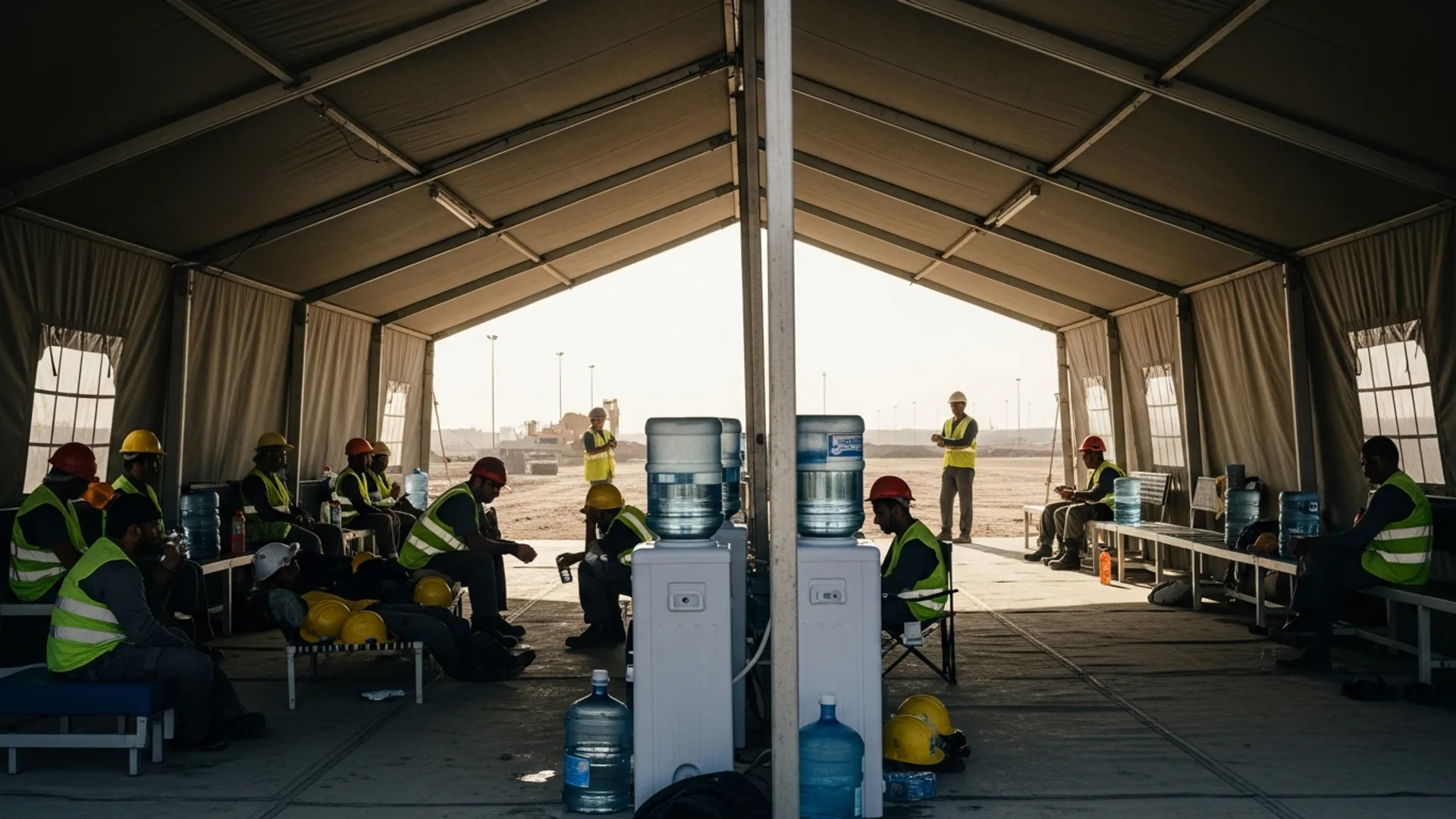
Stopping work is only half the obligation. During the banned hours, employers must give workers somewhere safe and cool to actually rest, so the pause delivers genuine recovery rather than merely relocating people to a patch of shade. In practice this means providing proper shaded rest areas, ideally ventilated or cooled, along with an ample supply of cool drinking water so workers can rehydrate through the hottest part of the day.
Welfare goes further than shade and water. Employers are expected to provide appropriate first-aid provision and to be alert to the signs of heat stress, cramps, dizziness, nausea and, most seriously, heat stroke, so that a worker in trouble is helped quickly. Many responsible contractors also supply electrolyte drinks, sun protection, and clear signage in the languages their workforce speaks, so the safety message actually lands. These measures are not just good practice; they are part of the employer's duty of care and feed directly into how an inspection assesses compliance.
There is a helpful financial footnote here. The cost of this welfare provision, shaded rest structures, water coolers, cooling equipment and first-aid supplies, is a legitimate business expense that is deductible when computing corporate tax, a framework administered by the Federal Tax Authority. With profits up to AED 375,000 taxed at 0% and 9% above that under the regime overseen by the Ministry of Finance, the after-tax cost of doing the right thing is lower than many employers assume. Protecting workers and managing tax efficiently are not in tension; the compliance spend is deductible while the fines for non-compliance are not a cost any business wants.
Fines and Penalties for Breaking the Rule
The enforcement regime is deliberately firm because the risk to workers is real. MOHRE inspectors visit sites during the summer, and specifically during the banned hours, to check compliance. Where they find workers labouring outdoors between 12:30 and 15:00 without a valid exemption, penalties follow. The figure that has been applied is AED 5,000 for each worker found working during the prohibited period, and where several workers are involved the total can rise to a cap in the region of AED 50,000.
Beyond the immediate fine, non-compliance carries wider consequences. Repeated or serious breaches can affect a company's standing with MOHRE, complicate the issuing or renewal of work permits, and damage a contractor's reputation with clients who increasingly demand demonstrable safety compliance from their supply chain. In a market where major developers and government projects audit their contractors, a heat-safety violation can cost far more than the headline fine through lost tenders and strained relationships.
The economics therefore favour compliance overwhelmingly. The cost of pausing work and providing shade and water is modest and, as noted, tax-deductible. The cost of a violation is an immediate fine per worker, potential permit friction, and reputational harm, none of it deductible or recoverable. For any employer weighing whether to "push through" the banned hours to hit a deadline, the rational calculation is clear: reschedule the work, protect the workers, and keep the record clean. The rule is not an obstacle to the business; the fines are.
How to Reschedule Work Legally Around the Ban
Compliance does not have to cost productivity, because the eight-hour standard working day still applies, it is simply rearranged around the banned window. The standard solution is the split shift: an early morning session before the heat peaks, a long midday rest that comfortably contains the 12:30 to 15:00 ban, and a later afternoon or early evening session once conditions ease. Total working time still fits within the eight-hour standard, so output need not fall if the day is planned well.
Good scheduling starts before the season. Employers plan the summer roster in advance, communicate the split-shift pattern to workers, arrange transport and accommodation around the new timings, and brief supervisors so no one improvises a return to work during the banned hours to "catch up". Where a project has an immovable deadline, the answer is to add resources or extend the overall programme, not to breach the ban, because a single inspection can wipe out any time saved and then some.
The interaction with overtime and pay also matters. If the rescheduled day pushes an employee beyond standard hours, the normal overtime rules apply, the basic hourly wage plus 25%, or plus 50% for hours worked at night or on a rest day, and all wages, including any overtime, must still flow through the Wages Protection System on time. Rescheduling for heat safety never suspends the ordinary payroll obligations; it works alongside them. Employers who integrate the summer roster, overtime rules and WPS payments into one plan sail through the season, while those who treat the ban as an afterthought scramble and risk fines.
Why the Midday Break Matters for Your Business
It is easy to frame the midday break purely as a compliance burden, but that misses the bigger picture. Heat stress is genuinely dangerous, and a workforce that trusts its employer to protect it in the summer is more productive, more loyal and less prone to costly accidents and absences. The rule aligns the humane thing and the commercially smart thing: rested, hydrated workers perform better in the cooler hours than exhausted ones would across a punishing unbroken day.
There is also a strong signalling value. Clients, particularly large developers, government bodies and multinational principals, increasingly screen their contractors for real health-and-safety performance, and Dubai Municipality and other authorities take site welfare seriously during inspections. A contractor with a clean heat-safety record, documented rest areas, water provision and split-shift rosters, is a more attractive, lower-risk partner. Compliance becomes a competitive advantage in winning and keeping work, not merely a box to tick.
Finally, embedding the midday break into your operating rhythm is part of running a properly structured UAE business. The same discipline that gets the summer roster, welfare and payroll right is the discipline that keeps contracts, permits and tax in order year-round. Treating the rule as one thread in a coherent compliance fabric, rather than a seasonal nuisance, is exactly the mindset that protects a growing company from the accumulation of small breaches that eventually become big problems.
How MOHRE Inspections Work in Practice
Enforcement of the midday break is active, not theoretical. During the summer window, MOHRE deploys inspectors who visit sites specifically during the banned 12:30 to 15:00 hours, because that is when a violation is visible. Inspections can be routine or triggered by a complaint, and inspectors look for the obvious, workers labouring in the open sun during the prohibited period, as well as the supporting welfare provision the rule requires.
An inspection is not only about catching workers outdoors. Inspectors also assess whether the employer has provided proper shaded rest areas, an adequate supply of cool drinking water, and appropriate first-aid facilities, because the rule is about genuine rest, not merely stopping tools. A site that has technically halted work but left staff in the sun without water and shade has still missed the point and can attract scrutiny. Good documentation, a visible summer roster, welfare logs, and clear signage, demonstrates compliance quickly.
For employers, the way to sail through an inspection is to make compliance obvious and provable. Keep the split-shift schedule posted, maintain the rest area in genuinely usable condition, log water and welfare provision, and brief supervisors so they never restart outdoor work during the banned hours to chase a deadline. An inspector who arrives to find an orderly, well-provisioned site with workers resting properly has nothing to penalise, which is exactly the outcome every employer should engineer in advance.
Preparing Your Site Before the Season
The employers who cope best with the summer are those who prepare before it starts, not those who react once the heat and the inspectors arrive. Preparation begins with the calendar: confirm the exact start and end dates MOHRE announces for the year, and build the split-shift roster around the banned window well ahead of time so workers, supervisors and clients all know the plan.
Physical preparation is the next step. Shaded, ventilated rest areas need to be in place and genuinely fit for the numbers on site, with reliable, replenished supplies of cool drinking water positioned where workers actually are. First-aid provision should be checked and stocked, and at least some staff should be trained to recognise and respond to heat stress. Where accommodation and transport are involved, timings may need adjusting so the new shift pattern works end to end rather than only on paper.
Communication ties it together. Workers should be briefed, ideally in the languages they speak, on the summer schedule, the reasons for it, and the welfare available to them, while supervisors need explicit instructions that the banned hours are non-negotiable. A short pre-season plan covering dates, roster, welfare and communication turns the midday break from a scramble into a routine, and it is the single most effective way to avoid both fines and, far more importantly, harm to workers.
Heat Stress: Signs, First Aid and Response
Behind the rule is a serious medical reality: heat stress can escalate quickly from discomfort to a life-threatening emergency, and everyone on a summer site should understand the warning signs. Early symptoms include heavy sweating, muscle cramps, headache, dizziness and nausea. If these are ignored, they can progress to heat exhaustion and then to heat stroke, a medical emergency marked by confusion, a very high body temperature and sometimes a collapse in the ability to sweat.
The response matters. A worker showing signs of heat stress should be moved into shade or a cool area immediately, given water to sip if conscious, helped to loosen heavy clothing and cooled with water or fanning. Anyone showing signs of heat stroke, confusion, loss of consciousness or a dangerously high temperature, needs urgent medical help without delay while cooling measures continue. Having trained first-aiders and a clear escalation plan on site can be the difference between a scare and a tragedy.
Prevention, of course, is better than response, and that is precisely what the midday break, shade and water provision are designed to achieve. Employers who treat heat safety as a genuine priority, rather than a box-ticking exercise, protect their workers and their business at once. The rule sets the minimum; a culture that watches out for early symptoms, encourages hydration and never pressures staff to push through dangerous heat delivers the outcome the law is ultimately reaching for.
Beyond the Ban: Year-Round Safety Duties
It is a mistake to think the employer's heat and safety obligations begin and end with the midday break window. The specific 12:30 to 15:00 ban addresses the peak-summer danger, but the underlying duty of care, to provide a safe working environment and to protect workers from foreseeable harm, applies all year round. Hot conditions can occur outside the formal window, and other site hazards never take a season off.
This wider duty means employers should manage heat sensibly even in the shoulder months, adjusting work in genuinely extreme conditions regardless of the calendar, and should maintain the broader safety framework, protective equipment, training, and hazard controls, throughout the year. The mindset that gets the summer roster right is the same mindset that keeps a site safe in every season, and it is the mindset MOHRE and other authorities expect from a responsible employer.
Framed this way, the midday break is a visible expression of a permanent obligation rather than an isolated seasonal rule. Employers who internalise that, treating worker welfare as a continuous responsibility woven into how the business operates, not a summer inconvenience, are the ones who avoid fines, pass inspections, win the confidence of major clients, and, above all, keep their people safe. That is the standard a well-run UAE business holds itself to, and it pays back in reputation and resilience.
The Wider 'Safety in the Heat' Effort
The midday break does not exist in isolation; it is the centrepiece of a broader national push to protect workers through the hottest months, often promoted under a "safety in the heat" banner. Alongside the mandatory ban, authorities and responsible employers run awareness campaigns on hydration, recognising heat stress, and using shade and rest, so that the culture of safety extends beyond the letter of the rule.
Employers are encouraged to go further than the minimum: distributing water and electrolyte drinks, providing cooling vests or reflective clothing where appropriate, adjusting the pace of physically demanding tasks, and educating workers in their own languages about the risks and the warning signs. These measures cost little relative to the harm they prevent, and, as noted earlier, the spend is a deductible business expense under the corporate tax framework administered by the Federal Tax Authority.
The point of the wider effort is that a fine-avoidance mindset is the wrong frame. The real objective is a workforce that finishes the summer healthy, and the businesses that embrace that objective, rather than doing the bare minimum, tend to have safer sites, lower absence, and stronger reputations with the major clients and authorities such as Dubai Municipality that scrutinise site welfare. Protecting people and running a resilient business are, in the summer heat as everywhere, the same project.
Common Mistakes with the Midday Break Rule in the UAE
- Assuming last year's exact dates apply, instead of checking the specific start and end dates MOHRE announces each summer.
- Treating the 12:30 to 15:00 ban as optional on busy days, and quietly letting crews work through to hit a deadline.
- Stretching the "cannot stop" exemption to cover ordinary construction that could easily be rescheduled.
- Sending workers to sit in unshaded areas without cool water, so the pause offers no real recovery from the heat.
- Forgetting first-aid provision and heat-stress training, leaving supervisors unable to respond to a worker in distress.
- Failing to plan split shifts in advance, then improvising a return to work during the banned hours to make up time.
- Miscalculating overtime or paying rescheduled hours off the books instead of through the Wages Protection System.
- Ignoring the tax angle, and overlooking that shade, water and cooling spend is a deductible business expense.
Staying Compliant with Noble Core
The midday break is a summer-specific rule, but the compliance mindset behind it, know the rules, plan ahead, document everything, applies to your business all year. Noble Core helps founders and contractors build that discipline in from the start. Whether you are establishing or scaling an operation, our team handles your business setup in Dubai so your legal entity, licensing and workforce obligations are aligned, and seasonal rules like the heat ban slot into a coherent plan rather than catching you out.
From there we put the everyday systems in place. That starts with a clear, compliant UAE labour contract that sets out hours, split-shift flexibility and overtime treatment, so summer rescheduling is straightforward. We support you through MOHRE enquiry services for permits, inspections and any complaint handling, and we make sure every wage, including rescheduled and overtime hours, flows correctly through the Wages Protection System (WPS). The result is a business that protects its people and passes its inspections. Book a free 20-minute consultation with Noble Core to review your summer compliance and payroll before the season begins.
Talk to Our Experts
Noble Core helps UAE employers stay compliant with MOHRE labour and heat-safety rules, from contracts to payroll and inspections. Free 20-minute consultation.
Frequently Asked Questions
What are the midday break hours in the UAE?
Outdoor and direct-sun work is banned from 12:30 to 15:00 each day, giving workers a two-and-a-half-hour rest during the hottest part of the day.
When does the midday break rule apply in 2026?
It runs from mid-June to mid-September, about three months. The exact start and end dates are announced each year by MOHRE ahead of the summer.
What is the fine for breaking the midday break rule?
MOHRE has applied fines of AED 5,000 per worker found working during the banned hours, up to AED 50,000 where several workers are involved.
Who is covered by the midday break rule?
It covers workers labouring outdoors and under direct sun, such as construction and landscaping. Indoor and air-conditioned workplaces are generally not affected.
Are there any exemptions to the midday break?
Yes, for work that cannot technically stop, such as continuous concrete pours or urgent utility repairs. Even then, the employer must provide cooling and follow safety conditions.
Can workers still do eight hours during the ban period?
Yes. Employers reschedule the day into split shifts, morning and later afternoon, so total working time still fits within the eight-hour standard around the banned window.
What must employers provide during the break?
Shaded rest areas, cool drinking water, and appropriate first-aid and welfare facilities, so workers can genuinely recover from the heat during the banned hours.
Is the cost of heat-safety compliance tax-deductible?
Yes. Spending on shade, water and cooling is a deductible business expense for corporate tax purposes, a framework administered by the Federal Tax Authority.
Contact Us For Free Consultation
Licensed UAE consultancy. One reply, no spam.
Thank you.
A consultant will reply on WhatsApp shortly.