Quick AnswerStart a podcast business in the UAE in 2026: media licences from AED 4,999, content permits, studio rules, sponsorship VAT and 9% corporate tax explained.
Audio has quietly become one of the most cost-effective media businesses to build in the Gulf, and launching a podcast business uae brands will actually sponsor takes far less capital than most founders assume. The equipment is inexpensive, the distribution is free, and the licensing floor is genuinely low: the cheapest published media licence anywhere in the country is Ajman Media City at AED 4,999, though with zero visa allocation. Packages that include a residence visa begin around AED 9,450 at KEZAD and roughly AED 12,500 all-in at Umm Al Quwain Free Trade Zone.
What founders underestimate is the second half — the compliance shape of a media business rather than a hobby. The moment you accept a sponsor, sell an ad read, take a brand-partnership fee, or charge for producing someone else's show, you are trading, and trading requires a licence, a tax registration and, depending on how you distribute, content permissions. This guide covers the whole path: activity codes, mainland versus free zone, studio premises, sponsorship revenue and VAT, corporate tax at 9% above AED 375,000, trademark protection through the Ministry of Economy, staffing, renewals and the mistakes that cost real money.
Your setup cost, in 10 seconds
Package prices. Health insurance is required by law and not included.
Thank you.
Your written quote follows on WhatsApp.
Do you need a licence for a podcast business in the UAE?
Yes — any monetised podcast is a commercial media activity requiring a trade licence from DET or a free zone authority. The cheapest published media licence is AED 4,999 with zero visas, packages with a residence visa start near AED 9,450, and corporate tax applies at 9% on taxable income above AED 375,000 with mandatory Federal Tax Authority registration.
A purely personal podcast with no revenue is not a business. The line is crossed the moment money moves in exchange for the audio or the audience — sponsorship, pre-roll advertising, affiliate commission, paid subscriptions, live-event tickets, or production fees for a client's branded show. Most podcasts cross that line within their first year, and retrofitting a licence after you have already invoiced a sponsor is the wrong order to do things in.
| Cost line (UAE podcast business, 2026) | Published figure | Notes |
|---|---|---|
| Cheapest published media licence, zero visas | AED 4,999 | Ajman Media City |
| Lowest published package including a visa | AED 9,450 | KEZAD, Abu Dhabi |
| Alternative all-in package with visa | ~AED 12,500 | UAQ Free Trade Zone |
| DET trade name reservation | AED 620 | Mainland, per name |
| Ejari tenancy registration | AED 177.75 app / AED 220 trustee | Mainland requirement |
| Establishment card | AED 300 (+ AED 2,000 e-system first time) | Prerequisite to any visa |
| Employment entry permit | AED 300 + AED 1,000 refundable | Per sponsored person |
| Status change in-country | AED 500 | If not exiting to activate |
| Medical fitness, Dubai | AED 270 / 700 (6h) / 1,020 (2h) | Per person |
| Residence permit | AED 100 + AED 100 per year + AED 100 smart | Per person |
| Emirates ID | AED 100 per year of residence + AED 100 smart | Per person |
| Green visa | AED 700 | Published federal fee |
| Golden visa | AED 1,200 | Published federal fee |
| VAT | 5%, mandatory above AED 375,000 turnover | Federal Tax Authority |
| Corporate tax | 0% to AED 375,000, 9% above | Federal Tax Authority |
| Overstay penalty | AED 50 per day | Per person |
Related: Umm Al Quwain FTZ
Our cost research checks what each authority actually publishes, so you can compare like with like:
- Umm Al Quwain Free Trade Zone — AED 12,500 all-in with a visa, and it renews at the same price
Choosing the right activity codes for audio production
The most common licensing error in podcasting is picking a single vague activity and assuming it stretches. It does not. A podcast operation typically generates revenue from several distinct commercial acts, and each maps to its own code:
- Audio and sound production — recording, editing and mastering audio content. This is the anchor activity for a show you produce yourself.
- Media production services — producing content on commission for a client, which is the model behind most branded podcasts and the highest-margin work in the sector.
- Advertising and marketing services — required if you sell ad inventory, broker sponsorship, or run campaigns on behalf of brands rather than simply reading a sponsor message on your own show.
- Social media management — relevant if you also run clients' channels, which podcast studios frequently upsell.
- Video production — increasingly essential, because most podcasts are now filmed. If you shoot video, the audio code alone does not cover you, and the same logic applies as for a standalone photography licence in Dubai.
- Event organisation — for live recordings and ticketed shows.
- Training or consultancy — for the courses and workshops many podcasters sell.
Front-load three or four adjacent activities at initial application. DET and free zone authorities charge per activity, quoted at application rather than published as a single flat rate, but the incremental cost at inception is invariably cheaper than an amendment later. To match what you actually sell against codes that exist, work through the Dubai business licence directory before you file.
Mainland DET or a free zone media package?
For a podcast business, free zone media clusters are the default and usually correct answer. The packages are inexpensive, the activity lists are media-native, a flexi-desk satisfies the premises requirement, and visa allocation scales with the desk tier you buy rather than with leased square metres. If your revenue comes from international sponsors, regional brands, agencies or other free zone entities, there is little reason to pay the mainland premium.
DET mainland earns its cost in one specific circumstance: when your clients are UAE government entities, semi-government bodies, or mainland corporates whose procurement systems require a DET-licensed vendor. Government-sector branded podcasts are a real and well-paid category in the UAE, and losing that tender because of your licensing authority is an expensive way to save on a flexi-desk.
Mainland also requires a genuine tenancy registered on Ejari — AED 177.75 through the application route or AED 220 through a trustee centre — and DET issues the licence against that address. Free zones substitute a facility agreement. Full foreign ownership is available on both routes for media activities, so shareholding is no longer a differentiator.
A word on the zero-visa trap. The AED 4,999 Ajman Media City licence is genuine and it is the cheapest published price in the country, but it allocates no visas. It cannot sponsor your residence, and without residence you have no Emirates ID and a much harder time opening a corporate bank account. If you need to live here, price the visa-inclusive tier from the start rather than buying the headline number and upgrading three months later.
Studio, home recording and premises approvals
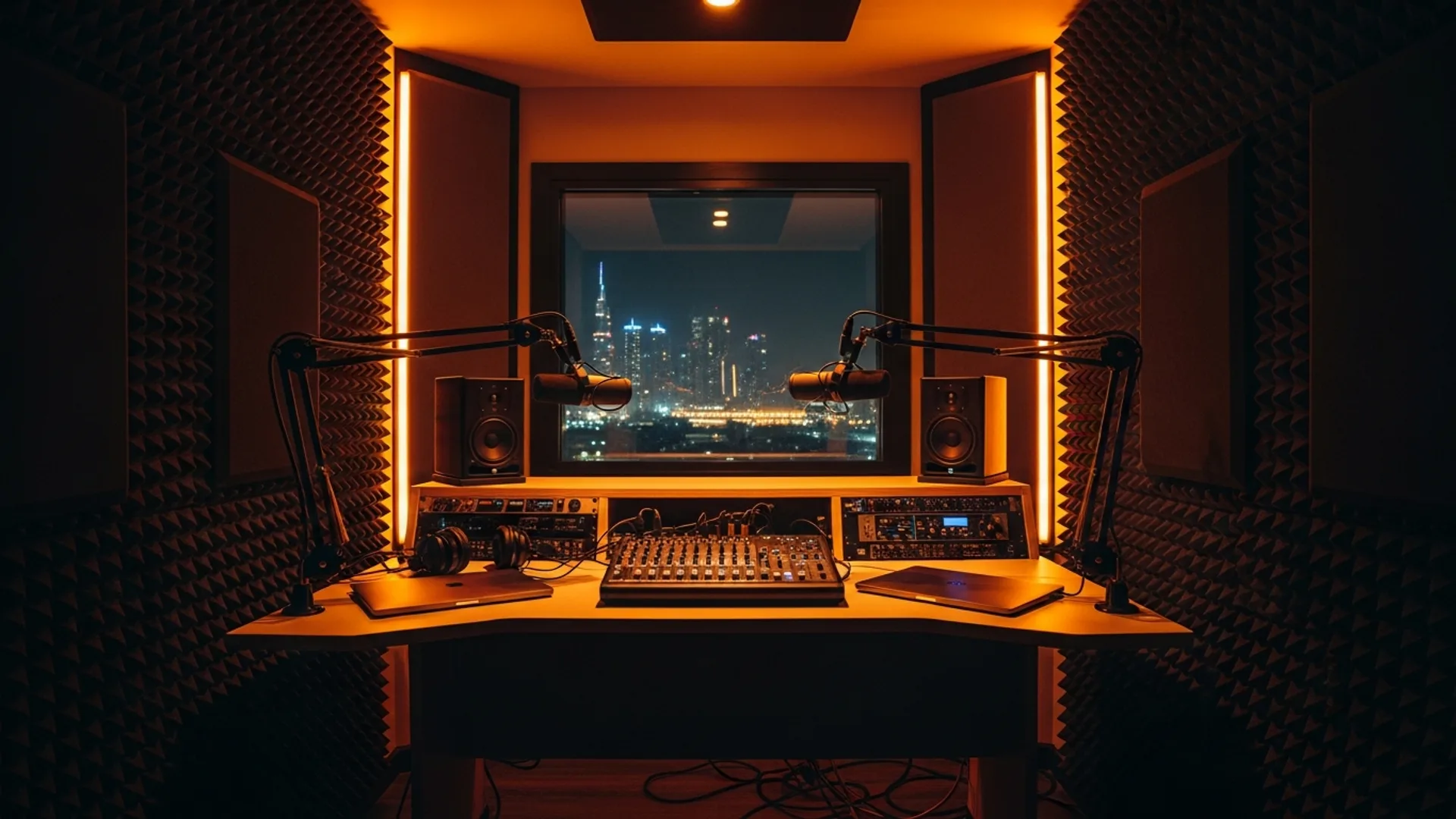
You do not need a studio to hold a licence. A great many UAE podcasts are recorded in a spare room, a rented studio hour, or a co-working booth, and the licence does not care where the microphone stands. Premises approvals only start to matter when you build something.
If you fit out a dedicated commercial studio on the mainland, Dubai Municipality approvals come into play for the fit-out itself, for signage on the building, and for compliance with health and safety requirements in a commercial unit. Acoustic treatment involves cladding and materials, which is a fit-out matter; Civil Defence sign-off applies to fire safety in the finished space. Neither is difficult, but both take time and neither is included in your licence fee. Ask your landlord what approvals the building already holds — fitted units in media-focused buildings often carry much of this already.
If you record at home, be honest about the limits. Residential premises are not licensed commercial premises, and while nobody objects to a founder recording solo, running a client-facing studio out of a villa with paying guests arriving is a different proposition. The moment clients come to you, lease something.
Renting studio time by the hour is the most sensible route for the first year. It converts a capital cost into a variable one, gives you better acoustics than most self-builds, and defers the fit-out approvals question entirely until your revenue justifies it.
Content permissions and what you can say
Media content published or distributed in the UAE sits under the permitting regime administered by the UAE Media Council. This is separate from your trade licence and separate from your free zone authority. What it requires depends on your format, your distribution channels and whether the content is advertising. A conversational show distributed on international platforms sits differently from a locally distributed advertising-funded programme, so confirm your specific position before you launch a monetised series rather than after.
Editorially, the practical guidance for a UAE-based podcast is straightforward and commercially sensible in any market: avoid content that criticises national leadership or government policy, avoid religious commentary, avoid defamation of named individuals or companies, and treat guest statements as your publication rather than theirs. Build a short pre-record briefing for guests and keep an unedited master of every episode. Most podcast problems in this market are not regulatory ambushes — they are an unvetted guest saying something the host did not challenge.
If your business includes representing or booking creators, that is a distinct regulatory question covered by the regime governing an influencer licence in Dubai. A podcast host who also takes brand deals on personal social channels is operating in both lanes at once and should be licensed for both.
Sponsorship revenue, VAT and corporate tax
This is where podcast businesses most often get into trouble, because revenue arrives in small, varied, cross-border pieces.
Corporate tax is 0% on taxable income up to AED 375,000 and 9% above it. Registration with the Federal Tax Authority through the EmaraTax portal at https://tax.gov.ae/ is mandatory for every licensed business, profitable or not, and the return falls due nine months after your financial year end. Small Business Relief may apply where revenue is at or below AED 3,000,000, which covers virtually every independent podcast operation.
VAT is charged at 5%, with mandatory registration once taxable supplies exceed AED 375,000 in any rolling twelve months and voluntary registration available from AED 187,500 of supplies or expenses. For podcasts the complications are specific:
- Sponsorship from a UAE brand is a taxable supply of advertising services at 5%. Your sponsorship agreements must state whether the fee is inclusive or exclusive of VAT.
- Sponsorship from an overseas brand may be zero-rated, but only where the conditions for export of services are met and evidenced. Do not assume; document.
- Platform payout revenue — advertising shares from distribution platforms — needs consistent treatment and clear records of the contracting entity.
- Barter deals, where a brand supplies equipment or travel instead of cash, are still supplies with a value and are still taxable. Podcasters routinely miss this.
- Listener subscriptions are supplies to individuals whose location determines treatment, and subscription platforms may or may not act as the supplier of record.
Keep the books from episode one. Retrofitting twelve months of small, mixed-currency sponsorship income into a compliant VAT return is far more expensive than doing it properly from the start.
Contact Us For Free Consultation
or
Ask on WhatsApp insteadLicensed UAE consultancy. One reply, no spam.
Thank you.
A consultant will reply on WhatsApp shortly.
Protecting the show name through the Ministry of Economy
A podcast's most valuable asset is usually its name. The Ministry of Economy administers trademark registration in the UAE, and registering the show name and logo early is one of the cheapest pieces of insurance available to a media business. Audience equity accrues to a name; discovering in year three that someone else registered it first, or that a similar mark blocks your expansion into merchandise, is a self-inflicted wound.
Register in the classes that match your actual and near-future business — entertainment and media services at minimum, and merchandise classes if you plan products. Note that your trade name reservation with DET at AED 620 is not a trademark; it stops another company registering the same corporate name, nothing more. The two are different instruments doing different jobs, and you generally want both.
Copyright in the recordings themselves is a separate question, and it should be settled in writing with co-hosts, producers and guests. Who owns the master? Can a departing co-host take the archive? Can a guest demand removal of an episode? A one-page agreement signed before the first record avoids all three disputes.
Hiring, freelancers and labour rules
Podcast businesses scale through a small core team plus freelancers. Under Federal Decree-Law 33 of 2021, administered by MOHRE, probation is capped at six months, notice runs 30 to 90 days, and annual leave is 30 days. Sick leave is 15 full-pay days, then 30 half-pay, then 45 unpaid, totalling 90 per year. Gratuity accrues at 21 days per year for the first five years, then 30 days per year. Overtime is basic salary plus 25%, rising to plus 50% between 22:00 and 04:00 or on rest days, capped at two hours per day — relevant when you edit overnight to hit a Monday release. Salaries must be paid through the Wage Protection System, and WPS failures block new visa issuance.
Editors, sound designers, videographers and social media producers are overwhelmingly freelance in this market. Engaging a freelancer who holds their own valid permit is straightforward. Engaging someone with no permit exposes your company, not them. Make permit verification part of your booking process and keep a copy on file.
Renewals, penalties and keeping it clean
Licences renew annually, and the chain is tenancy or facility agreement → licence → establishment card → visas. A break anywhere stops everything downstream. Late renewal brings escalating fines and freezes immigration transactions.
Watch these specifically: overstay at AED 50 per day per person; trading in an activity absent from your licence, which brings fines and, on repetition, suspension; expired Ejari, which stops a mainland DET renewal outright; and failure to register for corporate tax or file within nine months of year end, which carries Federal Tax Authority administrative penalties independently of whether tax is owed.
Step-by-step: licensing your podcast business
Step one — decide what you are actually selling. Your own show with sponsors, client shows produced on commission, or both. This determines your activity set and, downstream, your VAT model. Founders who skip this step license the wrong thing.
Step two — choose the emirate and route. Free zone media package for private-sector and international clients; DET mainland if you intend to serve government or semi-government entities. Compare the visa-inclusive tiers, not the zero-visa headline prices.
Step three — reserve the trade name. DET charges AED 620 on the mainland; free zones apply their own name approval within the package. Avoid religious references, country names and anything implying a regulated activity you do not hold.
Step four — obtain initial approval. This confirms no objection to you conducting the activity. Media activities may route through an additional clearance here, and free zones typically fold theirs into issuance.
Step five — premises. Register the mainland tenancy on Ejari at AED 177.75 through the application route or AED 220 at a trustee centre, or sign the free zone facility agreement for a flexi-desk. Do not sign a lease before initial approval clears.
Step six — execute and pay. Incorporation documents notarised where required, payment voucher settled, licence issued. You now legally exist but cannot yet sponsor anyone.
Step seven — open the establishment card. AED 300, plus AED 2,000 for the e-system on first issuance. Every immigration step depends on it.
Step eight — process visas. Entry permit AED 300 plus AED 1,000 refundable; status change AED 500 if you are already in-country; medical fitness AED 270 standard, AED 700 for six-hour or AED 1,020 for two-hour service in Dubai; residence permit AED 100 plus AED 100 per year plus AED 100 smart service; Emirates ID AED 100 per year of residence plus AED 100 smart. Dubai files route through GDRFA, federal and other-emirate files through ICP. Established media professionals may qualify for a Green visa at AED 700 or a Golden visa at AED 1,200.
Step nine — open the bank account. Bring signed sponsorship or production agreements, a clear description of the revenue model, and realistic projections. Banks scrutinise media businesses because revenue is small, frequent and often cross-border — coherence between your licence activities and your expected inflows is what gets the account opened.
Step ten — register for tax and set up bookkeeping. Corporate tax registration with the Federal Tax Authority immediately, VAT once you cross the threshold, and a bookkeeping process from your first invoice rather than your first audit.
Worked example: a two-person branded-podcast studio
Two founders launch a studio producing branded podcasts for regional companies, plus one flagship interview show of their own carrying sponsorship.
Their clients are private-sector brands and agencies, not government, so they choose a free zone media licence with a visa-inclusive tier — the KEZAD package at AED 9,450 covering one visa, with the second founder added at the incremental rate. They license four activities at inception: audio production, media production services, video production, and advertising services, avoiding two amendments they would otherwise have needed by month eight.
The establishment card costs AED 300 plus the AED 2,000 first-time e-system charge. Each founder's visa runs through entry permit at AED 300 plus AED 1,000 refundable, medical fitness at AED 270 standard, residence permit at AED 100 plus AED 100 per year plus AED 100 smart service, and Emirates ID at AED 100 per year of residence plus AED 100 smart.
They rent studio time hourly rather than fitting out, avoiding Dubai Municipality fit-out and signage approvals entirely in year one. They register the show name as a trademark through the Ministry of Economy in month two, before any audience equity exists. Editing is freelance, with permits verified at booking.
Projected year-one revenue is AED 620,000 — above the AED 375,000 VAT threshold, so they register and price client production fees exclusive of VAT with an explicit contract clause, treating overseas sponsorship separately with export-of-services evidence on file. Taxable profit after freelance costs, studio hire and salaries is projected at AED 190,000, so corporate tax is 0% for the year, but they registered with the Federal Tax Authority at incorporation and have the return diarised for nine months after year end.
Common Mistakes When Starting a Podcast Business in the UAE
- Taking sponsorship before getting licensed. The first paid ad read converts a hobby into a business. Invoicing without a licence is the most common failure and the easiest to avoid.
- Buying the AED 4,999 zero-visa licence expecting residence. It is the cheapest published price in the country and it sponsors nobody. Price the visa-inclusive tier if you need to live here.
- Licensing audio only, then filming everything. Video production is a separate activity. Almost every modern podcast is filmed, and almost every audio-only licence is therefore too narrow.
- Ignoring VAT on barter and overseas sponsorship. Equipment, travel and trips given in exchange for coverage are supplies with a value. Overseas sponsorship needs export-of-services evidence, not an assumption.
- Skipping corporate tax registration because revenue is small. Registration with the Federal Tax Authority is mandatory regardless of profit, and the penalty is independent of tax owed.
- Building a studio before checking fit-out and signage approvals. Dubai Municipality approvals for commercial fit-out and signage take time and are not covered by your licence fee.
- Never trademarking the show name. A DET trade name reservation at AED 620 is not a trademark. Register with the Ministry of Economy before you build audience equity.
- Booking freelance editors without verifying permits. Liability for engaging unauthorised workers sits with the engaging company, and podcast production is freelance-heavy by nature.
Launch Your UAE Podcast Business with Noble Core
A podcast business is cheap to start and easy to license incorrectly. The costs that hurt are not the licence fee — they are the amendment you needed because you licensed audio and shot video, the VAT you did not charge on a barter deal, and the sponsor you could not invoice because you had no entity yet. Noble Core Ventures handles all of it: selecting the right free zone or DET route against your real client mix, loading the full activity set at inception, arranging premises or Ejari where required, opening the establishment card, processing visas through GDRFA or ICP, registering your trademark with the Ministry of Economy, and getting you onto the Federal Tax Authority register on time.
For the wider comparison of mainland and free zone structures across every sector, start with our guide to business setup in Dubai. Hosts who also take personal brand deals should read the influencer licence in Dubai guide, and anyone filming episodes will want the detail in our photography licence breakdown. To pin down the exact activity codes for audio, video and advertising work, use the Dubai business licence directory.
Book a free 20-minute consultation and we will give you a written route, real costs and a realistic timeline for your podcast business.
Talk to Our Experts
Noble Core Ventures licenses podcast, audio and media production businesses across the UAE — choosing between DET mainland and free zone media packages, adding the right activity codes, content permits, studio premises, visas and Federal Tax Authority registration. Free 20-minute consultation.
Frequently Asked Questions
Do I need a licence to run a podcast business in the UAE?
Yes, if you monetise it. Commercial podcasting requires a trade licence with audio or media production activities from DET or a free zone authority, plus content permissions where applicable.
What is the cheapest podcast licence in the UAE?
Ajman Media City publishes AED 4,999 for a zero-visa media licence. Packages including one residence visa start around AED 9,450 at KEZAD or AED 12,500 at UAQ.
Can I podcast on a tourist or spouse visa in the UAE?
Not commercially. Accepting sponsorship or advertising revenue is business activity requiring a licence. A spouse visa holder needs a permit or their own licence to trade.
Does podcast sponsorship revenue attract VAT?
Yes. Sponsorship and advertising supplied to UAE clients are taxable at 5% once you exceed the AED 375,000 registration threshold in any rolling twelve-month period.
Do podcasters pay corporate tax in the UAE?
Corporate tax is 0% on taxable income up to AED 375,000 and 9% above. Registration with the Federal Tax Authority is mandatory regardless of whether you are profitable.
Do I need a studio to get a podcast licence?
No. Free zone flexi-desks satisfy licensing. A physical studio becomes necessary only when you record in-house, and it then triggers fit-out and signage approvals.
How long does it take to license a podcast business?
Free zone media licences are commonly issued within three to seven working days. Mainland DET applications typically take one to three weeks once Ejari is registered.
Can I trademark my podcast name in the UAE?
Yes. Trademarks are registered through the Ministry of Economy. Doing this early protects the show name before you build audience equity around it.
Do I need approval for podcast content in the UAE?
Media content published or distributed in the UAE falls under UAE Media Council permitting. Requirements depend on format and distribution, so confirm before launching a monetised series.
Can I hire freelance editors and producers?
Yes, provided each freelancer holds a valid independent work permit. Liability for engaging unauthorised workers sits with your company, not with the freelancer.