Quick AnswerScrap metal license UAE 2026: activities, yard permits, waste approvals, VAT and 9% corporate tax, plus setup costs from AED 9,450 upward.
Setting up a scrap metal business in the Emirates is far more than filing a trade name. The scrap metal license UAE authorities issue is only the first of several permissions, and the ones that trip founders up sit with the municipality and the environment regulators rather than the economic department. Budget realistically: a lean office-based trading company can start from published free zone packages such as KEZAD at AED 9,450 including a visa allocation, while a genuine yard operation with weighbridge, sorting bays and collection trucks runs into six figures before the first tonne moves.
This guide walks through the licence itself, the difference between trading and recycling, the yard and environmental approvals, the tax position under the Federal Tax Authority, and the operational permits that keep a scrap business compliant once it is running. Figures quoted are those published by the relevant authorities; where an emirate or free zone does not publish a price, that is stated plainly rather than guessed.
Your setup cost, in 10 seconds
Package prices. Health insurance is required by law and not included.
Thank you.
Your written quote follows on WhatsApp.
What is a scrap metal licence in the UAE and who issues it?
A scrap metal licence is a trade licence carrying a scrap, waste-metal or recycling activity, issued by an emirate's economic department — DET in Dubai, or a DET in the other emirates — or by a free zone authority. Trading-only licences start from roughly AED 9,450 in published free zone packages; yard and recycling operations additionally require municipality waste permits and industrial premises, adding several months and substantially more capital.
The licence is the legal permission to carry on the activity. It is not permission to occupy a yard, to store waste, to transport waste on public roads, or to process metal thermally or mechanically. Each of those is a separate approval from a separate body, and each has its own renewal cycle. Founders who treat the trade licence as the finish line discover the gap when a municipality inspector arrives at a yard that was never approved for waste storage.
| Cost item | Published or typical figure (AED) | Issued by |
|---|---|---|
| Trade name reservation (Dubai) | 620 | DET |
| Initial approval and licence issuance (mainland) | Varies by activity; DET does not publish a single headline price | DET |
| Free zone licence, no visas (cheapest published) | 4,999 | Ajman Media City |
| Free zone licence with visa allocation (published) | 9,450 | KEZAD |
| Free zone licence all-in with visa (published) | 12,500 | UAQ Free Trade Zone |
| Establishment card | 300 (plus 2,000 e-system first time) | MOHRE |
| Ejari tenancy registration | 177.75 app / 220 trustee | Ejari |
| Emirates ID | 100 per year of residence + 100 smart service | ICP |
| Residence permit | 100 + 100 per year + 100 smart service | ICP / GDRFA |
| Green residence visa | 700 | ICP |
| Golden residence visa | 1,200 | ICP |
| Municipality waste permits, yard approvals, environmental studies | Not published as a flat rate; assessed per site | Dubai Municipality / local municipality |
| Corporate tax registration | No fee | Federal Tax Authority |
A note on the figures above: they are the ones published by the issuing authorities. Mainland licence totals in Dubai vary with activity count, legal form, premises and the fees attaching to your specific activity list, and DET does not publish a single all-in number. Anyone quoting you a precise mainland total before seeing your activity selection and tenancy is estimating, not quoting.
Trading, collecting or recycling — three very different businesses
The phrase "scrap metal business" covers at least three models that the regulators treat separately.
Pure trading. You buy consignments and sell them on, often for export, without ever handling the material yourself. Goods move from the supplier's yard to the buyer's container. This is the lightest model: a commercial trade licence, an office, and customs registration. No waste permit is needed because you are not storing or processing waste.
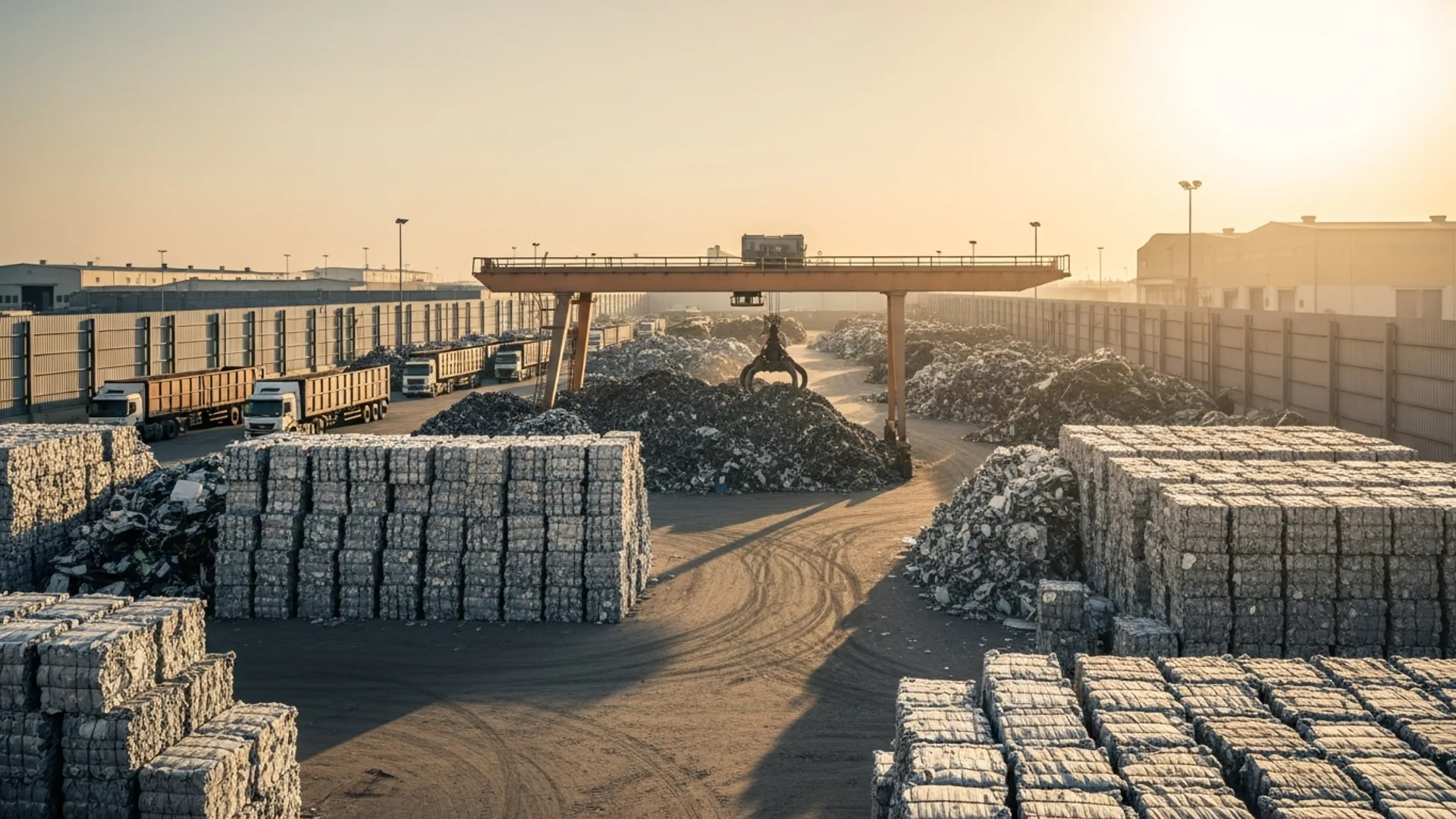
Collection and sorting. You run a yard, receive mixed material from garages, construction sites, factories and demolition contractors, then sort, bale and resell. This is where waste regulation bites. The yard needs to be on land zoned for the purpose, and the operation needs a waste-handling permit from the municipality.
Recycling and processing. You shred, granulate, smelt or otherwise transform metal into a new feedstock. This is manufacturing. It requires an industrial licence, industrial land, environmental impact assessment, emissions controls, and considerably more capital. In Dubai this is a Dubai Municipality and industrial-development conversation as much as a DET one.
Most founders start in the first or second category. The single most common structural error is applying for a trading licence with the intention of running a yard, then discovering the premises cannot be approved.
Choosing the right emirate and jurisdiction
Scrap is a heavy, low-margin, land-hungry business, which makes location economics decisive.
Dubai mainland gives you the ability to buy from and sell to any UAE customer without a distributor, and access to Jebel Ali and Port Rashid for export. Industrial land in Al Qusais, Ras Al Khor, Al Quoz and Jebel Ali Industrial is where the established yards sit. Rents are the highest in the country and permitted yards are genuinely scarce; secure the land before you commit to the licence.
Sharjah, Ajman, Umm Al Quwain and Ras Al Khaimah have historically hosted a large share of the country's scrap yards precisely because land is cheaper and industrial plots are more available. If your customer base is exporters and mills rather than Dubai retail, the cost saving is material.
Abu Dhabi offers large-scale industrial zones such as KEZAD with published licence pricing from AED 9,450, purpose-built industrial plots, and proximity to heavy industry that generates consistent offcut volumes.
Free zones suit export-focused traders. A free zone company can import, store in a bonded facility and re-export without paying the 5% GCC customs duty that applies when goods enter the domestic market. The trade-off is that selling into the UAE mainland means clearing customs and paying duty, or appointing a mainland distributor. Note that roughly half of UAE free zones publish no pricing at all; treat any quoted "package" from an unpublished zone as a sales figure, not an official tariff.
Step-by-step: obtaining the licence
Step one — fix the activity list. Work backwards from what you will physically do. "Trading in scrap and waste materials" is not the same activity as "collection and transport of solid waste" or "recycling of metal waste". Adding an activity later means amending the licence and, if the new activity triggers external approvals, re-opening the approvals file. Get this right at the outset.
Step two — reserve the trade name. In Dubai the published trade name fee is AED 620. Names may not imply a government connection or use religious terms, and abbreviations of personal names are restricted. Reserve early; names lapse.
Step three — obtain initial approval. The economic department confirms in principle that the shareholders and activity are acceptable. For scrap activities, initial approval is frequently conditional on external clearance, meaning the file will not progress until the municipality or environment authority signs off.
Step four — secure premises and register the tenancy. An office suffices for pure trading. A yard or warehouse must be on appropriately zoned land with a valid lease from the master developer or landlord. In Dubai the tenancy is registered through Ejari at AED 177.75 online or AED 220 through a trustee centre. The tenancy contract number is a hard prerequisite for licence issuance on the mainland.
Step five — collect external approvals. For yards this means the municipality waste-management department, and for processing operations an environmental permit. Civil Defence clearance is required where there is fire risk, fuel storage or cutting equipment. These approvals are inspection-driven: an officer visits, checks the boundary walls, drainage, spill containment, fire points and access, and either approves or issues a corrections list.
Step six — pay and collect the licence. Once external approvals are attached, the economic department issues the licence. Free zone routes compress steps three to six because the zone handles premises and, in many cases, internal approvals.
Step seven — register for tax and labour. Corporate tax registration with the Federal Tax Authority via EmaraTax is mandatory regardless of profit. VAT registration is mandatory once taxable supplies exceed AED 375,000 in twelve months, with voluntary registration available from AED 187,500. Open the MOHRE establishment file at AED 300, plus AED 2,000 for first-time e-system registration.
Waste, environmental and yard approvals
This is the part of the process that separates a compliant scrap operation from one that gets shut down.
Zoning. Open yards can only operate on land designated for that use. A general warehouse lease in a light-industrial park does not automatically permit open storage of waste metal. Check the permitted use on the lease and with the master developer before signing.
Waste-handling permit. Dubai Municipality's waste management function regulates the receipt, storage and onward movement of waste materials, including metals. The permit covers what you may accept, how it must be stored, and where it may go. Yards handling end-of-life vehicles, batteries, cables with insulation, or anything contaminated with oil face additional conditions because those streams carry hazardous components.
Hazardous fractions. Lead-acid batteries, waste oil, refrigerant-bearing white goods and insulated cable are the four items that most often push a "simple" scrap yard into hazardous-waste territory. Each has its own handling, storage and disposal rules and can generally only be passed to a permitted downstream facility with a documented transfer record. Burning cable to recover copper is prohibited and heavily penalised.
Waste transfer documentation. Every movement of waste should be documented — what left, in what quantity, on which vehicle, to which permitted receiver. Inspectors ask for this record, and its absence is treated seriously.
Vehicles. Collection trucks need standard registration plus, in Dubai, RTA permits governing heavy-vehicle routes, timing restrictions and oversized or overweight loads. Waste-carrying vehicles additionally need municipality approval as waste transporters. Running an unpermitted tipper on a collection round is a routine enforcement catch.
Tax: VAT, corporate tax and customs
Corporate tax. UAE corporate tax applies at 0% on taxable income up to AED 375,000 and 9% above that threshold. Registration is through EmaraTax with the Federal Tax Authority at tax.gov.ae, and the return is due nine months after the end of the financial year. Where revenue is at or below AED 3,000,000, Small Business Relief may be elected for the relevant tax period. Groups with consolidated revenue at or above EUR 750 million fall within the Domestic Minimum Top-up Tax at 15%.
VAT. The standard rate is 5%. Registration is mandatory above AED 375,000 of taxable supplies in a rolling twelve months and voluntary from AED 187,500. Scrap traders should pay particular attention to the domestic reverse charge mechanism that applies to specified supplies of raw metals between registered businesses: where it applies, the supplier does not charge VAT and the recipient accounts for it. Applying reverse charge to a transaction that does not qualify, or missing it where it does, is one of the more common audit findings in this sector. Confirm the treatment of your specific product mix directly with the Federal Tax Authority.
Customs. Imports into the domestic market attract 5% GCC common customs duty on most goods, declared through Dubai Customs' Mirsal 2 system. Goods held in a free zone and re-exported without entering the mainland do not attract that duty. Exports require an export declaration, and certain waste streams need environmental clearance before shipping under international waste-movement rules.
Record keeping. Scrap is a cash-adjacent trade, which makes documentation discipline non-negotiable. Weighbridge tickets, purchase vouchers with supplier identification, and banked receipts are what stand between you and a difficult conversation during a tax audit. Buying without documentation, from unidentified sellers, creates both a tax problem and a stolen-goods exposure.
Contact Us For Free Consultation
or
Ask on WhatsApp insteadLicensed UAE consultancy. One reply, no spam.
Thank you.
A consultant will reply on WhatsApp shortly.
Labour, safety and site operations
Scrap yards are physically demanding, outdoor, plant-heavy workplaces, and the labour rules matter.
Employment is governed by Federal Decree-Law 33 of 2021. Probation is capped at six months, notice runs 30 to 90 days, annual leave is 30 days, and sick leave is 15 full-paid, 30 half-paid and 45 unpaid days per year. Overtime is paid at basic plus 25%, rising to basic plus 50% for hours between 22:00 and 04:00 or on rest days, capped at two hours per day. End-of-service gratuity accrues at 21 days' pay per year for the first five years and 30 days thereafter. All salaries must be paid through the Wage Protection System.
Two rules bite hardest in this sector. First, the midday break ban: outdoor work is prohibited between 12:30 and 15:00 from mid-June to mid-September, and MOHRE inspects yards actively during that window. Build the restriction into your shift planning and posted schedules rather than treating it as an exception. Second, labour accommodation standards apply where you house staff — these are inspected, and non-compliance affects your ability to obtain further quotas.
On safety: personal protective equipment, machine guarding on shears and balers, lifting-gear certification for magnets and grabs, and controlled hot-work procedures for cutting are all inspectable. Fire risk in a yard holding oil-contaminated metal, tyres or cable is real, and Civil Defence conditions reflect that.
Worked example: a Sharjah collection and sorting yard
Consider a founder building a mid-sized ferrous and non-ferrous sorting operation.
She takes a commercial licence from the Sharjah economic department carrying scrap trading and waste collection activities, and leases a 20,000 square foot open yard on industrial land, with boundary walls, a concreted and bunded receiving area, and a small covered store for batteries and cable. Before the licence issues, she obtains municipality waste-handling approval and Civil Defence clearance; the inspector requires drainage interception and a designated hazardous-fraction bay before signing off, adding three weeks.
Her fleet is two flatbeds and one hook-lift, all registered and permitted as waste carriers. Staffing is eleven — a yard supervisor, a weighbridge clerk, six sorters, two drivers — all on WPS, with an accommodation lease inspected by MOHRE. Shifts run 06:00 to 12:15 and 15:15 to 18:30 through the summer to respect the midday break ban.
Commercially, she buys from garages, fabrication workshops and demolition contractors, sorts to grade, bales aluminium and copper, and sells ferrous to a regional mill and non-ferrous to exporters. Every inbound load gets a weighbridge ticket and a supplier record; every outbound load gets a waste transfer note. She registers for VAT immediately because volumes clear the AED 375,000 threshold in the first quarter, and registers for corporate tax with the Federal Tax Authority on incorporation. In year one, revenue below AED 3,000,000 makes Small Business Relief worth evaluating with her accountant.
Timeline from trade name to first inbound load: roughly fourteen weeks, of which nine were premises and approvals. That ratio is typical, and it is the reason experienced operators secure land first and licence second.
Renewals, penalties and staying compliant
The trade licence renews annually and requires a valid tenancy contract. Renewing late attracts fines from the economic department and can block visa transactions.
Municipality waste permits renew on their own cycle and are contingent on the yard still meeting the conditions in the original approval. Yards drift — piles creep beyond the bunded area, the hazardous bay fills with general material, drainage silts up — and re-inspection catches the drift. Run an internal check against your permit conditions each quarter.
Visas and Emirates IDs renew per the residence period, with Emirates ID at AED 100 per year of residence plus AED 100 smart service. Overstay is charged at AED 50 per day, which accumulates quickly across a large workforce if renewals are handled reactively.
On the tax side, corporate tax returns are due nine months after year-end and VAT returns on the assigned quarterly or monthly cycle. Late registration, late filing and inaccurate returns each carry administrative penalties under the Federal Tax Authority's penalty regime.
Environmental non-compliance carries the heaviest consequences. Uncontrolled burning, discharge of oily water to drains, accepting hazardous waste without authorisation, or passing waste to an unpermitted receiver can result in fines, licence suspension and closure orders. In a sector where the regulator's core concern is contamination, treating the environmental permit as the operating manual rather than a certificate on the wall is the correct posture.
Mainland versus free zone: a side-by-side view
| Factor | Mainland (DET) | Free zone |
|---|---|---|
| Selling to UAE customers | Direct, no intermediary | Requires customs clearance and 5% duty, or a mainland distributor |
| Import for re-export | Duty paid on entry, reclaimable in some cases | Duty deferred while goods remain in the zone |
| Open yard availability | Available on zoned industrial land in most emirates | Limited to zones with industrial plots; office-only zones cannot host a yard |
| Published pricing | Rarely published as a single figure | Published by some zones only; roughly half publish nothing |
| Government tenders and contracts | Generally accessible | Often restricted |
| Visa allocation | Driven by premises area and activity | Fixed by package tier |
The decision usually resolves on one question: where do your buyers sit? If you are supplying UAE mills, fabricators and construction contractors, the mainland removes friction that a free zone structure would add on every sale. If you are consolidating material for export to Asian or European smelters and the UAE is a transit point rather than a market, the free zone route is cheaper to run and simpler at customs.
A hybrid also exists and is common at scale: a mainland entity holding the yard, the collection fleet and the local supplier relationships, paired with a free zone entity handling consolidation and export. That structure is only worth its administrative overhead once volumes justify two sets of licences, two audits and two tax registrations, so most founders should start with one entity and revisit the question in year two.
One further consideration is banking. Scrap and waste trading is treated as a higher-risk sector by compliance teams, and account opening takes longer than for a typical trading company. Expect enhanced due diligence on your supplier base, source-of-funds documentation for shareholder capital, and questions about how cash purchases are controlled. Having documented purchase procedures, identified suppliers and a clean weighbridge trail from day one materially shortens that process — and it is the same evidence a tax auditor will ask for later, so the effort is not duplicated.
Common Mistakes When Applying for a Scrap Metal Licence
- Signing the yard lease before checking permitted use. A warehouse lease in a light-industrial park rarely permits open waste storage. Verify zoning and permitted use with the master developer and municipality before any deposit changes hands.
- Assuming the trade licence covers waste handling. It does not. Collection, storage and processing each require separate municipality and environmental approvals with their own inspections and renewal cycles.
- Choosing a commercial licence when the activity is industrial. Shredding, baling at scale, smelting and granulating are manufacturing. Running them on a trading licence is an unlicensed-activity offence and invalidates insurance.
- Buying without supplier documentation. Undocumented cash purchases create a corporate tax and VAT exposure and a stolen-goods risk. Weighbridge tickets and identified-supplier vouchers are the minimum standard.
- Getting the VAT reverse charge wrong on raw metals. Applying it where it does not belong, or ignoring it where it does, is a frequent audit finding. Confirm your product mix treatment with the Federal Tax Authority in writing.
- Ignoring the midday break ban. Outdoor work between 12:30 and 15:00 from mid-June to mid-September is prohibited and actively inspected. Build compliant summer shifts rather than improvising.
- Mixing hazardous fractions into general scrap. Batteries, waste oil, insulated cable and refrigerant-bearing appliances have specific handling rules. Contaminating a general pile turns an ordinary load into a regulated one.
- Running unpermitted collection vehicles. Heavy trucks need registration plus RTA route and load permits in Dubai, and waste carriers need municipality transporter approval. Roadside enforcement catches this routinely.
Setting Up Your Scrap Metal and Recycling Business with Noble Core
Scrap is a sector where the licence is straightforward and everything around it is not. The value in getting professional help sits in activity selection, premises viability and the sequencing of approvals — the three things that determine whether you open in ten weeks or ten months.
Noble Core Ventures works through that sequence with founders: mapping your intended operation to the correct activity codes, testing whether a candidate site can actually be approved before you commit to a lease, coordinating municipality waste approvals and Civil Defence clearance alongside the economic department file, and completing corporate tax and VAT registration with the Federal Tax Authority. Where an export-only model makes more sense, we model the free zone route against mainland and show the customs consequences of each.
If you are still deciding on jurisdiction and structure more broadly, our guide to business setup in Dubai covers the mainland-versus-free-zone decision, ownership rules and visa allocations in detail. Founders in adjacent automotive and industrial trades often read it alongside our breakdowns of the garage and auto repair licence in Dubai, which shares the same municipality and Civil Defence approval logic, and the auto spare parts trading licence, which is a natural forward-integration step for yards handling end-of-life vehicles. For a full view of what else you might add to the licence, the Dubai business licence directory lists activities and their associated approvals side by side.
Bring us your intended volumes, your target sites and your buyer profile, and we will tell you honestly what the approvals will take and what they will cost — before you sign anything.
Talk to Our Experts
Noble Core Ventures structures scrap metal, recycling and waste-trading licences across the UAE — choosing the right activity codes, securing municipality waste approvals and industrial yard tenancies, and registering for VAT and corporate tax. Free 20-minute consultation.
Frequently Asked Questions
What licence do I need to trade scrap metal in the UAE?
A commercial trade licence carrying a scrap or waste-metal trading activity, issued by the emirate’s economic department or a free zone. Yards and processing plants also need municipality waste approvals.
Can a scrap metal business be 100% foreign-owned?
Yes. Most mainland trading and recycling activities now permit full foreign ownership, and free zone companies have always allowed it. Confirm your specific activity code before incorporating.
Do I need an industrial licence or a commercial licence?
Pure buying and selling needs a commercial licence. Cutting, shredding, baling, smelting or otherwise transforming metal is manufacturing and normally requires an industrial licence and industrial land.
Is a yard mandatory for a scrap metal licence?
Not for pure trading conducted from an office, where goods ship directly between suppliers and buyers. Any physical collection, sorting or storage requires a permitted open yard or warehouse.
Does scrap metal attract VAT in the UAE?
Yes, VAT applies at 5%. Certain business-to-business supplies of specified raw metals fall under domestic reverse charge rules, shifting accounting to the buyer. Confirm treatment with the Federal Tax Authority.
What corporate tax applies to a scrap trading company?
Zero percent on taxable income to AED 375,000 and 9% above it. Companies with revenue at or below AED 3,000,000 may elect Small Business Relief for the relevant period.
Can I export scrap metal from the UAE?
Yes, subject to customs export declarations and, for regulated waste streams, environmental clearances. Some categories require notification and approval before the container leaves the country.
How long does it take to set up a scrap metal company?
A trading licence from an office typically takes one to three weeks. Yard-based or recycling operations take longer because environmental permits and fit-out inspections run in sequence.
Do collection trucks need special permits?
Yes. Heavy vehicles need registration and, in Dubai, RTA permits covering route restrictions and oversized loads. Waste-carrying vehicles also need municipality waste-transport approval.
What is the cheapest way to start a scrap metal business?
An office-based trading licence in a low-cost free zone. Published entry points include Ajman Media City at AED 4,999 without visas and KEZAD at AED 9,450 including a visa allocation.