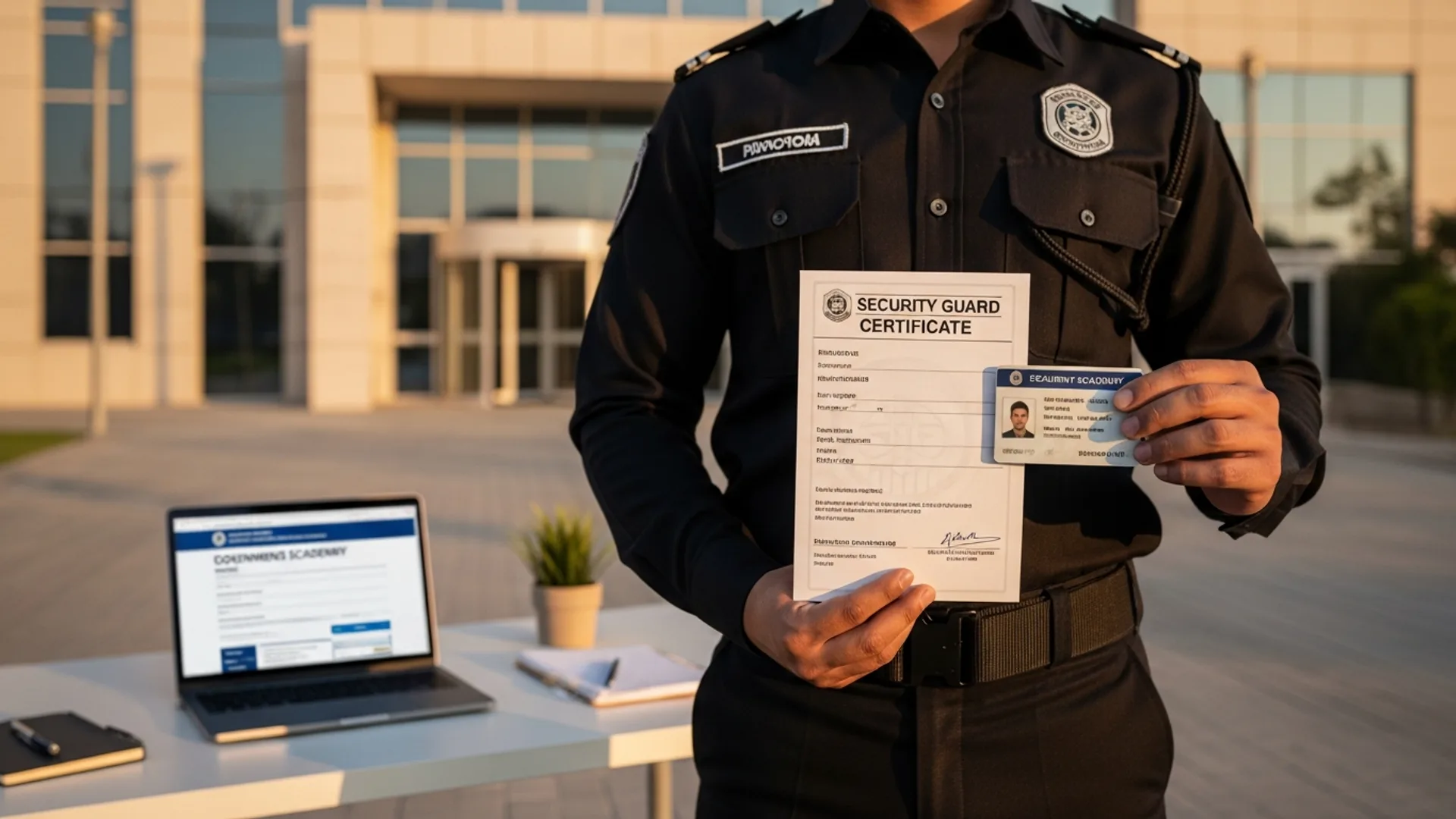
Quick AnswerHow to get a SIRA certificate and card in Dubai 2026: training, exam, security vetting, the steps, documents and indicative cost for security guards.
How do I get a SIRA certificate in Dubai?
To get a SIRA certificate in Dubai you enrol on a security guard training course at a SIRA-accredited training institute, complete the required training hours, pass the assessment, clear a mandatory background check, and then receive your security guard certificate and SIRA card. The Security Industry Regulatory Agency, which operates under Dubai Police, governs the whole process. As an indicative 2026 guide, the combined training, exam and card cost usually sits within a few hundred to a couple of thousand dirhams, and the journey from enrolment to card most often takes a small number of days to a few weeks, depending mainly on how quickly your security vetting clears. The card is the credential that lets you work legally as a guard in the emirate, and your accredited training provider handles the course, the exam and the application on your behalf, so the single most important first step is choosing a recognised, accredited institute.
That clear answer hides a handful of decisions that determine whether your path into security work in Dubai is smooth or frustrating. Choosing an accredited training institute rather than an unrecognised provider is fundamental, because only accredited training counts toward a valid card. The completeness and accuracy of your document pack drives how quickly the application moves, since paperwork is the most common cause of delay. The mandatory security vetting sits largely outside your control, so understanding that it sets the pace helps you plan realistically. And knowing the difference between an individual card, which is what a guard needs, and a company licence, which is what a security business needs, ensures you pursue the right thing from the start. None of these are difficult once you understand how they fit together. This guide walks through what SIRA is, what the certificate and card are, who needs them, the step-by-step process, the training and exam, the vetting, the indicative 2026 cost, how the card differs from a company licence and a labour card, and the mistakes people most often make, so you can plan your route with confidence.
What SIRA is and who regulates security work in Dubai
SIRA stands for the Security Industry Regulatory Agency, the body responsible for regulating the private security industry in Dubai. It operates under Dubai Police, which reflects the seriousness with which security work is treated in the emirate. Private security is not an ordinary line of work; it places individuals in positions of trust at the entrances of buildings, in shopping malls, across residential communities, at events and on commercial sites, often with responsibility for the safety of people and property. Because of that responsibility, the activity is regulated end to end, from the training a guard receives, through the assessment that confirms their competence, to the background vetting that confirms their suitability, and finally to the card that authorises them to work. SIRA sits at the centre of this system, setting the standards and overseeing how guards are trained, certified and carded.
Understanding that SIRA operates under Dubai Police helps explain why the process is structured the way it is. The carding system is designed to give the public, employers and clients confidence that anyone performing a security role has been properly prepared and properly checked. It also gives the sector a consistent professional baseline, so that a guard carrying a SIRA card has demonstrably met the same core requirements as every other carded guard, regardless of which company employs them or which site they work on. This consistency is part of what makes Dubai's security sector dependable, and it is one of the reasons the emirate maintains a strong reputation for safety. For an individual entering the field, the key takeaway is that there is a clear, regulated path, and following it correctly is what turns you from an applicant into a legally authorised, employable security professional.
The role of Dubai Police in this framework also signals that integrity and conduct matter as much as practical skill. A security guard is, in many situations, the first point of contact for the public and the first responder to an unusual situation, so the system places real emphasis on character, reliability and professional behaviour alongside the technical aspects of the job. This is why the background check is a non-negotiable part of becoming carded, and why the training and assessment cover conduct and procedure rather than only physical aspects of the role. Approaching the process with that understanding, that you are being prepared and entrusted to uphold safety in a position of responsibility, sets the right tone for a successful and lasting career in the sector.
SIRA certificate versus SIRA card: what each one is
People sometimes use the terms SIRA certificate and SIRA card interchangeably, but it helps to understand them as two connected parts of the same outcome. The SIRA certificate is the confirmation that you have completed the required security guard training and passed the associated assessment. It is the evidence of your professional preparation, demonstrating that you have learned the duties, procedures, safety awareness and conduct expected of a guard and that you have met the standard set for the role. In that sense the certificate is about competence: it records that you are trained and assessed.
The SIRA card, on the other hand, is the official identity and authorisation card that you carry and present as proof that you are an approved, working security guard in Dubai. The card is what links your completed training, your passed assessment and your cleared background check into a single credential that employers, clients and the authorities recognise. Where the certificate confirms what you have achieved, the card is the live authorisation that lets you actually take up duties. In practice you progress from one to the other: you complete training and earn the certificate, you clear vetting, and the card is then issued so that you can work. Both matter, but the card is the credential that governs day-to-day employability, because a security company can only deploy a guard who holds a valid card.
This distinction is more than terminology, because it affects how you think about renewal and ongoing compliance. The card is the thing that authorises you to work at any given moment, so keeping it valid is essential to continuing in the role, and lapses can interrupt your ability to be deployed. Understanding that the card is a live authorisation, not a one-time achievement, encourages the right habits around keeping your documents current and your card in good standing. For most guards, the employing security company helps manage this alongside their wider employment paperwork, but the responsibility to hold a valid card ultimately rests with the individual working in the regulated role.
Who needs a SIRA certificate and card
The broad principle is straightforward: anyone working in a security guard role in Dubai generally needs to be SIRA-certified and to hold a valid SIRA card. This covers the great majority of frontline security positions across the emirate. Guards stationed at the entrances and lobbies of office towers and commercial buildings, personnel working in shopping malls and retail environments, security staff in residential communities and apartment buildings, guards deployed at events and venues, and those protecting industrial, logistics and commercial sites all fall within the scope of the carding requirement. The common thread is that they are performing a security function in a position of trust, which is exactly what the SIRA framework is designed to regulate.
The reason the requirement is so comprehensive is that it protects everyone who relies on the security guard, from the residents of a building to the visitors at an event to the businesses whose premises and people are being safeguarded. By ensuring that every guard has completed accredited training, passed an assessment and cleared a background check, the system raises the overall standard of private security and gives clients confidence that the people protecting their sites are competent and trustworthy. This is consistent with the UAE's broader emphasis on safety, order and professional standards, and it is why security companies operating in Dubai are required to deploy only properly carded personnel. For an individual, this means the card is not an optional extra but the very thing that makes you employable in the sector, which is why securing it correctly is the foundation of a career in security.
There is, however, an important distinction worth drawing for those whose ambitions go beyond working as a guard. If your goal is to start and run a security services business, supplying guards to clients, providing manpower, or offering security systems and solutions, then the individual card alone is not what you need. A business in the security sector requires a company licence and the wider approvals that govern providing regulated security services, which sits at the organisational level rather than the individual level. Understanding which side of this line you are on, an individual seeking to work as a guard versus an entrepreneur seeking to build a security company, is the single most important early decision, because it determines whether you pursue an individual card or a company licence. The rest of this guide focuses on the individual card path, while our guide to the SIRA licence in Dubai covers the company route.
The step-by-step process to get your SIRA certificate and card
While the exact sequence is administered by your accredited training institute, the journey to a SIRA certificate and card follows a clear and logical path, and understanding it in full helps you move through it efficiently. The first step is choosing a SIRA-accredited training institute, which matters more than any other single choice you make, because only training delivered by an accredited provider counts toward a valid card. Accredited institutes are recognised to deliver the required security guard training, administer the assessment and submit your application through the SIRA system, so selecting a reputable, accredited provider sets the entire process up for success. Take the time to confirm a provider's accreditation before enrolling rather than discovering afterward that their training does not count.
The second step is enrolment and document submission. When you join a course, you provide the institute with your identity and residency documents, photographs to the required specification, and the personal details needed for the mandatory background check. This is the stage where preparation pays off, because a complete, accurate document pack allows the institute to register you smoothly and begin the application without back-and-forth. The third step is the training itself, which is typically delivered over several days and covers the duties and responsibilities of a security guard, the procedures you must follow, safety and emergency awareness, professional conduct, and the rules that govern private security work in Dubai. The training is designed to genuinely prepare you for the role, so treating it as real professional development rather than a formality serves you well.
The fourth step is the assessment, which you sit after completing the training to confirm that you have understood the material and are ready for the responsibilities of the role. The fifth step, running alongside the others, is the mandatory security vetting and background check processed through the SIRA system, which confirms that you are suitable for a position of trust. This step is the one most likely to set the overall pace, because it depends on verification that is outside your direct control. The final step is issuance: once you have passed the assessment and cleared vetting, your security guard certificate is issued and your SIRA card is produced, at which point you are authorised to take up duties as a guard. Knowing this sequence in advance lets you anticipate each stage, prepare your documents early, and understand why the vetting step, rather than the training, is usually what determines your timeline.
The training and the exam explained
The training component of the SIRA process deserves a closer look, because it is where you are genuinely equipped for the role and where the foundation of your competence as a guard is built. Accredited security guard training in Dubai is designed to cover the full breadth of what a guard needs to know to perform the job safely and professionally. This includes a clear understanding of the duties and responsibilities of the role, so you know what is expected of you on a site; the standard procedures you are required to follow, from access control to incident handling; safety and emergency awareness, so you can respond appropriately when something goes wrong; and the professional conduct and customer-facing behaviour that define a good guard, since you are often the first point of contact for the public. The training also grounds you in the rules and standards that govern private security work in the emirate, so you understand the framework within which you operate.
Because guards interact with the public and may need to follow and relay instructions clearly, many roles place value on communication skills, often including a reasonable standard of English alongside other languages. Good communication is not a peripheral nicety in security work; it is central to de-escalating situations, directing people, coordinating with colleagues and reporting accurately. The training and the role both reflect this, which is why approaching the course as preparation for real-world interaction, rather than only as content to memorise for an exam, makes you a more effective and more employable guard.
The exam, or assessment, follows the training and confirms that you have absorbed the material and are ready for the responsibilities ahead. It typically tests your understanding of the duties and procedures, your awareness of safety and emergency handling, your grasp of professional conduct, and your knowledge of the relevant rules governing the sector. The purpose is to ensure that everyone who holds a SIRA card has met a consistent professional standard, which is what makes the card meaningful to employers and reassuring to the public. The specific format, pass marks and any rules around retakes are set by the regulator and administered through accredited institutes, and they can be updated over time, so you should confirm the current exam details with your training provider before your course. Preparing properly for the assessment, treating it as a genuine professional benchmark rather than a hurdle to scrape past, both improves your result and aligns with the spirit of a system designed to uphold quality and trust in the security sector.
Security vetting and the background check
The mandatory security vetting is one of the defining features of becoming a SIRA-carded guard, and it is worth understanding why it exists and how it shapes your timeline. Because a security guard occupies a position of trust, with responsibility for the safety of people and property, the regulator requires that every applicant clears a background and security check before being carded. This check confirms that an applicant has a record suitable for a trusted security role, which protects the public, clients and the integrity of the sector. It is processed through the SIRA system, reflecting the agency's role under Dubai Police, and it is a non-negotiable part of the path to a card. Far from being an obstacle, it is precisely what gives the SIRA card its value, because employers and the public can rely on the fact that every carded guard has been properly vetted.
From a practical standpoint, the vetting step is the part of the process most likely to determine your overall timeline, because it depends on verification that runs at its own pace and is not something you can speed up directly. This is different from the training and the exam, which are scheduled and completed within a known window. What you can control is the quality and accuracy of the information you provide, because the smoothest vetting outcomes come from clean, consistent, accurate documents and details. Errors, inconsistencies or missing information are the most common causes of delay at this stage, so the most effective thing you can do is ensure that every detail you submit is correct and that your documents are complete and clear. Your accredited training institute manages the submission, but the accuracy of what they submit depends on what you provide.
Understanding the vetting step also helps you plan realistically. If you are joining a security company that needs you deployed quickly, it is sensible to begin the process early, prepare your documents in advance, and confirm with your training provider the current expected timeframe for vetting and card issuance, so that your expectations match reality. Identity and residency matters in the UAE are handled through the Federal Authority for Identity, Citizenship, Customs and Port Security, commonly referred to as the ICP, so having your Emirates ID and residency documentation in good order supports a smooth process. The combination of completing accredited training, passing the assessment and clearing this vetting is what ultimately produces your card, and recognising that the check is both essential and somewhat time-dependent allows you to approach it with patience and good preparation rather than frustration.
Indicative 2026 cost of a SIRA certificate and card
Cost is naturally one of the first questions for anyone considering security work, and the encouraging news is that the cost of becoming SIRA-certified is generally modest compared with many other professional qualifications or business setups. That said, understanding the components helps you budget accurately and avoid surprises. The main elements are the security guard training course, the assessment, and the SIRA card itself, and many accredited institutes bundle these into an all-in package, which makes the total cost clearer than paying for each piece separately. Additional elements that may apply include a medical fitness check, the card production fee where it is charged separately, and any retake fee if it applies, so it is worth confirming exactly what a quoted package includes before you commit.
A particularly important point for many guards is that employers in the security sector often sponsor or reimburse these costs for staff they hire. If you are joining a security company, there is a good chance the company arranges and covers your training and carding as part of bringing you on board, in which case your out-of-pocket cost may be minimal or nil. For individuals arranging their own certification, the package quoted by an accredited institute is the figure to focus on, and asking for an all-in quote that covers training, exam, medical and card avoids the uncertainty of piecemeal charges. The table below sets out the indicative components so you can see how a realistic budget comes together rather than fixating on a single headline number, and so you can compare what different providers include.
| Cost component (2026) | Indicative AED range | Notes |
|---|---|---|
| SIRA security guard training + exam package | 300 – 2,000 | indicative — confirm current fees with the authority |
| SIRA card production fee | 100 – 500 | may be bundled in the package or charged separately |
| Medical fitness check | 200 – 600 | where required as part of the process |
| Card renewal (per cycle) | 100 – 500 | keep the card valid to stay deployable |
| SIRA company licence (security business) | 15,000 – 40,000+ | different route — for running a security services firm, not an individual card |
As with all such figures, these ranges are indicative and provided to help you plan rather than as fixed prices, because official fees are set by the authorities and training providers update their packages over time. The right way to use the table is as a framework for the questions to ask: what does the package include, is the medical and card fee covered, is there a retake fee, and what is the renewal cost. Armed with those questions, you can compare accredited institutes meaningfully and arrive at an accurate budget for your own situation. And if your employer is sponsoring the process, the relevant cost may simply be a matter of confirming what they cover. Either way, treating the figures as indicative and confirming current costs directly with an accredited training institute is the responsible approach.
Contact Us For Free Consultation
or
Ask on WhatsApp insteadLicensed UAE consultancy. One reply, no spam.
Thank you.
A consultant will reply on WhatsApp shortly.
How the SIRA card differs from a company licence and a labour card
Two distinctions cause more confusion than any others, and clearing them up saves a great deal of wasted effort. The first is the difference between a SIRA card and a SIRA company licence. The card is an individual credential: it confirms that one person is a trained, vetted and authorised security guard who may work in a security role. The company licence is an organisational credential: it is what a business needs in order to provide security services as a company, such as supplying guards or manpower to clients or offering security systems. If you want to work as a guard, the card is your route, and it is the focus of this guide. If you want to start and run a security business, you need the company licence together with the wider trade-licence and approvals process that governs providing regulated security services in Dubai. These are different undertakings at different levels, and our guide to the SIRA licence in Dubai covers the business pathway in detail for those who want to build a company rather than work as an individual guard.
The second distinction is between a SIRA card and a UAE labour card. These serve entirely different purposes and are not interchangeable. The SIRA card is the sector-specific credential, issued under the Security Industry Regulatory Agency, that authorises you to perform the regulated security activity, confirming your training, assessment and vetting. A labour card relates to your formal employment status and your work relationship with an employer under the federal employment framework overseen by the Ministry of Human Resources and Emiratisation, known as MOHRE. In practice, a working security guard typically needs both: the appropriate employment status and documentation that establishes your right to be employed, and the SIRA card that authorises you specifically to perform security duties. One does not replace the other. Your employing security company usually manages the employment side alongside your SIRA certification, and our guide to the UAE labour card explains how the employment credential works so you can see how the two fit together.
Holding these distinctions clearly in mind helps you direct your energy correctly from the outset. Someone who wants to be a guard should focus on accredited training and the individual card, while ensuring their employment paperwork is in order with their employer. Someone who wants to build a security company should focus on the company licence and the broader business setup, including the mainland or relevant structure, the approvals and the operational requirements that come with offering security services. Mixing these up, for instance pursuing an individual card when you actually intend to run a company, or assuming a SIRA card covers your employment status, leads to wasted time and gaps in compliance. Clarity about what you are trying to achieve points you straight to the right credential and the right process.
Building a career or a business in Dubai's security sector
For an individual, obtaining the SIRA card is the gateway to a stable and respected line of work in a sector that the emirate values highly. Security professionals are present across virtually every part of Dubai's built environment, from its towers and malls to its communities and venues, and demand for properly certified, professional guards reflects the city's emphasis on safety and order. Once carded, a guard can build experience, develop specialisms and progress within the field, and the consistent professional standard that the carding system creates means that your credential is recognised across employers. Approaching the role with professionalism, keeping your card valid, and treating the training and conduct standards as the foundation of a genuine career, rather than a one-off requirement, positions you well in a sector with steady, ongoing need.
For an entrepreneur, the security sector represents a regulated but real business opportunity. Running a security services company in Dubai means meeting the company-level requirements, which include the appropriate licence and approvals to provide regulated security services and the obligation to deploy only properly carded personnel. Because security is a trusted, regulated activity, the bar is set deliberately, and that is a feature rather than a drawback, because it keeps standards high and protects reputable operators. Setting up such a business typically involves choosing the right structure, often a mainland company given the nature of the activity and where clients are based, securing the necessary approvals, and putting in place the operational capacity to recruit, train and deploy carded guards. Our guide to mainland company formation in the UAE explains the structural foundations, and our SIRA licence guide focuses on the security-specific approvals, so that an aspiring operator can see the full path from idea to a compliant, operating security firm.
Whether your goal is to work as a guard or to build a company, the same principle underlies success in this sector: compliance and professionalism are not obstacles but the very things that make the field dependable and that protect those who do it properly. The SIRA framework, operating under Dubai Police, exists to ensure that the people and businesses entrusted with safety meet a clear standard, and aligning yourself with that standard, rather than looking for shortcuts around it, is what builds a durable career or a sustainable business. For individuals, that means choosing an accredited institute, preparing thoroughly and treating the training as real professional development. For businesses, it means embracing the licensing and approvals as the foundation of a trustworthy operation. In both cases, doing it properly is the path that lasts.
Common Mistakes to Avoid
The most common and most costly mistake is enrolling with a training provider that is not SIRA-accredited. Because only training delivered by an accredited institute counts toward a valid card, choosing an unrecognised provider can mean paying for a course that does not lead anywhere, then having to start again with an accredited institute. Always confirm a provider's accreditation before you enrol, and treat that verification as the first and most important step rather than an afterthought. A reputable, accredited institute will be transparent about its status and will be able to handle the training, the assessment and the application through the proper channels.
A second frequent mistake is submitting an incomplete or inconsistent document pack. Missing photographs, expired identity or residency documents, or details that do not match across your paperwork are among the most common causes of delay, particularly at the vetting stage where accuracy matters most. The fix is simple but easily overlooked: ask your accredited institute for the definitive, current document checklist before you start, gather clean and clear copies of everything, and double-check that every detail is consistent. Arriving fully prepared on the first day of training allows the application to be submitted promptly and the vetting to proceed without back-and-forth.
A third mistake is misunderstanding the timeline by assuming the training course determines how long everything takes. In reality, the mandatory security vetting and background check is usually the step that sets the overall pace, and it depends on verification that runs at its own speed. People who assume they can be working within a day or two of finishing a short course can be caught out when the clearance takes longer. The remedy is to start early, prepare your documents in advance, and confirm the current expected processing time with your training provider, so your expectations are realistic and you can plan deployment accordingly.
A fourth mistake is confusing the individual SIRA card with the SIRA company licence, or assuming the card covers everything. An individual who actually wants to run a security business may waste time pursuing only a personal card, while an entrepreneur may underestimate the company-level approvals required to provide security services. Equally, some assume a SIRA card replaces their employment documentation or labour card, which it does not. Clarify from the outset whether you are an individual seeking to work as a guard or an entrepreneur seeking to build a company, and recognise that the SIRA card and your employment status are separate things that both need to be in order.
A final mistake is treating the training and the card as a one-off formality rather than an ongoing professional standing. The card is a live authorisation that needs to be kept valid to remain deployable, and letting it lapse can interrupt your ability to work. Likewise, treating the training merely as something to get through, rather than as genuine preparation for a responsible role, undermines both your competence and your prospects. Approaching the whole process with the professionalism the sector expects, keeping your card current, and treating your conduct and skills as the foundation of a real career, is what turns certification into lasting success. You can confirm the regulator's role and the official framework through the Dubai Police official portal, which oversees the Security Industry Regulatory Agency.
If you would like help, Noble Core Ventures can guide individuals toward the right accredited route to a SIRA certificate and card, and support entrepreneurs through the full process of licensing and setting up a compliant security services company in Dubai, from choosing the right structure to securing the necessary approvals.
Talk to Our Experts
getting your SIRA security guard certificate and card, or licensing a security services company in Dubai
Frequently Asked Questions
How do I get a SIRA certificate in Dubai?
To get a SIRA certificate in Dubai you enrol on a security guard training course at a SIRA-accredited training institute, complete the required training hours, and pass the assessment set under the Security Industry Regulatory Agency, which operates under Dubai Police. Your training provider submits your details for the mandatory security vetting and background check through the SIRA system. Once you pass the course assessment and clear vetting, your security guard certificate is issued and your SIRA security card is produced, which together authorise you to work legally as a security guard in the emirate. The practical first step is choosing an accredited institute, because they run the training, the exam and the application on your behalf, so picking a recognised provider keeps the whole journey straightforward.
What is a SIRA card and why do I need one?
A SIRA card is the official identity and authorisation card issued under the Security Industry Regulatory Agency in Dubai that confirms an individual is a trained, vetted and approved security guard. It is the credential that lets you work legally in a security role in the emirate, whether guarding a residential tower, a mall, an office building, an event or a commercial site. You need it because security work in Dubai is a regulated activity, and employers in the sector are required to deploy only properly certified and carded personnel. The card links to your completed SIRA training, your passed assessment and your cleared background check, so it serves as proof to employers, clients and the authorities that you meet the professional and integrity standards the regulator requires of everyone working in private security.
How long does it take to get a SIRA certificate and card?
Timelines vary by training institute and by how quickly your security vetting clears, but the most common path runs over a small number of days to a few weeks rather than months. The training course itself is typically completed within several days, after which you sit the assessment. The element that most often sets the overall pace is the mandatory background check and security clearance processed through the SIRA system, because that step is outside your control and depends on verification. A complete, accurate document pack submitted by your training provider keeps things moving, while missing paperwork or errors in your details are the usual cause of delay. To keep your timeline short, choose an accredited institute, bring all required documents on day one, and confirm the current expected processing time directly with the provider before you enrol.
How much does a SIRA certificate and card cost in 2026?
As an indicative 2026 guide, the combined cost of SIRA security guard training, the assessment and the card typically falls within a few hundred to a couple of thousand dirhams, with the exact figure depending on the training institute, the course package and whether items such as the medical, the card fee and any retake are bundled or charged separately. Many institutes quote an all-in package that covers the training, the exam and the card application, which makes budgeting clearer than paying piecemeal. Employers in the security sector often sponsor or reimburse these costs for staff they hire, so if you are joining a security company you may not pay out of pocket. Because official fees are set by the authorities and providers update their packages, treat any figure as indicative and confirm the current cost directly with an accredited training institute before you commit.
What are the requirements to become a SIRA-certified security guard?
The core requirements to become a SIRA-certified security guard in Dubai are consistent even though exact details can change. You generally need to be an adult meeting the minimum age set by the regulator, hold valid identity and residency documents, be medically fit for the role, and pass the mandatory security background check that confirms you have a clean record suitable for a trusted security position. You then complete the required SIRA-accredited training and pass the associated assessment, which together demonstrate that you understand your duties, the relevant procedures and the conduct expected of a guard. Many roles also require a reasonable standard of communication, often including basic English, because guards interact with the public and may need to follow and relay instructions. The clearest way to confirm the current requirements for your situation is to ask an accredited training institute, which checks your eligibility before enrolment.
Is there an exam for the SIRA security guard certificate?
Yes. After completing the SIRA-accredited security guard training, you sit an assessment that confirms you have understood the material and are ready for the responsibilities of the role. The assessment typically covers the duties and responsibilities of a security guard, the procedures you are expected to follow, awareness of safety and emergency situations, professional conduct and customer-facing behaviour, and the relevant rules that govern private security work in Dubai. The purpose of the exam is to ensure that everyone carrying a SIRA card has met a consistent professional standard, which protects the public and upholds the reputation of the security sector. Formats, pass marks and any retake rules are set by the regulator and administered through accredited institutes, and they can be updated over time, so you should confirm the current exam format and pass requirements with your training provider before your course.
What documents do I need to apply for a SIRA card?
While the exact list is confirmed by your accredited training institute and the regulator, you should generally be ready with a valid passport, your Emirates ID and your UAE residence visa where applicable, recent passport-size photographs that meet the required specification, and the personal details needed for the mandatory background and security check. A medical fitness check is commonly part of the process, and employer or sponsorship details are needed where a security company is engaging you. Having clean, clear copies of every document ready on the first day of training is one of the simplest ways to avoid delay, because incomplete or inconsistent paperwork is the most frequent reason an application stalls. Because requirements can be updated, ask your training institute for the current, definitive checklist before you enrol so you arrive fully prepared and the application can be submitted without back-and-forth.
What is the difference between a SIRA card and a SIRA company licence?
A SIRA card is an individual credential held by a security guard, confirming that the person is trained, vetted and authorised to work in a security role in Dubai. A SIRA company licence, by contrast, is what a business needs in order to provide security services as a company, such as supplying guards, manpower or security systems to clients. The two operate at different levels: the card is about a single person being allowed to work, while the company licence is about an organisation being approved to offer regulated security services and to deploy carded personnel. If you simply want to work as a guard, the card is your route. If you want to start and run a security services business, you need the company licence alongside the wider trade-licence and approvals process, and our guide to the SIRA licence in Dubai explains that business pathway in full.
Does a SIRA card replace a UAE labour card?
No. A SIRA card and a UAE labour card serve different purposes and are not interchangeable. The SIRA card is the sector-specific credential issued under the Security Industry Regulatory Agency that authorises you to work in a security role, confirming your training, vetting and approval as a guard. A labour card relates to your formal employment status and your work relationship with an employer under the federal employment system overseen by the Ministry of Human Resources and Emiratisation, known as MOHRE. A security guard typically needs the appropriate employment status and documentation as well as the SIRA card, because one establishes your right to be employed and the other authorises you specifically to perform the regulated security activity. Your employing security company usually handles the employment side alongside your SIRA certification, and you can read more in our guide to the UAE labour card.
Can I work as a security guard in Dubai without a SIRA card?
No. Security work in Dubai is a regulated activity, and individuals performing security guard duties are required to hold a valid SIRA card issued under the Security Industry Regulatory Agency, which operates under Dubai Police. Working in a guarding role without the proper certification and card is not permitted, and reputable security companies will only deploy carded personnel because they too are bound by the regulator’s requirements. The carding system exists to ensure that everyone in a position of trust in private security has been properly trained, assessed and vetted, which protects the public, clients and the integrity of the sector. If you want to work as a guard, the correct and only compliant route is to complete SIRA-accredited training, pass the assessment, clear the background check and obtain your card before taking up duties, which an accredited training institute can arrange for you.