Quick AnswerDubai CommerCity 2026 guide: licence prices are not published, so here are real federal costs from AED 300, 5% customs duty, VAT rules and setup steps.
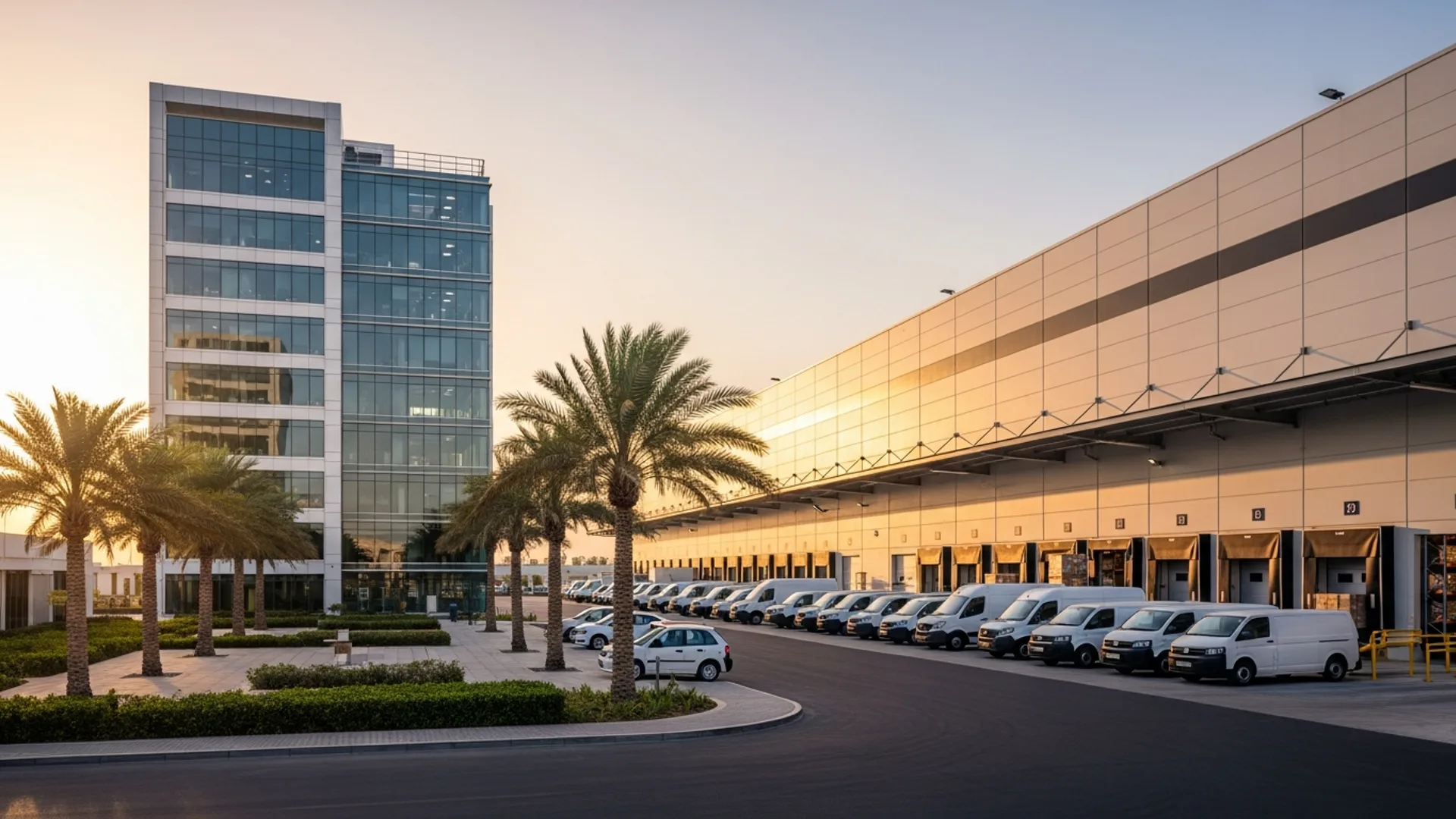
Dubai CommerCity is the region's first free zone designed from the ground up for ecommerce — offices, warehousing and fulfilment infrastructure on one campus in Umm Ramool, developed as a joint venture involving the Dubai Airport Free Zone Authority. For online retailers it is one of the few UAE jurisdictions where the physical logistics layer was designed alongside the licensing layer rather than bolted on afterwards.
What it does not offer is a published price list. Licence packages, office rents and warehouse rates are quoted on enquiry, which means any specific figure you find on a comparison site is a sales estimate. What is fixed and knowable are the federal costs — an establishment card at AED 300 plus AED 2,000 for first-time e-system registration, entry permits at AED 300, and the 5% GCC import duty that hits every consignment you clear into the mainland. This guide builds your ecommerce cost model from those verifiable numbers up.
Your setup cost, in 10 seconds
Package prices. Health insurance is required by law and not included.
Thank you.
Your written quote follows on WhatsApp.
What is Dubai CommerCity and what does an ecommerce licence there cost?
Dubai CommerCity is a purpose-built ecommerce free zone in Umm Ramool, Dubai, structured into three clusters: Business (offices), Logistics (warehousing and fulfilment) and Social (retail and food and beverage). Licence and warehouse prices are not published and are quoted per enquiry. The unavoidable federal costs are: establishment card AED 300 plus AED 2,000 first-time, entry permit AED 300 plus AED 1,000 refundable, and 5% customs duty on most imported goods.
The concept behind CommerCity is that ecommerce breaks the traditional free zone model. A conventional trading free zone gives you a licence and a warehouse, and assumes you ship pallets to distributors. An online retailer ships individual parcels to individual consumers, processes returns at volume, needs pick-and-pack capacity rather than bulk storage, and lives or dies on last-mile performance. CommerCity's three-cluster layout is an attempt to co-locate all of that.
| Cost item | Published figure (AED) | Authority |
|---|---|---|
| Dubai CommerCity licence package | Not published | Quoted on enquiry |
| Dubai CommerCity office / warehouse rent | Not published | Quoted on enquiry |
| Establishment card | 300 + 2,000 first-time e-system | Federal |
| Employment entry permit | 300 + 1,000 refundable | Federal |
| Status change (in-country) | 500 | Federal |
| Residence permit | 100 + 100 per year + 100 smart service | Federal |
| Emirates ID | 100 per year of residence + 100 smart service | Federal |
| Medical fitness (Dubai) | 270 standard / 700 VIP 6h / 1,020 VIP 2h | Dubai |
| Golden residence | 1,200 | Federal |
| Green residence | 700 | Federal |
| Overstay penalty | 50 per day | Federal |
| Import duty (most goods) | 5% of CIF value | GCC common tariff |
| VAT | 5%, threshold AED 375,000 | Federal Tax Authority |
| Trade name (Dubai mainland comparator) | 620 | DET |
| Ejari (mainland comparator) | 177.75 app / 220 trustee | Dubai |
| Masdar City (published comparator) | 7,000 / 12,000 / 17,500 / 27,000 + 5% VAT | Masdar City |
| Ajman Media City (cheapest published) | 4,999, zero visas | Ajman Media City |
| UAQ FTZ (published, with visa) | 12,500 all-in | UAQ FTZ |
| KEZAD (published, with visa) | 9,450 | KEZAD |
That comparator block at the bottom exists for a reason. When a zone does not publish, the only defensible way to judge a quote is against zones that do. Our primary research found roughly half of UAE free zones publish no prices, so this is not a CommerCity-specific complaint — it is the market norm, and it is why founders end up paying wildly different amounts for functionally identical setups.
The three clusters and what each one is for
Business Cluster. Office accommodation ranging from small serviced units to full floors, aimed at the commercial, marketing, buying and customer-service functions of an online retailer. This is where most licences are anchored and where your visa quota is typically calculated.
Logistics Cluster. Warehousing, storage and fulfilment facilities designed for parcel-level operations rather than pallet-level ones — pick-and-pack areas, returns processing, and the temperature and security segregation that certain product categories require. Third-party logistics providers operate here alongside brands running their own fulfilment.
Social Cluster. Retail, food and beverage and multipurpose space, supporting the campus population and providing a physical showroom or brand-experience option for online-first businesses that want a touchpoint.
The commercial logic of taking space in more than one cluster is real: brands that start with an office and outsource fulfilment often bring it in-house as volume grows, and doing that inside the same free zone avoids re-licensing.
Who Dubai CommerCity fits
Direct-to-consumer brands. Beauty, apparel, supplements, homeware and similar categories shipping parcels regionally, where fulfilment quality is a competitive differentiator.
Marketplace sellers and aggregators. Businesses selling across regional marketplaces that need bonded storage and rapid replenishment.
Ecommerce enablers. Platform providers, payment and checkout technology, returns and reverse-logistics specialists, subscription-box operators.
Third-party logistics and fulfilment operators. Companies whose product is the warehouse itself.
Digital agencies and service providers serving the above, though these have less reason to pay for logistics-adjacent real estate.
Who it fits poorly: a founder selling exclusively to UAE mainland consumers at low volume, for whom a mainland DET e-trader or standard commercial licence is simpler and avoids the customs friction entirely. And any business with no goods at all — a pure SaaS or consultancy — is paying for infrastructure it will never use.
Licence types and legal forms
Licence categories generally cover ecommerce and trading activities, general trading where broader import and re-export scope is needed, service and professional activities, and logistics activities for fulfilment operators. The activity list drives your customs treatment, your storage permissions and your visa allocation, so it should be scoped against a two-year operating plan rather than a first-quarter one.
Legal forms follow the standard free zone pattern:
Free Zone LLC. New incorporation, one or more individual or corporate shareholders, 100% foreign ownership.
Branch of a UAE company. An existing UAE entity extends into the zone; no separate legal personality.
Branch of a foreign company. An overseas parent registers a branch with fully attested and legalised documents.
Step-by-step: setting up an ecommerce company in Dubai CommerCity
Step 1 — Model the goods flow before the licence. For an ecommerce business the licence is downstream of the logistics question. Where do goods originate, where are they stored, who is the importer of record, who owns the stock, and who is the customer? Answer that and the licence structure becomes obvious. Get it wrong and you will restructure within a year.
Step 2 — Obtain a written, itemised quote. Because nothing is published, insist on separated line items: licence fee, office cost, warehouse cost per square metre, visa allocation cost, establishment card, registration fees, and refundable deposits. A single bundled figure cannot be compared.
Step 3 — Reserve the company name. Standard UAE naming rules apply — no religious references, no authority names, no misleading activity implication.
Step 4 — Submit shareholder documentation. Individuals: passport, entry stamp or visa page, proof of address, business profile. Corporate shareholders: attested certificate of incorporation, memorandum and articles, board resolution, certificate of good standing, power of attorney. All foreign documents require notarisation, legalisation and Arabic translation — start this immediately.
Step 5 — Select space across the clusters. Office in Business Cluster, warehouse or fulfilment capacity in Logistics Cluster if you hold your own stock. Visa quota follows space.
Step 6 — Issue the licence and corporate pack. Trade licence, certificate of incorporation, constitutional documents, share certificate and lease.
Step 7 — Register with customs. This is the ecommerce-specific step that founders most often underestimate. You need a customs client registration and an importer code before any consignment can be cleared. Dubai Customs administers this and operates the Mirsal 2 declaration system. Without registration your first container sits, accruing storage.
Step 8 — Establishment card and visas. Establishment card at AED 300 plus AED 2,000 first-time e-system. Then per person: entry permit AED 300 plus AED 1,000 refundable, or status change AED 500; medical AED 270 standard in Dubai; residence permit AED 100 plus AED 100 per year plus AED 100 smart service; Emirates ID AED 100 per residence year plus AED 100 smart service. Dubai files go through GDRFA, with ICP at https://icp.gov.ae/ as the federal authority.
Step 9 — Register with the Federal Tax Authority. Corporate tax registration through EmaraTax at https://tax.gov.ae/ is mandatory. VAT registration follows the threshold.
Step 10 — Set up payments, banking and platform accounts. Payment gateway onboarding requires the trade licence and often a bank account, and gateways underwrite ecommerce merchants on chargeback risk. Build two to six weeks into the plan.
Customs, duty and the mainland problem
This is the section that saves ecommerce founders the most money, because it is where the free zone model most commonly collides with reality.
A free zone is, for customs purposes, treated as outside the UAE customs territory. Goods sitting in your CommerCity warehouse have not been imported into the UAE. That is genuinely useful for re-export: stock can arrive, be stored, be picked and be shipped onward to another country without UAE duty ever crystallising.
The moment a parcel crosses into the UAE mainland to reach a customer, it is an import. Duty becomes payable — commonly 5% of CIF value under the GCC common external tariff, with some categories rated differently and some exempt. A customs declaration is filed through Mirsal 2 under your importer code. Dubai Customs administers this; it is a real authority for accuracy purposes but not one of the licensing bodies, and the licensing consequences sit with DET if you need a mainland presence.
Three structures founders commonly use:
Free zone entity plus mainland distributor. The free zone company sells to an independent mainland distributor who imports, pays duty, and sells onward. Clean, but you surrender margin and customer relationship.
Free zone entity plus mainland branch or subsidiary. You own both sides. The mainland entity, licensed by DET, is the importer of record and invoices UAE customers directly. More cost, more control.
Mainland-only. For a business whose customers are overwhelmingly UAE-based, skipping the free zone entirely and running a DET mainland e-trader or commercial licence is often simpler and cheaper on a total-cost basis.
Note also that Dubai Municipality at https://www.dm.gov.ae/ regulates food products, cosmetics and certain consumer goods, requiring product registration and label approval before sale. Ecommerce does not exempt you from product registration — it just means the enforcement finds you later.
Contact Us For Free Consultation
or
Ask on WhatsApp insteadLicensed UAE consultancy. One reply, no spam.
Thank you.
A consultant will reply on WhatsApp shortly.
VAT and corporate tax for online retailers
VAT. The standard rate is 5%. Mandatory registration applies once taxable supplies exceed AED 375,000 in a twelve-month period; voluntary registration is available from AED 187,500. For ecommerce the place-of-supply rules matter: goods delivered to a UAE address are generally a UAE supply, while genuine exports may be zero-rated with the correct evidence retained. Designated-zone status affects the treatment of goods moved into and out of certain free zone locations, but it does not make services supplied to UAE customers VAT-free. Keep export evidence obsessively — it is the single most common VAT audit failure in trading businesses.
Corporate tax. Registration with the Federal Tax Authority is mandatory. The rate is 0% on taxable income up to AED 375,000 and 9% above, with the return due nine months after year-end. A Qualifying Free Zone Person can achieve 0% on qualifying income without the AED 375,000 ceiling, subject to maintaining adequate substance, deriving qualifying income, not electing standard rates, complying with transfer pricing rules and staying within the de minimis limits for non-qualifying revenue.
For ecommerce specifically, the qualifying-income question is sharp: revenue from UAE mainland consumers is unlikely to be qualifying income. A D2C brand whose customers are mostly in the UAE should model the standard 9% outcome rather than assume 0%, and check whether Small Business Relief — available where revenue is AED 3,000,000 or less — covers the early years instead. Groups with consolidated revenue of EUR 750 million or more fall within the 15% Domestic Minimum Top-up Tax.
Comparison: CommerCity against the alternatives
| Option | Price published? | Fulfilment infrastructure | Mainland sales | Best for |
|---|---|---|---|---|
| Dubai CommerCity | No | Purpose-built, on campus | Via customs / distributor | D2C brands holding own stock |
| DMCC | Yes | General warehousing available | Via customs / distributor | Broad trading, services |
| Masdar City Free Zone | Yes — 7,000 / 12,000 / 17,500 / 27,000 + 5% VAT | Limited | Via customs / distributor | Cleantech, AI, R&D |
| KEZAD | Yes — 9,450 with visa | Strong industrial and logistics | Via customs / distributor | Volume logistics, manufacturing |
| UAQ Free Trade Zone | Yes — 12,500 all-in | Basic | Via customs / distributor | Budget trading entities |
| Ajman Media City | Yes — 4,999, zero visas | None | Via customs / distributor | Lowest published entry, no visas |
| Dubai mainland (DET) | Yes | Rent your own | Direct, unrestricted | UAE-focused online retail |
| Abu Dhabi mainland (DED via TAMM) | Yes — ~1,125 issuance, ~960 renewal | Rent your own | Direct, unrestricted | Capital-based operations |
The honest summary: CommerCity's value proposition is the infrastructure and the ecommerce-specific design, not the price. If your model needs parcel-level fulfilment inside a free zone, few alternatives match it. If your model is "sell to UAE customers online", a mainland DET licence removes the customs layer entirely and is frequently the better answer.
Worked example: a D2C skincare brand
A founder launches a skincare brand, manufacturing in South Korea, selling to UAE, Saudi and Kuwaiti consumers online, projecting AED 4 million of revenue in year two with three staff.
Structure. A free zone entity in Dubai CommerCity holding stock in the Logistics Cluster, plus — because roughly 60% of orders are UAE mainland — a mainland arrangement for importing and invoicing UAE customers.
Customs. Customs client registration and importer code before the first shipment. Import duty at 5% of CIF on goods clearing to the mainland; goods shipped onward to Saudi and Kuwait leave without UAE duty crystallising.
Product compliance. Cosmetics require product registration and label approval with Dubai Municipality. This must precede sale, not follow it.
Immigration. Establishment card AED 300 plus AED 2,000 first-time. Per person: entry permit AED 300 plus AED 1,000 refundable, medical AED 270, residence permit AED 100 plus AED 100 per year plus AED 100 smart service, Emirates ID AED 100 per residence year plus AED 100 smart service.
Tax. VAT registration is unavoidable at AED 4 million of supplies — 5% on UAE-delivered orders, zero-rating on genuine exports with evidence retained. Corporate tax registration with the Federal Tax Authority; because UAE mainland consumer revenue dominates, the founder models 9% above AED 375,000 rather than assuming Qualifying Free Zone Person status. Small Business Relief covered year one at under AED 3,000,000 but does not cover year two.
The lesson. The customs and VAT layer, not the licence, is what determines this business's unit economics. A founder who optimises the licence fee and ignores duty and place-of-supply is optimising the smallest line on the page.
Warehousing, returns and the operational realities
The reason a founder pays a premium for a purpose-built ecommerce zone is operational, so it is worth being precise about what that actually buys.
Storage profile. Ecommerce inventory is wide and shallow — many SKUs, low units per SKU — where traditional trading inventory is narrow and deep. That changes the racking, the pick paths and the space per dirham of revenue. Founders who budget warehouse space from a wholesale mental model consistently under-provision, and then discover that adding a second unit mid-year is neither cheap nor quick.
Pick, pack and dispatch. Parcel-level fulfilment needs packing benches, consumables storage, label printing and a dispatch area sized for courier collection windows rather than container loading. A shell warehouse without this layout is a fit-out project, and fit-out inside a free zone requires the zone's approval and, depending on the works, civil defence sign-off.
Returns. This is the line item most business plans omit entirely. Regional ecommerce return rates in apparel and footwear are high enough to require a dedicated inspection, refurbishment and restocking process. Returns also have a customs dimension: goods that were cleared into the mainland and are then returned to a free zone warehouse are a re-export movement, and the paperwork has to reflect that. Getting it wrong creates a stock ledger that no longer reconciles with customs records, which is a genuinely painful position to unwind during an audit.
Cash on delivery. COD remains a meaningful share of regional ecommerce orders. It affects working capital, reconciliation and fraud exposure far more than founders from card-dominant markets expect, and it interacts with VAT accounting because the tax point does not wait for the cash.
Last mile and courier selection. Delivery performance is a competitive weapon in this market, and courier contracts are negotiated on volume. A campus with courier presence on site shortens the collection cycle, which is worth real money at scale and nothing at all at ten orders a day.
Cold chain and regulated categories. Supplements, cosmetics and food require temperature control, segregation and product registration. Dubai Municipality governs product registration and label approval for these categories, and the requirement applies before first sale, not after the first complaint. Build registration lead time into your launch plan.
Insurance and liability. Stock in a free zone warehouse needs its own cover, and the lease will specify minimum requirements. Product liability is a separate consideration for anything applied to skin or ingested.
The honest test for whether CommerCity's infrastructure justifies its premium is simple: if you will hold your own stock, ship parcels at volume, and process returns as a routine operation, the campus earns its keep. If you are dropshipping, using a third-party fulfilment provider elsewhere, or shipping fewer than a few hundred orders a month, you are paying for capability you will not use — and a published-price zone or a DET mainland licence will serve you better.
Common Mistakes Ecommerce Founders Make at Dubai CommerCity
- Trusting an unsourced licence price. CommerCity does not publish package prices. Demand a written, itemised quote and benchmark it against zones that do publish — Masdar City, KEZAD, UAQ, Ajman Media City.
- Assuming free zone status means duty-free sales into the UAE. Every parcel crossing into the mainland is an import, attracting duty commonly at 5% of CIF and requiring a declaration under an importer code.
- Skipping customs registration until stock arrives. The importer code and customs client registration must exist before the first consignment. Without them, containers sit and storage charges accrue.
- Assuming 0% corporate tax. Registration with the Federal Tax Authority is mandatory, and revenue from UAE mainland consumers is unlikely to be qualifying income for Qualifying Free Zone Person purposes. Model 9% above AED 375,000 unless you have a genuine export-led case.
- Ignoring product registration. Cosmetics, supplements and food require registration and label approval with Dubai Municipality before sale. Selling first and registering later invites enforcement and stock seizure.
- Under-specifying warehouse capacity. Ecommerce inventory does not scale linearly with revenue — returns, seasonal peaks and SKU proliferation all consume space faster than forecasts assume.
- Neglecting VAT export evidence. Zero-rating an export without documentary proof is the most common finding in trading-company VAT reviews. Retain shipping and customs evidence for every zero-rated sale.
- Choosing a free zone when mainland was the right answer. If most of your customers are UAE-based, a DET mainland licence removes the customs and structuring complexity entirely and is often cheaper on a total-cost basis.
Building Your Ecommerce Business with Noble Core
Ecommerce is the UAE business model where the wrong jurisdiction costs the most, because the mistake compounds with every shipment rather than showing up once at renewal. Noble Core Ventures starts with your goods flow and customer mix, models the duty, VAT and corporate tax outcome for each realistic structure, and only then recommends a licence — Dubai CommerCity, a published-price alternative, a mainland licence, or a two-entity structure combining both.
We then run the execution: written quotes, incorporation, attestation, premises, customs client registration and importer code, establishment card, GDRFA and ICP residence files, Emirates ID, payment gateway and banking introductions, and Federal Tax Authority registration for corporate tax and VAT.
For the underlying decision framework, start with our Dubai business setup pillar guide. To benchmark any CommerCity quote against zones that actually publish their fees, use our UAE free zone cost comparison for 2026. If you are weighing the capital's logistics ecosystem instead, our Abu Dhabi business setup guide for 2026 covers KEZAD and the TAMM mainland route. And for founders who conclude that unrestricted mainland trading at lower overhead is the real answer, our guide to Sharjah mainland business setup in 2026 walks through that path in detail.
Book a free 20-minute consultation and we will model your actual landed cost before you sign anything.
Talk to Our Experts
Noble Core Ventures structures ecommerce companies properly — Dubai CommerCity or an alternative, customs registration, VAT and duty modelling, mainland distribution, visas and Federal Tax Authority registration. Free 20-minute consultation.
Frequently Asked Questions
What is Dubai CommerCity?
Dubai CommerCity is a free zone in Umm Ramool built specifically for ecommerce, combining office space, warehousing and fulfilment infrastructure in one licensed campus for online retail businesses.
How much does a Dubai CommerCity licence cost?
Licence and warehouse prices are not published publicly. Packages are quoted on enquiry by activity, space and visa count, so treat any fixed online figure as an agency estimate.
What are the three clusters at Dubai CommerCity?
The Business Cluster provides offices, the Logistics Cluster provides warehousing and fulfilment facilities, and the Social Cluster provides retail, food and beverage and multipurpose space.
Can Dubai CommerCity companies sell to UAE mainland customers?
Not directly without customs clearance. Goods leaving a free zone into the mainland attract import duty, commonly 5%, and usually require a mainland importer, distributor or branch.
Do I need customs registration for ecommerce?
Yes, if you import goods. You need an importer code and a customs client registration to file declarations through Mirsal 2 before shipments can clear into or out of the zone.
What is the UAE import duty on ecommerce goods?
The common GCC external tariff is 5% on most goods, calculated on CIF value. Certain categories carry higher rates and some are exempt, so verify by HS code.
Do ecommerce companies pay UAE corporate tax?
Yes, registration with the Federal Tax Authority is mandatory. A Qualifying Free Zone Person may pay 0% on qualifying income; otherwise 0% to AED 375,000 and 9% above.
When must an online store register for VAT?
Once taxable supplies exceed AED 375,000 in twelve months, registration is mandatory. Voluntary registration starts at AED 187,500 and the standard rate is 5%.
How long does Dubai CommerCity setup take?
Typically three to six weeks once shareholder documents are attested, longer if warehouse fit-out or customs registration is on the critical path. Visas add two to four weeks per person.
Is Dubai CommerCity better than DMCC for ecommerce?
CommerCity offers purpose-built fulfilment infrastructure; DMCC publishes its fees and offers broader trading scope. Compare written quotes for identical space and visa counts before deciding.