Quick AnswerElderly care license Dubai 2026: DHA facility approvals, DET trade licence, staffing, AED 620 trade name, visas, 9% corporate tax and timelines.
Demand for senior services in the emirate is rising steadily as the resident population matures and more families choose to remain in the UAE long term. Anyone pursuing an elderly care license Dubai regulators will actually issue needs to understand the structure first: this is a health-regulated activity, not an ordinary commercial one. The Dubai Health Authority (DHA) licenses the facility and its clinical professionals, the Department of Economy and Tourism (DET) issues the trade licence the company operates under, and Dubai Municipality plus Civil Defence approve the premises. Budget from day one for the AED 620 trade name reservation and Ejari registration at AED 177.75 online or AED 220 through a typing trustee.
Dubai's approach to senior care is deliberately protective, and rightly so. The regulators are looking for operators who can demonstrate clinical governance, dignified environments, safe staffing and genuine continuity of care. Founders who design their model around those expectations move through approvals steadily. Founders who treat the licence as a formality to be handled after the lease is signed lose months and, frequently, a substantial share of their capital. This guide sets out the full route in the sequence the authorities actually work in.
Your setup cost, in 10 seconds
Package prices. Health insurance is required by law and not included.
Thank you.
Your written quote follows on WhatsApp.
What Is an Elderly Care License in Dubai and Who Issues It?
A Dubai elderly care licence is a layered authorisation. DHA issues the health facility licence defining the services you may deliver and licenses every clinical professional individually, while DET issues the commercial trade licence. Dubai Municipality and Civil Defence approve the premises. Expect six to twelve months end to end, an AED 620 trade name fee, Ejari at AED 177.75 to AED 220, and corporate tax at 0% up to AED 375,000 then 9%.
The layering matters because each authority tests something different and none of them accepts another's approval as a substitute. DET tests the corporate vehicle: shareholders, legal form, activity codes, registered address. DHA tests clinical capability: the medical director or clinical lead, nurse-to-resident ratios, care protocols, medication management, infection control, incident reporting and record-keeping. Dubai Municipality tests hygiene, catering and environmental standards. Civil Defence tests fire detection and, critically for this sector, evacuation strategy for residents with limited mobility.
| Requirement | Authority | Position in 2026 |
|---|---|---|
| Trade name reservation | DET | AED 620 government fee |
| Initial approval and activity codes | DET | Health or social care activity classification |
| Tenancy registration (Ejari) | Ejari / DLD | AED 177.75 online, AED 220 via trustee |
| Health facility licence | DHA | Fee schedule published on the DHA portal by category |
| Individual professional licences | DHA | Per clinician; assessment and credential verification |
| Hygiene, catering and premises | Dubai Municipality | Assessed at fit-out and pre-opening |
| Fire and life safety certificate | Civil Defence | Required before occupancy |
| Establishment card | MOHRE / immigration | AED 300, plus AED 2,000 first-time e-system |
| Employment entry permit | MOHRE | AED 300 plus AED 1,000 refundable |
| Residence visa | GDRFA / ICP | AED 100 + AED 100 per year + AED 100 smart service |
| Emirates ID | ICP | AED 100 per year of residence + AED 100 smart |
| Corporate tax registration | Federal Tax Authority | 0% to AED 375,000, then 9% |
No single "elderly care licence price" exists, and any figure quoted second-hand should be checked against DHA's published schedule at dha.gov.ae on the day you apply. Fees vary by facility category, service scope and bed or capacity count.
Which Elderly Care Models Need a Licence in Dubai
Founders frequently assume that only a residential home requires health licensing. In practice the regulator looks at what is delivered, not what the building is called.
Residential long-term care — where residents live on site and receive assistance with daily living, nursing oversight and often rehabilitation — sits at the most heavily regulated end. Overnight staffing, medication administration, catering, laundry, infection control and evacuation planning are all assessed in depth.
Day care and social centres for seniors provide structured daytime programmes, meals, activities, therapy and transport without overnight stay. Premises standards remain demanding, particularly around accessibility, sanitary provision and safe transport arrangements, even though overnight staffing falls away.
Home health care delivers nursing, physiotherapy, wound care or post-operative support in the client's residence. This is licensed as its own facility category: DHA approves a base of operations, clinical governance structures and every visiting professional, even though the care itself happens off site. It is the lowest-capital entry route into the sector and consequently the most competitive.
Non-clinical companionship and domestic assistance — help with shopping, housekeeping, companionship, transport — may fall under a different classification entirely, but the boundary is narrow and easily crossed. The moment a carer administers medication, dresses a wound, monitors vital signs or provides any nursing intervention, the service becomes clinical and requires health licensing.
Rehabilitation and physiotherapy for older adults delivered as a standalone service is licensed as a therapy facility with its own equipment, space and professional requirements.
The reliable test is whether any clinical intervention occurs. If it does, assume DHA licensing applies. Operating clinically under a non-clinical licence is the most serious compliance error available in this sector and carries consequences well beyond a fine.
DHA Requirements for Elderly Care Providers
DHA's expectations cluster into five families, and every credible business plan should be built around them before a lease is signed.
Clinical leadership. A named clinical lead or medical director with relevant qualifications and experience must hold a current DHA professional licence. The regulator assesses the individual, not a generic job description, and expects genuine presence and accountability rather than a nominal appointment.
Staffing and skill mix. Nurse-to-resident ratios, carer coverage across day and night shifts, and access to physiotherapy, dietetics and medical review are all examined. Ratios drive the economics of this sector more than rent does, because dependency levels determine headcount. A facility serving high-dependency residents needs materially more staff per place than one serving largely independent seniors, and financial models built on a blended average almost always understate payroll.
Clinical governance and policies. Written protocols covering care planning, medication management and storage, falls prevention, pressure-area care, nutrition and hydration, infection prevention, dementia-aware practice, end-of-life care, safeguarding of vulnerable adults, complaints handling and incident reporting are all reviewed. These are living documents; inspectors test whether staff actually follow them.
Records and information governance. Individual care plans, medication administration records, clinical notes, consent documentation, incident registers and staff competency files must be maintained securely and produced on request. Patient confidentiality obligations are strict.
Quality assurance. Audit cycles, clinical outcome monitoring, resident and family feedback mechanisms, and documented improvement actions demonstrate that the service governs itself rather than waiting to be corrected.
Premises, Accessibility and Dubai Municipality Approvals
The building determines what you can be licensed to do, so site selection is the highest-leverage decision in the entire project.
Location and access. Ground-floor or low-rise units with step-free external access, ambulance access, sheltered drop-off and adequate parking are strongly preferred. Proximity to a hospital matters for both clinical escalation and family confidence.
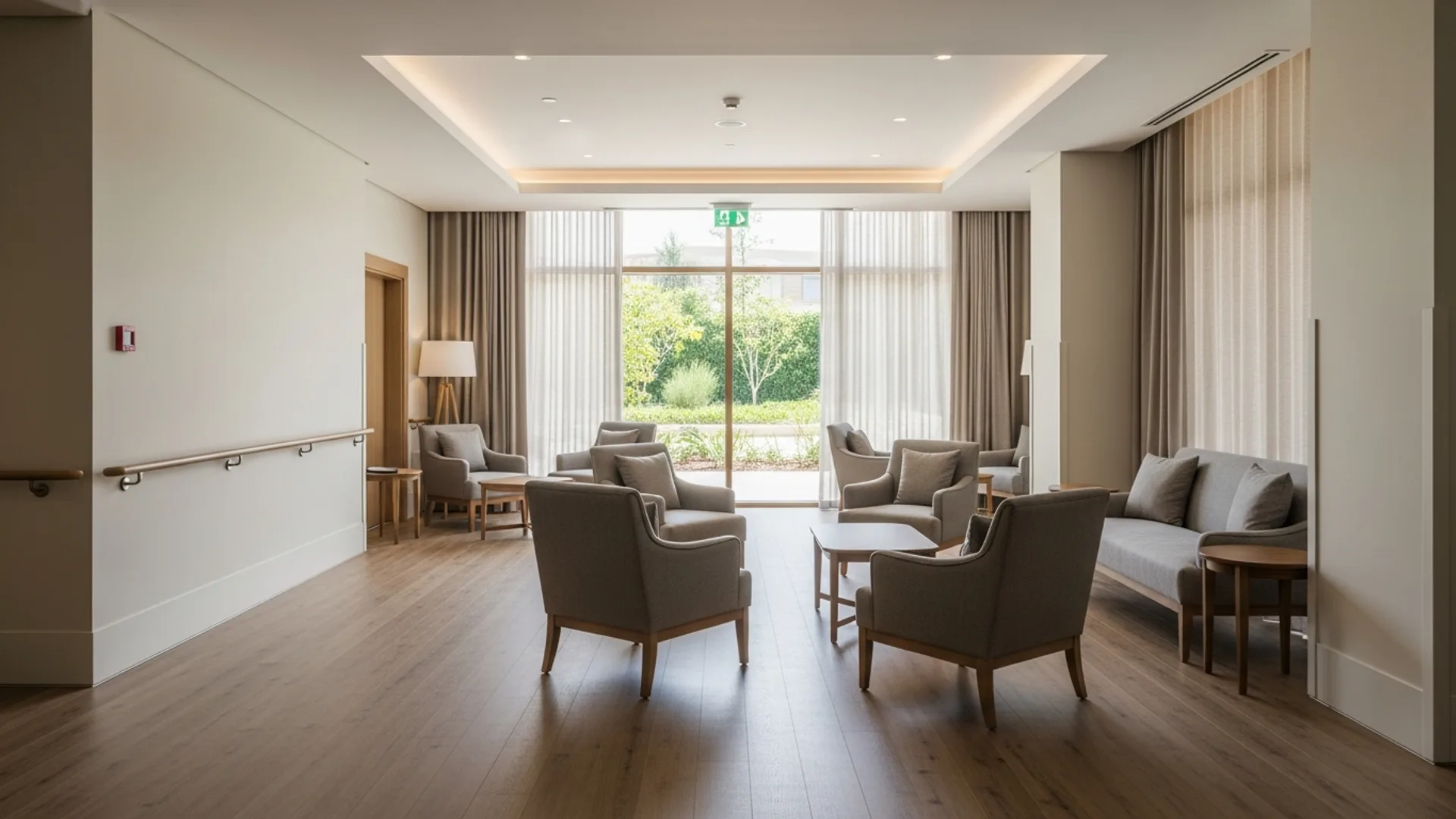
Accessibility throughout. Corridors and doorways wide enough for wheelchairs and mobility aids, level thresholds, handrails along circulation routes, accessible bathrooms with grab rails and appropriate turning circles, non-slip flooring, lever handles, accessible lift provision where the facility spans floors, and adequate lighting with minimal glare are all expected. Retrofitting accessibility into a unit designed as a standard office or villa is expensive and sometimes impossible.
Clinical and support spaces. Depending on category, you may need a treatment or examination room, a secure medication store with temperature control, clean and dirty utility areas, a nurses' station with sightlines, an assisted-bathing facility, a compliant kitchen, laundry with separation of clean and soiled flows, waste storage including clinical waste, and a quiet room for private family conversations.
Environmental standards. Dubai Municipality assesses hygiene, ventilation, water quality, food preparation and handling, pest control, waste segregation and general environmental health. Their published requirements are available at dm.gov.ae.
Fire and evacuation. Civil Defence approval turns on detection, alarms, emergency lighting, escape widths and — the decisive point for this sector — a horizontal or progressive evacuation strategy that works for residents who cannot use stairs unassisted. This single question has invalidated many otherwise attractive upper-floor sites. Resolve it before you sign, not during fit-out.
Appoint a fit-out consultant with delivered healthcare projects in Dubai. The premium is recovered several times over in avoided rework.
Step-by-Step: How to Obtain an Elderly Care Licence in Dubai
Step one: define the service model precisely. Decide residential, day care, home care or therapy; the dependency levels you will accept; capacity; and your clinical scope. DHA licences the scope you apply for, so vagueness at this stage produces a licence that does not match your business.
Step two: engage DHA early. Present the concept, proposed site and clinical leadership before committing capital. Early feedback that a site or scope is unworkable is the cheapest feedback available.
Step three: reserve the trade name and obtain DET initial approval. Pay AED 620 for the trade name, select the correct health or social care activity codes, and confirm legal form and ownership. Full foreign ownership is available across most mainland activities in this space.
Step four: secure premises and register Ejari. Register at AED 177.75 online or AED 220 via a trustee. Negotiate a generous rent-free fit-out period; six months is a reasonable ask for a clinical facility.
Step five: submit design drawings. Layouts, clinical room schedules, sanitary provision, kitchen and laundry design, medication storage and fire strategy go to DHA, Dubai Municipality and Civil Defence. Do not build on unapproved drawings.
Step six: execute the fit-out to approved drawings. Any variation, however sensible on site, must be re-approved.
Step seven: recruit and credential the clinical team. Individual DHA professional licences require credential verification and assessment, and this routinely takes longer than founders expect. Start with the clinical lead, then nurses and therapists.
Step eight: prepare the policy and governance file. Care planning, medication, infection control, safeguarding, complaints and emergency procedures must exist as documents before inspection.
Step nine: pass pre-opening inspections. DHA, Dubai Municipality and Civil Defence each inspect. Expect a snag list and a rectification round of three to six weeks.
Step ten: collect licences and complete post-licence registrations. DET trade licence and DHA facility licence in hand, then establishment card at AED 300 plus AED 2,000 first-time e-system, staff visas, MOHRE contracts, WPS registration and corporate tax registration with the Federal Tax Authority.
Costs, Cashflow and the Lines Founders Underestimate
Three lines dominate: premises, fit-out and payroll. Government fees, though numerous, are a small share of total investment.
Rent is charged on gross area while revenue derives from licensed places or care hours. Compare sites on rent per approved place rather than rent per square foot; a cheap unit with poor efficiency is expensive where it counts.
Fit-out for a care facility exceeds ordinary commercial cost per square metre substantially. Accessible bathrooms, assisted bathing, nurse call systems, secure medication storage, clinical waste handling, enhanced ventilation, separated laundry flows and a compliant evacuation strategy all add cost that generic budgets omit.
Payroll scales with dependency, not with occupancy. Overnight cover, relief for annual and sick leave, and specialist input all carry cost. Federal Decree-Law 33 of 2021 sets the framework: 30 days' annual leave, sick leave of 15 full plus 30 half plus 45 unpaid days per year, maternity of 45 full plus 15 half days, five days' parental leave, notice of 30 to 90 days, probation capped at six months, overtime at basic plus 25% — or plus 50% between 22:00 and 04:00 or on rest days, capped at two hours daily — and end-of-service gratuity of 21 days' basic pay per year for the first five years rising to 30 days thereafter. Salaries flow through the Wage Protection System.
Government and professional fees include AED 620 for the trade name, Ejari at AED 177.75 or AED 220, establishment card at AED 300 plus AED 2,000 first-time e-system, employment entry permits at AED 300 plus AED 1,000 refundable, status change at AED 500 where applicable, medical testing from AED 270 standard in Dubai (AED 700 for six-hour VIP, AED 1,020 for two-hour), residence visas at AED 100 plus AED 100 per year plus AED 100 smart service, and Emirates ID at AED 100 per year of residence plus AED 100 smart. Overstay penalties run at AED 50 per day.
Working capital is the line most often missed. Occupancy in residential care builds slowly because families take time to decide, and home-care client acquisition is a relationship business. Fund at least twelve months of full operating cost at partial occupancy.
Contact Us For Free Consultation
or
Ask on WhatsApp insteadLicensed UAE consultancy. One reply, no spam.
Thank you.
A consultant will reply on WhatsApp shortly.
Staffing, Professional Licensing and Labour Compliance
Clinical recruitment is the critical path. Every nurse, physiotherapist and clinical lead needs an individual DHA licence, which involves verifying qualifications with the issuing institution, confirming experience, and passing the applicable assessment. Verification through international primary-source channels can take weeks, so begin the moment a candidate accepts, and never assume an overseas licence transfers automatically.
Sponsorship runs in parallel: establishment card first, then entry permit at AED 300 plus AED 1,000 refundable, status change at AED 500 for candidates already in the country, medical testing from AED 270, residence stamping and Emirates ID at AED 100 per year of residence plus AED 100 smart service. Track every expiry centrally, because overstay accrues at AED 50 per day.
MOHRE contracts must reflect the genuine role, hours and salary, and salaries must be paid through WPS. Guidance is published at mohre.gov.ae. Health insurance is mandatory for all sponsored employees in Dubai.
Beyond compliance, retention is a clinical quality issue in this sector. Continuity of carers materially affects outcomes for older residents, particularly those living with dementia, and inspectors notice high turnover. Pay competitively, invest in dementia-aware and safeguarding training, and treat rostering as a quality control rather than a cost line.
Tax, VAT and Ongoing Obligations
Corporate tax applies at 0% on taxable income up to AED 375,000 and 9% above. Registration with the Federal Tax Authority through EmaraTax at tax.gov.ae is mandatory, and the return falls due nine months after the financial year end. Small Business Relief may be available where revenue does not exceed AED 3,000,000, which suits many single-site operators in early years.
VAT applies at 5%, with mandatory registration at AED 375,000 of taxable supplies and voluntary registration from AED 187,500. The treatment of care services is nuanced: qualifying healthcare services delivered by licensed professionals may be zero-rated, while accommodation, catering, companionship and other non-clinical elements are commonly standard-rated. A residential care fee is often a bundle of both, and how you contract and invoice determines the treatment. Because zero-rating preserves input VAT recovery on a large fit-out and exemption does not, resolve this before you commit the capital, not afterwards. Take a written position from a tax adviser and keep it on file.
Annually you will renew the DET trade licence, the DHA facility licence, individual professional licences, Ejari, the establishment card, staff visas and Emirates IDs. Maintain proper accounting records throughout.
Insurance is a further standing obligation rather than a one-off purchase. Medical malpractice cover for clinical staff, public liability, property and contents cover, and mandatory health insurance for every sponsored employee all renew annually and all need to remain in force continuously, because a lapse during a claim period is effectively no cover at all. Where you contract with insurers or corporate clients for funded care, expect them to request current certificates as a condition of payment. Build a single renewal calendar covering licences, permits, professional registrations, insurance and immigration expiries, assign a named owner internally, and review it monthly. In a regulated sector, administrative lapses damage credibility with families and referrers far out of proportion to the underlying error.
Worked Example: A Home Health Care Company in Dubai
Consider a founder entering through home care rather than residential, targeting post-operative and chronic-condition support for older adults across Dubai.
The model requires a modest licensed base of operations rather than a residential facility, so capital requirements fall dramatically: a compliant office with a secure medication and supplies store, a clean utility area, clinical records storage and administrative space, in place of a multi-million-dirham build. DHA engagement confirms the facility category and the clinical scope.
The trade name is reserved at AED 620, DET initial approval obtained with the correct activity, and Ejari registered at AED 220 through a trustee. Premises approvals take around eight weeks because the scope is limited. Fit-out runs six weeks.
The critical path is clinical staffing. The clinical lead's DHA licence takes ten weeks including primary-source verification of an overseas qualification. Six nurses follow, staggered so credentialing runs in parallel with visa processing. The establishment card is opened at AED 300 plus the AED 2,000 first-time e-system fee, and entry permits at AED 300 plus AED 1,000 refundable are raised as each nurse clears credentialing.
Pre-opening inspection produces a short snag list on medication storage temperature monitoring and clinical waste segregation, closed in two weeks. The facility licence issues in month seven.
Revenue builds through referral relationships with hospitals, clinics and insurers rather than advertising, which means a slow first two quarters and a steepening curve thereafter. Because the founder funded twelve months of operating cost, the ramp is survivable. Corporate tax registration is completed at incorporation, VAT treatment is documented in advance, and Small Business Relief is claimed in year one.
Common Mistakes When Applying for an Elderly Care Licence in Dubai
- Signing a lease before evacuation strategy is resolved. Upper-floor units without a workable horizontal evacuation route for non-ambulant residents fail Civil Defence review. This kills more sites than any other single issue and cannot be fixed by fit-out.
- Assuming a free zone licence covers clinical delivery. Care delivered to the public requires DHA facility licensing and appropriate premises. A free zone company alone does not authorise regulated care, however convenient the incorporation.
- Starting clinical recruitment late. Individual DHA professional licences require primary-source credential verification that routinely takes weeks. Facilities regularly sit finished and empty because nurses are not yet licensed.
- Blurring the clinical boundary. Delivering medication administration, wound care or vital-signs monitoring under a non-clinical companionship classification is a serious breach. Decide the boundary in writing and train carers to refuse anything beyond it.
- Modelling staffing on occupancy rather than dependency. High-dependency residents need materially more hours per place. Blended averages understate payroll and turn viable plans into loss-making ones within two quarters.
- Leaving VAT treatment until after fit-out. Whether care services are zero-rated or exempt determines input VAT recovery on the largest capital line in the project. Deciding late removes every option you had.
- Underfunding the occupancy ramp. Families take months to decide on residential care and referral networks take quarters to mature. Twelve months of full operating cost at partial occupancy is the realistic reserve.
- Treating policies as paperwork. Inspectors test whether staff follow the protocols, not whether the binder exists. Governance documents written by a consultant and never implemented fail inspection quickly.
Launching Your Dubai Elderly Care Business with Noble Core
Elderly care in Dubai rewards operators who build the compliance architecture first and the commercial model on top of it. The sequence — clinical scope, site feasibility, corporate structure, premises approvals, credentialing, inspection — is unforgiving if run out of order, and the cost of discovering a constraint after the lease is signed is measured in quarters, not weeks.
Noble Core manages that sequence end to end. We start with feasibility, because the site and the clinical scope constrain everything else, then structure the company and select activity codes with DET, reserve the trade name, register Ejari and prepare the DHA facility submission. We coordinate design approvals with Dubai Municipality and Civil Defence, brief contractors experienced in healthcare fit-out, and manage the pre-opening inspection cycle. Our wider business setup in Dubai practice covers structuring, banking and residency alongside the licence itself.
If your model is advisory rather than operational — care planning, training, quality consulting or family advisory work — the requirements are lighter and quite different, and are set out in our guide to the consultancy licence in Dubai. Because clinical staffing is the hardest half of this sector, founders placing nurses and carers at scale, or considering a healthcare manpower arm, should read our guide to the recruitment agency licence in Dubai. To compare care licensing against adjacent health and wellness activities before you commit, our Dubai business licence directory sets out authorities, approvals and typical timelines side by side.
We also handle everything that follows opening: establishment card and staff visas, professional licence renewals, MOHRE contracts and WPS registration, corporate tax registration with the Federal Tax Authority, VAT positioning across clinical and non-clinical revenue, and the annual renewal calendar.
Dubai is investing seriously in health and social infrastructure, and families here increasingly want high-quality, dignified support for older relatives close to home. That is a durable market for operators who can demonstrate genuine clinical quality. Speak to us before you sign a lease or commit to a scope.
Talk to Our Experts
Noble Core structures elderly care and home-care ventures in Dubai end to end: DHA facility licensing, DET trade licence, premises approvals, nurse credentialing, staff visas and corporate tax registration. Free 20-minute consultation.
Frequently Asked Questions
Which authority licenses elderly care in Dubai?
The Dubai Health Authority licenses the facility and its clinical staff, while DET issues the commercial trade licence. Dubai Municipality and Civil Defence approve the premises separately.
Is a home-care company treated differently from a residential centre?
Yes. Home health care is licensed as a distinct facility category with its own base-of-operations requirements, whereas residential or day centres face fuller premises, catering and overnight staffing standards.
Can a free zone company provide elderly care in Dubai?
Clinical services delivered to the public require DHA facility licensing and appropriate mainland premises. A free zone licence alone does not authorise regulated care delivery.
Do nurses and carers need individual licences?
Clinical staff such as nurses and physiotherapists require individual DHA professional licences, obtained through assessment and credential verification, before they may practise in the emirate.
How long does licensing take?
Plan six to twelve months from concept to opening. Premises approvals, fit-out and clinical staff credentialing dominate the timeline far more than the trade licence itself.
Is elderly care subject to 5% VAT?
Qualifying healthcare services may be zero-rated while non-clinical services such as accommodation, catering and companionship are commonly standard-rated. Obtain a written position from a tax adviser.
Does an elderly care company pay corporate tax?
Yes. Taxable profit up to AED 375,000 is taxed at 0% and 9% above that. Registration with the Federal Tax Authority via EmaraTax is mandatory.
Can 100% foreign ownership apply?
Most mainland healthcare and social care activities now permit full foreign ownership under DET rules, though the specific activity code and any conditions should be confirmed before incorporation.
What insurance is required?
Medical malpractice cover for clinical staff, public liability and property cover are expected. Employee health insurance is mandatory for all sponsored staff in Dubai.
Are unannounced inspections common?
Yes. DHA inspects licensed facilities on a risk-based cycle and may attend unannounced, while Dubai Municipality and Civil Defence conduct separate hygiene and fire-safety inspections.