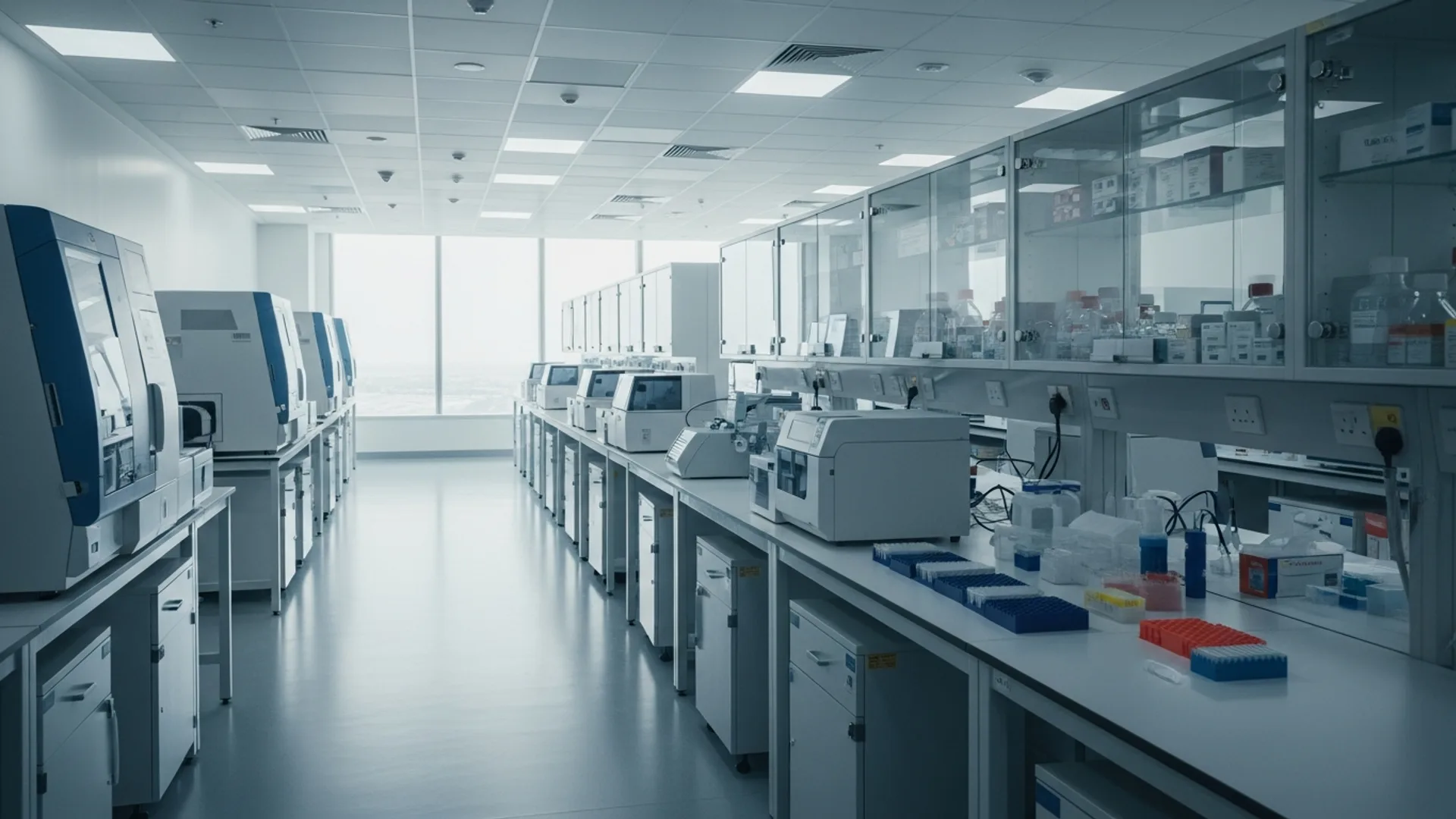
Quick AnswerHow to get a medical laboratory license in Dubai in 2026: DHA Sheryan steps, DET vs DHCC, ISO 15189, waste rules, 9% corporate tax and costs.
Opening a diagnostic laboratory in the emirate is one of the more demanding regulatory projects in UAE healthcare, and a medical laboratory license Dubai applicants often underestimate the layering involved. You are not applying for one permit but for a stack of them: a commercial entity, a health facility licence from the Dubai Health Authority, individual professional licences for every scientist and technologist who touches a specimen, municipal clearances for premises and waste, and federal tax registrations that begin the moment your taxable income passes AED 375,000.
The good news is that the sequence is predictable. Every stage has a defined owner, a defined document set and a defined queue. Founders who fail do so because they build premises before the regulator has approved the layout, or because they hire a laboratory director whose credentials cannot survive primary source verification. This guide walks the full path in the order the authorities actually process it, with realistic timelines, the government fees that are genuinely published, and the traps that cost applicants months.
Your setup cost, in 10 seconds
Package prices. Health insurance is required by law and not included.
Thank you.
Your written quote follows on WhatsApp.
How Do You Get a Medical Laboratory License in Dubai?
You need two licences running together. First form a company — a DET mainland trade licence or a Dubai Healthcare City free zone licence — then file the health facility application with the Dubai Health Authority through Sheryan. Expect four to seven months end to end, corporate tax at 9% above AED 375,000, and VAT registration once turnover reaches AED 375,000.
| Item | Authority | Published position (2026) |
|---|---|---|
| Trade name reservation | DET | AED 620 |
| Mainland commercial licence | DET | Varies by activity and share capital — quoted per file |
| DHCC free zone licence | DHCC Authority | Not published as a flat rate; quoted per facility scope |
| Health facility licence | DHA (Sheryan) | Fee schedule applied inside Sheryan per category |
| Professional licence per staff member | DHA (Sheryan) | Per-cadre fee in Sheryan; DataFlow PSV billed separately |
| Tenancy registration (Ejari) | Ejari / DLD | AED 177.75 (app) or AED 220 (trustee) |
| Establishment card | ICP / GDRFA | AED 300, plus AED 2,000 e-system fee first time |
| Employment entry permit | MOHRE / ICP | AED 300 plus AED 1,000 refundable deposit |
| Status change (inside country) | ICP / GDRFA | AED 500 |
| Medical fitness test (Dubai) | DHA | AED 270 standard · 700 six-hour · 1,020 two-hour |
| Emirates ID | ICP | AED 100 per year of residence plus AED 100 smart service |
| Corporate tax | Federal Tax Authority | 0% to AED 375,000, 9% above |
| VAT | Federal Tax Authority | 5%; mandatory registration at AED 375,000 turnover |
| Customs duty on imported analysers and reagents | Dubai Customs | 5% GCC common tariff on most goods |
Two points about that table matter more than the numbers themselves. First, DHA does not publish a single headline price for a laboratory facility licence the way a free zone publishes a package price; the fee is assembled inside Sheryan from the facility category, the number of approved activities and the number of professional licences attached. Anyone quoting you a firm all-in DHA figure before your scope is defined is guessing. Second, the immigration and tenancy figures above are federal or Dubai-published and are stable, which makes them the reliable anchor points for your budget.
Which Laboratory Category Applies to You?
DHA licenses laboratories by category, and the category you choose dictates your space requirement, your equipment list, your staffing matrix and your inspection intensity. Choosing the wrong one is the single most expensive mistake in this sector because the fit-out follows the category, and re-categorising after construction means rebuilding.
Standalone medical laboratory. An independent facility that receives specimens from clinics, hospitals, corporate clients and walk-in patients, performs analysis on site and issues reports under its own licence. This is the fullest category. You will need segregated pre-analytical, analytical and post-analytical zones, a dedicated microbiology area if you test cultures, defined storage for reagents and controls, and a laboratory director with the seniority to sign off on the entire scope.
Clinic-attached laboratory. A laboratory operating inside an already-licensed clinic or hospital, serving that facility's own patients. The application rides on the parent facility's file, which shortens the approval path considerably, but the scope is narrower — typically routine haematology, biochemistry and basic serology. If a clinic wants to sell testing to third parties, it usually needs to upgrade to a standalone category rather than stretch the attached one.
Reference laboratory. The most demanding tier: a laboratory that accepts referred work from other licensed laboratories, often including specialised molecular, histopathology, cytology, immunology or genetics testing. Reference operations attract the highest scrutiny on quality management, method validation, proficiency testing participation and consultant-grade staffing. Accreditation is effectively a commercial prerequisite here even where it is not spelled out as a licensing condition, because referring laboratories and insurers will ask for it.
Collection or sample-drawing centre. A phlebotomy and specimen-collection point with no analytical capability. It draws, labels, stores briefly and transports to a licensed laboratory under a validated cold chain. This is the lightest category and the fastest to license, which makes it a sensible way to build catchment and referral volume in new districts before committing to a second full laboratory. What it cannot do is issue results under its own name.
There is also the home-collection model, where phlebotomists visit patients at home or at corporate sites. That is normally an add-on activity attached to a licensed laboratory rather than an independent licence.
DET Mainland Licence or DHCC Free Zone?
The commercial layer sits underneath the health layer, and you must decide it first because the health application requires an entity, a tenancy and an address.
A DET mainland licence — issued by Dubai's Department of Economy and Tourism — puts your laboratory in the general Dubai market. You can lease premises in any commercially zoned building that meets DHA's technical requirements, open branches across the emirate, contract directly with mainland clinics and government entities, and bid for public-sector tenders where eligibility requires a mainland registration. Mainland is the default for laboratories building a retail or multi-branch network, because catchment matters enormously in diagnostics and you want the freedom to follow demand across Jumeirah, Deira, Al Barsha, Dubai South and beyond.
Dubai Healthcare City is a dedicated healthcare free zone with its own regulatory framework and its own facility licensing process, distinct from DHA's Sheryan pathway for the rest of Dubai. Its advantages are ecosystem-driven: you sit inside a cluster of hospitals, specialist clinics and academic institutions that generate referral volume, and the authority's staff understand healthcare files natively. The constraint is geography — your licensed premises must be inside the free zone, so a DHCC laboratory cannot simply open a branch in Mirdif without a separate structure.
A practical middle path used by several groups is a DHCC or mainland core laboratory paired with mainland collection centres. The analytics stay in one validated, accredited facility; the collection footprint expands cheaply. Whichever route you take, confirm the activity codes on the commercial licence match the health scope exactly. A mismatch between the DET activity list and the DHA facility scope is one of the most common causes of a rejected or stalled Sheryan file.
Step by Step: From Company to Open Laboratory
Step one — define the scope on paper. Write out every test family you intend to offer, the expected daily volume, the analysers you will use and the staffing matrix by cadre. Everything downstream flows from this document: the space you lease, the fee DHA assembles, the number of professional licences, and whether you need a microbiology suite or a molecular room with its own airflow discipline.
Step two — reserve the trade name and incorporate. Reserve the name with DET (AED 620) avoiding restricted words, then complete the commercial licence application with the correct medical laboratory activity. For a DHCC route, the free zone authority handles name, entity and premises allocation in a single track.
Step three — secure premises and register the tenancy. Lease a unit that can physically satisfy laboratory requirements: adequate floor loading for heavy analysers, water and drainage where benches will sit, three-phase power capacity, ventilation routes, and space for segregated clean and contaminated flows. Register the tenancy through Ejari (AED 177.75 through the app, AED 220 through a trustee) — you need the registration number for both the commercial licence and the health file.
Step four — submit the initial approval to DHA via Sheryan. Sheryan is DHA's licensing portal at dha.gov.ae, and it is where your facility file lives permanently. The initial approval package typically includes the entity documents, the tenancy contract, the proposed scope of services, the CVs and credentials of the proposed laboratory director, and a scaled layout drawing.
Step five — obtain layout approval before building anything. DHA reviews the drawing against category requirements: room sizes, workflow direction, hand-hygiene points, waste holding, storage separation, and sample reception design. Build only after this approval is in hand. Applicants who fit out first almost always rebuild something.
Step six — run professional licensing in parallel. Every scientist, technologist, phlebotomist and the director needs an individual DHA licence. Start these on day one of fit-out, because primary source verification is the slowest external dependency in the entire project.
Step seven — complete fit-out, Civil Defence and utilities. Fire detection and suppression, emergency lighting, extraction, and the mechanical drawings all pass through Civil Defence approval. DEWA connections and, where applicable, Dubai Municipality clearances for signage and general premises compliance run alongside.
Step eight — appoint your waste and cold chain contractors. Sign a medical waste contract with a Dubai Municipality approved provider and validate your specimen transport chain before inspection, not after.
Step nine — book and pass the DHA inspection. Inspectors verify the built environment against the approved drawings, check equipment calibration and validation records, review policies and procedures, confirm staff licences are live, and test that your quality system exists in practice rather than in a binder.
Step ten — receive the facility licence, then register federally. With the licence issued, complete corporate tax registration with the Federal Tax Authority via tax.gov.ae, open the MOHRE establishment file, obtain the establishment card and begin staff visa processing.
Laboratory Director, Technologists and DataFlow PSV
No laboratory opens without a DHA-licensed director. The director carries technical and regulatory accountability for the entire scope, signs off validation and quality decisions, and is the person the regulator holds responsible when something goes wrong. DHA assesses directors on qualification level, relevant post-qualification laboratory experience, and the match between their specialty and the scope you have applied for. A director qualified in clinical biochemistry does not automatically cover a histopathology scope.
Every professional application passes through DataFlow primary source verification. DataFlow contacts the issuing university, the licensing bodies and previous employers directly to confirm that each document is genuine. Verification commonly takes several weeks and can stretch far longer where an institution is slow to respond or has been restructured. Gather clean documentation before submission: degree certificates, transcripts, home-country licences, and dated experience letters on letterhead with exact job titles and employment periods.
Depending on cadre and scope, DHA may also require an assessment or examination step, and in some cases an interview. The practical management lesson is redundancy: identify a credible second candidate for the director role and for each critical technologist position, because one stalled verification can hold an entire facility licence hostage while rent accrues.
Premises, Biosafety and Civil Defence
Laboratory premises are engineered, not decorated. DHA's expectations centre on directional workflow — specimens should move from reception through processing to analysis to storage without doubling back through clean zones — and on physical separation of activities that must not cross-contaminate.
Core requirements to design around include a dedicated specimen reception and accessioning area separate from the analytical bench; impervious, easily cleanable surfaces and flooring with coved skirting; hand-wash basins at the exit of each working zone; an eyewash station and spill kit; reagent storage separate from specimen storage; a secure, ventilated waste holding point; and controlled access to the analytical area.
Biosafety requirements depend on what you handle. General clinical chemistry and haematology sit at basic containment, but microbiology involving culture work and molecular work involving amplification raise the specification — directional airflow, biological safety cabinets with documented certification, and strict physical separation between pre-amplification and post-amplification areas to prevent amplicon carryover. Your biosafety manual, exposure protocol, sharps policy and staff immunisation records all get read during inspection.
Civil Defence approval covers fire detection, suppression, alarm integration, emergency lighting, means of escape, and safe storage of flammable reagents. Because sign-off depends on the mechanical and electrical design, engage the process at drawing stage rather than at the end of construction. Dubai Municipality clearances also touch the premises envelope — signage permits and general building compliance — and Municipality involvement continues throughout your operating life through waste regulation.
Biomedical Waste, Cold Chain and Sample Logistics
Waste is where good laboratories quietly fail inspections. Every laboratory generates infectious waste, sharps, chemical waste and sometimes cytotoxic residues, and each stream has its own container, its own colour code, its own storage rule and its own disposal manifest. You must appoint a Dubai Municipality approved medical waste contractor and keep every transfer record. Inspectors ask for the manifests, and gaps in the sequence are treated as evidence of unrecorded disposal.
Practical discipline looks like this: puncture-resistant sharps containers replaced at the fill line rather than when overflowing; segregation at the point of generation, never sorted later; a locked, ventilated waste holding room with limited access and a defined maximum holding time; a documented spill response with trained staff and a stocked kit; and a monthly reconciliation between waste generated and waste collected. Staff training records are part of the file — dm.gov.ae publishes the environmental and waste framework the contractor operates under.
Cold chain governs specimen integrity, and it is a licensing and quality issue rather than a logistics convenience. Refrigerators and freezers need continuous temperature monitoring with alarms, calibrated probes, documented daily checks and a written excursion procedure. Transport boxes between collection centres and the core laboratory need validated temperature performance over the actual route duration, not a manufacturer claim. Every specimen needs unambiguous chain-of-custody: who drew it, when, at what temperature it travelled, when it arrived, who accessioned it.
Equipment Import, Registration and Validation
Analysers, reagents and in-vitro diagnostic kits are regulated products. Devices and diagnostic products intended for the UAE market require registration through the federal health regulatory framework, and importers must hold the appropriate registration to bring them in. Most laboratories buy through an authorised local distributor precisely to avoid holding that burden themselves — the distributor's registration covers the product, and you receive it with the documentation trail already assembled. If you do import directly, budget for 5% GCC common customs duty on most goods plus clearance handling, and remember that the shipment paperwork must match your licensed activity. Reagents with temperature constraints need cold-chain shipping and airport-to-laboratory transfer that does not break it.
Once installed, every instrument needs installation, operational and performance qualification documented and retained, plus a calibration schedule, a preventive maintenance contract and records of every service visit. Method validation — establishing precision, accuracy, linearity, reportable range and reference intervals appropriate to your population — is a licensing expectation for the tests in your scope, and inspectors will ask to see the validation file for any test they pick.
Contact Us For Free Consultation
or
Ask on WhatsApp insteadLicensed UAE consultancy. One reply, no spam.
Thank you.
A consultant will reply on WhatsApp shortly.
ISO 15189, Accreditation and Quality Systems
ISO 15189 is the international standard for quality and competence in medical laboratories, and it is the reference framework that Dubai's health regulator, insurers and referring clinicians all recognise. It covers the full testing lifecycle — from request and specimen collection through analysis to result reporting and interpretation — plus the management system that keeps it consistent: document control, internal audit, management review, non-conformance handling, corrective action and continual improvement.
Accreditation expectations scale with your category and scope. Basic clinic-attached testing carries a lighter burden than a reference laboratory running molecular diagnostics or histopathology. But the operational reality is that accreditation has become a commercial gate as well as a regulatory one: insurers, corporate wellness buyers and hospital groups increasingly ask to see it before signing a testing contract, and referring laboratories will not send you specialised work without it.
Build the quality system while you build the laboratory, not afterwards. That means writing standard operating procedures for every process before you run the first patient sample, enrolling in external quality assessment or proficiency testing schemes for each analyte family in your scope, running daily internal quality controls with defined acceptance rules and documented action when a control fails, and establishing turnaround-time monitoring and critical-value notification protocols. Retrofitting a quality system into a running laboratory takes twice as long and never fits as well.
LIS, E-Reporting and Data Obligations
A laboratory information system is not optional infrastructure in Dubai. Your LIS must handle order entry, barcode-driven specimen tracking, bidirectional interfacing with analysers so results are not manually transcribed, result authorisation with an audit trail, and structured report generation. Beyond internal workflow, Dubai's health system expects electronic reporting into the emirate's health information exchange so that patient records follow the patient across providers, and it expects notifiable results to reach public health surveillance promptly. Confirm with your LIS vendor that they have implemented that integration before — a vendor learning the interface on your project will delay your opening.
Data protection sits alongside this: role-based access so a phlebotomist cannot browse unrelated results, encryption at rest and in transit, retention periods that match regulatory requirements, and a documented breach response. Insurance claim submission also flows through the emirate's e-claim infrastructure, so your LIS must produce claim-ready output with correct coding or you will bleed revenue on rejections that have nothing to do with the quality of your testing.
Staffing, MOHRE, WPS and Visas
Once the entity exists, open the MOHRE establishment file and obtain your establishment card (AED 300, plus AED 2,000 for the e-system on first issuance). Each foreign hire then follows the standard route: employment entry permit (AED 300 plus a AED 1,000 refundable deposit), or a status change inside the country at AED 500, medical fitness testing in Dubai at AED 270 standard, AED 700 for the six-hour service or AED 1,020 for the two-hour service, Emirates ID at AED 100 per year of residence plus a AED 100 smart service fee, and residence permit stamping.
Employment terms follow Federal Decree-Law 33 of 2021: fixed-term contracts, probation capped at six months, notice between 30 and 90 days, 30 days of annual leave, sick leave of 15 full-pay days followed by 30 half-pay and 45 unpaid within a leave year, and end-of-service gratuity of 21 days' basic pay per year for the first five years then 30 days thereafter. Overtime is basic pay plus 25%, rising to plus 50% for hours between 22:00 and 04:00 or on rest days, capped at two hours per day — worth modelling carefully for laboratories running extended or night shifts. Salaries must be paid through the Wage Protection System; WPS non-compliance blocks new work permits, which for a growing laboratory is a serious operational brake. Full guidance sits at mohre.gov.ae.
Note the double licence for clinical staff: a MOHRE work permit alone does not authorise laboratory work. Every technical staff member needs a live DHA professional licence tied to your facility, and moving a technologist between facilities requires the licence to be transferred, not merely the visa.
Corporate Tax, VAT and EmaraTax
Laboratories are ordinary UAE taxpayers. Corporate tax applies at 0% on taxable income up to AED 375,000 and 9% above that threshold. You register with the Federal Tax Authority through EmaraTax and file a return within nine months of your financial year end. Where revenue is at or below AED 3,000,000, Small Business Relief may be available for eligible periods — a meaningful cushion during the ramp-up years when a new laboratory is absorbing equipment depreciation and low initial volumes. Very large multinational groups with revenue at or above EUR 750 million fall under the 15% Domestic Minimum Top-up Tax, which is not a concern for a single-facility operator.
VAT is 5%, with mandatory registration once taxable turnover reaches AED 375,000 and voluntary registration available from AED 187,500. VAT treatment in healthcare is genuinely nuanced: certain healthcare services qualify for zero-rating while others are standard-rated, and the position depends on the nature of the service, the recipient and the context in which it is supplied. Corporate wellness packages, pre-employment screening, research testing and cosmetic-adjacent testing frequently sit differently from diagnostic testing ordered by a licensed practitioner for a patient. Get the mapping right before you issue your first invoices — retrospective correction across thousands of low-value transactions is painful. FTA guidance and registration both live at tax.gov.ae.
Keep audit-ready books from day one: reagent inventory valuation, equipment capitalisation and depreciation, related-party transactions on arm's-length terms if you buy services from an affiliated clinic, and transfer-pricing documentation where thresholds apply. There is no personal income tax in the UAE, so founder remuneration planning is simple, but the corporate side rewards discipline.
Timelines and a Worked Cost Example
| Stage | Typical duration | Runs in parallel with |
|---|---|---|
| Scope definition and feasibility | 2–3 weeks | — |
| Trade name and entity formation | 1–2 weeks | Premises search |
| Premises lease and Ejari | 2–4 weeks | DHA initial approval |
| DHA initial approval and layout review | 4–8 weeks | Professional licensing |
| DataFlow PSV and professional licences | 6–16 weeks | Fit-out |
| Fit-out, Civil Defence, utilities | 8–16 weeks | LIS implementation |
| Equipment delivery, installation, validation | 4–8 weeks | Quality system build |
| DHA final inspection and licence issue | 2–6 weeks | Staff visas |
| Tax and MOHRE registrations | 1–2 weeks | Pre-opening trials |
A realistic worked example for a mid-sized standalone laboratory looks like this. On the published government line items you can budget with confidence: trade name AED 620; Ejari registration AED 220 through a trustee; establishment card AED 300 plus the AED 2,000 first-time e-system fee; and for each of ten expatriate staff, an entry permit at AED 300 with a AED 1,000 refundable deposit, medical testing at AED 270, and Emirates ID at AED 100 per year of residence plus AED 100 smart service — roughly AED 1,870 of non-refundable immigration cost per head before the residence permit and typing charges, or about AED 18,700 for ten. Those figures total a little over AED 21,800 across name, tenancy registration, establishment file and a ten-person immigration cycle.
The three genuinely large cost blocks — the DET or DHCC licence itself, the DHA facility and professional licence fees assembled in Sheryan, and the fit-out and equipment capital — are not published as flat rates and vary enormously with scope, location and whether you buy or lease analysers. Treat any confident all-in figure from a consultant as a quote to be tested, not a market price. Ask instead for a written breakdown separating government fees, professional fees, capital equipment and working capital, and insist on at least six months of operating runway, because diagnostic revenue ramps slowly while insurer contracting and referral relationships mature.
Renewals, Inspections and Penalties
Both licences renew annually and both must stay live. The DHA facility licence renewal requires a current tenancy, valid professional licences for all clinical staff, evidence of continuing quality participation and, where applicable, a renewal inspection. The DET or DHCC commercial licence renewal requires the tenancy and the standard corporate documents. An expired commercial licence blocks the health renewal, and an expired health licence stops you testing lawfully — with knock-on effects on staff visas, insurer contracting and claim settlement.
Professional licences renew on their own individual cycles, and continuing professional development requirements apply. Track them centrally in a compliance calendar with reminders 90 and 30 days out. Nothing derails a laboratory faster than discovering on a Sunday morning that your senior technologist's licence lapsed on Friday.
Inspections are both scheduled and unannounced. Common findings include incomplete calibration and maintenance records, quality-control failures without documented corrective action, expired reagents still in service, waste segregation errors, staff practising outside their licensed scope, and turnaround-time monitoring that exists on paper but is not reviewed. Penalties escalate from warnings and corrective-action notices to fines, scope restriction, suspension and, in serious cases, closure. On the fiscal side, late corporate tax or VAT registration and late filing carry their own administrative penalties from the Federal Tax Authority, and late trade licence renewal accrues monthly fines from DET.
Common Mistakes When Applying
- Fitting out before layout approval. Building to an architect's aesthetic vision rather than to DHA's approved drawing is the most expensive error in this sector. Approval first, contractor second, always.
- Starting DataFlow late. Primary source verification is the longest external dependency and the one you control least. Launch it the day you identify your director, not when fit-out finishes.
- Mismatched activity codes. A DET commercial activity list that does not mirror the DHA facility scope stalls the Sheryan file and forces an amendment cycle that adds weeks.
- Underestimating the second-shift staffing matrix. Laboratories that promise same-day turnaround need licensed cover across the whole operating window, not one licensed technologist and several unlicensed helpers.
- Treating the quality system as post-opening paperwork. Procedures, quality controls, proficiency-testing enrolment and validation files must exist before the first patient sample, because the inspector will ask for them.
- Ignoring the VAT mapping. Assuming every laboratory service is zero-rated healthcare produces incorrect invoicing across thousands of transactions and a painful retrospective correction with the Federal Tax Authority.
- Choosing premises on rent alone. Floor loading, three-phase power, drainage routes and ventilation determine whether a unit can ever be a laboratory. A cheap unit that cannot take an analyser is not cheap.
- No cold chain validation between collection points and the core lab. Manufacturer claims are not validation; you must prove temperature performance over your actual routes and durations.
Setting Up Your Dubai Medical Laboratory with Noble Core
Diagnostics is a sector where the regulatory build is as demanding as the commercial one, and where a three-month delay burns rent, salaries and referral momentum simultaneously. Noble Core Ventures runs the whole file: choosing between a DET mainland structure and a DHCC free zone entity, drafting the scope of services that determines your DHA category, preparing the Sheryan facility application, managing DataFlow verification for your director and technologists, coordinating layout approval with your fit-out contractor, and completing the Federal Tax Authority and MOHRE registrations that follow licensing.
If you are still weighing structures, our business setup in Dubai guide sets out the mainland and free zone trade-offs in full. Laboratories that will sit inside or alongside a clinical practice should read our medical clinic license Dubai guide, since an attached laboratory rides on the parent facility's file. For the professional licensing layer — the individual practitioner licences your scientists and technologists need — see our DHA license Dubai walkthrough. And if you are comparing this against other regulated activities before committing capital, our Dubai business licence directory maps the activity categories and their regulators in one place.
Bring us your intended test menu and target opening date, and we will map the critical path, flag the approvals that will bite, and give you a realistic budget separated into government fees, professional fees and capital. Free 20-minute consultation.
Talk to Our Experts
Noble Core Ventures structures, licenses and staffs medical laboratories in Dubai end to end — DET or DHCC entity, DHA Sheryan facility file, professional licensing, fit-out approvals and tax registration. Free 20-minute consultation.
Frequently Asked Questions
Who issues a medical laboratory license in Dubai?
The Dubai Health Authority issues the health facility licence through its Sheryan portal. You also need a commercial licence from DET for mainland, or from the DHCC authority inside that free zone.
Can I open a lab without a licensed lab director?
No. DHA requires a licensed laboratory director appointed to the facility file before the facility licence is issued. The director must clear DataFlow primary source verification and DHA assessment first.
How long does the whole process take?
Plan for roughly four to seven months from company formation to opening. Professional licensing and DataFlow verification run in parallel with fit-out, which is usually the longest single stage.
Is ISO 15189 accreditation mandatory in Dubai?
Accreditation expectations depend on the scope and category of your laboratory. ISO 15189 is the recognised international standard for medical laboratories and is strongly expected for reference and higher-complexity testing scopes.
Does a medical laboratory pay corporate tax in the UAE?
Yes. UAE corporate tax is zero on taxable income up to AED 375,000 and nine per cent above that. You register with the Federal Tax Authority through the EmaraTax portal.
Do laboratory services attract five per cent VAT?
Some diagnostic services qualify for healthcare treatment under UAE VAT rules and others do not. Confirm your exact service mix with a tax adviser and the Federal Tax Authority guidance.
What is the difference between DET mainland and DHCC?
A DET mainland licence lets you serve the wider Dubai market and hold multiple locations. DHCC is a healthcare free zone with its own regulator, premises and clustered medical ecosystem.
Can a collection centre operate without a full laboratory?
Yes, as a separate licensed category. A sample-drawing or collection centre may only draw and transport specimens under a validated cold chain, referring all analysis to a licensed laboratory.
How is biomedical waste handled?
Through a Dubai Municipality approved medical waste contractor, using segregated colour-coded containers, documented transfer manifests and retained disposal records that inspectors routinely request during facility visits, alongside written staff training records.
What happens if I miss the licence renewal date?
Both the DHA facility licence and the commercial licence carry late fees and escalating penalties, and an expired facility licence can suspend testing, staff visas and insurance claim processing.