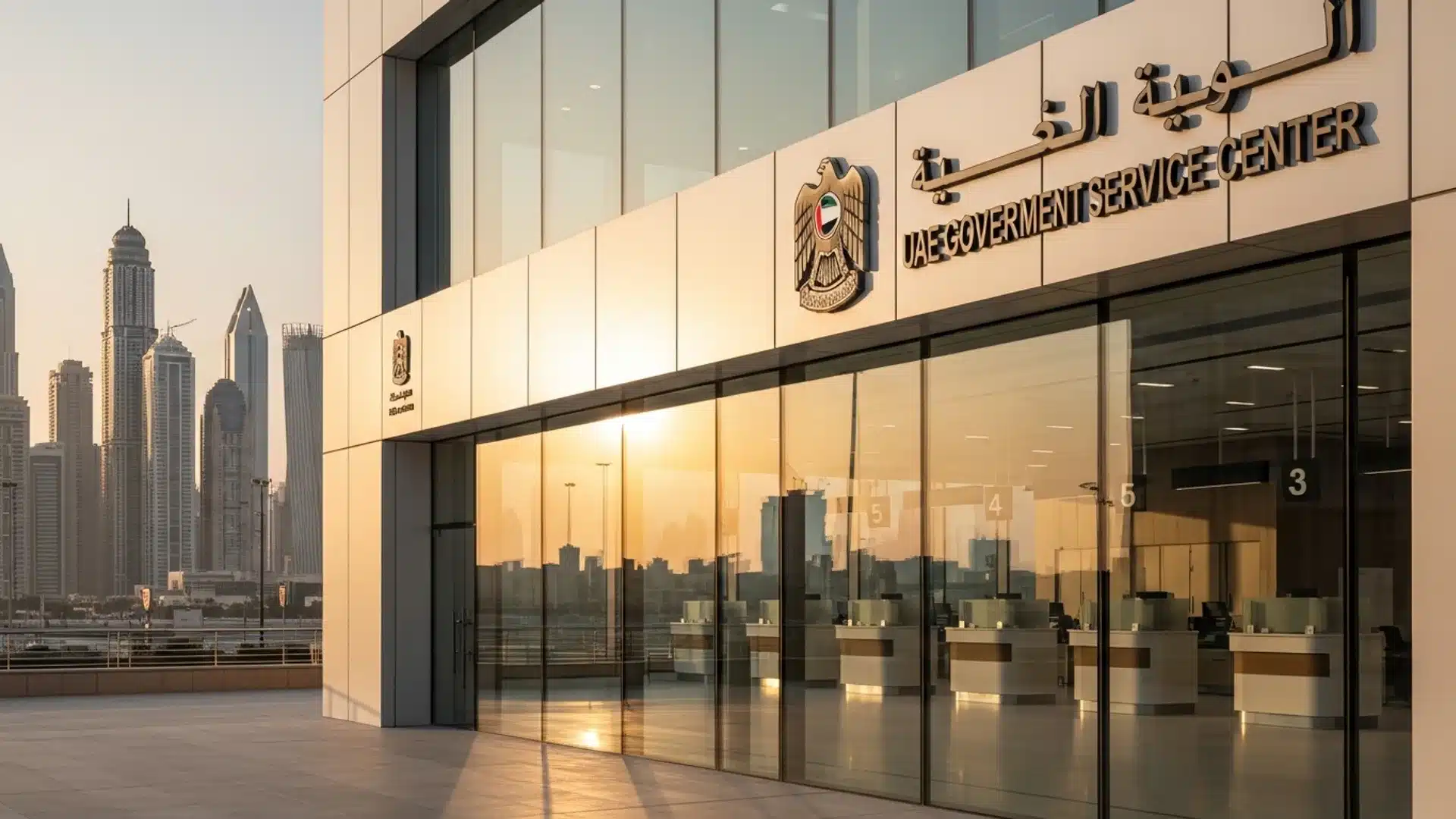
Quick AnswerTawjeeh vs Tasheel vs Amer in 2026: which centre does what, the right order for a 2-year employment visa, documents, timelines and penalties.
If you have just hired your first employee in Dubai, you will hear three names in the same week — Tawjeeh, Tasheel and Amer — and nobody will explain that they belong to two entirely different government departments. That single missing sentence is why so many onboarding files stall. Tasheel and Tawjeeh sit on the labour side, under the Ministry of Human Resources and Emiratisation (MOHRE). Amer sits on the immigration side, under the General Directorate of Residency and Foreigners Affairs (GDRFA) in Dubai. Above both sits ICP — the Federal Authority for Identity, Citizenship, Customs and Port Security — which issues the Emirates ID and runs Smart Services for the wider UAE.
Get the order right and a standard 2-year employment residence file moves smoothly. Get it wrong — send a runner to Amer before the work permit exists, or skip the Tawjeeh session — and you pay for the mistake in wasted trips, re-typed applications and days lost while a new joiner sits without a valid status. This guide explains exactly what each network does, which transaction belongs where, the sequence to follow, the documents to prepare, what drives cost, and the pitfalls that catch first-time employers.
What is the difference between Tawjeeh, Tasheel and Amer?
Tasheel, Tawjeeh and Amer are three service-centre networks, not three government departments. Tasheel processes MOHRE labour transactions — quotas, work permits, employment contracts and labour cards. Tawjeeh delivers the mandatory worker and employer awareness sessions plus related typing. Amer handles GDRFA Dubai immigration transactions — entry permits, status change and residence stamping. A typical 2-year employment visa touches all three; a 10-year Golden Visa may bypass the labour side entirely.
Think of it as one file crossing two desks. The labour desk answers: is this company allowed to employ this person, on what contract, in what role? The immigration desk answers: is this person allowed to live in the UAE, on whose sponsorship, for how long? Neither desk will act on the other's behalf, and neither will accept an application that the other has not yet cleared.
| Network | Parent authority | What it actually does | Typical transactions | Cost driver |
|---|---|---|---|---|
| Tasheel | MOHRE | Labour transactions and typing | Establishment card, quota, work permit, offer letter, employment contract, labour card, cancellation | Varies by company classification tier and skill category of the role |
| Tawjeeh | MOHRE | Awareness and orientation sessions | Worker orientation, employer awareness, related typing services | Fixed per-session service charge; varies by session type |
| Amer | GDRFA Dubai | Dubai residence and immigration | Entry permit, status change, visa stamping, cancellation, dependant sponsorship | Varies by visa duration, inside/outside country processing and urgency |
| ICP Smart Services | ICP (federal) | Federal identity and residence | Emirates ID issuance and renewal, residence files outside Dubai, entry permits | Varies by ID validity period and service speed |
| Free zone portal | Free zone authority (IFZA, DMCC, DAFZA and others) | Self-contained labour and immigration | Establishment card, e-channel, work permit, residence visa | Package-based; set by the free zone |
| Federal Tax Authority | FTA | Tax registration and returns | Corporate tax registration, VAT registration, filing | Corporate tax 0% to AED 375,000, 9% above; VAT 5% |
The table is the shortcut. The rest of this guide is the detail that stops a file from bouncing.
Tasheel explained: the MOHRE labour counter
Tasheel is the authorised service-centre network for MOHRE transactions. It exists because most labour applications need documents typed into MOHRE's format, verified, and submitted under a registered establishment account. You can do a great deal of this through MOHRE's own digital channels at mohre.gov.ae, but Tasheel remains the fallback for anything that needs a human to check attachments, correct Arabic name spellings, or handle a transaction the portal will not accept.
What belongs at Tasheel:
- Establishment card and company labour file. Before you can hire anyone on the mainland, your company needs an active MOHRE establishment file linked to its trade licence. This is the container everything else sits in.
- Company classification. MOHRE classifies establishments into categories based on compliance behaviour, workforce diversity and Emiratisation performance. Your classification directly changes what you pay for work permits — this is the single largest swing factor in labour costs, and it is why no honest guide can quote you one fixed permit price.
- Labour quota approval. Your quota is the number of employees you are permitted to sponsor, assessed against your premises, activity and licence. A quota request that outruns your office space is the most common early rejection.
- Work permit (employment entry permit approval). MOHRE's approval that a specific person may work for you in a specific role.
- Offer letter and employment contract. The MOHRE-standard offer letter must be issued and accepted before the contract is registered. Since the shift to fixed-term contracts under the current labour law framework, contract terms, notice periods and end-of-service treatment all flow from what is registered here — not from your internal HR template.
- Labour card issuance and cancellation. The formal record of employment.
- Amendments. Salary changes, job title changes, contract renewals and transfers between employers.
What does not belong at Tasheel: anything to do with residence status, visa stamping, Emirates ID or dependants. Those are immigration transactions. Presenting them at a Tasheel counter simply wastes a trip.
A practical note on Emiratisation: mainland companies above defined headcount thresholds carry Emiratisation targets, and non-compliance carries monthly contributions. The targets and contribution mechanics are set by MOHRE and updated periodically, so check the current-year requirement on the MOHRE portal before you plan hiring — it is a real cost line for growing companies, not an afterthought.
Tawjeeh explained: the awareness session nobody plans for
Tawjeeh is the orientation arm of the same MOHRE ecosystem. Its purpose is genuinely useful: making sure workers understand their rights and obligations under UAE labour law, and making sure employers understand theirs. Sessions are delivered in multiple languages so that the content actually lands with the workforce it is aimed at.
Two things surprise employers. First, Tawjeeh is a scheduled attendance, not a paperwork submission — somebody has to physically be somewhere for a defined period. Second, it is often surfaced as a condition during work permit processing rather than announced up front, so it lands in the middle of an onboarding timeline that was planned without it.
The session content typically covers the employment contract and what it binds both sides to, working hours and overtime, leave entitlements, wage protection and how salaries must be paid, end-of-service entitlements, workplace safety and conduct, and the complaint routes available if something goes wrong. There is an employer-facing counterpart covering obligations on the company side.
Tawjeeh centres also provide typing services, which is why they are sometimes confused with Tasheel. The distinction to hold on to: Tasheel processes your transaction; Tawjeeh delivers your session. If your instruction is "submit", it is Tasheel. If your instruction is "attend", it is Tawjeeh.
Which categories of worker require the session, and in which circumstances, is defined by MOHRE and reviewed over time. Do not rely on what a colleague did two years ago. Confirm the current requirement for your specific role category and permit type before you build it into a start date, because rescheduling a missed session is the kind of two-day delay that pushes a residence file past a flight booking.
Amer explained: the GDRFA Dubai immigration counter
Amer is the service-centre network for GDRFA Dubai. Once MOHRE has approved that a person may work for you, GDRFA decides whether that person may reside in Dubai under your sponsorship. Amer is where that conversation happens.
What belongs at Amer:
- Employment entry permit issuance. The document that legalises entry for residence purposes, or that supports a change of status for someone already in the country.
- Status change (change of status). Converting a visit or tourist status into a residence-application status without leaving the UAE. This is often the difference between a smooth onboarding and an unnecessary flight out and back.
- Residence visa issuance and stamping. Linking the residence file to the passport record.
- Visa cancellation. When employment ends, the residence file must be closed. Cancellation on the immigration side follows cancellation on the labour side.
- Dependant sponsorship. Spouse, children and, in defined circumstances, parents — subject to salary and accommodation conditions.
- Family and visit visas, and file amendments such as passport renewals reflected on the residence record.
Amer centres also handle a range of GDRFA services beyond employment: sponsor transfers, absconding-report management, and the administrative clean-up that follows a lapsed status. In practice, the strength of an Amer centre is that experienced typists know exactly which supporting document a particular GDRFA rule expects, which is precisely the knowledge that first-time employers lack.
ICP Smart Services: the federal layer above both
ICP is the federal authority, and its Smart Services platform at icp.gov.ae covers residence and identity services across the UAE. Two points matter for a Dubai employer.
First, the Emirates ID is an ICP product, wherever you live. Even if your residence file runs entirely through GDRFA Dubai and Amer, the Emirates ID application, biometrics capture and card issuance are ICP steps. The Emirates ID is the credential that then unlocks nearly everything else in day-to-day life — bank onboarding, telecoms, tenancy registration through Ejari, DEWA connections, RTA services and health insurance enrolment.
Second, outside Dubai, ICP replaces the Amer layer entirely. If you are hiring into Abu Dhabi, Sharjah or the northern emirates, the residence transactions that a Dubai employer routes through Amer are instead handled through ICP Smart Services and its authorised typing channels. Companies that expand from Dubai to a second emirate often assume the Dubai process travels with them. It does not — the labour side (MOHRE, via Tasheel) stays consistent nationwide, while the immigration side switches from GDRFA Dubai to ICP.
Free zones add a third pattern. IFZA, DMCC, DAFZA and other free zone authorities operate their own establishment cards, e-channel registrations and immigration workflows, often as bundled packages. A free zone employee's residence file is still ultimately recorded federally, and the Emirates ID still comes from ICP, but the day-to-day submission point is the free zone portal rather than Tasheel or Amer.
The correct sequence: labour side first, immigration side second
This is the single most valuable thing to internalise. Nothing on the immigration side can start until the labour side has cleared. GDRFA will not issue an employment entry permit for a person MOHRE has not approved you to employ.
Stage 1 — Company readiness (Tasheel / MOHRE). Active trade licence, establishment card, MOHRE establishment file, tenancy registered through Ejari, and quota approved for the headcount you intend to hire. If you are still at the licensing stage, this is where a mainland setup through DET is decided — activity list, legal form and premises all feed directly into what quota you will be granted.
Stage 2 — Work permit and offer letter (Tasheel / MOHRE). Submit the candidate's details, passport copy, photograph, qualifications where the role requires attestation, and the proposed salary. MOHRE issues the standard offer letter; the candidate signs and accepts it. Only then does the work permit approval issue.
Stage 3 — Tawjeeh session (where applicable). Book and attend. Treat this as a hard scheduling dependency, not an administrative afterthought.
Stage 4 — Entry permit (Amer / GDRFA Dubai). With MOHRE approval in hand, apply for the employment entry permit. If the candidate is overseas, they travel in on it. If they are already in the UAE on a visit status, apply for a change of status instead.
Stage 5 — Medical fitness screening. A required step for residence. Book it early; capacity at popular centres fluctuates, and the residence application cannot proceed without the result.
Stage 6 — Emirates ID application and biometrics (ICP). Fingerprints and photograph captured at an authorised centre. This is an in-person step regardless of how digital the rest of your process is.
Stage 7 — Residence visa issuance and stamping (Amer / GDRFA Dubai). The residence file is completed and linked to the passport record.
Stage 8 — Contract registration and labour card (Tasheel / MOHRE). The employment contract is registered and the labour card issued, closing the loop back on the labour side.
Stage 9 — Downstream compliance. Enrol the employee in the Wage Protection System so salaries are paid through a compliant channel, arrange health insurance, and add the new hire to payroll records. If the employee will sponsor family, the dependant applications go back to Amer once their own residence file is active.
The rhythm to remember: MOHRE → GDRFA → ICP → back to MOHRE. Labour opens the file, immigration grants the status, the federal authority issues the identity, and labour closes the loop.
Documents to prepare before you start
Most delays are document delays, not government delays. Assemble the following before the first submission and you remove the majority of the risk.
Company documents: valid trade licence, establishment card, MOHRE establishment file details, Ejari tenancy registration, memorandum of association or equivalent, passport and Emirates ID copies of the authorised signatory, and the company stamp. Keep a clean digital set — scans that are cropped, shadowed or low-resolution get rejected on sight.
Employee documents: passport with adequate remaining validity, passport-standard photograph against the correct background, attested educational certificates where the job category requires them, and the signed MOHRE offer letter. For candidates already in the country, the current visa page and entry stamp matter as much as the passport bio page.
The detail that catches everyone: name consistency. The English and Arabic spelling of the employee's name must be identical across the passport, the work permit, the entry permit, the medical record, the Emirates ID application and the residence file. A single transposed letter — or a middle name present on one document and absent on another — creates a mismatch that has to be corrected at the point it was introduced, which usually means going back two steps. Fix spellings at Stage 2, before anything is issued.
Attestation lead time. Where a degree certificate needs attestation from the issuing country and the UAE Ministry of Foreign Affairs, that process runs on its own timetable and cannot be compressed at the Dubai end. If the role requires it, start it before you start anything else.
What drives cost — and why nobody can quote you one number
Founders reasonably want a single figure. The honest answer is that labour and immigration costs are structurally variable, and any source quoting one fixed all-in number is either simplifying or out of date. The variables that actually move the total:
Company classification. MOHRE's establishment categories carry materially different work permit fee levels. A well-classified company pays less per permit than a lower-classified one for the identical hire. This is the biggest single lever, and it is earned through compliance behaviour over time.
Skill category of the role. Permit costs are banded by skill level, which is assessed from qualifications and job title. The same salary in two differently classified roles can produce different permit costs.
Visa duration and type. A standard 2-year employment residence visa, a 5-year Green Visa for eligible self-sponsored professionals, and a 10-year Golden Visa for qualifying categories all carry different fee structures and different renewal cycles.
Inside vs outside country processing. A change of status for a candidate already in the UAE carries different charges from an entry permit used to travel in.
Service speed. Standard, express and VIP tiers exist across Amer and ICP channels. Urgency is a real cost lever when a start date is fixed.
Mandatory add-ons. Medical fitness screening, Emirates ID issuance, health insurance, and — for mainland employment — the required guarantee or insurance mechanism attached to the work permit.
Service-centre charges. Tasheel, Tawjeeh and Amer centres levy their own service fees on top of government charges, and these vary by centre and transaction.
The practical approach: get a written, itemised quotation that separates government fees from service fees for your specific classification, role category and visa duration, and treat any single headline number with suspicion.
Timelines: what to promise a new joiner
Publish a range, not a date. A clean mainland file with complete documents typically moves through work permit approval, entry permit, medical, biometrics and stamping over a matter of weeks rather than days. What extends it:
- Quota approval, if the company file is new or the premises need reassessment.
- Certificate attestation from overseas.
- Tawjeeh scheduling, if the session is required and slots are tight.
- Medical fitness appointment availability.
- Any name or data mismatch, which resets the affected step.
- Public holidays and peak periods, when service centres and processing queues both slow down.
Build a buffer into offer letters. Telling a candidate "your visa will be ready in a week" and missing it damages trust in a way that a realistic range never does.
Renewals, transfers and cancellations
Renewals. A 2-year employment residence visa needs renewing on both sides — the labour card and contract on the MOHRE side, and the residence file on the GDRFA Dubai side, with the Emirates ID renewed through ICP. Start the cycle well before expiry. Renewals are ordinary transactions when handled early and expensive problems when handled late.
Transfers. Moving an employee from one employer to another is a labour-side transaction first, with the immigration side following. The current labour law framework made transfers considerably more straightforward than the old sponsorship-transfer culture suggests, but the sequence is unchanged: MOHRE, then GDRFA.
Cancellations. When employment ends, cancel properly and in order — labour card and contract cancellation through Tasheel, then residence cancellation through Amer or ICP. After cancellation a grace period applies before the individual must exit or obtain a new status. Grace periods vary by visa type and circumstance, commonly falling somewhere in the range of one to six months, so confirm the applicable period for the specific file rather than assuming a default. Leaving a residence file open after an employee has left is one of the more expensive administrative oversights available to a UAE employer, because it keeps a liability on the company file and consumes quota.
Penalties and what actually goes wrong
Penalties in this system are mostly the consequence of drift rather than deliberate breach.
Overstay fines accrue per day. If a residence application is not completed, or a cancellation grace period lapses, daily fines build against the individual. They must be settled before any new application can proceed, so an unresolved overstay blocks the next job as well as the last one.
Working without a valid work permit exposes both employer and employee to MOHRE penalties. An expired permit while a renewal is "in progress" is not a defence — start renewals early.
Wage Protection System non-compliance — late or non-compliant salary payments — can restrict a company's ability to issue new work permits, which stops hiring dead.
Quota and premises mismatches cause rejections rather than fines, but they consume weeks.
Emiratisation shortfalls trigger monthly contributions for companies above the applicable headcount thresholds, calculated per unfilled position.
Separately, remember that hiring interacts with your tax position. Registering with the Federal Tax Authority at tax.gov.ae is a corporate tax obligation for taxable persons, salaries are ordinary deductible costs, corporate tax is 0% on taxable income to AED 375,000 and 9% above that, and the return is due nine months after year-end. VAT sits separately at 5%, with a mandatory registration threshold of AED 375,000 in taxable supplies and a voluntary threshold of AED 187,500. There is no personal income tax, which is why the employment cost conversation in the UAE is dominated by permit, visa and insurance costs rather than payroll taxation.
Worked example: onboarding one employee end to end
A Dubai mainland consultancy licensed by DET has three shareholders and one existing employee. It wants to hire a marketing manager currently in Dubai on a visit visa, with a start date six weeks out.
Week 1. The company confirms its MOHRE establishment file is active and its Ejari tenancy is current. It requests an additional quota slot at a Tasheel centre, supported by the licence, establishment card and tenancy. Quota is approved. In parallel, the candidate's degree certificate attestation is confirmed as already complete — the single biggest timeline risk is removed on day one.
Week 2. The work permit application is submitted through Tasheel with the passport copy, photograph, attested certificate and proposed salary. The Arabic spelling of the candidate's name is checked character by character against the passport before submission. MOHRE issues the standard offer letter; the candidate reviews and accepts it electronically. The work permit approval follows.
Week 3. The Tawjeeh requirement for the role category is confirmed, the session is booked and attended. With the labour side clear, an Amer centre submits the change of status application to GDRFA Dubai, converting the candidate from visit status to residence-application status without an exit flight.
Week 4. Medical fitness screening is completed at an approved centre. Emirates ID application is submitted and biometrics are captured through the ICP channel. Health insurance is arranged in parallel so it is in force from day one of employment.
Week 5. GDRFA Dubai issues the residence visa and the file is linked to the passport record. The Emirates ID card is produced by ICP. Back on the labour side, the employment contract is registered through Tasheel and the labour card is issued.
Week 6. The employee is enrolled in the Wage Protection System, added to payroll, and issued company access. The start date holds. Total elapsed time: five working weeks with a one-week buffer that was not needed — because the attestation was already done and the name spelling was verified before the first submission.
Change one variable — an unattested certificate, or a quota request that outruns the office space — and the same file runs eight to ten weeks instead.
Common Mistakes to Avoid
- Going to Amer before the work permit exists. Immigration will not act ahead of labour. This is the most frequent wasted trip in Dubai onboarding, and it costs a day every time.
- Treating Tawjeeh as optional or as a formality that can be caught up later. It is a scheduled attendance with limited slots. Missing it stalls the permit step behind it.
- Assuming Amer works outside Dubai. Amer is GDRFA Dubai. Hiring into Abu Dhabi, Sharjah or the northern emirates means ICP Smart Services instead, while the MOHRE labour side stays the same.
- Letting name spellings drift between documents. One transposed letter between passport, work permit and Emirates ID application forces a correction at the point it was introduced — often two steps back.
- Starting attestation late. Certificate attestation from the issuing country runs on its own timetable and cannot be accelerated at the Dubai end. Start it before anything else.
- Requesting quota beyond what the premises support. Quota is assessed against your office space and activity. An over-ambitious request is rejected, not negotiated.
- Forgetting to cancel a departed employee's file. An open residence file keeps consuming quota and keeps a liability on the company record long after the person has gone.
- Renewing at the last minute. Labour card, residence visa and Emirates ID renewals are routine when started early and expensive when they lapse, because daily overstay fines and permit restrictions compound.
Getting your team onboarded properly with Noble Core
The Tawjeeh, Tasheel and Amer split is not complicated once you see the architecture behind it — MOHRE governs employment, GDRFA Dubai governs residence in Dubai, ICP issues identity and covers the rest of the country. What is complicated is running that architecture correctly, in the right order, for real people with real start dates, while you are also trying to run a business.
Noble Core Ventures handles the whole chain. We prepare and check the company file, secure quota, run work permits and contracts through the MOHRE side, schedule Tawjeeh where it applies, and manage entry permits, status changes, medical fitness, Emirates ID and residence stamping on the immigration side — with names, spellings and attachments verified before submission rather than after rejection.
If you are still deciding how your residence files should be structured, start with our complete guide to the UAE residence visa in 2026, which sets out visa types, eligibility and renewal cycles. For the Dubai immigration counters specifically — which centre to use, what they process and how the federal layer fits — see our breakdown of Amer and ICP centres in Dubai. For the labour side in detail, including work permits, contracts and establishment files, read our guide to Tasheel services across the UAE. And if the licence itself is still the open question — mainland versus free zone, activities, premises and the quota those choices produce — our business setup in Dubai service page is the place to begin, because the licensing decision you make today determines how many people you can hire tomorrow.
Book a free 20-minute consultation and we will map your hiring plan against the exact MOHRE, GDRFA and ICP steps it will require — with a realistic timeline and an itemised cost breakdown for your company's classification, not a headline number.
Talk to Our Experts
Noble Core Ventures maps every MOHRE, GDRFA and ICP step for your new hires — labour file, work permit, Tawjeeh session, contract, residence visa and Emirates ID — and runs the applications end to end so nothing stalls. Free 20-minute consultation.
Frequently Asked Questions
What is the difference between Tawjeeh, Tasheel and Amer?
Tasheel processes MOHRE labour transactions, Tawjeeh delivers the mandatory worker and employer awareness sessions, and Amer handles GDRFA Dubai residence and immigration transactions. Each covers a different stage.
Do I go to Tasheel or Amer first for a new employee?
Tasheel first. The MOHRE labour side — quota, work permit and employment contract — must be settled before Amer can process entry permit, status change and residence stamping through GDRFA Dubai.
Is the Tawjeeh session compulsory in 2026?
Tawjeeh orientation is required for defined worker categories under MOHRE rules and is commonly requested during work permit processing. Confirm your specific category on mohre.gov.ae before scheduling the session.
Can Amer centres issue work permits?
No. Amer centres handle GDRFA Dubai immigration transactions such as entry permits, residence visas and cancellations. Work permits and labour cards are MOHRE transactions processed through Tasheel.
What is the difference between Amer and ICP Smart Services?
Amer serves GDRFA Dubai residence files. ICP Smart Services is the federal platform covering other emirates and issuing Emirates ID nationwide. Dubai residents typically use both at different stages.
Do free zone companies use Tasheel and Amer?
Usually not. Free zone authorities run their own immigration and labour portals. Mainland companies licensed by DET use MOHRE via Tasheel and GDRFA Dubai via Amer.
How long does the full onboarding take?
Allow a few weeks end to end. Work permit, entry permit, status change, medical fitness, Emirates ID biometrics and residence stamping each add days, and delays usually come from document mismatches.
What happens if a residence visa is not completed in time?
Status becomes irregular and daily overstay fines accrue, plus possible MOHRE penalties on the employer file. Fix status through GDRFA Dubai or ICP before it blocks future applications.
Does hiring staff affect my corporate tax position?
Salaries are ordinary deductible business costs. Corporate tax is 0% up to AED 375,000 of taxable income and 9% above it, with returns due nine months after year-end.
Can I do everything online instead of visiting a centre?
Many transactions are available digitally through MOHRE, GDRFA Dubai and ICP channels. Biometrics and medical fitness still require attendance, and complex or first-time files often go faster in person.